Category: Dance

  • Oberlin Orchestra & Choral Ensembles/Carnegie Hall

    001-CHR-OC-Carnegie-012023

    Above: Maestro Raphael Jiménez with the Oberlin Orchestra at Carnegie Hall; photo by Fadi Kheir

    Author: Brad S Ross

    Friday January 20th, 2023 – On Friday evening, New York audiences were once again treated to a fine performance by the Oberlin Orchestra and Choral Ensembles as they returned to Carnegie Hall for the first time (publicly, anyway) since January 19, 2019. They were conducted by Oberlin Orchestras Director Raphael Jiménez, who led the performers in a unique program that included one repertory standard, one New York City premiere, and one buried gem.

    The evening began with long—very long—opening remarks by Oberlin College and Conservatory President Carmen Twillie Ambar and Oberlin Conservatory Dean William Quillen.

    Ambar’s remarks focused on two of the evening’s headlining pieces having been written by minority composers and therefore made all the requisite extollations about the need for representing historically marginalized groups. As important as this message is, it would be nice to hear the music of under-appreciated composers like Will Marion Cook, William Dawson, Florence Price, George Walker, etc., without this ever-obligatory preamble. My continued hope is that someday we will be able to let their music simply speak for itself.

    Quillen’s remarks, while less political, were a seemingly endless list of “thank you”s, not unlike an Oscar acceptance speech—only this time, there was no hope of the music playing him off. All the parents and staff in attendance no doubt appreciated the acknowledgements, but after a full quarter hour of talking I was getting pretty antsy for things to move along.

    Nevertheless, once the opening remarks concluded, the Oberlin musicians were finally able to grace the Isaac Stern Auditorium with their abilities—and what a pleasure they were to hear!

    First on the program was Johannes Brahms’s Tragic Overture, Op. 81, from 1880. There’s not much one can say about this work that hasn’t already been expressed over the last one hundred and forty years, so I won’t labor on it here. It’s a pleasant and undemanding symphonic poem, lasting about fourteen minutes and chock-full of the lyrical gestures typical of that Romantic master. Needless to say, the Oberlin musicians tackled the piece expertly, but it did leave me wanting to hear more of their technical skills.

    I was not left wanting for long, however, as the second work of the evening—the New York premiere of Iván Enrique Rodríguez’s A Metaphor for Power—immediately livened up the proceedings.

    Written in 2018, A Metaphor for Power is a single-movement essay for orchestra lasting about thirteen minutes. Rodríguez—a 32-year-old Puerto Rican native—composed the piece as a comment on the turbulence and inequalities of contemporary life in the United States, despite the promise of its founding (the title, indeed, comes from a quote by James Baldwin). His use of social commentary through music was much more subtle than that of other recent protest works, however (Anthony Davis’s quite overt You Have the Right to Remain Silent comes to mind), making for a composition that was both cleverly referential and electrifying to hear.

    The music opened with a bang before quickly diminuendoing into dream-like textures, complete with harp, mallets, and woodwind writing that sounded as though they had descended straight from Maurice Ravel’s Daphnis et Chloé. A contemplative middle section featured, among other memorable effects, distorted quotations from “America the Beautiful” and unsettling vocalizations from the orchestra as they recited overlapping lines from the Declaration of Independence. A great crescendo announced the beginning of the third, final section, which was marked by dramatic gestures that were almost filmic in execution. It all came to an energetic and wickedly engaging ending that lit up the room with excitement.
    002-CHR-OC-Carnegie-012023

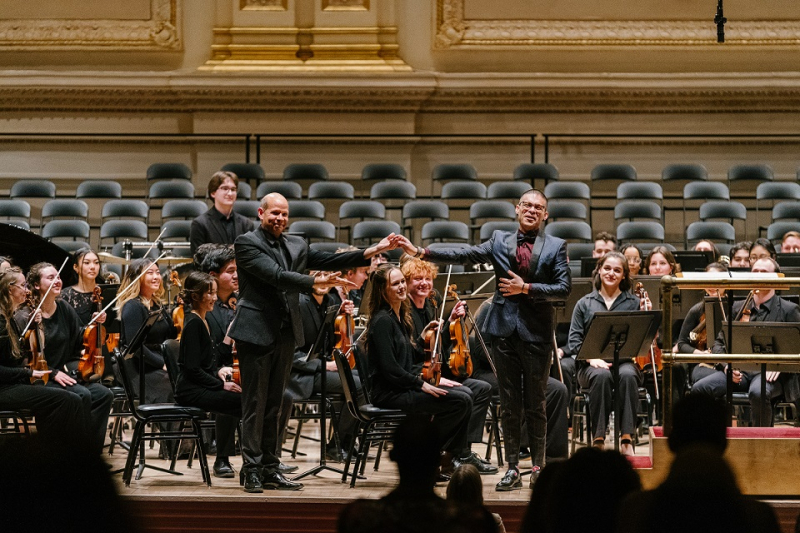
    Above: Maestro Jiménez and composer Iván Enrique Rodríguez take a bow; photo by Fadi Kheir

    The composer practically leapt from his seat and ran to the stage to share an emotional embrace with Jiménez before they took their bows together. The moment was as touching as it was well-earned. The composer having been unknown to me until that evening, I must say that I look forward to hearing much more from him in the future.

    003-CHR-OC-Carnegie-012023

    Above: the vocal soloists for the Dett oratorio: Chabrelle Williams, Ronnita Miller, Limmie Pulliam, and Eric Greene; photo by Fadi Kheir

    The final and most substantial work of the evening was Robert Nathaniel Dett’s oratorio The Ordering of Moses. Dett, a Canadian-born American composer of the early 20th century, became the first black man to graduate with a double major from the Oberlin Conservatory in 1908. He initially wrote The Ordering of Moses as a thesis project while completing his Masters of Music from the Eastman School of Music in Rochester in 1932. Dett later revised and expanded the work, however, and it was premiered in its final form by the Cincinnati Symphony Orchestra under Eugene Goosens in 1937.

    Clocking just under an hour, the oratorio is divided into nine sections and is cast for orchestra, chorus, and four vocal soloists. Joining the Oberlin musicians for this performance were soprano Chabrelle Williams, mezzo-soprano Ronnita Miller, tenor Limmie Pulliam, and baritone Eric Greene.

    020-CHR-OC-Carnegie-012023

    Above: soloists Ronnita Miller and Eric Greene; photo by Fadi Kheir

    The first section opened on warm instrumentation that favored the lower voices of the orchestra. A lone cello voice emerged for an occasional solo before Greene’s sonorous tones took center stage as “The Word,” describing the bondage of the Israelites under the Pharaoh. He was joined briefly by Miller, who cried out for mercy as the voice of the Israelites. The music was rather languid here, until a great exclamation of “Mercy, Lord” announced an upbeat transition into the second section, “Go Down Moses.”

    010-CHR-OC-Carnegie-012023

    A recent last-minute Metropolitan Opera debutant, tenor Limmie Pulliam (above, in a Fadu Kheir photo) then entered as the voice of the reluctant Moses, who is given the famous command by God, “Go down Moses, way down in Egypt’s land; tell Pharaoh: ‘Let my people go!’” (this section featured a particularly cheeky musical joke where Moses sings “I am slow of tongue!” at the most sluggish pace imaginable). The drama then moved fairly seamlessly into the third section “Is it not I, Jehovah!” as God affirms his edicts to Moses.

    This was followed by a mostly uneventful instrumental interlude as the story was transported forward to Moses’s parting of the Red Sea (“And When Moses Smote the Water”). This exuberant, celebratory section was followed by two more instrumental interludes: “The March of the Israelites through the Red Sea” and “The Egyptians Pursue.” The former was an almost jaunty affair, complete with military snare and wordless chorus, while the latter featured brassy blasts and dramatic descending runs as the crashing waters swept away the pursuers.

    021-CHR-OC-Carnegie-012023

    Above: soprano Chabrelle Williams; photo by Fadi Kheir

    Ms. Williams’s soaring vocals finally entered the proceedings in the waltz-like “The Word,” as the Israelites jovially sang praises to Jehovah. All forces joined for the triumphant finale “Sing Ye to Jehovah,” as the oratorio built to a final satisfying tutti instrumental blast.

    Everyone performed splendidly throughout and the piece was met with one of the most enthusiastic standing ovations I’ve seen in a while, yet I couldn’t help feeling slightly underwhelmed by the music itself. Considering the scale of forces at work, the writing was not terribly economical. The instrumentation was often sparse and seldom were all of the elements brought together for fuller effect. The solo parts also heavily favored the male voices, leaving Williams and Miller very little to do for most of its duration.

    This isn’t to say it was bad—far from it—, but it did leave me wanting a little bit more. Had Dett not died of a heart attack at the relatively young age of 60 in 1943, one cannot help but wonder what other and more exciting large scale works he might have brought to the concert hall. Nevertheless, it was exciting as always to hear a buried musical gem such as this get dusted off and given new life. It was a grand conclusion to another memorable concert by the Oberlin Conservatory musicians, who will hopefully return again soon to grace New York City audiences with another memorable program.

    014-CHR-OC-Carnegie-012023

    All performance photos by Fadi Kheir.

    ~ Brad S Ross

  • Renaud Capuçon/ORPHEUS @ Carnegie Hall

    _DSC8907

    Saturday February 21st, 2023 – Violinist Renaud Capuçon (above, performance photo by Chris Lee) joining the Orpheus Chamber Orchestra at Carnegie Hall for a program featuring works by Hanna Benn, Sergei Prokofiev, and Modest Mussorgsky.

    The East Coast premiere of Ms. Benn’s View (Un)titled, an Orpheus commission, opened the evening. The composer was inspired by artwork she had viewed at MoMA; she drew inspiration for the work’s structure from the beloved Mussorgsky piece which closed tonight’s program. Thus, View (Un)titled opens with a promenade: a walking motif set to a pacing rhythm from Orpheus’s rock-star bass player, Jordan Frazier.

    The musical exploration of the various artworks (eight of them) showed that Ms. Benn is a composer who values melody; her music has a fresh and vital feeling, and she has a gift for making a visit to a museum seem important. Which it is! 

    As the movements unfolded, my companion and i lost track of exactly where in the order of the things we were. So we simply enjoyed the work as a whole: its rhythmic variety, the rich strings, the distinctive sounds of the wind voices, and the cunning use of percussion. Cinematic one moment and intimate the next, this music continually delighted the ear…and the imagination.

    Hanna benn

    Above: composer Hanna Benn

    Ms. Benn was called to the stage for a bow after her work was played, and she was warmly greeted by the audience; returning to her seat, Ms. Benn received another around of applause, and she made a charming curtsey to the hall. During the interval, she slowly made her way up the aisle, pausing for autographs and selfie seekers. One tiny girl wanted to meet her, but was overcome by shyness (I know how she feels!); Ms. Benn knelt and spoke to her, putting the child at ease, and then they had a photo together: really such a sweet moment. 

    M. Capuçon then took the stage for a stunning performance of Prokofiev’s Sonata in F-Minor in an arrangement by Andrei Pushkarev.

    The opening Andante assai has a doleful feeling, from which the trilling of the violin emerges. Unison strings are heard in lamenting themes as M. Capuçon’s playing becomes increasingly passionate; the celli and bass play dirge-like passage. Now the enchanting sound of the marimba comes into play. The violinist executes slithering scales – and then a plucking passage – as the music fades away.

    In the Allegro brusco which follows, a military mood is established, the celli and bass trudging along, the drums issuing a stirring summons. M. Capuçon takes up a song, the accompaniment dance-like. The pace picks up, and reaches the sizzling point. The striking of the wood block draws our attention to the orchestra’s percussionist de luxe, Maya Gunji, who at one point plays the snare and bass drum simultaneously. The violin sings forth again, and this militant movement marches to its end. 

    Now comes the sonata’s luminous Andante. The delicious sounds of the marimba create a dreamy mood, and a lyrical melody from M. Capuçon becomes a duet with cello. The sound of the violin shimmering on high and meshing with the marimba evokes thoughts of the same composer’s Opus 19/The Dreamer.  Spine-tingling pianissimo arpeggios from the violinist bring the movement to an ethereal close.

    The concluding movement has a bustling start; the percussionist is kept endlessly busy, as is the violinist. But in a surprise move, the music gradually transforms to an andante, the violin turning lyrical, a fugue developing, the marimba sounding isolated notes.  A solo passage from the bass, and then the music slithers to silence.

    _DSC8797

    Above: M. Capuçon danced and swayed throughout his performance…very engaging; photo above by Chris Lee. The violinist won a fervent ovation, the Orpheus players joining in. He was re-called to the stage for two extra bows; the crowd was clearly hoping for an encore, though I am not sure what could have followed M. Capuçon’s dazzling playing of the Prokofiev.

    _DSC0128

    Modest Mussorgsky’s Pictures at an Exhibition was given in a fresh arrangement by Jannina Norpoth, and she gets major kudos for her luxuriant, imaginative vision of the music. Ms. Norpoth took a bow at the end, winning much-deserved shouts of approval from the hall…and spirited applause from the players, too. Chris Lee captured the moment in the above photo.

     A trumpet call heralds our entrance to the galleries where the pictures are on exhibition, and our tour is underway, interrupted periodically by a revisiting of the “promenade” theme. Applause between movements was distracting tonight, though understandable given the high level of the playing.

    Gnomes, a dolorous march, is by turns bustling, eerie, and clumsy…and superbly played. The Old Castle is an evocative, very slow dance for solo cello, joined later by violin and viola. The charming Tuileries tells of a dispute between children at play in the gardens. Bassoonist Gina Cuffari took a star turn with the droll and lumbering Cattle – music which gets big by the end. The whimsical, fluttery Ballet of the Chicks in Their Shells was charmingly set forth, and then we have Samuel Goldenberg und Schmuyle, which paints a picture of two Jewish citizens – one rich and one poor. The Market at Limoges is brisk and joyous, with a fast finish; in contrast come the long, organ-like chords of The Catacombs. Next, we feel shivers of mystery in Among the Dead. Following the big and boisterous Hut on the Fowl’s Legs (based on Baba-Yaga), we at last stand before The Great Gates of Kiev: a timely reminder of the world in which we now live.

    _DSC0175

    All of this was played sumptuously by the ladies and gentlemen of Orpheus, and the Carnegie acoustic suits them to a T: a wonderful night of music-making! At the end, the players and Ms. Norpoth formed a line-up stretching across the Carnegie Hall stage – Chris Lee’s photo above – enjoying the audience’s acclaim.

    ~ Oberon

  • Christmas Eve 2022 @ Carnegie Hall

    R rengel

    Above: violinist Rubén Rengel

    Saturday December 24th, 2022 – Spending Christmas Eve at Carnegie Hall with my longtime friend Rob Scott, we enjoyed the New York String Orchestra‘s annual holiday concert which brought us music by Elgar, Mozart, Bach, and Tchaikovsky. Jaime Laredo was on the podium, and the Venezuelan violinist Rubén Rengel was the soloist in a Bach violin concerto. The venerable Hall was packed to the rafters with music-lovers who ventured out on an extremely frigid, windy night to hear great music in the most perfect setting. 

    The New York String Orchestra is a young orchestra: as the players in this pre-professional ensemble took the Carnegie Hall stage, we were struck by their youthful energy and by their sense of dignity. Moments later, we were thrilled by the sheer richness and beauty of the sound they produced.
    Edward Elgar’s Introduction and Allegro, Op. 47, opened the concert. Composed in 1905 for performance in an all-Elgar concert by the newly-formed London Symphony Orchestra, the score calls for a string quartet and string orchestra. The NYSO’s concertmaster, Steven Song, led the quartet which further featured Minji Lee (Principal violinist), Raphael Masters (Principal violist), and Camden Michael Archambeau (Principal cellist).

    From note one of the Elgar, the players filled the Hall with music of abundant warmth, played with passion and poise. Among the quartet, violist Raphael Masters’ playing of a solo passage early on exemplified the high level of musicianship and tonal polish these young people have already achieved. The Elgar flowed on, with the agitated Allegro sections alternating with stretches of big lyricism that had the feeling of a classic film score. A fugue highlighted the sonic allure of each of the orchestra’s sections, and  – all evening, actually – the basses were extremely pleasing to hear.

    Mozart’s Divertimento in D-Major, K. 136, was luxuriantly played; the opening Allegro, with its familiar theme, was taken at a perfect tempo by Maestro Laredo. The Andante was noble and gracious, highlighted by silken sustained tones from Mr. Song’s violin. The steady pulse of the concluding Presto was finely sustained, whilst the music winks at us with sly touches of wit.

    Mr. Rengel now joined the orchestra for J. S. Bach’s Violin Concerto in A-Minor, BWV 1041. We had heard – and greatly enjoyed  – Mr. Rengel’s playing earlier this season with Ensemble Connect at Weill Hall. Tall and slender, the handsome Venezuelan caught the dancing spirit of the concerto’s lilting Allegro. In the Andante, his sweet tone and technical finesse produced enticing subtleties, his control of dynamics drawing us in to the music. The concluding Allegro assai again had a dance-like feeling, and Mr. Rengel’s fluency in rapid passages was a delight to the ear. The violinist, who had held the Hall in a palpable state of silence during this performance, was warmly cheered by the audience at the end, his colleagues onstage joining in the applause.

    Jaime laredo

    Above: Maestro Jaime Laredo

    Very high on my list of favorite musical works is Tchaikovsky’s Serenade for Strings. Like so many other people, I fell in love with this moving and melodious work through performances of Balanchine’s ballet Serenade at New York City Ballet. Tonight, hearing it in concert form, with the movements in their original order (Mr. B had placed the fourth movement before the third) was an immersive experience for me. The music was played with such heartfelt tenderness by these young people, the celli and basses constantly sending waves of poignant nostalgia thru me as memories – both sad and lovely – of past loves filled my mind.

    The love of music has, from a very early age, meant so much to me…most especially thru the dark years of my teens. Music is a constant lover: always there for me with its timeless, saving grace.  

    ~ Oberon

  • Danish String Quartet @ Chamber Music Society

    Danish qt

    Above: the Danish String Quartet, photographed by Caroline Bittencourt. From left: Rune Tonsgaard Sørensen (violin); Fredrik Schøyen Sjölin (cello); Frederik Øland (violin); Asbjørn Nørgaard (viola)

    NOTE: I again apologize for the “look” of this post. Due to a prolonged downtime at Typepad, the photo may not appear.

    Sunday October 30th, 2022 – How wonderful to hear the Danish String Quartet live again! Their iconic sound is really quite unlike that of any other string quartet, though how to describe what actually sets them apart is nearly impossible. You simply have to be there.

    This evening they brought us music of Mozart, Britten, and Schumann, all of it played with silken smoothness of tone and technique. One nice thing about the Danish: the two violinists switched seats in the course of the program, so that today we got to experience Rune Tonsgaard Sørensen taking the lead for the two Mozart works, and Frederik Øland in the Britten and Schumann.

    A large audience greeted the Danes with warm applause; the players sat down, and immediately set the evening sailing with Mozart’s Divertimento #15, K. 138. Expert timing marked their playing of the uplifting opening Allegro; world weariness was quickly banished as polished phrase after phrase drew us in. What sounds! The sustained line of the Andante allowed us to savour the textures of Mozart’s harmonies, which become quite delicate for a while. Mr. Tonsgaard Sørensen’s sublime phrasing, and the velvety warmth provided (all evening) by cellist Fredrik Schoyen Sjölin were most welcome. From its lively start, the concluding Presto swept us along, its charming and witty mid-section an added attraction. This short and sweet Divertimento was a perfect concert opener.

    How wonderful to hear Benjamin Britten’s Three Divertimenti the day after experiencing the composer’s masterwork PETER GRIMES at The Met. These brilliant miniatures make a nicely-contrasted concert set, and The Danes played them to perfection. The amusingly off-kilter March highlights the quartet’s outstanding violist Asbjørn Nørgaard. The music steps along, with a brief detour for some Mendelssohnian lightness, before gaining speed to a sudden finish. The second divertimento, Waltz,  features gently plucking rhythms, the violin and viola topping things off. We dance blithely along, faster and faster, to a cute conclusion. The agitato start of Burlesque soon has the players strumming, plucking, and tapping their instruments. The music accelerates to a brisk conclusion.

    Now for another Mozart treat: the Quartet in E-flat major, K. 428. The opening Allegro non troppo commences with the players in unison, Mr. Tonsgaard Sørensen leading the way. Such gracious music: the violist much (and marvelously) occupied, the cellist the beating heart, the violin’s upward runs providing a gentle lift to the spirit. It’s magical music, and magically played. The Andante con moto has a lovely start, with bending harmonies sweetly blended.  The intrinsic beauty of Mozart’s melodies creates a timeless feeling, with Mr. Tonsgaard Sørensen‘s silken tone giving us the blessing of calm. I wanted it to go on and on.

    But, instead, a Minuet must be danced: such elegance! A minor-key interlude provides contrast, and Mr.  Tonsgaard Sørensen‘s demonstrates perfect control before passing a theme off to Mr. Øland. We now arrive at the final Allegro vivace, bustling and blithe, with coy hesitations. The abounding charm of the music gives the feeling that all’s right with the world….an illusion, I know, but…illusions are, by their nature, sweet.

    Following the interval, Robert Schumann’s Quartet in A-major, Op.41, No, 3, made for a spectacular finish to the program. A feeling of sweet sadness permeates the opening movement, in which the intertwining voices mingle expressively. An agitato figuration for the cello draws a response from the other three voices. There is an underlying anxiousness at the start of the second movement which creates a restless feeling, and the cello takes the lead with a tender theme; the music – rich and dense – becomes a slow dance. Again, the blend the players achieve is simply miraculous.

    Now comes the crowing glory of the evening: the Adagio molto. Following a poignant start, the viola draws us in with a searching feeling. The violin and viola play a rising phrase that seems to draw us heavenward, whilst a captivating density of tone from the lower voices carries us deeper and deeper into the music; the sounds of the violins seem to hypnotize us. The end of the movement is so profoundly gorgeous that all else is forgotten. 

    But Schumann has an Allegro molto vivace up his sleeve to delight us: from an agitato start, scurrying motifs pop up. Then a trudging beat commences, dancing us on the the finish.

    Reveling in a full-house standing ovation, the Danish String Quartet offered an encore from Papa Haydn’s very first work for string quartet, giving us yet another sublime musical experience.

    ~ Oberon

  • Ensemble Connect Delights @ Weill Hall

    Screenshot 2022-10-25 at 07-45-30 Ensemble Connect

    Monday October 24th, 2022 – When I saw the announced program for this evening’s concert by Ensemble Connect at Weill Hall, I knew I had to be there: what an enticing line-up of composers…and, in the event,  it was all so dazzlingly played!

    The young musicians of Ensemble Connect are exceptionally talented; all the music tonight sounded fresh and vibrant. They are also appealing to watch. The works on this well-contrasted program spanned the years from 1717 to 1994, and it was a sonic feast from first note to last. 

    CH11266821

    Above, playing the Martinů: Yasmina Spiegelberg, Garrett Arney, Laura Andrade, and Cort Roberts; photo by Fadi Khier

    Bohuslav Jan Martinů’s rarely heard Quartet for Clarinet, Horn, Cello, and Side/Snare Drum, H. 139, dates from 1924. This rather quirky mix of instruments does – as hornist Cort Roberts pointed out in his introductory remarks – represent the four ‘families’ of the symphony orchestra: strings, winds, brass, and percussion. What delightful sounds we heard from Mr. Roberts and his colleagues: Yasmina Spiegelberg (clarinet), Laura Andrade (cello), and Garrett Arney (snare drum).

    The work is full of wit and irony, yet in the central Poco Andante comes a poignant lament that is extraordinarily moving. Snare drum and cello lead off the opening Allegro moderato, which becomes march-like as the clarinet and horn join in. A trudging feeling develops, with a horn solo which later shifts to the clarinet. The music seems about to fade away, but there’s a big bang ending.

    As the Andante commences, my companion and I were simply blown away by the depth and beauty of tone that cellist Laura Andrade produced. Ms. Andrade played in all four works this evening, and maintained her beautiful sound and sterling musicality at every moment. Ms. Spiegelberg joins the cellist with a rather mysterious air; Mr. Arney’s snare drum comments on the women’s duet, and then Mr. Roberts’ mellow horn sounded a somber theme. The cello solo returns to the touching opening passages, played with heart-rending beauty.

    At the jaunty start of the concluding Allegretto, the voices enter one by one: drum, cello, clarinet, horn. The music jogs along, with the horn ringing forth. After the instruments have exchanged lively, wry phrases, there is a little unison coda to round things off. Such a wonderful way to open the evening, and what a stroke of genius on Martinů’s part to center the work on that profound lament.

    The petite but hugely talented pianist Joanne Kang now joined the impressive Venezuelan violinist Rubén Rengel and Ms. Andrade for a simply glorious performance of Clara Schumann’s Piano Trio in G-Minor, Op. 17. Their playing was tremendously beautiful and moving, and they are as attractive to watch as to hear; their performance of this masterwork seem so vital and immediate, making it an outstanding musical experience of recent seasons

    Clara Schumann’s writing shows a mastery of counterpoint and a heartfelt gift for melody. It’s music alive with romantic ardor. The opening Allegro moderato begins in a melancholy mood, and soon develops a passionate flow of lyricism, with dramatic outbursts along the way adding a sense of urgency. Ms. Kang kept the momentum going with her perfect timing, whilst Mr. Rengel and Ms. Andrade displayed rich, abundant tone as one lustrous theme after another sprang up.  The Scherzo – “in the tempo of a minuet” – commences with an elegant passage for violin and piano; it is gentle, pensive music, and again Ms. Andrade’s plush sound warmed the soul.

    Ms. Kang lovingly played the Andante‘s waltz-like opening, soon joined by the hushed, poetic sound of Mr. Rengel’s violin; their blend carries them thru captivating harmonies. The music gets a bit wild, only to be calmed by more gorgeousness from the Andrade cello. Achingly beautiful playing from these young artists, with the cellist rounding everything of with a simple descending scale that brought tears to my eyes. 

    The trio’s final Allegretto brought forth more dazzling playing from the three musicians; Ms. Kang in particular shown here with sumptuous, large-scale playing and – later – passages of glistening arpeggios. Following a mini-fugue, the music gets grand, only to simmer down to a melody of longing, then moving onward to its epic finish. My companion and I were so thrilled by this rapturous performance.

    Eleanor+Alberga

    Following the interval, music by the Jamaican-born composer Eleanor Alberga (photo above): her String Quartet No. 2. As violist Halam Kim remarked before the playing started, the entire 18-minute single movement develops from a very brief descending phrase that opens the piece; this Mr. Rengel dashed off for us as an introductory demo: it lasts less than a second.

    From its active start, dance-like with dazzling dissonances, the piece moves on with complex harmonies and rhythmic shifts as well as witty touches, such as a repetitive figuration for the 2nd violin (Brian Hong) that made me smile. Mellowing to an andante section laced with enticing harmonies, we arrive at an intriguing passage where tremolo shivers from Mlles. Kim and Andrade underscore an eerily harmonized theme for Mssrs. Rengel and Hong. Ms. Andrade’s knockout cello playing continues to fascinate us, whilst plucked notes from Ms. Kim and Mr. Hong support a high-flying passage for Mr. Rengel’s violin.

    CH11266889

    Above, playing the Alberga quartet: Rubén Rengel, Brian Hong, Laura Andrade, and Halam Kim; photo by Fadi Kheir

    The music dances on, getting dense and with a big buildup until it turns heartfelt and lush; we seem to be headed to the finish line, but…no: a delightful return of the tremolo viola/cello combo with woozy violins pops up before the music’s energetic final measures. The piece was enthusiastically received; I was hoping Ms. Alberga might be among the audience so we could hail her for her colorful, marvelous score.

    There was a slight delay before the evening’s concluding piece as a technical glitch with the tablets took some straightening out. Ah, for the simple beauty of a paper score!

    CH11266818

    Above: the ensemble playing Bach; photo by Fadi Kheir

    It was with J. S. Bach’s Brandenburg Concerto No. 5 that the evening closed. The large ensemble featured all the players from earlier in the evening, plus bassoonist Nik Hooks – a player with rich, amiable tone and agile technique – and the proverbially “tall, dark, and handsome” Iranian/Pakistani/American flautist, Amir Farsi: limpid of tone, with a personable presence as he bends and sways to the music. Mr. Hooks and Ms. Andrade provided a very high-class continuo, with Ms. Kim and Mr. Hong the supporting strings. Mr. Rengel and Mr. Farsi played magnificently, and there was truly a sense of magic in the hall as the performance unfolded.

    CH11266826

    Above, Joanne Kang at the harpsichord for the Bach; photo by Fadi Kheir

    Of course, this is “the Brandenburg with the harpsichord”, and Mr. Kang gave us a fleet-fingered and fabulous rendition of the long cadenza. The audience, and her colleagues, could not resist breaking in with applause for her stunning playing, one of the highlights of the evening. Other treats in the Bach were the poignant blending of Mr. Rengel’s violin with Mr. Farsi’s flute in the Affetuoso, and the light and lively finale wherein Ms. Andrade and Mr. Hooks put the continuo in the spotlight.

    CH11266799

    Above, the principal players for the Bach: Rubén Rengel, Joanne Kang, and Amir Farsi; photo by Fadi Kheir

    Such a pleasing and deeply satisfying evening! For two hours, the woes of the world and the cares of daily life were forgotten. A thousand thanks to these dedicated musicians, and to the music that makes life worth living.

    All photos by Fadi Kheir, courtesy of Carnegie Hall.

  • Fouad Boussouf’s NÄSS @ The Joyce

    Nass fff

    Tuesday October 18th, 2022 – An exhilarating evening at The Joyce as choreographer Fouad Boussouf brought his handsome Company of dancers from his native Morocco to thrill us with Näss. The title is Arabic for “people”, and it’s a work where eclectic dance styles converge effortlessly, combining restless, relentless activity with a feeling of ancient masculine rituals. For an hour, the seven men danced to rhythmically wide-ranging music, with perfect timing and synchronization; though clearly carefully structured and well-rehearsed, Näss feels wonderfully and thoroughly spontaneous.

    The dancers in Näss are Sami Blond, Mathieu Bord, Maxime Cozic, Yanice Djae, Loïc Elice, Justin Gouin, and Maëlo Hernandez.

    Nass_Charlotte_Audureau4

    Above, photo by Charlotte Audureau

    The curtain rises on a totally darkened stage. Very slowly, the back panel is illuminated with the dancers ranged in a line-up, backs to the audience. Mingled with the sounds of street noise noise and garbled talking, angel voices are heard. Drumming strikes up and the men begin moving in place, stepping to the beat.

    Suddenly, they burst into movement, stomping and romping about the space. Unison moves, with gestures of supplication, are mingled with free-flowing solo passages and duets which vary in feeling from humorous to wildness. 

    Boussouf Nass_Charlotte_Audureau2

    Above photo by Charlotte Audureau

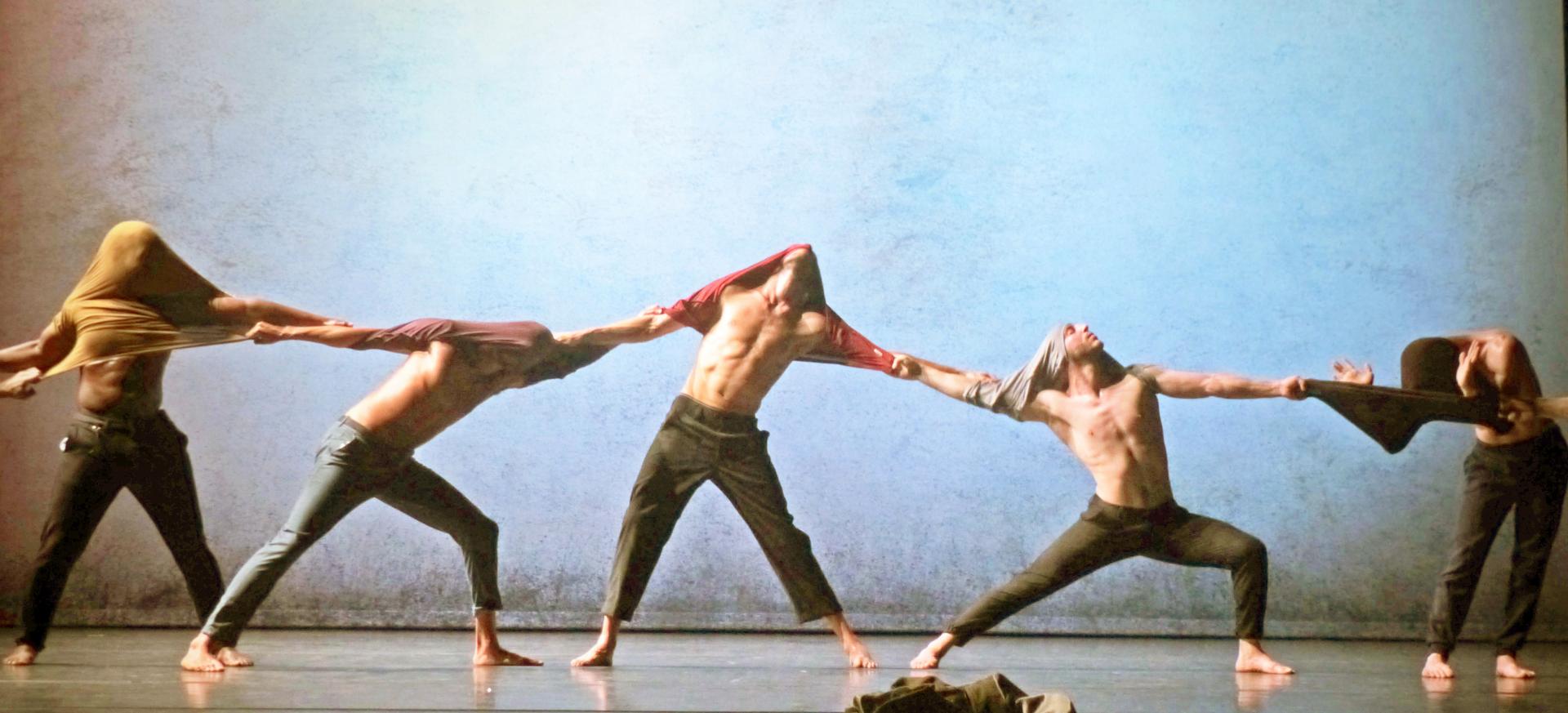
    The lighting takes on a golden hue; the men’s jackets are slowly shed and each is wearing a loose t-shirt of autumnal solour. Going into breakdance mode, they give us headstands and intricate floor motifs executed with panache. The t-shirts become part of the dance: they are pulled up to cover the men’s faces and expose their abs as the light fades a bit and a sense of calm is briefly felt. The dancers start talking.

    Then a quintet of men step-dancing in unison circle the stage in almost military precision whilst two others dance a pas de deux in their own world. The brotherhood then tramp about the space with heavy-footed accents. The lighting shifts, providing shadowplay.

    The dancers move upstage, clustered with backs to us; they become silhouettes as the music fades and the lighting is slowly extinguished until they vanish into the darkness from whence they came.   

    As silence fell there was a very brief lull before a house-wide standing ovation commenced. People screamed and shrieked as the dancers came out for their bows. Great atmosphere! Then the seven men began striking poses along the edge of the stage, and they commenced an impromptu encore, clapping their hands to set the pace. The audience picked up the rhythm, clapping and stomping. It was like being at a revival meeting where everyone has been saved. I felt high as a kite.

    Boussouf fouadcharlotteaudureau

    Photo: Charlotte Audureau

    ~ Oberon

  • Fouad Boussouf’s NÄSS @ The Joyce

    Nass fff

    Tuesday October 18th, 2022 – An exhilarating evening at The Joyce as choreographer Fouad Boussouf brought his handsome Company of dancers from his native Morocco to thrill us with Näss. The title is Arabic for “people”, and it’s a work where eclectic dance styles converge effortlessly, combining restless, relentless activity with a feeling of ancient masculine rituals. For an hour, the seven men danced to rhythmically wide-ranging music, with perfect timing and synchronization; though clearly carefully structured and well-rehearsed, Näss feels wonderfully and thoroughly spontaneous.

    The dancers in Näss are Sami Blond, Mathieu Bord, Maxime Cozic, Yanice Djae, Loïc Elice, Justin Gouin, and Maëlo Hernandez.

    Nass_Charlotte_Audureau4

    Above, photo by Charlotte Audureau

    The curtain rises on a totally darkened stage. Very slowly, the back panel is illuminated with the dancers ranged in a line-up, backs to the audience. Mingled with the sounds of street noise noise and garbled talking, angel voices are heard. Drumming strikes up and the men begin moving in place, stepping to the beat.

    Suddenly, they burst into movement, stomping and romping about the space. Unison moves, with gestures of supplication, are mingled with free-flowing solo passages and duets which vary in feeling from humorous to wildness. 

    Boussouf Nass_Charlotte_Audureau2

    Above photo by Charlotte Audureau

    The lighting takes on a golden hue; the men’s jackets are slowly shed and each is wearing a loose t-shirt of autumnal solour. Going into breakdance mode, they give us headstands and intricate floor motifs executed with panache. The t-shirts become part of the dance: they are pulled up to cover the men’s faces and expose their abs as the light fades a bit and a sense of calm is briefly felt. The dancers start talking.

    Then a quintet of men step-dancing in unison circle the stage in almost military precision whilst two others dance a pas de deux in their own world. The brotherhood then tramp about the space with heavy-footed accents. The lighting shifts, providing shadowplay.

    The dancers move upstage, clustered with backs to us; they become silhouettes as the music fades and the lighting is slowly extinguished until they vanish into the darkness from whence they came.   

    As silence fell there was a very brief lull before a house-wide standing ovation commenced. People screamed and shrieked as the dancers came out for their bows. Great atmosphere! Then the seven men began striking poses along the edge of the stage, and they commenced an impromptu encore, clapping their hands to set the pace. The audience picked up the rhythm, clapping and stomping. It was like being at a revival meeting where everyone has been saved. I felt high as a kite.

    Boussouf fouadcharlotteaudureau

    Photo: Charlotte Audureau

    ~ Oberon

  • Lydia Johnson Dance @ NYLA ~ 2022

    Ensemble

    Above: the dancers of Lydia Johnson Dance in Lydia Johnson’s For Eli; photo by Dmitry Beryzokin

    Saturday September 17th, 2022 – Lydia Johnson Dance performing at New York Live Arts in Chelsea. Having missed two New York seasons due to the ongoing pandemic, the Company took the opportunity to appear at NYLA in September rather than wait until their accustomed performance time in the Spring: the dancers of course were anxious to perform again, and guest artist Craig Hall of New York City Ballet fame was available…so: on with the show!

    Unfortunately, I was feeling sick and could not attend any of the performances; but I did see all four of the works being presented when I dropped in at a studio rehearsal the previous week. My friend Dmitry Beryozkin photographed the dress rehearsal, and sent me some images. So this is not a review, really, but simply a photo gallery. 

    The Company were not idle during the long shutdown: they spent a week at Kaatsbaan, where Lydia worked on new creations, they danced (outdoors) in Connecticut, and they gave a warmly-received studio showing at the Martha Graham Studio Westbeth on May 2022, previewing two new works: Glide Path and For Eli. 

    Glide Path opened tonight’s show: it’s set to music by the contemporary quartet ETHEL. Here are some of Dmitry’s evocative photos from the dress rehearsal of Glide Path:

    DSCF6446

    Minseon Kim and Chazz Fenner-McBride

    DSCF6455

    The ensemble of women

    DSCF6507

    Katie Lohiya

    DSCF6627

    Chazz Fenner-McBride and Willy Laury

    DSCF6648

    Emily Sarkissian, Minseon Kim, Amanda Egan, Michael Miles, and Michelle L. Siegel

    DSCF6709

    Willy Laury and Laura DiOrio

    DSCF6721

    Laura DiOrio and Willy Laury

    Next came For Eli, a poignant work commissioned by New Jersey-based artist Laura Lou Levy, in memory of her pianist-son Eli, who loved playing the music of Frédéric Chopin.

    A series of Dmitry Beryozkin’s images from For Eli:

    DSCF6840

    Michelle L. Siegel, Michael Miles, Minseon Kim, Amanda Egan, and Laura DiOrio

    DSCF6939

    Willy Laury, Michael Miles, Katie Lohiya, Amanda Egan, and Minseon Kim

    DSCF6944

    Katie Lohiya

    DSCF7056

    Amanda Egan, Emily Sarkissian

    DSCF7123

    Chazz Fenner-McBride and Willy Laury

    Following the interval, Craig Hall joined Lydia’s dancers for Time…and again, a new work set to Oscar Peterson recordings of jazz standards. This marked a return engagement for the former New York City Ballet star, whose performances in Lydia’s haunting Night and Dreams in 2019, dancing with Laura DiOrio, were deeply moving. Craig and Laura have reunited for Time…and again, joined by three other couples for a series of duets.

    Photos from this jazz work by Dmitry Beryozkin:

    DSCF7304

    Katie Lohiya and McGee Maddox

    DSCF7305

    Katie & McGee, Amanda & Laura, Minseon & Michael

    DSCF7377

    Laura DiOrio & Craig Hall

    DSCF7425

    Craig Hall & Laura DiOrio

    DSCF7456

    Laura & Craig

    DSCF7549

    Amanda Egan & Chazz Fenner-McBride

    DSCF7617

    Katie Lohiya & McGee Maddox

    DSCF7760

    Crag Hall

    DSCF7920

    Katie Lohiya with Michael, Laura, and Willy

    The music of Henryk Górecki makes a colossal impression in the evening’s concluding work, Undercurrent. Here are some of Dmitry Beryozkin’s pictures from this ballet:

    DSCF8146

    McGee Maddox, Chazz Fenner-McBride, and Michael Miles

    DSCF8361

    Students from Lydia’s school participated in the finale of Undercurrent

    DSCF8379

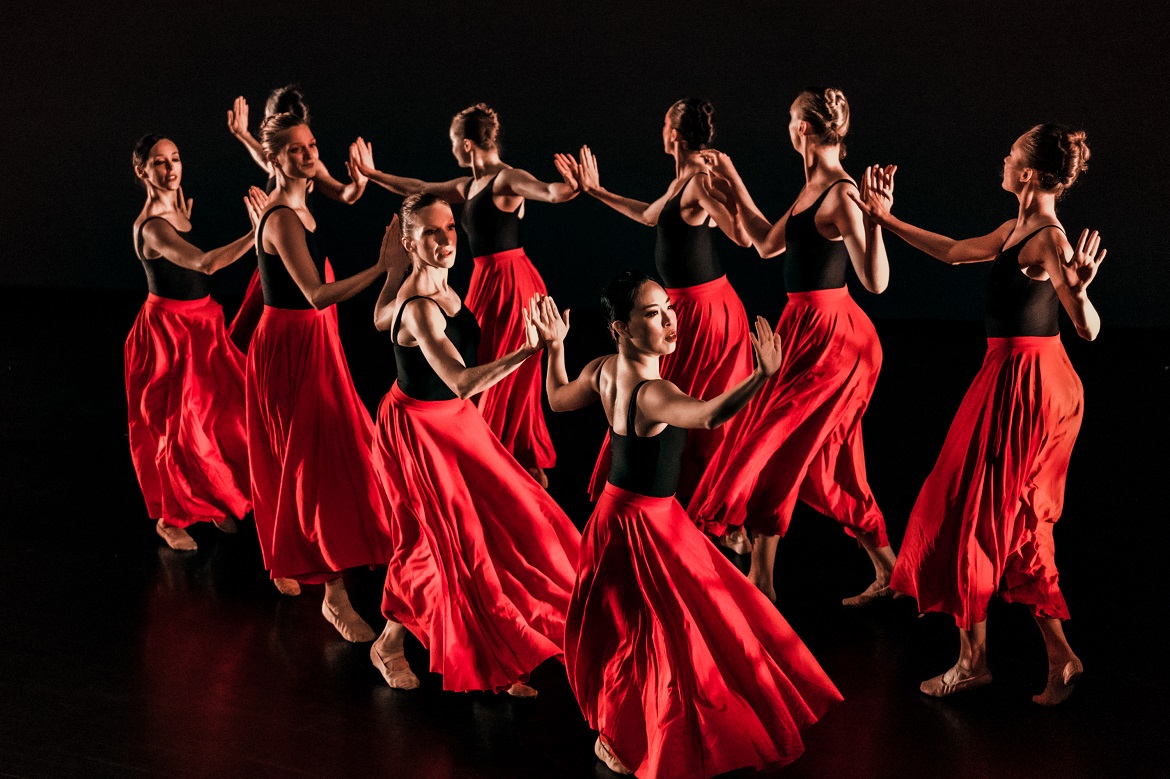
    The Company women in swirling red skirts

    DSCF8390

    The full Company onstage

    DSCF8393

    Michael Miles and Minseon Kim, center

    DSCF8434

    Michael Miles and student dancer Stella Weihrauch

    DSCF8446

    DSCF8486

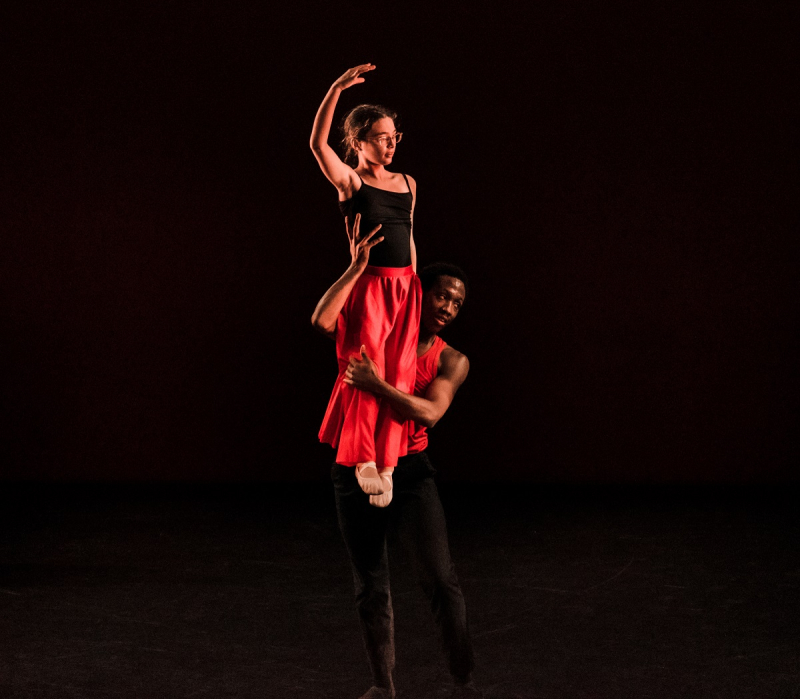
    Laura DiOrio, aloft, as Undercurrent come to an end

    All photos by Dmitry Beryozkin

    ~ Oberon

  • Steven Banks @ Mostly Mozart

    Steven-banks

    Friday July 22nd, 2022 – Saxophonist Steven Banks (above) headlined this evening’s concert by the Mostly Mozart Festival Orchestra at Alice Tully Hall. The wonderfully sprightly – and hugely talented – Xian Zhang was on the podium.

    The concert was presented as a choose-what-you-pay event, part of Lincoln Center’s Summer for the City festival. There were several small children in the audience, and for the most part they were well-behaved; I’m sure they found the very tall Mr. Banks – and the sound of his saxophone – intriguing, and most likely they were equally fascinated by Xian Zhang’s lively personality. The concert lasted about 90 minutes, without intermission.

    Composer Nokuthula Ngwenyama greeted us, speaking briefly about her work, Primal Message, which was having its New York premiere as the opening piece this evening. She talked about prime numbers and about possible ways of communicating with extra-terrestrial life, but thoughts of science, and of theories, evaporated as her appealing music filled the space. 

    Melodious, and even romantic-sounding at times, the music commences with themes for cello and viola, leading to a haunting violin solo and sweet sounding phrases from the harp. Pinging tones from the xylophone, and isolated chime notes, signify a mystical language as the work wends towards its delicate finish. If beings on other worlds were to receive Ms. Ngwenyama’s Primal Message, their response would doubtless be cordial. The audience seemed taken with the music, applauding both musicians and composer enthusiastically.

    I first heard saxophonist Steven Banks earlier this year in a noontime recital at the Morgan Library, presented by Young Concert Artists. Everything about his playing impressed me then, and he impressed me even more this evening. Mr. Banks towered over the diminutive Xian Zhang, but as artists they are of equal stature.

    Tonight, Mr. Banks took the Tully Hall stage for a rarity: Alexander Glazunov’s Concerto in E flat major for alto saxophone and string orchestra, Op. 109, written in 1934. It is music deeply rooted in Romanticism, and it has become a standard in the saxophone repertoire; this was my first time hearing it, and it’s a complete delight.

    Although invented in the early 1840s, the saxophone was still fairly new and unfamiliar in Glazunov’s day; it remained under-utilized for years as it was considered “low-brow”. Glazunov, however. was intrigued by this new timbre in the musical world; still, the composer almost certainly never heard his Saxophone Concerto publicly performed, since the Paris premiere of the work did not take place until after his death.

    The concerto commences with a big, unison string theme: this is lushly lyrical music. Mr. Banks’s warm, gorgeous tone fills out the melodies so persuasively, and there are passages of coloratura that are deftly handled. The saxophone sings over a rather hesitant accompanying rhythm, from which a long cadenza for the soloist arises. 

    The music turns animated and wryly amusing. A swirling solo melody becomes a fugue. Mr. Banks sails onward, thru various trills and furbelows, to a lovely finish, winning the audience’s vociferous approval.

    After a brief pause, Mr. Banks returned for another work: Jacques Ibert’s Concertino da Camera, written in 1935. From its flashy, almost chaotic start, Mr. Banks explores the saxophone’s jazzy side, later taking up a sad song over the orchestra’s swaying accompaniment. The strings, motivated by eloquent basses, commence a theme over which the saxophone delivers smooth fiorature. Things dance along, turning vibrant, and starting to swing. 

    In a mood-change, a soft and pensive saxophone solo sounds over the orchestra’s deep sighing: this is the sound of a broken heart, expressively sung by Mr. Banks and echoed by the horn. But you can’t keep a good man’s spirits down, and soon the sax player is reeling off rapid figurations: Mr. Banks revels in the subtleties of the score, polishing off a cadenza covering a vast range and brimming with dynamic shifts. Cries of “bravo” resounded in the Hall as this saxophone paragon took his bows. 

    Xian Zhang

    Above: tonight’s conductor Xian Zhang

    The evening concluded with the Beethoven’s Fourth Symphony, which was premiered at the Lobkowitz Palace in Vienna in March 1807; being a private concert, there are no first-hand reports of initial reaction to the work.

    Here, we can savour Xian Zhang’s mastery of both grandeur and finesse; the orchestra played superbly for her, and the wind soloists – flute, clarinet, oboe, bassoon, and horn – had a heyday, reeling off their passages with élan, whilst the Mostly Mozart strings were suitably satiny. Ironically, both my companion and I found ourselves thinking of Mendelssohn’s Midsummer Night’s Dream during the Beethoven.

    The concert ended with a joyous ovation, the conductor being hailed with special enthusiasm.

    But our complete enjoyment of the concert was dampened by the news that we may be facing the end of Mostly Mozart as we have known and loved it. Weaving a handful of Mostly Mozart concerts into a summer festival of general entertainment events at Lincoln Center won’t suffice for hardcore classical music-lovers. Or are we really witnessing the long-dreaded ‘death of classical’?

    This article sheds some light on the situation. Could another venue be found where Mostly Mozart could make their home – and flourish – in the future?

    ~ Oberon

  • Paul Taylor ~ Early Works @ The Joyce: Images

    Images and Reflections - Kristin Draucker_Photo by Ron Thiele 2

    Above: Kristin Draucker in Paul Taylor’s Images and Reflections

    Some images from Paul Taylor Dance Company‘s June 2022 season at The Joyce; the photos are by Ron Thiele. Read about the Company’s opening night performance here.

    Fibers - Lisa Borres_Photo by Ron Thiele

    Lisa Borres in Paul Taylor’s FIBERS

    Images and Reflections - John Harnage_Photo by Ron Thiele

    John Harnage in Paul Taylor’s Images and Reflections

    Hope is the Thing With Feathers by Michelle Manzanales - Company_Photo by Ron Thiele 1

    From Michelle Manzanales’ HOPE IS THE THING WITH FEATHERS

    Fibers - Lisa Borres and Devon Louis_Photo by Ron Thiele

    Lisa Borres and Devon Louis in Paul Taylor’s FIBERS

    Profiles - L-R Eran Bugge Madelyn Ho Alex Clayton John Harnage_Photo by Ron Thiele

    Eran Bugge, Madelyn Ho, Alex Clayton, and John Harnage in Paul Taylor’s PROFILES

    Hope is the Thing With Feathers by Michele Manzanales - Shawn Lesniak and Company_Photo by Ron Thiele

    Shawn Lesniak and the Company in Michelle Manzanales’ HOPE IS THE THING WITH FEATHERS

    Aureole - Maria Ambrose and Devon Louis_Photo by Steven Pisano - 1

    Devon Louis and Maria Ambrose in Paul Taylor’s AUREOLE

    Profiles - L-R Madelyn Ho John Harnage Eran Bugge_Photo by Ron Thiele

    Madelyn Ho, John Harnage, and Eran Bugge in Paul Taylor’s PROFILES

    All photos by Ron Thiele, courtesy of the Paul Taylor Dance Company