Category: Opera

  • Nicolae Florei – Prince Igor’s aria

    Florei

    Romanian bass-baritone Nicolae Florei sings Prince Igor’s aria from the Borodin opera.

    Listen here.

  • Nicolae Florei – Prince Igor’s aria

    Florei

    Romanian bass-baritone Nicolae Florei sings Prince Igor’s aria from the Borodin opera.

    Listen here.

  • Zinka Milanov in LA FORZA DEL DESTINO

    Forza

    Zinka Milanov in one of her greatest roles – Leonora in Verdi’s LA FORZA DEL DESTINO – from a 1958 Metropolitan Opera broadcast. Flaviano Labo, Mario Sereni, and Cesare Siepi are Zinka’s co-stars, and Fritz Stiedry is wielding the baton.

    Listen here.

  • Sondra Radvanovsky ~ La luce langue

    Sondra

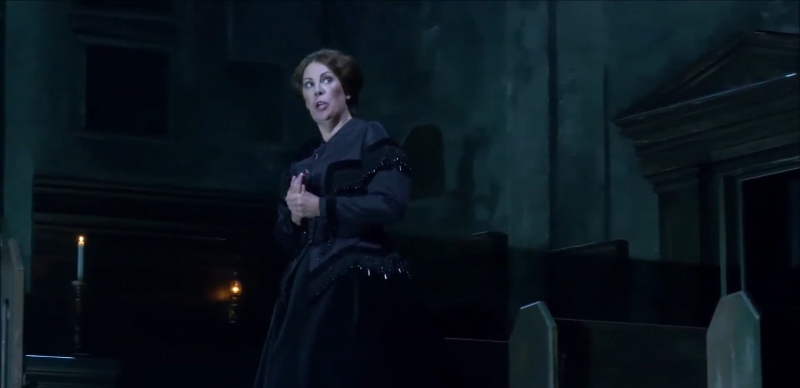
    Sondra Radvanovsky sings Lady Macbeth’s “La luce langue” from the Verdi opera.

    Watch and listen here.

  • Evgeny Kissin @ Carnegie Hall ~ May 2024

    Kissin 2

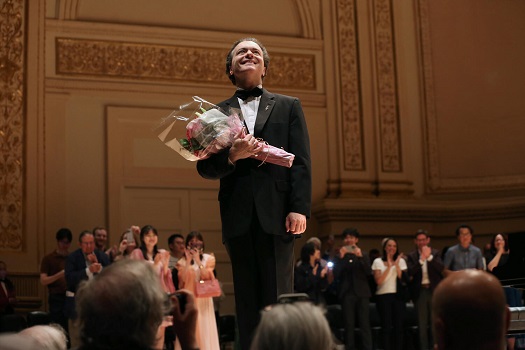
    Above, Yvgeny Kissin at Carnegie Hall; performance photo by Steve J Sherman

    ~ Author: Ben Weaver

    Friday May, 24th, 2024 – Evgeny Kissin is giving back-to-back concerts of the same program at Carnegie Hall this month. I attended the first one this evening, and it was a magnificent night of music, one of the best things I have heard in a concert hall this season. Kissin’s program is so popular, in fact, that not only were additional seats added on the stage (more about that later), but he will repeat this program on May 29th.

    Surprisingly this was my first time hearing Kissin live, though I have admired his many recordings over the years. He is a very unaffected performer, seemingly almost shy. His very sincere physical presence and unpretentious playing made an enormously positive impression throughout the night.

    Kissin began the program with Beethoven’s Piano Sonata No. 27 in E minor, Op. 90, composed in 1814. It reflects Kissin’s overall demeanor that he began with one of Beethoven’s least performed piano sonatas. Made up of only two movements – unusual for Beethoven – it open with a familiar Beethovenian bombast, but that falls away almost immediately and an achingly lovely melody takes over; it will return throughout the movement. The tonal contrasts throughout the the work can be hard to weave together. Kissin’s cleared those hurdles effortlessly. His playing was very clean and unfussy, each note etched like a diamond. Despite the Sonata’s Romanticism, Kissin seemed to be connecting it to Haydn and Mozart.

    Throughout the night one noticed Kissin’s very judicious use of the pedal, never letting the sound get murky and messy. This gave a great clarity to Chopin’s Nocturne in F-sharp minor, Op. 48, No. 2 and Fantasy in F minor, Op. 49 (both composed in 1841.) The long, melancholic melodies of the Nocturne – a particular specialty of Chopin’s – was played gently and without undue sentimentality. At each carefully built climax, Kissin pulled back just in time before falling into schmaltz. He launched into the Fantasy’s opening march right away. It felt like another example of Kissin not milking the crowd for affection.

    With Brahms’ Four Ballades, Op. 10 (composed in 1854) Kissin again reigned in much bombast, reminding us that Brahms, though composing at the height of Romanticism, was more of a classicist in temper. Which is not to suggest that his playing was lacking in brimstone. But Kissin’s very carefully chosen moments of when to let things blow up were fascinating to hear. The focus was always on the music and not the individual at the keyboard.

    Prokofiev’s Piano Sonata No. 2 in D-minor, Op. 14 (composed in 1912) is an early composition for the young composer (he was still a student at the St. Petersburg Conservatory), and it shows him trying out new ideas that would become trademarks in his future works. The Scherzo in particular sounds like echt Prokofiev: a playful melody played with demonic speed and attitude. Kissin’s hands were flying over the keyboard in a blur. With Prokofiev, Kissin ended the official program with the most outwardly virtuosic  piece played as dazzlingly as one can imagine.

    Kissin i

    Photo by Steve J Sherman

    The audience response was predictably wild. Kissin quickly offered 3 encores, all played superbly and all connected to the main program. A Mazurka by Chopin, March from Prokofiev’s opera “The Love for Three Oranges,” and Brahms’ gentle Waltz, Op. 39, No. 15. 

    During the opening Beethoven piece, the audience had been remarkably quiet. Perhaps making a note of this in my head jinxed the situation because what followed during the rest of the program was people repeatedly dropping things (probably their cell phones) and ringing cell phones. There is also always a risk in placing members of the audience onstage: one young girl in a white dress, sitting near the edge of the stage, was very bored and was swinging her legs the entire 1st half of the program. Thankfully her father probably took her home during intermission because they did not return. And just as Kissin launched into Prokofiev’s sonata, an elderly couple decided to exit the stage, down the steps, and out the door. Audience etiquette remains an untamable beast.

    ~ Ben Weaver

    Performance photos by Steve J Sherman courtesy of Carnegie Hall

  • Sophia van Sante sings Mahler Songs

    SANTESophiavan

    The Dutch mezzo-soprano Sophia van Sante and pianist Gérard van Blerk perform three songs by Gustav Mahler at a 1974 recital at The Hague.

    Listen here.

  • Sejong Soloists @ Zankel Hall

    240522 Sejong Here & Now Festival-5

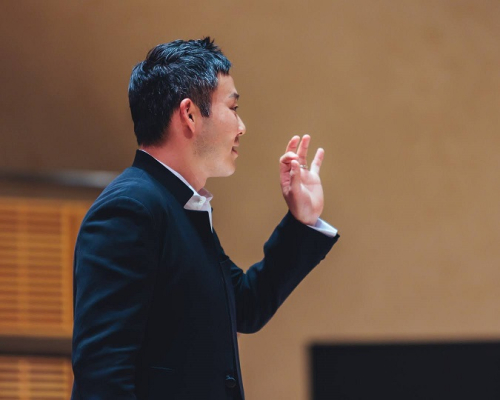
    Above: Maestro Earl Lee, photo by Emilio Herce

    Author: Oberon

    Wednesday May 22nd, 2024 – Celebrating their 30th anniversary this evening at Zankel Hall, Sejong Soloists presented the US premiere of Unsuk Chin’s “Puzzles and Games” from Alice in Wonderland, and the world premiere of Texu Kim’s With/out book-ending a spectacular performance of Felix Mendelssohn’s Octet. It was one of most enjoyable concerts of the season, joining such Springtime delights as violinist Lun Li’s Young Concert Artists recital at the Morgan Library, the Orchestra of St. Luke’s splendid Brahms REQUIEM at Carnegie Hall, and Chamber Music Society of Lincoln Center’s thrilling program, Songs and Snow, on my list of musical events that have kept my spirits up in these chaotic times.
    240522 Sejong Here & Now Festival-13

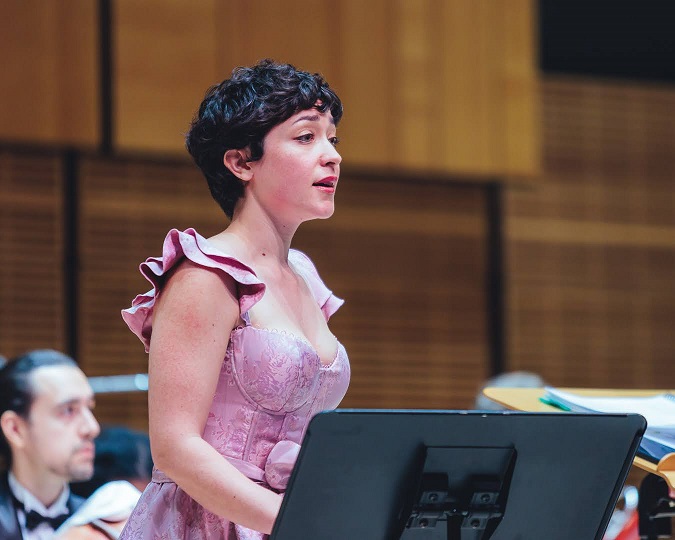
    Making her Carnegie debut tonight, soprano Juliana Zara (above, photo by Emilio Herce) was the soloist in the Unsuk Chin work, a daunting 20-minutes of singing which at times carries the singer into the highest range of the soprano voice. Ms. Zara never seemed daunted by the vocal writing: in fact, she seemed to revel in it. Conductor Earl Lee and his musicians gave the singer perfect support, whilst also seeming to savor the composers’ quirky and colorful writing for the ensemble.

    One by one, oboe, clarinet, flute, and bassoon join in the introductory phrases to Alice – Acrostic before Ms. Zara’s clear, lyrical voice is heard. This brief song ends with deep chords. Pizzicati are passed about in the introduction to If I Never Reach the Gardens, with gentle (slightly eerie) passages for the strings (and did I hear a harmonica?) before the music turns woozy; the soprano speaks much of the poem. The third and fourth songs, on the Curiouser and Curiouser theme, seem to run together. The music stays groggy, the words largely spoken, until a crashing chord is struck. Dotty rhythms and semi-singing in Who In The World Am I? are underscored by by insectuous strings and burbling winds before the flute has a final say.

    The piano introduces The Tale-Tail of the Mouse, with melodramatic sprechstimme from the soprano. Spaced-out harmonies and scurrying flutes lead to the final words: “Condemned to Death”. I thought I detected a musette in the atmospheric lullaby Sleep Tight My Ugly Baby, though my ears may have deceived me. The music is filled with droopy sighs; a sense of quietude settles in, and night chimes are heard. In Cat’s Aria, Ms. Zara ventured impressively into the upper extremes of the soprano range, lingering there is a series of amazing (and intentionally annoying) meows-in-alt.

    Twinkle, Twinkle Little Star has a delightful delicacy about it; then the music turned livelier and a catchy xylophone ‘cadenza’ established a playful mood. The music fades away at the end. The final song is Speak Roughly To Your Little Boy, introduced by a drum roll. A pulsing beat accompanies this mean mother’s lecture, with tambourine and bassoon interjecting. Now the vocal line goes completely bonkers – Ms. Zara didn’t simply manage it, she triumphed over it – as cymbal crashes bring this dazzling, quirky piece to a close. The soprano basked in a shouting ovation from the crowd, so truly deserved; she graciously signaled her thanks to the musicians and the Maestro.

    240522 Sejong Here & Now Festival-31

    Above: Ms. Zara, Maestro Lee, and the ensemble; photo by Emilio Herce

    The first time I heard the Mendelssohn Octet played live was at the New York City Ballet, where, in 2004, Peter Martins created a lovely ballet to this score, written by the composer at the ripe young age of 16. It is a veritable treasure chest of melodic and rhythmic felicities, and tonight it elevated my mood – constantly dragged down of late by the darkness that is spreading throughout the world – to one of great joy. 

    240522 Sejong Here & Now Festival-57

    An octet of prestigious string players (above photo by Emilio Herce) was led this evening by the Metropolitan Opera’s concertmaster David Chan, and the NY Philharmonic’s concertmaster, Frank Huang. From the Sejong Soloists’ roster, violinists Daniel Cho and Andrew Wan, violists Brian Chen and Paul Laraia, and cellists Ole Akahoshi and Jesús Castro-Balbi joined to create an ensemble alive with multi-hued timbres which created a very cordial blend.

    The Mendelssohn Octet is a four movements, with the opening Allegro moderato con fuocoin my opinion, one of the greatest movements in all the string quartet repertoire – being the longest by far. It opens with joyous arpeggios and vibrant accompaniments. A more lyrical second theme has an elegant feel. The Andante brings restfulness, but with a rather intense middle section that offers contrast. Mendelssohn is the King of Scherzi, and here we are offered a feast of trills and an ethereal lightness of textures. The concluding Presto is both deliciously agitated and cunningly witty. There were times when the piece seemed almost like a concerto, thanks to David Chan’s virtuosity. 

    240522 Sejong Here & Now Festival-69

    Above, taking a bow after the Octet; photo by Emilio Herce
    240522 Sejong Here & Now Festival-82

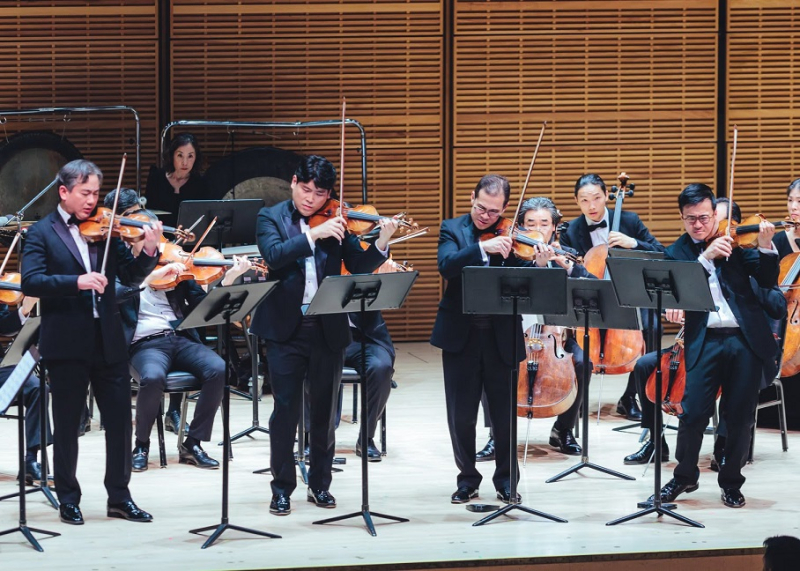
    Above, the soloists for the Texu Kim premiere: David Chan, Daniel Cho, Andrew Won, and Franck Huang; photo by Emilio Herce

    Violins remained in the spotlight for the world premiere of Texu Kim‘s With/out, which was positively brilliant. This is a concerto for four violinists, with string orchestra and a single percussionist. Frank Huang now took the lead, with Mssrs. Chan, Cho, and Wen again creating a stellar quartet. 

    The opening movement, lonesome and fluorescent, starts with a hesitant pulse; the musicians interject melodic fragments and quirky sighs. There are touches of humor, and a fresh bass beat is taken up. A short downward motif is passed among the four soloists (it will recur in the final movement), and the music becomes briefly grand, with repetitive pulsings. Then there’s a whirlwind…until a whip cracks, restoring order. A brief da capo leads to an other-worldly conclusion.

    The second movement, subdued and imploding, is darker and a bit eerie. The four violins play in unison, and then a shivering misterioso mood sets in. The basses strike up, again the whip cracks, and the beating timpani feels like a slow, swaying dance. The sound-textures are varied, holding our keen interest; each soloist shines in turn. After briefly turning epic, there is a passage of harmonizing for the orchestra’s violins. A sustained trill from Frank Huang leads to a sudden stop.

    The final movement, festive!!, has an oddly familiar start: an homage to Stravinsky with a brief quote from his Violin Concerto. This gave my companion and I a jolt, as we are both Balanchine fans. The timpani plays a role, setting up a forward impetus. There is an intermezzo, with the descending motif from the first movement popping up again. The music becomes cinematic and, after a lull, rebounds to a finale.

    240522 Sejong Here & Now Festival-90

    Above: composer Texu Kim joins the musicians for a bow following his with/out, photo by Emilio Herce

    The hall erupted in a lively ovation which doubled in intensity when the charming, youthful-looking composer (he’s 34) hoisted himself onto the stage as cries of bravo! rang out. A perfect end to a perfect evening. 

    ~ Oberon

    Performance photos by Emilio Herce, courtesy of Beverly Greenfield/Kirshbaum Associates
     

  • Martinelli Gala @ The Old Met ~ 1963

    Martinelli 2

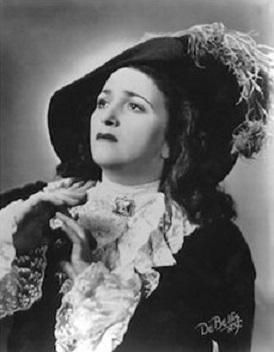
    I had never previously heard this gala concert honoring the 50th anniversary of the Metropolitan Opera debut of the great Italian tenor Giovanni Martinelli (above). Parts of it had sometimes cropped up on reel-to-reel trade lists back in the day, but invariably in poor sound. The present recording, which just popped up on YouTube, seems to have been made via the Met’s house wire.

    Listen here.

    The date is significant because two days later, John F Kennedy was assassinated in Dallas, Texas. And a week later, I attended my first performances at the Old Met.

  • 50 Years Ago Today: My First PARSIFAL

    Parsifal - 1st time-1 jpg

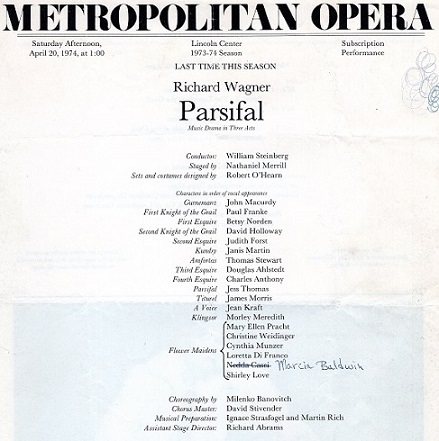
    Fifty years ago today, on April 20th, 1974, I saw my first performance of Wagner’s PARSIFAL  I was in my twelfth year of being an opera-lover, and I understood the importance of seeing this opera for the first time. I’d heard it twice already on Met Texaco Saturday broadcasts: the first in 1966 with Régine Crespin, Sándor Kónya, Walter Cassel, and Jerome Hines, conducted by Georges Prêtre, and the second in 1971, with Irene Dalis, Mr. Kónya, Thomas Stewart, and Cesare Siepi, conducted by Leopold Ludwig. The music seemed way beyond me at the first hearing, though – having been raised in a devout Christian household – I found a lot of it very moving; in fact, I was sometimes moved to tears, though I was not sure why. By 1971, the music seemed much more immediate and the characters – and their stories – began to seem more meaningful. 

    A lot had happened to me between that 1971 broadcast and the afternoon in 1974 that I walked into The Met for my first live performance of this mythic opera. I was, in fact, pretty down at the time. I’d had my first gay sexual experience in October 1973, only to be dumped by the object of my affection soon after. We’d been friends up until our night together, and it wasn’t until a few weeks after that I found out he already had a serious relationship going.

    Uncharacteristically, I stayed away from Gotham for a while, but I kept in touch with another boy in our group, TJ. I had turned to him for solace, and we grew very close, though our ‘first night’ was a disaster. But we really liked each other, so we eventually got on the same groove. As I recall, it was the day after the PARSIFAL that we went to The Frick and it was there, in the Atrium, that we revealed our feelings and decided to make a go of it. A few weeks later, I went up to The Cape to spend the Summer with him. At the end of the Summer, we tried to resume our lives apart, but we missed each other so much that I moved down to live with him in his dorm room at Sarah Lawrence College.

    Anyway, my diary entry about my first PARSIFAL is much briefer than my usual performance notes. As a rule, my diary was hand-written; I am not sure why I typed this entry: Parsifal 2-1 jpg

    I should perhaps clarify that Ms. Martin soon found the ‘staircase’ to her upper register and went on to be a very fine Sieglinde, Ortrud, Dyer’s Wife, and Tosca. Mr. Thomas, who had been my first Calaf and Tristan, went on singing for another eight seasons, with mixed results. Mr. Macurdy continued to develop and refine his Gurnemanz, and it became one of his greatest roles. 

    15747816_10209586751519649_7050039478046055439_n

    The next opera I saw came five months later; by then, I was happily living on campus at Sarah Lawrence with my bookish boyfriend, and posing as a student. Photo by TJ.

    ~ Oberon

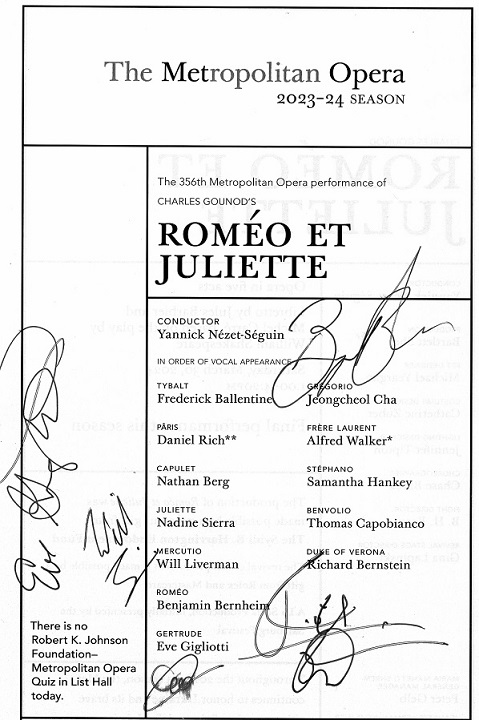
  • @ My Met Score Desk for Roméo et Juliette

    Snapshot

    Above: tenor Benjamin Bernheim as Romeo

    ~ Author: Oberon

    Saturday March 30th, 2024 matinee – Earlier this season, I renewed my acquaintance with Bizet’s CARMEN at The Met, an opera I had not seen for many years. Musically, I enjoyed it thoroughly, and so this afternoon I was hoping for a similar experience with Gounod’s ROMEO & JULIETTE.

    My first encounter with the Gounod opera was an unforgettable matinee in October of 1967, when Jeannette Pilou made a last-minute Met debut as Juliette opposite Franco Corelli’s matinee idol Romeo. I fell in love with Ms. Pilou that afternoon, and made many trips to New York from the little town specifically to see her in her many Met roles in the ensuing seasons. I saw Jeannette as Juliette a second time, and since then I have seen only Colette Boky and Hei-Kyung Hong in the role.

    Today’s matinee started the same way as my first-ever ROMEO in 1967: the news that Nadine Sierra had canceled and was being replaced by So Young Park, whose Met credentials to date have been a handful of recitals with piano in the NY Parks, and a single Queen of the Night in 2019. 

    The Met Orchestra played with its accustomed polish, and the chorus has a lot to do in this opera…and they did it very well. For the most part, Yannick Nézet-Séguin resisted his usual temptation to have the orchestra play too loudly…though there were moments…

    The orchestral opening was heavy-handed, followed by a chorale, and then the poignant love theme sounds from the strings. The first solo voices to be heard are those of Frederick Ballentine as Tybalt and Daniel Rich as Paris; Mr. Ballentine would have more to do later, in the duel scene…and he made a strong impression there.

    Nathan Berg was a fine Capulet; his ‘aria’ at the ball was subtly done, and his scene with Juliet prior to her taking the potion was excellent, as was his expression of remorse over her supposed death. Eve Gigliotti was an impressive Gertrude, making the most of her part in the wedding quartet, and in her scene with the the characterful Grigorio of Jeongcheol Cha. Richard Bernstein’s Duke of Verona made his anger at the dueling factions palpable, and his sentencing of Romeo to exile is a pivotal moment in the story.

    Alfred Walker’s Frère Laurent brought the basso’s warmth of timbre and eloquence of feeling to the scene of the wedding, and his consoling singing gives Juliette the courage to take the sleeping potion. Will Liverman delivered Mercutio’s tricky Queen Mab aria with complete assurance – a highlight of the evening for sure. Will’s handsome timbre is always so appealing, and his delivery was light and lively in the aria’s swift phrases, turning more lyrical in the central, more reflective passages. Bravo! Samantha Hankey’s singing of Stephano’s “Que fais tu blanche tourterelle” was a vocal treat. Melodious in the opening tune, the page chides the Capulet men with her insouciant teasing at “Gardez bien la belle”, finishing off with a mini-cadenza up to a perfectly placed top note which she sustained to brilliant effect. This aria was an early-career success for the great Frederica von Stade; may it bring Ms. Hankey similar good fortune!

    So Young Park has a girlish, clear voice which captured the innocence of the teen-aged Juliette right from her opening lines. At first, the voice was a bit tremulous, but she bravely shimmered up to a sprightly top note in her cadenza. Soon after, she was breezing thru the delectable waltz, in which she had all the coloratura well in-hand; the lovely pensive passage “Loin de l”Hiver morose…” was beautifully sung, and then the soprano sailed up to neat top-C, and lingered there.

    She and Mr. Bernheim were sweetly playful in their first encounter, Mr. Bernheim so persuasive in his gentle flirtation which is dressed up as poetry. Ms. Park’s delight at being so charmed by the handsome stranger vanished into sadness when she learns who he is: an enemy of her family. 

    The balcony duet was alive with the fascination of young love;  Ms. Park, now settled-in vocally, brought sweet lyricism to her lines – and the voice bloomed lovingly in response to the tenor’s ardent “O nuit divine…”. Then they harmonized to ravishing effect with “De cet adieu si douce e la tristesse“, and then Mr. Bernheim melted all hearts with his hushed, gorgeous “Va, repose en paix…” For me, die-hard romantic that I am, this entire scene was enthralling.

    Ms. Park’s voice sailed over the wedding scene quartet, where Ms. Gigliotti and Mssrs. Bernheim and Walker were all vocally aglow. The spine-tingling prelude to the bridal night duet was magically played by the Met Orchestra, and then Ms. Park and Mr. Bernheim gave us some of the most captivating singing imaginable with “Nuit d’hyménée! Ô douce nuit d’amour!”, their voices entwining in quiet rapture. The call of the lark – “the harbinger of the dawn” – draws them out of their reverie: thrillingly, they bid each other farewell. Romeo rushes to his fate, as Juliette sings a quiet blessing. This is the end of their happiness, though they do not know it.

    Ms. Park sang the dramatic Potion Aria effectively, though the conductor’s sudden need to pump up the volume elicited a rather brassy climactic top note from the soprano: so predictable with him on the podium. But such things only matter to a handful of listeners. The soprano finished the opera with her touching farewell to her beloved as they ask god to forgive them.

    The afternoon was a total triumph for Benjamin Bernheim. It is a great pleasure to hear this voice, which is both elegant and passionate. Following the sublime ‘lullaby” of the entr’acte leading up to the balcony scene, the tenor’s “O nuit!” marked the start of Bernheim’s dreamy recitative which carries us to a gorgeous clarinet solo before he takes up greatest love song in all opera: “Ah! Lèvetoi, soleil!” I have heard many 
    superb interpretations of his aria – from the likes of Franco Corelli, Alfredo Kraus, and Neil Shicoff – but none has moved me quite as deeply as M. Bernheim’s. Sung with deep tenderness, and ending with a  thrilling B-flat, the tenor was vociferously hailed by the audience. Listen to a brief clip here.

    Following his anguish at being exiled, the Bernheim Romeo capped the duel scene’s final ensemble with a bold top-C. Yet, for all the excitement of hearing a tenor deploy such golden high notes, it was in the quiet despair of the final scene that Bernheim achingly conveyed the pain of a broken heart: the sublime tenderness of his pianissimo farewell to Juliet, which was followed by the heart-rending echo of “No, ce n’est pas le jour…”, recalling the lovers’ moments of their brief happiness.

    Benjamin Bernheim’s Romeo brought some of the finest tenor singing I’ve heard at The Met in the last half-century. His voice has an innate poetic quality that cannot be taught; it is a voice that touches my heart. Thru the years, I have sometimes felt my deeply romantic soul to be a curse, but today I realized that it’s a gift.

    Now I have rambled on long enough. I went to the stage door after the curtain calls and met Eve, Benjamin, Will, and Richard. They were so kind…I love them all. What intrigues me so much about opera singers is that they can do things we mere mortals can only dream of. I admire their devotion and their courage, putting themselves on the line night after night so that we can bask in the glory of the greatest art form ever. 

    Romeo 2024-1 jpg

    And here are the curtain calls!

    ~ Oberon