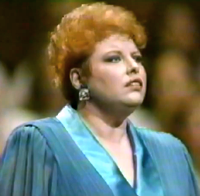
Soprano Susan Dunn (above) sings Strauss’s Vier letzte Lieder from a concert given in 1986 by the Montréal Symphony Orchestra, conducted by Günther Herbig. Listen here.
Soprano Susan Dunn (above) sings Strauss’s Vier letzte Lieder from a concert given in 1986 by the Montréal Symphony Orchestra, conducted by Günther Herbig. Listen here.
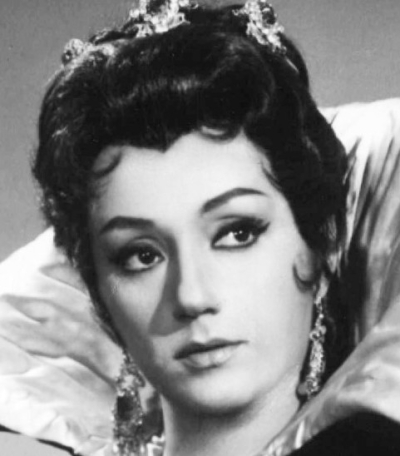
While it was the voice of Renata Tebaldi that initiated my lifelong obsession with opera, it was her compatriot, Gabriella Tucci, who was my favorite soprano during the 1960s when I was glued to the radio for every Met matinee radio broadcast. Tucci’s singing of Aida, both Leonoras, Violetta, Desdemona, Cio-Cio-San, Alice Ford, and Marguerite in FAUST on these broadcasts captivated me, and thru her I developed a love for hearing the words sung with such colour and feeling.
Seeing Gabriella Tucci in TROVATORE at the Old Met was a very special experience for me. I went on to see her in more roles – Liu, Elisabetta, Mimi – at the New Met, and enjoyed her so much, yet it was those formative Old Met broadcasts that linger in my mind to this day: I was learning these great operas at the time, and she taught me how beautifully they could be sung.
I’ve just come upon this video of Ms. Tucci singing Tosca’s “Vissi d’arte” on the Ed Sullivan Show in 1962, and it reminds me of everything I loved about her.
Watch and listen here.

Soprano Christiane Karg (above) sings Maurice Ravel’s Shéhérazade with Stanisław Skrowaczewski conducting the Frankfurt Radio Symphony Orchestra. The performance took place in September 2013.
Watch and listen here.

While best-remembered as an interpreter of the great Rossini mezzo-soprano roles, Lucia Valentini-Terrani here shows another facet of her artistry, singing Johannes Brahms’ Alto Rhapsody. Peter Maag conducts.
Lucia Valentini-Terrani – Brahms ~ Alto Rhapsody – Peter Maag cond – RAI 1979
Valentini-Terrani, born in Padua, sang at all the major Italian opera houses, as well as at Paris, Moscow, Buenos Aires, Chicago, and Washington DC. She debuted at The Met as Isabella in L’ITALIANA IN ALGERI in 1974, and had a huge success at Covent Garden in 1976 in LA CENERENTOLA. Beyond Rossini, her repertoire extended to such diverse roles as Eboli, Carmen, Charlotte in WERTHER, and Jocasta in OEDIPUS REX.
Diagnosed with leukemia in 1996, Lucia Valentini-Terrani passed away in 1998 at the age of 51.
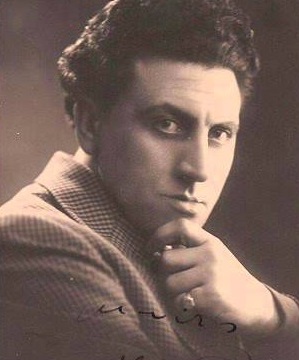
The Italian baritone Aldo Protti (1920-1995) was a native of Cremona. He studied at Parma, and made his operatic debut in 1948, at the Teatro Pergolesi in Jesi, as Rossini’s Figaro. Within two years, he was at La Scala, singing Amonasro in AIDA. From that point forward, Protti sang in Italy’s leading theaters as well as making guest appearances in Vienna; he participated in several broadcasts for the RAI, and in 1957 sang at Lyric Opera of Chicago as Barnaba (GIOCONDA) and Marcello (BOHEME).
Protti made important recordings for Decca, including a 1954 OTELLO with del Monaco and Tebaldi, Alberto Erede conducting. When Herbert von Karajan planned his stereo-remake of that Verdi opera for Decca in 1961, Ettore Bastianini was chosen to sing Iago. But Bastianini had failed to learn the part, so Karajan called upon Protti to repeat the role; the baritone surpassed his earlier recorded portrayal both vocally and in terms of characterization.
In 1985, at the age of 65, Protti sang a single performance as Rigoletto at The Met. He then joined the Company on tour, singing the role in six cities (including in Boston, where his Gilda was Roberta Peters in her final performance with The Met). He sang Rigoletto twice more, in concert form, with The Met in the Parks.
Rigoletto was Protti’s most frequent role, which he performed 425 times in all; Scarpia, Count di Luna, and and Iago each figured prominently in his repertoire, with 100 performances of each role in his résumé.
Also Protti passed away at Cremona in 1995.
Protti sings the PAGLIACCI Prologo here.
~ Oberon

Above: Roberta Knie as Isolde & Jon Vickers as Tristan; photo by Tony Romano
A performance of Wagner’s TRISTAN UND ISOLDE given by Lyric Opera of Chicago in 1979. Franz-Paul Decker conducts, with the following cast:
Tristan – Jon Vickers
Isolde – Roberta Knie
Brangaene – Mignon Dunn
Marke – Hans Sotin
Kurwenal – Siegmund Nimsgern
Melot – Richard Versalle
Shepherd – Gregory Kunde
Steersman – Daniel McConnell
Voice of a Young Sailor – William Mitchell
Listen here.
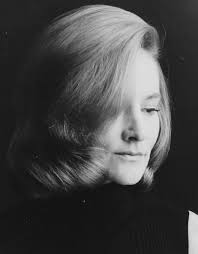
Soňa Červená (above) sings the aria “Connais-tu le pays ?” from Ambrose Thomas’ MIGNON, recorded under the baton of Heinz Fricke. Listen here.
Ms. Červená, a Czech mezzo-soprano who recently passed away at the age of 97, was a mainstay at the Frankfurt Opera, and was on the roster of singers at the National Theatre in Prague. She also appeared with the San Francisco Opera.
After reading of her passing, I listened to more of her recordings and was quite taken with her rather unusual rendering of Mahler’s Kindertotenlieder. Listen here.
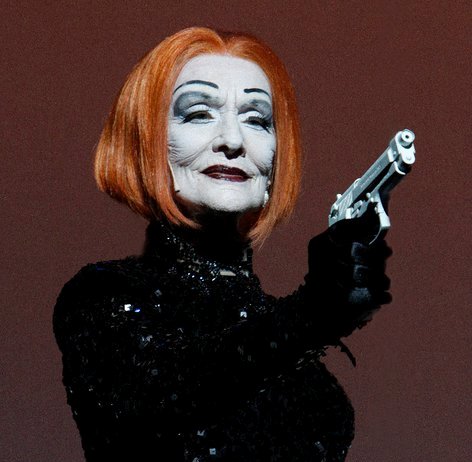
Following her retirement from singing, Ms. Cervena continued her stage career, appearing as Emilia Marty (above) in a Robert Wilson production of Karel Čapek’s drama The Makropulos Case at the National Theatre in Prague. She debuted in this staging in November 2010, and returned to the role many times, performing well into her 80s.

Above: Hugh Cutting
~ Author: Oberon
Tuesday June 17th, 2023 – The Orchestra of St. Luke’s, conducted by Bernard Labadie, presenting countertenor Hugh Cutting in a program of music by Bach and Handel at Zankel Hall.
The players of St. Luke’s, led by their gracious concertmaster, Krista Bennion Feeney, set the mood of the evening with a cordial performance of the Sinfonia from the Bach cantata “Wir müssen durch viel Trübsal” (“We must pass thru great sorrow”), BWV 146, featuring organist Avi Stein. This music drew us in with its melodic flow and rhythmic grace. A key element of the entire program was the rich double-bass playing of John Feeney: like the heartbeat of the universe.
Mr. Cutting then took the stage; blonde and boyish, he reminds me a bit of cellist Jonathan Swensen. In Bach’s immortal “Vergnűgte Ruh” BWV 170, Mr. Cutting’s lovely clarity of tone, his mastery of dynamics, and his intriguing personality at once engaged us; it was easy to understand why, in 2021, he was the first countertenor to win the Kathleen Ferrier Award. The voice effortlessly fills the hall, and his gorgeous straight-tone notes, gradually infused with a touch of sensuous vibrato, were spine-tingling.
The second half of the program was given over to Handel, commencing with the overture to Giulio Cesare, which was the very first music of Handel I ever heard in live performance…yes, the night of Beverly Sills’ triumphant Cleopatra at New York City Opera. Mr. Cutting then offered a sly and captivating rendering of Cesare’s ‘hunting’ aria, “Va tacito e nascosto” from Giulio Cesare, with Zohar Schondorf playing the demanding horn part. The two gentlemen seemed to revel in their duetting, bowing to one another at the aria’s finish.
The charismatic Mr. Cutting then switched characters to offer Tolomeo’s angry aria, “L’empio, sleale, indegno!” from Giulio Cesare. With acting as vibrant as his singing, he has a wonderful gift for ornamentation, reveling in his technical prowess, much to the audience’s delight.
A four-movement suite from Handel’s Ariodante featured some nimble playing from bassoonist Shelley Monroe Huang in the second and fourth movements. In the third, marked Allegro, Maestro Labadie set an exhilarating pace, and then accelerated to the finish line.
Mr. Cutting brought vibrant dramatic accents to the opening recitative “Otton, qual portenso fulmine è questo?” from Agrippina; then, in the pensive aria “Voi che udite“, he was at his most affecting, his singing seconded to lovely effect by oboist Melanie Feld. In the da capo, Mr. Cutting’s voice was incredibly moving. Here again, Mr. Feeney’s double bass was so poignant.
In “Furibondo spira il vento” from Handel’s Partenope, the singer tossed off Handel’s florid demands with stunning virtuosity: his scale passages swift and sure, his low notes lending dramatic vitality. This incredible showpiece caused the audience to erupt in cheers and applause at the end. Mr. Cutting was called back three times; the crowd so wanted an encore, but none was forthcoming.
We must hear this voice again, and soon. There is so much music I want to hear him sing.
~ Oberon

Above: The French poet André Chénier was one of the last people executed during the Reign of Terror; he had been charged with “crimes against the state”. Three days after Chénier was guillotined, Maximilien Robespierre himself met the same fate. Robespierre had been head of the Committee for Public Safety which condemned an estimated 50,000 people to death during the Reign of Terror. With Robespierre’s execution, the Reign of Terror ended.
In Act III of Umberto Giordano’s opera ANDREA CHENIER, Carlo Gérard prepares the indictment against Chénier. Gérard recalls how he had fervently joined the Revolution and wonders how he has come to this: collaborating in the death sentences of men he knows to be good and just.
In the course of this great aria, Nemico della patria (“Enemy of the Fatherland”), Gérard realizes he is only a pawn of the Committee for Public Safety. Called on to read the charges against Chenier at the trial, Gérard instead passionately defends the poet. Nevertheless, the death sentence is quickly handed down. In the opera’s final scene, set in the Saint Lazare prison, Gérard is still trying to get Chenier released, but to no avail.
The words of the aria are timely in our day and age:
“Enemy of the fatherland?!
It’s an old fable
That people still blissfully swallow.
Born in Constantinople? A Foreigner!
Studied at Saint-Cyr? A Soldier!
Traitor! Accomplice to Dumouriez!
And a poet? A corrupter of hearts
And morals!
I once lived joyfully
Without hatred or vengeance…
Pure, innocent and strong,
I thought myself a giant.
But I’m just a servant
Who has changed masters:
An obedient servant to their violent, sadistic passions!
Ah, worse yet: I kill…!
And while I kill, I’m weeping!
Me, a son of the Revolution,
The first to hear its cry…!
For the world, I united that cry to my own!
Have I now lost faith
In that dream of destiny?
Oh, how my path
Shone with glory!
The heart’s conscience…
Reawakening the people,
Gathering up the tears
Of the vanquished and suffering,
Making the world a Pantheon,
Changing men into gods!
And with one kiss,
To embrace all mankind!
Dmitri Hvorostovsky – Nemico della Patria ~ ANDREA CHENIER
~ Oberon
 Oberon's Glade