Category: Opera

  • My First – and Only – Public Appearance

    coppelia size

    (This article originally appeared on Oberon’s Grove in 2008. I’ve brought it forward to the Glade as it’s about an especially meaningful period of my life.)

    When I was twenty-five I fell in love with a 17-year-old kid who spent his summers working for a small ballet company, Dance Theatre of Cape Cod. He invited me to spend a summer with him there; we would live in a room in a big house in Harwichport across the street from the studio.

    Within a week after we got there, he was totally immersed in the ballet. They were mounting COPPELIA at the end of the summer; he was dancing Franz and also was the business manager for the school. He and Helen, the woman who ran the program, were very close. I could see that I was going to be playing second fiddle to COPPELIA all summer.

    At this point in my life, I had never seen a ballet performance; just tidbits on TV. I was a big opera fan, but whenever there was a ballet in an opera performance I was bored to death.

    coppelia 2

    The studio was located behind (and connected to) the Harwichport Town Library, directly across the street from the house where we were staying. So, the music of COPPELIA wafted over from the studio, and that drew me there. When I first walked into the studio I was much intrigued by the musty smell of old costumes that were hung out to air, and the girls (ages 8-16) were dazzled to have a man watching them. They became giggly and adorable.

    The teacher eyed me with the sort of interest that small-time ballet mistresses have eyed young men for decades: could she transform me into a “dancer”?  She had TJ to play Franz, she had a local actor to play Doctor Coppelius, and the boyfriend of one of the girls to play the Mayor. She wanted very much to have another male in her production, especially to pique the jealousy of the rival ballet school a few miles away.

    “I’m planning to stage a little folk dance in the third act,” she said to me. “Would you think about it? I’ll make it easy for you…” TJ was poking me in the ribs, “Say yes!” She played the piece for me: it would be myself and one of the girls; the music (which Balanchine uses for the Jesterettes) was bouncy and the piece was short.  Realizing that if I didn’t join in I would be seeing very little of TJ all summer, I said OK.

    Then came the clincher: I had to take class. This gave me pause, but only for a minute. I was slender then, and in reasonably good shape. We drove to a small dance supply shop in Hyannis where TJ helped me get a dance belt, tights and slippers.

    My first class was a riot. The beginners class, 8- and 9-year-olds, were thrilled to have a man in their class. They all wanted to stand next to me at the barre. When we began tendus, the teacher waltzed up to me and said: ” Point your foot!” to which I replied “Point my foot…at what?”

    The studio had a ghost, Ada, who we contacted nightly using a Ouija board. She was a nurse who told us she had cared for soldiers returning home after World War I. How she ended up in a dance studio was never revealed. (I have since found out that the building did indeed house recuperating soldiers upon their return from Europe!)

    I found that I had a natural affinity for ballet, not that I would have guessed. I began rehearsing my dance; my partner was a beautiful black-haired 14-year-old named Elaine. We got on perfectly. We played a betrothed couple who danced at Swanhilda’s wedding fete. Elaine was light and springy so the lifts were easy.In the dance, she did most of the work. Lots of stomping and romping. The piece ended with me on one knee; I reeled her in from some turns she was doing, she sat on my other knee and we smooched.

    coppelia 3

    Above: only known photo of me wearing tights…with my partner Elaine Aronson, a talented 14-year old.

    Costumes…I wore a blue satin vest, white tights and shirt, and blue suede boots. Elaine wore a white “peasant” dress with red character shoes and flowers in her hair. One of the mothers did my makeup. We had 3 performances, and our dance was a hit. One night one of Elaine’s friends tossed her a bouquet when we were bowing. Little kids asked us for our autographs.

    After that summer TJ and I moved to Hartford; eventually we split up. I continued taking class for about 3 years. Whenever I hear the music of COPPELIA I’m transported back to that sweltering studio and that care-free time.

    Beth Taylor had danced Swanhilda in our performances; the following winter she danced the Sugar Plum Fairy in another company’s NUTCRACKER. TJ and I drove down to the Cape in wintry weather to see her; aside from Beth several of the kids who had been in COPPELIA were dancing in the NUTCRACKER.

    coppelia 4c

    TJ took this picture of me & Beth after the show; it was the last time I ever saw her, or any of the other people I’d spent my memorable summer with.  

  • Remembering Hildegard Behrens

    behrens c

    (This article appeared on Oberon’s Grove in 2009, following Ms. Behrens’ death at the age of 72.)

    “It is so difficult for me to comprehend that Hildegard Behrens has died. She was only 72 and it seems not all that long ago that my friend Bryan and I visited her in her dressing room after what was to be her penultimate Met performance: as Marie in Berg’s WOZZECK.

    Hildegard Behrens was one of a half-dozen singers who, in the nearly half-century that I’ve been immersed in the world of opera, made an impression that transcended mere vocalism and acting. Her voice was utterly her own: a ravaged, astringent quality often beset her timbre – the price of having given so unsparingly of her instrument in some of opera’s most taxing roles. And yet she could produce phrases of stupendously haunting beauty, and she could suddenly pull a piano phrase out of mid-air. Her unique mixture of raw steely power, unmatched personal intensity and a deep vein of feminine vulnerability made her performances unforgettable even when the actual sound of the voice was less than ingratiating.

    So many memories are flooding back this morning while I am thinking about her: the Wesendonck Lieder she sang at Tanglewood during my ‘Wagner summer’…a rare chance to hear her miscast but oddly moving singing of the Verdi REQUIEM…her televised RING Cycle from the Met…her wildly extravagant ‘mad scene’ in Mozart’s IDOMENEO…her passionate Tosca and Santuzza, cast against the vocal norm…a solo recital at Carnegie Hall…the dress rehearsal of the Met revival of her ELEKTRA  where she made up (and how!) for an off-night at the premiere. Hildegard Behrens was also the holder of the Lotte Lehmann Ring, which was left to her by her great colleague Leonie Rysanek upon Rysanek’s untimely death in 1998.

    behrens 2

    It was in fact the Behrens Elektra, sung in concert at Tanglewood with the Boston Symphony Orchestra under Seiji Ozawa in August 1988 that has always seemed to me the very epitome of what an operatic portrayal can be. In a black gown and violently teased hair, the soprano (announced as being indisposed by allergies) transformed a stand-and-deliver setting into a full-scale assault on the emotions. I’ll never forget that performance and I was fortunate a week later to record it from a delayed broadcast.

    In the great scene in which Elektra recognizes her long-lost brother, Behrens transported me right out of this mortal world. Here it is, from her 1994 Met performance with Donald McIntyre.

    It’s going to be hard for me now to listen to Hildegard – her Berlioz Nuits d’Ete is my favorite recording of those beloved songs, unconventional as her voice sounds in that music – or to watch her on film as Brunnhilde or Elektra. For a while I will just let the memories play.”

    behrens tosca

    Above: Ms. Behrens as Tosca

    behrens 4

    Above: the soprano in concert with Daniel Barenboim

  • Verdi REQUIEM ~ BBC Proms

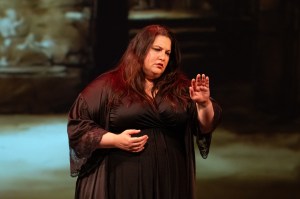
    Tamara wilson

    Marin Alsop leads the Orchestra of the Age of Enlightenment in a performance of the Verdi REQUIEM given at the BBC Proms in 2016.

    The soloists are soprano Tamara Wilson (photo above), mezzo-soprano Alisa Kolosolva, tenor Dimitri Pittas, and bass Morris Robinson; recorded live at the Royal Albert Hall.

    Watch and listen here.

  • Raina Kabaivanska ~ In questa reggia

    Kabaivanska a

    A rare document: the great Bulgarian soprano Raina Kabaivanska singing Turandot’s “In questa reggia” at a concert given at Viareggio in 1978. As far as I know, she never performed the entire role during her long career (though she was an admirable Liu), nor can I find any mention of her singing Turandot’s narrative/aria anywhere else.

    Watch and listen here

  • Singers: Jeannette Pilou

    (I have imported this story from Oberon’s Grove…it used to include lots of photos, but I just wanted to save what I’d written back in 2007. Here is a photo I took of her that she loved…she was so sweet as signed it for me.)

    pilou

    Around noon on October 7, 1967, I bought a big bunch of yellow chrysanthemums from a street vendor and rushed over to the stage door of the Metropolitan Opera House; the flowers were for one of my idols at the time, the Italian soprano Mirella Freni who was singing Juliette in Gounod’s ROMEO & JULIETTE that afternoon. I bounded up the steps to the Met’s stage door reception area and approached the desk. An indifferent woman was there, talking on the phone. When she finally hung up, she ignored me. “I want to leave these flowers for Miss Freni!” I said.  She looked up at me wearily and said, “Miss Freni is ill and is not singing this afternoon.”  Walking out, I held the door for a chorister who was coming in; “Want some flowers?” I said to her, handing her the mums. A few hours later I had fallen in love.

    Gay men fall in love with women all the time; of course, it isn’t ‘that kind’ of love. It’s usually an attraction to their beauty and their talent, tinged with a bit of regret that it couldn’t ever be the ‘other kind’ of love. That is exactly how I always felt about Jeannette Pilou. She made her Met debut that afternoon as Juliette and for the next few years she was a singer who intrigued me so often with the delicacy and charm of her singing, her unfailingly fresh dramatic interpretations of some of opera’s most beloved characters, and her modest sincerity and great kindness. The stages at Lincoln Center have been home to so many beauties, from Carol Neblett to Helene Alexopoulos, and Pilou was one of the most memorable of them all.

    Jeannette Pilou was born in Egypt and could trace her heritage to the Greeks, but for me she was always a French soprano. Her voice was lyrical with a metallic thread that gave it an easy projection. It was not in itself one of those beautiful instruments that immediately melt the listener; she never had a long breath line and her top register could get an edgy quality. Her appeal vocally was in the way she phrased and used a delicate pastel palette to make music you’d heard a hundred times seem new and alive. Aside from her incredible physical appeal, Pilou’s interpretations invariably brought those little gestures and expressions that you always remember. In the final act of TRAVIATA when the dying Violetta rises from her sickbed to be reunited with her beloved Alfredo, Pilou hastily looked at herself in the mirror before turning to present her ravaged face to her lover. I’ve never forgotten that moment of desperation which spoke so clearly of Violetta’s helpless regret over her fate.

    But I’ve gotten ahead of myself, because I must start with that debut Juliette which is where my love affair began. Pilou looked so fetching on her first entry at the Capulet ball, spiraling into her little introductory “Ecoutez, ecoutez!” with a voice that wafted clearly into the big house. Not long after, she won her first big applause at the Met singing Juliette’s waltz, “Je veux vivre” with easy scale-work, pointed diction and youthful vivacity; she even touched on the high-D in the cadenza which Freni had been omitting. Moments later Pilou encountered her handsome Romeo, Franco Corelli, and the chemistry was apparent from the start. Corelli was having quite a success as Romeo at the Met with his passionate vocalism, thrilling the house with a stunning diminuendo on the final B-flat of “Ah, leve-toi soleil!”. He was one of the few tenors at that time who looked good in tights, too. In their love duets, Corelli really seemed smitten with Jeannette and they sounded wonderful together. Corelli drew a thunderous ovation when he took a full-throttle top C upon Romeo’s banishment from Verona. The afternoon ended with a mammoth ovation; the curtain calls had been designed so that the title characters always bowed together and they came out several times until finally Jeannette made the beautiful gesture of withdrawing to let Franco have a solo call. The house exploded and Franco was so gracious when he brought Jeannette out again. In addition to the lovely impression her Juliette had made, Jeannette had endeared herself to the legion of Corelli fans in no uncertain terms. I met her after the performance and she was so lively and sweet, and even more beautiful up close than she had seemed to be onstage. Her speaking voice was so intimate and enchanting; I immediately added her to the list of singers whose performances would be a priority.

    Violetta in the Cecil Beaton production of TRAVIATA was my next Pilou role; she looked every bit as striking as Moffo in these costumes.  She was paired with the light-voiced tenor Luigi Alva  and they made a beautiful blend in the duets. Jeannette was so moving in the great Act II duet with Germont (Robert Merrill) where she struggled valiantly to maintain her composure as her fragile world crumbled around her. Phrase after phrase of wonderfully modulated vocalism wove a spell.  A few years later, Pilou stepped in to a broadcast of TRAVIATA replacing Montserrat Caballe; I was in the house enjoying Jeanette’s portrayal and her colleagues Carlo Bergonzi & Sherrill Milnes so much. A downward transposition in “Sempre libera” caused something of a scandal among the fans; I thought it was a rather minor transgression in view of what she was able to convey in the role.

    Micaela in CARMEN followed with Jeannette making a particularly lovely impression in the Act I duet with Nicolai Gedda. This was the infamous Jean-Louis Barrault production set inside the bullring. The cast, led by Grace Bumbry, almost managed to overcome the awkward staging; Jeannette’s big aria was lovingly phrased. Next came Zerlina in DON GIOVANNI in which she presented a very youthful, zesty portrayal of the peasant girl; singing opposite the Don of the young Puerto Rican heartthrob Justino Diaz, Jeannette reveled in the seductive expressiveness of “La ci darem la mano”.

    Jeannette & Franco Corelli created an atmosphere of extraordinary romance when they appeared together in BOHEME. This was one of Jeannette’s most moving portrayals,  using her mastery of parlando in the Act I narrative and spinning out some fragile piani in her ‘Addio senza rancor’. Franco was in prodigious voice, his singing so passionate and virile but also very tender; he was obviously smitten with his beautiful Mimi and changed the words in the love duet from “Dammi il braccio, mia piccina” to “Dammi il braccio, mia bambina.” In the moving trio where Rodolfo tells Marcello of Mimi’s hopeless ill-health, not knowing that Mimi is listening, Franco tore his heart out and the audience burst into a volley of bravos mid-act. Jeannette & Franco carried the romance of their characters into the curtain calls.

    At the dress rehearsal of NOZZE DI FIGARO in February 1972, Jeannette had one of her most attractive roles in Susanna. She gave a portrayal free of soubrette cuteness, utterly natural. Vocally she was in the captivating company of Cesare Siepi, the reigning Figaro of the day, the radiant Pilar Lorengar (Contessa) and the beloved and versatile Evelyn Lear (Cherubino). On the podium the great Karl Bohm served up perfect tempi and ideally supported his singers. The ensembles and gentle comic by-play were a joy. FIGARO soared. The photo shows Jeannette with one of New York’s best-known opera fans, Lois Kirschenbaum.

    It was amusing to walk Jeannette out from her dressing room after the rehearsal; when we came to the main reception area it was jammed with singers coming and going from coachings and I very much enjoyed observing the effect Jeannette had on all the men, including some very well-known tenors and baritones. If she was aware of the waves she was causing, it didn’t show; she greeted everyone with easy, modest charm and left them all panting in her wake.

    Later in the month, Jeannette took part in a memorable evening when FALSTAFF was revived. Sir Geraint Evans and Regina Resnik trod the boards with grand portrayals of Sir John and Dame Quickly. Renata Tebaldi was singing Alice Ford for the first time at the Met. The orchestra launched the scampering introduction to the second scene and when the curtain rose and the audience caught sight of the great Italian diva, the place erupted. The applause obliterated the music and when it died down the singers had lost their way; “Start over!” someone yelled and that is exactly what Christoph von Dohnanyi (debut) did. Jeannette was a cuddly Nannetta. In a magical moment she arrived at Herne’s Oak dressed as the Queen of the Fairies on a white Shetland pony. Her aria, “Sul fin d’un soffio” was spun out of moonlight. At the end of the romping ensemble which concludes the opera, Jeannette tackled a bright top-C. The curtain calls were so much fun and the audience truly reluctant to let the singers go. I had an aisle seat in the orchestra and sitting two rows ahead of me was Franco Corelli. I thought it was pretty nice of him to come out and support his long-time colleague Tebaldi. After the performance I spent a long time backstage with Jeannette who was in a particularly sociable mood. Everyone else had gone home, but she seemed in no hurry to leave. I said goodnight and came out to find Corelli pacing back-and-forth near the stage door with a limo waiting. Did they have a date? If so, she may have been standing him up.

    Jeannette and Nicolai Gedda were reunited in a wonderful performance of Gounod’s FAUST; the Met’s production was rather ugly (though later replaced by an even uglier one) but along with Cesare Siepi’s famed Mephistopheles, the singers carried the day.  The role really suited Jeannette to perfection: her clarity of enunciation of the French text added to the sweetness and dexterity of her singing made the long ‘Roi du Thule’ and Jewel Song sequence delightful. Later she and Gedda harmonized rapturously in the ‘Laissez-moi’ duet (the highlight of the score, in my opinion) and Jeannette sang the concluding lines of the Garden Scene (‘Il m’aime!’) with slowly mounting ecstasy. As the tides turned against Marguerite, Jeannette relied on the metallic thread in her voice to project over the orchestra in the Church Scene and in the ascending phrases of the final trio.

    It was a long time before I saw her onstage again; I spent some time in Houston and she was busy at other opera houses. In fact four years elapsed before I next saw her, again as Marguerite in FAUST, this time opposite the less-than-romantic looking but mellifluous Stuart Burrows in the title role. Jeannette’s interpretation had deepened although the production had deteriorated further with an especially awful ballet now being interpolated. She and Burrows rescued the evening.

    There was another very long hiatus before her next – and for me her most memorable – Met role as Melisande in Debussy’s masterpiece in 1983. The production was murky and grim (it has since been replaced by a far more atmospheric one) but musically it was so rewarding both in James Levine’s brooding traversal of the dense score and in the ideal interpretations of the three principal roles: Pilou as Melisande, Dale Duesing as Pelleas and the unforgettable Jose van Dam as Golaud.  As the gentle and mysterious Melisande, Jeannette ‘spoke’ her lines with a refined sense of lyricism and she was so moving in her simplicity and deeply feminine vulnerability. The overwhelming sadness of watching Melisande’s life fade away following the birth of her daughter left me feeling bereft.

    Two years later I saw Jeannette onstage for the last time, singing Nedda in PAGLIACCI. The tension in her upper register had taken its toll but she had some wonderful lyric passages, most notably in the duet with Silvio, and she mounted a fiery defense in the final moments before Nedda is brutally murdered.

    I had long since stopped visiting singers backstage but I did run into her in the Met lobby during her final season of Neddas and Micaelas and she was as lovely and gracious as ever. In the years since I first met Jeannette Pilou, the memories of her portrayals and of her easy kindness to a young and eager fan have stayed with me vividly.

    Here is Jeannette singing Juliette’s entrance and Waltz @ The Met.

  • THE PEARL FISHERS ~ Duet

    Pearl+Fishers

    Matthew Polenzani, tenor, and Hyung Yun, baritone, sing the great duet Au fond du temple saint” from Georges Bizet’s Les Pêcheurs de Perles; Howard Watkins is the pianist.

    Watch and listen here.

  • Love & Death

    (Having learned that my original blog, Oberon’s Grove, will soon be shutting down, I am bringing forward some of my most-read articles from the Grove to the Glade.)

    This story about the joint assisted suicide of British conductor Sir Edward Downes and his wife at a Swiss clinic was both touching and thought-provoking for me. I admire the couple’s courage and am deeply moved that they chose to die together rather than face continuing deteriorating health. Since Dmitry sent the story to me this morning I have not been able to stop thinking about it.

    When I was in my darkest days (high school and the three or four years immediately after graduating) I thought often about killing myself. I managed to steal enough sleeping pills from my father’s pharmacy to do the trick, though I lacked the courage to actually take them. I kept the capsules in a place where I knew my mother would never look: in a box of opera cassettes. During the worst days I would think ‘tonight I’ll do it’ but I would come home, isolate myself with my opera recordings and eventually talk myself out of taking the pills. Two things kept me from going thru with it: the thought that either I would not die but somehow be paralyzed or disabled, or that just after I’d swallowed the pills someone would call or come to me with ‘the answer’ and it would be too late.

    The other gay boy in town was more courageous; he took his father’s gun and shot himself. It was the talk of the town for days though of course the word ‘queer’ was never mentioned. My mother said the oddest thing to me: “You would never do anything like that, would you?” Well, no…dad doesn’t own a gun for one thing. My plan was to fill the bathtub, light dozens of candles, put on a recording of  ‘Casta diva‘ on endless repeat and get in the tub (fully clothed) and drift away, knowing how horrible my parents would feel when they came home and found me.

    As I became more withdrawn and sullen, my parents sent me to a shrink. I went once a week and sat in his office, uncommunicative, as he kept saying in a thick German accent: “I vant to understand zee nature of your problem.” Eventually I told my parents they were wasting their money. The sessions stopped. I got more depressed.

    I had flunked out of State university; I had simply not gone to the classes I had registered for, instead spending the days driving around the countryside while my parents assumed I was in class. In danger of being drafted, I enrolled at a community college. My parents found me a room in a rooming house with maid service and I stayed in the room for days on end listening to opera and going out only to buy cookies and milk. I did sometimes go to class though, because I loved my (female) math and Spanish teachers and my (male) Black Lit teacher.

    One day I came out from class and it was pouring. I went into the Student Union – I’d never been in there before – to wait out the storm. A girl from my Black Lit class was there with a couple of her friends. She waved me over. It was Ann(e), the person who changed my life.

    From there is was still a long road out of the closet but it was her friendship, her notion that being different was the coolest thing possible, her sense of humour and her beautiful singing voice that got me out of my shell. Thoughts of suicide were swept away. The next time I was home I dissolved the pills in boiling water and poured them down the drain – a symbolic act, since by then they were surely no longer potent.

    What the joint suicide in Switzerland set me thinking about is that suicide is not for the young; whatever problems a young person might be facing there is always a path or a person that will lead you out of your darkness. Finding the way may be frustrating and things may seem hopeless but it’s worth it to hold on thru the despair. If I had given in on one of those wretched nights, all the beautiful people I have met since then, all the music I have heard, all the dancing I have seen, books I have read, beaches I have walked along, lovers I have lain with, all the poems and paintings would never have been mine. Life is always worth living for the possibilities it affords.

    But for Sir Edward and his wife, suicide seems to me a beautiful ending to their long life together; with their happiness and good health in the past they made a decision to venture into the unknown on their own terms. I wish them a peaceful sleep.  

    ~ Oberon


  • Maria von Ilosvay

    Maria von Ilosvay

    The Hungarian mezzo-soprano Maria von Ilosvay won the 1937 International Singing Contest at Vienna. Thereafter she joined a touring opera company for two years – even traveling to America, in performances organized by Sol Hurok – before joining the Hamburg Opera in 1940. She sang at Vienna, Brussels, Amsterdam, and Salzburg,

    Ms. von Ilosvay participated in the first post-war Bayreuth Festivals. In her book New Bayreuth, Penelope Turing writes with admiration of the mezzo in such RING Cycle roles as Erda, Waltraute, and the First Norn.

    At the Salzburg Festival, Ms. von Ilosvay took part in the first staged performance of LE VIN HERBE by Frank Martin in 1948, and in the premiere of Carl Orf’f”s ANTIGONAE in 1949. With the ensemble of the Hamburg Staatsoper, she was a guest at the Edinburgh Festival, and in 1956 sang Jocasta in Stravinsky’s OEDIPUS REX at the Holland Festival. Also in 1956, she appeared as a guest artist at London’s Royal Opera House.

    In 1967, Maria von Ilosvay sang Marcellina in a filmed German-language ‘studio’ performance of Mozart’s NOZZE DI FIGARO. Her scene with the brilliant Susanna of Edith Mathis is a delight.

    Ms. von Ilosvay recorded the role of Erda twice, and was the mezzo-soprano soloist on a recording of the Verdi REQUIEM with the Accademia di Santa Cecilia. She is also The Mother on Herbert von Karajan’s recording of HANSEL UND GRETEL. She did a great deal of concert work, and was a noted recitalist.

    Maria von Ilosvay passed away at Hamburg in 1987.

  • Rita Gorr ~ Printemps qui commence

    rita gorr

    The great Belgian mezzo-soprano Rita Gorr sings Dalila’s evocative aria “Printemps qui commence” from Camille Saint-Saëns’ SAMSON ET DALILA.

  • Dame Joan Hammond ~ Vissi d’arte (in English)

    Read about the beloved Australian soprano Dame Joan Hammond here.

    Listen to her singing Tosca’s “Vissi d’arte” in English: