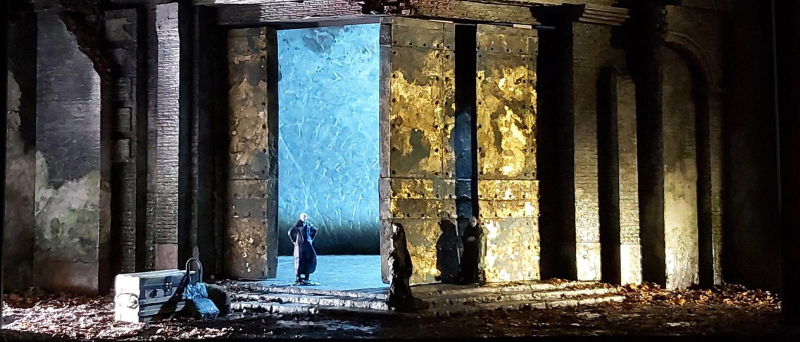
Tuesday September 27th, 2022 – The Metropolitan Opera opened their 2022-2023 season this evening with the Met premiere of Cherubini’s MEDEA. Originally performed in French – the opera’s world premiere took place on March 13th, 1797, at the Théâtre Feydeau in Paris – MEDEA in its Italian version became one of Maria Callas’s greatest triumphs.
This was my fourth time experiencing MEDEA in the theatre. In 1974, the New York City Opera staged the work for their premiere singing-actress, Maralin Niska, who was magnificent in the role. Incredibly, in 1982, the Company offered another new production of the work – somewhat more timeless in feeling – with Grace Bumbry very effective in the title-role. In 1987, the opera was given in Bridgeport, Connecticut, in a traditional setting; Gilda Cruz-Romo sang Medea. Gilda, a longtime favorite of mine, was not ideally suited to the role but she still had plenty of voice a her disposal; it was the last time I ever saw her onstage.
Met Opening Night tickets being prohibitively expensive, I took a score desk for this performance; I plan to go a second time to have a view of the sets and costumes. This evening was a huge personal triumph for Sondra Radvanovsky; singing to a sold out house – a real rarity at The Met in this day and age – she won a thunderous ovation of the kind singers like Tebaldi, Nilsson, Rysanek, and Dame Gwyneth Jones used to garner. Sondra deserved every decibel, for she threw herself into the difficult and demanding role with total commitment.
The evening opened with the national anthem. I have always love singing it, but when we came to the words “…o’er the land of the free…” and was suddenly overcome with grief. We seem to be rushing headlong to our doom as a great democracy; I am hoping I won’t live long enough to experience the bitter end.
MEDEA itself is maddeningly uneven: thrilling passages – mainly for the title-character – alternate with routine music; conductor Carlo Rizzi led a performance that was more dutiful than inspired. It was in the individual singers that the evening made its musical impact; chorus and orchestra played a vital role in keeping the opera afloat when the main characters were otherwise occupied.
Matthew Polenzani’s Giasone is quite different from that of such earlier stalwarts in this music as Jon Vickers and James McCracken: more lyrical and thus more vulnerable. Polenzani sang beautifully, and his voice carried perfectly in the big hall. His expressive range veered from poetic (with his bride) to defiant (dealing with his ex-), to ultimate despair as he watched his entire world go up in flames.
Janai Brugger’s Glauce made much of what is a rather ungrateful role; Glauce has a very demanding aria early in the opera and thereafter is eclipsed both musically and dramatically by her rival, Medea. Ms. Brugger’s voice sails easily into the hall, and she combined full-toned lyricism with technical assurance.
Michele Pertusi has had a long and distinguished career, and tonight, as Creon, he was most impressive. The voice is steady and sure, and it fills the house. It’s always wonderful to hear a native Italian making the most of the words. Pertusi’s Creon was outstanding, establishing real authority.
I had previously experienced Ekaterina Gubanova as a powerful Cassandra in a concert performance of LES TROYENS, and as Brangaene in a concert version of Act II of TRISTAN UND ISOLDE where she sounded a bit taxed in her upper range. Tonight, as Medea’s faithful companion, Neris, Ms. Gubanova was superb. Her poignant aria, with its haunting bassoon accompaniment, was the musical centerpiece of the evening. The singer seemed to hold the house under a spell as she sang of her devotion to her mistress, winning warm applause at the aria’s end, and an enthusiastic round of bravas at her bows.
Mille bravi! to Met principal bassoonist Evan Epifanio for his gorgeously mellow playing in Neris’s aria; he and Ms. Gubanova ideally complimented one another.
Witnessing the Radvanovsky triumph was vastly pleasing to me, as I have been a great admirer of the diva since her days as a Met Young Artist. In her many performances that I’ve experienced, she has always seemed to have a unique gift for making opera seem important. Sondra’s dynamic range is her greatest gift: the incredible focus and power of her highest notes can be followed moments later by a shimmeringly “alive” pianissimo. And she has an enthralling stage presence: a fearless actress, she seems to become the woman she is portraying. All this made her Medea a holy terror.
Medea makes a sneaky entrance, and soon she is alone with her former lover/husband, to whom she pours out her emotions in the great aria “Dei tuoi figli la madre…“; here, the Radvanovsky voice ranges from extraordinary tenderness to blind fury. I might have wished for a more chesty expression at “Nemici senza cor!” (Sondra really opened the chest range in Act II!) but the soprano knew what she was about. Polenzani gave a powerful response, eliciting a blistering, sustained top note from the furious sorceress. They quarreled on, to brilliant effect.
Act II commences without a break (thank god they didn’t bring up the houselights to quarter!) and Sondra, who had had a couple of throaty notes in Act I, was now blazing away on all cylinders, the voice fresh as can be, and the increasing use of chest voice adding to the thrills. Medea’s pleadings to Creon to be given one more day in Corinth cover a wide range of cajoling and deceit…Sondra and Mr. Pertusi were electrifying here. And when she won, Sondra celebrated her success: Medea now has time to work her destructive spells.
Following Neris’s gorgeous aria, sounds of the wedding ceremony are heard, with the chorus invoking the gods to bless Glauce and Giasone. Medea counters this with diabolical mutterings of her own, cursing the crowd with a starkly chested “Rabia infernal!“. Then, suddenly, she sails up to a vibrant final phrase. I admit I was kind of hoping Sondra would “take the fifth” here, as Callas sometimes did, but that notion was lost in the barrage of applause.
Act III is only about 30 minutes long, and is preceded by an over-long prelude. Sondra again stuns us with her powerful “Numi, venite a me!” and then gives us her finest, most magical singing of the evening with “Del fiero duol!” capped by en enormous high note. Polenzani, maddened by grief, assails her: “Our sons! What was their crime that they deserved to die?”…to which she answers, “They were your children!”
I stood up from my desk to watch the finale: flames are licking at the walls of the temple; the corpses of the two boys are lying on the floor upstage. Medea delivers her final line to Giasone: “Al sacro fiume io vo! Colà t’aspetta l’ombra mia!” (“I go to the sacred river…there, my shade will await you!”) and moves slowly to her dead sons. She settles herself between them, taking their bodies in her arms as the entire temple is engulfed in flames.
There’s a video of tonight’s finale – and the curtain calls – that is a wonderful souvenir of the evening. However, having been recorded on a cellphone, it gives no idea of the sheer volume and depth of the sound of a full-house standing ovation at The Met. To Sondra, it must have felt like being hit by an avalanche of affection. Watch here.
~ Oberon




 Oberon's Glade