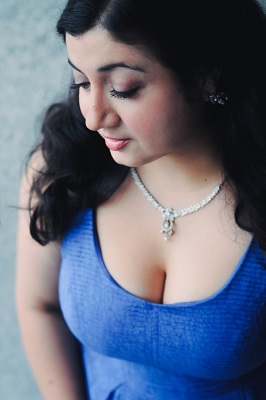
A performance of Claudio Monteverdi’s Laudate Dominum with soprano Sherezade Panthaki (above) and members of Voices of Music: Elisabeth Reed (viola da gamba), Hanneke van Proosdij (Baroque organ) and David Tayler (archlute).
Watch and listen here.
A performance of Claudio Monteverdi’s Laudate Dominum with soprano Sherezade Panthaki (above) and members of Voices of Music: Elisabeth Reed (viola da gamba), Hanneke van Proosdij (Baroque organ) and David Tayler (archlute).
Watch and listen here.
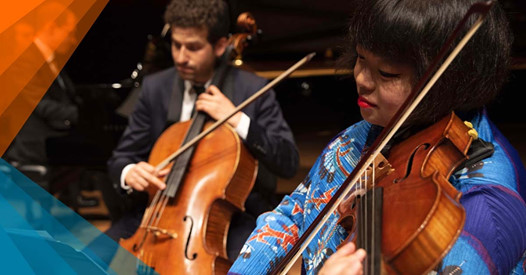
Above: cellist Nicholas Canellakis and violist Yura Lee
Sunday November 21st, 2021 – This evening at Alice Tully Hall, Chamber Music Society of Lincoln Center gave us a wonderfully satisfying program of music by composers from Russia, Germany, Hungary, and France. The works were all composed between 1849 and 1890.
A very high level of playing is maintained by the Society, making it almost impossible to single out certain concerts as being of particular merit; but tonight was surely one of the most impressive and enjoyable programs have experienced since I started going to CMS concerts regularly a few seasons back.
The program opened with the Andante Cantabile from Tchaikovsky’s String Quartet No. 1, performed in a 1888 arrangement for solo cello and strings. “Cantabile” is an Italian word meaning “singable” or “song-like”, and that’s exactly how cellist Nick Canellakis performed it: as if singing an operatic cavatina.
From the work’s tranquil start, Nick gave us impeccable playing: warm of tone and alive with dynamic subtlety. Seated next to him, the Society’s co-Artistic Director David Finckel threaded a lovely line to compliment his cellist-colleague. Mr. Finckel and violist Misha Amory offered a gentle plucking accompaniment as Nick’s cello continued to sing a melody with a vaguely Asian feeling. Violinists Cho-liang Lin and Alexi Kenney gave silken textures to the music. The work ends on a sweetly blended pianissimo. Mr. Finckel urged Nick Canellakis to stand first; then the other players refused to rise, leaving Nick with a solo bow, much to the delight of the crowd.

Above: Cho-liang Lin
Johannes Brahms’ Quintet in G-major for Two Violins, Two Violas, and Cello, Op. 111, was written in 1890, at the start of the last decade of the composer’s life. It provides a veritable feast for the ear to listeners who – like me – love the sound of stringed instruments. Mssrs. Lin, Kenney, Amory, and Canellakis were joined by that delectable violist, Yura Lee. Ms. Lee, who always delights with her choice of footwear, tonight wore white pumps; her one-shoulder black frock showed off some beautiful tattoos.
The opening movement, marked Allegro non troppo, ma con brio (“…fast, but not too fast, but with a lively feeling…”) gets off to a joyous start, the violas begin duetting in a passage taken up by the violins. The music is so melodious and congenial, with Cho-liang Lin’s poignant violin theme standing out. The music turns mysterious; then Yura Lee’s passionate playing leads back to a reprise of the earlier pairings of violins and violas. Meanwhile, Mr. Canellakis’s cello is giving everything a velvety cushion. The entire movement kept me entranced: simply fantastic playing from everyone.
The ensuing Adagio, in D-minor, has a feeling of melancholy as Yura Lee leads off with a familiar melody. Soon the music had me so engrossed that the rest of the world seemed to vanish: they were playing this music sublimely, and playing it just for me. Yura’s ‘cadenza’ near the end was hypnotically beautiful.
Mr. Lin’s violin sets the third movement, Allegretto, in motion. This is essentially a scherzo, and the melodies flow merrily on. Inspired by Hungarian folk dances, the quintet’s finale is marked Vivace ma non troppo presto (“…lively, but not too fast…”). Yura Lee’s viola is aglow, and Mr. Lin relishes his opportunities to spin more silk with his subtle playing. Suddenly the pace doubles, and the players break into an exultant dance. The crowd went wild: the only possible reaction to this kind of playing.

Pianist Inon Barnatan (above) kept the audience under a spell with his magical playing of Franz Liszt’s “Funérailles” from the Harmonies poétiques et religieuses, written in 1849. The pianist, who in 2016 gave us a mesmerizing performance of Ravel’s Gaspard de la Nuit in this very hall, was spell-binding again this evening.
This piece, which my companion Monica Wellington soon recognized as the music to which the late Liam Scarlett’s 2014 ballet for New York City Ballet, Funérailles, is set. I did not see that pas de deux, costumed by Alexander McQueen, but hearing the music tonight, it’s hard to image a dancework set to it: the music seems to wander thru many mood swings, but Mr. Barnatan’s playing made it cohesive.
The piece opens with gloomy funeral chimes in the slow register. A plodding rhythm reminds us of mourners in a cortège; this stops, and a somber fanfare-like passage is heard. The sense of doom lessens, and then a nostalgic melody is heard, which gets rhapsodic. Animated figurations for the left hand give rise to militaristic passages, followed by a great rise in passion, Full stop. A soft, sad tune is played, whilst low-register rumblings are heard. The music ends suddenly. All this was splendidly played by Mr. Barnatan.
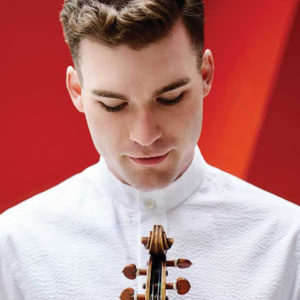
Above: Alexi Kenney
The concert concluded with Gabriel Fauré’s Quartet No. 2 in G-minor for Piano, Violin, Viola, and Cello, Op. 45. The piece premiered on January 22nd, 1887, at the Société Nationale de Musique; it is dedicated to Hans von Bülow, the pianist and conductor who was the first husband of Cosima Liszt who later married Richard Wagner.
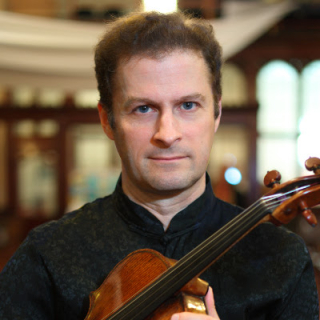
Above: Misha Amory
Inon Barnatan returned to the Steinway for this evening’s de luxe rendering of the Fauré; he was joined by violinist Alexi Kenney and violist Misha Amory, both displaying exceptional beauty of tone, whilst Nick Canellakis rounded off his stellar evening with still more phenomenal playing.
The opening Allegro molto moderato commences dramatically, and with passion. The restless piano supports unison strings; the violin, and then the viola, have solo melodies, exquisitely played. Mr. Barnatan continues to work his magic with the music, whilst the strings bring us gorgeous blends, with Mr. Kenney’s upper register truly affecting. Nick Canellakis keeps the cello line prominent without being over-bearing. The opening restive piano and unison strings return, moving to a sublime finish.
The Scherzo: Allegro molto contains lively string pizzicati heard over the piano’s dazzling agitato; though the music is tinged with a strange sense of worry, there is a forward impetus. Marvelous flourishes from the keyboard lead to a sudden stop.
In the Adagio non troppo, in which the composer drew on childhood memories of the sound of church bells, provides lyrical passages for each instrument. There is much subtlety and also much passion in their playing. A curious little interlude develops into a feeling of yearning. This quietens, as piano and viola converse; then the violin takes over. Cello and piano, soon joined by the higher strings, bring us a dreamy ending.
The Finale : Allegro molto has a vibrant start; again Mr. Kenney’s heavenly high-range lures the ear. The music gets bouncy, and then quite grand, as the quartet sails on thru shifting moods. The audience expressed their delight in the music – and with the the playing of it – with a joyous ovation, calling the artists back for a second bow. I felt elated as I headed out into the chilly evening air.
~ Oberon

Saturday November 20th, 2021 matinee – In 2016, Anita Hartig was a radiantly-sung Liu in TURANDOT at The Met. When her Violetta was announced in the 2018-2019 season, I was eager to hear her again, only to find that – at least at the performance I attended – she was having serious pitch problems. So this year, despite wanting to hear Charles Castronovo and Artur Ruciński in BOHEME, I hesitated to go because Ms. Hartig was the Mimi. Then I heard a clip from the prima of Mimi’s Act I narrative and the soprano sounded fabulous. So, there I was today, in a packed house, experiencing the Franco Zeffirelli BOHEME for the umpteenth time.
The afternoon started on a sour note: while waiting for the curtain to rise, the two women sitting next to me removed their masks, started eating crackers, called people on their phones, and even called each other! Seriously! I wasn’t about to let them ruin the performance for me, so I abandoned my seat with a view and went back to my more usual score desk.
I liked Eun Sun Kim’s conducting a lot. Her tempi felt just right, and she seemed to breathe with the singers, allowing them leeway with sustaining notes when they wished. The orchestra were in fine fettle, and I especially loved the harp passages at the opening of Act III.
BOHEME is a love story, and today’s lovers were excellently paired. Ms. Hartig’s “Mi chiamano Mimi” was gorgeously sung and phrased, and she turned on the power for the ecstatic cresting phrase of the love duet, and again for the climax of the ensemble following Musetta’s Waltz. Ms. Hartig’s sustained high-C at the end of Act I was handsomely harmonized by Charles Castronovo, today’s Rodolfo. The tenor’s Act I aria was particularly appealing in his way with the words; his top notes do not ‘bloom’ but they have ample power. In Act III, his anguish in telling Marcello the real reason he must break with Mimi was passionately expressed. Ms. Hartig’s “Addio senza rancor” was very moving, and she gave us an exquisite pianissimo on the final “…rancor!” A few moments later, having decided to stay with Mimi until the Spring, Mr. Castronovo ravished the ear with his own lovely pianissimo on “…alla stagion dei fior!“
Artur Ruciński’s Marcello was sung with power and warmth; he led the ensemble ‘reprise’ of Musetta’s Waltz in a commanding way, and was wonderful in his Act III duet with Mimi, and then in his conversation with Rodolfo. Fererica Lombardi was a bright-toned Musetta, making the most of her Waltz. Alexander Birch Elliott was an excellent Schaunard, and I very much liked Nicholas Brownlee’s voice as Colline – so much so that I regretted leaving before his Coat Aria (the thought of sitting thru another endless Gelb-Intermission sent me packing after Act III). The Scottish baritone Donald Maxwell, long a favorite at the Royal Opera, Covent Garden, doubled in the roles of Benoit and Alcindoro.
The Zeffirelli BOHEME has come in for some bashing of late. Some people feel it’s time for a change. But – like the Zeffirelli TURANDOT – it’s been a veritable cash cow for the Met, selling out (or selling “big”) no matter who is singing. Today’s nearly full house seemed attentive and appreciative. And of course they applauded the rise of the curtain on the Café Momus scene. Oh dear, people actually enjoying themselves at the opera! We can’t have that, now, can we?
Metropolitan Opera House
November 20th, 2021 matinee
LA BOHÈME
Giacomo Puccini
Mimì....................Anita Hartig
Rodolfo.................Charles Castronovo
Musetta.................Federica Lombardi
Marcello................Artur Rucinski
Schaunard...............Alexander Birch Elliot
Colline.................Nicholas Brownlee
Benoit..................Donald Maxwell
Alcindoro...............Donald Maxwell
Parpignol...............Marco Antonio Jordão
Sergeant................Tyler Simpson
Officer.................Ross Benoliel
Conductor...............Eun Sun Kim
~ Oberon

Stephen Powell at the piano; photo by Shannon Finney
Acis Productions have released a new recording from baritone Stephen Powell, Why Do The Nations, which brings us 27 songs in ten languages, with the singer accompanying himself at the piano. When I first read of it, I wasn’t quite sure how I would feel about it. It’s a lot of ground to cover, for one thing. And then: is Mr. Powell as fine a pianist as he is a singer?
An initial playing of the disc dispelled any misgivings I might have had. The songs weave a multi-hued sonic tapestry of languages and styles. And – as it turns out – Mr. Powell’s an excellent pianist. I wept, I laughed…I derived great pleasure from this collection. So many of the songs – and Stephen’s singing of them – reached me on a very personal level.
Stephen Powell talks with Brad Cresswell about how Why Do The Nations came to be here.
The disc offers a mix of the very familiar with several songs I’ve never heard, and a couple of composers I’d never heard of.
Four of Germany’s lords of lieder – Schubert, Brahms, Wolf, and Strauss – are represented. Of their songs on this disc, only Schubert’s “Die Forelle” was familiar to me; Mr. Powell sings it so well, and his pianistic skills are impressive, too. Hugo Wolf’s “Auch Kleine Dinge“, about a delight in small things, is sung with an appealing subtlety. A truly beautiful Strauss song that I’d never heard, “Ich Trage Meine Minne”, speaks of the sustaining power of love; after a somewhat darker second verse, the song returns to light and joy with the memorable line: “I carry my love in silent bliss”. From Johannes Brahms, Mr. Powell brings us “Meine Liebe ist grün”, which celebrates the Springtime of love, wherein the poet is intoxicated by the scent of lilacs…something to which I can easily relate.
From France, we have songs by Maurice Ravel, Gabriel Fauré, and Émile Paladilhe, the last-named being only a name to me. His song, “Petits Enfants“, receives its world premiere recording on Mr. Powell’s disc. The poem, about the beauty of young children, is by Alphonse Daudet. The song has a delicate piano accompaniment, and Mr. Powell’s sweet upper notes sustain the atmosphere. Maurice Ravel’s boisterous drinking song, “Chanson à boire” comes from the well-beloved song cycle Don Quichotte à Dulcinée. It’s full of laughter, and ends with the piano on its own. Mr. Powell gives a fresh feeling to Fauré‘s familiar “Mandoline“, sung with a light touch, and with the piano part deftly handled.
Three of America’s greatest 20th century composers are heard from: Samuel Barber, Charles Ives, and Aaron Copland. Barber’s I Hear An Army, composed in 1937, has an aggressively dynamic accompaniment over which the words of James Joyce compare the end of an intimate relationship to the galloping hooves of an attacking troop of cavalrymen.
In 1952, Aaron Copland adapted Zion’s Walls, originally a folk song that became popular at camp meetings in Georgia; Copland eventually used the song in his opera THE TENDER LAND. On first hearing Mr. Powell’s rendering of Zion’s Walls, I simply wrote: “This Is Great!”
Charles Ives wrote Majority in 1921; Mr. Powell chose it as the final song on the disc. It’s a sort of toiling dirge, but with a reassuring ending.
The two kings of Italian opera turn up in canzoni mode: Giuseppe Verdi and Giacomo Puccini are allotted two songs each. Verdi”s La Seduzione (a seduced-and-abandoned tale) and the touching Il Poveretto (“The Poor Man”) have an operatic feeling to them. The latter tells of a poor veteran who, having served his country, is now reduced to begging. The song was written in 1847, but the problem still exists today. An ironic waltz springs up, only to halt as Mr. Powell movingly voices the line, “My country has forgotten me!”
The disc’s other Verdi song, La Seduzione, starts with a slow waltz and becomes more animated, with the telling line: “Nine moons moaned the betrayed…” The singer’s voice becomes tearful as he tells of the disgraced woman’s lonely, anonymous death.
It’s to Puccini that Stephen Powell turns for his opening song: Morire? (“To die?”). The text is by Giuseppe Adami, the composer’s librettist for LA RONDINE, IL TABARRO, and TURANDOT. It’s a poem that reflects on the meaning of death; one curious feature of this song is that the piano drops out for most of the final verse. The voice goes on high at the end.
Puccini’s Terra e mare did what a song often does for me: it put me in mind of a beloved literary passage, in this case from JRR Tolkien’s Lord of the Rings:
“Legolas Greenleaf long under tree, In joy thou hast lived, Beware of the Sea! If thou hearest the cry of the gull on the shore, Thy heart shall then rest in the forest no more.”
In this Puccini song, a man falls asleep, lulled by the sound of the wind in the poplar trees, which he dreamily mistakes for the sound of the sea. It’s a restless song, and both the piano and the voice capture the sensations of the lyrics perfectly.
Russian jewels by Peter Ilyich Tchaikovsky and Sergei Rachmaninoff bring forth some of Mr. Powell’s most engaging singing. Tchaikovsky’s “Nights of frenzy, sleepless nights”, a lament for a lost love of long ago, is particularly fine. In Rachmaninoff’s familiar “Spring Waters“, the singer conveys an almost operatic sense of vocal authority. The same composer’s “The Soldier’s Wife” is one of the collection’s saddest songs: the lament of a woman who married the man she loved, only to have him be taken from her by army recruiters. The song, with its deep sorrow, covers a wide vocal range and ends with a vocalise.
Benjamin Britten and Michael Head represent the United Kingdom. Two contrasting Britten songs are heard: the wryly humorous The Brisk Young Widow (which benefits greatly from Mr. Powell’s very clear diction), and the more pensive Every Night and Every Morn, with words by William Blake. In this song, the accompaniment seems somehow unsettling. There’s a rise in drama as the song nears its end…and then a questioning air at the finish. Composer Michael Head is new to me; his song Money, O!, written in 1928, covers a big vocal range, going deep. It sings of some of the advantages of being poor.
Meu Amor Me Disse Adeus (“My love told me goodbye forever“) by the Brazilian composer Cláudio Santoro hit me right where it hurts as the tenth anniversary of a bitter parting looms before for me. Like so many songs in this collection, this one is intensely personal, and Mr. Powell’s affecting singing of it makes it even more so.
The songs from the Asian lands are of special interest to me, in part because my spouse is Chinese, and in part because I’ve never heard them before. All three – one each from China, Japan, and Korea – could easily come from the pen of a Western composer, though the tell-tale harmonies say otherwise. I imagine Western singers might be happy to explore more song literature from these lands, but mastering the languages is not easy.
Listening to Mr. Powell sing Rentarō Taki‘s dreamlike Kōjō no Tsuki (“Moonlight Over the Ruined Castle”) – one of the most evocative songs on the disc – made me wish that my late friend, the contralto Makiko Narumi, was still here to sing me some Japanese songs.
The Korean composer Dong Jin Kim gives us a remarkably beautiful song, Gagopa (“I Want to Go Back“), full of longing for the days of childhood. The poet recalls the place of his birth, which he left long ago: “I want to recapture those days that had no tears.”
I asked my husband, Gotham’s premier Chinese tutor and translator, to listen to Mr. Powell’s recording of Zhao Yuanren’s “How Can I Not Think of Her“, wherein everything in nature reminds the poet of his lost love. I asked Wei to rate the singer’s diction. After a line or two, he said: “Good…very good…very clear!”. Then he asked to hear the song again, and he began to sing along.
From Spain, songs by Fernando Obradors, Manuel de Falla, and Xavier Montsalvage have a particular appeal in Mr. Powell’s interpretations. Fernando Obradors’ ¿Corazón porqué pasáis…? a brief delight of a song about affairs of the heart. The accompaniment is particularly pleasing, while a central passage of wordless vocalizing seems to say: “Don’t take this song too seriously.”
Manuel de Falla’s ironic El paño moruno (“The Moorish Cloth” ) is the shortest song in the collection. To very familiar melody, the story tells of a tiny stain on a piece of fine cloth that diminishes its value.
As with every song recital disc, there’s bound to be a favorite track. From Stephen Powell, we get the most hauntingly beautiful rendering of Xavier Montsalvage’s dusky lullaby “Cancion de cuna para dormir a un negrito” from Tres Canciones Negras that I have ever heard.
~ Oberon

Above: bass-baritone John Lundgren
Wagner’s DIE WALKURE from the 2016 Bayreuth Festival, conducted by Marek Janowski with the following cast:
Siegmund – Christopher Ventris
Hunding – Georg Zeppenfeld
Wotan – John Lundgren
Sieglinde – Heidi Melton
Brünnhilde – Catherine Foster
Fricka – Sarah Connolly
Gerhilde – Caroline Wenborne
Ortlinde – Dara Hobbs
Waltraute – Stephanie Houtzeel
Schwertleite – Nadine Weissmann
Helmwige – Christiane Kohl
Siegrune – Mareike Morr
Grimgerde – Wiebke Lehmkuhl
Rossweisse – Alexandra Petersamer
Watch and listen here.

Above: from NARCISSUS; photo by Andrew Jordan
Saturday October 30th, 2021 matinee – At New York Live Arts this afternoon with Roberto Villanueva for a performance of Christopher Williams’ NARCISSUS. It was a purely delightful hour, wherein the music, choreography, lighting, costumes, and the beautiful cast of dancers all combined to create a dreamworld at once quirky, erotic, and poignant.
NARCISSUS is set to Nikolai Tcherepnin’s score “Narcisse et Echo” which was composed in 1911 for Michel Fokine’s ballet of the same title, produced by Serge de Diaghilev for the Ballets Russes. In Mr. Williams re-imagining of the ballet, he takes a fresh look at the timeless tale of Nacissus, a young man very much taken with his own beauty. The enticing production features costume and set designs by Andrew Jordan and lighting by Joe Levasseur.
In a brief prologue, in which bouche fermée voices are heard, a group of Boeotians are silhouetted against the breaking dawn. We then meet the Oreads: a brotherhood of mountain nymphs with Spock-like ears. Dancers Casey Hess, Jack Blackmon, Alexander Olivieri, Michael Parmelee, and Logan Pedon cavort, their heavenly, nearly nude bodies adorned with fantastical red penises. For all the intimacy of their partnering, they paradoxically seem chaste. The music underscores the ecstatic feeling of these youthful males, savoring their delight in nature and in each others company. Throughout this provocative scene – and indeed, throughout the entire ballet – the choreography in superbly musical.
The music shifts with the arrival of Echo, who has both a penis and female breasts; Mac Twining plays the part handsomely. Echo is a lonely creature, and is rejected by the Oreads who hiss at him like animals. Now the Boeotians return: hetero and same sex couples of varying ages are danced by Janet Charleston, Alan Good, Ching-I Chang, Shayla-Vie Jenkins, Justin Lynch, and Jake Montanaro. They are joined by a trio of Bacchantes (Christiana Axelsen, Breckyn Drescher, and Caitlin Scranton), dressed in flame-coloured gowns, their faces painted white, their dark hair almost Medusa-like. Their dance is a highlight of the ballet. Now the music becomes tumultuous, the dancing joyous.
The Oreads re-appear, and we are only too happy to see them again; and finally we meet Narcissus himself – in the magnetic person of New York City Ballet principal dancer Taylor Stanley. Clad in a short blue tunic, his solo depicts the character’s self-love.
For Narcissus has fallen in love with his own reflection: a reflection danced by Cemiyon Barber in a yellow tunic. Their duet of mutual admiration is danced in-sync; meanwhile, their shadows follow them on the wall.
Echo returns; smitten with Narcissus, his dance is a visual lament. As the music veers from powerful to eerie, he sustains a balance as if teetering on the verge. Mr. Twining excelled here. Now Narcissus and his double return; the music gets big as they fill the space with swirling leaps and mirror-image passages. They embrace, sink to the ground, their bodies communing whilst the forlorn Echo watches them in despair. Narcisssus expires; reaching under his dead idol’s tunic, Echo brings forth a yellow narcissus as darkness falls.
The dancers were enthusiastically applauded; though I thought solo bows for Mssrs. Stanley, Barber, and Twining were in order, they were not forthcoming. The choreographer was warmly greeted by dancers and audience alike.
One of the many reasons I wanted to see this production was the presence in the cast of my friend Justin Lynch. Justin has danced for Amanda Selwyn, Lydia Johnson, and Nai-Ni Chen, and in 2014 he appeared in the Metropolitan Opera’s controversial production of DEATH OF KLINGHOFFER. In 2010, he participated in Kokyat’s photoshoot at the Secret Theater. Justn’s such a handsome fellow: it was great to see him again.
~ Oberon

Above: Stefka Evstatieva as Leonora and John Cheek as Padre Guardiano
The Canadian Opera Company’s 1987 production of Verdi’s LA FORZA DEL DESTINO with Stefka Evstatieva, Judith Forst, Yuri Marusin, Allan Monk, Peter Strummer, and John Cheek, conducted by Maurizio Arena.
Watch and listen here.

Scenes from a 1982 San Francisco Opera performance of TURANDOT with Linda Kelm (above), Nicola Martinucci, Barbara Daniels, and Kevin Langan, conducted by Myung-Whun Chung.
Listen here.
CAST:
A mandarin: Gregory Stapp; Liù: Barbara Daniels; Calaf: Nicola Martinucci; Timur: Kevin Langan; Ping: Thomas Woodman; Pang: David Gordon; Pong: Jonathan Green; Emperor Altoum: Eddie Albert; Turandot: Linda Kelm
I love finding any recordings by Johanna Meier. Despite the missing part of the first Strauss song, her vocalism is so pleasing in this 1982 recording from a concert by the Milwaukee Symphony conducted by Lukas Foss.
Listen here.
One of my all-time favorite sopranos, I saw Ms. Meier frequently at The Met and New York City Opera. She made a memorable impression in so many roles: as Puccini’s Musetta and Tosca, as Strauss’s Countess Madeleine, Marschallin, Ariadne, Kaiserin, Chrysothemis (both at The Met and at Tanglewood), as Rosalinda, Marguerite in FAUST, as Mozart’s Donna Anna, and Countess Almaviva, and as Wagner’s Elisabeth, WALKURE Brunnhilde, and – most especially – as Sieglinde.

On September 26th, 1966, I attended my first opera at the New Met: a performance of Puccini’s TURANDOT starring Birgit Nilsson (above), Franco Corelli, Teresa Stratas, and Bonaldo Giaiotti, conducted by Zubin Mehta.
A few weeks earlier, I had taken an over-night bus from Syracuse to New York City and joined the ticket line for the opening performances at the new opera house. Read about my adventure here.
I had seen the Met’s Cecil Beaton production of TURANDOT previously, at the Old Met. It was considered quite lavish at the time, but within a couple decades it was wildly surpassed by the elaborate Franco Zeffirelli setting. Birgit and Franco seemed thoroughly at home on the Beaton sets, their by-play with Turandot’s all-day-lollipop/sceptre, was always commented upon by the fans, who gauged the scene to determine how well the two superstars were getting along on a given evening.

My diary entry was very brief:
“First performance at the New Met!! Magnificent evening, dazzling experience. After hearing Nilsson and Corelli on Saturday matinee broadcasts, it was electrifying to hear them “live“; you can’t really tell how immense and thrilling their voices are over the radio. They are great stars!
Teresa Stratas was excellent as Liu, and my favorite bass, Bonaldo Giaiotti, sounded great. Uppman, Nagy, Anthony, and Goodloe – all singers know from the broadcasts – were fine. Mehta tremendous!
There was huge applause after each act, and many curtain calls. The Corelli fans in particular went crazy.”
After the ovation finally ceased, I went to the stage door where a huge crowd of people were waiting to meet the artists. They finally came out, and they were all very nice to me. Stratas signed my program, and Birgit signed the photo at the top of this article.
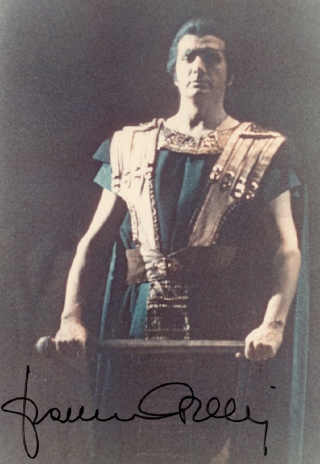
I’d brought along the above photo of Corelli as Radames for him to sign; he seemed genuinely pleased to see this picture of himself, and the fans gathered around him were gasping, “Where did you find this???”
I remember that I slept very little after getting back to The Henry Hudson Hotel that night. I was really wound-up: I had been going to the opera sporadically since 1962 – plus catching every Met broadcast and building a big record collection. But this evening marked the start of the next phase of my operatic career. I began coming down to New York for long weekends, taking the over-night bus from Syracuse and staying at the Henry Hudson; opera was everything to me.
After spending the Summer of 1974 on Cape Cod with TJ, working for a small ballet company, I moved into his dorm room at Sarah Lawrence College where we spent the 1974-1975 academic year together. We went down to the opera (and also the ballet!) constantly, taking a bus from Bronxville to the A train station at 207th Street – the station that’s now a block from where I live.
After he graduated, we moved to Hartford; we were poor, and trips to New York City were few and far between. But after we broke up, I got my own place place and began spending frequent long weekends in NYC again. My promiscuous phase – can 25 years be considered a phase? – started at this point.
Finally, in 1998, shortly before my 50th birthday, I moved to New York City. This had been my plan since that first solo excursion to join the Met ticket line in late Summer 1966, but Hartford had been a 22-year detour.
Now, at last, I was home.
~ Oberon

 Oberon's Glade