Category: Opera

  • Christopher Williams ~ NARCISSUS @ NYLA

    Narcissus jpg

    Above: from NARCISSUS; photo by Andrew Jordan

    Saturday October 30th, 2021 matinee – At New York Live Arts this afternoon with Roberto Villanueva for a performance of Christopher Williams’ NARCISSUS. It was a purely delightful hour, wherein the music, choreography, lighting, costumes, and the beautiful cast of dancers all combined to create a dreamworld at once quirky, erotic, and poignant.

    NARCISSUS is set to Nikolai Tcherepnin’s score “Narcisse et Echo” which was composed in 1911 for Michel Fokine’s ballet of the same title, produced by Serge de Diaghilev for the Ballets Russes. In Mr. Williams re-imagining of the ballet, he takes a fresh look at the timeless tale of Nacissus, a young man very much taken with his own beauty. The enticing production features costume and set designs by Andrew Jordan and lighting by Joe Levasseur.

    In a brief prologue, in which bouche fermée voices are heard, a group of Boeotians are silhouetted against the breaking dawn. We then meet the Oreads: a brotherhood of mountain nymphs with Spock-like ears. Dancers Casey Hess, Jack Blackmon, Alexander Olivieri, Michael Parmelee, and Logan Pedon cavort, their heavenly, nearly nude bodies adorned with fantastical red penises. For all the intimacy of their partnering, they paradoxically seem chaste. The music underscores the ecstatic feeling of these youthful males, savoring their delight in nature and in each others company. Throughout this provocative scene – and indeed, throughout the entire ballet – the choreography in superbly musical.

    The music shifts with the arrival of Echo, who has both a penis and female breasts; Mac Twining plays the part handsomely. Echo is a lonely creature, and is rejected by the Oreads who hiss at him like animals. Now the Boeotians return: hetero and same sex couples of varying ages are danced by Janet Charleston, Alan Good, Ching-I Chang, Shayla-Vie Jenkins, Justin Lynch, and Jake Montanaro. They are joined by a trio of Bacchantes (Christiana Axelsen, Breckyn Drescher, and Caitlin Scranton), dressed in flame-coloured gowns, their faces painted white, their dark hair almost Medusa-like. Their dance is a highlight of the ballet. Now the music becomes tumultuous, the dancing joyous.

    The Oreads re-appear, and we are only too happy to see them again; and finally we meet Narcissus himself – in the magnetic person of New York City Ballet principal dancer Taylor Stanley. Clad in a short blue tunic, his solo depicts the character’s self-love.

    For Narcissus has fallen in love with his own reflection: a reflection danced by Cemiyon Barber in a yellow tunic. Their duet of mutual admiration is danced in-sync; meanwhile, their shadows follow them on the wall. 

    Echo returns; smitten with Narcissus, his dance is a visual lament. As the music veers from powerful to eerie, he sustains a balance as if teetering on the verge. Mr. Twining excelled here. Now Narcissus and his double return; the music gets big as they fill the space with swirling leaps and mirror-image passages. They embrace, sink to the ground, their bodies communing whilst the forlorn Echo watches them in despair. Narcisssus expires; reaching under his dead idol’s tunic, Echo brings forth a yellow narcissus as darkness falls.

    The dancers were enthusiastically applauded; though I thought solo bows for Mssrs. Stanley, Barber, and Twining were in order, they were not forthcoming. The choreographer was warmly greeted by dancers and audience alike. 

    One of the many reasons I wanted to see this production was the presence in the cast of my friend Justin Lynch. Justin has danced for Amanda Selwyn, Lydia Johnson, and Nai-Ni Chen, and in 2014 he appeared in the Metropolitan Opera’s controversial production of DEATH OF KLINGHOFFER. In 2010, he participated in Kokyat’s photoshoot at the Secret Theater. Justn’s such a handsome fellow: it was great to see him again.

    ~ Oberon

  • Canadian Opera: FORZA DEL DESTINO ~ 1987

    Evstatieva cheek forza

    Above: Stefka Evstatieva as Leonora and John Cheek as Padre Guardiano

    The Canadian Opera Company’s 1987 production of Verdi’s LA FORZA DEL DESTINO with Stefka Evstatieva, Judith Forst, Yuri Marusin, Allan Monk, Peter Strummer, and John Cheek, conducted by Maurizio Arena.

    Watch and listen here.

  • TURANDOT @ San Francisco Opera ~ 1982

    Kelm (2)

    Scenes from a 1982 San Francisco Opera performance of TURANDOT with Linda Kelm (above), Nicola Martinucci, Barbara Daniels, and Kevin Langan, conducted by Myung-Whun Chung.

    Listen here.

    CAST:

    A mandarin: Gregory Stapp;  Liù: Barbara Daniels; Calaf: Nicola Martinucci; Timur: Kevin Langan; Ping: Thomas Woodman; Pang: David Gordon; Pong: Jonathan Green; Emperor Altoum: Eddie Albert;  Turandot: Linda Kelm

  • Johanna Meier Sings Strauss & Mahler

    Johanna meier

    I love finding any recordings by Johanna Meier. Despite the missing part of the first Strauss song, her vocalism is so pleasing in this 1982 recording from a concert by the Milwaukee Symphony conducted by Lukas Foss.

    Listen here.

    One of my all-time favorite sopranos, I saw Ms. Meier frequently at The Met and New York City Opera. She made a memorable impression in so many roles: as Puccini’s Musetta and Tosca, as Strauss’s Countess Madeleine, Marschallin, Ariadne, Kaiserin, Chrysothemis (both at The Met and at Tanglewood), as Rosalinda, Marguerite in FAUST, as Mozart’s Donna Anna, and Countess Almaviva, and as Wagner’s Elisabeth, WALKURE Brunnhilde, and – most especially – as Sieglinde.

  • 55 Years Ago ~ TURANDOT @ The Met

    Birgit (2)

    On September 26th, 1966, I attended my first opera at the New Met: a performance of Puccini’s TURANDOT starring Birgit Nilsson (above), Franco Corelli, Teresa Stratas, and Bonaldo Giaiotti, conducted by Zubin Mehta.

    A few weeks earlier, I had taken an over-night bus from Syracuse to New York City and joined the ticket line for the opening performances at the new opera house. Read about my adventure here.

    I had seen the Met’s Cecil Beaton production of TURANDOT previously, at the Old Met. It was considered quite lavish at the time, but within a couple decades it was wildly surpassed by the elaborate Franco Zeffirelli setting. Birgit and Franco seemed thoroughly at home on the Beaton sets, their by-play with Turandot’s all-day-lollipop/sceptre, was always commented upon by the fans, who gauged the scene to determine how well the two superstars were getting along on a given evening.

    Turandot-1 jpg
    My diary entry was very brief:

    “First performance at the New Met!! Magnificent evening, dazzling experience. After hearing Nilsson and Corelli on Saturday matinee broadcasts, it was electrifying to hear them “live“; you can’t really tell how immense and thrilling their voices are over the radio. They are great stars!

    Teresa Stratas was excellent as Liu, and my favorite bass, Bonaldo Giaiotti, sounded great. Uppman, Nagy, Anthony, and Goodloe – all singers know from the broadcasts – were fine. Mehta tremendous!

    There was huge applause after each act, and many curtain calls. The Corelli fans in particular went crazy.”

    After the ovation finally ceased, I went to the stage door where a huge crowd of people were waiting to meet the artists. They finally came out, and they were all very nice to me. Stratas signed my program, and Birgit signed the photo at the top of this article.

    Franco

    I’d brought along the above photo of Corelli as Radames for him to sign; he seemed genuinely pleased to see this picture of himself, and the fans gathered around him were gasping, “Where did you find this???” 

    I remember that I slept very little after getting back to The Henry Hudson Hotel that night. I was really wound-up: I had been going to the opera sporadically since 1962 – plus catching every Met broadcast and building a big record collection. But this evening marked the start of the next phase of my operatic career. I began coming down to New York for long weekends, taking the over-night bus from Syracuse and staying at the Henry Hudson; opera was everything to me.

    After spending the Summer of 1974 on Cape Cod with TJ, working for a small ballet company, I moved into his dorm room at Sarah Lawrence College where we spent the 1974-1975 academic year together. We went down to the opera (and also the ballet!) constantly, taking a bus from Bronxville to the A train station at 207th Street – the station that’s now a block from where I live.

    After he graduated, we moved to Hartford; we were poor, and trips to New York City were few and far between. But after we broke up, I got my own place place and began spending frequent long weekends in NYC again. My promiscuous phase – can 25 years be considered a phase? – started at this point.

    Finally, in 1998, shortly before my 50th birthday, I moved to New York City. This had been my plan since that first solo excursion to join the Met ticket line in late Summer 1966, but Hartford had been a 22-year detour.

    Now, at last, I was home.

    ~ Oberon

  • Alfreda Hodgson

    Hodgson

    The English contralto Alfreda Hodgson studied at the Northern School of Music in Manchester. She was mainly known as a concert artist, performing such works as Mahler’s 2nd and 8th symphonies, Lied von der Erde, and Das Knaben Wunderhorn; Elgar’s Dream of Gerontius, The Kingdom, and The Apostles; Schoenberg’s Gurrelieder, the Beethoven 9th, Mendelssohn’s Elijah, Mozart’s Requiem, Britten’s Spring Symphony, and works by Monteverdi, Bach, and Handel. Her operatic roles included Ulrica and Orfeo.

    Known for interpretive gifts, Ms. Hodgson worked with such renowned conductors as Klemperer, Giulini, Maazel, Haitink, Ozawa, Rattle, Abbado, Sir Colin Davis, and Zubin Mehta. Her career flourished in Britain, the USA, and Israel.

    Alfreda Hodgson passed away in 1992 at the early age of 52.

    Ms. Hodgson sings Brahms’ Alto Rhapsody, conducted by Bernard Haitink, here.

    From one of the few operatic roles Alfreda Hodgson recorded complete:

    Alfreda Hodgson – Voce di donna ~ GIOCONDA – w Caballe-Baltsa-Pavarotti-Milnes-Ghiaurov

  • Teresa Zylis-Gara Has Passed Away

    Z-g

    Teresa Zylis-Gara, the Polish soprano who possessed one of the most beautiful voices of my experience, has passed away at the age of 91. From 1968 to 1984, she sang nearly 250 performances with the Metropolitan Opera at Lincoln Center and on tour; I had the good fortune to see her in several roles, and to hear her on a number of live radio broadcasts.

    Ms. Zylis-Gara studied at Łódź, and in 1954 won first prize in the Polish Young Vocalists Contest at Warsaw. This led to her operatic debut in 1956. From 1960-1970, the soprano was based in Germany where she sang at Oberhauser, Dortmund, Frankfurt, Frankfurt, Hamburg, Cologne, Munich, and Berlin. She also appeared at Vienna, Glyndebourne, Paris, London, Salzburg, and San Francisco.

    ln 1968, Ms. Zylis-Gara made her Metropolitan Opera debut as Donna Elvira; she sang there frequently over the next several seasons. I first saw her as Violetta in TRAVIATA where she made a lovely impression, though hindered by inferior cast-mates and lacklustre conducting. Thereafter, I saw her as Donna Elvira, Elisabeth in TANNHAUSER, Amelia in BALLO IN MASCHERA, Manon Lescaut, Leonora in TROVATORE, Cio-Cio-San, and as Adriana Lecouvreur. In each of these roles, her creamy voice and ultra-feminine persona made  a memorable impression.

    Z-g desdemona jpg

    Above: Teresa Zylis-Gara as Desdemona; photo by Louis Mélançon

    Among the roles in which I missed seeing her onstage but greatly enjoyed her singing of on broadcasts included Desdemona (in a new production with James McCracken in the title-role, conducted by Karl Böhm), Mozart’s Pamina and Contessa Almaviva, Marguerite in FAUST, Puccini’s Suor Angelca, Mimi, and Liu, Elsa in LOHENGRIN and – most movingly – as Tatyana in ONEGIN and as the Marschallin.

    Zg tosca

    While I was living in Hartford, Ms. Zylis-Gara came up from New York City to the Bushnell to sing Tosca. Inferior conducting almost ruined the performance, but her singing was luminous.

    Leaving The Met in 1984, the soprano settled in Monte Carlo and continued to sing on the Continent, where she took on roles like Maddalena in CHENIER, Ariadne, Sieglinde, and Chrysothemis which had not been offered to her at The Met.
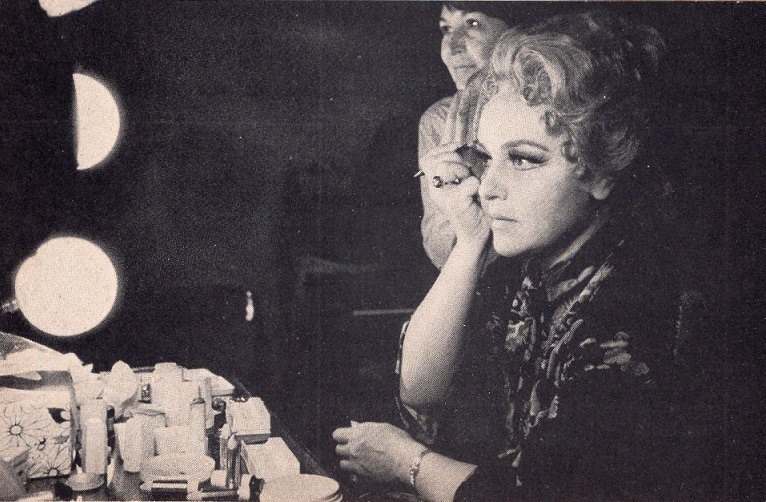
    Zg makeup

    Above: getting ready…I love this photo!

    Teresa Zylis-Gara made several recordings, and there are also numerous pirated documents of her broadcasts and live performances. Here are some souvenirs of her singing that I especially love:

    Teresa Zylis-Gara as The Composer ~ ARIADNE AUF NAXOS – with Janowitz & T Adam

    Teresa Zylis-Gara – Signore ascolta! ~ TURANDOT – Berlin 1975

    Teresa Zylis-Gara & John Alexander – BUTTERFLY ~ Love duet – Met bcast 1976

    Teresa Zylis-Gara ~ Song to the Moon – RUSALKA

    Zg tannhauser 2

    Above: Elisabeth welcomes Tannhauser’s return to the Hall of Song ~ Zylis-Gara & Richard Cassilly

    TANNHAUSER ~ Act II scene – Zylis-Gara-Cassilly-A Monk – Met bcast 1984

    Teresa Zylis-Gara – Toujours vers toi ~ Tchaikovsky

    Zg tatyana

    Above: Teresa Zylis-Gara as Tatyana

    Teresa Zylis-Gara – Letter Scene – ONEGIN – Met bcast 1978

    Then there is this – one of the great jewels of my collection. I remember listening to Zylis-Gara’s Four Last Songs for the first time, and thinking: this is perfection. And when the music ended, there was applause; this was recorded live. For me, no other version of these beloved songs compares.

    Teresa Zylis-Gara – Four Last Songs~Strauss – Radio Hanover-Live bcast

    And now for a once-in-a-lifetime performance: Teresa Zylis-Gara and Franco Corelli sang the love duet from Act I of Verdi’s OTELLO at the Metropolitan Opera’s gala honoring Sir Rudolf Bing in 1972. It was the first time that Corelli sang any music from this opera in public. Zylis-Gara is the ideal Desdemona. Watch and listen here.

    Z-g 2

    Z-g adriana-1 jpg

    I’ve reached that inevitable point in my life when the great singers who fanned the flames of my passion for opera are passing away, one by one. Thinking of Teresa Zylis Gara, I recall with special affection seeing her in the title-role of Cilea’s ADRIANA LECOUVREUR at a matinee performance given on the Met’s 1983 tour in Boston. It was to be the last time I saw her onstage. And it was a marvelous afternoon, with the soprano and her colleagues all singing divinely: Neil Shicoff as Maurizio, Bianca Berini as the Princesse de Bouillon, and Sesto Bruscantini as Michonnet. For all the glorious sounds that filled the hall that day, nothing sent such a thrill thru me as Zylis-Gara’s gossamer pianissimo on the phrase: “La promessa terrò …”  when Adriana vows to save her rival from humiliation in the opera’s second act. It’s of such moments that the fabric of dreams are woven.

    ~ Oberon

  • Angela Gheorghiu – Pleurez, pleurez mes yeux

    A g

    Romanian soprano Angela Gheorghiu sings Chimène’s great aria ‘Pleurez, pleurez mes yeux’ from Massenet’s LE CID at a concert given in Amsterdam, 2005.

    Watch and listen here.

  • Angela Gheorghiu – Pleurez, pleurez mes yeux

    A g

    Romanian soprano Angela Gheorghiu sings Chimène’s great aria ‘Pleurez, pleurez mes yeux’ from Massenet’s LE CID at a concert given in Amsterdam, 2005.

    Watch and listen here.

  • Bruna Baglioni ~ Judgement Scene

    Bb

    Mezzo-soprano Bruna Baglioni (above) is Amneris in this concert performance of the Judgement Scene from Verdi’s AIDA given at Brescia, date unknown. Nicola Martinucci is Radames, and Bonaldo Giaiotti sings Ramfis.

    Watch and listen here.

    Ms. Baglioni, a native of Frascati, Italy, made her operatic debut at Bologna in 1974 as Leonora in LA FAVORITA. She sang at opera houses throughout Italy, and at Vienna, London, Barcelona, and The Bolshoi. Her roles were many: Verdi’s Fenena, Ulrica, Azucena, Eboli, Amneris; Olga in EUGEN ONEGIN, Adalgisa, both Laura and La Cieca in LA GIOCONDA, Charlotte in WERTHER, Carmen, the Princesse de Bouillon in ADRIANA LECOUVREUR, Dalila, the title-role in Giordano’s FEDORA, and the Gran Vestale in the Spontini opera.

    In 1978, I saw Bruna Baglioni in the role of Azucena at The Bushnell in Hartford, Connecticut. The production, sets and costumes, conducting, and the other principal singers were all at a rather provincial level, but Ms. Baglioni was superb: “…she rose above the many flaws of the performance to create a truly potent Azucena…the role is a gift really, and the singer seized upon it with power and subtlety in both her singing and acting. She won the evening’s biggest applause for her Act II monologue in which her strong tops and impressive chest voice were put forth to fine dramatic effect. Her duets with Manrico, and her scene with di Luna, were the highlights of the evening, and she successfully captured both the terror and repose of the old gypsy in the opera’s final scene, ending the evening strongly with fine high B-flat. Had her colleagues attained a similar level, this would have been an exciting performance indeed.”

    In that same year, Ms. Baglioni made her debut at The Met as Laura in LA GIOCONDA. Her other Met roles were Santuzza, Eboli, Dalila, and Leonora in LA FAVORITA. In 1982, she sang Laura again in a GIOCONDA series; I saw her in the role twice. At the first, she more than held her own in a powerhouse cast led by Eva Marton and Placido Domingo. A couple weeks later, she sang Laura opposite Galina Savova and Domingo, and it was again a very exhilarating performance.