
Soprano Karina Gauvin sings “Lascia ch’io pianga” from Handel’s RINALDO in a recording session film.
Watch and listen here.
Soprano Karina Gauvin sings “Lascia ch’io pianga” from Handel’s RINALDO in a recording session film.
Watch and listen here.

Soprano Karina Gauvin sings “Lascia ch’io pianga” from Handel’s RINALDO in a recording session film.
Watch and listen here.

Above: Elena Cernei as Amneris
You never forget your first Amneris; mine happened to be Elena Cernei, a comely Romanian mezzo-soprano with a marvelous chest-register. My first AIDA came during the Met’s second season at Lincoln Center, on December 27th, 1967; Ms. Cernei’s colleagues were Gabriella Tucci, Flaviano Labo, Mario Sereni, and Bonaldi Giaiotti, with Thomas Schippers on the podium.
Born in 1924, Ms. Cernei studied at Bucharest. She joined the Romanian National Opera in 1952, singing there thru 1977. She also sang at La Scala, Paris, Barcelona, Brussels, Mexico City, and at the Bolshoi.
She debuted at The Met in 1965 as Dalila; her other Met roles were Amneris, Maddalena in RIGOLETTO, the Princesse de Bouillon in ADRIANA LECOUVREUR, and Carmen.
Ms. Cernei’s repertoire further included Azucena, both Laura and La Cieca in LA GIOCONDA, Ulrica, Rossini’s Arsace, and Gluck’s Orfeo. She was named an Honored Artist of the Republic of Romania. Upon retiring from the stage, she lived and taught at Rome. She passed away in 2000, and a commemorative postage stamp was issued in her honor.

Elena Cernei sings the Séguédille from Bizet’s CARMEN here.
And here’s a sampllng of her Dalila:
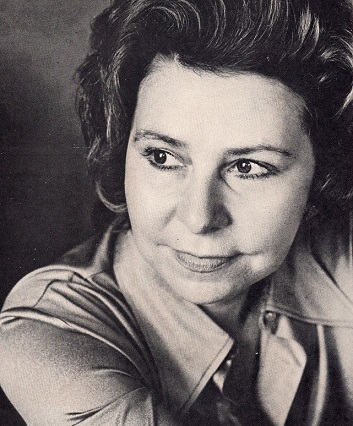
April 25th, 2021 – Throughout the sixty years that I have been obsessed with opera, I have loved and admired many wonderful singers. But when people ask me, “Who was the greatest singer you ever heard?”, I must answer: “Christa Ludwig.” Today, news has come of her death at the age of 93.
Christa Ludwig made her Vienna State Opera debut as Cherubino in Mozart’s NOZZE DI FIGARO in 1955. She went on to give 769 performances of 42 roles in Vienna. At the Metropolitan Opera, her 1959 debut (also as Cherubino) marked the start of a 38-year association with The Met, where she sang 119 performances of 15 roles.
Christa Ludwig was my first Octavian, and also my first Dyer’s Wife in FRAU OHNE SCHATTEN (in a stellar cast with Leonie Rysanek, Irene Dalis, James King, and Christa’s then-husband, Walter Berry, with Dr. Böhm conducting), my first Dido in TROYENS, and my first Klytemnestra. Her other Met roles were Amneris, Brangaene, Ortrud, Fricka, Kundry, Charlotte in WERTHER, and Waltraute; and she gave a single performance as Leonore in FIDELIO.
My first experience of seeing Christa Ludwig onstage was as the Dyer’s Wife; my first FRAU was part of a thrilling weekend in February 1969 that also included my very first RHEINGOLD (with Herbert von Karajan conducting) and the now legendary Nilsson/Caballe TURANDOT. Christa’s Dyer’s Wife was a blazing creation, her voice spanning the wide range with complete command, the highest notes sailing into the Big House with stunning clarity and power.
From a commercial recording of the great Act III duet for Barak and his wife:
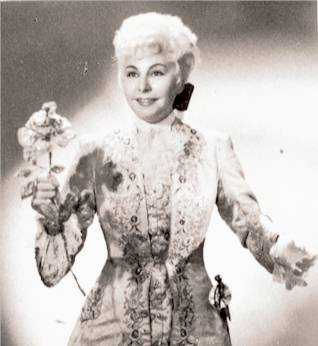
I next saw Ms. Ludwig onstage on Valentine’s Day, 1970, as Octavian in DER ROSENKAVALIER. Karl Böhm was again on the podium, and the cast further featured Marion Lippert, Reri Grist, and Mr. Berry. The sight of Ms. Ludwig as Octavian entering the hall of the Faninal mansion, bearing the silver rose, left an indelible impression on my romantic heart. Over time, it became for me the iconic image of everything I love about opera.

Above: Nuit d’ivresse with Jon Vickers and Christa Ludwig; a Louis Melançon photo
On October 27th, 1973 – a red-letter day in my personal life – I saw LES TROYENS for the first time. Shirley Verrett and Louis Quilico as Cassandra and Chorebus had given glorious performances in PRISE DE TROIE. Then, as the scene shifts to Carthage, Christa Ludwig and Jon Vickers sang so poetically the quietly rapturous love duet, Nuit d’ivresse. Inspired by their ecstasy, I spent the night with Z – and I have ever since felt that life really began for me with that encounter.
More than a decade was to pass before I saw Christa Ludwig on the Met stage again: in 1984, she was a fascinating Klytemnestra in my first-ever ELEKTRA. Ute Vinzing, Johanna Meier, and Simon Estes were her co-stars, with Maestro Levine presiding. Ms. Ludwig’s singing, with an undercurrent of creeping madness, bore the stamp of a great lieder singer; her characterization sometimes veered endearingly to the melodramatic.
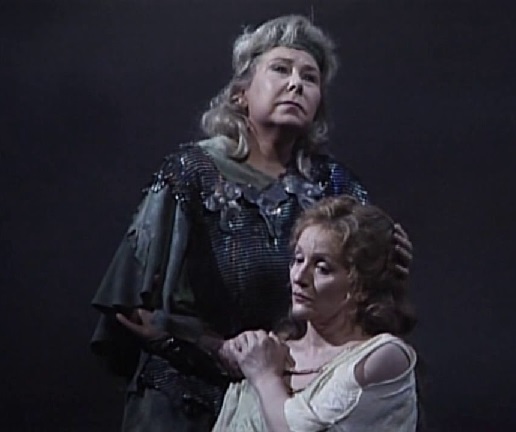
Above: Ludwig and Behrens in GOTTERDAMMERUNG
A four-year interval then passed before I saw Christa in opera again: the 1988 opening night of the Schenk/Levine GOTTERDAMMERUNG. This was a spectacular performance in every regard: Levine and his orchestra were on peak form, and Hildegard Behrens and Matti Salminen thrilled me to the core as Brunnhilde and Hagen. Christa, as Waltraute, looked spiffy in her Valkyrie gear – with black trousers and high black boots – and she moved about, restless as a caged panther, as she told her sister of their father’s frightening state of mind. Having failed in her mission, Waltraute rushes away. The curtain calls that night were fantastic: I think Ms. Ludwig truly didn’t expect the massive wave of applause and bravas that greeted her as she stepped out for a solo bow. It was so moving to watch her accept the audience’s loving appreciation.
I saw Christa Ludwig on the Met stage for the last time in April 1989 as Fricka in WALKURE. It was a cast of titans: Hildegard Behrens, Jessye Norman, Gary Lakes, James Morris, and Kurt Moll were Christa’s colleagues, and again Levine and the Met orchestra were beyond the beyond. The tension in the great argument between Fricka and Wotan was palpable; then Christa – having won – gathered her dignity and took her final parting shot at Brunnhilde with barely disguised contempt.
Christa Ludwig made her farewell appearance at The Met as Fricka in a Saturday matinee broadcast of WALKURE on April 3, 1993. Here is her scene from that performance, with Dame Gwyneth Jones as Brunnhilde, James Morris as Wotan, and James Levine conducting. I was listening at home, and as Ms. Ludwig exited the stage, I had a sense that the audience wanted desperately to burst into applause.
Christa Ludwig as Fricka ~ Met farewell performance with G Jones +J Morris – Levine cond – 4~3~93
While Vienna and The Met loomed large in the Ludwig career, she also appeared at La Scala, Covent Garden, Chicago Lyric Opera, and at the festivals at Bayreuth and Salzburg. In addition, she sang the great concert works of Bach and Mahler.
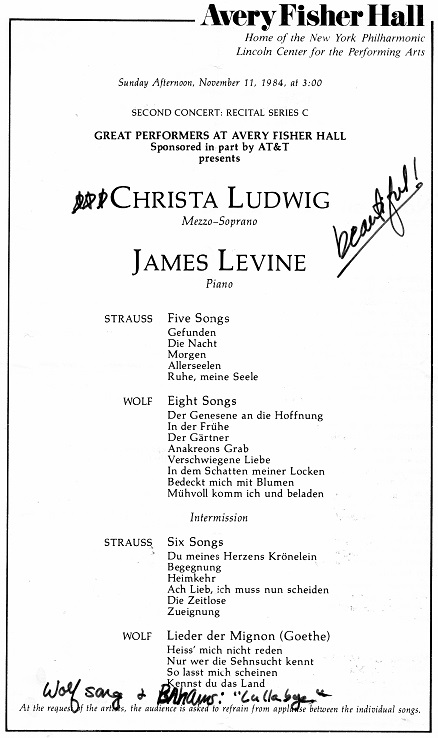
Christa Ludwig was a beloved recitalist; in 1984, I had the great pleasure of hearing her at Avery Fisher Hall with James Levine at the piano. The program of Strauss and Wolf lieder ended with a marvelous encore: the Brahms “Wiegenlied”.
Ms. Ludwig left us with a large and lovely catalog of recordings; among my favorites are Bartok’s BLUEBEARD’S CASTLE, the Kempe LOHENGRIN, the Solti TANNHAUSER, the Böhm TRISTAN from Bayreuth with Nilsson and Windgassen, scenes from Strauss operas with Walter Berry…and her SAMSON ET DALILA with James King holds a special appeal for me. She created a stir in 1986 by recording Schubert’s Winterreise with James Levine; they had performed the great Schubert cycle together on the Met stage in 1983.
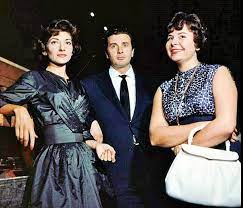
Above: Christa in the recording studio with Maria Callas and Franco Corelli for the EMI NORMA
Christa Ludwig sings Strauss’s “Morgen” with Charles Spencer at the piano. Watch and listen here.
Listen to more from Christa Ludwig:
Christa Ludwig – Es gibt ein reich – ARADNE AUF NAXOS
Christa Ludwig – MACBETH – Act I scena – Vienna 1970
Christa Ludwig – Liebestod ~ TRISTAN UND ISOLDE
Christa Ludwig – Mahler ~ Ich bin der welt abhanden gekommen
Christa Ludwig – Der Engel from Wagner’s Wesendonck Lieder
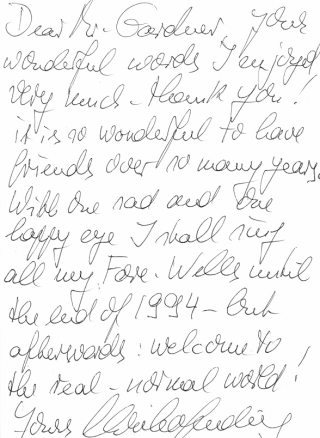
A lovely note I received from Christa Ludwig after I wrote to her on the occasion of her Met farewell in 1993:
~ Oberon
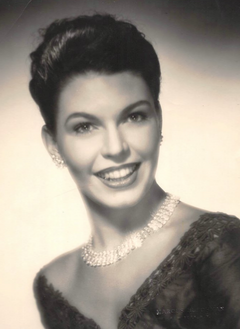
Soprano Eileen Schauler, a pillar of the New York City Opera in my earliest years of opera-going, has passed away at the age of 92.
A native of New Jersey, Ms. Schauler studied at Juilliard. She first made her mark as a powerful Katerina Ismailova at New York City Opera; among her other roles were Anna Maurrant in STREET SCENE, Lizzie Bordon, the Marschallin, and the Governess in TURN OF THE SCREW. She was admired for her stage presence and committed acting as well as for her emotionally engaged singing. I saw her as Tosca (a performance that marked Placido Domingo’s conducting debut) and as a fiery Santuzza.
After retiring from the stage, she taught both privately and at college.
Eileen Schauler – TOSCA aria – in English – Pasadena 1967
Eileen Schauler as Tosca – Act III excerpt – in English – Pasadena 1967
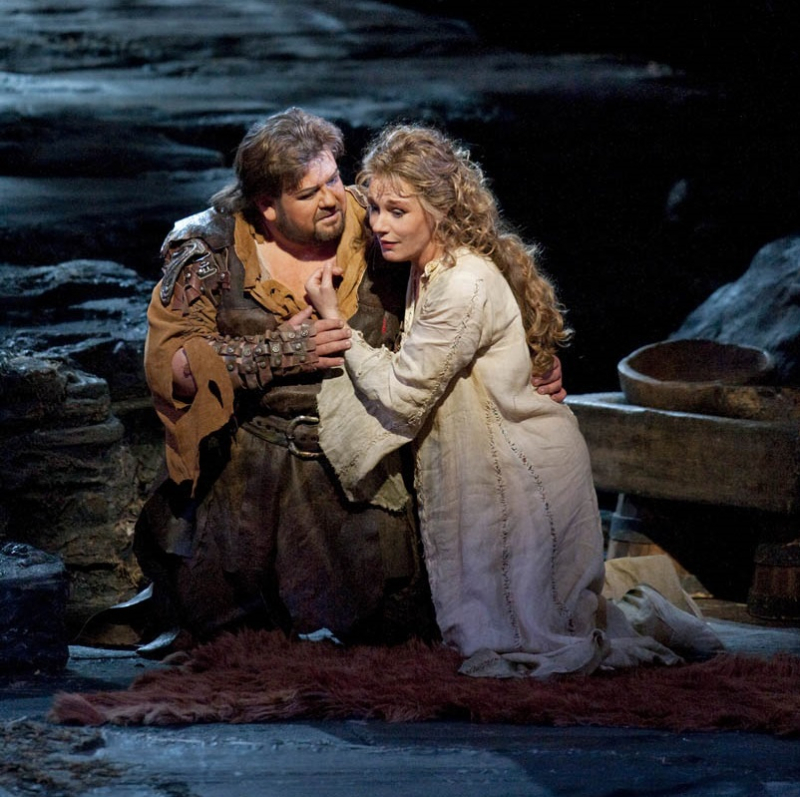
On April 6th, 2009, Waltraud Meier and Johan Botha appeared as Sieglinde and Siegmund in DIE WALKURE at The Met – the only time they sang these roles together in New York City. They gave a thrilling performance of their Act I scene, conducted by James Levine.
Waltraud Meier & Johan Botha – WALKURE ~ Act I scene – Levine cond – Met 2009
The photo is by Ken Howard/Met Opera.

Above: Régine Crespin as Charlotte
On March 31st, 1971, I saw Massenet’s WERTHER for the first time. It was one of the events of the season, as the beloved soprano Régine Crespin was singing Charlotte with the Company for the first time, and Franco Corelli was repeating his popular success as the melancholy poet of the title-role.
Mme. Crespin seemed to be transitioning to mezzo-soprano roles at this point in her career. By 1975, she would soon be owning the role of Carmen with her unique portrayal of the seductive gypsy. But while both Charlotte and Carmen had sometimes been sung by sopranos, Crespin’s increasing discomfort in the upper range meant that her days as the Marschallin, Sieglinde, and Tosca were over. Her final Met role with Mme. de Croissy in Poulenc’s DIALOGUES DES CARMELITES, in which she appeared with the Company for the last time in 1987.
There had been rumors of the French diva’s vocal and personal crises, but on the night of the WERTHER, we were simply happy to be seeing and hearing her again…and in a new role.
Regine Crespin – Air des Larmes ~ WERTHER
Here’s what I wrote in my opera diary the morning after:

I still remember the long ovation after the final curtain, with the principals called out several times. Up in the Family Circle, the mood was celebratory: between the Corelli fans and the Crespin admirers, there was plenty of cheering.
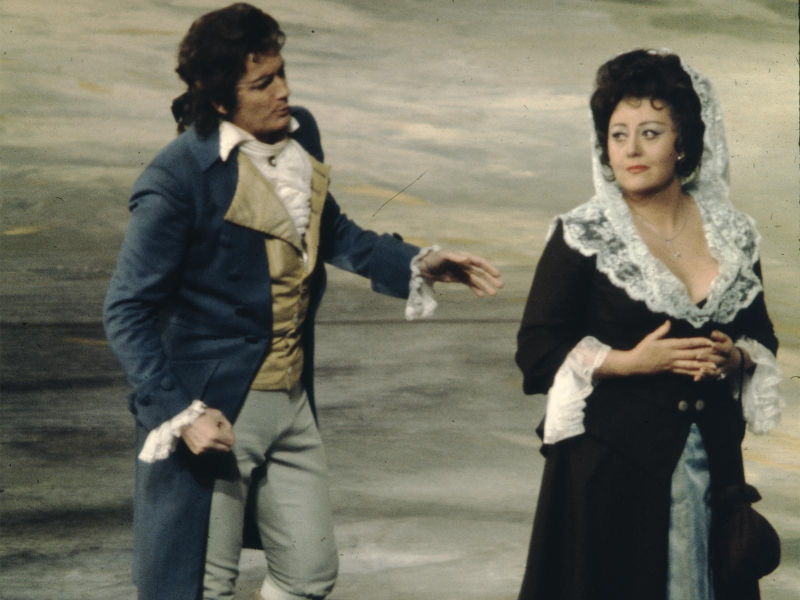
Above: Corelli and Crespin onstage; a Met Opera photo
I went backstage after the performance; Mme. Crespin looked radiant and was very charming when I asked to take her photo. I can’t recall why I didn’t ask her to sign my cast page that night, but here’s the happy prima donna:

~ Oberon
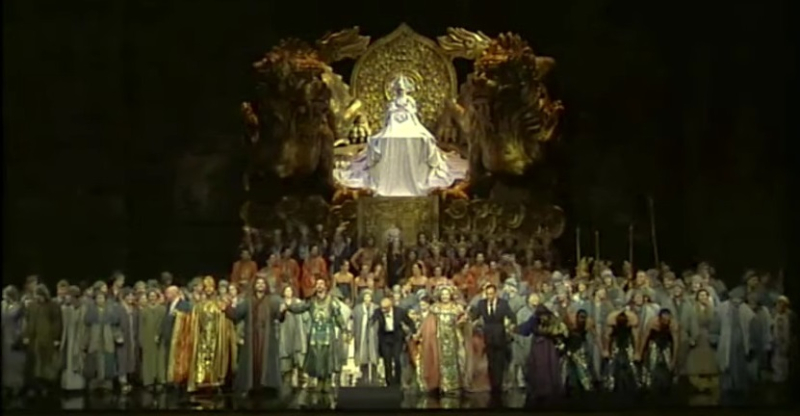
A performance of TURANDOT at the Teatro del Gran Liceu, Barcelona, in 2009
Watch and listen here.
CAST:
Turandot (Soprano): Anna Shafajinskaia
Calaf (Tenor): Fabio Armiliato
Liu (Soprano): Daniela Dessi
Ping, Canciller (Barítone): Gabriel Bermùndez
Pang (tenor): Eduardo Santamaria
Pong (tenor): Vicente Esteve Madrid
Timur (Basso): Giorgio Giuseppini
Altoum (tenor): Josep Ruiz
Conductor: Giuliano Carella
In this production by Nuria Esprit, Turandot kills herself at the end, thus fulfilling her promise: “Mai nessun m’avrà!“
Anna Shafajinskaya sang an exciting Turandot at New York City Opera in 2001.

Soprano Michelle Bradley and pianist Valeria Polunina perform Samuel Barber’s Hermit Songs.
Watch and listen here.
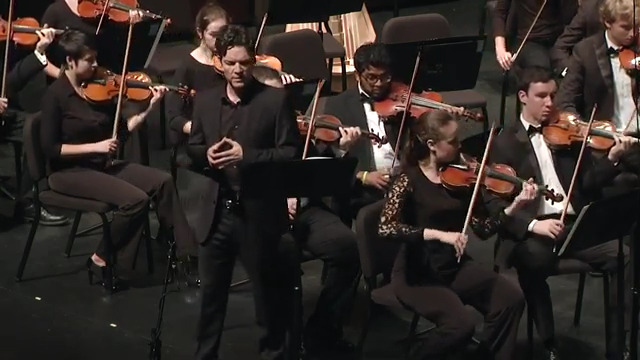
The University of North Carolina Symphony Orchestra, conducted by Tonu Kalam, Music Director, leads a performance of John Adams’ The Wound-Dresser with bass-baritone soloist Marc Callahan. The concert took place in October 2018.
Watch and listen here.
 Oberon's Glade