Category: Opera

  • NYCO’s 1971 COQ D’OR ~ Restored

    Sills

    Above: Beverly Sills as the Queen of Shemakhan

    The New York City Opera’s 1971 televised production of Rimsky-Korsakov’s LE COQ D’OR has been restored. Watch and listen to the freshened version here.

    Beverly Sills, Norman Treigle, and Enrico di Giuseppe have the principal roles, and Julius Rudel conducts.

  • NYCO’s 1971 COQ D’OR ~ Restored

    Sills

    Above: Beverly Sills as the Queen of Shemakhan

    The New York City Opera’s 1971 televised production of Rimsky-Korsakov’s LE COQ D’OR has been restored. Watch and listen to the freshened version here.

    Beverly Sills, Norman Treigle, and Enrico di Giuseppe have the principal roles, and Julius Rudel conducts.

  • WALKURE @ Vienna 2016

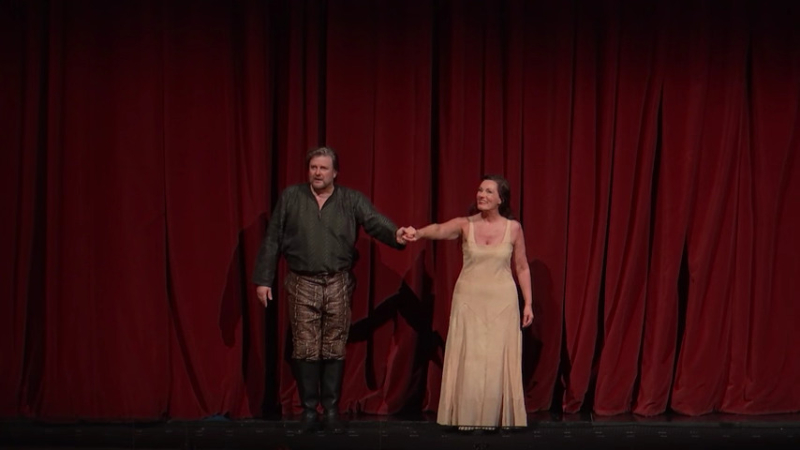
    Snapshot walkure

    Above: Christopher Ventris and Waltraud Meier winning a huge ovation after Act I of WALKURE

    Adam Fischer conducts a performance of Wagner’s WALKURE at the Vienna State Opera in 2016 with Linda Watson (Brunnhilde), Waltraud Meier (Sieglinde), Michaela Schuster (Fricka), Christopher Ventris (Siegmund), Tomasz Konieczny (Wotan), and Ain Anger (Hunding).

    Watch and listen here.

  • Gabriella Tucci Has Passed Away

    Tucci

    Above: my favorite photo of Gabriella Tucci, costumed as Leonora in TROVATORE and posing at the New York World’s Fair in 1964. I cut it out of Opera News and pasted it on shirt-board; she signed it for me in 1968 after a performance of TURANDOT at The Met. It has been ‘borrowed’ by other websites, but this is the original.

    Soprano Gabriella Tucci passed away on July 11th, 2020, in Rome, the city of her birth. She was 90 years old. In recent days, I had been listening to Ms. Tucci a lot, unaware of her death. 

    Gabriella Tucci was the first soprano I called “my favorite”. She sang in some of the earliest Met broadcasts I heard from our house in the little town  – AIDA, OTELLO, FAUST, FALSTAFF, MADAMA BUTTERFLY, TRAVIATA, FORZA DEL DESTINO, and TROVATORE – and her voice, a blooming lyrical and wonderfully feminine sound, always seemed to get to the heart of the character she was portraying. 

    Ms. Tucci studied at the Accademia di Santa Cecilia and made her operatic debut at Lucca as Violetta in 1951. After winning a voice competition at Spoleto, she appeared in LA FORZA DEL DESTINO opposite Beniamino Gigli. In 1953, she sang Glauce in Cherubini’s MEDEA at the Maggio Musicale with Maria Callas in the title-role.

    Thereafter, the Tucci career then took off: she made her La Scala debut in 1959 as Mimi, and appeared at Rome, the Arena di Verona, Vienna, Berlin, Moscow, Tokyo, San Francisco, and Buenos Aires.

    82386433_10218182844816609_8898027572693041152_n

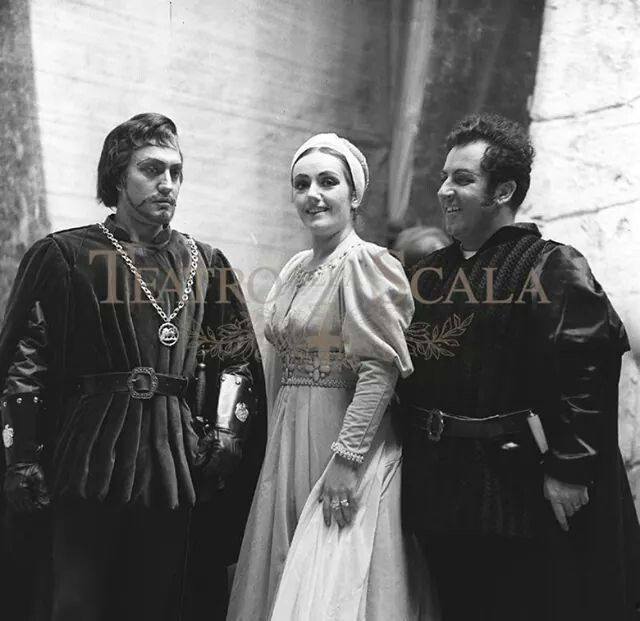
    Among Ms. Tucci’s notable evenings at La Scala was a 1964 production of TROVATORE where her co-stars were Piero Cappuccilli and Carlo Bergonzi (photo, above).

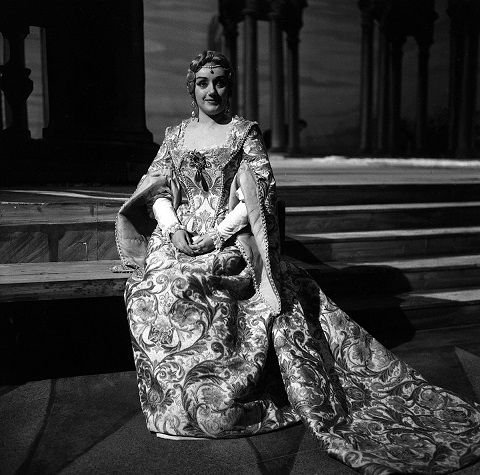
    Tucci desdemona

    Gabriella Tucci sang 260 performances with the Metropolitan Opera in New York City and on tour. In 1964, she was Desdemona (photo, above) in a new production of OTELLO that featured the return of James McCracken to The Met.

    Falstaff

    Also in 1964, Ms. Tucci sang Alice Ford in a new production of FALSTAFF conducted by Leonard Bernstein. In the above photo, she and colleagues Regina Resnik (Dame Quickly) and Rosaline Elias (Meg Page) attempt to hide Falstaff (Anselmo Colzani) in a laundry basket.

    She opened the Met’s 1965-1966 season in a new production of FAUST, and sang ravishingly in the love duet on a broadcast of that opera the following year. Her singing of “O silence! ô bonheur! ineffable mystère!” is pure magic:

    FAUST ~ scene – Gabriella Tucci – John Alexander – Justino Diaz – Met 1966

    On October 23rd, 1965, Ms. Tucci was heading to her dressing room after a matinee of FAUST when she was asked by Sir Rudolf Bing if she would be willing to step in for an ailing colleague in that evening’s performance of BOHEME. She did, with great success. And on April 16th, 1966, she was (officially) the last soprano to be heard at the Old Met when she sang the final trio from FAUST with Nicolai Gedda and Jerome Hines as the closing number at the gala that bade farewell to the venerable house.

    My first experience of hearing Gabriella Tucci live was at the Old Met in November of 1965; she sang – gloriously – the music of Leonora in TROVATORE, one of her most felicitous roles.

    Gabriella Tucci – D’amor sull’all rosee ~ TROVATORE

    In the late Summer of 1966, I traveled to New York City alone for the first time and joined the ticket line for the first performances at the New Met. I had been on the line for about five minutes when a woman next to me casually asked, “What singers do you like?” and I replied, “Gabriella Tucci!” She called some other friends over, and we discussed the soprano and her various roles in detail. Finally, I had found some kindred spirits after years of being a lonely opera-lover in my hometown. 

    Ms. Tucci was my first Aida and my first Elisabetta in DON CARLO. I saw her again in TROVATORE, and as  Liu and Mimi. But as the 1970s arrived, Tucci’s star had begun to fade; after years of singing roles like Aida and Amelia in BALLO that – in truth – extended her beyond her natural lyric realm, time seemed to catch up with her voice. She gave her last performance at The Met on Christmas Day, 1972, in FAUST

    Many years later, while I was working at Tower Records, a lively woman of a certain age came in; her hair was done in curls with a reddish tinge, and she wore a mini-skirt. I could not immediately place her, but her speaking voice gave me a clue: “Do you have the live performance of AIDA from Tokyo,1961?”   I handed her a copy. “Have you heard it?” she asked. “Yes, it’s very exciting…but…I am not sure it’s Mario del Monaco.” She smiled: “I am Gabriella Tucci, and I assure you it’s him!” I kissed her hand and after telling her she had always been a great favourite of mine, she smiled, and then returned to the topic of the Tokyo AIDA. “Why do you think it is not del Monaco?” I gave my reasons. She thought for a moment. “Well, who do you think it is, then?” and I replied “Gastone Limarilli.” “Hmmmm…you know your stuff. I did sing Aida with Gastone and I can understand your impressions of del Monaco’s performance…he was ill during that tour, and dropped out of the CAVALLERIA. I agree, he was not his best in the AIDA. But…he definitely sang that day!” She gave me a big hug, and swept from the room.

    Oddly, just the day before I learned of her passing, I was listening to that AIDA which includes her impressive “O patria mia“:

    Gabriella Tucci – O patria mia – AIDA – Tokyo 1961

    And then there’s the scene of the sighting of Pinkerton’s ship from Act II of MADAMA BUTTERFLY. Helen Vanni is Suzuki. Tucci elicits a burst of applause after her “…ei torna e m’ama!“. Listen to it here.

    It’s had to choose favorite Tucci items from among so many, but she and baritone Ettore Bastianini are superb in a scene from Act III of ANDREA CHENIER. Listen to them here.

    …and she sings a beautiful “Pace, pace mio dio” from FORZA DEL DESTINO:

    Gabriella Tucci – FORZA aria – Met 1965

    ~ Oberon

  • Judith Raskin

    Hqdefault

    American soprano Judith Raskin (above) began taking voice lessons while attending Smith College. She began concertizing, and in 1957 sang Sister Constance in a televised performance of Poulenc’s DIALOGUES OF THE CARMELITES. She made her New York City Opera debut as Despina in 1959, and enjoyed a personal success there in the title-role of Douglas Moore’s BALLAD OF BABY DOE

    Ms. Raskin made her Metropolitan Opera debut in 1962 as Susanna in NOZZE DI FIGARO and went on to give more than a hundred performances with the Met company over the next decade. Her roles included Marzelline, Nanetta, Sophie in ROSENKAVALIER, Zerlina, Pamina, and Micaela.

    69628137_10216986455747630_1200814637679902720_n
    I first saw Judith Raskin onstage as Pamina in the Marc Chagall production of THE MAGIC FLUTE. She made such a beautiful impression in Mozart’s sublime music. Later I saw her in her signature role as Susanna in NOZZE DI FIGARO. Her last Met performance was as Marzelline in 1972.

    Judith Raskin sang with the opera companies of Chicago and San Francisco, and appeared as Pamina at the Glyndebourne Festival, She also performed frequently in concerts, most notably with the Cleveland Orchestra under George Szell. And she once said, ““In my heart of hearts, I have always been a recitalist.”

    After retiring from the stage, Judith Raskin taught at the Manhattan School of Music. She passed away in 1984.

    Judith Raskin sings Samuel Barber’s Knoxville: Summer of 1915 here.

    ~ Oberon

  • TABARRO ~ Madrid 1979

    Ag

    I heard soprano Ángeles Gulín (above) as Valentine in a concert performance of LES HUGUENOTS at Carnegie Hall in 1969, singing Valentine opposite Beverly Sills and Tony Poncet. Ms. Gulín had one of the biggest voices I ever encountered.

    There are not many souvenirs of her career. This TABARRO, though not in great quality, is enjoyable.

    Watch and listen here.

    CAST: Luigi: Placido Domingo; Giorgietta: Ángeles Gulín; Michele: Sylvano Carrolli; Frugola: Isabel Rivas; Tinca: Jose Manzaneda; Talpa: Jose Luis Alcalde. Conductor: Olivero di Fabritiis

  • Martha Graham Dance Company~Immediate Tragedy

    -gvdt0Bg

    Above, clockwise from top left: Graham dancers Ying Xin, Lloyd Knight, Lorenzo Pagano, and Leslie Andrea Williams performing Immediate Tragedy from their homes. Photo by Ricki Quinn.

    Update: You can now watch Immediate Tragedy on YouTube here.

    Friday June 20th, 2020 – In a joint collaboration with The Soraya and Wild Up, the Martha Graham Dance Company today presented the world premiere performance of a digital dance creation, Immediate Tragedy, inspired by Martha Graham’s lost solo from 1937. This freshly-imagined version features the fourteen remarkable artists of the Graham Company performing from their homes to a new musical score composed by Wild Up’s Christopher Rountree (photo below).

    Rountree

    The loss of the 2020 Graham season in New York City was for me one of the saddest after-shocks of the pandemic. Nowadays, I keep wondering if dance, music, opera, and theatre – not to mention museums – can return to what we think of as ‘normal’ in the foreseeable future.

    The members of the Graham Company have, over the past decade or so, become very dear to me, not just as dancers but as human beings. Their energy, commitment, and their unique individual stories make them so appealing. I cannot wait to see them “live” again. But for now, today’s webcast of Immediate Tragedy at least let me behold their beautiful faces and forms again. 

    Host Thor Steingraber, executive director of The Soraya, welcomed viewers. Graham artistic director Janet Eilber and composer Christopher Rountree of Wild Up gave us some background information about the collaborative effort to bring Martha Graham’s “lost” 1937 solo back to life in a new guise nearly eighty years after it was last seen.

    Ms. Eilber spoke of receiving a collection of black-and-white images of Martha Graham performing Immediate Tragedy in 1937. They were taken by Robert Fraser, and it was Fraser’s son who contacted Ms. Eilber to say, “I have these photos…”  One thing led to another, and when the pandemic forced dancers to remain isolated, the idea of a digital dancework in which each Graham dancer would be filmed dancing at home, elaborating on the poses from the Fraser photos, made perfect sense. Each dancer was mailed four of the Fraser images, showing various moments from the original solo. Ms. Eilber oversaw the “new”  choreography, but…there was no music to dance to. Enter Mr. Rountree, who provided an intriguing score which five musicians from Wild Up play superbly.

    The last time Immediate Tragedy was performed, it was paired with another Graham solo, Deep Song. A gorgeous film of dancer Anne Souder performing Deep Song at the Teatro Real Madrid in 2017 opened today’s presentation. The solo, also dating from 1937, was another Graham response to the Spanish Civil War  – a war that raged until 1939 – and its dire effect on the women of Spain. The music is by Henry Cowell. 

    At first glance, the bench employed in Deep Song puts the viewer in mind of Graham’s iconic Lamentation, which was created in 1930. The two solos have an indelible connection, though the sources of inspiration – and the music used – are vastly different. Ms. Souder, striking in a beautiful re-creation of Edythe Gilford’s original black-and-white costume design, is a wonderfully supple and nuanced dancer; she gives a vivid performance. As the solo progresses, the bench becomes part of the choreography. Up-ended, it becomes a chair on which the dancer sits and slowly rotates in place. Later, she takes refuge under it and – momentarily – it has the feeling of a coffin. Then the dancer’s hands tremble: her indomitable spirit cannot be stilled.

    In a solo that runs an emotional gamut from defiance to despair, Ms. Souder’s dancing of Deep Song showed a perfect mixture of vulnerability and resolve.

    KoZuV8aQ

    Above: Wild Up’s Jodie Landau playing Intermediate Percussion; photo credit Ricki Quinn

    Perhaps picking up from the black-and-white of Anne Souder’s gown, the presentation continues with an entr’acte: a black-and-white film featuring Wild Up’s percussionist Jodie Landau playing at home. He employs a kit of drums and cymbals, as well as some household items. Jodie plays in a relaxed, utterly delightful way, pairing two ‘forgotten’ Henry Cowell works to create an interlude entitled Intermediate Percussion. Composer Chris Rountree said that he wasn’t sure if the brief Cowell works had ever been publicly performed, or even published, but that Jodie was playing from the manuscripts. The works are entitled Canto Hondo and Sarabande.

    Intermediate Percussion, far from being an idle filler while the “stage” was being “reset”, was a fascinating and integral part of today’s presentation. The black-and-white film has a refreshing, journalistic feel, and Mr. Landau’s playing was as pleasing to watch as to hear.
    Graham deep song - Copy

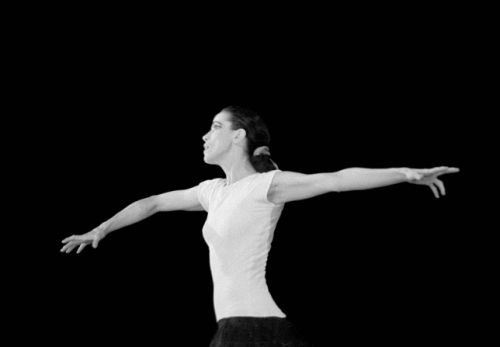
    Above: Martha Graham performing Immediate Tragedy in 1937; photo by Robert Fraser, courtesy of the Martha Graham Dance Company

    The black-and-white theme running thru the program now becomes palpable as a collage of the incredible Robert Fraser photos of Martha Graham from 1937 herald the start of Immediate Tragedy. Slowly, each individual photo of Ms. Graham is replaced by a photo of one of the current Graham dancers. Clad in dark colours, against white or neutral backgrounds, they are a sight to see. And then they begin to move.

    The Graham dancers appear in individual frames, sometimes paired, or in trios, or foursomes, and periodically in solo shots. So Young An, Alessio Crognale, Laurel Dalley Smith, Natasha Diamond-Walker, Lloyd Knight, Charlotte Landreau, Jacob Larsen, Lloyd Mayor, Marzia Memoli, Anne O’Donnell, Lorenzo Pagano, Anne Souder, Leslie Andrea Williams, and Xin Ying each dance the Grahamian modes of movement: kneeling, collapsing, contracting, stretching tall, with gestures of longing, supplication, or hopelessness. 

    The quintet of musicians of Wild Up – Jiji (guitar), Richard Valitutto (piano), Jodie Landau (percussion/harpejii/synth/voice), Brian Walsh (clarinets), and Derek Stein (cello) – play Mr. Rountree’s score impeccably. The music sings of loneliness and quiet anguish; thanks to the acoustic guitar and clarinet, there is an aptly Spanish quality about it at times. Cunning use of the harpejii adds a melismatic flavour. As the piece nears its end, there is a slow crescendo and an exciting acceleration of tempo during which the harpejii sounds like a mad, swirling dulcimer. It reaches a mighty climax, and then all falls silent.

    During this final musical build-up, the frames of the dancers move swiftly up the screen, shrinking in size whilst growing in numbers. When the music suddenly ends, the screen goes black. A hauntingly pensive clarinet coda is heard as, one by one, the dancers reappear in their frames. As they slowly attain the work’s final pose – hands clasped behind their heads – the bass clarinet descends to the depths. 

    Snapshot c

    In silence, the frames of the individual dancers all disappear, leaving only Leslie Andrea Williams. Just as Leslie fades from view, her figure morphs into the 1937 image of Martha Graham sustaining the same pose.

    “I was upright, and was going to remain upright at all costs.” ~ Martha Graham

    Though originally a necessary response to the pandemic – a way to keep dancers dancing and musicians playing – Immediate Tragedy has taken on yet another dimension following the murder of George Floyd and the massive international protests opposing racism and injustice. We seem to be living now on the edge of a knife; the coming months will determine the future of our democracy and – no exaggeration – the fate of mankind. For now, music, dance, art, and poetry continue to give solace. Immediate Tragedy – so beautifully performed – today felt like a ray of hope in a chaotic, dimming world.

    ~ Oberon

  • Régine Crespin ~ O ma lyre immortelle

    Crespin

    Régine Crespin sings the great final aria from Gounod’s rarely-heard opera SAPHO:

    Régine Crespin – O ma lyre immortelle ~ SAPHO

    "O my immortal lyre,
    often when tears I have shed...
    My voice has been the portal
    thru which my sorrows fled.

    In vain now does your sweet murmur
    Seek to console me in my sadness
    No, you cannot heal this final wound -
    a wound deep in my heart,
    Only death can end my despair.

    Farewell, flame of the world!
    Sink down to the bosom of the sea.
    Myself, I shall descend into the depths
    to my eternal rest.

    Another day, Faone,
    will dawn for you.
    But you will not think of me
    As you watch the sun arise.

    Open now, bitter sea,
    open now!
    I shall sleep forever
    beneath the waves."

    ~ She flings herself into the ocean.

  • Nadine Sierra @ The Met’s At-Home Gala

    Snapshot sierra

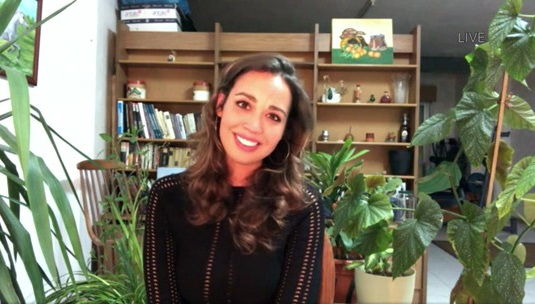
    Nadine Sierra sang Mimi’s narrative “Mi chiamano Mimí” from LA BOHEME for the Metropolitan Opera’s At-Home Gala on April 25th, 2020. Watch and listen here.

  • Nadine Sierra @ The Met’s At-Home Gala

    Snapshot sierra

    Nadine Sierra sang Mimi’s narrative “Mi chiamano Mimí” from LA BOHEME for the Metropolitan Opera’s At-Home Gala on April 25th, 2020. Watch and listen here.