Category: Opera

  • Sandra Warfield & James McCracken

    Thumbnail_image009

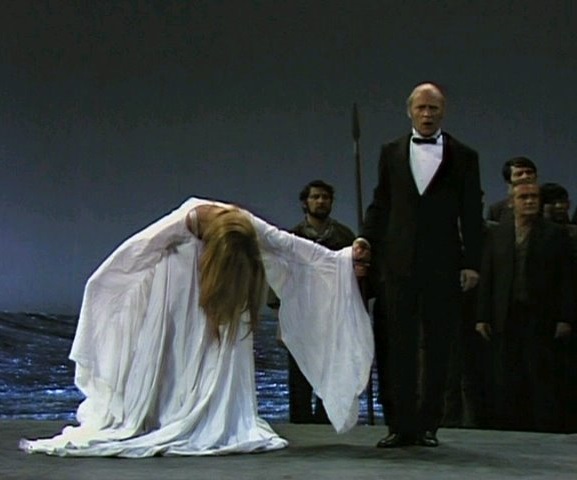
    Mezzo-soprano Sandra Warfield and tenor James McCracken were husband and wife. McCracken of course had a huge international career, Verdi’s Otello being one of his finest roles. Ms. Warfield’s career was not so hi-profile, though substantial.

    The couple were married in 1953. In 1957, feeling that The Met was not utilizing him to his full capabilities, McCracken headed to Europe where he and Ms. Warfield joined the Zurich Opera. In 1964, McCracken returned to The Met in triumph as Verdi’s Moor.

    In 1966, the couple sang together as Samson and Dalila in a Met concert performance at Lewisohn Stadium. In 1968, they sang these roles together again in the Met’s New York City Parks series. On January 13th, 1972, Warfield and McCracken finally appeared together in principal roles on The Met stage in a performance of SAMSON ET DALILA that marked Ms. Warfield’s final Met appearance.

    Sandra Warfield went on to a successful career in cabaret whilst her husband continued to be a major Met star until 1986, when he sang with the Company for the last time in a concert performance of AIDA in Central Park. Aprile Millo and Grace Bumbry were his co-stars that evening. Mr. McCracken passed away in 1988, and Ms. Warfield in 2009.

    In 1983, having absented himself from the Met yet again for three years, McCracken sang at the gala performance celebrating the 100th birthday of The Met. Having been thrilled by two of the tenor’s late-career performances as The Moor at Hartford and Boston, I was so happy to have been there on that gala afternoon to witness the warm welcome he received when he walked onstage to sing Otello’s great monolog, with James Levine conducting. You can watch that performance here. Thereafter he sang about a dozen more performances with the Company, including the AIDA that marked Leontyne Price’s farewell to opera in 1984 – a performance that was televised. 

    I am not sure if Mr. McCracken ever sang Andrea Chenier onstage, but his recording of the Act I Improviso is powerful:

    James McCracken – ANDREA CHENIER ~ Improviso

    Ms. Warfield is heard here as Mozart’s Marcellina in the Act I duet with Roberta Peters as Susanna.  And here are Warfield and McCracken together in the Judgement Scene duet from AIDA:

    Sandra Warfield & James McCracken – AIDA scene 

    ~ Oberon

  • Prologo

    6a00d8341c4e3853ef01b8d186fec0970c-800wi

    One of my all-time favorite renderings of the Prologue to Leoncavallo’s PAGLIACCI by the wonderful Puerto Rican baritone Pablo Elvira.

    PAGLIACCI – Prologo – Pablo Elvira – Met bcast 1

  • Love Duet

    6a00d8341c4e3853ef025d9b3f78e1200c-800wi

    On February 3rd, 1962, I tuned in to Texaco Metropolitan Opera Radio Network (as it was then called) and heard Puccini’s MADAMA BUTTERFLY sung live for the first time. Gabriella Tucci, who in my earliest years of opera mania was my favorite soprano, gave a magnificent performance. Carlo Bergonzi stepped in for the indisposed Sandor Konya, and this was a boon for me as Bergonzi was (and remains) my favorite tenor. 

    And so, the Tucci/Bergonzi rendering of the love duet from that matinee performance is very special to me: 

    Gabriella Tucci & Carlo Bergonzi – MADAMA BUTTERFLY ~ Love Duet – Met 1962

  • Souvenirs from Cardiff ~ Part II

    6a00d8341c4e3853ef01bb09d9801f970d-800wi

    ~ Author: Oberon

    1989 was a banner year for the Cardiff Singer of the World Competition: the “Battle of the Baritones” put the competition on every opera lover’s map. Dmitri Hvorostovsky and Bryn Terfel vied for the top prize; in the end, Dima was named Singer of the Year and Sir Bryn captured the Lieder Prize. Both men went on to hugely successful international careers.

    Of course, at the time, there was no internet to speak of. You could not instantly follow the competition from afar, and even news of it was slow to reach us from the other side of The Pond. But my wonderful friend Mollie Warren diligently taped much of the proceedings directly off the BBC; then she made copies of the cassettes to send to me. So within a couple of weeks, I was listening – in Hartford CT – to the sounds of Mssrs. Hvorostovsky and Terfel: I like to think I was one of the very first people in the Western Hemisphere to hear these voices.

    The three other finalists in the 1989 competition were Finnish mezzo-soprano Monica Groop, Swedish soprano Hillevi Martinpelto, and the Australian soprano Helen Adams. I cannot seem to find much information regarding Helen Adams in the years following her appearance at Cardiff; she is heard here in “Depuis le jour” from LOUISE.  

    Monica Groop

    Above: Monica Groop

    Monica Groop’s extensive international career in opera, concert, and song has included a memorable portrayal of Lucretia in Britten’s RAPE OF LUCRETIA in 2003 at New York City Opera; it marked the only time I saw this wonderful singer live onstage. Her other operatic roles have ranged from Melisande to Zerlina, and she has sung and recorded a great deal of Baroque music – in which she excels – as well as lieder of Schubert and Brahms, and the complete songs of Edvard Grieg.

    Some samples of Ms. Groop’s artistry, singing in Italian, French, and German:

    Monica Groop – Stà nell’Ircana ~ ALCINA

    Monica Groop – D’amour l’ardente flamme ~ DAMNATION DE FAUST

    Monica Groop sings Schubert’s Du bist die Ruh

    Monica Groop at Cardiff, 1989:

    Monica Groop – Cardiff 1989 – CLEMENZA~WERTHER

    Hillevi Martinpelto went on from Cardiff to a very successful career, performing and recording with prominent orchestras and conductors.

    Here she is singing Weber…

    Hillevi Martinpelto – Ocean! Thou mighty monster ~ OBERON

    …and in a true rarity:

    Hillevi Martinpelto – from Karl-Magnus Fredriksson’s The Disguised God ~ Soprano & Chorus

    Here is Hillevi Martinpelto at Cardiff, 1989:

    Hillevi Martinpelto – FORZA aria – Cardiff 1989

    And finally, the winners:

    Dmitri-Hvorostovsky

    …Dima… 

    Dmitri Hvorostovsky – BALLO aria – Cardiff 1989

    Hqdefault

    …and Bryn…my original cassette of Bryn from the competition would not play, but here he is, onstage, singing Schumann…

    …and here’s a bit of Wagner, from a commercial recording:

    Bryn Terfel – Song to the Evening Star – TANNHAUSER

    ~ Oberon

  • Moffo & Merrill ~ LA TRAVIATA @ The Met

    Moffo Merrill

    ~ Author: Oberon

    By chance, I came upon this lovely Louis Melançon photo (above) of Anna Moffo and Robert Merrill in Verdi’s LA TRAVIATA in the Met’s 1966 Cecil Beaton production of the Verdi classic, which evoked in me memories of their partnership in this opera. From Moffo”s debut in 1959 til her final Met appearance in a staged opera there in 1976, they sang these roles together 50 times with the Company, in New York and on tour. They also made a beautiful recording of the opera together for RCA. Listen to a portion of their Act II duet here.

    Moffo’s 1959 Met debut came at The Old Met in the Tyrone Guthrie production. On September 24th, 1966, during the second week at the New Met, Cecil Beaton’s lavish production opened with Moffo, Merrill, and tenor Bruno Prevedi in the leading roles. Georges Prêtre was on the podium. I saw the Moffo Violetta four times, twice with Merrill as Germont, and twice with Mario Sereni, who was very good in the role, and a less ‘wooden’ actor than Merrill.  

    Moffo Violetta

    Above: Moffo as Violetta in the scene at Flora’s party

    Anna Moffo had two Saturday matinee broadcasts of TRAVIATA in the Beaton production, nine months apart. For me, they offered tell-tale signs of what would be the diva’s eventual vocal decline. In the first broadcast, on March 25th, 1967, she sounded fantastic: the voice lyrical and free-flowing, the top gorgeous, the drama expressed thru colour rather than force: in sum, one of her great performances.

    During June, 1967, I saw two more Moffo Violettas (one with Merrill, the second with Sereni) and she was very impressive indeed, receiving huge ovations. I met her at the stage door; she was extremely beautiful in person, and very kind. 

    On December 30, 1967, Moffo had her second matinee broadcast in the Beaton production. I was very excited to be seeing her onstage again, but from her very first line – “Flora, amici, la notte che resta...” – something had changed.  On “…che resta..” she really leaned heavily on the low notes, sounding almost chesty. I was still a novice opera-lover at that time, but alarm bells went off. Moffo continued to pressurize her lower notes throughout the first act, but the coloratura and high notes of “Sempre libera” seemed fine.

    During the intermission, I asked a fellow Moffo fan if her vocalism that day was worrisome to him; he felt she was making an effort to sound more ‘dramatic’, and he didn’t feel panicky about it. The soprano continued singing in this manner for the rest of the opera, and – since the drama gets increasingly intense as the story unfolds – we heard these big, juicy lower notes from Moffo throughout the afternoon.

    As it turned out, I never saw Anna Moffo on The Met stage again after that, though she continued singing there for nearly a decade. On February 1, 1969, came the disastrous LUCIA DI LAMMERMOOR broadcast, which I listened to in disbelief, which gave way to despair. The voice was wildly unpredictable: woozy in the middle, over-ripe in the lower range, and screamy at the top. Awkwardly, I ran into her in the Met lobby a couple of weeks afterward and she recognized me; she asked if I had heard the LUCIA broadcast, and I gave a neutral response. She said she had been ill that day, but that now things were back to normal.

    I cannot say for certain whether she ever regained peak form again, but from reports from friends, she was not singing with the lustre and ease we’d come to expect from her. Her later recordings are so sad…I cannot listen to them. 

    In 1975, TJ and I – living in Hartford – tuned in for her broadcast of Nedda in PAGLIACCI. Moffo sounded dreadful, the voice unsupported. “What is she thinking?” I asked TJ. “I guess she feels she still has something to offer,” he replied.

    In 1979, I was still living in Hartford (but no longer with TJ) when Moffo came to The Bushnell to sing MERRY WIDOW in English. I decided to go, and always regretted it afterwards.

    Anna Moffo and Robert Merrill reunited on the Met stage one last time for the Met’s 100th Anniversary Gala on October 22, 1983. They sang the duet Sweethearts from Sigmund Romberg’s MAYTIME. The audience greeted them affectionately, and they managed to get thru their duet without mishap.

    I hadn’t intended to delve into the story of Moffo’s decline when I posted the photo at the top of the article; I prefer simply to remember her lovely performances from the first decade of her Met career. But one thing led to another once I started writing.

    One of the most moving passages in her performances as Violetta was her farewell to Alfredo in Act II, when she thinks she will never see him again. In the Beaton production, this was staged so that Violetta came downstage while sustaining the top B-flat and sank to her knees, clasping Alfredo’s hand. Here is the phrase – “Amami, Alfredo…!” as Ms. Moffo sang it at La Scala in 1964:

    Anna Moffo – Amami Alfredo! ~ TRAVIATA (Live)

    And here is Moffo at her best, from a commercial arias compilation, conducted by Sir Colin Davis:

    Anna Moffo – TRAVIATA ~ Act I scena (commercial recording)

    ~ Oberon

  • Moffo & Merrill ~ LA TRAVIATA @ The Met

    Moffo Merrill

    ~ Author: Oberon

    By chance, I came upon this lovely Louis Melançon photo (above) of Anna Moffo and Robert Merrill in Verdi’s LA TRAVIATA in the Met’s 1966 Cecil Beaton production of the Verdi classic, which evoked in me memories of their partnership in this opera. From Moffo”s debut in 1959 til her final Met appearance in a staged opera there in 1976, they sang these roles together 50 times with the Company, in New York and on tour. They also made a beautiful recording of the opera together for RCA. Listen to a portion of their Act II duet here.

    Moffo’s 1959 Met debut came at The Old Met in the Tyrone Guthrie production. On September 24th, 1966, during the second week at the New Met, Cecil Beaton’s lavish production opened with Moffo, Merrill, and tenor Bruno Prevedi in the leading roles. Georges Prêtre was on the podium. I saw the Moffo Violetta four times, twice with Merrill as Germont, and twice with Mario Sereni, who was very good in the role, and a less ‘wooden’ actor than Merrill.  

    Moffo Violetta

    Above: Moffo as Violetta in the scene at Flora’s party

    Anna Moffo had two Saturday matinee broadcasts of TRAVIATA in the Beaton production, nine months apart. For me, they offered tell-tale signs of what would be the diva’s eventual vocal decline. In the first broadcast, on March 25th, 1967, she sounded fantastic: the voice lyrical and free-flowing, the top gorgeous, the drama expressed thru colour rather than force: in sum, one of her great performances.

    During June, 1967, I saw two more Moffo Violettas (one with Merrill, the second with Sereni) and she was very impressive indeed, receiving huge ovations. I met her at the stage door; she was extremely beautiful in person, and very kind. 

    On December 30, 1967, Moffo had her second matinee broadcast in the Beaton production. I was very excited to be seeing her onstage again, but from her very first line – “Flora, amici, la notte che resta...” – something had changed.  On “…che resta..” she really leaned heavily on the low notes, sounding almost chesty. I was still a novice opera-lover at that time, but alarm bells went off. Moffo continued to pressurize her lower notes throughout the first act, but the coloratura and high notes of “Sempre libera” seemed fine.

    During the intermission, I asked a fellow Moffo fan if her vocalism that day was worrisome to him; he felt she was making an effort to sound more ‘dramatic’, and he didn’t feel panicky about it. The soprano continued singing in this manner for the rest of the opera, and – since the drama gets increasingly intense as the story unfolds – we heard these big, juicy lower notes from Moffo throughout the afternoon.

    As it turned out, I never saw Anna Moffo on The Met stage again after that, though she continued singing there for nearly a decade. On February 1, 1969, came the disastrous LUCIA DI LAMMERMOOR broadcast, which I listened to in disbelief, which gave way to despair. The voice was wildly unpredictable: woozy in the middle, over-ripe in the lower range, and screamy at the top. Awkwardly, I ran into her in the Met lobby a couple of weeks afterward and she recognized me; she asked if I had heard the LUCIA broadcast, and I gave a neutral response. She said she had been ill that day, but that now things were back to normal.

    I cannot say for certain whether she ever regained peak form again, but from reports from friends, she was not singing with the lustre and ease we’d come to expect from her. Her later recordings are so sad…I cannot listen to them. 

    In 1975, TJ and I – living in Hartford – tuned in for her broadcast of Nedda in PAGLIACCI. Moffo sounded dreadful, the voice unsupported. “What is she thinking?” I asked TJ. “I guess she feels she still has something to offer,” he replied.

    In 1979, I was still living in Hartford (but no longer with TJ) when Moffo came to The Bushnell to sing MERRY WIDOW in English. I decided to go, and always regretted it afterwards.

    Anna Moffo and Robert Merrill reunited on the Met stage one last time for the Met’s 100th Anniversary Gala on October 22, 1983. They sang the duet Sweethearts from Sigmund Romberg’s MAYTIME. The audience greeted them affectionately, and they managed to get thru their duet without mishap.

    I hadn’t intended to delve into the story of Moffo’s decline when I posted the photo at the top of the article; I prefer simply to remember her lovely performances from the first decade of her Met career. But one thing led to another once I started writing.

    One of the most moving passages in her performances as Violetta was her farewell to Alfredo in Act II, when she thinks she will never see him again. In the Beaton production, this was staged so that Violetta came downstage while sustaining the top B-flat and sank to her knees, clasping Alfredo’s hand. Here is the phrase – “Amami, Alfredo…!” as Ms. Moffo sang it at La Scala in 1964:

    Anna Moffo – Amami Alfredo! ~ TRAVIATA (Live)

    And here is Moffo at her best, from a commercial arias compilation, conducted by Sir Colin Davis:

    Anna Moffo – TRAVIATA ~ Act I scena (commercial recording)

    ~ Oberon

  • Antonín Švorc

    B2baebce2c7e431084e2cf604d2c62cf

    Above: Antonín Švorc as the Flying Dutchman; photo by Oldrich Pernica

    Antonín Švorc was a Czech operatic bass-baritone. He studied at the Prague Conservatory, making his professional opera debut in 1955, and joined the roster of principal artists at the National Theatre in Prague in 1956. In 1962, Švorc debuted with the Prague State Opera where he performed for the next several decades. In 1985 he was named a People’s Artist of Czechoslovakia. After retiring from the stage, he taught at the Prague Conservatory. He passed away in 2011.

    Antonín Švorc’s repertory was vast indeed. In addition to singing in many Czech operas (including those of Dvořák and Smetana), his oles in the standard repertory included Verdi’s Amonasro, Iago, Nabucco, and Simon Boccanegra, Wagner’s Dutchman, Hans Sachs, Wotan, Kurvenal, Telramund, and Donner; Strauss’s Jochanaan, Orest, and Barak, as well as Scarpia, Alfio, Don Pizarro, Prince Igor, and Boris Godunov.

    0f0c8d9970fb434791822b37f285442a

    Above: Antonín Švorc as Simon Boccanegra; photo by Jaromir Svoboda

    Czech soprano Ludmila Dvořáková joins her compatriot, Antonín Švorc, in a recording of the final scene of DIE WALKURE (sung in Czech) here.

    Švorc gives a dramatic reading of the opening portion of the Dutchman’s monolog….

    Antonín Švorc – Flying Dutchman ~ monolog

    …and in Berlin in 1967, he sang Orestes opposite Ingrid Steger’s Elektra, conducted by Otmar Suitner. Here is part I of the Recognition Scene from that performance:

    Ingrid Steger & Antonín Švorc – ELEKTRA – Recognition Scene ~ Part I – Berlin 1967

    ~ Oberon

  • Janis Martin as Kundry

    Janis Martin

    The American soprano Janis Martin was my first Kundry; she was also my first Sieglinde and Marie in WOZZECK. She was a featured singer at the Bayreuth Festival from 1968 to 1989 where she appeared in nine different roles: Magdalene, Fricka, Eva, the Second Norn, Gutrune, Kundry, Freia, Sieglinde, and Brünnhilde. She returned in for the 1995 and 1997 festivals, again as Kundry.

    Janis Martin sang nearly 150 performances at the Metropolitan Opera, commencing in 1962 as Flora Bervoix in TRAVIATA. As a young opera-lover, I heard her many times on the Texaco broadcasts. She eventually progressed to “medium-sized” roles: Siebel, Nicklausse, Lola in CAVALLERIA RUSTICANA. Hearing her in these roles (in which she excelled), one would not have anticipated how her career would develop.

    Ms. Martin left The Met in 1965 to build a career abroad, moving into soprano territory. She returned to The Met from 1974 thru 1977, when I saw her as Kundry, Marie in WOZZECK, and Sieglinde. Following another hiatus, she was back at Lincoln Center from 1988-1992, singing the Witch in HANSEL & GRETEL, the Dyer’s Wife in FRAU OHNE SCHATTEN, Senta, the Foreign Princess in RUSALKA, and two performances of Tosca.

    Here is Ms. Martin as Kundry in a scene from the 1973 Bayreuth production of PARSIFAL; Jean Cox sings the title-role, with Eugen Jochum conducting:

    Janis Martin – Ich sah das kind ~ PARSIFAL – with Jean Cox – Bayreuth 1973

    ~ Oberon

  • Jean Cox ~ Heldentenor

    Jean Cox

    A native of Alabama, tenor Jean Cox studied with Marie Sundelius at the New England Conservatory and made his operatic debut at Spoleto as Rodolfo in LA BOHEME. In the early 1950s, Cox built his repertory and reputation at Kiel and Mannheim.

    The tenor made his Bayreuth debut in 1956 as the Steersman in FLIEGENDE HOLLANDER; he returned to the Festival as Lohengrin in 1967 and went on to sing there until 1984, taking on the Siegfrieds, Erik in HOLLANDER, Parsifal, and Walther in MEISTERSINGER.

    At other major opera houses, Cox sang Otello, Herod in SALOME, Bacchus in ARIADNE AUF NAXOS, Max in DER FREISCHUTZ, Gherman in PIQUE-DAME, and Captain Vere in BILLY BUDD. In 1976, Jean Cox made his Met debut as Walther von Stoltzing in a series of performances of DIE MEISTERSINGER in New York City and on tour. This was the sum total of his Met career.

    Jean Cox was married to the British mezzo-soprano Anna Reynolds, a noted interpreter of Bach and Wagner, and one of my very favorite singers. Following their retirement from the stage, the couple opened a vocal academy where they trained singers from all over the world. While I was working at Tower Records in the early 2000s, I met two students from this academy. I asked them to give  Ms. Reynolds a message from me; I wonder if they ever did.

    Jean Cox passed away in 2012 at Bayreuth; he was 90 years old. Ms. Reynolds died two years later.

    Enjoy this rare film clip of Jean Cox and the great basso Gottlob Frick in excerpts from Smetana’s BARTERED BRIDE and Weinberger’s SCHWANDA THE BAGPIPER.

    And here are some audio samplings of Jean Cox singing at the Bayreuth Festival.

    Jean Cox – Die Meistersinger ~ Prize Song

    Jean Cox as Parsifal – finale of the opera – Bayreuth 1973

    ~ Oberon

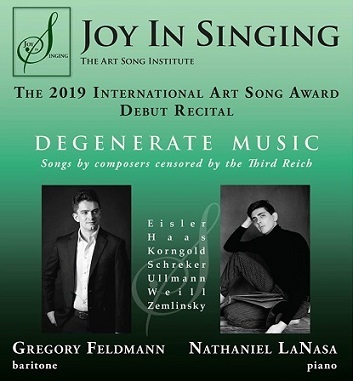
  • Gregory Feldmann|Nathaniel LaNasa @ Weill Hall

    83265515_10157528132085353_8525152423453392896_o

    ~ Author: Oberon

    Thursday February 27th, 2020 – Baritone Gregory Feldmann, recipient of the 2019 Joy in Singing Art Song Award, in recital at Weill Hall. Pianist Nathaniel LaNasa was the singer’s collaborator in a program of songs by composers whose music was suppressed under the Nazi regime.

    The program was particularly timely, living as we are during a period when our own government seems hellbent on destroying our democracy. It’s ironic that we fought Facism in the 1940s – and that in recent years we have sent our soldiers into harm’s way in faraway lands, purportedly to bring democracy and freedom to the oppressed – only to find our country is now under threat from within. With these thoughts in mind, tonight’s concert became much more than just another lieder recital.

    Mssrs. Feldmann and LaNasa, looking dapper in black bow-ties, took the stage to a hearty welcome from the packed house. The first half of their program was given over to songs by such well-remembered composers as Kurt Weill, Franz Schrecker, Alexander von Zemlinsky, and Erich Korngold.

    Kurt Weill’s cabaret-style “Berlin im Licht” opened the evening. Weill had been living in Paris – and then in New York – since 1933. But this song was composed for the Berlin Festival of September 1928 (ten years after Germany’s humiliation in World War I); that event marked a resurgence of German pride in its cultural endurance that would eventually fuel Hitler’s rise to power. Tonight, Mr. Feldmann and Mr. LaNasa gave the song a swinging, optimistic treatment.  

    Franz Schreker had died in 1934, but his music was still proscribed by the Third Reich. In three Schrecker songs, the musical attributes of this evening’s two artists came to the fore. In the Straussian style of Und wie mag die Liebe“, Mr. Feldmann’s handsome lyric baritone – and his persuasive way with words – assured us we were in for a great deal of very fine vocalism tonight. Of equal appeal was Mr.LaNasa’s playing, especially in the song’s postlude. 

    The partnership of the two musicians made for a luminous “Sommerfäden”, wherein the duo showed an affinity for Viennese-style melody. The shimmering piano introduction was enticingly played by Mr. LaNasa; this song has a rapturous mid-section, and then a big, operatic outpouring where Mr. Feldmann’s voice rang true.

    Stimmen des Tages” is darkish and unsettled at first; mood swings carry the two musicians thru to a passionate passage. Following a pause, the song resumes as if from the start. The gorgeous piano postlude was a treat in itself in Mr. LaNasa’s rendering.

    Four Alexander von Zemlinsky songs were most congenial to the Feldmann voice. The composer, who had moved to Vienna in 1933 and then on to New York City in 1938, was largely forgotten in Germany. His songs have long attracted great singers, and in the first three tonight – “Tod in Ähren“, “Nun schwillt der See so bang “, and “Entbietung” – singer and pianist were simply superb. “Tod in Ähren” stood out for me: following its big opening from the keyboard, it becomes a lament. Both musicians were so persuasive in this song’s gentle lyricism, and in the tenderness of farewell.

    The final Zemlinsky offering, “Afrikanischer Tanz” (African Dance), was a complete change of pace: aggressive and blood-stirring!  Mssrs. Fedmann and LaNasa caught the mood perfectly, and the song drew a whooping response from the crowd. 

    Erich Korngold, best-known of the evening’s composers (well, aside from Kurt Weill), was famous for his opera DIE TOTE STADT and for his film scores. He was already established in Hollywood by the time World War II broke out. Tonight we heard a set of four Korngold songs, of which the last – “Vesper” – was of particular appeal, with the piano’s repetitive notes evoking the evening chimes, and a vocal line that took the singer into his upper range. The song’s sustained ending was wonderfully evocative.   

    Following the interval, works by a trio of less fortunate composers: both Viktor Ullmann and Pavel Haas were sent to Theresienstadt, and then on to Auschwitz where they both perished in 1944, whilst Haans Eisler faced trials of a different sort.

    Ullman’s Liederbuch von Hafis consists of four songs, in which jazz influence can be felt. In the bouncy and ironic “Vorausbestimmung”, the music goes deep before one final bounce from the keyboard. In the following song,  “Betrunken” (Drunk), agitation finds a lull before proceeding on its droll trajectory.

    Mr. Fedmann’s lower range settled in nicely for “Unwiderstehliche Schönheit” (Irresistible Beauty), perhaps the most interesting of the Ullmann set: the piano takes up a trudging motif, a sort of tongue-in-cheek march. It is briefly interrupted by some bright, tinkling keyboard phrases before the pacing resumes. This leads immediately into the final song,”Lob des Weines” (In Praise of Wine), a salute to intoxication. Mssrs. Feldmann and LaNasa certainly had fun with this cycle. 

    Pavel Haas, who was Czech, drew on ancient Chinese texts for his Four Songs on Chinese Poetry; their sensual nature immediately won the label “degenerate”, and they offered so much fascination tonight as singer and pianist drew us along Haas’s musical pathway.

    The songs are full of longing – for home and for loved ones – which must have seemed all too poignant to Pavel Haas, who left his wife and child behind when he was deported. A recurring motif in the songs is a four-note musical ‘message’, referring to the Chorale to St. Wenceslaus: representing home and freedom, this small token would have been meaningful to other Czech prisoners at Terezín.

    In these four songs, Mssrs. Feldmann and LaNasa covered a wide spectrum of rhythmic, melodic, and poetic moods. Lines such as “My home is so far away…” and “My yearning keeps me awake…” seemed so poignant, and were so thoughtfully expressed tonight. But all is not gloomy, for the final song – “A Sleepless Night” – suddenly gives way to the sound of a magpie chattering at dawn, depicted by the pianist.

    A native of Leipzig, Haans Eisler spent the war years in Hollywood, where he was a successful composer of film score. His troubles came later, when he was investigated by the House Un-American Activities Committee; his own sister denounced him as a Communist. Eisler was deported in 1948.

    It was with Eisler’s “Friedenlied” (Peace Song) that the concert tonight ended. With a folkish feeling, this ballad sets forth a vision of hope. Despite a very annoying cellphone interruption, Mssrs. Feldmann and LaNasa carried on, with the pianist savouring a final postlude.

    A Zemlinsky encore was the performers’ response to a very enthusiastic ovation.

    These observations by the evening’s two artists are truly meaningful:

    “When we memorialize victims of atrocities such as World War II,” wrote Mr. LaNasa, “we must also remember the conditions that led to such horrors, and the voices of those who tried to tell the world what they feared was approaching.” And Mr. Feldmann said, “We want to commemorate the lives and work of these artists by giving our audience the opportunity to respond to their work. The oppressors of their day prevented society from hearing these words and scores, and it’s a privilege for us to thwart that mission with music that is so beautiful and potent.”

    The vociferous applause at the end of the concert indicated that the price these composers paid is not to be forgotten…and that they live on thru their music.

    ~ Oberon