Category: Opera

  • GrahamDeconstructed: CIRCE

    StudioSeries_Circe_003

    Above: So Young An as Circe, with Lorenzo Pagano as The Snake and Lloyd Mayor, perched in Noguchi’s tree, as The Lion; photo by Melissa Sherwood

    ~ Author: Oberon

    Wednesday February 26th, 2020 – A revival of Martha Graham’s CIRCE will figure prominently in the Company’s 2020 season at New York’s City Center, which runs from April 22nd – 26th (details here).

    Premiered in 1963, CIRCE has not been performed for fifteen years. To a score by Alan Hovahness, and with settings designed by Isamu Noguchi, the ballet is inspired by the mythic Circe, a sorceress with a penchant for turning men into animals. 

    Circe – or characters modeled after her – has appeared in various theatrical representations over time. She is often given the name Alcina, as in Francesca Caccini’s opera LA LIBERAZIONE DI RUGGIERO (the first opera written by a woman that has come down to us in a performable version); dell’Arte Opera presented this work in 2019. Handel’s opera ALCINA is rumored to be having its first Metropolitan Opera production in the next two or three years. And Circe plays a part in the narrative of my favorite opera, Richard Strauss’s ARIADNE AUF NAXOS, although she never actually appears. The young god Bacchus has escaped Circe’s island domain, and as he sails towards Naxos – where he will rescue Ariadne – he chides the sorceress by calling out to her across the waves:

    Circe kannst du mich hören ~ ARIADNE AUF NAXOS – Ben Heppner & Deborah Voigt

    Tonight, at the Graham Company’s homespace at Westbeth, a full run-thru of the work – replete with the Noguchi sets – was presented, with So Young An in the title role and six of Martha’s Men as those who have fallen under her spell or those she would like to add to her menagerie. It was an exhilarating experience.

    Alan Hovanhess’s score is intriguing: by turns lyrical and dramatic, it also sometimes going off-kilter, indicating that things are far from normal in Circe’s realm. The composer makes fine use of solo instruments, notably the trumpet, horn, clarinet, and oboe. You can listen to the music here.

    The Noguchi setting features a small boat and an archway which might also be a tree. These were designed for an earlier Graham work, FRONTIER, which had fallen out of the repertoire. Ms. Graham kept the set pieces in storage until she found the perfect home for them on Circe’s island.

    So Young An was supple and tempting as Circe; the character’s magic resides in a flowing red scarf which she dons when it is seduction time. Ulysses (Lloyd Knight) and his Helmsman (Ben Schultz) arrive at the island in the very cramped boat. Circe observes them from her perch in the arch/tree.

    StudioSeries_Circe_004

    Above: Lorenzo Pagano (The Snake), Alessio Crognale (The Deer) So Young An (Circe), Lloyd Mayor (The Lion), and Jacob Larsen (The Goat). Photo by Melissa Sherwood.

    StudioSeries_Circe_002

    Above: Jacob Larsen as The Goat; photo by Melissa Sherwood

    Four men who have been transformed by Circe into animals now take an interest in the new arrivals: enslaved by the sorceress, they will aid her in bringing about the downfall of Ulysses and his comrade. Lorenzo Pagano as The Snake first appears dangling from the tree; Lloyd Mayor is The Lion, Alessio Crognale The Deer, and Jacob Larsen The Goat. All the men in this ballet wear very little; I think that’s the way Martha liked her men. These dancers dispatched the demanding choreography with élan.

    StudioSeries_Circe_001

    Above: Lloyd Knight as Ulysses, photo by Melissa Sherwood

    As the story unfolds, it comes down to a battle between Circe, bent on conquest, and the Helmsman, who wants to save Ulysses and get the hell out of there. The red scarf nearly works its magic: Ulysses is falling under Circe’s spell. Hunkered down in the boat, the Helmsman is attacked by the Snake and sinks into a stupor.

    StudioSeries_Circe_005

    Above, Deer, Goat, and Lion: Alessio Crognale, Jacob Larsen, and Lloyd Mayor, photo by Melissa Sherwood

    The other animals stalk and caper, driving the victim into the enchantress’s arms. Just as Ulysses is about the capitulate, the Helmsman revives, hauls his master into the boat, and they sail away. Circe and her pets must now wait for someone else to succumb to the lure of her siren song.

    Danced with the technical prowess and personal commitment that make the Graham dancers the best in the world, CIRCE truly does cast a spell. I look forward to seeing it again, often, and to having it become part of the Company’s permanent repertory.

    All photos by Melissa Sherwood.

     ~ Oberon

  • Budapest Festival Orchestra ~ All-Mahler Program

    Gerhild-romberger

    Above: contralto Gerhild Romberger

    ~ Author: Oberon

    Monday February 24th, 2020 – The Budapest Festival Orchestra, conducted by Iván Fischer, offering Mahler’s 5th symphony, preceded by the Kindertotenlieder, sung by Gerhild Romberger, contralto, in her New York debut. The program was part of Lincoln Center’s Great Performers series.

    Ms. Romberger – previously unknown to me – was revelatory. This was my third experience of hearing the Kindertotenlieder (Songs of the Dead Children) in live performance: previously, the grand Polish contralto Ewa Podles and the inimitable Russian baritone Dmitri Hvorostovsky had given enthralling interpretations of these evocative songs, each taking a rather operatic point of view. Ms. Romberger, more intimate and poetic in her approach, was deeply moving…and the voice fascinated me.

    Handsomely coiffed, and clad in black, the contralto took up the opening song, “Nun will die Sonn’ so hell aufgeh’n” (Now Will the Sun Rise as Brightly) following its haunting introduction from the winds. Her sound is rich yet contained, projecting a sense of calm despite the bleakness of the knowledge that the sunrise can no longer bring comfort. The horn and harp add to the wistful atmosphere, and the singer’s dreamy softening of the upper notes at “…die sonne..” is indeed magical. Ambiguously, the music shifts between minor and major.

    In “Nun seh’ich wohl, warum so dunkle Flammen” (Now I See Well Why Such Dark Flames) with its gorgeously expressive start, Ms. Romberger’s beauteous palette of soft colours was at play as she described the eyes of the children, and the premonition of their death. There is a sense of consolation in the orchestral writing, but it’s the desolate feelings that of loss permeates in the singer’s touching turns of phrase. Her hands, meanwhile, communicated her emotions in gracefully-shaped gestures.

    Wenn dein Mütterlein” (When Your Dear Mother) commences with oboe and bassoon, sounding rather doleful in a motif of intervals. Here Ms. Romberger’s gifts as a storyteller are to the fore, and her sense of gentle restraint in the upper reaches of the voice is endlessly evocative. The deep, rich sound of the Budapest’s basses sustaining the final note sent a chill thru me.

    In “Oft denk’ ich, sie sind nur ausgegangen” (Often I Think They Have Only Gone Out). Mahler again allows the music to wander between major and minor, underscoring the illusion that the children have only gone out for a walk. With sweet lyricism in her upper range, the singer seeks to reassure herself – and us – that all is well. Her singing here is simply sublime. But at last comes acceptance that the children have gone to another place, wherein there is the hope of one day be reunited with their parents.

    In diesem Wetter, in diesem Braus” (In This Weather, in This Torrent) tells of the stormy weather on the day of the funeral: restless, aggressive music. In resignation, Ms. Romberger sings that the children have found rest, and her vocal control and the somber yet luminous expressiveness of her singing here reached me at the depths of my soul: so hauntingly and gently she sang as the harp sounded. A horn chorale seemed like a benediction.

    Ms. Romberger was given very warm and sustained applause following her poignant performance: returning for a solo bow, the entire orchestra joined in a moving tribute to this remarkable artist. She and Maestro Fischer were called out yet again, and while I cannot imagine an encore following the Kindertotenlieder, we can surely hope that she and the Maestro will return to New York City soon, bringing us the RückertLieder…or the Wesendonck. I can only imagine what that would be like!

    During the interval, I remained under a sort of spell from this cherishable performance: I even thought of leaving, and taking my memories of it with me to some solitary place where I could continue to meditate on what I had heard.

    Of his 5th symphony, Gustav Mahler famously said: “…a symphony must be like the world; it must embrace everything.” Mahler composed this sprawling work during the summers of 1901 and 1902, while on holiday from his job as director of the Vienna Court Opera. Prior to beginning his fifth symphony, Mahler had met the beauteous Alma Schindler, daughter of a famous landscape painter. The composer proposed to her in the Autumn of 1901, and the symphony seems to mirror Mahler’s journey from sorrow thru the dreamworld of the Adagietto to a triumphant state of happiness with his beloved.

    The symphony’s brilliant opening trumpet fanfare, played with summoning clarity and force by Tamás Pálfalvi, gave notice that a sonically vivid performance lay ahead of us. As the first two movements of this very long symphony progressed, Maestro Fischer drew inspired – and inspiring – playing from the artists of the Budapest Festival Orchestra.

    In the Scherzo, Horn soloist Zoltán Szöke came forward and was seated next to the podium. He played splendidly, sometimes raising the horn’s bell to project the music with sumptuous power. But I must admit that during this movement – with its endlessly repeated 6 note motif, played as a fugue – Mahler fatigue started to set in. It began to have the feeling of the music being too much of a good thing.  

    The classic Adagietto, sometimes considered Mahler’s “greatest hit”, features strings and harp. The conductor summoned luminous textures from the musicians, creating a depth of beauty in which we could – for a few minutes – forget the dark dangers of living in today’s uncertain world.

    In the symphony’s concluding Rondo-Finale, the Maestro and his musicians swept the celebratory feeling forward, pausing only for a couple of rather gratuitous detours, and on to its epic conclusion. The audience’s response was tumultuous.

    For all the 5th symphony’s marvels, it was – for me – the Kindertotenlieder that gave this evening its particular glow. 

    ~ Oberon

  • Consuelo Rubio

    A-1241315-1532445277-3560.jpeg

    Spanish soprano Consuelo Rubio (above) studied voice in Madrid and came to public attention in 1953 when she won the International Voice Competition at Xinebra.

    Her career took her to the Spanish music centers as well as to Aix-en-Provence, Chicago, Vienna, Rio de Janeiro, Munich, Amsterdam, Rome, Brussels, Turin, Buenos Aires, and the Hollywood Bowl; her wide-ranging repertoire included Susanna in NOZZE,  Carmen, Mimi, Donna Elvira, Eva in MEISTERSINGER, Elisabetta in DON CARLO, and Strauss’s Ariadne.

    Consuelo Rubio did not leave many recordings – and some of the ones she did make were only issued on vinyl. But here is a sampling of her spirited, soprano Carmen:

    Consuelo Rubio – Seguidilla – CARMEN – Leopold Simoneau

    She also Marguerite on the classic Igor Markevitch 1961 recording of Berlioz’s DAMNATION DE FAUST:

    Consuelo Rubio – D’amour l’ardente flamme ~ DAMNATION DE FAUST

    Ms. Rubio passed away in 1981 at the age of 54. 

    ~ Oberon

  • Anne-Sophie Mutter ~ Beethoven Evening

    CH1766263_Medium_res_comp

    Above: Anne-Sophie Mutter, photographed during the performance by © Jennifer Taylor.

    ~ Author: Oberon

    Thursday January 30th, 2020 – As the Beethoven Celebration year kicks off, only a handful of the announced “all-Beethoven” programs that are scheduled here in Gotham are of interest to me. But I would not have missed Anne-Sophie Mutter’s performance at Carnegie Hall tonight for anything. The esteemed violinist offered a pair of sonatas book-ending the “Ghost” trio. Ms. Mutter’s longtime collaborator, Lambert Orkis, was at the Steinway, and cellist Daniel Müller-Schott joined them for the trio.

    The comely violinist, now in the 40th year of her professional career, was warmly welcomed by a packed house as she walked onto the Carnegie Hall stage in a black gown bedecked with silver appliqué. She and Mr. Orkis immediately commenced the violin sonata No. 5 in F-Major, Op. 24, fondly known as “Spring”: the blithe opening passages were played softly, at once settling the audience and drawing them in.

    This opening Allegro continues thru a series of lyrical themes in which the two players alternate roles: melodist and accompanist. Minor key intrusions sometimes imply that clouds are passing overhead, but the sunshine always returns. A unison section shows the advantages of a longtime musical partnership: simply perfect.

    In the ensuing Adagio molto espressivo, Ms. Mutter and Mr. Orkis sustained a heavenly, pensive atmosphere with playing of exquisite delicacy and spun-out legato: they seemed to cast a spell over the venerable Hall. With a charming light touch, the Scherzo is over before it starts, and we are plunged into the Rondo – Allegro ma non troppo, in which almost Mozartean pleasantries are sometimes interrupted by jolts of fast and furious playing. But all’s well as ends well, and the Springtime sun illuminates the sonata’s optimistic ending.

    CH1766260_Medium_res_comp

    Above: Ms. Mutter and Mssrs. Orkis and Müller-Schott, photo © Jennifer Taylor.

    The Piano Trio in D Major, Op. 70, No. 1, “Ghost” brought cellist Daniel Müller-Schott to the stage, joining Ms. Mutter and Mr. Orkis. 

    The energetic start of this popular trio, in which the cello quickly establishes a prominent place, leads on to a flowing lyricism with deftly rolling piano motifs which Mr. Orkis delivered with gracious sweep.

    The eerie start of the Largo heralds the movement which gives this trio its sobriquet: “Ghost.” A mournful theme from Mr. Müller-Schott’s cello is soon mingling with Ms. Muller’s bittersweet violin colorations. Again Mr. Orkis’s mastery of the piano’s softest dynamics is mesmerizing. Passion waxes and wanes as the movement approaches its finish, and Mr. Orkis plays a long and spell-binding downward scale in which every note has a quiet luminescence.

    Melancholy is swiftly dispelled by the opening of the concluding Presto. Mr. Orkis interjects flourishes of filigree as the music wends its way forward with alternating currents of vitality and delicacy. There were fleeting moments in the Trio this evening that made me feel that intonation was slightly off, but only by a hair’s breadth.

    CH1766262_Medium_res_comp

    Above: taking a bow after the “Ghost” trio, photo © Jennifer Taylor.

    During the interval, DK and I were anticipating our second “live” encounter with the Kreutzer sonata, Beethoven’s Op. 47, in the span of a month’s time. This epic work, which places so many demands on the two musicians, found the Mutter/Orkis partnership at its inimitable best.

    An intrusion at the very start almost destroyed the performance: just as the first notes were sounding, a very loud cellphone with a chiming ring tone-blared from one of the boxes. The culprit hastily fled, and for a moment I thought the musicians might pause and start over. But they moved on, leaving me to re-connect with the music as best I could. The playing was simply magnificent, with both players reveling in the bravura demands of the first movement’s Presto section. Together they brought a great sense of structure and musical coherence to the entire work.

    The “theme” of the ensuing Andante is a descending phrase which Arrigo Boito may have subconsciously lifted for the aria “Dai campi, dai prati” in his opera MEFISTOFELE. A ‘theme and variations’ setting develops, in which Ms. Mutter’s high-flying coloratura and enchanting trills ravished the ear. 

    The sonata’s Finale is exhilarating, with the irresistible impetus of a tarantella. A feeling of joy seemed to fill the house as the music sped on its way, Ms. Mutter and Mr. Orkis musically to urginge us to cast off our woes and – at least for the moment – savour the genius of Beethoven as played by two incredible artists.

    A massively enthusiastic full-house standing ovation commenced the moment the music ended. Ms. Mutter announced an encore: Beethoven’s Allegro in G-major, for mechanical clock, as arranged by Willy Hess. This little gem was delivered with tongue-in-cheek charm.

    Re-called by further waves of applause and cheers, Ms. Mutter charmingly introduced her second encore: an arrangement of ‘Nice To Be Around’ from the film Cinderella Liberty, part of her recent collaboration with composer John Williams. This beautiful tune was beautifully shaped by violinist and pianist.

    CH1766261_Medium_res_comp

    Above: Ms. Mutter and Mr. Orkis, photo © Jennifer Taylor.

    All performance photos are © Jennifer Taylor, courtesy of Carnegie Hall.

    ~ Oberon

  • Franz Mazura Has Passed Away

    Mazura

    The great Austrian singing-actor Franz Mazura has passed away at the age of 96. Mazura made his operatic debut at Kassel in 1949, and went on to appear at numerous German theaters in a wide variety of roles. His career eventually took him to the great stages of Paris, Vienna, Bayreuth, and New York City.

    Mazura was a stalwart at the Bayreuth Festival for fifteen summers, beginning in 1971. His most frequent Wagnerian roles were Alberich in the RING Cycle and Klingsor in PARSIFAL, but he also sang the Wanderer and Gurnemanz at the Wagner shrine.

    Franz Mazura as Gurnemanz – Bayreuth 1973

    Cap189

    At Bayreuth, he appeared in 1976 as Gunther in the controversial Pierre Chéreau centennial production of the RING Cycle: photo above, with Dame Gwyneth Jones as Brunnhilde.

    In 1979, Mazura sang Doctor Schön and Jack the Ripper in the premiere of the completed version of Alban Berg’s LULU at the Paris Opéra, conducted by Pierre Boulez.

    After making his Metropolitan Opera debut in 1980 in the Berg double-role, Franz Mazura went on to appear on The Met stage 175 times. In 1989, he was a magnificent Alberich in the RING Cycle, my first experience of seeing the Cycle in the span of a week. Earlier, in 1987, he had stepped in as Wotan in WALKURE, a performance my friend Paul Reid attended; Paul described Mazura as “…a cantankerous god.”

    Franz Mazura’s final Met appearance was as Schigolch in LULU in 2002.

    Here is a sampling of his extraordinary portrayal of Klingsor:

    PARSIFAL – scene from Act II – Leonie Rysanek & Franz Mazura – Met bcast 1985(1)

    Among the many roles Franz Mazura sang in his long career was the Spirit Messenger in DIE FRAU OHNE SCHATTEN:

    Helga Dernesch & Franz Mazura – FRAU OHNE SCHATTEN ~ opening scene – C Perick cond – Met 1989

    He displayed his versatility in such roles as La Roche in CAPRICCO, Pizarro in FIDELIO, Scarpia in TOSCA, the Doctor in WOZZECK, Creon in OEDIPUS REX, and the Speaker in ZAUBERFLOETE. His final operatic appearance was at Berlin as Schwarz in MEISTERSINGER on April 21st, 2019…the eve of his 95th birthday.

    Franz Mazura appears in the film of Pierre Chéreau‘s 2013 production of ELEKTRA from the Aix-en-Provence Festival; he makes a touching effect as the Tutor of Orest.

    ~ Oberon

  • Souvenirs from Cardiff

    _68156259_1983-karita-matila

    Above: Finnish soprano Karita Mattila with the Cardiff Singer of the World trophy in 1983

    BBC Cardiff Singer of the World is a competition for opera and lieder singers held every two years. The competition was started by BBC Wales in 1983 to celebrate the opening of St David’s Hall in Cardiff, Wales, home of the BBC National Orchestra of Wales. The first singer to win the title of Cardiff Singer of the World was Karita Mattila. Since then, hundreds of singers have competed; many have gone on to stellar careers whilst others have faded from view.

    Karita Mattila’s winning performance is documented here.

    Soon after that first Competition, my English friend Mollie began sending me cassettes of the various rounds of each year’s competition. From these, I saved items of interest which I eventually was able to convert to MP3s.  I’ll be posting these, in no particular order, over the coming months.

    Sune

    Danish tenor Sune Hjerrild

    Sune Hjerrild – Waft her Angels ~ JEPTHA – Cardiff 2005

    P011ffrm

    Latvian counter-tenor Sergejs Jēgers

    Sergejs Jēgers – Latvian counter-tenor – Venga pur ~ MITRIDATE RE DI PONTO – Cardiff 2005

    J K

    Above: basso Julian Konstantinov

    In 1993, Italian mezzo-soprano Elisabetta Lombardi and Bulgarian basso Julian Konstantinov competed. Excerpts from their Cardiff appearance:

    Elisabetta Lombardi ~ Julian Konstantinov Cardiff 1993

    Lombardi

    Ms. Lombardi (above) sings Alban Berg’s Die Nachtigall here

    …and Samuel Barber’s Hermit Songs here.

    ~ Oberon

  • Met’s MAGIC FLUTE – Saturday Matinee

    Taymor Flute

    ~ Author: Oberon

    Saturday December 21st, 2019 matinee – The Met’s shortened, English-language version of Mozart’s DIE ZAUBERFLOETE may not be as musically fulfilling as hearing the original, but it does afford an opportunity to hear lots of voices – from Met veterans to newbies – in one fell swoop, and thus I am likely to go two or three times each season that it is on offer. Although the cuts are irksome, and Papageno is too much the center of attention, there’s still enough opportunities for the singers to make their mark.

    The House was full of children today, and with people who’d forgotten to turn off their cellphones. The kids were receptive during the music, but some longish stretches of dialogue prompted then to have audible monologues of their own. Is it really necessary, in a 100-minute reduction, to bring up the Seven-fold Shield of the Sun? I suppose it really doesn’t matter, since apparently this is the last season we’ll see this production. (Or might they have a new ZAUBERFLOETE, and keep this Taymor holiday season specialty around?)

    Lothar Koenigs was on the podium this afternoon; his tempi were mostly spot-on, but there were some places where stage and pit were not totally in-sync. The Three Genii were unfortunately a weak trio vocally, and at times sounded a little like The Chipmunks. The Three Ladies – Gabriella Reyes, Megan Esther Grey, and Renee Tatum – sounded good individually, but did not always mesh well; the conductor seemed at times to leave them adrift. (Is Megan Esther Grey related to the great Wagnerian soprano, Linda Esther Grey? I will try to find out.)

    Ashley Emerson’s Papagena managed to get the words across when doing her “old lady” voice: no mean feat. Once transformed, she sang brightly. Rodell Rosel was an audience favorite as the crafty Monastatos. The Priests (Christopher Job and Scott Scully) and Guards (Arseny Yakovlev and Jeremy Galyon) did well.

    Joshua Hopkins sang excellently as Papageno, and the audience loved him; his referring to the Priests as “coneheads” was priceless. David Portillo’s attractive tone and appealing lyricism made his Tamino a winning vocal presence, with a nice feeling of tenderness. In his scene with Patrick Carfizzi’s Speaker, to my mind the key to the whole opera, both singers were clear of diction and dramatic intent. Mr. Portillo’s “O endless night!” was moving; and later, his “Music is the heart’s true home…” seemed to express what this opera is all about.

    Joelle Harvey’s vocal shimmer at “Be truthful!” was engaging, as was her self-defense to Sarastro. She made a lovely, vulnerable impression in Pamina’s aria with her expressive dynamic palette and persuasive phrasing. At her “Tamino mine!” a sense of radiance was met by Mr. Portillo’s ardent response. The two sang gently and sweetly in the quartet with the Two Guards.

    Kathryn Lewek’s Queen of the Night gave the afternoon its spark; after swirling thru the coloratura of her first aria, she sustained the high-F: an exciting moment. Her “Wrath of Hell” had great accuracy and brilliance, the high-Fs slightly metallic but hitting the bullseye each time. On her final command, “Swear!”, the soprano took a soft attack and then swelled the note to white-heat. She won vociferous applause here, and again at her solo bow. She has amply proven herself in this demanding role several times; I hope now we can hear her as Lucia or Constanze. 

    Morris  r jpg

    Spectacularly anchoring the performance was Morris Robinson’s Sarastro: generous of tone, crystal clear of diction, and benevolent by nature. A grand performance from this formidable basso. Bravo!

    All afternoon, much of the spoken dialogue seemed over-wrought and campy; Papageno tended to shriek at the least provocation. David Portillo as Tamino spoke with a slight, charming accent: not amiss, as this prince has come from afar.

    ~ Oberon

  • A Memorable ROSENKAVALIER

    E_Soderstrom_Grevinnan

    [Reviving this article, which has been updated with some audio clips]

    In 1983, the Metropolitan Opera took DER ROSENKAVALIER on their annual Spring tour. James Levine was the conductor and the stellar cast was led by Elisabeth Söderström (above) as the Marschallin, Frederica von Stade as Octavian, Kathleen Battle as Sophie, and Aage Haugland as Baron Ochs. Interestingly, this particular alignment of stars never performed the Strauss opera at The Met. It was given in six cities on the tour, culminating with this performance…
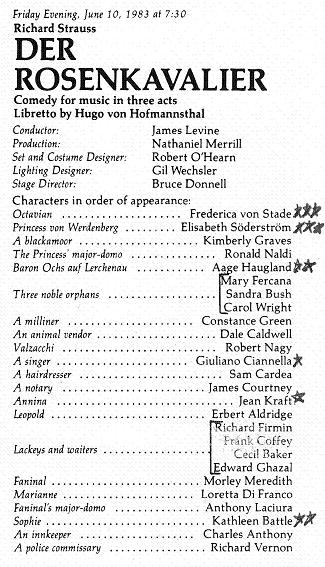
    IMG
    …in Boston, which I was lucky enough to attend. Unfortunately one of my most vivid memories of the evening was the presence of some people sitting about six rows behind me who talked throughout the performance. Even though I had sprung for an orchestra seat – the better to concentrate on the array of vocal talent onstage – these people served notice that sitting in expensive seats doesn’t make you classy. They were continuously being shushed by people around them (as annoying as their talking, actually) and the usher came to admonish them at one point. Apparently they had some sort of clout that kept them from being ejected; at any rate, they spoiled a great performance. I’m sure they are all dead now, and good riddance.

    Despite this major distraction, the performance was extremely moving and superbly sung. Maestro Levine, whose 1976 ROSENKAVALIER broadcast had seemed sluggish and thick-textured orchestrally, was now fully in his element with the Strauss score. The towering Aage Haugland – a great favorite of mine during his Met career – was a grand Baron Ochs, and Miss Battle was a shimmering-voiced Sophie.

    It was the vocal and theatrical chemistry between Elisabeth Söderström and Frederica von Stade that gave this ROSENKAVALIER its unique appeal. Their older women/younger man romance was brilliantly portrayed, while their distinctive vocal timbres served their respective characters to perfection. By this point in time, the Söderström voice was an expressive rather than opulent instrument, but she truly knew her way around this music and her singing was so meshed with the character’s moods – it was simply all of a piece. In the monolog, she poked fun at herself as “die alte frau, die alte Marschallin“, sung with a crackly old-lady sound. Telling Octavian that he will soon tire of their romance, she seized von Stade by the shoulders, trying to shake some sense into him. The Söderström Marschallin was an unforgettable mixture of dignity, bitterness, and nostalgia: a woman who watches something cherishable slipping thru her fingers and finds the courage to let it go.

    Frederica von Stade, with her immaculately tailored sound, was boyish and impetuous in behavior. and her vocalism was always elegant and wonderfully personal. Other Octavians – Ludwig (my first!), Baltsa, Troyanos – have sung this music in grander style but no other Octavian of my experience has quite captured the coltish confusion of a boy on the brink of manhood who has a loving heart and a tender, noble young spirit…which von Stade showed us so memorably.

      Battle-Soderstrom

    While the Söderström/Battle/von Stade collaboration was never heard in a complete public performance of ROSENKAVALIER here in New York City, the three women did perform the opera’s Act III trio at the Met’s 100th anniversary gala. The day-long celebration was telecast live; I attended the matinee portion and can attest to the palpable atmosphere in the house as the three women sang this magical Strauss creation. You can listen to them here, with Levine on the podium.

    For years, I assumed this film clip was the only extant souvenir of this unforgettable convergence of voices – though I am sure someone recorded it someplace along the tour’s path – but recently my friend Ben Weaver surprised me with recordings of the first and third acts in very good sound from a rehearsal at the Met just before the tour commenced. Someone there had the presence of mind to realize that this was a rarity in the making and that Ms. Söderström’s Marschallin was a jewel worth preserving; and so this valuable sound document has come down to me, some thirty years after the event.

    Elisabeth Söderström – monolog from ROSENKAVALIER~Act I – Levine cond – Met stage rehearsal 1983

    Flicka octavian

    Frederica von Stade (above) regrettably never sang a complete Octavian at The Met – though she did sing a gorgeous Rose Presentation duet with Judith Blegen on the same gala programme as the filmed clip above.
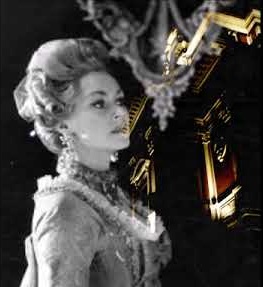
    E S

    In 1987, Elisabeth Söderström made her ‘first’ Met farewell singing the Marschallin on a Saturday matinee which was broadcast. That was a very moving experience, yet it has always been the Boston performance that’s stayed so clearly in my mind. The magic of the Söderström Marschallin is so perfectly distilled in the closing moments of Act I, where her ‘silberne rosen‘ takes on a ghostly patina of lyrical regret and resignation.

    Elisabeth Söderström – Die silberne rose – 1st Met farewell 2~21~87

    ~ Oberon

  • Rehearsal: Cherylyn Lavagnino’s Monsters of Grace

    IMG_7835a

    Above: Dorrie Garland and Dervia Carey-Jones of Cherylyn Lavagnino Dance

    Monday November 26th, 2019 ~ In the early afternoon, I went down to the NYU/Tisch studios where Cherylyn Lavagnino was running a rehearsal of her latest creation, Monsters of Grace, set to the aria “In The Arc of Your Mallet” from the almost-forgotten Philip Glass opera Monsters of Grace.

    Here is the text of the aria, drawn from the writings of the Persian poet and scholar Rumi (1207-1273):

    “Don’t go anywhere without me.
    Let nothing happen in the sky apart from me,
    or on the ground, in this world or that world,
    without my being in its happening.
    Vision, see nothing I don’t see.
    Language, say nothing.
    The way the night knows itself with the moon,
    be that with me. Be the rose
    nearest to the thorn that I am.
    I want to feel myself in you when you taste food,
    in the arc of your mallet when you work,
    when you visit friends, when you go
    up on the roof by yourself at night.
    There’s nothing worse than to walk out along the street
    without you. I don’t know where I’m going.
    You’re the road, and the knower of roads,
    more than maps, more than love.”

    It seems very…contemporary, doesn’t it?

    And here are some photos from the rehearsal, courtesy of Cherylyn Lavagnino Dance:

    IMG_7826

    Dervia Carey-Jones, Dorrie Garland, Kaitlyn Yiu, and Lila Simmons

    IMG_7837

    Corinne Hart and Dervia Carey-Jones

    IMG_7853

    Kaitlyn Yiu and Dorrie Garland

    IMG_7854

    Kaitlyn and Dorrie

    Cherylyn’s choreography strikes me as ideally suited to the music; the ballet has the feeling of ritual…a feeling I love.

    My thanks to Cherylyn and her beautiful and generous dancers Dervia Carey-Jones, Dorrie Garland, Corinne Hart, Lila Simmons, and Kaitlyn Yiu for this engaging studio experience.

    ~ Oberon

  • Rehearsal: Cherylyn Lavagnino’s Monsters of Grace

    IMG_7835a

    Above: Dorrie Garland and Dervia Carey-Jones of Cherylyn Lavagnino Dance

    Monday November 26th, 2019 ~ In the early afternoon, I went down to the NYU/Tisch studios where Cherylyn Lavagnino was running a rehearsal of her latest creation, Monsters of Grace, set to the aria “In The Arc of Your Mallet” from the almost-forgotten Philip Glass opera Monsters of Grace.

    Here is the text of the aria, drawn from the writings of the Persian poet and scholar Rumi (1207-1273):

    “Don’t go anywhere without me.
    Let nothing happen in the sky apart from me,
    or on the ground, in this world or that world,
    without my being in its happening.
    Vision, see nothing I don’t see.
    Language, say nothing.
    The way the night knows itself with the moon,
    be that with me. Be the rose
    nearest to the thorn that I am.
    I want to feel myself in you when you taste food,
    in the arc of your mallet when you work,
    when you visit friends, when you go
    up on the roof by yourself at night.
    There’s nothing worse than to walk out along the street
    without you. I don’t know where I’m going.
    You’re the road, and the knower of roads,
    more than maps, more than love.”

    It seems very…contemporary, doesn’t it?

    And here are some photos from the rehearsal, courtesy of Cherylyn Lavagnino Dance:

    IMG_7826

    Dervia Carey-Jones, Dorrie Garland, Kaitlyn Yiu, and Lila Simmons

    IMG_7837

    Corinne Hart and Dervia Carey-Jones

    IMG_7853

    Kaitlyn Yiu and Dorrie Garland

    IMG_7854

    Kaitlyn and Dorrie

    Cherylyn’s choreography strikes me as ideally suited to the music; the ballet has the feeling of ritual…a feeling I love.

    My thanks to Cherylyn and her beautiful and generous dancers Dervia Carey-Jones, Dorrie Garland, Corinne Hart, Lila Simmons, and Kaitlyn Yiu for this engaging studio experience.

    ~ Oberon