Category: Opera

  • LA GIOCONDA ~ Barcelona 1978

    gulin gioconda

    Above: Ángeles Gulín as Gioconda and Montserrat Aparici as Cieca

    A slam-bang performance of one of my favorite Italian operas, LA GIOCONDA, from the Liceu, Barcelona, in 1978. The singers simply go at it.

    Watch and listen here.

    Gioconda: Ángeles Gulín; Laura: Bruna Baglioni; Cieca: Montserrat Aparici;  Enzo: Nunzio Todesco; Barnaba: Sabin Markov; Alvise: Ivo Vinco.

    I only heard Ángeles Gulín live once: she sang Valentine in HUGUENOTS at Carnegie Hall in 1969; Beverly Sills was Marguerite de Valois and Tony Poncet was Raoul. Ms. Gulín had an enormous voice and she used it unsparingly.

    This GIOCONDA has the right knives-out, heart-on-sleeve passion. It’s that kind of all-or-nothing opera. As Gioconda sings of her love for Enzo in Act I: “My destiny is this: to love him, or to die!”

    ~ Oberon

  • @ My Met Score Desk for BARBIERE DI SIVIGLIA

    Barbiere_jonathan tichler met opera

    Above: Jack Swanson as Count Almaviva and Andrey Zhilikhovsky as Figaro; a Jonathan Tichler/MET Opera photo

    Author: Oberon

    Saturday May 31st, 2025 matinee – With the exceptions of Aigul Akhmetshina and Alexander Vinogradov, all the singers in this afternoon’s Met matinee of Rossini’s BARBIERE DI SIVIGLIA were new to me: not only had I not heard them before, I hadn’t even heard of them. On the podium, Giacomo Sagripanti was also unfamiliar to me.

    Barbiere_aigul and kalman tichler met opera

    Above: Aigul Akmetshina as Rosina and Peter Kálmán as Dr. Bartolo; a Jonathan Tichler/MET Opera photo

    It turned out to be a very worthwhile afternoon, not just because of the infectious rhythms and sheer brilliance of the score, but it also served to take my mind off – at least for the duration – of a looming domestic falling out. 

    In his Met debut season, Giacomo Sangripanti proved a deft Rossini maestro; his tempi seemed lively but never rushed, he never let the orchestra encroach on the singers volume-wise, and he allowed some added notes and embellishments from the singers, which is always fun. The orchestra played the overture swiftly and brightly and solo passages for oboe, horn, clarinet, and bassoon were all beautifully played.

    Joseph+Lim+Baritone

    The first voice to be heard was that of baritone Joseph Lim as Fiorello, and he made an excellent impression. In the past he has covered some roles at The Met (and he’d sung one of the Flemish Deputies in a DON CARLO I attended); I think he deserves more stage opportunities. After I got home and took a look at some of his on-line photos (there’s one above), I realized he had been at the stage door talking with friends after the performance. I wish I had chatted him up. 

    The lovely orchestral intro to Lindoro’s serenade set the scene for the very appealing singing of Jack Swanson as Count Almaviva, who had just made his Met debut in the opera’s previous performance. His singing is technically neat, with nice phrasing and an enticing dynamic range. The audience took to his singing at once, and he was warmly applaud throughout the performance.

    Mr. Lim’s voicey Fiorello was again heard, and then Figaro, in the person of Andrey Zhilikhovsky opened his afternoon with a fantastic “Largo al factotum” bringing some subtle touches to the familiar piece, along with blooming top notes. He was unfazed by the super-fast tempo of the aria’s final section, polishing it off with a splendid, Met-sized high note. The house rang with cheers from the crowd, who seemed thoroughly engaged in the opera’s every note and word.

    A special bouquet here to the excellent harpsichordist, Liora Maurer, who kept reminding us all afternoon of the instrument’s charm. The big-toned bass voice of  the Hungarian Peter Kálmán asserted itself briefly, and then Mr. Swanson rewarded us with more poised lyricism with “L’amoroso sincero Lindoro”, to which Ms. Akmetshina briefly replied before being whisked from her window. Mssrs. Swanson and Zhilikhovsky now set up their plan to gain access to the Count’s beloved; their duet features some fluent coloratura from the baritone, in which the tenor joins; the pair harmonize to fine effect. Figaro urges the Count to play drunk when they gain admitance to the Bartolo household; the pair have more mirthful, high-speed singing, and then Mr. Swanson tops the first scene off with a golden high note.

    Ms. Akmetshina’s “Una voce poco fa” showed off the warmth and depth of her luscious low range, along with engaging fiorature and some bright top notes; her singing flows on thru her playful warning that anyone who tries to cross her will pay for it. Another excited burst of applause was her reward. Mr. Kálmán’s prodigious bass returns…

    Vinogradov

    …and we then meet the imposingly sung, characterful Don Basilio of Alexander Vinogradov (photo above). His “Calunnia” aria is full of insinuating inflections, but is always sung rather than giving in to buffo-parlando. His thunderous colpa di canone” shook the house, and then a mini-cadenza took his voice high before plunging to the deepest depths…once again, fervent applause burst forth, filling the hall.

    The wonderful Rosina/Figaro duet, “Dunque io son” found Aigul throwing in some extra top notes; Mr. Zhilikhovsky suggested she write a love note to her Lindoro, which – she slyly replies – she’s already done. Their duetting is speedy, laced with humor, and filled with luscious tone.

    I’m beginning to feel the severe chill that almost always affects enjoyment of the opera up in the score desk area. Mr. Kálmán’s “A un dottor della mia sorte” blends power with insinuation in a buffo tour de forceIt concludes with the basso’s perfect pattering and a hilarious finish capped by a massive final note.

    We briefly meet the house-keeper Berta, usually sang by a mezzo but today taken on by soprano Kathleen O’Mara; the change in range will bring some fun in her aria later on. 

    The ensemble “Fredda ed immobile” was the part of the opera I liked most when I first heard it live (as “Frigid and motionless“) at Lake George many, many moons ago. The puttering introduction and Aigul’s chesty lead into the long, riotous Act I finale held my interest, but by now I was literally shivering, so I thought of going home.

    But then a young Frenchman, Guillaume – visiting New York City for the first time – stopped by to chat and next thing I knew, Act II was about to  start.

    Ms. Akhmetshina turned Rosina’s music lesson aria, “Contro un cor” into  a real showpiece, capped by a brilliant top note, whilst Mr. Vinogradov added some extra low notes to Basilio’s music. Mr. Kálmán expressed Dr. Bartolo’s fury vibrantly.

    O'mara

    Ms. O’Mara (above, at the 2024 Operalia competition, where she won 1st prize) added some embellishments to Berta’s aria, along with interpolated top notes, including a real zinger at the end.   

    As the opera moves towards its ending, I must again mention Maestro Sangripati’s excellence; the music truly seemed so alive

    The charming “Zitti, zitti” trio was neatly dispatched by Ms. Akhmetshina and Mssrs. Swanson and Zhilikhovsky, and then the tenor took on the demanding “Cessa di piu resistare” with its beautiful andante, which segues into an elaborate tenorized setting of what sounds very much like the finale of LA CENERENTOLA. Mr. Swanson capped his impressive afternoon with a final top note, superbly sustained, igniting a tumultuous ovation during which each cast member evoked shouts of approval. 

    I very much enjoyed seeing Aigul again after the show, and she signed my program:

    Barbiere signed-1jpg
    I had wanted to meet the other singers, but either I didn’t recognize them in time to approach them, or they seemed preoccupied.

    ~ Oberon

  • Fernando Teixeira’s Stunning PAGLIACCI Prologo

    Teixiera

    The great Brazilian baritone Fernando Teixeira (above) sings a magnificent PAGLIACCI Prologo from a performance given at Rio de Janeiro in 1979. David Machado conducts.

    Listen here.

  • Jo Ann Pickens as Cleopatra

    6a00d8341c4e3853ef026bdecd1436200c-320wi

    American soprano Jo Ann Pickens sings Cleopatra’s two arias from Samuel Barber’s ANTONY & CLEOPATRA: “Give Me Some Music” and “Give Me My Robe, Put on My Crown”.

    The recording is from a live radio broadcast from the 1982 Spoleto Festival. Cal Stewart Kellogg conducts the Spoleto Festival Orchestra.

    Listen here:

  • Egon Schiele Goes to Prison

    ~ The Austrian Expressionist has been having a moment with gallery goers. Now his life is an opera.

    by Andrew Kupfer

    Schiele in prison

    In 1963, when she was 29, Alessandra Comini was in Neulengbach, Austria, hunting for Egon Schiele. Or rather for his prison cell. An art historian, Comini was in the country for graduate school, and she knew that in 1912, long before the Nazis dubbed his art degenerate, Schiele had been jailed for obscenity—the only European painter ever to have been imprisoned for his work. She also knew from his prison diaries that his basement cell had bars widely enough spaced to toss an orange between them, as Schiele’s lover had done when he was incarcerated. And on this day she had a hunch the old municipal building she was standing before was the right place. She approached the caretaker. He refused to let her in, claiming the former cells held important government papers.

    She left, but loitered nearby. At lunch she noticed a stream of workers leaving the building. “So I did what we used to do to sneak into the movies when we were kids,” she told me. “I stood in the crowd as they exited and slowly walked backwards into the building.” She popped down the stairs and found six doors. On the inside of the second were the carved initials of Schiele’s predecessor, just like in one of Schiele’s prison watercolors. She had found it. As she was leaving, she looked for the government documents. “There were no papers,” she recalls. “Only firewood.”

    Ten years later, that story led to a book, Schiele in Prison, her first of three about the artist. And now that book has inspired an opera by Jared Schwartz, 43, the all-around musical polymath who composed the score and wrote the libretto.

    Jared 3

    Above: Jared Schwartz

    A century after he created them, Schiele’s paintings still have the power to shock. They are unflinching, raw, frank, and altogether unsettling, and they challenge the visitor to experience emotions one usually doesn’t feel when viewing a painting, like disgust. In a way, they are car-crash art: one can hardly bear to look and yet one cannot look away. Drama is inherent in the images.

    What better subject for an opera?

    The project came to fruition about four years ago when a friend and collaborator of Schwartz introduced him to Comini, who broached the idea of an opera. The more he heard the more he liked it. He began composing, meeting with Comini once or twice a week to talk through their ideas. And she provided him with a budget. With that funding, and with the Neue Gallery in New York as a presenting partner, Schwartz mounted a workshop production of Schiele in Prison in January. And I got to see the rehearsals.

    How I happened to be there was a bit of serendipity. Schwartz was staying with an old friend of mine while he was running the rehearsals, and I passed on word that I’d love to sit in one day. I was struggling to write a show of my own and was hoping to see first-hand how an opera might come together. He kindly wrote to say I could come to whatever rehearsals I wished. I think both he and I were surprised that I ended up coming to all of them, every day for two weeks. But after the first rehearsal, I was curious to see what happened next, and after the second or third came a compulsion to see how it all turned out. The singers seemed to accept me as part of the furniture. And here I was with a thrilling opportunity—to witness a group of supremely talented people at the top of their profession as they created a work of art.


    Any opera goer can tell you of the electrifying moment when a well-tuned chorus reaches full voice and fills a hall with sound. To encounter those vocal forces in a small rehearsal studio from a distance of three feet is an altogether different experience. Within two seconds, the thoughts going through my head in quick succession are (1) OHMYGOD THAT’S LOUD (2) People can do that? (3) Is this safe?

    It was also gorgeous. And art isn’t supposed to be safe anyway. In other words, this first impression is a good aural metaphor for Schiele’s art. Schiele in Prison aims to subvert the common conception of the painter as a twisted curio, showing him as a courageous idealist. And that changes how we see the paintings.

    The opera opens in the basement cell where Schiele served his sentence—and where Schwartz spent a night to steep in the atmosphere. He likens the experience to being in a tomb. “It was terrifying,” Schwartz says. “Schiele was only there for 24 days, but for the first 21, he didn’t know how long he would stay. I knew I could leave, but even so I felt panicked and choked.” Along with Schiele’s prison diaries, the visit informed Schwartz’s libretto.

    From there Schwartz moves back in time through the watershed events in Schiele’s life. First Schiele (played in the workshop by Colin Levin) and his younger sister (Christa Dalmazio) try to navigate their fraught childhood in a home dominated by an unbalanced father who had conversations with people who weren’t there. Schiele then bristles against the orthodoxies of art school, impulsively quitting and seeking the mentorship of Gustav Klimt (Bert Johnson). He visits his lover, Max Oppenheimer (Hans Tashjian), an artist, who laments that Schiele doesn’t have the courage to be open about his bisexuality. The scene shifts to the flat he shares with his other lover, Wally (Soon Cho), his model and muse; she would be with him during the pivotal event of the story, when police arrive in search of a young girl who had earlier taken shelter there. The police find not the girl but Schiele’s paintings. “What is this filth?” ask the police. “My art,” replies Schiele simply, again and again.

    Next comes the wild heart of the opera, a kaleidoscopic spectacle in which the cast morph into townspeople attending a show of Schiele’s art. As they gather at the gallery, they hold masks to their faces in a display of piety. They lower them as they are seized by deliriously obscene desires, accosting Schiele’s agent to buy one or another of the erotic works that best fits their masturbatory, armpit-licking fantasies. The ensemble leaves the scene en masse, swirling from the gallery into Schiele’s jail cell, at which point the audience will realize that the scenes from Schiele’s life had all been conjured by the artist as he sat in prison. The opera ends as it began, with Schiele, defiant, defending his art.


    I don’t think of high school very often, but during the fortnight of rehearsals I remember a lesson in my physics class on the difference between constructive and destructive interference in sound. When sound waves from two sources—a tenor and a baritone, say—are perfectly in synch, they combine, producing a larger crest and delivering a louder sound than the sum of the two waves on their own. If they are even slightly out of synch, with one wave sliding toward its trough as the other peaks, they partially cancel each other out, and the perceived sound diminishes, which is one reason why a professional chorus can sound louder than a chorus of talented amateurs three times its size.

    It is that synchronic confluence of voices that nearly knocks me out of my seat on the first day of rehearsals. What follows from that salvo is a primer on how to mount a show, which, for anyone interested in process, is fascinating in its granular detail and has me canceling all my other plans for two weeks. The rehearsals start with the gallery scene, musically the most demanding in the show, with almost the entire ensemble in action. Each day brings a new section, with the action usually returning to the gallery scene in any spare moment. Emphasis shifts throughout. The early days focus on musical phrasing and clarity of diction—bite off your words so the listener can tell when they end, music director Richard Cordova, cajoles the players again and again—which, with 11 people singing at once, is a challenge. When they do, the sound pops.

    That the cast’s voices align so well is a function of how Schwartz worked with them in the weeks before the group rehearsals, meeting with the singers one-on-one to go over their parts. If something didn’t sit well with their voice, Schwartz made revisions to the score at the piano as they rehearsed. These deft on-the-fly touches helped give the singing its power.

    As the rehearsals progress, the focus widens to take in dramatic presentation, fine-tuning gesture and attitude. Jim Brown, the staging director, works with Schiele’s demented father to sharpen his insanity. “Sometimes you glance over to your family when you’re supposed to be talking to your imaginary guests,” says Brown. “It seems like you’re talking to your wife.” David Mejia, as the father, adjusts, boring in on his phantoms.

    Over the course of the first week, Brown layers in blocking and choreography, with movements that are clever enough to add doses of attitude and humor but simple enough for a group of non-dancers to master quickly. In the gallery scene, he deploys the cast for an assault on the sensibilities of a prim and proper Vienna. “In the third bar of the fanfare the lights will come up,” he explains. “You can’t wait to see this debased art. You run in and see the audience, and you stop dead. You put up your masks because you don’t want them to see you.” Brown has them march in time to the music, and, as they sing “We are the people who Run. This. Town!” they point to themselves on each word, a gesture that gives the crew a collective moxie. Whenever they walk backward—which is often—they lean forward, and when they move ahead, they lean back. “Contraporto!” Brown exclaims. “Remember, the more precise it is, the funnier it is.”

    Indeed, if the earlier scenes are alternately harrowing and moving, the gallery scene is raucous fun. Brown encourages improvisation. “We want various sexy poses,” he says. “So meet your scene partners!” The tableau instantly transforms into a Bosch painting, if the figures in a Bosch painting could bump and grind. A soprano immediately stands behind a tenor and bends him forward at the waist. Another duo entwine limbs and gyrate as they hocket. Later, during a solo, a tenor gives a pelvic thrust. “And when you say ‘erotic’, you need another pelvic thrust,” says Brown. “More pelvic thrusts!” Each time they run the scene, the improv is different, and just a bit raunchier, and it’s a hoot to see how inventively the cast use dramatic muscles opera singers don’t often get to flex.

    In week two, rehearsals move to the performance venue, and a string quartet joins the company, marking the first time all the singers and musicians are in the same place at the same time—the so-called sitzprobe, or seated rehearsal, where the entire ensemble gathers to run through the music. It’s the one day of rehearsals I miss; I have finally come down with the fluey illness that has been tearing through the cast, forcing a few to rehearse by Zoom some days. The new venue is as different from a dank basement prison cell as you can imagine—an urban sky mansion in the old headquarters building of the Carl Fischer music publishers, now condominiums, this one the property of Jim St. George and Mark Sullivan, tech philanthropists who frequently use the space to help creators mount workshop productions of new shows.

    Schwartz is now at the keyboard—which will be his station for the performances—and he is worried about the balance between the piano and the strings; he plays with enough power to drown out the quartet if he doesn’t take care. In fact, he had been on track to be a concert pianist till he was 18 and damaged the tendons in his right wrist playing tennis, necessitating surgery; it was months before he could play again, and the wrist was never the same. “It’s my first string quartet,” he confesses. “But I started playing the violin when I was 5. And then the viola. And then the cello.” Wait—you play the violin, the viola, the cello, and the piano? “And the French horn, too. And a whole bunch of other instruments,” he says. He’s also a singer, a lyrical bass. “I’ve just really loved music since I was 3.”

    Tweaks and adjustments continue through the dress rehearsals. Brown adapts the choreography to the new space. It’s a vast, open-plan layout, but there are some immovable obstacles—on the left a marble coffee table that reminds me of the altar in The Brutalist (if you haven’t seen The Brutalist, it’s a hunk of Carrara marble that had to be winched into place), on the right a kitchen island. In the dress rehearsal, the pace picks up, with no time to work passages and with tweaks made on the spot.

    During a run-through of the phantasmagoric fifth scene, Schwartz declares from the piano: “You’re getting this wrong every single time!” Someone was singing the old version of a passage that Schwartz had changed a few days before. He repeats the section, and suddenly dashes from the keyboard to the choral scrum with the hint of a smile and sticks his ear an inch from the mouth of each vocalist, like the round, flat mike in a recording session. He returns to the keyboard mollified; he’s a perfectionist. “I knew I had to do something outrageous to get their attention,” he admits later. “As a music director, I have very high standards, and I offer high support. I also have a lot of fun.” Schwartz agrees with my impression that the singers were having fun too. “Every single person in the cast really wanted to be there. They really wanted the show to work,” Schwartz says. “That’s not normal. Usually most people are there to do the gig.”

    Performance day arrives. Well suited to the venue are the plummy complement of invited guests. A good number of them have come from Austria. The cast negotiate the obstacles and sail past the odd glitch and dropped line with no one in the audience who hadn’t sat through 50 hours of rehearsal any the wiser. “All I could hear is every wrong note I played at the piano,” Schwartz tells me afterwards. “But the piece is compelling and powerful, even in a living room, even in rushed circumstances.” The first show marks the birthday of Professor Comini. At the end Colin Levin, who plays Schiele, pulls her up to take a bow with the cast. She nearly topples over—she is 90 that day—but she holds her ground, as she did all those years before in Neulengbach.

    Now come revisions and the hard graft of finding backers and a producer. Europe is the most likely site for a fully staged performance; the opera is a little too racy for, say, Texas. Schwartz plans to restore some material that he removed for the workshop performances. “I tamed it down. I didn’t want penises out in Mark and Jim’s living room. It’s too small a space,” he says. “But all the nudity and masturbation will have to be there for Europe. I’ll have to get back into the score and make it scandalous again.”

    So more creative tests lie ahead. A workshop—even a terrifically exciting one—is just a first step.

    ~ Andrew Kupfer is a writer and editor in New York City.

  • A Late-Season BOHEME @ The Met

    Met boheme may 2025 ~ MET Opera photo

    Above, today’s BOHEME cast: Anthony Clark Evans, Gabriella Reyes, Dmytro Popov, Sean Michael Plumb, Corinne Winters, and Alexander Köpeczi; a MET Opera photo

    ~ Author: Oberon

    Sunday May 25th, 2025 matinee – A cast largely new to me brought me to the Met this afternoon for yet another BOHEME. It proved to be one of the most moving BOHEMEs I have ever experienced, and it brought us the Mimi of an extraordinary soprano, Corinne Winters.

    Opening my Playbill today, I was surprised to find that Yannick Nézet-Séguin was listed as the conductor. I was quite certain that he had not originally been scheduled, and sure enough – in checking the season brochure – it was to have been Riccardo Frizza. I was annoyed at the prospect of Y N-S ruining the afternoon with his tendency to overwhelm the singers with volume from the pit. There were passages where this happened today, but to me he was more attentive than usual to the voices. (Chatting with folks at the stage door after the show, the general feeling was that the orchestra was often too loud.)

    The quartet of Bohemians today was exceptionally pleasing. Tenor Dmytro Popov as Rodolfo had made a very fine impression in this role last season, and he was equally appealing today. The two excellent young baritones in the cast were Anthony Clark Evans as Marcello and Sean Michael Plumb as Schaunard.

    Alexander Köpeczi

    And the Hungarian-Romanian basso Alexander Köpeczi (above) was making Met debut this afternoon as Colline; I’d lately read about him and have watched some of his video clips on Facebook….very impressive!

    A favorite with Met audiences, Gabriella Reyes, was a warm-toned, lively Musetta, and in Corinne Winters we had one of the most moving Mimis of my (extensive) experience; she had first appeared at the Met in 2011 as Countess Ceprano in RIGOLETTO, but today really felt like a Met debut – and an extraordinary one at that.

    Curtain up, and Mr. Evans’ rich tone gets the singing off to a great start; Mr. Popov immediately shows off a finely-projected lyric tenor. They are joined by Mr. Köpeczi, his darkish, handsome timbre will keep the music gorgeously anchored all afternoon. And then Mr. Plumb makes his mark with a voice that will bring Schaunard to prominence as the opera unfolds. Evans/Marcello baits the Met’s go-to Benoit – Donald Maxwell – and then he and his pals head out to Cafe Momus, leaving Mr. Popov momentarily alone. A knock at the door brings Corinne Winters’ Mimi onto the Met stage: the beginning of a captivating performance from this fascinating singer. Her sound and style are Italianate, and the voice carries beautifully in the big space.

    Mr. Popov’s “Che gelida manina” is lovingly phrased, with persuasive dynamics and a true sense of the poetry. The conductor is not really supportive, but the tenor fares very well anyway, with a nice top-C. Then Ms. Winters commences Mimi’s narrative, in the course of which both Rodolfo and myself will fall in love with her. Clear-toned lyricism is a Winters trademark; her lower range distinctive, her word-colourings always fresh and appealing. The orchestra is much too loud at the start of the love duet – and must the audience laugh at every single title as love blooms between poet and seamstress? But the singing is so convincing as the couple experience the delight of new-found happiness. The act ends on a long-held, harmonized note. Magic!

    The scene-change lasts so long, they might as well make it an intermission: the mood has been shattered anyway. Mr. Popov makes the most of every note and word as he introduces Mimi to his friends…and the tenor makes something special out of “…sbaccio l’amor!” The children’s chorus have fun with their calls of “Parpignol…Parpignol!” and Mssrs. Evans, Plumb, and Köpeczi seize upon every note to keep their characters engaging us in this crowded staging.

    Musetta arrives in the person of Gabriella Reyes, and, as she settles in after some initial commotion, Ms. Winters and Mr. Popov have a lovely exchange. Then Ms. Reyes launches the waltz, full of allure and insinuation. The soprano shines in this aria, capping it with a house-filling top-B. Anthony Clark Evans then encores the melody with baritone-power, leading to a massive climax. The parade passes thru: the last joyous moment of the opera.

    Following an endless interval, the prelude to Act III was nicely and subtly played by the Met orchestra. Ms. Reyes’s sweet lyricism recalls her waltz, and then the hapless Mimi appears. From her first hesitant line, Corinne Winters captures every nuance of Mimi’s plight with her touching, expressive singing. Finding Marcello/Evans, the soprano and baritone are simply wonderful in their duet: clear, emotionally-charged singing from both. The soprano is spectacular here, her timbre and way with the words would make you swear you’re listening to an Italian prima donna

    As Mimi hides, Mssrs. Popov and Evans have a telling exchange, superbly voiced despite some over-playing from the pit. Then the tenor confesses his fears about Mimi’s health with “Mimi a tanto malata…” which continues to his outpouring of truth at “Una terrbil tosse“. Mr. Popov saturates these passages with passionate despair…bravissimo!

    Mimi steps forward to the sound of a theme full of heartbreak, and Ms. Winters is infinitely touching in Mimi’s farewell, “Donde ieta usci...”, so beautifully phrased and coloured, her lower range so evocative, her crushing final words gorgeously intoned, with a lingering last note that vanished into the air like a whispered goodbye. 

    Rodolfo/Popov seeks to mend things; the couple remind one another of the things they love – and hate – about each other. Meanwhile, Musetta and Marcello are having their own battle royale. In the ensemble, the sopranos pour out vibrant sounds. Then, alone again, Mimi and Rodolfo resolve to stay together: Mr. Popov’s ravishing “…stagion di fior...” true poetry.

    After a pathetic second intermission wherein most of the audience stayed in their seats, twiddling their thumbs, we have the reminiscing duet of Rodolfo and Marcello, recalling happier days: wonderful singing from the Popov/Evans team; and though the orchestra encroached for a spell, it ended with soft musing. Bravi, gentlemen! 

    Now the four Bohemians reunite; recalling past good times together, they party, all singing lustily. Mr. Plumb again impresses here. They dance, and duel, until suddenly Musetta bursts in, bringing with her the dying Mimi. In this heart-stopping moment, time seems to stand still. Ms. Winters brought forth a wealth of detail in her singing here, from the outpouring of Si rinasce…” to her wistful greeting of each of the Bohemians: “Tutti qui...”  

    Mr. Köpeczi sings Colline’s wrenching farewell to his old coat, hauntingly recalling it as his longtime companion thru good times and bad…the basso’s resonant voice, loaded with emotion, sounds marvelous in the big house. Bravissimo!

    Finally left alone with Rodolfo, Ms. Winters seals her fascinating performance with her heart-rending singing of “Sono andanti…?”  Pure poetry here, her lower range battering my heart with its unique incandescence.

    The mood was somewhat spoilt by audience members laughing at the title/translations…they should by turned off by this point. But Ms. Winters restores proper dignity when she finds Mimi’s pink bonnet under the pillow, inducing a flow of memories. And then she sleeps away.

    The curtain calls were lovely today, each singer warmly greeted as he/she stepped before the gold curtain in this, one of the last two Met productions wherein curtain calls involve an actual curtain. Ms. Winters was deservedly cheered for her engrossing performance.

    Boheme may 2025-1 jpg
    Above: a sizeable crowd gathered at the stage door to greet the singers, and I was very happy to re-connect with tenor and voice teacher Jason Ferrante, who I’d met when he was at Julliard and I worked at Tower Records. Ms. Winters is one of Jason’s longtime students. I met Ms. Reyes, and Mssrs. Evans, Plumb, and Köpeczi (how Mr. Popov managed to slip by me I am not sure). And Ms. Winters’ personality is as lovely as her voice; she seemed genuinely moved by the audience’s response to her performance this afternoon. 

    All in all, a wonderful afternoon at The Met…an afternoon that recalled another such day – many, many seasons ago – when I fell in love with Jeannette Pilou. Today, Corinne Winters cast a similar spell over me. She was so kind as I tried – so clumsily – to express my admiration.     

    ~ Oberon

  • John Adams: ANTONY & CLEOPATRA @ The Met

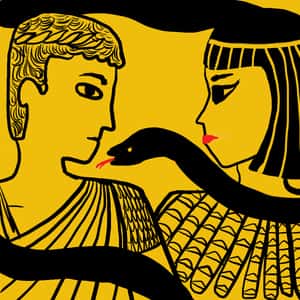
    Antony-and-cleopatra

    ~ Author: Oberon

    Saturday May 24th, 2025 matinee – I hadn’t originally planned to go to a performance of John Adams’ Antony & Cleopatra, but some singers I especially like were in the cast, so I got a score desk – even though I was scoreless – for today’s matinee. My previous experiences with the composer’s operas have both disappointed (though the second was enthralling for the first 40 minutes); you can read about my reaction to The Death of Klinghoffer here and to El Niño here.

    The Met’s first incarnation of the Shakespearean tale of Antony and Cleopatra was the opera by Samuel Barber which opened the New Met in 1966. In the late summer of that year, I had made my first solo trip to New York City in order to buy tickets to some of the performances in the first few weeks of the season, and Antony & Cleopatra was on my list. 

    On the evening of September 16th, 1966, in my little room in the little town, I was tuned in for the live broadcast of the new opera. I was on pins and needles because the Met Orchestra had announced an impending strike; they’d agreed to play the opening night as it was drawing international attention in the music world. Luminaries had flown in from other nations, and Lady Bird Johnson was to be the guest of honor. For two acts, I was feeling more and more certain that the performances I’d bought tickets for would never take place: rumors indicated that the standoff could not be resolved, and that both sides were standing firm. Then, before the start of Act III, Sir Rudolf Bing appeared before the gold curtain to announce that a settlement had been reached and to welcome the musicians back “as friends”. I ran screaming thru the house; my mother thought – not for the first time – that I was deranged. 

    On December 1st, 1966, I saw the last Met performance of the Barber Antony & Cleopatra to date. I’d learned a lot of the music from repeated playings of the reel-to-reel tape I had made of the opening night broadcast, and I was thrilled to experience the voices of Leontyne Price, Justino Diaz, Jess Thomas, Ezio Flagello, and Rosalind Elias in this music ‘live‘; I was able to silently sing along with them much of the time. 

    Though the Met never revived the opera, a production given at the Juilliard School, staged by Gian Carlo Menotti and conducted by James Conlon, kept much of the music intact, whilst introducing a love duet for the title-characters. Then, in 2009, the New York City Opera presented a concert performance of the Barber opera at Carnegie Hall, with Lauren Flanigan and Teddy Tahu Rhodes in the leading roles. Read about it here

    In the ensuing years, I’ve kept favorite passages of the opera in my mind: not just the big themes and the weighty arias, but the delicious (and later cut) scene for the eunuch slave Mardian and Cleopatra’s handmaidens, full of one-liners; the haunting, poetic beauty of Antony’s young attendant Eros’s suicide (“Thus do I escape the sorrow of Antony’s death...”), and most especially the opera’s original ending, with Charmian finishing Cleopatra’s last line, “What? Should I stay…?” “…in this vile world?  Now boast ye, Death, for in thy bosom lies a lass unparalleled…your crown’s awry! I’ll mend it, then play til Doomsday...” as intoned by the sumptuous voice of Rosalind Elias. And of course, the glorious sound of Leontyne Price is forever bound to the music of Cleopatra.

    Enough nostalgia, and forgive me for rambling on. 

    So this afternoon, I am sitting alone in the great darkened hall that had reverberated to the Barber score some sixty years ago, hoping to be similarly captivated by the new Adams opera. As it turned out, I was far more fascinated with the orchestral writing than with the vocal. The composer had written a very long program note, but the print was so small I could not read it. Even while the players were tuning and warming up in the pit, the sounds of such instruments as celeste, harmonium, harpsichord, mandolin, glockenspiel, vibraphone, tam-tam, flexatone (which creates glissando effects), and numberless bells, chimes, and drums, teased my ear. Adams put all of these to cunning use, creating textures that sustained my interest throughout the 90-minute first act.

    The composer reportedly stipulates that amplification of the singing be used when his operas are presented. It’s OK by me, but the mixing board (taking up one of the parterre boxes) sometimes allowed the voices to be covered by the orchestra despite the singers being miked. A few times, the lower range of Julia Bullock (Cleopatra) took on a reverb feeling from over-amplification. I also noted that the cast’s diction was not always clear.

    A restless orchestral prelude opens the opera, wherein Antony (Gerald Finley, the superb baritone) ignites Cleopatra’s fury when he tells her he must return to Rome due to the death of this wife, Fulvia. Between un-interesting vocal writing and patches where the singers were covered by orchestral volume, this scene was basically expendable. 

    A noisy interlude takes us to Rome, where Antony is greeted coolly by his ‘boss’, Caesar (the clear, lyrical tenor Paul Appleby). To patch things up between the two men, it is suggested that Antony marry Caesar’s sister, Octavia. Agrippa, the match-maker (sung by Jarrett Ott, whose clear diction was a joy) gives way to Enobarbus (that superb basso Alfred Walker) whose description of Cleopatra sailing on the Cydnus is more a sung narrative than a melodious “aria”. 

    Back in Alexandria, Cleopatra’s voicing of “O happy horse, to bear the weight of Antony!” is no match for Samuel Barber’s setting of the text, which Leontyne Price savoured so smoulderingly. Told by Eros (Brenton Ryan) of Antony’s marriage to Octavia sets off a wild reaction from Cleopatra, though it is expressed more by the orchestra than by Ms. Bullock’s parlando and her furious song, which goes on too long…though finely rendered by the soprano.

    After an orchestral interlude, a big, beaty, turbulent theme is launched as Octavia (the plush-toned mezzo Elizabeth DeShong) cannot decide between loyalty to her brother Caesar and the appeal of Antony. Tired of her vacillating, Antony divorces her on the spot and rushes back Cleopatra. Ms DeShong brings vocal glamour to her singing, though at times the orchestra covered her. Caesar’s fury at Antony’s treatment of his sister is another case of the fascinating orchestration trumping the vocal line. When Octavia/deShong reveals (with some gorgeous measures of vocalism) that she is pregnant, her brother declares war on Antony. 

    A wondrously wrought orchestral interlude leads to a musical depiction of a disastrous sea battle, in which Antony miscalculates and Cleopatra erroneously calls off her own fleet of ships; there is a brief vocal highlight wherein Mr. Finley’s lament blends with a soaring phrase from Ms. Bullock; but it’s over almost as soon as it begins. Lights flash thru the hall as the orchestra pounds away at themes of battle in an endless ending to the opera’s first act. 

    In the 90-minute span of this opening act, memorable vocal moments have been few and far-between, whilst the orchestra has shone brilliantly. The voices were there, ready to make much of the music, but the composer’s lack of “lyric musing” (program note) deprives them of opportunities.     

    ~ Oberon

  • Josef Jeongmeen Ahn ~ Pierrot’s Tanz-Lied

    Josef Jeongmeen Ahn

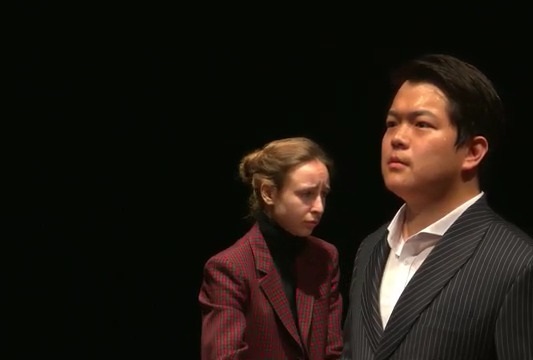
    Baritone Josef Jeongmeen Ahn sings Pierrot’s Tanz-Lied from Korngold’s DID TOTE STADT. The pianist is Nadia Kisseleva.

    Watch and listen here.

  • Jadwiga Rappé Has Passed Away

    Rappe

    One of my favorite contraltos, the Polish concert and opera singer Jadwiga Rappé (above), has passed away at the age of 73. Ms. Rappé performed at the most prestigious venues in Europe, Asia, and North America, and she leaves behind more than fifty recordings. She worked with such illustrious conductors as Chailly, Sir Colin Davies, Harnoncourt, Nagano, Janowski, and Antoni Wit.

    I first became intrigued by Ms. Rappé’s voice after hearing a recording of her singing in Krzysztof Penderecki’s Seven Gates of Jerusalem – a work in which she had sung the world premiere performance at Jerusalem in 1997 under the baton of Loren Maazel. In 2001, she sang the premiere performance of Wojciech Kilar’s Missa pro pace at Warsaw, conducted by Kazimierz Kord. Works were composed specially for her contralto voice by Juliusz Łuciuk, Piotr Moss, and Krzysztof Baculewski. In 2008, in Prague, she took part in the world premiere of Ladislav Kubik’s Gong ~ Sinfonietta for solo mezzo-soprano, Mixed choir and orchestra, and in July 2011 she premiered Paweł Mykietyn’s Symphony no.3 at the National Philharmonic in Warsaw.

    Jadwiga Rappé’s operatic repertoire included works by Gluck, Handel, Ponchielli, Verdi, Wagner, and Richard Strauss. Erda in Wagner’s RING Cycle was her most frequent stage role: she appeared in nine different premiere productions of the cycle at opera houses around the world, and she recorded the role for EMI under the baton of Bernard Haitink. She scored  successes as Gaea in Strauss’s Daphne, and as Clytemnestra.

    Her discography includes recordings on several labels: BMG Music, Teldec, Erato, Denon, Orfeo, Philips, Decca, Chandos, CD-Accords, and Naxos.

    After retiring from performing, Jadwiga Rappé taught at the Fryderyk Chopin University of Music, and later headed the board of the Witold Lutosławski Society.

    Ms. Rappé sings the aria “Weh ihnen, dass sie von mir weichen” from Mendelssohn’s ELIAS here.

    And here is “Zasmuconej” by Mieczysław Karłowicz.

    The contralto sings Cagion son io del mio dolore” from Handel’s SERSE here.

  • Irene Dalis as The Nurse

    Dalisobit-blog427

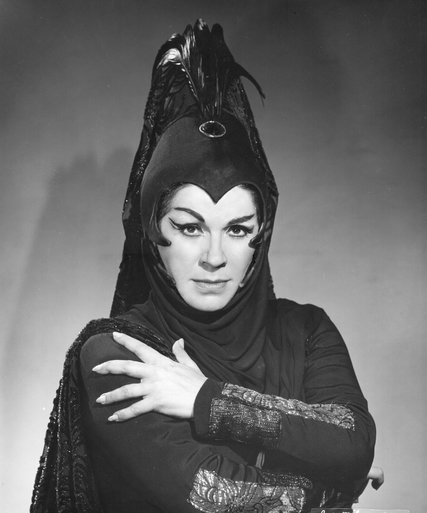
    The great mezzo-soprano Irene Dalis (above) found her most memorable role as The Nurse in Richard Strauss’s DIE FRAU OHNE SCHATTEN; I was fortunate enough to have seen her in this opera twice at The Met, and both times she simply dazzled in the fiendishly difficult vocal writing whilst creating a vivid theatrical portrait of this mercurial creature.

    The Nurse above all is devoted – to the point of obsession – to her charge: the half-human/half-spirit Empress, daughter of the mysterious and omniscient Keikobad. In the opera’s opening scene, the Nurse is visited by Keikobad’s messenger. The Empress has been married to the Emperor, a mere mortal, for one year, but as she still does not cast a shadow – the sign of her ability to bear children – Keikobad plans to re-claim her for the spirit world in three days. The Nurse is delighted, as she very much hates the Emperor; she longs to return to Keikobad’s realm.

    The Nurse asks what will become of the Emperor after the Empress is taken by her father; “Er wird zu Stein!” says the Messenger: “He will be turned to stone!” This prospect gives the Nurse even greater satisfaction: “He will be turned to stone!” she repeats. “There do I recognize Keikobad, and bow before him!”

    FRAU ~ opening scene – Irene Dalis & William Dooley – Bohm cond – Met bcast 1966

    January 23, 2017 | Permalink