Category: Opera

  • Beth Taylor @ Carnegie Hall

    The English Concert

    The Scottish mezzo-soprano Beth Taylor enjoyed a great success at her Carnegie Hall debut, singing Cornelia in Handel’s GIULIO CESARE with The English Concert.

  • Remembering Sixten Ehrling

    Ehrling

    When I had moved to New York City in 1998 and was working at Tower Records, Maestro Sixten Ehrling came in frequently. He was rather cranky the first time I met him: he did not guess that I knew who he was, and he barked at me that no one on the store staff had offered to help him. I let him cool down for a couple of seconds, then I made a small bow, and said: “You conducted my first RING operas, Maestro!”

    From then on, and for years to come, Maestro Ehrling was a customer I always looked forward to seeing. He had a million stories, including tales of how antagonistic the Met musicians were towards him during those RING performances. He taught me how to pronounce the names of the RING characters: “…say ZEEEG-lin-da, not See-GLIN-da!”)

    Then there was his tale of a recording session he had scheduled with Victoria de los Angeles on the day after her marriage. A couple of times, I forfeited my lunch hour just to stay and chat the Maestro up.

    Maestro Ehrling was married to a former ballerina, a very kind woman with Old World manners. As time went by, the Maestro became increasingly feeble and unsteady. He sometimes came in unshaven, wearing rumpled clothing. Then, for a while, Madame would come in alone to get CDs for him, saying he was under the weather but slowly on the mend. For a few weeks, she too stopped coming in. I sensed that Mr. Ehrling had taken a turn for the worse.

    The news came out that Maestro Ehrling had passed away. I wondered if Madame would remain in New York City (I believe they had a daughter living here). Then one day, she came in. She walked up to me with a gentle smile, saying, “I wanted to thank you for always being so kind to Sixten!”  I almost burst into tears. She became teary also. There was nothing more to be said. She held out her hand, which I kissed, and then she left.

  • @ My MET Score Desk for the New AIDA/3rd of 3

    Garace jagde ken howard

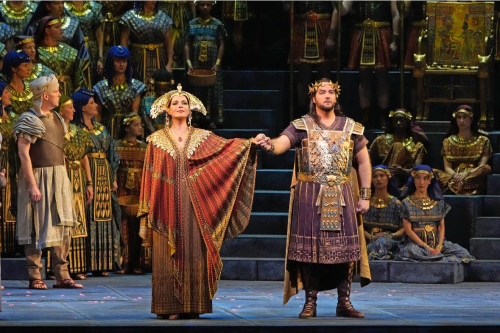
    Above: Elīna Garanča and Brian Jagde as Amneris and Radames; a Ken Howard/MET Opera photo

    ~ Author: Oberon

    Sunday April 27th, 2025 matinee – Two of the opera world’s brightest stars joined the cast today for the first of four Metropolitan Opera performances of Verdi’s AIDA, concluding this season’s run of the new production: Elīna Garanča, who had recently withdrawn from some European performances but who thankfully made it here to sing for us, was Amneris this afternoon, and the great Mongolian baritone Amartuvshin Enkhbat, whose Met debut as Germont in 2022 was truly impressive, as was his Amonasro this afternoon. Both of these singers came to worldwide recognition after participating in the Cardiff Singer of the World competition, the mezzo in 2001 and the baritone in 2015.  

    The only aspect of today’s performance that I wasn’t looking forward to was the presence on the podium of Yannick Nézet-Séguin, whose fast-and-loud, brass-happy conducting has spoiled several Met performances for me. 

    After a the opera’s expressive prelude, superbly played by the MET Orchestra, the huge voice of Morris Robinson drew us immediately into the story. As Radames, the stentorian tenor sound of Brian Jagde responded to the hint that Robinson/Ramfis had just dropped with an urgent recitative and then commenced the “Celeste Aida” which was taken a bit faster than usual; the tenor’s massive top notes immediately impressed the crowd, winning Jagde enthusiastic applause: with this man in command, the Egyptians were sure to win the coming battle.

    Ms. Garanča as Amneris enters, immediately making a lovely vocal impression as a lyrical princess; in her elegant phrasing, her every note spoke of her deep affection for Radames. A dulcet clarinet solo introduces Angel Blue’s Aida. The orchestra was sometimes too loud during the ensuing trio.

    Krzysztof Bączyk immediately made an excellent vocal impression as the King, as did the clear-toned Messenger of Yongzhao Yu. “Su del Nilo” felt a bit rushed, but Mr. Bączyk and Mr. Robinson traded bass sonorities to fine effect. Ms. Garanča chimes in…but from the pit, a N-S noise fest is developing. Angel Blue soars above the ensemble, then immediately commences “Ritorna vincitor!” in which Aida’s dilemma is introduced: she is torn between her love for Radames and love of her homeland. Some nice, chesty resonances underscore her anguish, though her topmost range seemed a bit tight. Her lyrical, prayerful ending of the aria was truly beautiful.

    As the action moves to the Temple of Vulcan, Tessa McQueen’s offstage Priestess is too far upstage to make an immediate impression but soon she is moved to a more congenial spot from which to display her attractive voice. There are lovely harmonies from the priests, and then ballet commences, only to have the music’s beautiful sense of calm (played with nice rubato touches) spoilt by someone’s coughing fit. Morris Robinson’s fabulous introduction to the consecration ritual, and Mr. Jagde’s heroic response, soon fall victim to over-playing from the N-S pit, nearly swamping the voices. 

    Bringing the house lights up a bit prior to the ensuing boudoir scene really shatters the mood; there’s a late seating, with latecomers stumbling about in the near darkness whilst people who’d arrived on time think it’s a bathroom break. Cellphones come on throughout the hall. Chatter spoils the ensuing opening harp solo as the women’s chorus seeks to restore the mood after this intrusion of reality.

    Ms. Garanča’s thrice-voiced, dreamy summoning of her beloved is so seductive. After the ballet interlude, the Egyptian princess baits her Ethiopian rival. Sparks fly as their rivalry is revealed; Amneris has the upper hand, and Ms. Garanča’s “Figlia de’ Faraino!” is blisteringly set forth. Some of Ms. Blue’s higher notes are a bit harsh, but her touching prayer at the end – Numi pieta!” – sounded gorgeous.

    The Triumphal Scene is grandly done, orchestra and chorus blazing away – interspersed with more lyrical passages – and then the ballet boys bring down the House with their bold, stomping dance. Mr. Bączyk sounds splendid as the King greets the conquering hero: Radames. The prisoners of war are brought in, among them the incognito King of Ethiopia – Aida’s father, Amonsaro – in the person of Amartuvshin Enkhbat. N-S lets loose the brass, but the baritone is unfazed, singing handsomely. Angel Blue produces a shining top-C. Now Mssrs. Robinson and Bączyk exchange bass sonorities as they debate the fate of the prisoners…of course, the priest wins. Bączyk now gives his daughter’s hand in marriage to Radames, with Ms. Garanča revelling in her triumph. The concluding ensemble was a bit messy. 

    On the banks of the Nile, Morris Robinson again impresses as he leads Amneris to a all-night prayer vigil. Angel Blue phrases the “O patria mia” poetically, her lyricism to the fore. She doesn’t float the top-C, but she makes much of the ensuing lament with a neat crescendo and then a hushed “…mai più…!” 

    Amartuvshin Enkhbat is authoritative and truly impressive as he tells his daughter what she must now do in the name of her country. His wonderful phrasing as he manipulates her leads to some very fine cantabile passages from Ms. Blue. The orchestra again overplays, but the baritone rises to the challenge with an epic “Non sei mia figlia!” Ms. Blue’s anguish is palpably voiced, and her father responds with the inspiring “Pensa che un popolo, vinto, straziato!”; here the orchestra gave truly marvelous support, making it a highlight of the performance.

    Radames now appears, and Ms. Blue treats us to a very seductive “La tra foreste vergini” as she tempts him to run away with her. The soprano’s turnings of phrase here is most inviting. But Mr. Jagde is unsure…his dolce B-flat as he ponders his choices was magical indeed. There was an intrusion by someone in distress in the audience, which killed much of the atmosphere as the duet moved to its end; Ms. Blue’s closing B-flat was short and unsteady; then the stretta was on the wild side, the soprano’s top not really assured. Amonasro’s reappearance sealed the baritone’s success, and then Mr. Jagde nailed his “Io resto a te!” with amazing power and thrust.

    Elīna Garanča now took command of the Met stage with a Judgement Scene in which every word and note counted. Her “Vorrei salvarlo…” was full of hesitant hope, and then the chilling orchestral passage, ending on a splendid clarinet low note, brought Radames before her. Simply gorgeous clarinet playing underscored Ms. Garanča’s beautifully desperate plea, to which Mr. Jagde responded with a great outpouring of tone. Garanča’s brilliant “Morire!!?” was phrased immediately into her ensuing entreating passages. Jagde silenced her with a massive B-flat. Tension reaches a boiling point, Garanča’s voice rising to two scorching B-flats as her desperation overwhelmed her.

    Radames is led away, and Ms. Garanča’s lament is hauntingly sung, her anguish over her jealously having caused Radames’s downfall marked by a pianissimo intoning of “…io stessa lo gettai!” fading to a whisper. Morris Robinson’s chilling calls of “Radames!” must still be echoing somewhere in the univese. Soft drum rolls ominously underscore the ensuing trial, with Robinson/Ramfis becoming increasingly impatient.

    Harsh accents from the orchestra underscore the death penalty prouncement, the deep brass voices terrifying. Ms. Garanča’s pleas are in vain; in her fury she curses the priests, soaring to a climatic top A. A prolonged ovation ensued, the crowd cheering the beloved mezzo in a well-deserved salute.

    The final scene opened with Mr. Jagde’s doom-ladened phrases of farewell to Aida. When she steps from the darkness of the tomb, the great farewell duet commences. Here one wished for more piano singing from Ms. Blue but overall the duetting voices were wonderfully expressive and moving. Then Ms. Garanča’s solemn invocation of peace lingered on the air as darkness fell.

    The ovation when Elīna Garanča took her first solo bow was genuinely tumultuous; a bouquet flew onto the stage, and the comely Elīna literally prostrated herself in response to the waves of love pouring across the footlights. 

    ~ Oberon

  • Mozart & Bartók @ The NY Philharmonic

    Week32-BrandonPatoc_0059

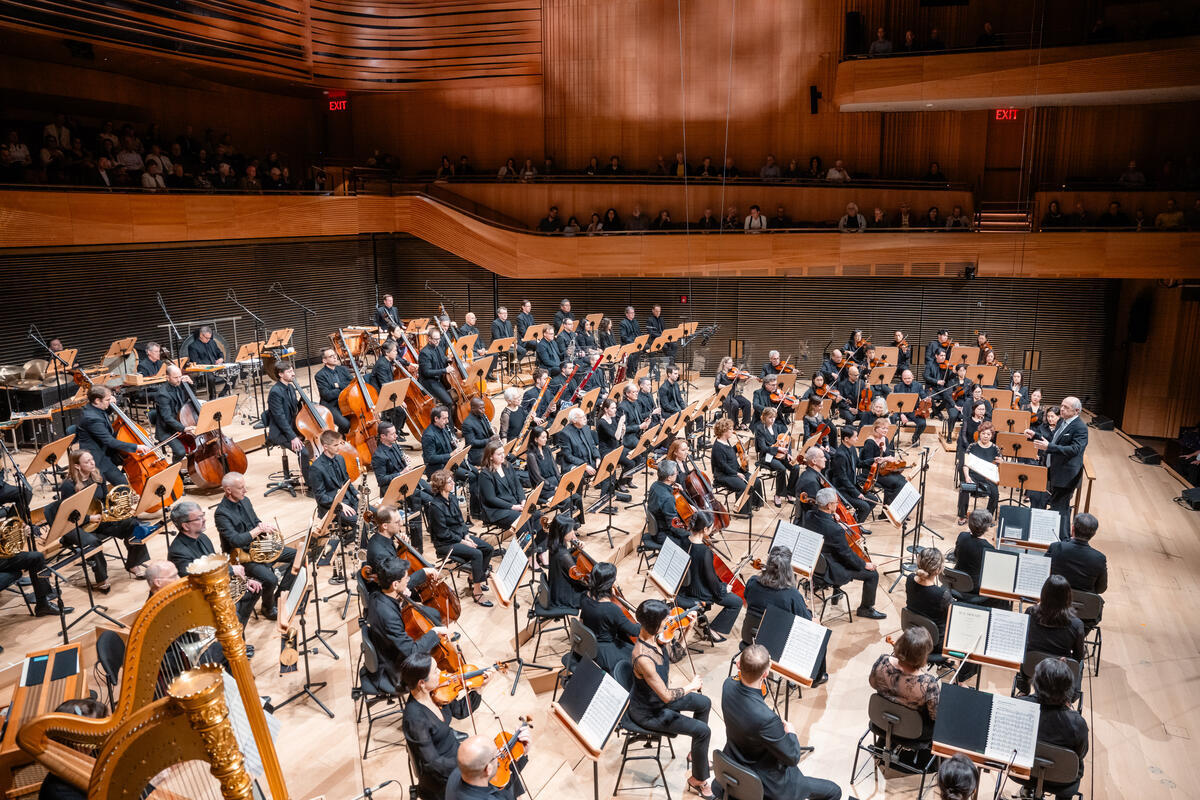
    Above: performance photo by Brandon Patoc

    ~ Author: Mark Anthony Martinez II

    Saturday April 26th, 2025 – The New York Philharmonic played a fantastically curated concert of Mozart and Bartók. Although the throughline of the pieces isn’t immediately apparent, the pairing of Mozart at his most theatrical — with the Magic Flute Overture and his Fifth Violin Concerto — with Bartók’s The Wooden Prince, originally written as music for a ballet, made for a fantastic night of music.

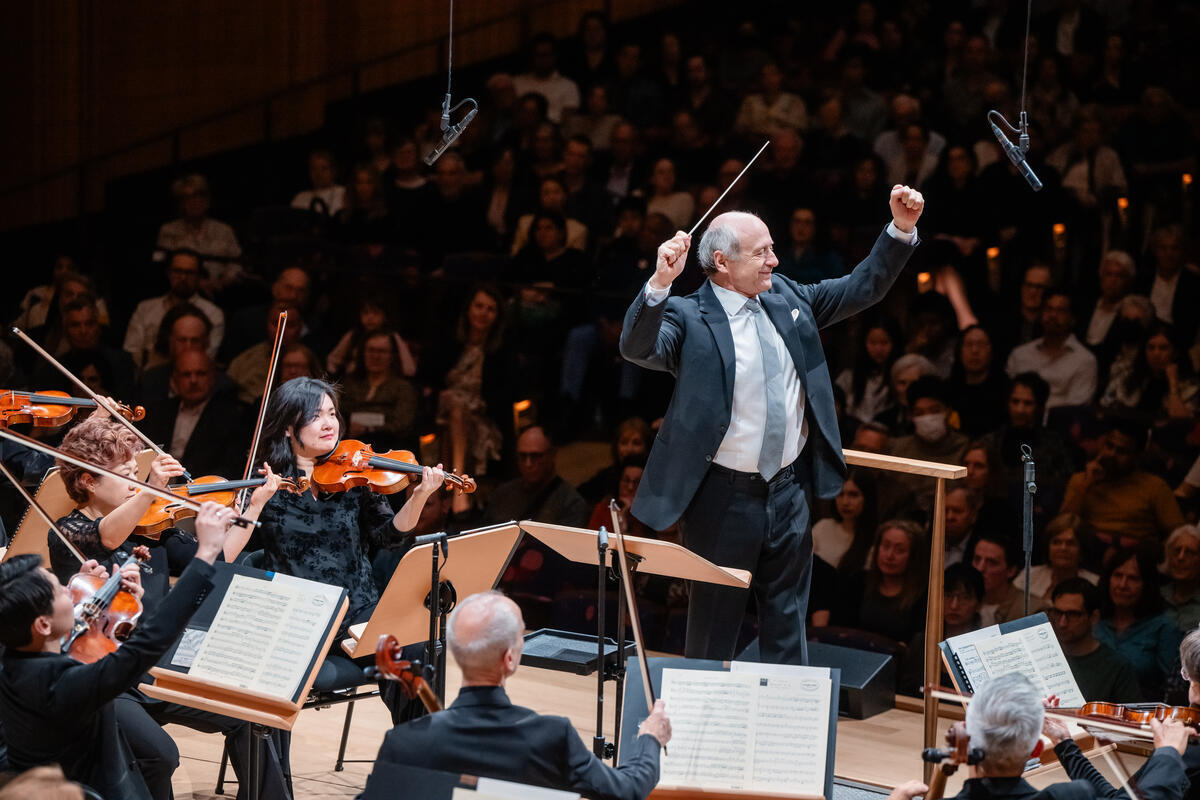
    The guest conductor was Iván Fischer, and he conducted marvelously: at ease in the music while simultaneously seeming to really have fun. Maestro Fischer appeared to conduct The Magic Flute Overture from memory at the podium, moving through the different sections of the piece with wide arm gestures.

    I had just recently seen The Magic Flute at the Metropolitan Opera the week before, so the piece was still fresh in my memory. Something very interesting was that, when I heard it that night at the Philharmonic, the overture seemed more like a symphonic suite than an overture to a stage play. It seemed more related to Mozart’s Jupiter Symphony somehow in this moment, rather than the opening to Così fan tutte. The music was played perfectly, with every dynamic crystal clear in execution. Maybe it was the perfection of how the piece was played that made it seem more symphonic and less like a piece written for the stage, where inevitably something new happens every night.

    Week32-BrandonPatoc_0013

    I particularly liked the restraint that Maestro Fischer (above, photo by Brandon Patoc) showed in the moments of the overture where silence mattered more than sound, such as the callback to the brass opening punctuated with long rests. The rests seemed longer than usual, but the impact was memorable because of it.

    The audience gave a very warm and deserved applause, after which the orchestra reduced in size to prepare for the violin concerto.

    Lisa b

    The soloist, Lisa Batiashvili (above), came out in a very memorable bright yellow dress with a baby blue sash around her waist. Normally, I don’t notice what soloists wear in performances, but this outfit seemed too intentional, almost as if it were making a statement. I thought that the color scheme seemed coincidentally similar to the Ukrainian flag until I saw a giant brooch of the U.S. Stars and Stripes cinching the sash onto her. So whatever the intent was, I’m sure it meant something to those more sartorially inclined.

    Batiashvili played the Mozart with clear familiarity with the style and music. Normally, I feel soloists tend to lean into the fiery, show-stopping nature of concertos, but Batiashvili tended toward austerity and restraint in her playing for the first two movements. The piece was played in a way that seemed courtly: certainly pleasant, but not too forward to draw attention to itself. Things changed when Batiashvili reached the cadenza of the first movement. The cadenza started out seeming to be in a Mozartian style, then veered into the chromatic and atonal. It wasn’t bad by any means, and certainly showcased Batiashvili’s virtuosity. It was just surprising to hear something so very non-classical in such a quintessentially classical piece. I read the program afterwards and saw that the cadenza was composed by a 15-year-old Georgian composer named Tsotne Zedginidze, which made quite a lot of sense in hindsight.

    I quite enjoyed the unconventional cadenza because it made me look forward to hearing the other cadenzas, which were also newly composed, one of them by the soloist herself. The other cadenzas were more traditional in nature though, which maybe was a good pairing with the one anachronistic one.

    The third movement was where Batiashvili took off and seemed to have the typical soloist verve. I had never heard the finale of this concerto before, and I loved the effects that gave the whole piece the moniker of “Turkish.” The sections where Batiashvili played the more exotic melody and the strings played col legno seemed like a vision into the future of where classical music would head with early Romanticism. The sections sounded more like Mendelssohn in one of his symphonic overtures rather than Mozart, and I was thrilled to hear it.

    After the concerto, Batiashvili gave several curtain calls, and it seemed like there was going to be an encore, but in the end, one didn’t come.

    Before the concert began, I overheard some audience members chatting and wondering why the screen normally used for super-titles for lyrics was open. Another audience member joked that it was just so they could make sure to tell people to silence their cell phones before the show.

    During intermission, the size of the orchestra ballooned, and it was almost impossible to fit more musicians on the stage. Before he started the Bartók piece, Maestro Fischer gave a short introduction. He told the audience that the piece was originally written for a short ballet, and — in an unconventional but amazing idea — had the original stage directions for the ballet projected onto the aforementioned screen while The Wooden Prince was being played.

    This piece was another first for me, and it was truly a masterpiece. The piece starts with a humming sound that almost feels like what you’d expect from a movie showing deep space.

    The story of The Wooden Prince follows a prince who falls in love with a princess, who is guarded by a fairy. The prince is blocked from being able to see the princess by the fairy, who enchants the forest in which they are to physically prevent the prince from reaching her.

    The stage directions were such a wonderful idea because they showed where Bartók’s mind went when he was creating the music for each physical gesture. At first, I thought there were going to be instruments tied to each of the characters, but in the end, the entire orchestra was involved in every scene to provide complete sonic storytelling.

    I found myself thinking about how The Wooden Prince compared with some of the other great ballets, like Tchaikovsky’s Swan Lake and Stravinsky’s Rite of Spring. The conclusion I came to was that The Wooden Prince was uniquely its own masterpiece.

    ~ Mark Anthony Martinez II

    (Performance photos by Brandon Patoc, courtesy of the NY Philharmonic)

  • BSO x 2 ~ Mostly Shostakovich

    Dimitri-Shostakovich

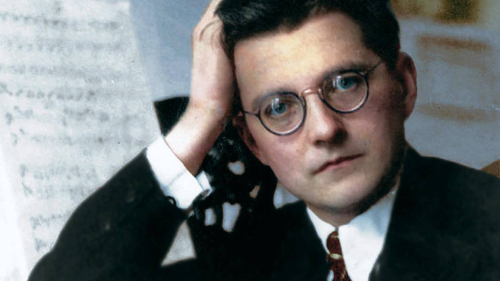
    Above: Dimitri Shostakovich

    ~ Author: Ben Weaver

    Wednesday April 23rd and Thursday April 24th, 2025 – Dmitri Shostakovich was the focus of Boston Symphony Orchestra’s two-concert visit to Carnegie Hall this week, under the leadership of its music director Andris Nelsons. Shostakovich’s son Maxim, dedicatee and first performer of the Second Piano Concerto, was in attendance on the second evening.

    Shostakovich died 50 years ago, and his famous struggles living and composing in a totalitarian regime, always one offense away from the gulag, sadly remain relevant today – not just in Russia, but in the United States as well. Cellist Yo-Yo Ma made a brief statement from the stage, quoting Josef Stalin’s famous line: “A single death is a tragedy, a million deaths are a statistic.” Ma pleaded that no death should ever be a statistic, and he wanted to honor anyone suffering loss of life or dignity. Ma did not name any names, but the meaning is loud and clear as our own US government is disappearing human beings into foreign gulags. For anyone who argues that artists should stay out of politics, people like Shostakovich remain an important reminder that art has launched revolutions, and if art was not political, it would never be banned.

    Ma Cello-Concerto-No.-1-Robert-Torres

    Above: Yo-Yo Ma, photo by Robert Torres

    Cello Concerto No. 1 in E-flat major, Op. 107, composed in 1959, was dedicated to Mstislav Rostropovich (as was, incidentally, the 2nd.) Yo-Yo Ma has been performing it for much of his career and his deep affection for it is clear. His warning about tyranny just before the performance was reflected in his approach to the jolly opening tune, which Ma played with a rawness that made it darker and more sinister. Irony and the grotesque are deeply ingrained in Soviet art, a tool for plausible deniability which anyone who wished to survive purges needed to master. The Playbill notes by Harlow Robinson point out that Shostakovich buried in the score a small, distorted fragment from Josef Stalin’s favorite Georgian folk song, “Suliko” – something even Rostropovich did not spot until Shostakovich finally pointed it out. (Stalin died in 1953, six years before the Concerto was composed.) As an encore Ma joined Boston Symphony’s entire cello section and they delivered a jaunty version of a traditional Yiddish tune “Moyshele,” arranged for a cello ensemble by BSO’s principal cellist Blaise Déjardin, who also contributed magnificent solo playing.

    Two late symphonies by Shostakovich received searing performances under Andris Nelson’s leadership. Over the last few years maestro Nelsons performed and recorded all of Shostakovich’s symphonies with the Boston Symphony Orchestra for Deutsche Grammophon. It is an excellent cycle (which also includes the Piano Concertos with Yuja Wang, Violin Concertos with Baiba Skride, Cello Concertos with Mr. Ma, and the opera Lady Macbeth of Mtsensk District. I have found much of these performances excellent.)

    Shosty

    Above: Maestro Nelsons, photo by Chris Lee

    Symphony No. 11 in G minor, Op. 103 (composed in 1956-57) carries the subtitle “The Year 1905.” The work depicts the failed revolution against the Russian monarchy and earned Shostakovich the Lenin prize.

    The opening movement Adagio, subtitled “The Palace Square,” is dark and gloomy, with dull strikes from the timpani foreshadowing events to come. Nelsons’s deliberate tempo set the mood well, building tension to the bloodshed to come. (I also noticed there is a section here John Williams “borrowed” for T-Rex in the score for “Jurassic Park.”) The brutal second movement (Allegro, “The 9th of January”) depicts the “Bloody Sunday” at the Winter Palace where peaceful protesters were massacred by the guard. The pounding march depicting the assault was led by BSO’s excellent percussion section. A mournful “Memory Eternal” and defiant “Tocsin” movements (a celesta taking the place of a tocsin bell) were emotionally shattering under maestro Nelson’s leadership.

    Shostakovich’s last Symphony, No. 15 in A major, Op. 141 (composed in 1970-71) was originally intended to celebrate his own 65th birthday. Several medical emergencies, including a heart attack, delayed its composition and premiere, which finally took place under his son Maxim’s direction in 1972. It’s most unusual aspect is presence of extensive unaltered quotations from Rossini’s William Tell Overture and Wagner’s Götterdämmerung and Tristan und Isolde, composers and works not immediately identified with Shostakovich. The full mystery of why he included these specific quotations remains a matter of speculation. I’ve always found the “Lone Ranger” theme to be especially jarring, but it’s important to note that Shostakovich is highly unlikely to have been familiar with that American TV series, so his point of reference to that music would have been very different from ours. Musically the choices do fit into the fabric of the symphony. The raucous opening movement – which Shostakovich ones called a “toy shop” – is a perfect place for the galloping Rossini tune. And Wagner’s music is a perfect fit for the stillness of the symphony’s latter movements. Shostakovich also quotes some of his own music. The closing percussion – like tickings of a clock – immediately remind one of the ending of the second movement of his Symphony No. 4. Andris Nelsons and his Boston forces delivered a largely superb performance, although I think maestro Nelsons’ lethargic take on the Adagio (second and fourth movements) was a misstep. They dragged and lost focus, no matter how beautifully the orchestra played. But special mention to concertmaster Nathan Cole, principal cellist Blaise Déjardin, and flautist Lorna McGhee for superb solo contributions.

    Bso uchida


    Above: Maestro Nelsons and Mitsuko Uchida take a bow; photo by Chris Lee


    Ludwig van Beethoven’s Piano Concerto No. 4 in G major, Op. 58 opened BSO’s two-night residence at Carnegie, with the always brilliant Mitsuko Uchida as soloist. The concerto has often been interpreted as Orfeo calming the furies (particularly in the magical second movement, where calmness by the soloist is interrupted by angry strings) – and so Ms. Uchida bravely faced a consumptive audience member who began proudly coughing as Ms. Uchida began to play. After a few calming chords, Ms. Uchida stopped and held up her hands in the direction of the patient. The offender took her time exiting the auditorium, coughing non-stop. We could still hear her coughing up a lung from the hallway, but that’s the most we could hope for.


    Finally the performance resumed with Ms. Uchida delivering an deeply moving performance. The work is full of conflict, but – somewhat unusual for Beethoven – if his voice its the soloist, he calms the other side instead of fighting it. Such dignified understatements were presented by Ms. Uchida with unaffected dignity and charm. That stunning second movement, with angry strings being repeatedly silenced by the soothing soloist, is among Beethoven’s most powerful and beautiful statements, and Ms. Uchida is simply second-to-none with sincerity and beauty. The rollicking Rondo: Vivace that closes the concerto is Beethoven’s victory over adversity dance, but one filled with humor. Here, too, Ms. Uchida played with unabashed, contagious joy.


    Uchida 2


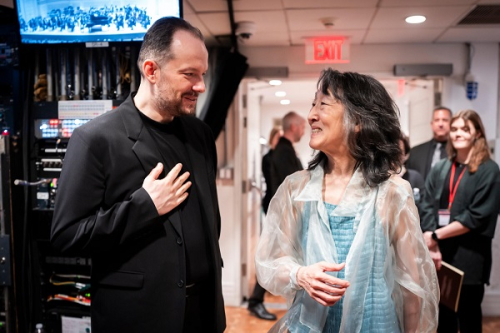
    Backstage: Maestro Nelsons and Ms. Uchida; photo by Chris Lee


    Andris Nelsons is an excellent accompanist, which I’ve had a chance to note many times. His respect for his soloists, keeping the orchestra from burying them, is an admirable trait – one I wish a few other notable conductors would also acquire.

    ~ Ben Weaver

    (Chris Lee’s performance photos courtesy of Carnegie Hall)

  • New Music for Percussion, Piano, and Strings

    S swartz

    Above: composer Steven Swartz

    ~ Author: Lili Tobias

    Thursday April 24th, 2025 –  It was unexpectedly difficult to get to the location of the New Music for Percussion, Piano, and Strings concert, performed at NYU. After waiting in the lobby for half an hour and being ushered towards the elevators with no other directions, the other audience members and I finally arrived at Room 620 shortly before the music began. Composer Steven Swartz, who had an exciting premiere on the program, described the feat as “breaching the walls of the castle.” But fortunately, all the music on last night’s program was entirely worth the struggle of getting there!

    The program began with two pieces for piano trio, each made up of a handful of very short movements. These were Miu Sato’s Threads of Belonging and Takashi Yoshimatsu’s Atom Hearts Club Suite No. 1. Despite the brevity of the music, both composers packed an incredibly diverse array of sounds into each piece, from lush, pianistic arpeggios that filled out the space around the violin and cello’s melodies to energetic syncopated rhythms in odd meters. The three performers, Angel Guanga (violin), Noelia Carrasco (cello), and Malka Bobrove (piano) are all currently undergraduate students at NYU, but their sound as an ensemble was nothing short of professional, playing with an incredible level of confidence and precision.

    I was also impressed with pianist Miles Avery’s performance of …couple égyptienne en route vers l’inconnu… by György Kurtàg. The music featured pointillistic collections of notes, connected together through the overtones left behind by the sustain pedal. Avery played every single note with such intention that each sound that emanated from the piano seemed to have an entirely different character from the last.


    Soundcheck - MN + JH


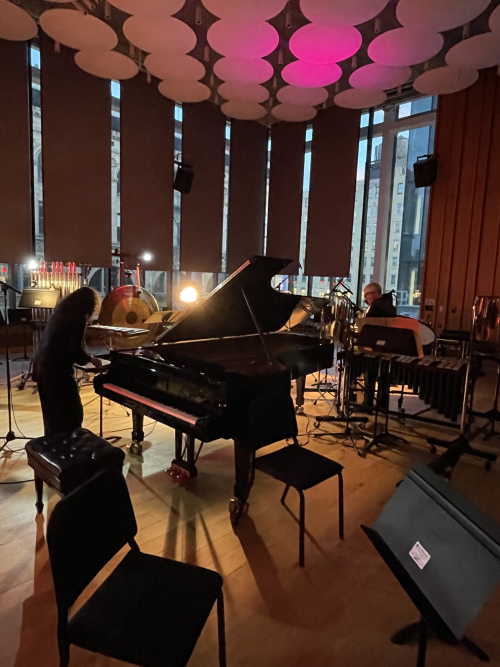
    Above: pianist Marilyn Nonken and percussionist Jonathan Haas do a soundcheck before the world premiere of Steven Swartz’s When the horizon has a mind of its own.


    I was absolutely mesmerized by the fragments of sound that emerged just to trail off again, reminding me of light refracted through glass. Swartz’s inspiration for this piece came from a light source as well—he observed the intricacies and ever-changing motion of the sunset and aimed to capture the elusiveness of those moments in this piece. I certainly felt that ephemeral nature: The music felt aimless in an entirely good way, the sort of aimlessness you might have when you’re walking through nature on a summer afternoon without being in a hurry to get anywhere in particular. I also felt an all-encompassing sense of serenity in the moments of silence between the notes, especially in the silences after the deep rumble of the bass drum or passages in the very lowest register of the piano. This piece of music is certainly one of those pieces that I want to listen to over and over again!


    The program ended with two pieces by Jacob Druckman, Reflections on the Nature of Water  (Shiqi Zhong, marimba) and Animus II (Bowen Zheng, mezzo-soprano, Natalie North, percussion, Zhaoxuan Song, percussion). Animus II was certainly the most eclectic music of the night: The colorful lighting, unintelligible singing, and bubbly electronic noises turned the room into an extraterrestrial landscape. As I was heading out, I caught a glimpse of one of the percussion scores, which was one of those half traditional notation, half graphic scores that bridges the gap between a useful tool and visual art. I also spoke with percussionist Natalie North, who told me that they had been working on this piece for the whole semester and had never performed from a score like that before. It certainly looked like they knew what they were doing though!


    Swartz mentioned in the program notes the playful nature of a sunset, and his music was equally playful. In fact, all the pieces on this program were exceptionally playful, each in their own unique ways, which made for such a joyful evening. I hope that When the horizon has a mind of its own has the opportunity to be performed many more times going forward!

    Lili Tobias

  • Callas @ Dallas/1957

    callas

    In 1957, Maria Callas sang a concert with the Dallas Symphony under the baton of Nicola Rescigno. Someone snuck a tape recorder into one of the rehearsals for this concert, and the resulting “Callas/Rehearsal in Dallas 1957” made the rounds of reel-to-reel tape-traders back in the 1960s.

    David Abramovitz, my very first opera-friend, gave me a copy of the rehearsal tape and I enjoyed it, despite being somewhat frustrated with the stops-and-starts as Callas and Rescigno worked out the interpretive details. I was especially impressed by the different takes on passages from the entrance scena – sometimes referred to as the Letter Scene – of Lady Macbeth from Verdi’s MACBETH.

    It occurred to me to patch these phrases together and create a complete run-thru of the recitative and aria. Years later, when I was getting rid of my reel-to-reel collection, it was one of the few things I saved. The voice of Maestro Rescigno can sometimes be heard, and there’s some static at first, and a bit of tape drag. But once she’s into the aria proper, it gets better.

    Maria Callas – MACBETH aria – rehearsal composite – Dallas 1957

  • Anna Reynolds: Berlioz ~ LA CAPTIVE

    6a00d8341c4e3853ef00e553e672fe8834

    Anna Reynolds was my first RHEINGOLD Fricka; at The Met’s Saturday matinee performance of February 22nd, 1969, conducted by Herbert von Karajan, Ms. Reynolds replaced the scheduled Josephine Veasey in the role of Wotan’s wife and made a memorable impression on me. I sent Anna Reynolds a fan letter a couple of days later, and received the above photo from her soon after. Read about that spectacular February weekend here.

    In 1975, I had the good fortune to see Ms. Reynolds again on The Met stage as the WALKURE Fricka; she was superb. For years, I owned an LP of the mezzo-soprano singing Schumann songs; her interpretation of Mondnacht remains a favorite, though the LP has long since vanished.

    Among the hundreds of items I was able to rescue from my old cassettes – converting them to MP3s – this recording of Anna Reynolds singing Berlioz’ La Captive from a 1969 BBC broadcast is particularly dear to me.

    Anna Reynolds – Berlioz ~ LA CAPTIVE – BBC 1969

  • Licia Albanese ~ Letter Scene

    Images

    Licia Albanese learned Tatyana’s Letter Scene from EUGENE ONEGIN in Russian at the request of Leopold Stokowski especially for this recording. Albanese reportedly coached the aria with baritone George Cehanovsky, a Met comprimario stalwart who was married to Elisabeth Rethberg.

    EUGEN ONEGIN – Letter Scene – Licia Albanese – Stokowski cond

  • My first LADY MACBETH OF MTSESNK

    malfitano

    In the year 2000, I saw Shostakovich’s LADY MACBETH OF MTSENSK for the first time; the Met was presenting a grandiose musical performance which offset the somewhat overly-funny staging. Gergiev’s conducting, the superb orchestra, and an extraordinary cast assured that the opera would be thrilling. The cartoonish aspects of the staging were valid: it’s both over-the top and tongue-in-cheek. It was one of the most entertaining nights at the Met ever!  The fact that a bit more darkness might have been to the good didn’t detract from a magnificent evening of music and theatre.

    Catherine Malfitano (photo above) continued her string of Met triumphs in the singing-actress category with her powerful portrayal of Katerina. In a peroxide-blonde wig and oozing lethargic sex appeal at every moment, La Malfitano used her powerful, sometimes ravaged – but always expressive – voice to vivid effect. She swept thru the vast range of emotions and plugged into the vulnerable quality of her voice to insure sympathy for the character: a woman who has lost everything (if an unhappy marriage, bullying father-in-law, and desperate boredom count as things of value). In the harsh severity of the death march to Siberia, this Katerina was living proof of the theory that we don’t know when we are well-off. Ms. Malfitano’s huge success was thoroughly deserved.

    Sergei Koptchak’s magnificent Boris was utterly “real”, and his slime-infested vocalism so natural and apt. Mark Baker and Vladimir Galouzine were powerful vocal forces, and Galouzine proved himself an appealingly dastardly actor. Victoria Livengood sang her music in an awesome chest register, and was the perfect cheap slut. Vladimir Ognovenko’s big sound and easy stage presence made his Police Sergeant a gem, especially when he started ‘hoofing’ it with a chorus-line of cops. 

    Excellent bassos Grigori Karasev (hilarious as the Priest) and Gennady Bezzubenkov (moving as the Old Convict who leads the final ‘hymn’) – and a brilliant bit from Dennis Peterson as the shabby peasant who lives in a junk heap – were further attractions of the evening, whilst Bernard Fitch and Janet Hopkins (as teacher and cook) each made their mark. The chorus were really into the action, and the evening swept by with an exhilarating force.

    Joining my friend Paul in a backstage visit to his friend, Vicky Livengood, I greeted her with “Great chest!” to which she replied “Which one?”

    lady macbeth-1 jpg