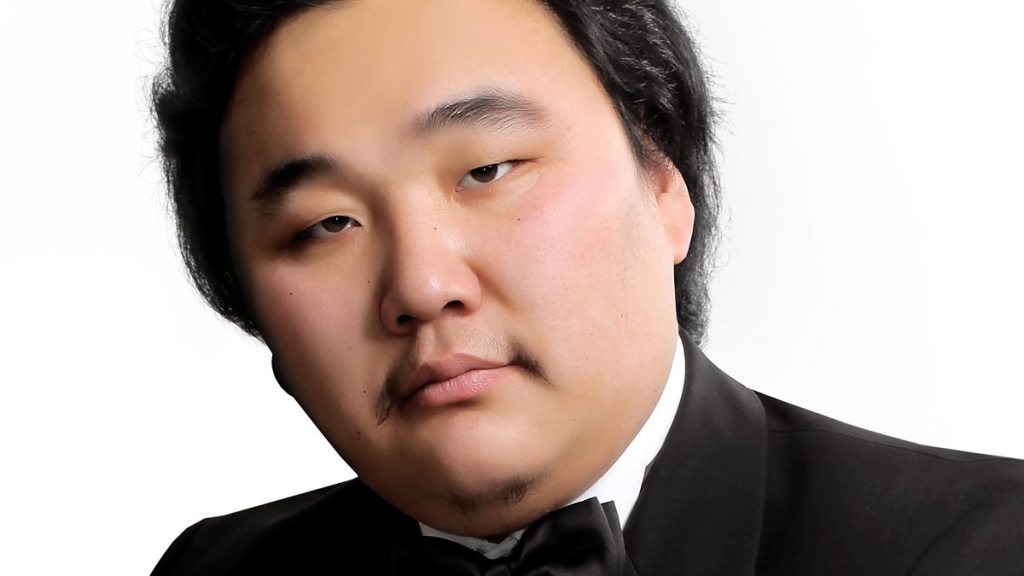
Mongolian baritone Enkhbatyn Amartüvshin sings the Prologue from Leoncavallo’s PAGLIACCI.
Watch and listen here:
Mongolian baritone Enkhbatyn Amartüvshin sings the Prologue from Leoncavallo’s PAGLIACCI.
Watch and listen here:
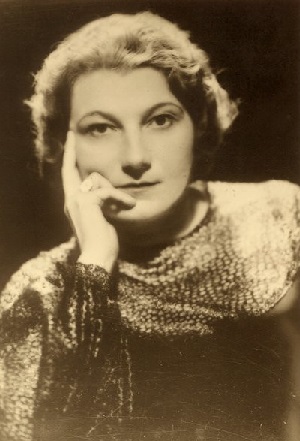
Gertrud Rünger (1899-1965) sang both mezzo-soprano and dramatic soprano roles during her career. She began as a choral singer, moving on to solo roles in smaller German houses in 1923.
In 1930, she joined the ensemble of the Vienna State Opera, and in 1934 came to the Berlin Staatsoper. She sang Verdi’s mezzo roles in German, and developed a reputation as a Wagnerian soprano, singing in Paris, London, Amsterdam, Dresden, and Munich.
Ms. Rünger sang the Nurse in FRAU OHNE SCHATTEN at the Salzburg Festival in 1932-1933, and later appeared there as Klytemnestra and as Beethoven’s Leonore. She sang briefly at The Met in 1937, as the WALKURE and GOTTERDAMMERUNG Brunnhildes, Fricka in RHEINGOLD, and as Ortrud opposite Kirsten Flagstad’s Elsa.
Designated as Kammersängerin, Gertrud Rünger continued to perform into the 1950s, whilst also teaching voice. She passed away at Berlin in 1965.
Gertrud Rünger – Sleepwalking Scene ~ MACBETH – in German
Gertrud Rünger – DON CARLO aria – in German
And here is Ms. Rünger live in a thrilling rendition of Ortrud’s Invocation.
~ Oberon

Dwayne Croft as Donner summons the mists as Wagner’s DAS RHEINGOLD draws to its finish. I vividly recall how thrilling this was in the House as the baritone strode up the inclined stage and deployed his powerful voice into the great cavern of The Met.
The performance dates from 2010 and is conducted by James Levine.
Watch and listen here: https://www.youtube.com/watch?v=bBETnbgm6sE

~ Author: Lane Raffaldini Rubin
Saturday March 29th, 2025 – Not one but two composers were present at David Geffen Hall tonight to receive enthusiastic ovations for their music performed by Leonard Slatkin and the New York Philharmonic. It was, in a sense, a family affair. The composer John Corigliano has been a friend of Slatkin’s and the Philharmonic for half a century, while the other composer, Cindy McTee, is Slatkin’s wife. While the third composer of the evening—Dmitri Shostakovich—was not on hand, this evening’s concert was a testament to the vitality of music of the present era.
Cindy McTee’s 2010 piece Double Play is a two-movement fantasia on Charles Ives’s 1908 composition The Unanswered Question. More than just an exercise in Ivesian orchestral writing, the piece is a sonic lava lamp of shifting ambiguities and cinematic episodes. A low drone in the double basses unifies the fragmentary material in the woodwinds while hushed string chords oscillate between gorgeous dissonance and consonance.
The second movement, entitled “Tempus Fugit”, begins with the ingenious tick-tocking of an ensemble of mallets, sounding like a cupboardful of disagreeing clocks and metronomes. The Ivesian writing of the first movement returns under this misaligned timekeeping, establishing an fascinating non-relationship between the disparate concepts of the two movements.
This juxtaposition is muddied in the second movement by the inclusion of passages of chase-scene-style music and Gershwin-like big-band flourishes (although played brilliantly crisply by the Philharmonic brass). McTee’s piece was intricately orchestrated and finely crafted but went on a bit longer than it needed to and wouldn’t have suffered from cuts in the second movement.

Above: Cindy McTee and Leonard Slatkin take a bow; photo by Chris Lee.
For John Corigliano’s 2020 piece Triathlon the soloist Timothy McAllister brought three saxophones to the stage. In writing the piece, Corigliano asked himself “what would happen if I wrote a concerto for saxophonist and orchestra, not saxophone and orchestra.” McAllister, the preeminent classical saxophonist for whom the concerto was written, is, after all, a skilled player of the soprano, alto, and baritone saxophones. Corigliano exploits the unique qualities of all three in Triathlon.
The first movement, “Leaps” for soprano saxophone, bursts right out of the gate with slinking high and low figures, bustling orchestral sounds, and swaggering bravura material for the soloist. McAllister’s playing is assured and confident while maintaining a chamber music sensibility, which suits well the elaborate dialogues that Corigliano writes between the soloist and various voices in the woodwinds and brass. One notable section of this movement appears to quote Ravel’s children’s opera L’enfant et les sortilèges with ravishingly mysterious textures in the woodwinds, providing a fluttering backdrop for lyrical solos in the soprano saxophone.
The second movement, entitled “Lines”, hews close to its name by eschewing rhythmic figuration in favor of “linear” melodic material. This movement for alto saxophone occupies a hybrid sound-world somewhere between the hazy atmosphere of Coltrane and the broad horizons of Copland’s A Lincoln Portrait.
Things get wilder in the third movement, which begins with a baritone saxophone cadenza of key clicks, slap tonguing, and other extended techniques up and down the range of the instrument. “Licks”, the title of this movement, has multiple meanings as the soloist seems to riff and improvise and produce very physical sounds from the tongue itself. The entire movement is a rollicking pseudo-improvisatory accompanied recitative. In a fun plot twist at the very end of the piece, McAllister picks up the soprano sax for one last picaresque lick.

Above: Timothy McAllster and Maestro Slatkin playing the Corigliano; photo by Chris Lee
In the second half of the program, Slatkin led the Philharmonic in Shostakovich’s Symphony No. 5 of 1937. It’s a piece that is, as Slatkin writes, “a bit more familiar for both musicians and audience”. Indeed, it was an admirable if conventional performance, with thrilling—booming—climaxes, flawless details across the woodwinds, and propulsive treatment of dramatic transitions.

Throughout the concert, Slatkin (above, photo by Chris Lee) frequently put down his baton to conduct with his hands, only to pick the baton back up within the same movement. Slatkin holds the baton from the end of its long handle, rather than gripping it, which means that he relies on his left hand to communicate finer-grain detail to the players. His conducting was at its best when he put down the baton (as in the first movement of McTee’s piece and the sublime Largo of Shostakovich), allowing him to be expressively geometric—an impressively effective semaphore for the musicians. During the Shostakovich Largo, which he conducted from memory, I wondered where his baton had gone, since there was no music stand on the podium for him to rest it on. When the movement was over, he reached behind the folder on the first desk of the violas to retrieve his baton from where he had stashed it. Meant to be invisible, it was just one of the many clever details that added up to this superbly crafted concert.
~ Lane Raffaldini Rubin
Performance photos by Chris Lee, courtesy of the New York Philharmonic
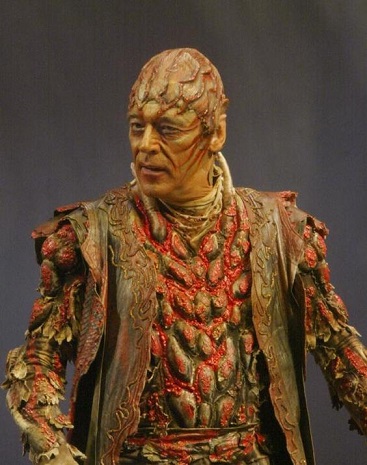
Reading thru some of my hand-written diaries from a quarter-century ago, this entry about a tremendous performance of DAS RHEINGOLD brought back vivid memories.
“Wonderful to see this opera again, and the cast of (mainly) RING veterans gave a superbly confident and nuanced performance. Levine had the huge orchestra under finger-tip control…there were passages of great beauty and lyricism, along with the unleashing of massive sound at times. Although the lighting seems less evocative now, the production is still quite effective, though the first scene could use some freshening: the Rhinemaidens don’t always remember that they are underwater, and the rock pinnacle holding the gold wavered as Alberich clambered up.
To start from the beginning: lovely lyricism from the Rhnemaidens: Joyce Guyer, Kristine Jepson, and Jane Bunnell each sang well in their solo lines, and their voices blended beautifully.
Ekkehard Wlaschiha remains a powerful, vivid Alberich…his voice is now sketched indelibly on this music: magnificent in defeat, and in his vibrant, chilling curse. Hanna Schwarz brought her personal allure and great vocal authority to her interpretation of Fricka. She spun out some lovely soft phrases, creating a sensuous appeal that is not always heard in this music. James Morris shows some vocal wear and tear as Wotan, but he is still able to hurl out vocal thunderbolts (especially at the end) as well as many pages of wonderfully musing soft singing. Very much a god to be reckoned with…bravo!
Hei-Kyung Hong’s vocal radiance and sheer physical beauty made Freia a major role. She’s at her peak now, and I’m so lucky to be living here in NYC to witness it! Mark Baker brought wafting lyricism as well as power to Froh’s music, and Alan Held’s darkish baritone produced a steady stream of well-inflected singing as Donner – his “Heda! Hedo!!“was a vocal high-point.
Splendid giants: the flowing depths of tone from Eric Halvarson perfectly complimented the more gritty, malevolent sound of Sergei Koptchak…bravissimi, gentlemen!! Graham Clark has a perfect role in Mime, where he is able to bring some “real” singing to a part that doesn’t always get it. His incisive diction was crystal clear. Brigitta Svendén sounded simply gorgeous, and she makes Erda the alluring, mysterious icon she must be.
Dominating the stage and the music, Philip Langridge as Loge (photo at the top) used his multi-coloured “big lyric” voice with the finesse of a poet. Langridge created the enigmatic character in purely musical terms whilst the added physical dimension of his portrayal (the grace of a ballet dancer, the gestures of a skilled magician) simply clinched the evening for this great singing-actor. He was greeted with a massive ovation at his bows.
The entire cast was deservedly hailed by the Houseful of avid Wagnerites, and Levine and his orchestra were given a rousing ovation. A very stimulating evening!

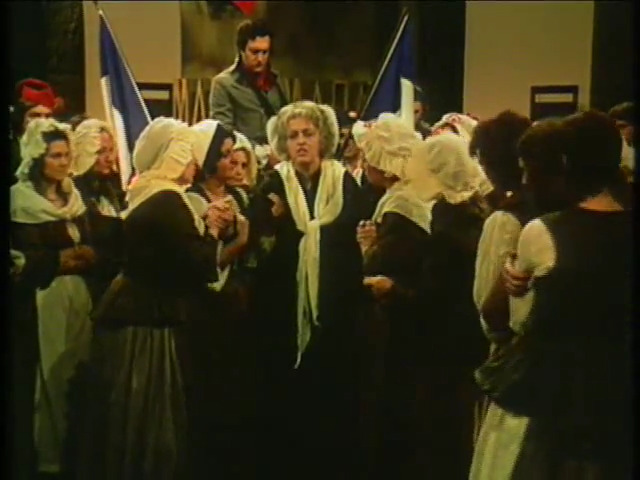
Christina Anghelakova sings the aria of La Vecchia Madelon from a film of Giordano’s opera, ANDREA CHENIER.
Watch and listen here.

Teresa Berganza sings the Habanera from Bizet’s CARMEN here, in a live performance from L’Opera de Paris on May 14th, 1980. It’s just about the most perfect rendering of this super-familiar aria I ever heard.
Watch a video clip of Jerry Hadley and Judith Haddon singing the love duet from a 1982 New York City Opera performance of Puccini’s MADAMA BUTTERFLY here.

~ Author: Oberon
Tuesday March 25th, 2025 – Young Concert Artists presenting bass-baritone Joseph Parrish (photo above) in recital at Merkin Hall, with Francesco Barfoed at the piano.
I first heard Mr. Parrish in a performance of Pauline Viardot’s CENDRILLON given by City Lyric Opera in 2021; I was immediately impressed by his singing, acting, and charismatic personality. In 2023, he sang superbly at the Gerda Lissner Winners Concert, having won first prize in the song/lieder division. And in 2024, Mr. Parrish made a most convincing (and beautifully sung) Salieri in Rimsky-Korsakov’s opera MOZART AND SALIERI, performed by Parlando.
Tonight, Mr. Parrish showed that his is a voice that can bring people together. His stage presence is relaxed and cordial, with glimmers of humor along the way; it is a voice with an extensive range and a mastery of dynamics that allows him to veer impressively between hall-filling power and the most gentle of pianissimos. He can turn a phrase like a magician, whilst all the time his body language and expressive face draw listeners to him like a magnet. This is charisma personified.
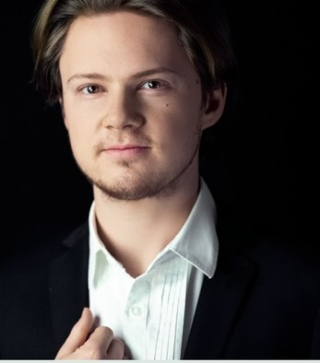
For the first half of the program, Mr. Parrish shared the stage with a stellar pianist: Francesco Barfoed (photo above). Francesco is a musician of extraordinary talent, his playing so perfectly aligned with the singer’s vision of the music.
Mr. Parrish opened the evening with Harry Burleigh’s “Elysium”, and in this single song he set a very high standard for himself: a standard which he would often surpass as the concert progressed. “Elysium” displayed the voice’s sheer power, as well as its sense of control…the last note was simply awesome. More Burleigh next – “You ask me if I love you” – in which the singer details the sensations he experiences when with his beloved…as if to say: “Do you really need to ask? “
Classics from two masters of lieder followed: Mahler’s romantic Liebst du um Schönheit with its poetic words, so lovingly rendered, and Schubert’s immortal Ständchen, in which the pianist plays a major role; the music covers a big vocal range and part of the allure is in the detailing of subtle nuances. The song reached a majestic pinnacle but then ends quietly. Then back to Burleigh for “Her Eyes Twin Pools“; Mr. Barfoed’s playing here is essential to the song’s meaning, whilst the singer’s face, expressive hands, and slender form create a visual poem all their own.
Charles Brown’s ‘The Barrier‘ at first seems to sing of an admirer’s shyness in hesitating to approach the object of his desire, but there is another reason for his reluctance, revealed in the song’s final line. Whilst listening to the song, I was thinking: “How lovely…how poetic…” and then the last words sent a chill thru me.
“Along The Dusty Road” by Hal Johnson seems like a folksong at first; a touch of the blues takes us to a spiritual place; Mr. Parrish sang so many beautiful notes in this song until reaching a whispered final tone that hung on the air.
Charles Brown’s “Song Without Words” is just that. The singer begins with humming, then switches to what the French call “bouche fermée“ which has a slightly different feel from plain old humming. The singer opens his mouth but no words emerge, just sound. Who knew vocalizing could be so expressive?
The New York Premiere of Psalm by YCA Composer-in-Residence Alistair Coleman draws on the old German hymn “How a Rose E’er Blooming“. The words “No one…” are repeated endlessly, as Mr. Parrish displays his vast dynamic range. The words change to “We were…we are…” and the music grows more passionate. The piano then introduces the carol itself, creating an air of fragrant softness. Hypnotically, “…the thorn…” now becomes the song’s lyric.
After the interval, Mssrs. Parrish and Barfoed returned with a Margaret Bonds piece, “You Can Tell The World“, a song with a theatrical feel – so alive – and giving the pianist a chance to shine brightly; it reaches a fantastical finish. Three beloved classics came next. First, “Deep River” in which Joseph made such a poignant impression, displaying the strength, range, and awesome breath control at his command. In “A City Called Heaven“, I had that uncanny feeling that he was singing just to me. At last, the triumphant “Ride On, King Jesus” in which his singing moved me so deeply with his range, power, and vitality.
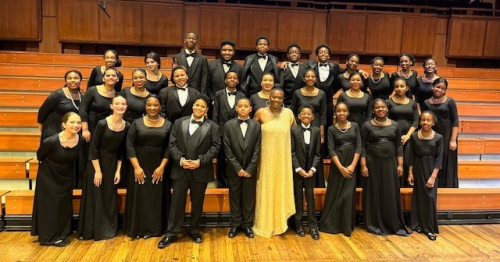
Now the young singers of the Washington Performing Arts Children of the Gospel Choir (above) took the stage, greeted by a vociferous ovation. Dressed in black gowns and tuxedos, they are just plain gorgeous to behold. And then they sang! Under the elegant and inspiring conducting of the group’s artistic director Michele Fowlin, and accompanied by the delightful pianist Anthony “Tony” Walker, they dazzled Merkin Hall with their young voices, weaving perfect harmonies, gesturing poetically, and swaying to Mr. Walker’s marvelous rhythms. Judging by the perfection their singing achieved, I would guess Ms. Fowlin can be a demanding taskmaster, but also that she has a heart of gold. She seemed to glow with pride for her young prodigies.
Their Praise Medley encompassed Greg Roberts’ Prelude to Worship, Rodnie Bryant’s We Offer Praise, and Richard Smallwood’s Anthem of Praise. The audience went crazy for these astounding kids, and Ms. Fowlin and Mr. Walker caused screams of joy to erupt as they took their bows. One boy in the choir reminded me so much of mi amor de loin, Brix, in far away Cebu; after one song, the boy fell to his knee and opened his arms as if to embrace the world.
Mr. Parrish offered three more songs – Bobby McFerrin’s Don’t Worry Be Happy, the profound Let Us Break Bread Together, and Richard Smallwood’s Total Praise (Joseph at the piano himself…!); the last two songs were arrangements by Ms. Fowlin. By then, I’d pocketed my pen and was letting the magic carry me. So much joy filled the hall as the evening came to an end.
~ Oberon

(NOTE: this was originally published during the pandemic…)
During these endless days of being at home, I’ve been reading thru my opera diary, a hand-written document I started in 1962 and which now fills numerous file folders. So many wonderful memories of the great performances I saw over the years were stirred up by reading about them.
One such exciting night was the 1988 premiere of the Otto Schenk GÖTTERDÄMMERUNG, the closing opera of Wagner’s epic RING Cycle. Often referred to affectionately as “the Levine RING”, full cycles of the production in the ensuing seasons created a great international buzz; Wagnerites from all over the globe gathered in New York City to witness this classic staging.
Having already seen the RHEINGOLD, WALKURE and SIEGFRIED, I had a pretty good idea of what to expect; still, when the Gibichung Hall loomed into view, it took my breath away. Levine was mostly magnificent, though there were moments when he let things drag a bit; his orchestra gave it their all, and the chorus sounded sensational as they gathered in lusty expectation of the double wedding.
As to the singers, here’s what I wrote upon returning to my room at the Colonial House after the performance:
“Casting was strong, with pretty singing from the Rhinemaidens – Joyce Guyer (in her Met debut), Diane Kesling, and Meredith Parsons – and Franz Mazura made an astoundingly vivid Alberich, singing with oily malice. The opening scene of Act II, with Alberich pawing at the sleeping Hagen, was very atmospheric.
The Gibichung brother and sister were rather curiously cast: as Gunther, Anthony Raffell’s voice sounded veiled and throaty, and Kathryn Harries’ beautiful (and beautifully acted) Gutrune was undone by effortful singing and a prominent vibrato. [I mentioned that Cornell MacNeil and Lucine Amara could have made for far more interesting casting in these roles!].
The Norn Scene, which I have always loved, benefited from the super casting of Mignon Dunn as 1st Norn, sung with richly doom-ladened tone. Hanna Schwarz (2nd Norn) had a couple of husky moments, but overall sang vividly, with excellent diction. As the 3rd Norn, Marita Napier sometimes sounded a bit insecure, but she did not let down the side. These three really made something of their opening discussion.
Toni Kramer sang erratically but acceptably in the torturous role of Siegfried. He seemed to be husbanding his powers, doing his best singing in Act III.

Above: Christa Ludwig as Waltraute and Hildegard Behrens as Brunnhilde
The divine Christa Ludwig made a thrilling Waltraute, singing with great clarity and verbal point. The distinctive Ludwig tone – that cherished sound – drew the audience in to her every phrase. Add to this the anguished urgency of her delivery, and the result was a veritable triumph.
The Ludwig Waltraute produced one of my all-time favorite curtain calls: stepping before the gold curtain for her first solo bow, she was greeted by such a din of applause and shouting that she halted in her tracks; her eyes opened wide in amazement, and she broke into a huge smile. It seemed to me that she had not expected such an avalanche of affection. She bowed deeply, clearly savoring this outpouring of love from the crowd.

The towering magnificence of Matti Salminen as Hagen (above) produced tremendous excitement in the House. His huge voice was at peak form, effortlessly filling the hall with sinister sound. In the scene where Hagen’s father appears to him in a dream, Salminen and Franz Mazura matched one another in both power and eerily expressive subtlety: thoroughly engrossing. The basso’s portrayal as the drama of Act II unfolded was towering in its epic nastiness and in his manipulation of the situation to attain the character’s sole goal: to regain the ring. This was a performance thrilling to behold, and to hear.
The roar of applause for each of Salminen’s solo bows was thunderous, and I was so excited to be part of it, shouting myself hoarse.
~ Sample the Salminen Hagen, from a later broadcast…it gives me he chills:
Matti Salminen as Hagen – Met 1993
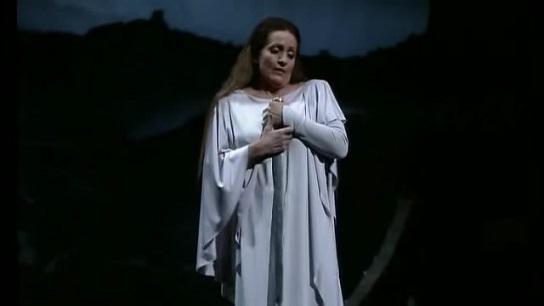
Hildegard Behrens (above) was a Brunnhilde of terrifying intensity and incredible feminine strength. This was an overwhelming interpretation, in which voice and physicality combined to transcend operatic convention, reaching me on the deepest possible level. Behrens lived the part, in no uncertain terms.
The Dawn Duet found Behrens portraying the tamed warrior maid to perfection, savoring her domestic bliss but eager that Siegfried should go out into the world and do great deeds. Her unconventional beauty and her inhabiting of the character were so absorbing to behold. Later, In the scene with Waltraute, Behrens as Brunnhilde listened anxiously to all her sister’s words and she began to grasp the first signs of the downward spiral that would culminate with Siegfried’s betrayal and her own sacrifice. Even so, she dismissed Waltraute with fierce disdain. Behrens’ vivid depiction of Brunnhilde’s terror and helpless dejection as the false Siegfried wrested the ring from her was palpable.

In one of the evening’s most gripping moments, Behrens – having become possessed by Brunnhilde’s plight in Act II – responded to Siegfried’s oath by snatching Hagen’s spear away him and singing her own oath with blistering abandon. Totally immersed in the character, her pain was painful to behold. In the powerful trio that ends Act II, Behrens, Raffell, and Salminen were splendid.

Above: Hildegard Behrens as Brunnhilde ~ Immolation Scene
In the Immolation Scene, the great strength of Brunnhilde’s love for Siegfried, and her determination to perish in the flames of his funeral pyre, marked the culmination of Hildegard Behrens’ sensational performance. Her singing was powerful, with unstinting use of chest voice and flaming top notes; there were moments when expressionistic effects crept in but it all seemed so right. The amazing thing about Behrens’ singing and acting here was that it all seemed spontaneous…she seemed to be living it all in the moment. One cannot ask more of an operatic portrayal.
The curtain calls went on and on, the audience eager to show their appreciation with volleys of bravos as the singers stepped forward time and again. Here we must also thank James Levine, whose grand design underlies the great success to date of the individual operas. Ahead, in the Spring, seeing the full cycle in a week’s time is already on my calendar. My dream will come true!”
~ Oberon
 Oberon's Glade