Category: Opera

  • Patricia Brooks as Mélisande

    Brooks 2

    Above: Patricia Brooks

    One of my dearest memories from my early opera-going experiences is of my first PELLEAS ET MELISANDE, in a lovely production at New York City Opera in 1970. Debussy’s haunting score moved me, even though it was not always easy to comprehend. And the poetry of the words conveyed a sense of mystery; since I had studied French in high-school (with a native-born Frenchwoman as my teacher) it was engrossing to listen to the language being sung.

    One of the most memorable portrayals in the superb cast was that of the mysterious, fragile Mélisande by Patricia Brooks. Apart from her iconic Violetta, Mélisande was the Brooks role that I recall most vividly. I was so excited to find this recording on YouTube.

    Read more about this soprano here.

    Julius Rudel is the conductor, with the following cast:

    Arkel – Malcolm Smith; Geneviève – Francis Bible; Golaud – Louis Quilico; Pelléas – André Jobin; Mélisande – Patricia Brooks; Yniold – Robert Puleo; Physician – Don Yule; Shepherd – William Ledbetter

    The above names may be largely forgotten by now, some 55 years on. To me they were remarkable artists who played a part in my abiding passion for opera.

    If you are not familiar with the Brooks voice, this will give you an idea of her unique qualities as a singer:

    Patricia Brooks as Violetta – w Molese – NYCO – 9~28~69


  • Gihoon Kim at The Met

    Gihoon & sophia

    Above: Korean baritone Gihoon Kim with Met Opera fan Sophia Cerovsek

    ~ Author: Oberon

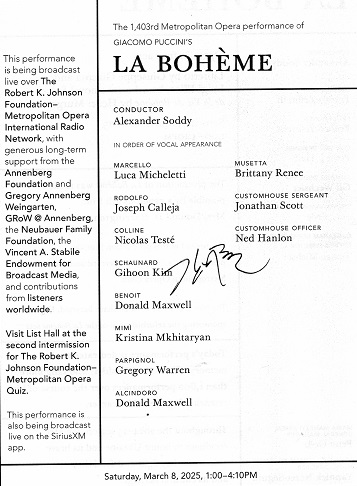
    Saturday March 8th, 2025 matinee – I wanted to catch Gihoon Kim’s Schaunard in the Met’s BOHEME a second time. Since watching the Korean baritone take the title Cardiff Singer of the World at the 2021 competition, where his Tanzlied from Korngold’s DIE TOTE STADT brought the beloved soprano Roberta Alexander (one of the judges) to tears, I have followed Gihoon’s career, and even befriended him on Facebook. He has a wonderful voice and a sunny, life-embracing personality.

    Although I was at a score desk, I’d heard about Gihoon’s dance routine (and the ensuing duel) in Act IV, so this time I stood up and took in all the action. Hilarious! Later in the act, it is Schaunard who first realizes that Mimi has breathed her last: “…è spirata…” , which Gihoon spoke in a hushed voice. After the performance, I went to say hello to him at the stage door.

    Gihoon-1 jpg

    Aside from Gihoon, the only singers in the cast whose work I was familiar with were Joseph Calleja (Rodolfo) and Kristina Mkhitaryan (Mimi, who I’d previously seen as Musetta). Brittany Renee (Musetta), Luca Micheletti (Marcello), and Nicolas Testé (Colline) took the other leads today, and the British conductor Alexander Soddy was on the podium.

    Although there was sometimes a feeling that the cast was under-rehearsed, overall the performance came off quite well; Maestro Soddy did cover the voices at times (a trend at the Met these days), but his tempi were nice, and I liked the energy he developed as the military parade passes by the Café Momus.

    I had not heard Joseph Calleja (Rodolfo) in the House since his 2019 Pollione. The voice has always had a fast but fascinating vibrato, and that was in play today; for me, it adds a special appeal to his singing. Today, his highest range seemed somewhat compromised; he may have been ill, or perhaps this is how he sounds now, after having sung, in recent years, some roles that stretched his essentially lyrical voice. Whatever the trouble, he managed to find a work-around, keeping the higher notes brief, or trying a headier resonance. At the end of the love duet, he at first harmonized with the soprano, but then went for the concluding top note which was a bit husky but which his Mimi’s clear note helped to masque. Thereafter, Mr. Calleja was a truly poetic Rodolfo; his singing has a vulnerable trace that is most appealing. His most magical moment came at the end of Act III when he produced a gorgeous falsetto tone on “…la stagione dei fiori…”  Really exquisite. Earlier, at the end of “Che gelida manina…” he had created the same intimate atmosphere with his delicate “Via piaccia dir?“, sustained down to a whisper.  

    Today’s two sopranos both have vibrant voices, capable of filling the Met (so long as the Maestro kept the orchestra’s volume agreeable). Both Kristina Mkhitaryan and Brittany Renee have a bit more vibrato in their tone than I could wish, but other opera friends of mine feel this is a trend nowadays, and they are not bothered by it.

    Ms. Mkhitaryan’s Mimi made her entrance after a lovely flute solo; oddly, for the first time, I sensed that a shadow of doom lies over the seamstress right from her hesitant “Scusi…”. As her narrative-aria unfolded, the vibrato became less intrusive; her singing was poetic. The orchestra slowed a bit, so she could make the most of the lyrical Ma, quando vien lo sgelo...”; and in the lingering phrases that follow, the soprano was most persuasive. In their classic duet, she and Mr. Calleja beautifully expressed their blooming love. The tenor’s haunting “Che m’ami, di...” was met by the soprano’s delicate “Io t’amo!“.  Nothing in the world compares to falling in love at first sight; I’ve done it hundreds of time thru the years…usually in vain.

    Ms. Mkhitaryan’s singing in the Act III duet with Marcello was tinged with desperation, and her Donde lieta usci...” was truly touching, especially her hushed “Bada, sotto il guanciale c’è la cuffietta rosa…” which made me choke back tears. The aria had a ravishing, sustained ending. In the final minutes of Mimi’s life, Ms. Mkhitaryan summoned a lovely palette of vocal pastels; she even introduced a touch of playfulness as she and Rodolfo recalled their first meeting. But then the fatal cough sets in, her final lines trailing off into eternity.

    Ms. Renee’s Musetta, like most takes on this role, is an extrovert. Her noisy disruption of the Momus party was laced with moments of shrill shrieking, but she settled in for the Waltz, especially nice in the insinuating subtleties of the second verse, and then capping off the ensemble with a bright top note. At the end of the third act, Musetta again gets shrewish as she and Marcello indulge in name-calling. Ms. Renee was at her most compelling when we see the other side of her as she prays for Mimi’s recovery, and she and Marcello comprehend the depth of their love for one another.

    From note one, Luca Micheletti was a superb Marcello; this can really be a star role – when it’s truly well sung and acted – and that’s what this baritone made it. Every note and line counted for something, so that even the big moments – like leading the Act II ensemble, singing the melody of Musetta’s waltz – are part of a grander scheme. In his Act III duet with Ms. Mkhitaryan, and again in his Act IV duet with Mr. Calleja, the singer sounded just the way you want an Italian baritone to sound: passionate, expressive, and assured. I will look for him in the future…bravissimo!

    No less impressive than his painter/colleague, Nicolas Testé as the philosopher Colline excelled. Taking every opportunity to make his mark, the French basso highlighted such moments as joining Micheletti/Marcello in a commanding “Abbasso, abbasso l’autore!” as they dismiss Rodolfo’s feeble effort to get a fire going in the stove of their frigid garret. His observations of the two ‘loving’ couples at Momus were spot on. But of course it was in the Coat Aria of Act IV that M. Testé (abetted by excellent horn playing from the pit) struck vocal gold. Really beautifully done…grand merci!! 

    It was not a perfect performance, but it was extremely moving; and sometimes that is all that matters. I found myself thinking of my sister’s passing last July; like Mimi, she slipped away quietly – with loved ones watching over her – at the end of her battle with cancer. Ironically, LA BOHEME was one of only two operas my sister ever saw – at the Old Met in her college days. I was always jealous that the cast she had seen included Dorothy Kirsten, Carlo Bergonzi, and Anneliese Rothenberger.

    Sitting at my score desk, people often come up to talk to me during intermission; they’ve spotted me from Family Circle, with my reading lamp on, my score open, and taking notes. Today, three young engineering students from Columbia University stopped by, each wearing a necktie and all looking very dapper. They were all seeing their first opera; they asked me many questions, and I found my usually-reticent self babbling away about how wonderful opera is, and how it changed my life (literally!). Once I get started on the topic, it’s impossible to shut me up.

    Earlier, I’d been chatting with the young woman seated in front of me; she was seeing her second opera this afternoon, and she asked for suggestions of what other operas she should try. In the course of our chat, she apologized for mispronouncing the names of the great operas, and of the characters in them. I assured her that all opera lovers start out that way; you can only imagine how I mangled the title of Leonora’s great aria “Pace! Pace, mio dio!” for several weeks before I heard the correct pronunciation. To this day, I still blush to myself when I think of it. 

    ~ Oberon

  • Amina Edris ~ “Dis-moi que je suis belle”

    Amina_edris_capucine_de_chocqueuse_0

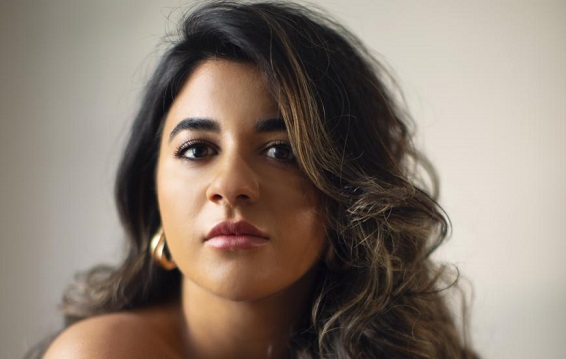
    Egyptian-born soprano Amina Edris (above, photo by Capucine de Chocqueuse) sings “Dis-moi que je suis belle” from Massenet’s Thaïs at a concert in Prague with the Prague Philharmonia, conducted by Lukasz Borowicz.

    Watch and listen here.

    Ms. Edris will be making her Metropolitan Opera debut in April 2025 as Mimi in La Boheme.

  • Orchestra of St. Luke’s ~ Bernstein’s ‘Kaddish’

    Samuel-pisar

    Above: Samuel Pisar

    ~ Author: Oberon

    Wednesday January 29th, 2025 – Carnegie Hall marked the 80th anniversary of the liberation of Auschwitz with a performance of Leonard Bernstein’s Symphony No. 3, “Kaddish.” A setting of ‘A Dialogue with God’ by the late Samuel Pisar – who had himself been a survivor of Auschwitz – was spoken tonight by Pisar’s wife, Judith Pisar, and their daughter Leah Pisar, with James Conlon leading the Orchestra of St. Luke’s. The Bard Festival Chorus, directed by James Bagwell, and the Brooklyn Youth Chorus, led by Dianne Berkun Menaker, made the choral passages an integral part of the evening’s performance.

    The reviews were quite harsh when the Boston Symphony Orchestra, conducted by Charles Munch, premiered this symphony on January 10, 1964; it is dedicated to the memory of President John F. Kennedy, who had been assassinated on November 22, 1963.

    Tonight was my first time hearing this work. In preparation, I read some articles and reviews of the piece; these seemed mostly to center on the narrative rather than on the musical setting. My idea was to focus on the music and let the narration flow, but that proved impossible: such is the power of Mr. Pisar’s writing.

    Former Secretary of State Antony Blinken, stepson of Samuel Pisar, made an eloquent introductory speech in which he drew a connection between the substance of Bernstein’s Kaddish and the current situation here in the USA. This of course was surely weighing on the minds of most everyone in the audience.

    Judith and Leah Pisar had taken their places next to the podium, and Maestro Conlon entered to a warm greeting. Most of my experiences with Mr. Conlon’s conducting have been at the Metropolitan Opera, where he debuted in 1976  and went on to preside over nearly 300 performances, the latest having been Shostakovich’s LADY MACBETH OF MTSENSK, more than ten years ago. I’d love to see him on the Met podium again.

    Low humming from the chorus opens the Kaddish, and then Judith Pisar, a petite woman, began to speak. Her voice is deep and profound as she talks of the Age of Anxiety, which seems to be having its second dawning. Leah Pisar’s speaking voice has a sense of passion and urgency which contrasted with Mme. Pisar’s more solemn tones.

    A high violin tone is sustained by concertmaster Krista Bennion Feeney until the xylophone sounds an alarm. A melancholy theme of unison celli turns anxious as the basses join. Following a resounding crash, the music gets wild and fast, with the crack of a horsewhip. The chorus’s rhythmic clapping gets a bit jazzy; their song is accented by the xylophone, and it moves to a big finish.

    Over quiet percussion and choral humming, Judith Pisar speaks long…and movingly; the essence of the work now becomes evident: where was god when these horrible things were happening to his people? What wrongs had they committed to merit such torment and anguish? Was god angry or simply indifferent?

    As questions are raised – “How did the Holocaust, the genocides, and the ethnic cleansings become acceptable?” – and as the spoken words become more haunting and horrifying, the actual music tends to feel less engrossing.

    But then, soprano Diana Newman’s high, sweet voice floats over an accompanying harp: clear and reassuring. The female choristers join, and the music turns grand, only to fade with the xylophone sounding. Ms. Newman resumes, supported by high, spun-out sounds of the violins. Angelic voices hum, whilst scurrying music underscores Leah Pisar’s speaking of “incendiary demagogues”.  

    The music turns delicate; Mme. Pisar speaks until a crescendo obliterates her voice; her daughter speaks of “chaos on Earth”. Aching celli and basses play deep and rich; the music swells with both choruses joining. Stabbing accents turn into an oddly merry passage for clarinet, flute, and bassoon. The Youth Chorus sings; the spoken description of “the warm embrace of democracy” seems ironic now.

    A postlude of strings and brass becomes a lament, with muted trumpet and oboe. The music hesitates; Leah Pisar speaks again, with Ms. Feeney’s violin as solo accompaniment. Now Mme. Pisar issues a plea for peace as horn and trumpet sound. There is a fast and jazzy chorus, which Ms. Newman joins. The finale feels a bit extended, but then a dramatic pause leads to a final Amen.

    Throughout the work, the eternal question hovers overall: why does god allow these things to happen? And why did he abandon the faithful in their hour of direst need? Another such test seems to loom before us now. Perhaps there are no gods, and we’re simply going to have to make it on our own.

    ~ Oberon

  • Les Arts Florissants/Zankel Hall Center Stage

    CH11515039

    Above: William Christie, photo by Richard Termine

    ~ Author: Lane Raffaldini Rubin

    Tuesday January 28th, 2025 – Tonight,  Les Arts Florissants made what has become the rare appearance of an early music ensemble on a Carnegie Hall stage.

    To celebrate the eightieth birthday of its founder and co-musical director William Christie, the group presented selections from the core of its repertory, including scenes from the operas of Marc-Antoine Charpentier (1632-1704), Jean-Baptiste Lully (1632-1687), and Jean-Philippe Rameau (1683-1764). Christie has been a champion of these composers since the 1970s and it was with a 1986-87 production of Lully’s Atys – an opera that had not been staged since 1753 and whose music was excerpted at Tuesday’s performance – that Les Arts Florissants made its first big break.

    Seeing the thirteen players and six vocalists take the stage of Zankel Hall’s intimate in-the-round configuration, one might get the sense that Les Arts Florissants is simply a small group of musicians dedicated to the French Baroque. Back in France, however, this group is just one component of a multifaceted institution that includes early music performance, music pedagogy, professional development for young singers and instrumentalists, a historic country house with fanciful Baroque-style gardens (themselves home to many of the group’s activities), training for gardeners, and a garden studies research center. Christie himself (an American, mind you, who left the States as an objector to the Vietnam War) is the godfather of this musical-cultural web.

    Tuesday’s performance was a testament to the group’s decades-long legacy of learning and teaching, its total grasp of this body of music, and the kinship of its members, who played and sang together like family.

    CH11515040

    The chosen excerpts reveal the dramatic directness and emotional turbulence of French Baroque opera. We heard none of the repetitive music of Italian da capo arias or strophic forms. Instead, we heard through-written works that interweave recitative dialogues and monologues with airs and duets. The transitions between air and recitative were at times fitful and at times seamless, but always served a clear dramatic function. That formal range and psychological charge were on display in the excerpts from Charpentier’s 1693 Médée, where a dialogue between Médée and her confidante Nérine is interrupted by outbursts of jealousy and vengefulness. This all culminated in the aria “Quel prix de mon amour”, sung by mezzo-soprano Rebecca Leggett, a lamentation undergirded by fleeting but searing dissonances in the orchestra.

    Another characteristic of this music is its emphasis on French diction. Lully, the favorite composer of Louis XIV, explicitly sought to differentiate his music from the florid and opaque sounds of Italian opera of the time. In excerpts from the later acts of Atys of 1676, the tenor Bastien Rimondi sang with clarity and shapely elegance as he communicated his character’s yearning and anguish.

    The highlight of the program was Rimondi’s “Règne, Amour” from Rameau’s Pigmalion (1748). Rameau’s opera music, which dominated the evening, was presented simultaneously as a development of Lully’s legacy as well as an innovation upon and a perversion of it. In the Pigmalion excerpts we hear varied instrumental colors, free-spirited use of the recorders and reeds, heavy basso continuo inversions that drive harmonic motion, and a Handelian rhythmic motor. Rimondi sang his part with pure joy. His exquisitely crisp diction permeated ornate passages and more straightforward melodic lines, never hindering a sweet, clear tone and blooming vibrato on sustained notes.

    The program concluded with two scenes from Rameau’s 1735 Les Indes galantes, the flagrantly cancelable opera-ballet featuring unrelated tales of exotic places and their inhabitants. Both scenes were drawn from the act “Les sauvages” depicting North American landscapes and natives. One might think the inclusion of the “Forêts paisibles” chorus to be pandering to the New York audience, but this scene also includes the famous dance of the savages which serves as Les Arts Florissants’s frequent sendoff at the end of their concerts. They tossed off this music with swung beats and confident restraint.

    CH11515089

    As an encore, Christie and Les Arts Florissants offered the quartet “Tendre amour” from the third act of Les Indes galantes (which Rameau cut from the opera after its first performances). Christie described this music as “one of the most beautiful pieces of the eighteenth century” and indeed it was gorgeous and pastoral with vocal lines floating high in the air. It was a birthday gift from Christie to the audience.

    CH11515067

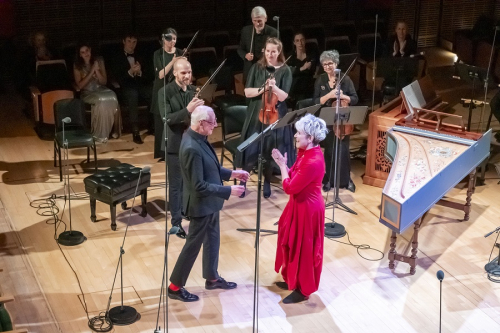
    Above: Maestro Christie greets Joyce DiDonato; photo by Richard Termine

    But the ensemble members had something else up their sleeve. The star mezzo-soprano Joyce DiDonato emerged onto the stage and lavished praise on Christie, whom she met while rehearsing for his 2004 production of Handel’s English-language opera Hercules. In tribute to Christie, she and the ensemble presented “As with rosy steps the morn” from the oratorio Theodora (why didn’t they choose something from Hercules?). After a full program of Charpentier, Lully, and Rameau, DiDonato’s Handel seemed monumentally scaled, possessing a different species of substance and intensity. The strophic form of this piece (repeating sections of music with new verses of text) set an obvious contrast with the French music of the main program and put the French works’ organic, dramatic, and transparent value into focus.

    The program was, after all, a didactic showcase of French Baroque music and its performance techniques. Among early music groups, Les Arts Florissants is a champion of craft, forgoing the temptations to produce the highly biting, peppery sound that is so en vogue these days. Surrounding the ensemble on all sides, it was as if we the audience could simply enjoy overhearing a reading of this music being shared among friends.

    Performance photos by Richard Termine, courtesy of Carnegie Hall

    ~ Lane Raffaldini Rubin

  • Paola Prestini/Magos Herrera ~ Primero Sueño

    Prestini herrera

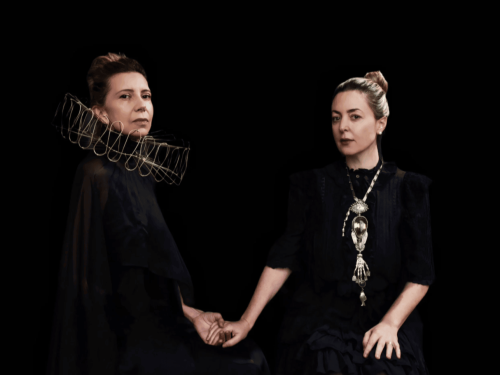
    Above: Paola Prestini and Margos Herrera

    ~ Author: LiIi Tobias

    Friday, January 24th, 2025 – My evening began with a pilgrimage to the Met Cloisters to attend the world premiere of Paola Prestini and Magos Herrera’s opera Primero Sueño. After traveling for an hour and a half on the subway from Queens up to Washington Heights, I then trekked uphill along a perilously icy pathway into Fort Tryon Park. As I neared the museum, the stone towers emerged majestically above the bare treetops in the night sky. I had never been to the Cloisters at night, not to mention in the Winter either, and it was certainly an experience unlike any of my daytime, Summer excursions. But it was pleasantly warm inside, though dimly lit which created an air of mystery for the music to come….

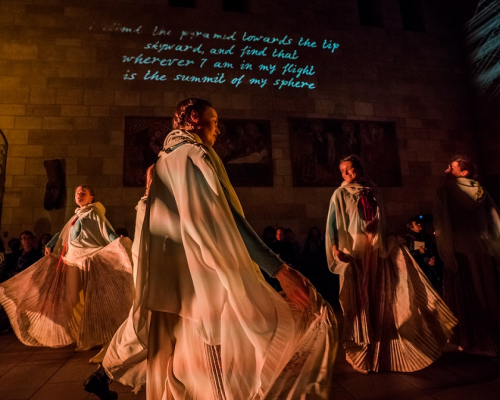
    As the audience mingled in the entry room, we were greeted by a group of ghostly singers, draped in translucent white veils. These were the sjaella (sisters) – the nuns living in Sor Juana’s convent. The sisters sang on a sustained “ah,” the tones drifting to and fro, wavering gently between consonance and dissonance. They then beckoned us to walk up the stairs where they had first appeared and into the adjacent room, which bordered a candle-filled colonnade encircling a dark garden. 


    As a “procession opera,” this production gave prominence to the spatial aspect of sound. As we walked into this first room, the singing of the nuns faded as it was gradually overtaken by the gentle plucking of a harp and theorbo. Later in the opera too, we were separated into two groups and led by the nuns around the circumference of the colonnade, while they performed a processional chant. Their voices, singing the refrain “Santa Maria,” reverberated through the corridors and around the corners of the space, and their shadows were projected on the stone walls as they walked. I imagine it must have been an entirely different experience for almost every audience member,  just based on where they were standing within the group!


    Primero Sueño at The Cloisters_1049_


    Production photo by Jill Steinberg


    Movement and dance were both incredible forces of expression in this performance—just as important as the music. In the second room that the singers and musicians traveled to, Sor Juana (performed by co-composer and librettist, Magos Herrera), lead the other nuns in song and dance as she worked on writing her poem, “Primero Sueño.” The rhythmic nature, expressed through both the music and dance, created an exuberant atmosphere as the women worked together helping Sor Juana write. 


    However, their happiness and safety was suddenly challenged by the appearance of the god Morpheus (danced by Jorrell Lawyer-Jefferson), who struck fear in the nuns. He didn’t sing, but his unsettling movements, accompanied by a distorted recording, came across as otherworldly and dangerous. Lawyer-Jefferson appeared later in the opera as well, both as Quetzalcoatl and Phaeton – both much more positive and comforting mythical figures compared to Morpheus. The abundance of mythical figures in this opera was really interesting, given that Sor Juana and the sisters are nuns, so Christian figures such as Mary coexisted with the indigenous deity Quetzalcoatl, as well as with the Greek Nyctimene, Morpheus, and Phaeton. 


    Primero Sueño at The Cloisters_0599_


    Production photo by Jill Steinberg


    The juxtaposition of multiple very different religious and cultural traditions was just one of many intriguing juxtapositions in this production. The opera also created a space where music from many different traditions—classical choral, jazz, electronic, folk, etc.—could exist at the same time. While much of the time, the music felt extremely mystical and otherworldly, there were also many sudden shifts back to the mundane. Back in the first room, the sisters broke into song as they complete their daily tasks, such as sewing and gardening. Their simple call and response, accompanied by recorded birdsong, grounded the scene in the present world, rather than the mystical realm Sor Juana was inhabiting just a few moments before. The final number, when Sor Juana has ultimately returned to her poem is also a joyous return to the real world after her encounter with Phaeton in the cosmos. The music here has a folk-like feel, as Sor Juana recites the verses to the audience, performing her words like telling a story.


    PHOTO-2025-01-22-16-58-38


    Production photo by Jill Steinberg


    I was constantly captivated, surprised, and inspired by every aspect of Primero Sueño. The production worked so well in the Cloisters, and I hope that it can be performed there again, or even in another similarly gorgeous location. At the end of the production, all the performers, joined by Paola Prestini and who I believe was Louisa Prouske, the director, were celebrated with raucous applause and (literally!) danced their way out of the final room.

    ~ Lili Tobias

  • Björling & Merrill: FORZA DEL DESTINO ~ Duet

    Merrill & bjorling

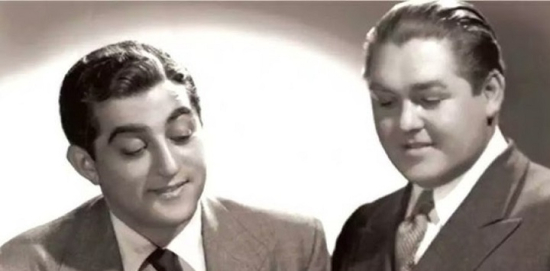
    Jussi Björling and Robert Merrill sing the great duet “Solenne in quest’ora” from Verdi’s LA FORZA DEL DESTINO.

    Listen here.

    These two voices were among the first I became familiar with in the early 1960s when I was discovering opera. It became my lifelong obsession.

  • Björling & Merrill: FORZA DEL DESTINO ~ Duet

    Merrill & bjorling

    Jussi Björling and Robert Merrill sing the great duet “Solenne in quest’ora” from Verdi’s LA FORZA DEL DESTINO.

    Listen here.

    These two voices were among the first I became familiar with in the early 1960s when I was discovering opera. It became my lifelong obsession.

  • Michal Partyka ~ Vision fugitive

    Partyka jpg

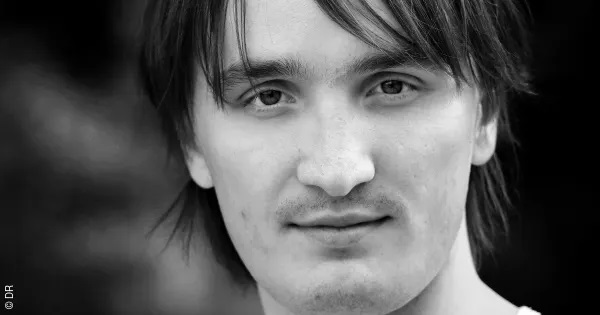
    Polish baritone Michal Partyka (above) sings “Vision fugitive” from Massenet’s HERODIADE at a 2012 concert given by the Orchestre de L’Opera National de Paris, conducted by Guillaume Tourniare.

    Watch and listen here.

  • Loretta Di Franco Has Passed Away

    Rigoletto

    Above: Loretta Di Franco as Countess Ceprano in RIGOLETTO, with Placido Domingo as the Duke of Mantua

    Soprano Loretta Di Franco has passed away; from her Met debut as a Page in TANNHAUSER in 1961 to her farewell in 1995, she sang over 900 performances with The Met in New York City and on tour.

    A native New Yorker, Ms. Di Franco had started out at The Met as a member of the chorus. In 1965, she entered and won the Met Auditions, thereafter taking on a vast number of roles in seven languages; I saw her in many of them. She sang both Barbarina and Marcellina in NOZZE DI FIGARO, Pousette in MANON, Berta in BARBIERE DI SIVIGLIA, Giannetta in ELISIR D’AMORE, both Papagena and the 1st Lady in ZAUBERFLOETE, Lisa in LA SONNAMBULA, both the Sandman and the Dew Fairy in HANSEL AND GRETEL, Marianne Leitzmertzin in ROSENKAVALIER, Zerlina, Frasquita, Xenia in BORIS GODUNOV, both Woglinde and Gerhilde in the RING Cycle, and Kate Pinkerton. She sang Violetta in some student matinees of TRAVIATA, and appeared in two Janacek operas at The Met: JENUFA and KATYA KABANOVA.

    Upon retiring from singing, Loretta continued to work at The Met as a language coach.

    Loretta Di Franco appears in videos of several Met productions, but the only free-standing excerpt I could find is the LUCIA sextette from the Met’s 100th Anniversary Gala in 1983: she sings Alisa, joining Robert Nagy (Arturo), Julien Robbins (Raimondo), Roberta Peters (Lucia), Dano Raffanti (Edgardo), and Brian Schexnayder (Enrico). Sir Richard Bonynge conducts. Watch and listen here.