
Teresa Stratas and Placido Domingo are Mimi and Rodolfo in a scene from Act I of Puccini’s LA BOHEME from a 1970 televised Gala Performance given at Sadlers Wells in London. Sir Charles Mackerras conducts.
Watch and listen here.
Teresa Stratas and Placido Domingo are Mimi and Rodolfo in a scene from Act I of Puccini’s LA BOHEME from a 1970 televised Gala Performance given at Sadlers Wells in London. Sir Charles Mackerras conducts.
Watch and listen here.

Above: Guillermo Sarabia as the Dutchman
Audio-only performance of Wagner’s Der Fliegende Holländer performed at The New York City Opera in 1977, conducted by Julius Rudel, with the following cast:
Holländer – Guillermo Sarabia
Senta – Johanna Meier
Daland – Ara Berberian
Erik – Richard Taylor
Mary – Diane Curry
Steuermann – Jerold Siena
Listen here.
Ms. Meier, Ms. Curry, and Mr. Berberian were all great favorites of mine, and I saw Mr. Sarabia’s Dutchman twice: once in Houston and later in Springfield, Massachusetts. Mr. Siena sings the Steersman beautifully.
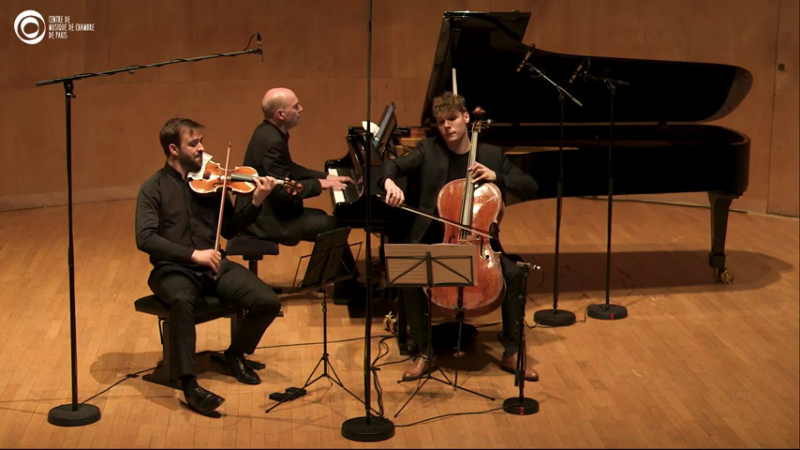
William Hagen (violin), Bruno Philippe (cello), and Jérôme Ducros (piano) in a performance of M. Ducros’ Trio pour violon, violoncelle et piano (2009). The recording was made at the Salle Cortot, Paris, on March 12th, 2020 – the exact date that the pandemic began to cause the curtailment of musical events here in Gotham.
Watch and listen here.
I love this piece, and it is exceptionally well-played. Many thanks to my late friend Raphaël Michaud, who first sent me the link in 2020.

A 1977 performance from the Bayerische Staatsoper of Wager’s DIE WALKURE features the Sieglinde of Hildegard Behrens (above); I saw Behrens in the role twice at The Met in 1983, and she was thrilling.
Listen here.
Conductor: Wolfgang Sawallisch
Siegmund – James King
Sieglinde – Hildegard Behrens
Hunding – Kurt Böhme
Brünhilde – Gwyneth Jones
Wotan – Theo Adam
Fricka – Brigitte Fassbaender
Gerhilde – Leonore Kirschstein
Ortlinde – Antonie Fahberg
Waltraute – Charlotte Berthold
Schwertleite – Ortrun Wenkel
Helmwige – Gertrud Freedmann
Siegrune – Helena Jungwirth
Grimgerde – Liliana Netschewa
Roßweiße – Gudrun Wewezow

Above: Maestro Fabio Luisi
Author: Shoshana Klein
Sunday March 26th, 2023 – I have to admit to not knowing much about the Dallas Symphony Orchestra before tonight. I’ve seen Fabio Luisi guest conduct before but not work with his home orchestra. As it turns out, they put on a great concert – they played with energy, focus, and dynamic range, and Luisi does a great job of keeping things interesting and restrained to keep the music interesting later on. Despite, or maybe because of this, somehow the concert still had more people dropping things in the audience than any other concert I’ve ever been to.

What keeps me awake by Angélica Negrón (above, photo by Quique Cabanillas) started the concert – a short 7-minute piece, but a very nice introduction to the concert. Negrón created a distinctive but not completely unfamiliar sound world – though this might have something to do with the fact that I listen to her band, Balún – which seriously, you should check out if you haven’t heard them. Negrón is the Composer in residence at the DSO and I’m looking forward to hearing more pieces that come out of that collaboration.
The piece evokes uncertainty and wandering like her program note explains – navigating moving from Puerto Rico to New York City as a Latina composer trying to fit into spaces that historically excluded people who look like her.

Rachmaninoff’s second piano concerto with Garrick Ohlsson (above) was very enjoyable. I’m usually in the balcony, and being on the orchestra level so close to the stage, I could actually feel the sounds through my feet when the brass let loose. The orchestra was super sensitive under Luisi, the piano sections drawing us all in and the louder sections contrasting well. Ohlsson played the 3rd movement with some extra snappiness, which was just enough to keep my full attention for a piece many of us have heard… somewhat frequently. Near the middle/end of the third movement, I think the piece loses steam a bit compositionally, but it almost makes the end more exciting – right around the time you start to be ready for it to be over, it gets into it again and heads for the hyper-romantic finish.
Ohlsson did an encore that he announced from the stage, though it wasn’t really necessary – Chopin’s op 9 no 2, probably the most well-known of the nocturnes. Near the end, he had a little fun with it, adding some whimsy in places.
The Tchaikovsky, (which started at almost 10pm, the joys of an 8:30 start time) was really well paced, restrained just enough more than usual to be noticeable. Some tempi choices in the second movement caught my ear, the bassoon solo section – while sounding great – was a little slow to me, and the horn solo also sounded good but a little fast. However, overall I chose to trust the plan as the whole piece came together really well. The wind soloists were all fantastic, and more soloistic than their counterparts in the first half of the concert.
It’s played so much, but this is one of those pieces to me that if you put it away for long enough, it regains most of its charm. It turns out I hadn’t heard it in long enough that it felt fresh and new, at least with this exciting performance.
~ Shoshana Klein
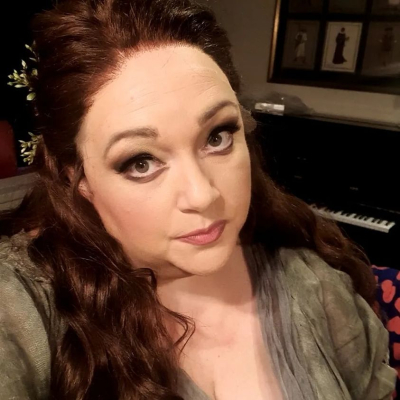
Above: Helena Dix, costumed as Norma, in her Met dressing room; I borrowed this image from the soprano’s Facebook page
Author: Oberon
Saturday March 25th, 2023 matinee – The three great peaks of the bel canto repertoire are – for me – Donizetti’s LUCIA DI LAMMERMOOR, Rossini’s SEMIRAMIDE, and Bellini’s NORMA. This afternoon I was at The Met to see the season’s final performance of the Bellini. The casting of Sonya Yoncheva in the title-role turned out to be pretty controversial, and the soprano took to social media to complain that people were comparing her Norma to recordings and remembered performances from decades ago.
I guess she is unaware that this has always been a favorite pastime of serious opera-lovers…something that I learned early on in my opera-going career. Examples: during the enormous ovation after the Mad Scene of Beverly Sllls’ first New York Lucia, Maria Grimaldi waltzed up behind me and growled in my ear: “Not as good as Lily Pons!”. And while I was yelling “brava” at the Met for Birgit Nilsson’s 1971 Isolde triumph, the fellow next to me, who was applauding feebly, said: “I guess you are too young to have heard Flagstad!”
Anyway, the problem became moot when Ms. Yoncheva (who was wonderful as Giordano’s Fedora earlier this season) took ill and withdrew from the final three NORMAs, one by one. Angela Meade was called in for the first Yoncheva cancellation, and the cover – Helena Dix – stepped in for the second. Everyone was waiting to see if Yoncheva would come back with a vengeance for today’s final NORMA, which was being broadcast.
In truth, I was hoping for a cast change, and that Ms. Dix would be singing today. I’d started following the plucky Aussie soprano on Facebook a few weeks ago when I began to see her postings about what it’s like to cover a major role at The Met. She had covered Norma here in 2017, and had also covered Alice Ford in FALSTAFF in 2019, going on at one performance for her Met debut.
This year, as it happened, she ended up singing quite a few of the NORMA rehearsals. But Ms. Yoncheva sang the prima, and the next two performances. When she became ill, Peter Gelb applied his frequent tactic: he located a “star” to step in rather than relying on the cover. Thus, Ms. Meade returned to a production in which she has previously appeared.
This morning, as I was getting ready to leave for the noontime matinee, an e-mail from a soprano/friend of mine popped up: “Helena Dix is singing Norma today!” This elevated my mood considerably.
The house was nearly full as Maurizio Benini took his place on the podium. Benini has frustrated me in the past with his eccentric tempi in operas like LUCIA DI LAMMERMOOR, MARIA STUARDA, and MANON. As the afternoon progressed, he upheld his reputation as a routinier.
Christian van Horn as Oroveso was simply superb in the opera’s opening scene, and he remained so throughout the afternoon: a potent vocal force and an imposing stage figure. His “Ah, del Tebro” later in the evening was gorgeously sung, and his shock at Norma’s revelation of her motherhood was a lightning bolt. Together with Ms. Dix and Mr. Spyres, Mr. van Horn made the opera’s poignantly dramatic finale, “Deh! Non volerli vittime…” heart-rendingly moving.
Meanwhile, back in Act I, as the Druids withdraw from the forest clearing, the Romans appear: Michael Spyres as Pollione and Yongzhao Yu as Flavio. The latter showed a fine voice and was an alert actor, whilst Mr. Spyres – a marvelous Met Idomeneo earlier this season – was sounding more baritonal today. The Spyres voice has great immediacy and, despite a hoarse high-C in “Meco all’ altar di Venere” his singing and dramatic engagement (all afternoon, really) was a potent experience. The tenor was having a rousing go at the cabaletta “Me protegge, me difende“, reaching the final phrase with a penultimate A-flat which he then elevated to the more customary B-flat, at which moment Benini decided to amp up the orchestra, ruining the effect.
When Ekaterina Gubanova was announced as Adalgisa, I admit I had misgivings; her Act II Brangaene at Geffen Hall at 2019 showed some unease in the music’s upper reaches, and Adalgisa is quite demanding in that regard. But Ms. Gubanova seemed today to have solved (for the most part) that problem. She was wonderfully expressive in her opening monologue, and she matched Mr. Spyres in passion and tonal appeal in their long duet where Adalgisa finally succumbs to Pollione’s pleadings.
The opera’s sixth character, Norma’s confidante Clothilde, was the excellent Brittany Olivia Logan, who we need to hear in larger roles.
Ms. Dix appeared onstage as the chorus hailed the coming of their high priestess. The soprano carefully mounted the pointless platform from which she must sing opera’s most demanding entrance aria, the immortal “Casta diva”. The Dix voice is not large, but it’s well-projected. Her opening address was authoritatively declaimed, ending with a shimmering softness at “Il sacro vischio io mieto…“
Benini set a slow pace for the “Casta diva…” which Ms. Dix sang as a spellbound invocation. As her soft tones flowed thru the vocal line, a hush fell over the house; in the second verse, a tiny embellishment on the phrase “Che regnar tu fai nel ciel” sent a frisson thru me…a delightful feeling that would be experienced several times as the opera progressed. For this is Ms. Dix’s signature vocal attribute: these delicate pianissimi that are woven into phrases at just the right moment, putting an individual stamp on the music. I came to anticipate them, and she never let me down.
But we were jarred out of reverie when Benini set up a tempo for the cabaletta, “Ah! bello a me ritorna” that only a Sills or a Bartoli could have coped with. Ms. Dix went at it gamely, but to little avail.
Things settled in after that, and the soprano’s confidence increased – though through no help from the conductor. Mlles. Dix and Gubanova formed a sisterly duetting society, and Mr. Spyres’ bristling anger at finding that his secret love had unwittingly betrayed him stirred up a fiery finish to the first act, polished off with a Dix top-D.
Ms. Dix’s contemplating the murder of her children was effectively done, and then Ms. Gubanova appeared and the two women got to the heart of the matter with a finely-matched “Mira O Norma” filled with lovely, expressive singing from both. Benini then luckily set a perfect tempo for “Sì, fino all’ore estreme” wherein the singers indulged in a bit of rubato, harmonized the scale passages to fine effect, and Adalgisa took her leave in a fit of optimism, unaware that they will never see each other again.
The final scene of NORMA is a masterpiece all on its own: Norma’s hopes are dashed, but when she has Pollione in her power, she cannot kill him. Ms. Dix and Mr. Spyres excelled in a super-charged “In mia man alfin tu sei” but despite his defiance, she still cannot bring herself to slit his throat. About to reveal Adalgisa’s crime of breaking her sacred vows, Norma is overcome with guilt and names herself instead. Ms. Dix spins out more delicate suspended tones at “Io son la rea!“, and, later, at “O padre!” as she prepares to beg her father to spare her children. The tragedy moves towards its end with the devastating “Deh! Non volerli vittime” and a last haunting piano plea from Ms. Dix: “Ah! Padre, abbi di lor pietà!“. Norma and Pollione go to their deaths, scorned and spat upon by the Druids.
I went to the stage door to greet Mr. van Horn, and to meet Ms. Dix, who is a delightful person. A sizeable crowd had gathered; people, intrigued by her “cover” story, wanted to meet her. She gave me a special autograph before joining the young boys who had portrayed her sons, Axel and Magnus Newville, to pose for photos.

You can get an idea of what makes Helena Dix an intriguing singer in this brief clip from the Verdi REQUIEM.
~ Oberon

The wonderful American soprano sings Elisabeth’s great aria from Act IV of Verdi’s DON CARLO from a German-language performance given at Hamburg in 1968.
Claire Watson as Elisabeth de Valois – DON CARLO – in German – Hamburg 1968

Many, many years ago, my fellow opera-lover Susan Gould sent me a poster from a performance of the Verdi REQUIEM given at the Teatro La Fenice in Venice in 1972. With her usual thoughtfulness, Susan very kindly took the time to have it autographed for me by the four soloists – Katia Ricciarelli, Beverly Wolff, Nicolai Gedda, and Bonaldo Giaiotti – and by Maestro Thomas Schippers. It’s one of my treasures.
Today, completely by chance, I found the performance on YouTube. Listen to it here.
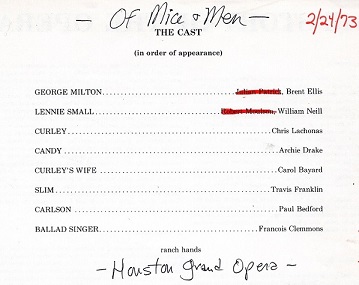
Fifty years ago, on this date, I was in Houston, Texas, attending a Houston Grand Opera performance of Carlisle Floyd’s OF MICE AND MEN with my friends the Humeniuk sisters – Ann(e) and Helen – and Larry Knickerbocker.
Helen, Larry, and I had moved down to Texas in January 1973 where Ann(e) was attending the University of Houston and working as a waitress. Helen started taking courses, and Larry got a job as an auto mechanic; they had fallen in love and they would eventually marry.
I was working in a drugstore at the Astroworld Hotel. We went to basketball games and to the roller derby, but we were poor so we spent most evenings at the apartment, singing folk songs while passing a joint and a bottle of Boone’s Farm Strawberry Hill. At night, we’d fall asleep with Jackson Browne’s first album, Saturate Before Using, playing on endless repeat:
“Well, I looked into a house I once lived in
Around the time I first went on my own
When the roads were as many as the places I had dreamed of,
And my friends and I were one…”

It was a peaceful, laid-back life I was leading, and it could have gone on indefinitely. But I often found myself thinking of New York City, of The Met and New York City Opera, and of my opera-loving friends. And there was also this restlessness: a feeling that time was passing me by and that a different life was meant for me.
I was very attracted to one of Ann(e)’s male friends, but he was married to a woman and they had a daughter. A couple of times I got a vibe that the feeling was mutual, but I simply didn’t know how to go about making something happen.
By March, I was getting weary of the situation. A falling out with my boss at the drugstore prompted me to quit my job. For a couple of days I looked at some job ads, but nothing appealed to me. Then one day I got up, feeling that something had to give; Ann(e) and Larry were at work, and Helen was studying. I began packing my stuff into my car. Helen asked, “Are you leaving us?” but she didn’t try to persuade me to stay. I left a note for Ann(e) and took off.
On the 1,600-mile journey, I spent two nights in motels and finally arrived back in the little town. I hadn’t let my parents know I was returning; I walked into the kitchen where my mom was puttering around, and asked: “What’s for supper?”
After a few days, I got a job in a pharmaceutical supply warehouse in Syracuse and took a tiny apartment nearby. But there were some crazies in the building, and after a few weeks, I moved back home and made the hour-long drive to work every morning.
Meanwhile, New York City was calling me. It wasn’t until June that I got back to the City, for an AIDA with my beloved diva, Gilda Cruz-Romo. I loved seeing all my old friends again; during the intermission, we were standing about, gossiping. Z, a boy I was attracted to, was standing next to me. He was wearing a maroon sweater-vest and on his chest a stray bit of white thread caught my eye. I reached out and picked the thread off; he gave me a big smile. For the first time, everything felt right. But it wasn’t until October that anything actually happened between us.
I often think back to the interlude in Houston, and what might have happened had I stayed on there. But in time, Ann{e), Helen, and Larry moved back to Syracuse and our friendship picked up where it had left off. Helen and Larry married and raised a family; Ann{e) also got married.
Meanwhile, in the City, after my hopeless love for Z sputtered out, I took up with TJ: my first domesticated gay relationship. After I moved to join TJ at Sarah Lawrence College, I began to lose touch with my Syracuse friends. After TJ finished school, we moved to Hartford and, after spending 22 years there, I finally moved to my dream City in 1998, just shy of my 50th birthday.
One sad story that came out of the weeks I spent in Houston was that D, the married boy I had a crush on, did eventually leave his wife and enter into a gay relationship. But it was terribly difficult being gay in those years, especially deep in the heart of Texas. I eventually heard that D had committed suicide, and I found myself regretting that I had not responded to his shy flirting; like so many of life’s possibilities, it remains a troubling enigma. When the Facebook era arrived, I became friends with his wife and daughter.
In 2017, I received news that Helen had passed away; although I had not seen or heard from her for many years, her death upset me deeply. I found Helen and Larry’s two eldest daughters, Katherine and Rebecca, on Facebook where I see them often and keep tabs on their kids, being constantly reminded of those close friendships from so long ago.

Above: the artists of Ensemble Connect; photo by Fadi Kheir
Author: Oberon
Tuesday February 21st 2023 – Ensemble Connect offering a wide-ranging program at Weill Hall this evening, opening with Jennifer Higdon’s Dark Wood, a work for bassoon and piano trio. Nik Hooks, the Ensemble’s excellent bassoonist, kicked off his busy evening here (he played in three of the four works); for the Higdon, he was joined by pianist Joanne Kang, cellist Laura Andrade, and guest violinist Stephanie Zyzak. The piece’s title refers to the lustrous, deep-dark polish of the bassoon.
Dark Wood opens with staccati for the bassoon and piano; the plucking violin and cello soon join. The music is jagged, buzzing with trills and big accents, full of nervous energy. A prolonged note for bassoon launches a sprightly, animated passage; then the piano begins to rumble, the bassoon and cello playing deep. Another long, dark bassoon tone leads to slithering strings and a pulsing piano motif.
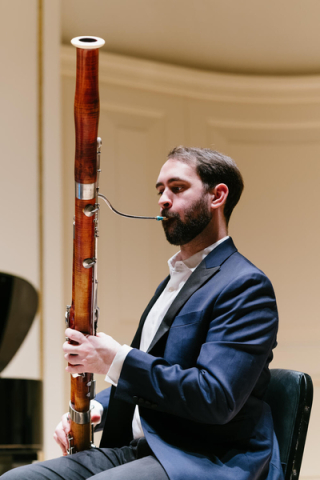
Above: bassoonist Nik Hooks; performance photo by Fadi Kheir
The violin and cello sigh, and things turn dreamy. Dotty violin notes sound over a wistful bassoon melody and then the cello offers a rich theme; this is all quite beautiful to hear. Things perk up, with the bassoon trilling and the strings sizzling, and then Ms. Kang at the keyboard takes over, with big playing, agitated and insistent. Heartfelt strings and a forlorn song for bassoon and piano follow; Ms. Kang offers plucked notes with a “prepared piano” sound, the others playing poignantly. Now the music rushes forward, somewhat chaotically, to a brisk finish.
Ms. Kang and Mr. Hooks were soon back onstage for Mozart’s delightful Quintet for Piano and Winds in E-flat Major, K. 452, joined by three more of the Ensemble Connect’s brilliant wind players: Amir Farsi (flute), Jasmina Spiegelberg (clarinet), and Cort Roberts (horn).
Mozart apparently thought highly of this piece, and he would doubtless have loved this evening’s performance of it. It opens rather hesitantly; Mr. Roberts plushy, golden tone immediately grabbed me, frustrated high-school horn player that I am. The blend of wind voices was sonorous, and after the piano introduces a new and more animated theme, it is passed about from instrument to instrument.
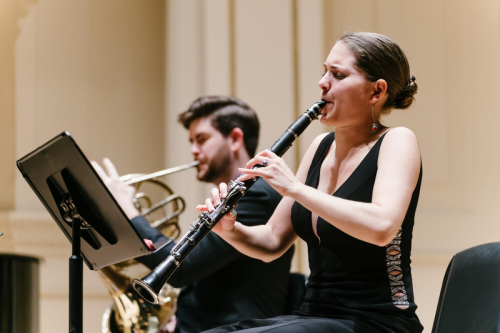
Above: Cort Roberts (horn) and Jasmina Spiegeberg, clarinetist; performance photo by Fadi Kheir
The Larghetto brings us a gracious, courtly melody, with Ms. Spiegelberg’s lambent tone and persuasive phrasing leading the way; flute, horn, and bassoon take up the line in succession. A bel canto atmosphere develops, with the piano offering accentuations; Mr. Roberts’ horn cavatina is so stylish, with the others harmonizing expressively.
The final Rondo/Allegretto rolls along, each player showing a vibrant sense of virtuosity: a sustained flute trill from Mr. Farsi was but one of many decorative delights.

Above: composer Michi Wiancko
Michi Wiancko’s 7 Kinships, a Carnegie Hall commission, was having its New York premiere this evening. The composer charmingly introduced the work; she spoke of how 7ths and 9ths express a feeling of longing. I could not agree more.
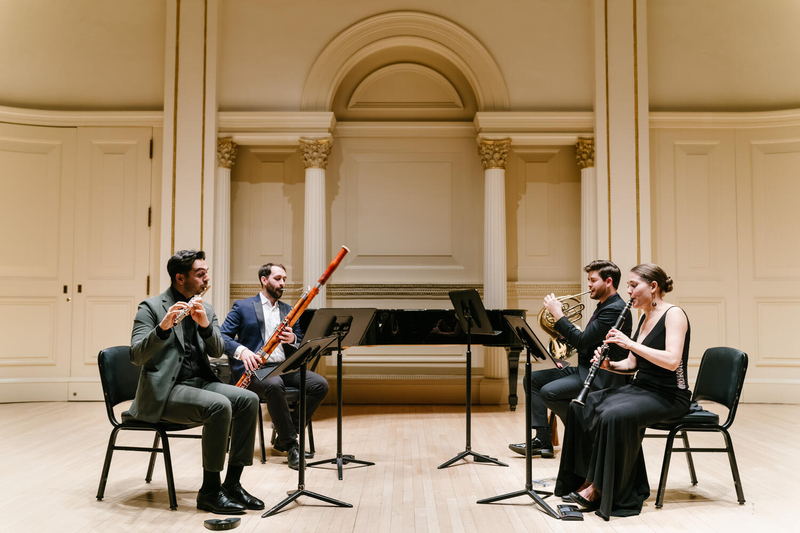
Above: The evening’s wind players – Mssrs. Farsi, Hooks, and Roberts, and Ms. Spiegelberg – giving a sterling performance of the Wiancho; performance photo by Fadi Kheir
In the work’s seven brief movements, Ms. Wiancho’s thoughtful craftsmanship gave the players ample opportunity to revel in their artistry. The music ranges from lyrical to animated, with moods veering from whimsical to lamenting. The sounds of the instruments entwine to delight the ear, sometimes in strange harmonies, whilst rhythmically the composer displays touches of wit. The musicians seemed to genuinely enjoy playing this music.
Before commencing the program’s final work, Robert Schumann’s Piano Quintet, violist Halam Kim read one of the composer’s letters to his beloved Clara; I admit this outpouring of love brought tears to my eyes. And then to recall that it was Clara who played the quintet’s demanding piano part at the work’s public premiere, making it all the more touching.

Above, playing the Schumann: Mr. Rengel, with Mlles. Zyzak, kang, Andrade, and Kim; photo by Fadi Kheir
The Ensemble Connect’s marvelous violinist, Rubén Rengel, led the ensemble, with Ms. Kang honoring Clara Schumann with her delectable playing, and Mlles. Zyzak, Kim, and Andrade all sounding gorgeous.
This beloved work is bursting with magical passages: the ‘dialogue’ for cello and viola in the opening movement, a theme to which Mozart frequently returns, is especially endearing, and in the dirge-like second movement, Mr. Rengel ‘s playing is exceptional. Mlles. Zyzak and Kim take ups this calmly funereal theme, and Ms. Abdrade’s sumptuous tone is ever at the heart of the matter.
In the bustling Scherzo, Mr. Rengel is again in his element, and Ms. Kang has much to do, her rising scales setting the scene for a fast dance, her music-making on the grand scale. It is Ms. Kang who initiates the final Allegro ma non troppo with her scintillating playing. A hymn-like interlude arises, and then low rumblings from the piano develop into a slow sway; this then accelerates, dancing us on to the finish.
All performance photos by Fadi Kheir, courtesy of Carnegie Hall.
~ Oberon
 Oberon's Glade