Category: Reviews

  • CMS Winter Festival: All-Schubert Evening

    Gilbert-kalish-header

    Tuesday January 24th, 2023 – This year, Chamber Music Society of Lincoln Center‘s annual Winter Festival is centered on the works of Franz Schubert. Tonight’s program featured the eminent pianist Gilbert Kalish and my beloved Escher String Quartet in three masterworks from the composer’s brilliant – but all too brief – career.

    The single-movement Quartettsatz in C-minor for Strings, D. 703, was composed in 1820. It seems to have been intended to be the first movement of a full quartet, but the composer never composed additional movements.

    From its scurrying start, the Escher Quartet’s performance of the Quartettsatz was a complete delight; their rhythmic attentiveness and tonal appeal were amply on display, their playing full of both vitality and nuance. The silken sheen of Adam Barnett-Hart’s violin made its distinctive mark in solo passages, the music flowing onward to a sudden tempest. This is soon calmed, but Brook Speltz’s restless cello figurations keep things lively. There is a da capo, a sort of coda, which draws on to a full-toned chordal passage; here, the classic Escher blend could be deeply savoured.

    Gilbert Kalish then took the stage for Schubert’s Sonata in B-flat major for Piano, D. 960, composed in 1828. This long and demanding work begins with an Allegro Moderato. Mr. Kalish delivers the theme with a sense of serenity; then a low trill sounds, seeming rather ominous – a trill which later brings music of great tenderness. As things become more intense, so does the playing: modulations are beautifully handled by the pianist. The low trill returns before a final recapitulation.

    Mr. Kalish brought forth the austere calm – and the poignant colours – of the ensuing Andante sostenuto; the music’s steady rhythmic pulse puts us in a trance. The movement’s ending feels like a benediction.

    In a striking volte face, the pianist takes up the boundless animation of the Scherzo. The music breezes along, pausing only for a courtly interlude. The sonata’s concluding Allegro ma non troppo is filled with an uplifting sense of buoyancy and good humor. Passing shadowy clouds momentarily blot out the sun, but by the end, all is bright and fair.

    Mr. Kalish was hugely applauded by the packed house at Alice Tully Hall. If Wikipedia is correct, the pianist is 88 years young…simply remarkable! 

    Escher qt

    Above, the players of the Escher String Quartet: Adam Barnett-Hart, violin; Brendan Speltz, violin; Brook Speltz, cello; and Pierre Lapointe, viola.

    The gentlemen of the Escher Quartet returned after the interval for the G-major quartet, Opus 161, dating from 1826. From the work’s striking beginning, this music – which I first heard ions ago in the Woody Allen film CRIMES AND MISDEMEANORS – always casts a deep spell over me. Incredibly rich and vividly detailed, the opening movement features tremelo effects – introduced  by the Escher’s stellar violist Pierre Lapointe – and achingly beautiful, ethereal themes for Mr. Bernett-Hart’s violin. The music becomes triumphant, reaching a passionate end.

    As the sonata moves on, cellist Brook Speltz’s role takes on increasing prominence. In the Andante, his sublime cello melody sets the tone, with his colleagues providing gorgeous harmonies. The music becomes intensely poignant, and Mr. Speltz’s playing has me thoroughly engrossed…hypnotized, really.

    But suddenly the music stopped; at first, I thought someone had broken a string, but apparently it was a tuning issue; corrections were made, and, after a few moments, the players resumed. It took a while to re-establish the mood; the music becomes hushed, with 2nd violinist Brendan Speltz and Mr. Lapointe sharing a duet passage. Then tremelos again are heard, and the music draws us on to an elegant finish.

    Things had been set to rights following the interruption, and the final Allegro assai should have been the frosting on this delicious cake: a deftly Mendelssohnian affair wherein the cellist has more opportunities to enchant us…which he did. But, a jingling cellphone began to sound. The musicians played on, the music so reminiscent of Mendelssohn’s Italian Symphony. The phone ceased for a bit, then rang again. Could the timing have been any worse?

    The players persevered, and the audience hailed them with a boisterous standing ovation at the end. While the intense connection to the music I was experiencing prior to the unexpected lull was never re-established, it was still a wonderful evening.

    ~ Oberon

  • Renata Scotto & Beniamino Prior ~ BALLO duet

    Scotto prior ballo

    Renata Scotto and Beniamino Prior sing the love duet from Verdi’s UN BALLO IN MASCHERA from a performance given at Dallas, Texas, in 1978.

    Listen here.

  • CMS Brandenburgs ~ 2022

    Bach

    Tuesday December 20th, 2022 – Chamber Music Society of Lincoln Center‘s annual presentation of Bach’s Brandenburg Concertos is always a highlight of the New York concert season, and this year these immortal works maintained their ‘masterpiece’ status as the Society rounded up a spectacularly talented team of players. As is the CMS custom, the concertos are presented in a different order each year, and the program is given three times in order to accommodate all the music lovers who are craving a holiday alternative to the Messiah and the Nutcracker.

    This evening, a packed house enthusiastically responded to music-making of the highest level. As a special treat, the gentlemen of the Escher Quartet joined the lineup; I love these guys, both as musicians and as personalities. 

    The program opened with the 5th Brandenburg, which belongs to the harpsichordist. Shai Wosner played the long cadenza with striking clarity and elegance. Violinist Daniel Phillips and cellist Sihao He then joined Mr. Wosner for a gorgeous  rendering of the Affetuoso, Clad in a royal purple gown, flautist Sooyun Kim dazzled with her luminous tone and deft technique. The complimentary string trio of violinist Aaron Boyd, violist Paul Neubauer, and bassist Lizzie Burns were excellent. Ms. Burns and Mr, Wosner went on to be pillars of musical perfection as the evening flowed onward.

    Next up was the 2nd Brandenburg, with trumpet virtuoso Brandon Ridenour sailing superbly thru the music. Mssrs. He and Wosner were joined by violinist Brendan Speltz, flautist Demarre McGill, and oboist James Austin Smith in weaving a lovely tapestry of sound in the Andante. Adam Barnett-Hart, Aaron Boyd, and Pierre Lapointe formed an admirable string trio, and it is always wonderful to hear Peter Kolkay offering his mellow bassoon tone to the music. In the concluding Presto, Mr. Ridenour and Mr. Smith vied with one another as they traded phrases, much to our delight.

    In the 4th concerto (in G-major), violinist Adam Barnett-Hart was very much in his element, alternating sustained tones of gentle lustre and with passages of high-speed coloratura. Duetting flautists Demarre McGill and Sooyun Kim dazzled the ear with the swift surety of their playing in the outer movements, and tugged at the heartstrings with the poignant harmonies of the central Andante. Ms. Burns and cellist Brook Speltz brought just the right weightiness of sound to counter-balance the high voices of the flutes and violin. In the final Presto, Mr. Barnett-Hart displayed incredible virtuosity.

    Following the interval, the 1st concerto, brought forth two horn players, Michelle Reed Baker and Julia Pilant, festively gowned (respectively) in red and green. They sounded as fine as the looked, and their duetting harmonies drew plushy responses from a trio of oboists: Stephen Taylor, James Austin Smith, and Randall Ellis. Mr. Kolkay’s dulcet bassoon playing has a prominent role here. The horns are silent during the poignant Adagio, where Aaron Boyd and the oboe trio spun pleasing harmonies over velvety unison phrases from Mihai Marica’s cello and Ms. Burns’ bass. The high horns swing into the jaunty Allegro, after which a wave of applause greeted the players. But there’s still a fourth movement – a mix of minuet and polonaise – in which separate choirs of winds and strings alternated, keeping the musical textures fresh til the end.

    The 6th concerto features pulsing cello and bass figurations, and duetting violas (Mssrs. Neubauer and Phillips). Mr. Neubauer and cellist Sihao He (graciously accompanied by Ms. Burns’ bass) drew us in to the moving tenderness of the Adagio, Mr. He concluding with a brief cadenza. Then without pause, the sneaky start of the closing Allegro begins to sweep us along. Mr. He dazzled us with his swift, fluent playing, whilst the two violists had a field day with the fast-paced music. This Allegro induced fervent applause from the crowd.

    The evening’s finale, the 3rd concerto, is a particular favorite of mine; it calls for three violins (Mssrs, Boyd, Brendan Speltz, and Barnett-Hart), three violas (Mssrs. Lapointe, Phillips, and Neubauer) and three cellos (Mssrs. Marica, He, and Brook Speltz), whilst the dedicated Wosner/Burns duo kept everything merry and bright. This concerto is unusual in that its “phantom” Adagio movement consists only of a brief passage from Mr. Wosner’s keyboard. Bach immediately sends the players back into a swirling Allegro. The evening’s performance drew to an end, the audience rising to hail the players with great – and much-deserved – enthusiasm. A second bow was called for, and then we headed out into the chilly night air, our spirits fortified by glorious music of Bach.

    ~ Oberon

  • Benjamin Bernheim in RIGOLETTO @ The Met

    Feola bernheim rigoletto

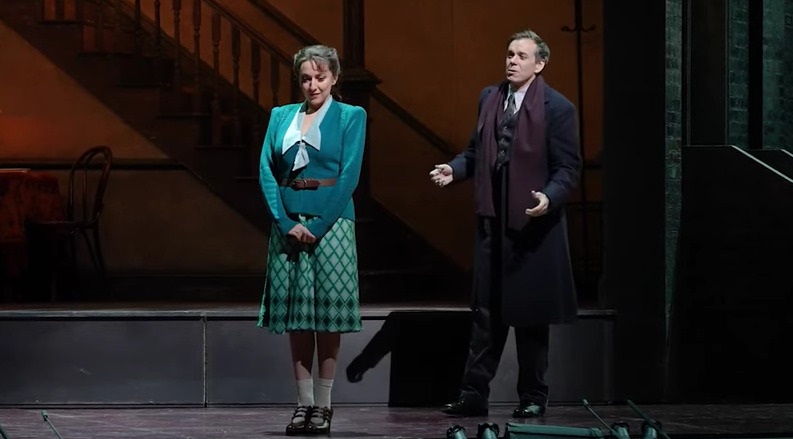
    Above: Rosa Feola and Benjamin Bernheim in RIGOLETTO at The Met

    Author: Oberon

    Saturday November 26th, 2022 matinee – After reading several glowing reviews of the French tenor Benjamin Bernheim over the past few years, and hearing of his recent success in LUCIA DI LAMMERMOOR opposite Lisette Oropesa at Vienna and Zurich, I decided to add today’s Met matinee of RIGOLETTO to my schedule. And I’m glad I did! This afternoon’s performance was strongly cast, from the title-role down to the Page and Guard.

    This was my first time to see the Bartlett Sher production. The staging is inoffensive, with some interesting ideas; but the scene of Gilda’s sacrifice at the inn was clumsily managed. The set sometimes revolves like a carousel on high speed. Having been brought to the palace by the courtiers, Gilda seems eager when the duke comes to her, but then she seems humiliated when she emerges from the bedroom soon after. Having a bloodstain on her white nightgown might have been a telling touch.

    In my estimation, Mr. Bernheim carried off top vocal honors. The voice is wonderfully clear and well-projected, with top notes that bloom. He is capable of ravishing soft singing, and he keeps the music fresh with subtle dynamic shifts. His performance was stylish and assured; I certainly hope we will hear more of him at The Met. 

    Kelsey

    Quinn Kelsey’s Rigoletto (photo above) was sung with great power and commitment. His incredibly sustained “Ah no, è follia!” at the end of the “Pari siamo!” monolog was one of the afternoon’s great thrills, and throughout the opera, his vocal generosity seemed boundless. Whether it was the baritone’s decision or the conductor’s, “Cortigiani, vil razza dannato!” was taken at an absurdly fast pace, giving it a surface urgency rather than a deeper sense of feeling; but when “Miei signori…” was reached, the great beauty and tenderness of the Kelsey voice was at its most impressive. There were a few rather husky notes as the opera progressed, but overall Kelsey’s Rigoletto was a stunning performance. (I should mention here the beautiful playing of the cellist in the “Miei signori…” section).

    Rosa Feola had many lovely passages as Gilda, though the sound of the voice is not truly distinctive. To me, she seems more of a lyric rather than a coloratura soprano, and some of the topmost notes tested her a bit. It would be nice to hear her as Liu or Mimi.  

    Aside from Mr. Bernheim, John Relyea’s Sparafucile was a big draw for me. The basso cuts a fine figure as the assassin, and his dark timbre is perfect for this music. At the end of his Act I encounter with Rigoletto, Mr. Relyea’s incredibly sustained low-F drew a round of applause.

    In her Met debut role of Maddalena, Aigul Akhmetshina displayed an attractive presence and a plushy voice; she merits more Met opportunities. I consider Monterone to be a very important character in the opera; though his scenes are relatively brief, if they are powerfully delivered they can make a great impact. Today Bradley Garvin sang the role with vivid authority. As the courtiers, Scott Scully (Borsa), Jeongcheol Cha (Marullo), and Paul Corona and Brittany Renee (the Cepranos) were all excellent, and Edyta Kulczak’s Giovanna – clearly on the Duke’s payroll – had a memorable moment: as Rigoletto stands aghast at having been an accomplice in the kidnapping of this own daughter, the nurse flees the house with her suitcase. Brilliant! 

    How many times over the decades that I have been going to the opera have the singers of the Page and the Guard in RIGOLETTO captured my attention? Today was the first! Met choristers Andrea Coleman and Yohan Yi each stepped up to bat, and each hit a home run. Ms. Coleman has a bit more to sing, and she sang it prettily indeed; and Mr. Yi’s “Schiudete: ire al carcere Monteron dee!” was strikingly voiced. I borrowed this photo of Mr. Yi and Ms. Coleman from the Met Chorus’s Facebook page:

    Yi and coleman

    I met Speranza Scapucci when she was at Juilliiard; several of my young singer-friends who were studying there at the time spoke highly of her. Lately, she has come into her own, with prestigious productions on her resumé, including a debut at La Scala conducting Bellini’s CAPULETI ED I MONTECCHI featuring Ms. Oropesa as Giulietta. This run of RIGOLETTO marked her Met debut performances.

    From the pit, Ms. Scapucci certainly gave us a lively RIGOLETTO; the opera swept by with a feeling of inevitability, yet she also had a handle on the more reflective passages. The only drawback, really, was her tendency to let the brass players cover the voices; things got out of hand in the ‘storm’ trio in the final act, where Mlles. Feola and Akhmetshina and Mr. Relyea were giving their all, to no avail.

    Metropolitan Opera House
    Saturday November 26th, 2022 matinee

    RIGOLETTO
    Giuseppe Verdi

    Rigoletto...............Quinn Kelsey
    Gilda...................Rosa Feola
    Duke of Mantua..........Benjamin Bernheim
    Maddalena...............Aigul Akhmetshina
    Sparafucile.............John Relyea
    Monterone...............Bradley Garvin
    Borsa...................Scott Scully
    Marullo.................Jeongcheol Cha
    Count Ceprano...........Paul Corona
    Countess Ceprano........Brittany Renee
    Giovanna................Edyta Kulczak
    Page....................Andrea Coleman
    Guard...................Yohan Yi

    Conductor...............Speranza Scappucci

    ~ Oberon 

  • Luana DeVol as Elektra

    Snapshot 2

    Above: Luana DeVol and Ricarda Merbeth celebrate their deliverance

    A concert performance of Richard Strauss’s ELEKTRA with Luana DeVol in the title-role, with the Vienna Philharmonic conducted by Peter Schneider.

    The event took place at the Passionstheater Oberammergau in 2005. Note that cuts have been made. 

    Watch and listen here.

  • Ben Weaver @ The “New” Geffen Hall

    Geffen hall

    ~ Author: Ben Weaver

    Saturday November 19th, 2022 – It is wonderful to be back at David Geffen Hall to hear the New York Philharmonic. I love the new space, which is far more attractive than the previous relic of 1960s hideousness. Bringing the stage forward to make room for seating  behind the orchestra – something practically every European concert hall has been doing for decades – shrinks the auditorium and creates an intimate space. I thought I’d be distracted by the people behind the orchestra, but the design of the stage – with its horizontal lines and wood trims – creates a nice frame for the eye to focus, so my gaze was always on the players, rarely above them. (Except when someone turned on their phone flashlight to find something they dropped…that’s when one wishes one had a cannon to shoot the audience member right into the sun.) But otherwise, the hall is gorgeous.

    And the sound is spectacular. For decades NY Philharmonic audiences had to listen to music land with a thud and the glorious sound of this orchestra never bloomed. No more. This was the reason these renovations were essential and long overdue. We can finally hear this great orchestra in all its sonic glory! Tonight’s concert gave us a wide range of musical styles to appreciate the varied nuances of the new acoustic.

    The announced program for this concert was supposed to begin with Jean Sibelius’ glorious tone poem Oceanides. Alas, it was replaced with an Igor Stravinsky piece I’ve always found to be rather a waste of time: Symphonies of Wind Instruments. Composed in 1920 and revised in 1945-47, it is a shapeless, senseless series of tedious honking. Occasionally echoes of Le Sacre du printemps do not save it. Its premiere was not a success (“hisses and laughter”) and with good reason. Fortunately it only lasts 10 minutes. One can’t fault the wonderful Philharmonic wind section here because they played wonderfully and it is good to hear them play in isolation. I wish more music was programmed generally to showcase specific sections of the orchestra.

    Béla Bartók’s Concerto for Two Pianos, Percussion, and Orchestra, composed in 1937 as a sonata for two pianos and transformed into its current concerto form in 1940, is a virtuosic tour-de-force. One can easily see that the work was conceived as a sonata for two pianos because the orchestral contribution is rather spare throughout. The two pianists dominate, but the percussionists get a fair workout as well. The caustic, rhythmic Bartók is on full display here, the pianists and percussionists taking turns trading blows. The first and second movements are particularly aggressive, though the second movement in a more creepy way. The strings are struck with bows, adding to the percussive nature of the piece. Pianists Daniil Trifonov and his former teacher Sergei Babayan were spectacular. Playing – and occasionally swaying – in perfect sync, their ability to bring beauty and lyricism into Bartók’s most caustic music was magical. The three Philharmonic percussionists – Christopher Lamb, Daniel Druckman  and Markus Rhoten – were in perfect sync with the two star pianists. The lighter and almost humorous final movement was a lively conclusion to this difficult work. Conductor Hannu Lintu coordinated everyone spectacularly.

    Hannu lintu

    Finland – home of Maestro Lintu (above) – dominated the second half of the program. Kaija Saariaho’s Ciel d’hiver – lifted from her larger 2003 composition Orion – was a gorgeous sensory experience. Saariaho has a highly unique sound palette, her ability to create otherworldly sounds are extraordinary. There’s a timelessness and weightlessness to her music; it’s as if it has always been there, like primordial space – it is all around us. The transparency of the sound can now be appreciated in the new acoustics.

    Jean Sibelius’ Symphony No. 7 – composed in 1924 – finally allowed us to hear the Philharmonic in its combined glory, and to appreciate the acoustics of the new Hall. If Saariajo’s music is like a frozen lake, Sibelius is a surging river and ocean of sound. His ability to make you feel the cold wind of a Finnish winter has always been a distinct feature of his extraordinary music. A relatively brief single-movement work, the Seventh realized Sibelius’ desire to pare down his music to the barest essentials. (Sadly he seems to have pared himself down to nothing just two years later. Only two major works followed the Seventh, and then Sibelius stopped composing – though he lived another 30 years!)

    The symphony is made of 11 interconnected sections, some highly lyrical (recalling the more Romantic Sibelius of yore), and some far more abstract. The symphony’s final note, held by the strings, raising in volume and intensity – by turns sinister and unfinished – always reminds me of the harrowing Interlude in Berg’s Wozzeck, after Wozzeck has murdered Marie. A sustained note full of terror and hysteria. How can a single note contain so much emotion? And yet it can. Here Sibelius, like Berg before – although more subtle than Berg – shows us how.

    Hannu Lintu has this music in his bones and brought out the most extraordinary performance from the Philharmonic. The climaxes were shattering, and because of the clear acoustic in the new Hall, they were shattering in volume and clarity, as well as emotion. The music simply glowed.

    ~ Ben Weaver

  • Elīna Garanča ~ Alto Rhapsody

    Alto rhapsody

    Elīna Garanča sings Johannes Brahms’ Alto Rhapsody with Christian Thielemann conducting. The performance took place at the Salzburg Festival on July 30th, 2022.

    Watch and listen here.

  • FAUST ~ Final Trio: Scotto/Kraus/Ghiaurov

    Faust 3

    Renata Scotto, Alfredo Kraus, and Nicolai Ghiaurov sing the final trio from Gounod’s FAUST from a performance given at Tokyo in 1973.

    Watch and listen here.

  • Gubanova/Muti ~ Alto Rhapsody

    Snapshot gubanova

    Ekaterina Gubanova sings Johannes Brahms’ Alto Rhapsody in a performance from the 2012 Ravenna Festival; Riccardo Muti conducts.

    Watch and listen here.

  • Britten’s LES ILLUMINATIONS ~ Roxana Constantinescu

    Snapshot illuminatins

    Roxana Constantinescu (above) sings Britten’s LES ILLUMINATIONS in a performance from the Kammermusikfest Lockenhaus, 2014. Pekka Kuusisto is the concert-master.

    Watch and listen here.