Category: Reviews

  • Crespin & Meliciani ~ AIDA Scene

    Meliciani

    Soprano Régine Crespin and baritone Carlo Meliciani (above) sing the father/daughter duet from Act III of Verdi’s AIDA; the performance is from Mexico City, 1962, with Nicola Rescigno conducting. Jon Vickers is heard as Radames.

    Listen here.

    Mr. Meliciani recently passed away at the age of 92. He was a popular star at La Scala, debuting there In 1959 as Ping in TURANDOT and continuing to sing there thru the 1970s, taking on the Verdi baritone roles. He performed at the major opera houses of Italy, where such roles as Scarpia, Tonio in PAGLIACCI, and Carlo Gerard in ANDREA CHENIER supplemented his Verdi list. Mr. Meliciani also appeared at Wiesbaden, Lausanne, in Greece, Mexico, and in the USA (Philadelphia and Hartford). 

  • Truls Mørk ~ Bloch’s Schelomo: Rhapsodie Hébraïque

    Mork

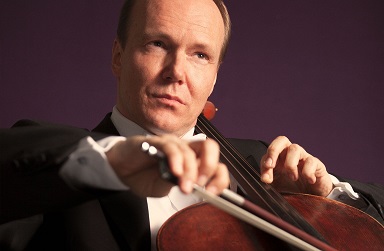
    One of my favorite artists, the Norwegian cellist Truls Mørk, joins the Stavanger Symphony Orchestra in a performance of Ernest Bloch’s Schelomo: Rhapsodie Hébraïque at a concert given in August 2019. Markus Stenz is the conductor.

    Watch and listen here.

  • Truls Mørk ~ Bloch’s Schelomo: Rhapsodie Hébraïque

    Mork

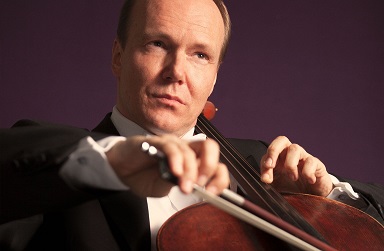
    One of my favorite artists, the Norwegian cellist Truls Mørk, joins the Stavanger Symphony Orchestra in a performance of Ernest Bloch’s Schelomo: Rhapsodie Hébraïque at a concert given in August 2019. Markus Stenz is the conductor.

    Watch and listen here.

  • Transfigured Night @ Chamber Music Society

    Arnold_Schonberg_Richard_Gerstl

    Above: portrait of Arnold Schoenberg by Richard Gerstl

    ~ Author: Oberon

    Friday March 18th, 2022 – Whenever Arnold Schoenberg’s Verklärte Nacht (“Transfigured Night”) is being performed in Manhattan, I will try to be there. This evening, it was the closing work on an imaginative program of ‘music of the night’ put together by Chamber Music Society of Lincoln Center.

    Opening the evening was Luigi Boccherini’s Quintet in C-major for Two Violins, Viola, and Two Cellos, G. 324, “La musica notturna delle strade di Madrid”  which was composed in 1780. As my friend Ben Weaver remarked after hearing it tonight: “This music is so ahead of its time…it could have been composed yesterday!” To be sure, it is very inventive work, and there’s so much packed into its 12-minute duration.

    Tonight, this Boccherini gem was performed to perfection by Yura Lee (having exchanged her more usual viola for the violin this evening), violinist Stella Chen, violist Matthew Lipman, and cellists Nicholas Cannellakis and Sinhao He. The best-known section of the work, the Minuet, caused a ripple of recognition to run thru the hall. Elsewhere, plucking and shivering motifs provide accompaniments as the melodies spin out; it ends with a regal section as Retreat is sounded and the guardsmen return to barracks.

    Franz Schubert wrote his Notturno in E-flat major for Piano, Violin, and Cello, D. 897, Op. 148, in 1828. It is sublimely beautiful, and was played tonight by three extraordinary musicians: Yura Lee (violin), Sihao He (cello), and Michael Brown (piano).

    The piano commences a slow waltz, the violin and cello harmonizing. Then roles are reversed: the strings take up a plucking rhythm as the pianist assumes the melody. From gentleness, there comes a rise of passion, with rippling keyboard figurations. The opening melody is repeated, becomes expansive, fades briefly, is revived, and then on to a quiet ending. Throughout the ten-minute work, I greatly enjoyed watching the silent communication between the three players.

    James+Austin+Smith

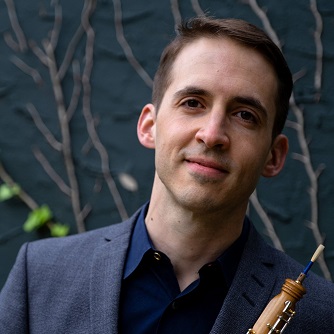
    Above: oboist James Austin Smith

    This evening brought my second hearing of Benjamin Britten’s Phantasy Quartet for Oboe, Violin, Viola, and Cello, Op. 2,  which. was written in 1932 for a competition for single-movement chamber works established in 1905 by Walter Wilson Cobbett,

    When I heard this work in 2013, James Austin Smith was the oboist; and he was back tonight, playing it so clearly and thoughtfully. He was joined by violinist Stella Chen (elegantly gowned in purple and white), violist Hsin-Yun Huang (very chic in a halter top and toreador trousers), and cellist Nicholas Cannellakis. 

    The piece commences with short, dotty cello notes, and then a march develops. The oboe takes up a songful passage. A swift and vibrant allegro is followed by a string trio before the oboist picks up where he left off, and the music marches off into the air as magically as it appeared. Mr. Smith’s delicious, multi-hued playing was – as always – a delight to hear.

    After the interval, the Society’s Executive Director, Suzanne Davidson, gave a brief speech, dedicating the concert to the heroic people of Ukraine. The crowd’s reaction was loud and clear.

    Maxresdefault

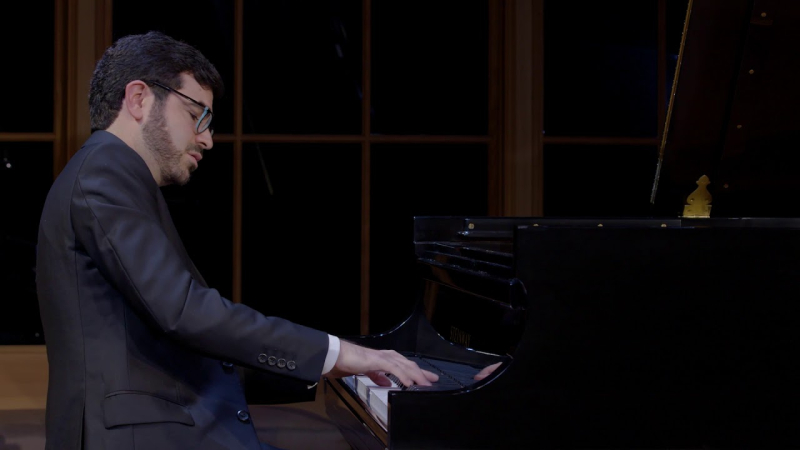
    The program continued as Michael Brown (above) took the stage alone to ravish the ear with his magical playing of two piano works by Claude DebussyLa terrasse des audiences du clair de lune” from Préludes, Book II (1913), and “Clair de lune” from Suite bergamasque (circa 1890; revised in 1905).

    In the first, Mr. Brown’s incredibly hushed pianissimo playing cast a spell of rapture and mystery over us; his control was astounding. As the prélude reached its tranquil end, Mr. Brown kept his hands poised over the keyboard momentarily and then embarked on an intoxicating rendering of the “Clair de lune”.. I found myself wishing that this poignant dream could go on and on… 

    Huang_

    Above: violist Hsin-Yun Huang

    To end this fascinating program, Arnold Schoenberg’s Verklärte Nacht (“Transfigured Night”) was magnificently played by a string sextet of the highest order: Yura Lee and Stella Chen (violins), Hsin-Yun Huang and Matthew Lipman (violas), and Nicholas.Cannellakis and Sinhao He (cellos).

    The composer drew inspiration for this work from a poem by the Austrian poet Richard Dehmel which tells of a man and woman wandering together late into the evening. The woman confesses to her lover that she is pregnant by another man. In the shadowy forest, the man consoles his beloved and, through his forgiveness, her guilt us assuaged. He assures her that he will care for the child as his own. Their love is transfigured through this night of communion they have shared, and they look to the future with hope.

    In its thirty-minute time span, Verklärte Nacht traces the lovers’ journey with incandescent harmonies and haunting melodies that sing of the redemption of forgiveness and the enduring power of love, The music traces the arc of the poem from its first line – “Two people walk through a bare, cold wood;” to its last: “Two people walk on through the high, bright night.” For a die-hard romantic like myself, few other works can compare.

    One of the most wonderful things about this work is the way Schoenberg distributes the musical treasures in his score: each of the six players has ample opportunity to display their tone and artistry as melodies are passed about and harmonies mingle on the air. As the music wends towards its finish, a great flow of lyricism rises up.

    Stella-Chen-

    Above: violinist Stella Chen

    This evening’s performance was so richly rewarding; the players captured every nuance of this profoundly moving score. At the end, a standing ovation was the only possible audience reaction; onstage, the artists quietly embraced one another during the bows.

    The cumulative effect of Verklärte Nacht tonight was to pull me – at least for a time – out of a deep feeling of world-weariness that has weighed on me in recent weeks, due to the lingering pandemic, the downward spiral of our great democracy, and a war started by a power-mad fiend. Indeed, it has, at times, felt like life is no longer worth living.

    To the musicians who played tonight: please know the great value of your music-making, and what it means to us. You provide a ray of light in an ever-darkening world. . 

    ~ Oberon

  • Franco Fagioli

    Fagioli

    Argentine counter-tenor Franco Fagioli makes a splendid impression in the aria ‘Vo solcando un mar crudelefrom Leonardo Vinci’s ARTASERSE from a performance given at Nancy in 2012.

    Watch and listen here.

  • 50 Years Ago ~ Fabulous FALSTAFF!

    Evans and tebaldi

    Above: Sir Geraint Evans and Renata Tebaldi in FALSTAFF

    February 23, 2022 – Fifty years ago this evening, the Metropolitan Opera presented a memorable performance of Verdi’s FALSTAFF. The evening marked the first time Renata Tebaldi sang Alice Ford in New York City; beloved Met luminaries Regina Resnik and Sir Geraint Evans sang Dame Quickly and Sir John Falstaff, and Christoph von Dohnanyi made his Met debut on the podium. Of key interest for me was the beauteous Jeannette Pilou, a great favorite of mine, in the role on Nannetta.

    This was my diary entry, written right after the performance:

    “A great performance in every way. Christoph von Dohnanyi’s Met debut was a success, despite some moments that seemed under-rehearsed. When the curtain rose on the opera’s second scene and the audience caught sight of La Tebaldi, a sustained round of applause caused the opera to come to a halt. For a moment, no one seemed quite sure what to do, til someone yelled “Start over!”, and that’s what Maestro von Dohnanyi did.

    The cast was incredibly good. Two de luxe character tenors – Paul Franke (Dr. Caius) and Andrea Velis (Bardolfo) – scored numerous verbal points at the opera progressed. And…they can sing! Richard Best was a sturdy-voiced Pistola and Joann Grillo a comely, warm-toned Meg Page.

    Kostas Paskalis sang splendidly as the jealous Master Ford, his monolog being one of the vocal highlights of the performance. His voice is huge, with a darkish tint. Luigi Ava was a sweetly lyrical Fenton, and he played the role of the love-struck youth well. Regina Resnik was a fabulous, genuinely funny Dame Quickly. The voice is not really very attractive these days, but she knows how to sing, and she uses her voice as a dramatic instrument. She is, in every respect, a great Dame.

    Jp nannetta

    Jeannette Pilou (above, as an enchanting Nannetta) seemed so alive, so real, no mannerisms. Her voice is so pretty and clear, and she brought some very appealing pianissimo effects to her Act III aria. Pilou is such a beautiful woman; her arrival on a white Shetland pony as Hearne’s Oak was a lovely moment. Bravissima! 

    Renata Tebaldi enjoyed an immense success in her first Met appearance as Alice Ford. The voice seemed fresher than in recent seasons: very sweet and warm. Her high notes came quite easily tonight. On the last top-C, she really sailed, whilst Pilou tossed her head back and joined her, bringing this romp of an opera to a joyous end. Tebaldi’s sensational good looks, her charm and humor, and her lively entrance into the spirit of the evening made for another triumph for the great diva. Bravissima!

    Towering above all others was that magnificent singing-actor, Sir Geraint Evans, as Sir John Falstaff. In his revelatory portrayal, one sees every aspect – the comic and the tragic – of this incredible character. So pompous at first, so funny and full of himself at Alice’s, so frighteningly degraded as he runs to the Garter Inn at the start of Act III, so touchingly terrorized at Hearne’s Oak, and so human in the opera’s final moments. I’ve heard the role sung with more sheer voice, but never with such flair and nuance. Bravissimo, Sir Geraint: you are Falstaff!    

    Scanned Section 1-1

    The final ensemble was so much sheer fun: the singers lined up along the footlights and mocked the audience…and themselves. And then that great dual-high-C. The curtain calls were numerous, with everyone staying on, and a big gathering at the orchestra rail where flowers were thrown and we all yelled ourselves hoarse.”

    Lois & jp

    Above: Jeannette Pilou with New York’s most famous opera fan, Lois Kirschenbaum

    ~ Oberon

  • Romantic Perspectives @ Chamber Music Society

    Wu Han

    Above: pianist Wu Han

    Sunday January 39th, 2022 – This evening’s program at Chamber Music Society of Lincoln Center, entitled Romantic Perspectives, was truly a soul-warming experience, following a week of cold weather and a gusty snowstorm the previous day.

    The program got off to an exciting start with a performance of the Scherzo from Johannes Brahms’s “F-A-E” Sonata for Violin and Piano, dating from 1853. With Wu Han at the piano, violinist Chad Hoopes brought real flair to his playing. From the buzzy opening, the two musicians were in perfect sync. This Scherzo has a lyrical interlude, wherein the players’ dynamics meshed ideally; then, back to a lively allegro. What an exhilarating way to start a concert!

    Next came a spectacular performance of Gustav Mahler’s sole work in the chamber music genre: the Quartet in A-minor for Piano, Violin, Viola, and Cello, composed in 1876. Violinist Danbi Um, elegant in a ruffled ultramarine tulle gown, led her colleagues onstage. Before taking her place at the Steinway, Wu Han stepped forward to introduce us to two young musicians making their CMS debuts this evening: violist Timothy Ridout, and cellist Sihao He

    No pianist can establish a musical mood quite like like Wu Han does; with the deep, brooding opening measures of the Mahler, she immediately drew us in. The fabulous sound Sihao He summons from his cello was soon blending with Mr. Ridout’s handsome viola tone and the silken magic of Ms. Um’s violin. As the single movement progressed, the four musicians took us deeper and deeper into the music, their playing resplendently full-bodied and thrillingly intense. Passions ebb and flow, and then a darkish calm settles over us. Ms. Um’s exquisite playing, and the extraordinarily poetic phrasing of Mssrs. Ridout and He, were all underscored by Wu Han’s captivating dynamic mastery. It seemed impossible to think that only four players could produce such an ‘orchestral’ sound; their performance moved me deeply.

    Ridout

    Above: violist Timothy Ridout

    Composed in 1861, Antonín Dvořák‘s Quintet in A-minor for Two Violins, Two Violas, and Cello, Op.1, brought together the evening’s full string contingent: violinists Danbi Um and Chad Hoopes, violists Paul Neubauer and Timothy Ridout, and cellist Sihao He.

    Written when Dvořák was twenty years old, this quintet was the first of his works to be ascribed an opus number. In the opening Adagio — Allegro ma non troppo, the unison slow introduction gives way to a dancing, animated feeling. The tone qualities of the five musicians were perfectly integrated, with Mr. Hoopes excelling in the numerous melodic flights for violin, nimbly seconded by Ms. Um; and Sihao He amplified the beautiful impression he had made in the Mahler. This movement has an unusual ending.

    The ensuing Lento brings forth cantabile melodies; the main theme is taken up by Mr. Ridout’s viola (Dvořák’s own instrument) playing over a rhythmical accompaniment provided by the other players. The middle section of the movement provides a fresh theme, after which we hear a reprise of the introductory melody. The composer gives both violists ample opportunity here, and the contrasting timbres of Mssrs. Neubauer and Ridout were savourable indeed. The violins play in unison, then Mr. Hoopes again moved me with a high-lying passage. A swaying mood develops, and a rising violin motif leads us to the movement’s finish

    The quartet’s Finale – Allegro con brio involves three primary themes. The marvelous sound of Sihao He’s cello was continually alluring to the ear, and Mr. Ridout again shone in a songful passage. The superb blend these five artists achieved carried us on to the work’s ending, hailed by the crowd with warm applause.

    It is interesting to note that Dvořák seemingly never heard his opus 1; its first public performance came seventeen years after his death, and it was not published until 1943.

    Sihao he

    Above: cellist Sihao He

    Having recently enjoyed Maxim Vengerov’s stunning performance of César Franck‘s Violin Concerto at Carnegie Hall, I was definitely in the mood for more of Franck’s music. This evening’s CMS program ended with the composer’s Quintet in F-minor for Piano, Two Violins, Viola, and Cello, dating from 1879.

    With a descending phrase from Danbi Um, the passionate slow introduction to the first movement is underway. Wu Han’s gorgeous entry has a hesitant feeling, as if the composer is not quite sure where he wants to take us; a rather fitful acceleration finally achieves Allegro status. Now all five players begin to pass the melodies from one to another. Mr. Neubauer’s dusky viola, Wu Han’s magical piano, the lovely sense of longing from Danbi Um’s violin, the poignant sound of Sihao He’s cello…all combined as the music turns huge. In this movement, a melody of chromatic half-steps is heard, creating a musical tension which  our players today clearly relished.

    The second movement, marked Lento, con molto sentimento, begins with a haunting theme from Wu Han’s keyboard, and sublime lyricism from Danbi Um. The chromaticism which awoke in the opening movement becomes more pervasive now, with Ms. Um and Mr. He trading phrases. Wu Han’s playing is heavenly, and the cellist is simply stunning. The music builds in grandeur and then dissipates, becoming celestial. Mr. Neubauer’s lovely viola passage, ethereal sounds from the piano, and Danbi Um’s haunting violin draw the movement to a tender finish.

    Chad Hoopes opens the final movement with a bustling motif, joined by Ms. Um in an agitato mode. The strings play the work’s main melody in unison, with a vibrant crescendo. A brief, sweet song from Danbi Um leads to a big build-up of sound and emotion as the quintet sails onward to an epic finale.

    A full-house standing ovation greeted the players, who were called back for a second bow, much to everyone’s delight.

    ~ Oberon

  • LA BOHEME @ Macerata ~ 1977

    Boheme

    An audio-only recording of a performance of BOHEME given at Macerata in 1977 with Raina Kabaivanska (Mimi), José Carreras (Rodolfo), Elvida Ferracuti (Musetta). Rolando Panerai (Marcello), and Carlo Cava (Colline). Ferruccio Scaglia conducts.

    Listen here.

    The sound of planes passing over is an occasional distraction.

  • @ My Met Score Desk ~ BOHEME Matinee

    Agresta castronovo

    Above: Maria Agresta and Charles Castronovo in LA BOHEME; a MetOpera photo

    Saturday January 22md, 2022 matinee – This performance had its ups and downs, The conducting of Carlo Rizzi was hit-or-miss; he sometimes allowed the orchestra to swamp the singers. But I did like his speedy take on the first several minutes of the Cafe Momus scene.

    Charles Castronovo repeated his very persuasive Rodolfo from the November run. His singing is emotional without straying from the notes, and he has both power and subtlety in perfect measure. His Mimi this afternoon, Maria Agresta, sounded sadly out-of-sorts, her vibrato prominent, and her highest notes not entirely comfortable. Offsetting these reservations was her congenial phrasing and some lovely piano effects.

    Lucas_meachem

    Lucas Meachem (above) was a magnificent Marcello, making every phrase count. The voice is large and warm, and he handily dominated the ensemble ‘reprise’ of the “Musetta Waltz” theme in Act II. His duet with Ms. Agresta in Act III was impressively sung. Gabriella Reyes screeched and shrilled Musetta’s lines at first, but settled in for a nice rendering of the Waltz; I feel that she might be better cast as Mimi.

    Alexander Birch Elliott was a fine Schaunard, despite having to cope with lacklustre conducting from Mr. Rizzi. I liked Peter Kellner’s Colline very much, too, but the thought of enduring a second Gelb intermission caused me to head home without hearing his “Vecchia zimara“.

    The House was substantially full, and there was surprise applause after the Bohemians dismissed Benoit in Act I. Lots of noisy chatter from the ceiling lighting bay during Act I was distracting, and the interminable first intermission simply killed whatever dramatic impetus the opera had going.

    Metropolitan Opera House
    Janaury 22nd, 2022 matinee

    LA BOHÈME
    Giacomo Puccini

    Mimì....................Maria Agresta
    Rodolfo.................Charles Castronovo
    Musetta.................Gabriella Reyes
    Marcello................Lucas Meachem
    Schaunard...............Alexander Birch Elliot
    Colline.................Peter Kellner
    Benoit..................Donald Maxwell
    Alcindoro...............Donald Maxwell
    Parpignol...............Gregory Warren
    Sergeant................Jonathan Scott
    Officer.................Ned Hanlon

    Conductor...............Carlo Rizzi

    ~ Oberon

  • Wolfscrag Scene ~ Araiza & Schexnayder

    Araiza (3)

    The Wolfscrag Scene from Donizetti’s LUCIA DI LAMMERMOOR sung by tenor Francisco Araiza (above) and baritone Brian Schexnayder from a 1988 performance.

    Watch and listen here.