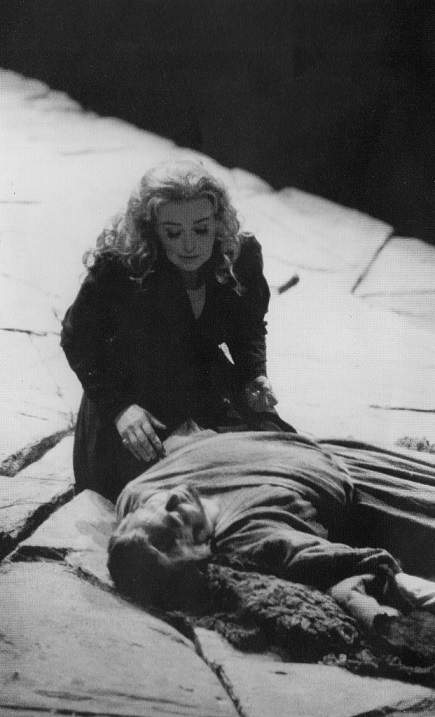
Julia Varady and Wolfgang Brendel in the final scene from Tchaikovsky’s EUGENE ONEGIN, from a performance given at Munich in 1985.
Category: Reviews
-
CMS Summer Evenings 2025 – Concert VI
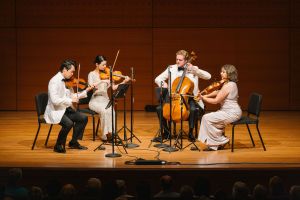
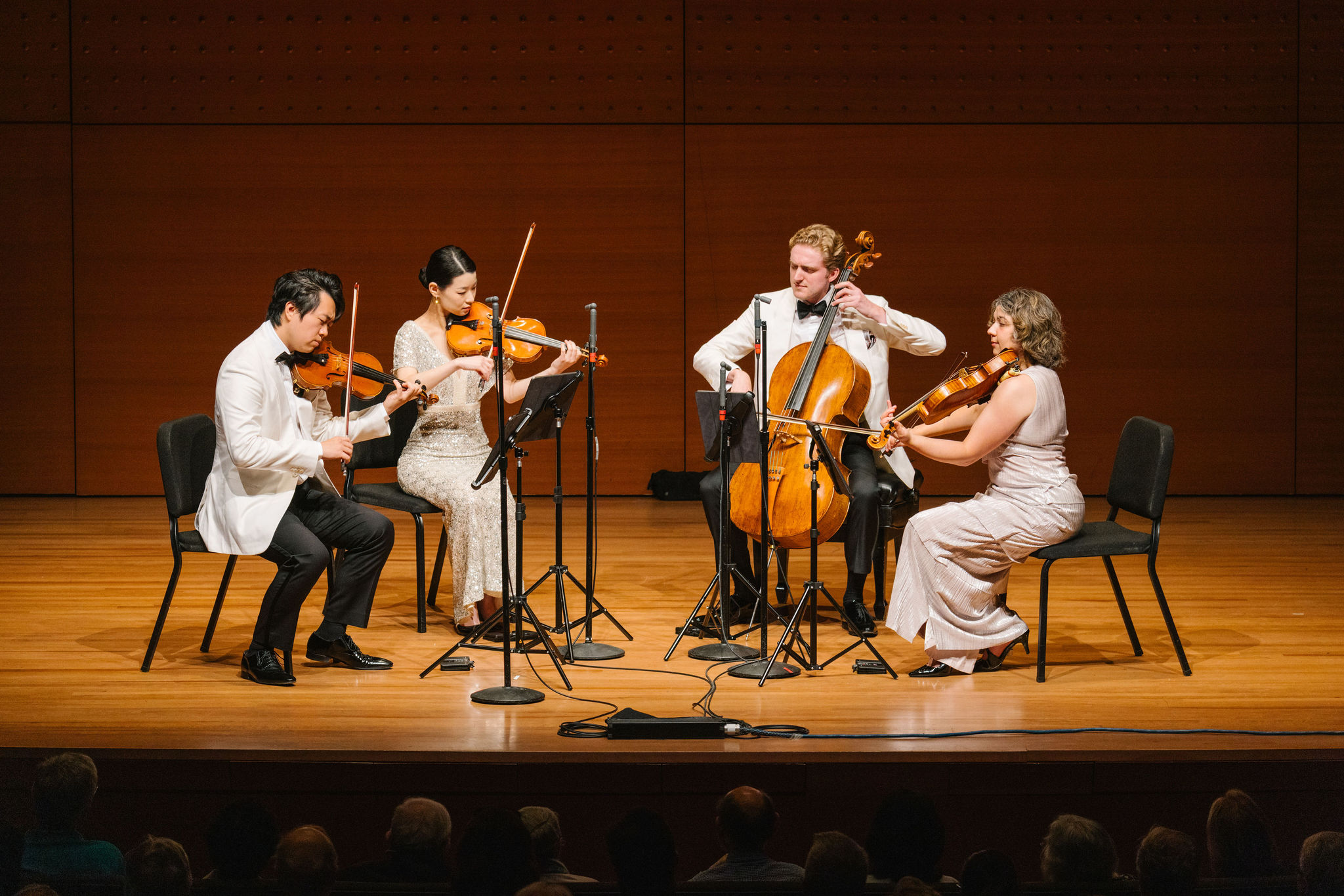
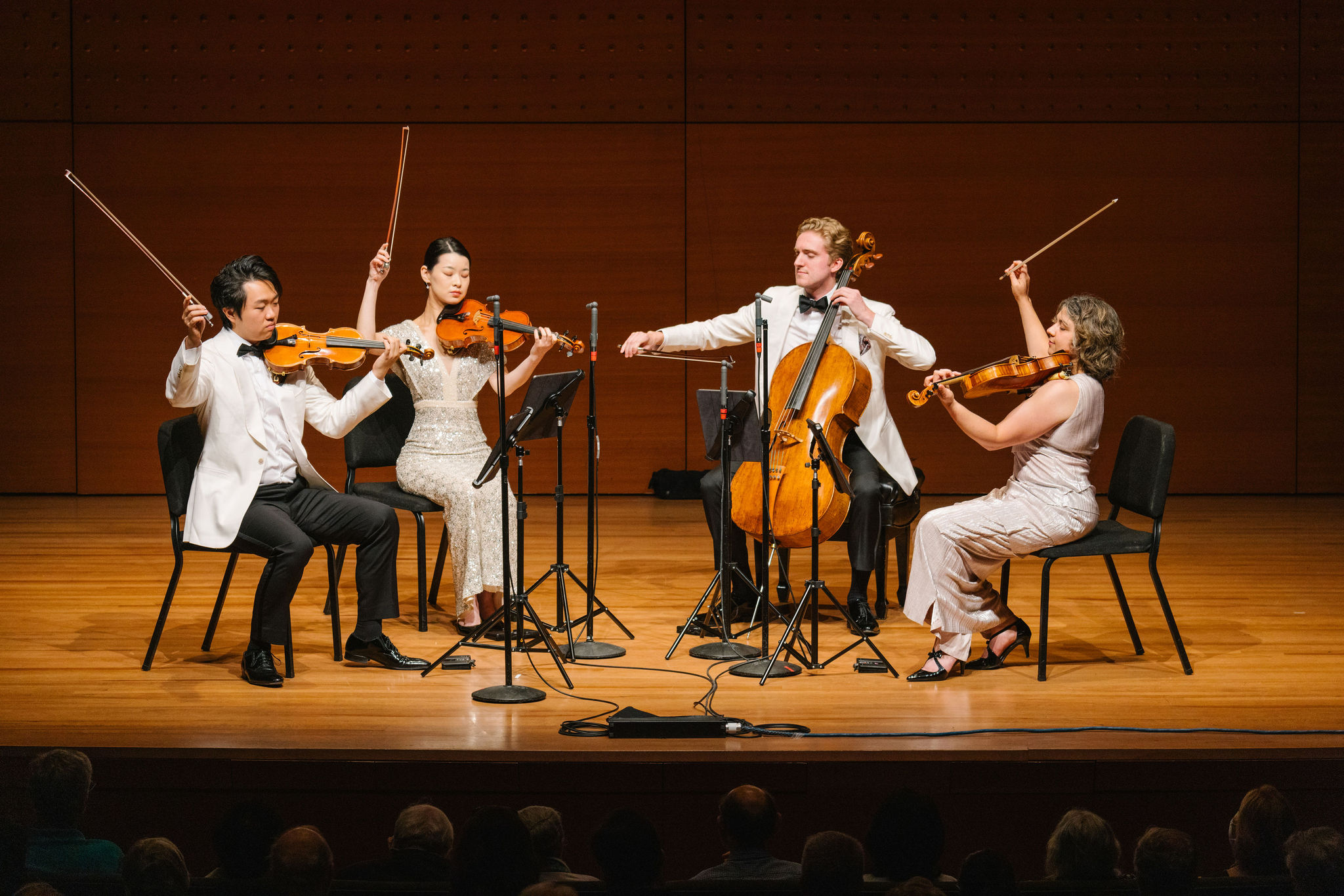
Above, the Viano Quartet: Hao Zhou & Lucy Wang (violins); Tate Zawadiuk (cello); and Aiden Kane (viola). Photo by Da Ping Luo.
~ Author: Ben Weaver
Sunday July 27th, 2025 – The oppressive heat of the summer was broken for a few hours by the Chamber Society of Lincoln Center with the last of their summer concerts at Alice Tully Hall. The Viano Quartet – Lucy Wang & Hao Zhou, violins; Aiden Kane, viola; Tate Zawadiuk, cello – played a wonderful program of Haydn, Mozart, Mendelssohn, and Schumann to a sold out hall.
First half of the program was for the classical era – Haydn and Mozart. I think many think of Haydn music as preceding Mozart, and Haydn was certainly older. But he outlived Mozart and his String Quartet in D minor, Hob. III:83, heard tonight, was composed 21 years after Mozart’s. Consisting of only two movements, Haydn did intend to compose the traditional four, but his failing health prevented its completion. It opens with a graceful, charming Andante grazioso, although the movement is briefly interrupted by a more driven middle section, before reprising the light first theme. The Minuet is more dramatic and the Vianos revealed a muscular sound. First violinist Hao Zhou dominated the proceedings, but Tate Zawadiuk was given a few solo passages to show off his warm cello playing.
Mr. Zhou remained in the first violin chair for Mozart’s G major String Quartet, K. 387. This was one of Mozart’s so-called “Haydn Quartets,” which he dedicated to the older master. The opening Allegro vivacious assai is also a light and elegant, and Mozart lets the second violin (Lucy Wang, who would move into the first chair for the second half of the program) take some wonderfully soaring solo turns. The movement ends gently, almost as if in the middle of a thought. The playful Menuetto was interrupted by a ringing cell phone, as was the lovely slow movement that followed. Mozart gives all the instruments turns to shine on their own, and every member of the Viano Quartet is a first-rate soloist. The closing movement consists of two fugatos, with each instrument passing melodies to one another and then back again.
Felix Mendelssohn’s Fugue in E-flat major, Op. 81 is the final of the Four Pieces for String Quartet, which were published posthumously, though Mendelssohn composed the Fugue when he was just 18. (The other pieces in the collection were composed 20 years later.) It opens somberly with the viola before the others join in. Mendelssohn’s layering of the melodies is masterly, and not just for one so young. Mendelssohn’s mastery of the form – and the occasionally wild nature of the writing – reminded me somewhat of Beethoven’s demented Grosse Fugue.
Robert Schumann’s magnificent Quartet in A major, Op. 41, No. 3 closed the program and brought down the house. Schumann opens with work with a brief slow introduction before unleashing a yearning, romantic melody, which is said to represent his wife Clara. The rest of the piece is filled with anxiety, restlessness and thunderous outbursts, with occasional humorous and romantic reprieves.
The Viano Quartet produces a big, dominating sound. There’s a raw, visceral energy and bite to their performances, though they are capable of tenderness that makes you lean in. It’s always so interesting to hear how the same four instruments can combine to create such different sounds depending on the four musicians and their approach to music-making. The Vianos’s energy and drive reminded me of the great Belcea Quartet, who also manage to pack a wallop.
As an encore the quartet performed a lovely arrangement of Debussy’s beloved Claire de lune, before everyone made their way out to the simmering NYC streets.
CMS will stream a video recording of this wonderful concert in the coming weeks, so check out their web-site.
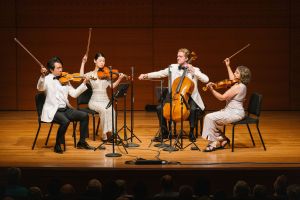
Performance photo by Da Ping Luo
~ Ben Weaver
(Concert photos by Da Ping Luo, courtesy of Chamber Music Society of Lincoln Center…with our thanks to Beverly Greenfield)
-
Vivaldi ~ GLORIA

Above: the Cathedral Church of the Assumption of Mary in Koper, Slovenia
A performance of the Vivaldi GLORIA with the Camerata Academica Koper Chamber Orchestra and the University of Primorska Acedemic Choir and the Chamber Choir Aegida.
The soloists are Tatjana Vasle and Neža Vasle, sopranos, and Edita Garčević Koželj and Ana Vidmar, altos. Choral preparation by Ambrož Čopi; the conductor is Slaven Kulenović.
The performance took place at the Cathedral Church of the Assumption of Mary in Koper, Slovenia, in July of 2020.
Watch and listen here.
Koper, Slovenia, can trace its name back to the Roman town of Caprea. In 1278, the town voluntarily joined Venice and was later renamed Capo d’Istria. Once part of the Venetian republic, it was ceded to Austria in 1797 and then to Italy in 1918; the city was later incorporated into Yugoslavia. The Communists built an unattractive sprawl of factories and warehouses to the city’s south, but mercifully left the old town almost entirely untouched; it’s this treasure trove of Italian architecture that draws tourists to Koper in modern times.
-
David Rendall Has Passed Away
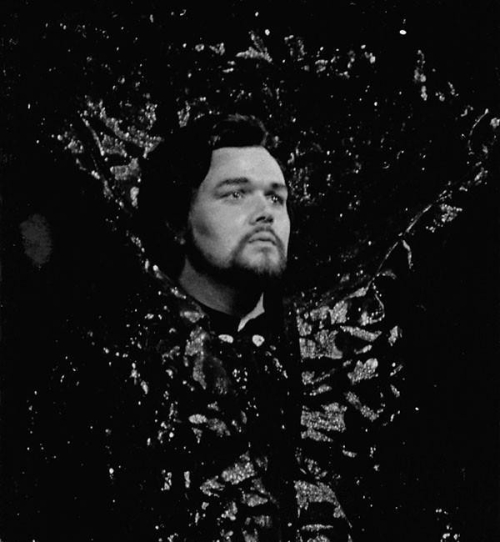
Above: David Rendall as Don Ottavio in DON GIOVANNI
It’s sad to learn of the death of British tenor David Rendall, who enjoyed a brilliant international career until an onstage injury forced his premature retirement.
Read about Mr. Rendall’s rise from his studies at the Royal Academy of Music, London, to his great successes on the world’s foremost opera stages here. He later wrote of his sad demise here.
I had the good fortune to see David Rendall onstage at the Metropolitan Opera House where he sang more that 130 performances in NY City and with the Company on tour, beginning with his 1980 debut as Ernesto in DON PASQUALE. My first chance to hear him came when the Met brought their DON GIOVANNI to Boston. I later saw him – an expert Mozartean – in COSI FAN TUTTE and IDOMENEO, as well as Matteo in Strauss’s ARABELLA. His other Met roles included David in MESTERSINGER, Alfredo in LA TRAVIATA, and Tamino in ZAUBERFLOETE.
In 1983, David participated in the Met’s 100th anniversary gala, joining such luminaries as Edda Moser and Sesto Bruscantini in an ensemble from Rossini’s ITALIANA IN ALGERI, which brought down the House. Watch it here.
One of my favorite Rendall recordings is of the English-language production of Donizetti’s MARY STUART, which marked Dame Janet Baker’s farewell to the English National Opera; listen to their lovely duet here.
And here is the tenor’s “Il mio tesoro” from Mozart’s DON GIOVANNI.
David Rendall was married to the beloved mezzo-soprano Diana Montague; their son, Huw Montague Rendall, upholds the high musical standards set by his parents in his highly successful career in opera and lieder.
-
Kseniia Nikolaieva ~ Voce di donna
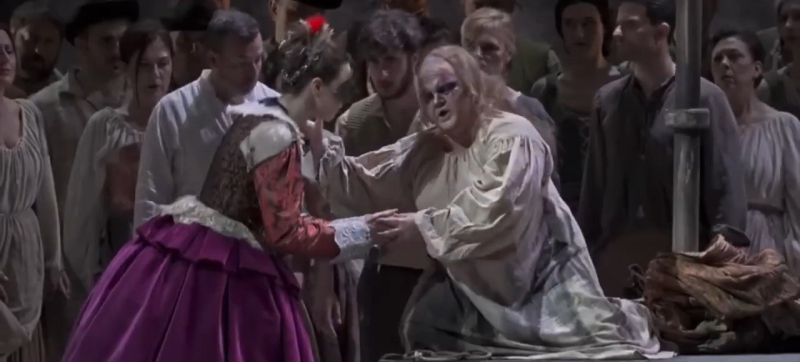
Ukrainian contralto Kseniia Nikolaieva sings “Voce di donna” from Ponchielli’s LA GIOCONDA (above) from a performance given at Naples in 2024. Also in the cast are Anna Netrebko as Gioconda, Eve-Maud Hubeaux as Laura Adorno, Jonas Kaufmann as Enzo Grimaldo, Ludovic Tézier as Barnaba, and Alexander Köpeczi as Alvise Badoero. Pinchas Steinberg conducts.
Watch and listen here.
I love how the choristers immediately sink to their knees when the rosary’s blessing is given.
(Read about Mr. Köpeczi’s Met debut (in May 2025) as Colline in LA BOHEME here.)
-
Sir Thomas Allen ~ Grieg Songs
Sir Thomas Allen (above) sings two songs by Edvard Grieg:
Sir Thomas Allen – 2 Grieg Songs – BBC 1993
Sir Tom has always been a particular favorite of mine; I had the great pleasure of meeting him in 2001 when he was in New York City for performances of MEISTERSINGER in which he was a splendid Beckmesser. I’ve also greatly enjoyed him as Count Almaviva in NOZZE DI FIGARO and as the Music Master in ARIADNE AUF NAXOS; he also played an exceptionally moving and beautifully-sung Sharpless in MADAMA BUTTERFLY.
-
The Crossing: The Book of Never

Above: The Crossing; photo by Charles Grove
~ Author: Lili Tobias
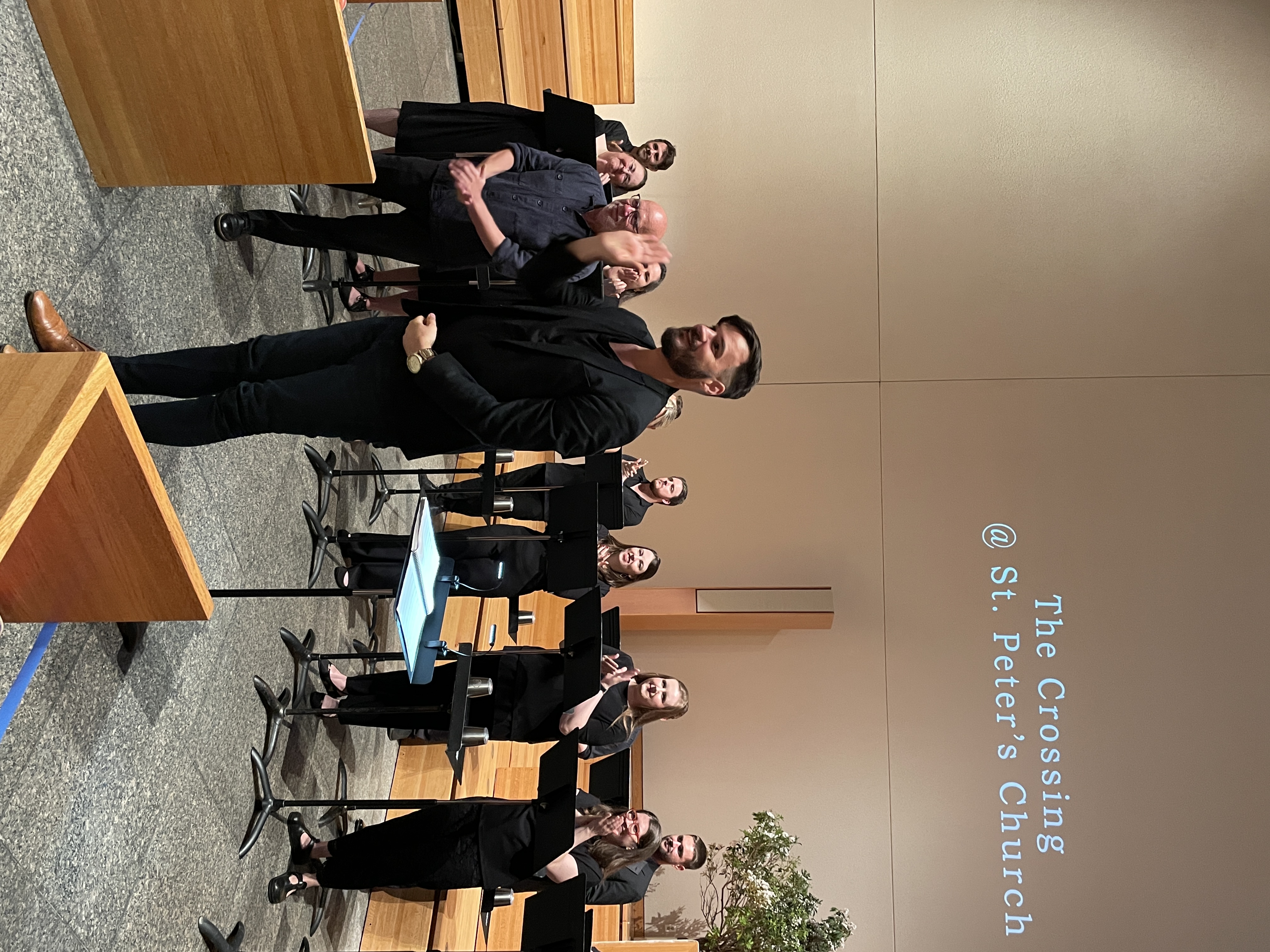
Friday June 20th, 2025 – The Crossing, conducted by Donald Nally, presented the New York premiere of Aaron Helgeson’s The Book of Never, along with selections from Gavin Bryars’s The Last Days of Immanuel Kant—two adventurous works of music! The program was presented by the Arts and Architecture Conservancy at Saint Peter’s.
The Last Days of Immanuel Kant began the concert, the text of which is drawn from Thomas DeQuincey’s book of the same title. Bryars set the words true to the rhythms of the original prose, with flowing sentence-shaped phrases. The lush harmonies were full of suspended notes, some resolving and others remaining in a state of lingering uncertainty. But no matter what happened eventually, the result was always beautiful!
In the program notes for “II. Prologue,” Bryars notes “DeQuincey’s astonishing assumption: ‘I take it for granted that every person of education will acknowledge some interest in the personal history of Immanuel Kant.’ I, for one, do not have any particular interest in Immanuel Kant, but that didn’t detract from my enjoyment of the music at all. Without the historical context, the text could have been about any regular person in their final stages of life. The singers describe mundane activities like recording conversations on scrap paper in order to remember them, difficulty sleeping, visiting a friend’s garden, etc.—all things that are shared by many in the process of aging and dying, no matter if you’re a famous philosopher or ordinary person.

Above: Aaron Helgeson, photo by Sam Gehrke
The text for The Book of Never also originates from an unconventional source. Composer Aaron Helgeson sets the fragmented remains of the Novgorod Codex, at the same time weaving in text from a variety of other sources (including Gertrude Stein and the Rolling Stones, to name a few). Themes of exile tie the patchwork of text and personal histories of the authors together, and the powerful vocalizations of The Crossing brought Helgeson’s musical realization to life. All proceeds from this concert were donated to Safe Passage 4 Ukraine, an organization which helps Ukrainians displaced from the war find safety and new homes.
Helgeson describes the contents of the Novgorod Codex in part as like “the chanting of a vindictive spell,” and the music certainly embodied that. The singers recited words one after the other on the same pitches or oscillated across wide intervals. Textures like this often punctuated more polyphonic sections, inciting a sense of urgency (like the near shouting of “And you bow down” in “III. Burns I’d Like to Forget…”). The harmonies, too, were mysteriously intriguing. Helgeson upended the traditional distinctions of “consonance” and “dissonance” (which are completely relative anyway) with notes and melodies drawn from a collection of hymns associated with the Novgorod Codex. During any moment of silence within the piece, the haunting echoes of dense cluster chords lingered in the air.
All in all, The Book of Never is true choir music. Not just because it’s written for singers, but because Helgeson achieves an assembly of notes, words, vocal expression, and meaning that only a choir can facilitate. Arranged for any other ensemble, I feel that the music would lose a significant amount of the deep emotional nuance it has in its original form. Many of the movements feature different sequences of words sung nearly simultaneously, the listener’s attention shifting from one phrase to the next and back again but absorbing the meaning of both at the same time.

Above: The Crossing and Aaron Helgeson, photo by Steven SwartzThe final movement, “VII. Names of Things I Once Believed…,” exhibited this truly non-linear presentation of ideas to the extreme. Half the choir sustained multiple words at once (“all/always,” “why/waiting, “end/ever,” etc.) while the other half chanted longer, more descriptive phrases of resilience amidst suffering and self doubt. The intricate layers of music illuminated the complicated contradictions of existence in a world that does not value everybody’s existence. From start to finish, Helgeson’s innovative choral writing brought The Book of Never to an entirely new dimension of comprehension, and it was an absolutely exhilarating space to inhabit!
~ Lili Tobias
-
TRISTAN UND ISOLDE: Jones & Kollo

~ Author: Oberon
Recalling the day I spotted this DVD of TRISTAN UND ISOLDE on the shelf at the Library of the Performing Arts. The production is from the Deutsche Oper Berlin, filmed on tour at Tokyo in 1993. It stars Dame Gwyneth Jones and Rene Kollo (photo above), two veteran Wagner specialists who were in their mid-50s at the time. During a few days of break from live opera and symphonic performances, I watched this TRISTAN one act at a time on three successive days of bitter cold weather. Despite flaws, I found it to be a moving experience.
TRISTAN is an opera that took me a long time to embrace. Following my first live performance of it – the thrilling prima of a new production at The Met in 1973 with Birgit Nilsson and Jess Thomas in the name roles – I still found myself shying away from repeated viewings. It was the Dieter Dorn/Jürgen Rose Met production that finally brought me under the spell of this great opera; unfortunately, that gorgeous setting has since been discarded for a tedious updated production – set on a 20th-century battle cruiser – that makes little dramatic sense. Who knows when I’ll see TRISTAN in the theatre again?
On the DVD, I found the Deutsche Oper’s simple and spare Götz Friedrich production serviceable – though lacking in poetry – in the first two acts. There’s a lot of standing about, but perhaps that’s the nature of the piece. One exciting moment comes at the close of the Liebesnacht, when the stage is flooded with light at King Marke’s return. And I was deeply moved that it is Kurwenal, not Isolde, who collapses in despair over the mortally wounded Tristan as the curtain falls on Act II.
In the third act, the production reaches its zenith. On an outcropping of rock at Castle Kareol, bathed in silvery light from a desolate sun, Tristan lies near death. During the long scene between Tristan and his faithful retainer Kurwenal, the relationship between the two men has never seemed so poignant (this is thanks in part to Gerd Feldhoff’s splendid acting as Kurwenal). Isolde arrives, her auburn hair now streaming loose, and seeks to revive her lover. The confusion of the arrival of the second ship is well-handled: Kurwenal slays Melot, but then he too meets his death. King Marke’s lamenting words are unheeded by Isolde, who has left earthly matters behind.
Maestro Jiří Kout shapes the yearning prelude thoughtfully; his conducting throughout the long opera manages to be both passionate and respectful of the singers. At curtain-rise, Clemens Bieber’s singing of the Sailor’s plaintive song is very effective.
Dame Gwyneth Jones, possessor of one of the biggest voices ever unleashed in an opera house, shows off that power to fine effect when she chooses; but much of the music is quietly and expressively sung, displaying the soprano’s incredible control. Her highest notes are steady and strong. Annoyingly and inexplicably, the filming continually shows us Tristan rather than Isolde during her Act I Narrative and Curse. While Dame Gwyneth looks rather mature – the costuming in Acts I and II is a bit dowdy – she is entirely credible. Her Liebestod is not vocally perfect, but it moved me deeply. A year after this performance was filmed, I saw the soprano as Elektra at The Met where her singing had staggering force and brilliance.
Rene Kollo’s experienced Tristan is cannily sung; his tone can display a steady beat, but he is nonetheless vocally persuasive throughout. His third act is truly impactful; passing moments of vocal strain can be overlooked in view of the power and commitment of Kollo’s singing and acting.
Hanna Schwarz, Chereau’s Fricka and a splendid Met Klytemnestra in 1999 and 2002, is a bewitching Brangaene; her voice is lyrical yet well-pointed. Ms. Schwarz, slender and graceful, appears to have materialized from out of the Mists of Avalon. Magnificent singing, awash with heartbreak, sets Robert Lloyd among the finest of King Markes.

I’ve seen some mighty impressive Kurwenals in my day, but I think Gerd Feldhoff (above) takes the prize – not only for his the clumsy sincerity of his declarations of love for and loyalty to Tristan, but also for his truly beautiful and moving vocalism. His performance makes the third act unforgettable.
Maestro Kout gives us an expressive rendering of the “Wesendonck” prelude to Act III. Also making a strong mark in the final act are the superb English horn player, tenor Uwe Peper’s crippled and touchingly voiced Shepherd, and Ivan Sardi’s Steersman.
Peter Edelmann, whose father Otto was an iconic Baron Ochs, beams with smug self-satisfaction as he betrays Tristan: a small but telling bit of characterization.
I’ll be returning to this DVD in future, for so many reasons.
~ Oberon
-
PAGLIACCI – Metropolitan Opera Record Club ~ 1958

Above: Frank Guarrera
During the pandemic, all sorts of operatic treasures had popped up on YouTube. I think that the collectors who have their own channels are finding time to post more, digging deep into their archives. It’s such a boon for music lovers, who – up til then – had been mostly deprived of live in-venue performances..
Here we have Leoncavallo’s PAGLIACCI from a recording made in 1958 for the Metropolitan Opera Record Club. All of the singers in the cast were dear to me in my earliest days of opera fandom.
Listen here.
-
Scotto/Carreras ~ BUTTERFLY Love Duet
Renata Scotto and Jose Carreras sing the love duet from Act I of Puccini’s MADAMA BUTTERFLY from a live performance given at San Francisco in 1974.

 Oberon's Glade