Category: Reviews

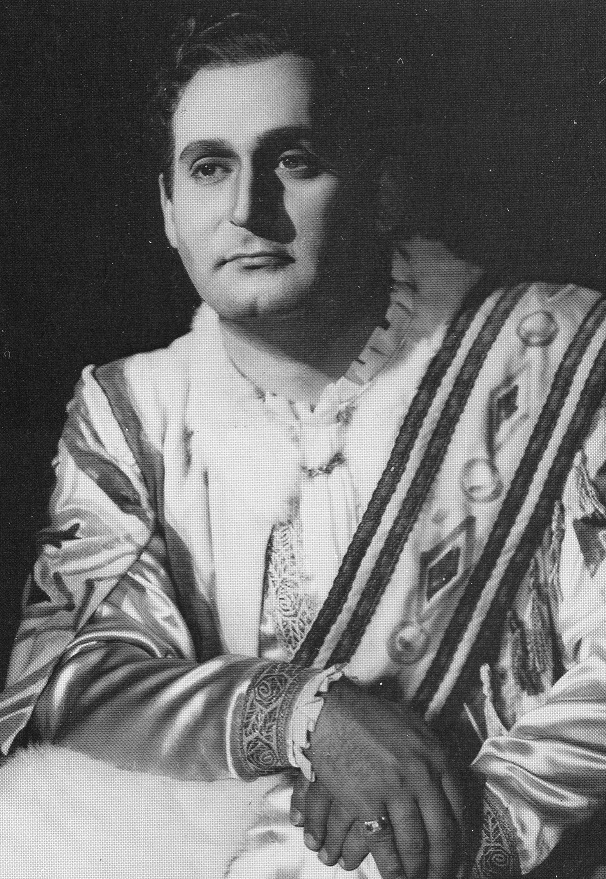
  • Forgotten Voices: Rudolf Ritter

    5ab02691af300

    I came upon the voice of Rudolf Ritter by chance while sampling recordings of different tenors in the music of Verdi’s Otello.

    Rudolf Ritter – Otello’s Death ~ OTELLO – in German

    Following service in the Austro-Hungarian army (1898-1908), Rudolf Ritter studied singing at the Vienna Music Academy. In 1910 he made his debut at the Volksoper in Vienna, where he sang until 1913; he then joined the Hofoper in Stuttgart, where he made a name for himself as a leading artist for twenty years, singing in world premieres by Braunfels and Zemlinsky as well as the standard repertory.

    Ritter joined a touring group, the German Opera Company, in 1923. In North America, he sang at Chicago and in Kienzl’s Der Evangelimann in New York City. He appeared at the Bayreuth Festival from 1924-1930 as Siegfried and Tannhäuser, and in 1926 he scored a major success with performances in South America.

    From 1929-1931 season, Ritter was again touring North America with the German Opera Company, along with soprano Johanna Gadski.  He made guest appearances at London’s Covent Garden, the Paris Opéra, Vienna Staatsoper, and Zurich. In 1927 at the Zoppot Festival, he sang Siegfried in Götterdämmerung.

    Rudolf Ritter retired from the stage in 1933, settling at Stuttgart where he taught and coached. He was married to the pianist Gret Hein. He passed away in 1966.

    Ritter’s rounded, steady tone sounds really good in Wagner:

    Rudolf Ritter – Allmächtǵer Vater ~ RIENZI

    Rudolf Ritter – Winterstürme wichen dem Wonnemond ~ WALKURE

    ~ Oberon

  • Elena Zilio Today

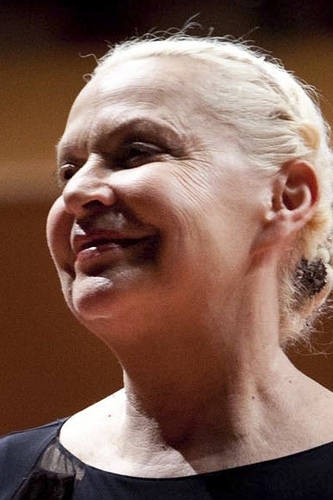
    Elena Zilio 2018

    Mezzo-soprano Elena Zilio (above) made her operatic debut in 1963 and went on to sing dozens of roles – everything from Cherubino to Dame Quickly – throughout the world.

    One of my favorite Zilio souvenirs is her passionate singing of Suzuki, Madama Butterfly’s faithful servant who, in this trio, foresees the story’s tragic ending:

    BUTTERFLY scene Zilio P Dvorsky Stilwell Chicago 1985

    Here she sings the aria of a distraught mother, Rosa Mamai, from Cilea’s L’ARLESIANA:

    Elena Zilio – Esser madre e un inferno ~ L`Arlesiana

    More recently, Elena Zilio has carved out a lovely niche for herself in character roles.

    Earlier this year, Ms. Zilio had a personal triumph as Mamma Lucia in CAVALLERIA RUSTICANA at Covent Garden. In 2019, she alternates that role and Madelon in ANDREA CHENIER in performances at Firenze, Naples, London, and Munich.

    ~ Oberon

  • Jeannine Crader

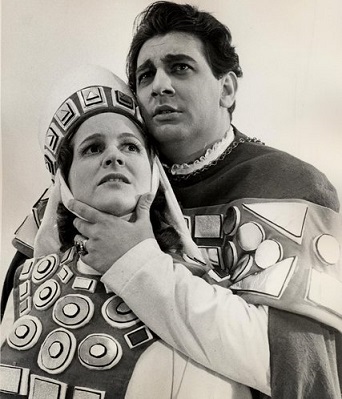
    Crader Domingo Ginastera's DON RODRIGO Fred Fehl

    Above: Jeannine Crader and Placido Domingo in Ginastera’s DON RODRIGO; photo by Fred Fehl

    Soprano Jeannine Crader was a member of the San Francisco Opera’s Merola Program in the late 1950s, and sang Magda Sorel in Menotti’s THE CONSUL with the San Francisco Opera’s Spring Program in 1969.

    Crader-beni-baldwin

    She performed with the Metropolitan Opera Studio Company (above, in COSI FAN TUTTE, with Gimi Beni and Marcia Baldwin) before joining New York City Opera where she sang in the US premiere of Alberto Ginastera’s DON RODRIGO, opposite Placido Domingo, in 1966. 

    I saw Ms. Crader only once – as Donna Elvira at New York City Opera in 1966. With the Company, she also sang Tosca, Butterfly, and Giorgetta in IL TABARRO. In 1967, she and Domingo sang in ANDREA CHENIER together at the Cincinnati Opera.

    Ms. Crader appears on Maurice Abravanel’s recording of the Mahler 8th, and there is a complete recording of DON RODRIGO available from Opera Depot. Beyond that, I can only find two Puccini souvenirs, both with Mr. Domingo:

    Jeannine Crader & Placido Domingo – E Ben Altro Il Mio Sogno ~ TABARRO – NYCO 1968

    Jeannine Crader & Placido Domingo – TOSCA scene ~ Act III – NYC Opera

    Jeannine Crader sings a William Mayer duet, “Barbara, What Have You Done?” with Dorothy Renzi (audio only) on YouTube. I like it a lot. 

    Ms. Crader taught at the University of North Texas from 1970-1997.

    ~ Oberon

  • Maxim Vengerov @ Carnegie Hall

    Maxim-Vengerov

    Above: violinist Maxim Vengerov

    ~ Author: Oberon

    Tuesday October 30th, 2018 – Three wonderfully contrasted violin sonatas were on offer tonight at Carnegie Hall as the renowned Maxim Vengerov took the stage, joined by the excellent Roustem Saïtkoulov at the Steinway.

    About ten years ago, Mr. Vengerov – as most classical music-lovers know – developed a mysterious arm/shoulder ailment that took nearly four years to diagnose and treat. He returned to the stage in 2012, and I first heard him live in 2015, playing the Tchaikovsky violin concerto with the New York Philharmonic. It was a thrilling performance, and tonight I was very excited to be hearing him again. In the grand and glorious setting of Carnegie Hall tonight, Mssrs. Vengerov and Saïtkoulov made a most congenial collaboration, to the great benefit of the music they’d chosen, and to the great delight of the audience.

    Johannes Brahms’ Violin Sonata No. 3 in D-Minor is in four movements rather than the more usual three. It opens with an achingly romantic lyrical theme, aglow with passionate colours. The Vengerov/Saïtkoulov partnership brought a lot of nuance to the music, with a lovely dynamic palette and finely dovetailed modulations. In a heartfelt piano passage, Mr. Saïtkoulov’s playing moved me. An intoxicating, soulful finish seemed to entrance the audience.
     
    The Adagio commences with a wistful melody, sublimely tailored; the players’ astute attention to dynamics again kept up their intriguing effect. The familiar descending theme of this movement brought a feeling of plushy, Olde World magic, but then a dropped program booklet and a cellphone intrusion ruined the ending.
     
    Rhythmic vitality, and some charming plucking motifs, adorned the Scherzo, which has a somewhat sentimental quality: no mere jesting here.

    Then players immediately launched the concluding Presto agitato, full of great swirls of notes and a rich mix of colours. Syncopations are at work here; the music builds and subsides, and then re-bounds in a rush to the finish. Prolonged applause, but the players did not come out for a bow.

    George Enescu wrote his Violin Sonata No. 2 in F-Minor at the age of seventeen, reportedly in the space of a fortnight. Mssrs. Vengerov and Saïtkoulov play in unison for the sonata’s rather mysterious start. Turbulence is stirred up, but reverts to the unison motif. The piano then shimmers as the violin sings above with rising passion. Vengerov and Saïtkoulov both demonstrated great control of dynamics as the music took on a restless quality. They play in unison again, moving to a quiet finish.
     
    A sad song opens the second movement, marked Tranquillement, pervaded by a strangely lovely feeling of melancholy. Again Mr. Vengerov displays pinpoint control of line in an affecting soft theme that rises to an exquisite sustained note. There’s a darkish quality from the piano as the violin is plucked. Then: a sudden stop. The music resumes – so quietly – with a shivering violin tremolo. The ending is simply gorgeous.
     
    The concluding movement, marked simply Vif (“Lively”), starts off all wit and sparkle; both musicians savor the animation, tossing in wry soft notes from time to time. The music turns briefly grand, then softens, and the liveliness resumes. The players are on the verge of exceeding the speed limit when they suddenly veer into an unexpected ‘romance’. But wit prevails in the end.
     
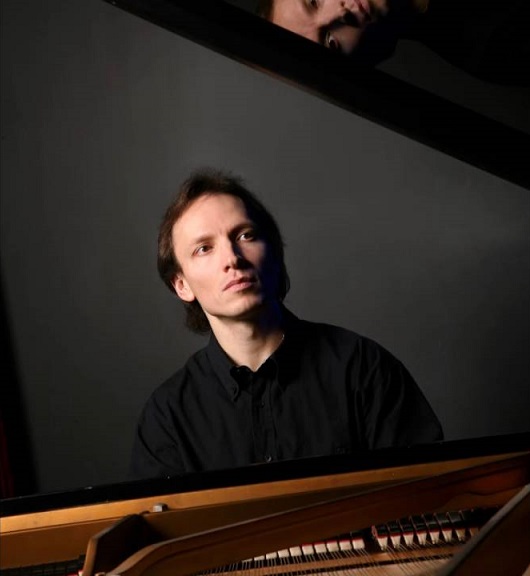
    Roustem Saïtkoulov  Piano
     
    Above: pianist Roustem Saïtkoulov
     
    Maurice Ravel’s Violin Sonata was premiered in Paris on May 30, 1927, with none other than George Enescu as violin soloist, and Ravel himself at the piano. The opening Allegretto starts quietly, with a piano theme that is taken up by the violin. Mr. Vengerov sweetens his tone here, making the most of the melodic possibilities. The violin trembles over a shadowy piano passage, and then a transportive lyricism builds, with the violin rising and lingering. A heavenly conclusion: sustained violin tone over a shimmering piano.
     
    To open the Blues: Moderato, the violinist plucks in altering soft and emphatic notes. The piano sounds rather glum at first, then starts pulsing persuasively as the violin gets jazzy, bending the phrases enticingly.
     
    From a gentle start, the Perpetuum mobile finale lives up to its name. The piano goes scurrying along, and Mr. Vengerov turns into a speed demon. The music rocks along – Rhapsody in Blue and Fascinatin’ Rhythm are evoked briefly – with the violinist verging on manic whilst Mr. Saïtkoulov’s playing stays light and luminous.
     
    The concluding works on the printed program both felt very much like encores: Heinrich Ernst’s decorative incarnation of The Last Rose of Summer and Nicolo Paganini’s super-elaborate take on the great aria Di tanti palpiti from Rossini’s TANCREDI (arranged by Fritz Kreisler) each had an “everything-but-the-kitchen-sink” feeling. Mr. Vengerov managed the fireworks well, drawing a celebratory audience response. My feeling was that one or the other of these two virtuoso pieces would have sufficed.
     
    As an encore, Fritz Kreisler’s Caprice Viennois was beautifully played. The audience then began streaming out. We were in the lobby when we heard a second encore commencing; but it was too late to double back.
     
    ~ Oberon

  • Ensemble Connect @ Weill Hall

    Gabriella-smith-691px
     
    Above: composer Gabriella Smith
     
    ~ Author: Brad S Ross
     
    Monday October 22nd, 2018 – It was a cold night in New York City—one of those now all-too-often days where summer seems to have skipped fall entirely and moved straight into winter.  Respite could be found for the audience at the Weill Recital Hall in Carnegie Hall, however, where the immensely talented players Ensemble Connect brought some much-needed warmth to a small percentage of classical music lovers.
     
    Ensemble Connect is a two-year fellowship program with Carnegie Hall that comprises some of the finest young players in the United States.  These musicians hail from some of the nation’s top music schools, including, as the program noted, the Curtis Institute of Music, the Juilliard School, the Peabody Institute, and the University of Southern California, among others.  Indeed, there was not one sour note or poorly delivered phrase of the entire evening.
     
    The concert began with György Ligeti’s Six Bagatelles for Wind Quartet—a set of six short movements adapted from his larger piano work Musica ricercata.  Written in 1953 while the composer lived in Communist Hungary, the piece is a texturally rich and rhythmically adventurous foretaste of the polyphonic styles for which he would later come to fame with such works as Atmosphères and Lux aeterna.  Six Bagatelles opens on an amusing Allegro con spirito followed by an attractively dissonant Rubato: Lamentoso, a warm and pulsing Allegro grazioso, a spirited Presto ruvido, a richly mysterious Adagio: Mesto (written in memoriam of the composer Béla Bartók), and an energetic Molto vivace that cheekily concludes the work.  Performed with precision and zest by the members of Ensemble Connect, it was a delightful demonstration of mature musical humor—a rare quality in classical music.
     
    Next was the New York premiere Anthozoa, a 2018 Ensemble Connect commission written for violin, cello, piano, and percussion by the young American composer Gabriella Smith.  Anthozoa, as Smith explained in a brief pre-performance talk, was inspired by recordings that the composer made while scuba diving of sea life (its unique title derives from a class of marine invertebrates that encompasses corals and sea anemones).  It opened on a colorful percussion solo that is quickly joined by prepared piano, sliding pizzicato cello, and unpitched strikes on the violin.  Lengthy and propulsive soundscapes shifted throughout its twelve-minute duration revealing at times otherworldly sonorities.  Dramatic piano chords gradually emerged underneath a rushing full-ensemble crescendo before receding into a somber, elegiac diminuendo that faded to a silent finale.  Extended technique abounded in Anthozoa, which was as much fun to watch as it was to hear, and Smith received a well-earned ovation—perhaps the longest of the evening—before the concert paused for intermission.  It’s a colorful and invigorating new work, one that will hopefully find many more performances in the future.
     
    5ae73b5def11d7a7712dc59adb06728432140a61b8e6d9718e5f2a36ffcd

    Above: composer Kaija Saariaho, photographed by Maarit Kytöharju
     
    Following intermission was Light and Matter for violin, cello, and piano by the Finnish composer Kaija Saariaho.  Saariaho, who by now must be counted among the finest composers alive, more than lived up to her reputation here as a master of the craft.  Written during the autumn of 2014, Light and Matter was conceived, as the composer put it, “while watching from my window the changing light and colors of Morningside Park.”  Menacing pulses open from the lower registers of the piano and cello before being joined by a belated violin.  Once combined, they exchange a series of vivid textures and haunting atmospheres that cast a hypnotic spell for the piece’s twelve-minute duration.  This aptly complimented the October evening of its performance.
     
    The most warmth was brought to the proceedings with the final piece of the night, Johannes Brahms’s Clarinet Trio in A-minor.  Composed in 1891, the trio marked Brahms’s return to composition after he considering retiring one year before.  This is owed to his admiration of the clarinetist Richard Mühlfeld, whom Brahms regarded as “a master of his instrument.”  Clarinetists may be forever grateful of this relationship, which also led to the composition of his Clarinet Quintet in 1891 and two Clarinet Sonatas in 1894.  The Clarinet Trio, cast in four movements over approximately twenty-four minutes, comprises an inviting Allegro, a wistful Adagio, a buoyant Andantino grazioso, and an upbeat Allegro that sings the work to its final minor chord.  The trio’s sweeping musical gestures and warm consonances were the very apex of Romanticism; this, combined with the relative coziness of the Weill Recital Hall, made for a sumptuous conclusion before players and audience retired into the chilly night air.
     
    All of the musicians performed with the seemingly effortless mastery we’ve come to expect from such things, though it’s easy to forget sometimes just how much work and dedication got them there.  Each deserves a mention, and to this end I will oblige; they were the hornist Wilden Dannenberg, the cellist Ari Evan, the pianist Tomer Gerwirtzman, the percussionist Sae Hashimoto, the violinist Jennifer Liu, the clarinetist Noémi Sallai, the flautist Leo Sussman, the oboist Tamara Winston, and the bassoonist Yen-Chen Wu.  All should be cherished for their well-honed talents and can hopefully anticipate bright careers ahead.
     
    ~ Brad S Ross

  • Salon Seánce @ Tarisio

    ~Author: Scoresby

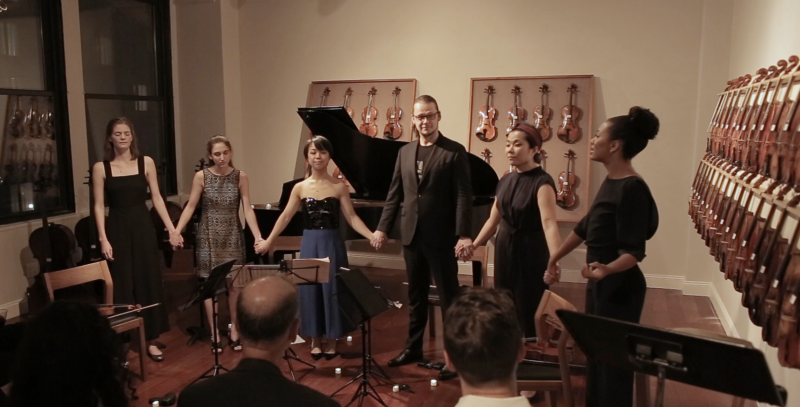
    Thursday October 19 2018 – After the many concerts I’ve reviewed in the past week or so that had theatrical elements, ranging from the NY Philharmonic’s MUTED to Berlioz’s Lélio, it was satisfying to hear a performance that finally seemed to strike the rare balance between excellent music and intellectually interesting theater. Salon Séance, co-founded by siblings violinist Mari Lee (an ensemble connect Alumnus) and Simon Lee (who provided the research for the work), performed its unusual structure in the show room of the string instrument auction house Tarisio with electric candles all over the stage and a backdrop of 50 or so rare instruments. Essentially, this performance consisted of full pieces of music by a specific composer being played, punctuated with short theatrical monologues that illuminate context in which those pieces were composed while threading a common theme through it all. The theme of this concert about Britten and Auden was addressing the question “How Do I live in a Broken World?”

    Screen Shot 2018-10-24 at 5.42.55 PM
    Above Ms. Valla leading the musicians in contacting Britten’s spirit; photo credit: Rodrigo Aranjuelo

    In the opening, actress Sagine Valla was alone​ as​ the five​ musicians walked toward the stage speaking to her. Because of this unusual setup there was none of the traditional clapping as the musicians entered, a welcome relief from the usual program. After a bit of awkward dialogue, the performance became interesting when the musicians and Ms. Valla gathered in a circle to summon the spirit of Benjamin Britten. After a few unsuccessful attempts, she suggested for the musicians to play something to rouse Britten. The quartet then launched into the first movement of his String Quartet No. 1, Op. 25 played by fantastic chamber musicians and the performance didn’t let up until the end of the evening.

    The quartet performing included violinists Rebecca Anderson (an Ensemble Connect Alumnus) and Mari Lee, cellist Mihai Marica (a regular at CMS at Lincoln Center), and violist Ayane Kozasa (a founding member of the Azuri Quartet). The first movement of this piece alternates between two contrasting themes that slowly develop using each other as springboards. The first is a slow ethereal theme layered with nostalgia played with the violins and viola in the highest ranges of their instruments while the cello plucks an almost child-like theme in a completely different register. Ms. Anderson, Ms. Lee, and Ms. Kozasa did a wonderful job of sustaining the high-pitched melody cleanly while Mr. Marica’s warm pizzicatos filled the room. The group brought verve to the raucous second theme, but they were best in the closing bits of the movement as the first theme turns from sweetness to longing.

    Instead of moving into the next movement, Ms. Valla (now taken by Mr. Britten’s spirit) began to talk in the first person about Britten’s life during the time the quartet was composed. Ms. Valla (with Noelle Wilsons’s brilliant script) painted Britten’s move to New York and the way his love of California made him long to be back in England. She also introduced the moment Britten met poet W.H. Auden who later became the core of the evening’s drama.

    After a riveting performance of the other three movements, Ms. Lee, Ms. Valla, and pianist Julia Hamos joined together for the most creative part of the evening. While Ms. Lee and Ms. Hamos performed the Waltz, March, and Moto perpetuo from Britten Violin Suite, Op. 6, Ms. Valla gave a monologue about Britten’s travels through Europe. At first, she talked about how he went to Vienna and found it magical just as the Waltz began. As Ms. Valla transitioned to talk about the way Britten felt alienated by the rise of Nazism the music moved into the sinister the March. Ms. Valla’s monologue wasn’t constant, there was plenty of space for the music too. Instead it was sort of a trio between the three performers. While Ms. Lee and Ms. Hamos were a bit too loud for Ms. Valla at times, it is hard to play a difficult piano part softly enough for a speaker in such a small space (the audience fit only perhaps 40 people).

    The drama of the night reached its peak when the text shifted back to Britten’s fraught relationship with Auden as the Moto perpetuo begins. Here Mr. Lee’s detailed research and Ms. Wilson’s energetic script paid off as Ms. Valla captured Britten’s jealously and infinite admiration for Auden, all while their personal connection soured. As the music broke off, Ms. Valla recited an emotionally abusive letter Auden sent to Britten, essentially lambasting him for what Auden thought was naivety and privilege on Britten’s part. Ms. Valla then claimed to lose Britten’s spirit from exhaustion and the piece goes into intermission.

    Screen Shot 2018-10-24 at 5.48.16 PM

    Above: Ms. Anderson, Ms. Lee, Mr. Marica, and Ms. Kozasa; Photo Credit: Rodrigo Aranjuelo

    After intermission, “Britten” talked about the horror he felt at World War II and performing at the Bergen-Belsen Concentration Camp with Menhuin for survivors, “I never felt the same after that trip.” It was his vehement belief that art was a panacea for those dark times. With this in mind, the quartet performed the complete String Quartet No. 2, Op. 36 which was composed contemporaneously. While the first two movements are lovely, the Chacony is one of Britten’s most substantial pieces of music. Each quartet member (Ms. Lee and Ms. Anderson switched positions) gave her/his all in the difficultly paced movement, getting every nuance from the sunny bursts of optimism that end the work to the sinewy dissonant textures that start the movement. It was among the liveliest chamber music performances I’ve heard this year, but with Ms. Valla’s speech in mind about the war it became even more emotionally potent.

    The genius of Ms. Lee’s production and Mikael Södersten’s direction is that the speech never sounds corny and the music is from top notch performers. This a serious historically informed piece about Britten’s inner life that links directly with the music they perform, almost like immersive program notes that both the novice and aficionado can enjoy. My only wish is that there was more speech in the second half of the program. Nonetheless, it is a relief from the staid concert environment. From the audience members I talked to afterword seemed to make even the most jaded listeners seemed won over – a rewarding evening all around. I look forward to seeing the project’s next production with the next composer. 

    ~Scoresby

    To recap, the performers:

    Rebecca Anderson, violin

    Julia Hamos, piano

    Ayane Kozasa, viola

    Mari Lee, violin/co-creator

    Simon Lee, researcher/co-creator

    Mihai Marica, cello

    Mikael Södersten, director/advisor

    Sagine Valla, actor

    Noelle P. Wilson, playwright

    The program:

    Britten String Quartet No. 1, Op. 25

    Britten Violin Suite, Op. 6 selections

    Britten String Quartet No. 2, Op. 36

  • Mignon Dunn as Dalila

    Mignon-dunn-01

    In the aftermath of the opening night performance of a new SAMSON ET DALILA at The Met, the folks on The List and at Parterre are discussing favorite interpreters of the opera’s title roles; the name of Mignon Dunn came up.  

    Mignon was a great favorite of mine and her performances in such roles as Laura in GIOCONDA, Fricka in the RING Cycle, Anna in TROYENS, Brangaene in TRISTAN UND ISOLDE, and Ortrud in LOHENGRIN are among my fondest operatic memories.

    In 1985, I had the good fortune to see Mignon Dunn as Dalila in a production by the Connecticut Opera Association at The Bushnell in Hartford. She and her co-stars, Jon Frederic West and Charles Karel, sang powerfully whilst doing what they could dramatically in an old-style, rather campy setting.

    In the course of my two-year project of rescuing music from my vast cassette collection, I was able to preserve this recording of Mignon singing Dalila’s opening aria from Act II with piano from a radio program in 1975 which I taped off the air:

    Mignon Dunn – Amour viens aider ma faiblesse – SAMSON & DALILA – Met Marathon 1975

    I’ll be seeing the Met’s new SAMSON ET DALILA twice in the coming weeks: once with each cast.

    ~ Oberon

  • Audrey Stottler Has Passed Away

    AudreyStottler

    September 15th, 2018 – I’ve learned of the death of Audrey Stottler (above), who I met in 2003 when she was in New York City to cover – and sing a single performance of – the Dyer’s Wife in FRAU OHNE SCHATTEN at The Met.

    Audrey came in the opera room at Tower Records where I was working at the time, and my boss Bryan and I chatted her up. Bryan had seen her as Turandot at Virginia Opera in 1993. and I’d seen her 2002 Met Turandot – a role she sang worldwide – and we were looking forward to the FRAU. She was most gracious during our long conversation.

    Audrey had a notable success as the Dyer’s Wife; I recall being especially impressed by her juicy upper tones, the unusual richness of her lower range, and the sense of lyricism in her singing.

    This scene from WALKURE displays her vocal attributes quite well:

    Audrey Stottler – Die Walküre ~ Der manner sippe

    And this is thrilling, grand-scale Wagner singing:

    Audrey Stottler – Tristan und Isolde ~ Isolde’s Narration & Curse

    At the time of her unexpected death, Audrey was running a popular voice studio in Minneapolis.

    Scanned Section 2-1 (3)

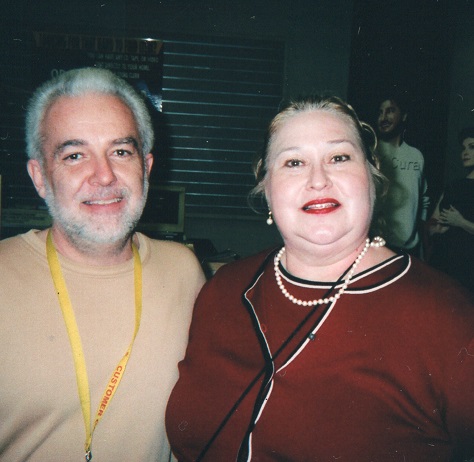
    Bryan took this photo of me with Audrey the day we met her. There are some lovely tributes to her on Norman Lebrecht’s blog.

    ~ Oberon

  • Bringing Down the House

    Tucker

    Richard Tucker elicits an ovation after singing “Cielo e mar!” in a performance of LA GIOCONDA at the Teatro Colon in Buenos Aires in 1966. Tucker was one of the most generous singers I ever encountered, as his singing here attests.

    Richard Tucker – Cielo e mar! – GIOCONDA – Buenos Aires 1966

    And, speaking of Richard Tucker, the annual Tucker Gala will be held on Sunday, October 21st, 2018, at 6:00 PM at Carnegie Hall. Information and tickets here.

  • Rudolf Knoll

    A-870624-1523602270-9499.jpeg

    German baritone Rudolf Knoll had an extensive career in Europe, singing at the Vienna State Opera, Zurich, and major German houses. He made several recordings of opera and lieder.

    He was less well-known in America, where his Met career consisted of two roles – Kothner in MEISTERSINGER and Faninal in ROSENKAVALIER – sung over a two-year span. He was in the casts of the first performances of those two operas I ever experienced, the ROSENKAVALIER being particularly stellar: his colleagues were Marion Lippert, Reri Grist, Christa Ludwig, Walter Berry, and George Shirley, with Karl Böhm conducting.

    In Europe, Knoll’s repertoire ranged from Alberich, Beckmesser, Pizarro, and Mandryka to Iago, Count di Luna, and Rigoletto. After retiring from opera, he taught at the Salzburg Mozarteum; among the singers he worked with was the prominent baritone Sir Simon Keenlyside.

    The only photo I am able to find of Mr. Knoll is from his teaching days (above).

    Rudolf Knoll as Donner – Rheingold

    Rudolf Knoll – Cortigiani vil razza dannata ~ RIGOLETTO

    Rudolf Knoll passed away in 2007.