Category: Reviews

  • LA GIOCONDA ~ Barcelona 1978

    gulin gioconda

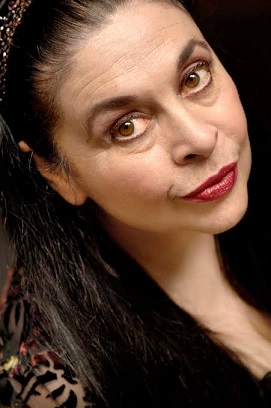
    Above: Ángeles Gulín as Gioconda and Montserrat Aparici as Cieca

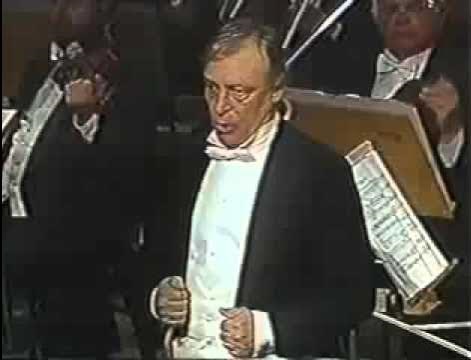
    A slam-bang performance of one of my favorite Italian operas, LA GIOCONDA, from the Liceu, Barcelona, in 1978. The singers simply go at it.

    Watch and listen here.

    Gioconda: Ángeles Gulín; Laura: Bruna Baglioni; Cieca: Montserrat Aparici;  Enzo: Nunzio Todesco; Barnaba: Sabin Markov; Alvise: Ivo Vinco.

    I only heard Ángeles Gulín live once: she sang Valentine in HUGUENOTS at Carnegie Hall in 1969; Beverly Sills was Marguerite de Valois and Tony Poncet was Raoul. Ms. Gulín had an enormous voice and she used it unsparingly.

    This GIOCONDA has the right knives-out, heart-on-sleeve passion. It’s that kind of all-or-nothing opera. As Gioconda sings of her love for Enzo in Act I: “My destiny is this: to love him, or to die!”

    ~ Oberon

  • @ My Met Score Desk for BARBIERE DI SIVIGLIA

    Barbiere_jonathan tichler met opera

    Above: Jack Swanson as Count Almaviva and Andrey Zhilikhovsky as Figaro; a Jonathan Tichler/MET Opera photo

    Author: Oberon

    Saturday May 31st, 2025 matinee – With the exceptions of Aigul Akhmetshina and Alexander Vinogradov, all the singers in this afternoon’s Met matinee of Rossini’s BARBIERE DI SIVIGLIA were new to me: not only had I not heard them before, I hadn’t even heard of them. On the podium, Giacomo Sagripanti was also unfamiliar to me.

    Barbiere_aigul and kalman tichler met opera

    Above: Aigul Akmetshina as Rosina and Peter Kálmán as Dr. Bartolo; a Jonathan Tichler/MET Opera photo

    It turned out to be a very worthwhile afternoon, not just because of the infectious rhythms and sheer brilliance of the score, but it also served to take my mind off – at least for the duration – of a looming domestic falling out. 

    In his Met debut season, Giacomo Sangripanti proved a deft Rossini maestro; his tempi seemed lively but never rushed, he never let the orchestra encroach on the singers volume-wise, and he allowed some added notes and embellishments from the singers, which is always fun. The orchestra played the overture swiftly and brightly and solo passages for oboe, horn, clarinet, and bassoon were all beautifully played.
    Joseph+Lim+Baritone

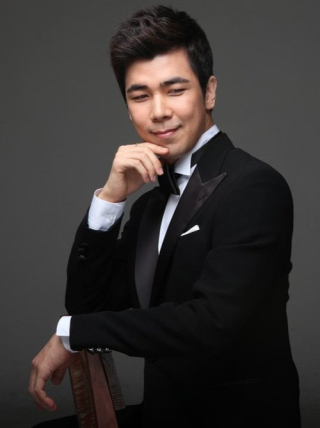
    The first voice to be heard was that of baritone Joseph Lim as Fiorello, and he made an excellent impression. In the past he has covered some roles at The Met (and he’d sung one of the Flemish Deputies in a DON CARLO I attended); I think he deserves more stage opportunities. After I got home and took a look at some of his on-line photos (there’s one above), I realized he had been at the stage door talking with friends after the performance. I wish I had chatted him up. 

    The lovely orchestral intro to Lindoro’s serenade set the scene for the very appealing singing of Jack Swanson as Count Almaviva, who had just made his Met debut in the opera’s previous performance. His singing is technically neat, with nice phrasing and an enticing dynamic range. The audience took to his singing at once, and he was warmly applaud throughout the performance.

    Mr. Lim’s voicey Fiorello was again heard, and then Figaro, in the person of Andrey Zhilikhovsky opened his afternoon with a fantastic “Largo al factotum” bringing some subtle touches to the familiar piece, along with blooming top notes. He was unfazed by the super-fast tempo of the aria’s final section, polishing it off with a splendid, Met-sized high note. The house rang with cheers from the crowd, who seemed thoroughly engaged in the opera’s every note and word.

    A special bouquet here to the excellent harpsichordist, Liora Maurer, who kept reminding us all afternoon of the instrument’s charm. The big-toned bass voice of  the Hungarian Peter Kálmán asserted itself briefly, and then Mr. Swanson rewarded us with more poised lyricism with “L’amoroso sincero Lindoro”, to which Ms. Akmetshina briefly replied before being whisked from her window. Mssrs. Swanson and Zhilikhovsky now set up their plan to gain access to the Count’s beloved; their duet features some fluent coloratura from the baritone, in which the tenor joins; the pair harmonize to fine effect. Figaro urges the Count to play drunk when they gain admitance to the Bartolo household; the pair have more mirthful, high-speed singing, and then Mr. Swanson tops the first scene off with a golden high note.

    Ms. Akmetshina’s “Una voce poco fa” showed off the warmth and depth of her luscious low range, along with engaging fiorature and some bright top notes; her singing flows on thru her playful warning that anyone who tries to cross her will pay for it. Another excited burst of applause was her reward. Mr. Kálmán’s prodigious bass returns…
    Vinogradov

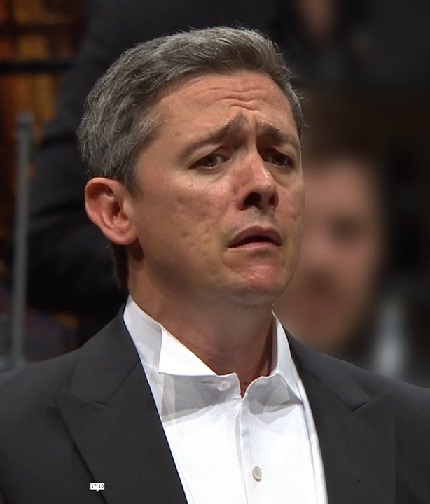
    …and we then meet the imposingly sung, characterful Don Basilio of Alexander Vinogradov (photo above). His “Calunnia” aria is full of insinuating inflections, but is always sung rather than giving in to buffo-parlando. His thunderous colpa di canone” shook the house, and then a mini-cadenza took his voice high before plunging to the deepest depths…once again, fervent applause burst forth, filling the hall.

    The wonderful Rosina/Figaro duet, “Dunque io son” found Aigul throwing in some extra top notes; Mr. Zhilikhovsky suggested she write a love note to her Lindoro, which – she slyly replies – she’s already done. Their duetting is speedy, laced with humor, and filled with luscious tone.

    I’m beginning to feel the severe chill that almost always affects enjoyment of the opera up in the score desk area. Mr. Kálmán’s “A un dottor della mia sorte” blends power with insinuation in a buffo tour de forceIt concludes with the basso’s perfect pattering and a hilarious finish capped by a massive final note.

    We briefly meet the house-keeper Berta, usually sang by a mezzo but today taken on by soprano Kathleen O’Mara; the change in range will bring some fun in her aria later on. 

    The ensemble “Fredda ed immobile” was the part of the opera I liked most when I first heard it live (as “Frigid and motionless“) at Lake George many, many moons ago. The puttering introduction and Aigul’s chesty lead into the long, riotous Act I finale held my interest, but by now I was literally shivering, so I thought of going home.

    But then a young Frenchman, Guillaume – visiting New York City for the first time – stopped by to chat and next thing I knew, Act II was about to  start.

    Ms. Akhmetshina turned Rosina’s music lesson aria, “Contro un cor” into  a real showpiece, capped by a brilliant top note, whilst Mr. Vinogradov added some extra low notes to Basilio’s music. Mr. Kálmán expressed Dr. Bartolo’s fury vibrantly.

    O'mara

    Ms. O’Mara (above, at the 2024 Operalia competition, where she won 1st prize) added some embellishments to Berta’s aria, along with interpolated top notes, including a real zinger at the end.   

    As the opera moves towards its ending, I must again mention Maestro Sangripati’s excellence; the music truly seemed so alive

    The charming “Zitti, zitti” trio was neatly dispatched by Ms. Akhmetshina and Mssrs. Swanson and Zhilikhovsky, and then the tenor took on the demanding “Cessa di piu resistare” with its beautiful andante, which segues into an elaborate tenorized setting of what sounds very much like the finale of LA CENERENTOLA. Mr. Swanson capped his impressive afternoon with a final top note, superbly sustained, igniting a tumultuous ovation during which each cast member evoked shouts of approval. 

    I very much enjoyed seeing Aigul again after the show, and she signed my program:

    Barbiere signed-1jpg
    I had wanted to meet the other singers, but either I didn’t recognize them in time to approach them, or they seemed preoccupied.

    ~ Oberon
  • Fernando Teixeira’s Stunning PAGLIACCI Prologo

    Teixiera

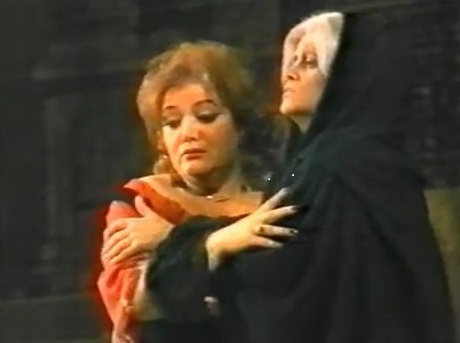
    The great Brazilian baritone Fernando Teixeira (above) sings a magnificent PAGLIACCI Prologo from a performance given at Rio de Janeiro in 1979. David Machado conducts.

    Listen here.

  • Bel Canto Duet

    puritani

    Lisette Oropesa and Lawrence Brownlee in a duet from Bellini’s I PURITANI, from a performance in March 2025 at l’Opéra Bastille in Paris.

    Watch and listen here:

  • Peixin Chen

    Chinese basso Peixin Chen has impressed me with his performances as Timur and Sarastro at The Met.

    He sings “Gada Meiren“, a Mongolian folk song, here:

  • Remembering Sixten Ehrling

    Ehrling

    When I had moved to New York City in 1998 and was working at Tower Records, Maestro Sixten Ehrling came in frequently. He was rather cranky the first time I met him: he did not guess that I knew who he was, and he barked at me that no one on the store staff had offered to help him. I let him cool down for a couple of seconds, then I made a small bow, and said: “You conducted my first RING operas, Maestro!”

    From then on, and for years to come, Maestro Ehrling was a customer I always looked forward to seeing. He had a million stories, including tales of how antagonistic the Met musicians were towards him during those RING performances. He taught me how to pronounce the names of the RING characters: “…say ZEEEG-lin-da, not See-GLIN-da!”)

    Then there was his tale of a recording session he had scheduled with Victoria de los Angeles on the day after her marriage. A couple of times, I forfeited my lunch hour just to stay and chat the Maestro up.

    Maestro Ehrling was married to a former ballerina, a very kind woman with Old World manners. As time went by, the Maestro became increasingly feeble and unsteady. He sometimes came in unshaven, wearing rumpled clothing. Then, for a while, Madame would come in alone to get CDs for him, saying he was under the weather but slowly on the mend. For a few weeks, she too stopped coming in. I sensed that Mr. Ehrling had taken a turn for the worse.

    The news came out that Maestro Ehrling had passed away. I wondered if Madame would remain in New York City (I believe they had a daughter living here). Then one day, she came in. She walked up to me with a gentle smile, saying, “I wanted to thank you for always being so kind to Sixten!”  I almost burst into tears. She became teary also. There was nothing more to be said. She held out her hand, which I kissed, and then she left.

  • Bach ~ Magnifcat

    Snapshot bach (2)

    Nicholas Harnoncourt leads Concentus Musicus Vienna and the Arnold Schoenberg Choir in a performance of Bach’s Magnificat in D-major given at the Kloster Melk, Austria, in 2000.

    The soloists are Christine Schäfer, Anna Korondi, Bernarda Fink, Ian Bostridge, and Christopher Maltman.

    Watch and listen here.

  • Anna Reynolds: Berlioz ~ LA CAPTIVE

    6a00d8341c4e3853ef00e553e672fe8834

    Anna Reynolds was my first RHEINGOLD Fricka; at The Met’s Saturday matinee performance of February 22nd, 1969, conducted by Herbert von Karajan, Ms. Reynolds replaced the scheduled Josephine Veasey in the role of Wotan’s wife and made a memorable impression on me. I sent Anna Reynolds a fan letter a couple of days later, and received the above photo from her soon after. Read about that spectacular February weekend here.

    In 1975, I had the good fortune to see Ms. Reynolds again on The Met stage as the WALKURE Fricka; she was superb. For years, I owned an LP of the mezzo-soprano singing Schumann songs; her interpretation of Mondnacht remains a favorite, though the LP has long since vanished.

    Among the hundreds of items I was able to rescue from my old cassettes – converting them to MP3s – this recording of Anna Reynolds singing Berlioz’ La Captive from a 1969 BBC broadcast is particularly dear to me.

    Anna Reynolds – Berlioz ~ LA CAPTIVE – BBC 1969

  • My first LADY MACBETH OF MTSESNK

    malfitano

    In the year 2000, I saw Shostakovich’s LADY MACBETH OF MTSENSK for the first time; the Met was presenting a grandiose musical performance which offset the somewhat overly-funny staging. Gergiev’s conducting, the superb orchestra, and an extraordinary cast assured that the opera would be thrilling. The cartoonish aspects of the staging were valid: it’s both over-the top and tongue-in-cheek. It was one of the most entertaining nights at the Met ever!  The fact that a bit more darkness might have been to the good didn’t detract from a magnificent evening of music and theatre.

    Catherine Malfitano (photo above) continued her string of Met triumphs in the singing-actress category with her powerful portrayal of Katerina. In a peroxide-blonde wig and oozing lethargic sex appeal at every moment, La Malfitano used her powerful, sometimes ravaged – but always expressive – voice to vivid effect. She swept thru the vast range of emotions and plugged into the vulnerable quality of her voice to insure sympathy for the character: a woman who has lost everything (if an unhappy marriage, bullying father-in-law, and desperate boredom count as things of value). In the harsh severity of the death march to Siberia, this Katerina was living proof of the theory that we don’t know when we are well-off. Ms. Malfitano’s huge success was thoroughly deserved.

    Sergei Koptchak’s magnificent Boris was utterly “real”, and his slime-infested vocalism so natural and apt. Mark Baker and Vladimir Galouzine were powerful vocal forces, and Galouzine proved himself an appealingly dastardly actor. Victoria Livengood sang her music in an awesome chest register, and was the perfect cheap slut. Vladimir Ognovenko’s big sound and easy stage presence made his Police Sergeant a gem, especially when he started ‘hoofing’ it with a chorus-line of cops. 

    Excellent bassos Grigori Karasev (hilarious as the Priest) and Gennady Bezzubenkov (moving as the Old Convict who leads the final ‘hymn’) – and a brilliant bit from Dennis Peterson as the shabby peasant who lives in a junk heap – were further attractions of the evening, whilst Bernard Fitch and Janet Hopkins (as teacher and cook) each made their mark. The chorus were really into the action, and the evening swept by with an exhilarating force.

    Joining my friend Paul in a backstage visit to his friend, Vicky Livengood, I greeted her with “Great chest!” to which she replied “Which one?”

    lady macbeth-1 jpg
  • Anja Silja Celebrates Her 85th Birthday

    Silja5

    Anja Silja celebrated her 85th birthday on April 18th, 2025. She had made her operatic debut 70 years earlier, as Rosina in BARBIERE DI SIVIGLIA. In 1980, I saw her in a riveting performance of Alban Berg’s WOZZECK at The Met, with Jose van Dam in the title-role and James Levine on the podium. The production was issued on DVD and is very much worth watching…if you can find it.

    Read Bruce Duffie’s 1996 interview with the German diva here.