Category: Reviews

  • SOLOperas at The Tank

    Tank

    ~ Author: Shoshana Klein

    Thursday March 20th, 2025 – This evening, I went to The Tank in Midtown (close to my office!) for a showing of solo operas in a small black box theater. Two operas were performed, both in impressive solo performances with varied skills and stories compellingly set forth forth. Other than that, they were very different experiences! 
    Shoshana 2


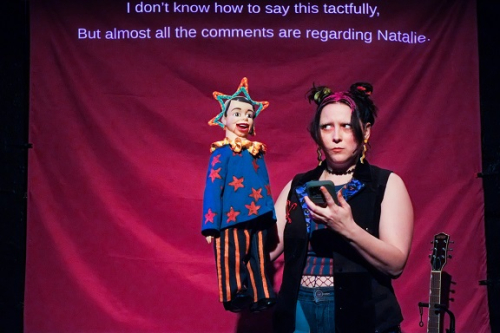
    This is not about Natalie ~ Jason Cady


    The first opera followed an unsuccessful musician feeling bad about her ex-music partner who became successful and moved on from their band. The story was told by way of daily vlogs that included conversations with a puppet – performer Sarah Daniels (photo above by Reuben Radding) did a great job, singing varied types of music, sometimes accompanying herself on electric guitar, and interacting with the ventriloquist puppet (whose voice had been pre-recorded, along with some accompaniment music, which was mostly kind of synth-pop). I thought it was interesting and pretty fun that the texture of the music – including songs performed as if they were kind of indie pop or rock – were being sung operatically, which somehow on the whole worked pretty well. The piece was clever, though transparent, and well executed.


    INcomplete Cosmicomics ~ Anna Heflin 


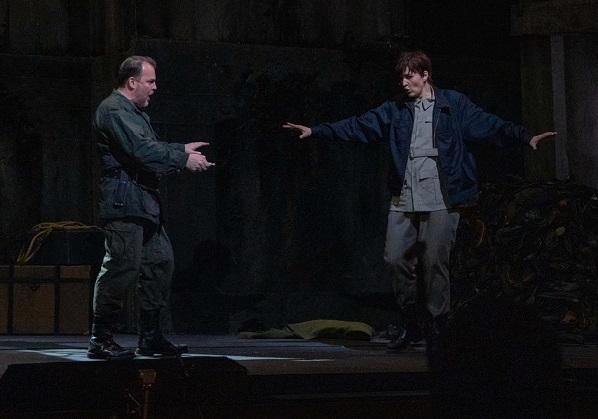
    After intermission, we settled in for a piece twice the length of the first. This piece was different in most ways. Based off of/inspired by/in conversation with Calvino’s Cosmicomics (Which I came in knowing almost nothing about), the character Qwfwq spends the hour in verbal and musical conversation with the audience. There was no operatic style singing – just one performer with a cello, voice, and looper with some effects. The music often made use of the looper, with stories being told intermittently – stories that often felt like folk tales, but sometimes involved ruminations, and other times explanations. Qwfwq was in conversation with his author, and those who have written about him – Ursula K Le Guin, and some others I didn’t know – he responds in a very human way to the criticisms given to him.


    Qwfwq spoke to us as the audience, directly, wearing an altered blue jumpsuit (photo above by  with patches and doodles sewn on, and wool socks. The character often had a kind of self-deprecating self awareness that was very engaging, as well as feeling friendly and approachable, though presented as fragments, or a set of thoughts.


    The music used a lot of looping – including with singing and speaking voice, as well as the cello, sometimes in complicated counterpoint. The piece went through many creative sound worlds that I liked – including making use of a tray of beads with contact microphone, and lots of breathing sounds that molded from the voice to the cello almost seamlessly. 


    Soshana


    I should have known this piece would have been great, since Anna wrote a somewhat similar solo piece for a friend of mine based on Alice and Wonderland – using voice and various effects to create something impressively textured and evocative. Prepared or not, I thoroughly enjoyed the performance, and Aaron Wolff (photo above by Reuben Radding) was an impressive interpreter – as an actor, cellist, and communicator. 

    ~ Shoshana Klein

    (Performance photos by Reuben Radding)
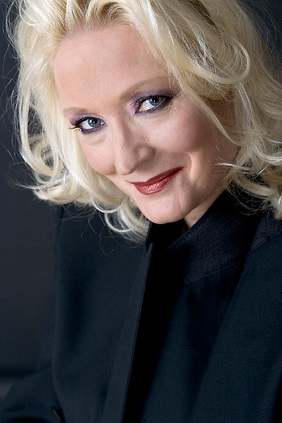
  • Miranda van Kralingen

    Portrait-miranda-van-kralingen

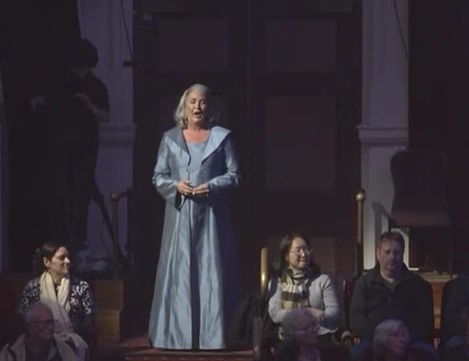
    The Dutch soprano Miranda van Kralingen competed at the 1991 Cardiff Singer of the World Competition. Her performance of ‘Beim Schlafengehn’ from Strauss’s Four Last Songs stood out among much fine singing at that prestigious event, and I’ve preserved my tape of it over the years, despite a radio dropout during the orchestral interlude.

    Click below to listen:

    Miranda van Kralingen – Beim Schlafengehn ~ R Strauss – Cardiff 1991

  • Waiting for Elisabeth Grümmer

    The most-read article from Oberon’s Grove:

    Gruemmer

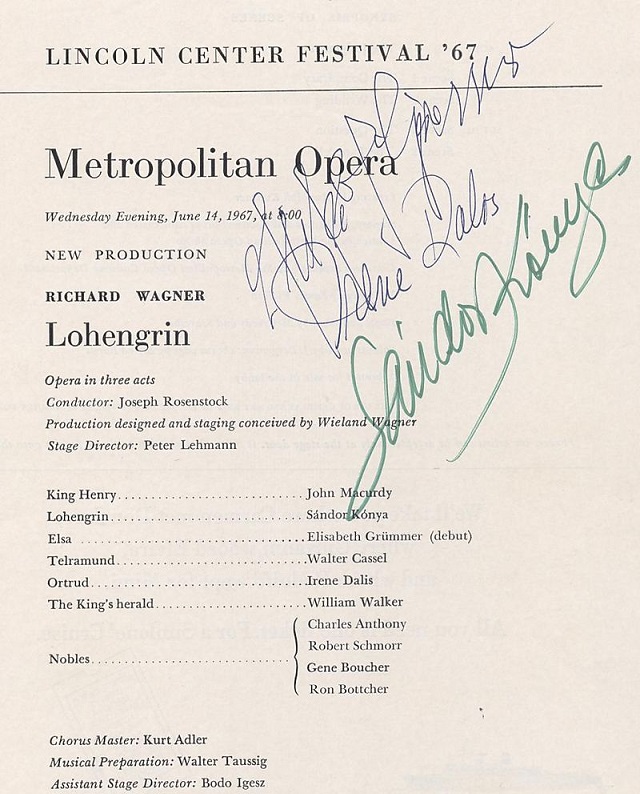
    ~ In 1967 the Metropolitan Opera held its first June Festival. Having just opened the ‘New Met’ in September 1966, ticket demand for the premiere season at Lincoln Center had been phenomenal and the Company seized the opportunity to add several performances in the month of June. This was a bonanza for the fans and also provided the general public, who were curious to see the interior of the new opera house, expanded possibilities. The Met offered some very fine casting that June, and topping the list of exciting events (at least from the fans’ point of view) was the belated Met debut of the German soprano Elisabeth Grummer. 

    Grümmer was 57 at the time, and had already had a very successful career in Europe and had made several top-class recordings, working with Europe’s finest conductors. She had made her debut with the Met on tour in Boston earlier that Spring and was now coming to the House in the role of Elsa in Wieland Wagner’s production of LOHENGRIN.

    This was my first chance to see this opera; Sandor Konya was at that time the leading exponent of the title role, and my beloved Irene Dalis was singing her venomous Ortrud. Stalwarts Walter Cassel, John Macurdy and William Walker completed the cast. Andre Cluytens, who was to have conducted this production of LOHENGRIN, had died the previous summer and so Joseph Rosenstock was on the podium. I suppose by international standards that Rosenstock was considered a routinier but – inexperienced as I was – I was simply thrilled to be there.

    Grümmer made her entrance, and I recall the entire phalanx of Family Circle standees were waiting with collectively bated breath for her first line, which she deployed with a silvery pianissimo: “Mein armer bruder!”  We were under her spell immediately and she went on to sing a really thrilling Elsa and to win a very warm acclaim from the packed house. Although nearing the end of her career, Grümmer had maintained her clarity of sound; the voice had a lyrical feeling but she was able to ride the ensembles  with a bit of metallic thrust. It was an exciting debut but after repeating the role once, she never sang at the Met again. (She did appear as the Marschallin at the New York City Opera the following season.)

    A large contingent of fans gathered at the stage door. Sandor Konya came out and was so kind; aside from signing my programme he gave me a beautiful photo of himself as Lohengrin. Irene Dalis  appeared and she even remembered me and thanked me for coming. Then the crowd began to drift away. I knew Grümmer hadn’t left yet and I couldn’t imagine why no one wanted her autograph after such an exciting debut.

    After a few moments only a half-dozen of us remained. A chorister walked out and someone asked him if Miss Grümmer was coming out soon: “Oh, she doesn’t sign autographs!” Someone else emerged and saw us: “You waiting for Grümmer? She won’t sign.” The other fans left. I figured at least I would get a glimpse of her. It had been an hour since the curtain had fallen, and I was exhausted. But something kept me there.

    A car pulled up; the driver got out. He looked at me and said, “If you’re waiting for Elisabeth Grümmer, you’re wasting your time.  She doesn’t like giving autographs.”  I shrugged, trying to pretend that I WASN’T waiting for Elisabeth Grümmer.

    Finally the stage door opened and Ms. Grümmer walked out with a gentleman. They got in the car and closed the doors. But they didn’t leave. I stood by the stage door holding my program and pen, looking as forlorn as I could. I was 19 but looked younger, and I hoped she would take pity on me. The driver was pointing at me and the soprano looked my way hesitantly. Then she suddenly rolled down her window and gestured to me. Neither of us spoke, but I handed her the program. She briskly wrote her name and handed it back to me with just a trace of a smile. I thanked her and made a little bow; she rolled up the window and the car pulled away.

    Click to enlarge:

    6a00d8341c4e3853ef00e553e3255c8833-800wi
  • The Marcella Sembrich Museum

    Sembrich museum-1 jpg

    In the summer of 1963, my parents took me to see an English-language production of Rossini’s BARBER OF SEVILLE given by the Lake George Opera Company; this was my third live opera performance. I still remember how cold it was in the small theater, how much I liked the Berta (played by Ellen Berse, who later joined the short-lived Metropolitan Opera National Company), and that my favorite part of the opera was the “Frigid and motionless” ensemble. 

    We spent an extra day on Lake George, which included a visit to the Marcella Sembrich Museum; this was housed in a pink cottage at Bolton’s Landing, NY, where the legendary Polish soprano spent her off-seasons from The Metropolitan Opera, giving voice lessons.

    The main thing I remember about our time at the museum was that it was far briefer than I had anticipated. Although I was fascinated by all the opera artwork, old photographs, scores, even some of Sembrich’s costumes and accessories, my parents seemed oddly tense. It took me a few minutes to realize that the middle-aged man who was overseeing the place was subtly eyeing me; whenever I stopped to examine a particular photo or artifact, he would hover nearby and comment on whatever it was I was looking at. My mother would then materialize out of nowhere.  

    We’d only been there for 15 minutes when my father announced that it was time to go; I was not anywhere near done looking around, and I had also wanted to ask if I could play the piano (I was sure it was forbidden) and then sit outside the cottage, enjoying the sun and the lake view. The man then suggested that my parents leave me there and come back and pick me up in an hour. My mother turned frosty, and we left a few seconds later. Once in the car, I complained that there was so much I hadn’t gotten to see. They quickly changed the subject: where should we have lunch?

    Of course. I knew perfectly well what was going on: they viewed the man as a predator and me as an innocent victim. I wasn’t exactly innocent anyway; I’d been fooling around with one of the neighbor boys for a while. But I sometime think back on that afternoon; it would be another ten years, filled with fantasies and frustrations, before I took the leap. 

  • @ My Met Score Desk for FIDELIO

    Fidelio tk and ld

    Above: Tomasz Konieczny and Lise Davidsen in Act II of FIDELIO; a MET Opera photo

    ~ Author: Oberon

    Saturday March 15th, 2025 matinee – I’ve never really been drawn to Beethoven’s FIDELIO. I’ve only seen it a few times; my first Leonore was Shirley Verrett (!), later followed by Hildegard Behrens, Karita Mattila, and  Waltraud Meier in the title-role. I love the drama of Leonore’s rescue of her beloved Florestan, but I don’t like the ‘operetta’ couple who are quite silly; they hold up the action in what could otherwise be a potent drama.

    This afternoon’s performance of the Beethoven opera was sold out, and overall it was a good FIDELIO. Susanna Mälkki’s conducting seemed on the fast side, and at times she seemed to succumb to the current Met trend of swamping the singers. The orchestra were on peak form, with excellent work from the horns. The chorus likewise excelled.

    In the briefest roles, tenor Jonghyun Park’s sweet lyricism made his mark as the First Prisoner; Jeongcheol Cha was equally fine as the Second Prisoner, though he has less to sing. Ying Fang as Marzelline and Magnus Dietrich as Jaquino both sang beautifully, but their characters are cardboard…and if they were absent from the narrative, it wouldn’t matter. 

    Milling fidelio

    The impressive Danish basso Stephen Milling (above, in a MET Opera photo) is ever welcome at The Met. Today he had the brief but pivotal role of Don Fernando, and he sang with authority; I look forward to his Sarastro later in the season.

    Rene Pape, who turned 60 last Autumn, retains the power and firmness of his cherished voice; he has given me so many wonderful memories in my opera-filled lifetime, and he sang handsomely and effortlessly today. His Act I aria, and his scene with Leonore as they prepare for their gruesome task, were highlights of the afternoon.

    Tomasz Konieczny was a vivid Don Pizarro; his first spoken lines had a sense of urgency, and he displayed the meanness of the character in his sinister inflections. Joining Mr. Pape in duet, the sheer amplitude of their sound defined the description “Met-sized…”. Later, Mr. Konieczny’s taunting of the hapless Florestan was unsettling. 

    Following a superb prelude to Act II from the MET Musicians under Ms. Mälkki’s baton, tenor David Butt Philip emitted an uncanny, sustained tone with his opening “Gott!” The intensity of Florestan’s suffering was strikingly voiced by the English tenor, who has an impressive list of European achievements to his credit. His trio with Ms. Davidsen and Mr. Pape had a palpable feeling of terror. Rescued by his wife’s cry “Töd’ erst sein Weib!” as she holds Pizarro at gunpoint, Florestan joins Leonore in the blazing “O namenlose Freude!”  But I did miss hearing Florestan’s haunting spoken line, “Was hast du für mich getan?” 

    Lise Davidsen was the star of the afternoon, just as Leonore is the heroine of the story. The tall Norwegian soprano is pregnant with twins, and this run of FIDELIO at the Met will be her last performances until after the babies arrive. She was in excellent voice today, and her strikingly clear and shining top notes seemed truly to stun the audience. Her singing of the great aria “Abscheulicher!” had remarkable power but also some incredible subtleties, and the prayerful passage “Komm, Hoffnung” moved me deeply.  The soprano then went on to a blazing, prolonged top B at the aria’s climax, drawing cries of brava! from the Hall. In the opera’s finale, more of the soprano’s high notes lit up the afternoon. 

    Following a benedictive passage from Mr. Milling’s Don Fernando, the minister then asks Leonore to remove her husband’s shackles. In this moving moment, I glanced up at the sculpture that hangs over the Met’s proscenium; created by American sculptor Mary Callery, it was described at the time the House opened in 1966 as having been inspired by the opened shackles of Florestan, rescued by his devoted wife. 

    ~ Oberon

  • Decoda ~ Verklärte Nacht

    Schoenberg

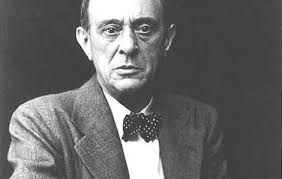
    Above: Arnold Schoenberg

    ~ Author: Oberon

    Tuesday March 11th, 2025 – A rare chance to hear Arnold Schoenberg’s Verklärte Nacht played live drew me to Weill Hall tonight where the work was on a program offered by Decoda, an ensemble of musicians who had first met while playing with Ensemble Connect.

    Songs by two pairs of husband-and-wife composers – the Schumanns and the Mahlers – opened the evening. Pianist Mika Sasaki played Robert Schumann’s “Eintritt” from Waldszenen, a melody that describes entering the forest path. Baritone Thomas Meglioranza and Ms. Sasaki then offered Herr Schumann’s Sehnsucht nach der Waldgegend“; any song with ‘sehnsucht’ (longing or desire) in the title is bound to please me.

    A sextet of string players now joined the pianist for Clara Schumann’s “Geheimes Flüstern“, in an arrangement by Clara Lyon; this brought forth soprano Lucy Fitz Gibbon, her voice light and charming.  

    Mr. Meglioranza stepped forward again for Gustav Mahler’s “Ich ging mit Lust durch einen grünen Wald” (arranged by Brad Balliett), expressively sung.

    Alma Mahler’sLicht in der Nacht” was sung by Ms. Fitz-Gibbon in an arrangement by Terry Cook (could this be the Terry Cook, a popular Met Opera basso who sang nearly 200 performances with the Company from 1983 to 2006?), accompanied by the sextet.

    During this lieder segment of the program, Ms. Fitz-Gibbon and Mr. Meglioranza did not lend an operatic feeling to their singing, but rather sounded like they were performing among friends at the Schumann’s salon.

    [Special note: anyone with an interest in Alma Mahler’s life and work should seek out the film Bride of the Wind.]

    From the concluding Alma Mahler song, the music led directly into the Schoenberg masterpiece, Verklärte Nacht; the players were Anna Elashvili and Clara Lyon (violins), James Thompson and George Meyer (violas), and Hannah Collins and Claire Bryant (cellos).

    The work was inspired by a collection of poems by Richard Dehmel published in 1896. Entitled Weib und Welt (Woman and the World), the saga speaks of a man and a woman as they walk through the moonlit woods on a frigid but clear winter evening. Guilt leads the woman to admit that, craving motherhood, she had become pregnant by another man before meeting and falling in love with her current amour. The woman stumbles miserably on in the silent darkness; but then the man tells her, “Do not let the child you carry burden your soul.” He pledges that he will love and care for the unborn child as if it were his own. They embrace, and they continue their walk on into the night, their love transfigured thru forgiveness.

    Played without break, the score mirrors the five sections of the poem: throughout, Schoenberg continuously transforms themes and motifs into an expressive musical depiction of the poem. The composer travels the road from the opening line of the poem – “Two people walk through bleak, cold woods…” to its marvelous finale: “Two people walk through exalted, shining night….”

    The playing by the Decoda artists was nothing less than sublime; as individual voices, and in their harmonizing and phrasing, the sextet summoned all the magic that the composer packed into his writing. Of special note was cellist Hannah Collins, whose rich-toned playing was both poetic and powerful.

    Despite what seemed to me a riveting performance thus far, audience distractions during the first half of the program were especially annoying, climaxing with a dropped metal water bottle at a particularly poignant moment in the Schoenberg. Although the second half the program certainly sounded interesting –  a work by four composers featuring all the evening’s artists – I decided to head out, taking the memories of the Schoenberg home with me. 

    ~ Oberon

  • Taís Víera ~ Poème de l’Amour et de la Mer

    Snapshot tais 2

    Taís Víera is the soloist in a performance of Ernest Chausson’s Poème de l’Amour et de la Mer with the Orquestra Sinfônica Municipal de Santos, conducted by Luís Gustavo Petri.

    Watch and listen here.

  • TRISTAN UND ISOLDE ~ Act II ~ Auckland Philharmonia

    Karneus

    Above: Katarina Karnéus singing Brangäne in a concert performance of Act II of Wagner’s TRISTAN UND ISOLDE by the Auckland Philharmonia, conducted by Giordano Bellincampi.

    CAST:

    Tristan – Simon O’Neill; Isolde – Ricarda Merbeth; Brangäne – Katarina Karnéus; Kurwenal – Johan Reuter; King Marke – Albert Dohmen; Melot – Jared Holtin

    Watch and listen here.

  • Wagner: Siegfried Idyll ~ Toronto Symphony Orchestra

    Snapshot si 2

    A performance of Richard Wagner’s SIEGFRIED IDYLL by the Toronto Symphony Orchestra conducted by Peter Oundjian.

    Watch and listen here.

  • Roomful of Teeth/Tambuco Percussion Ensemble

    CH11514760

    Above: performance photo by Jennifer Taylor

    ~ Author: Lili Tobias

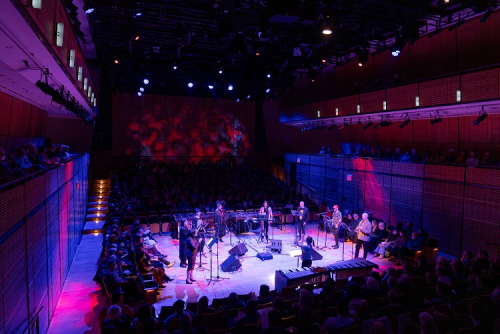
    Saturday January 25th, 2025 – Tonight, I had the joy of hearing Roomful of Teeth and Tambuco Percussion Ensemble perform at Carnegie Hall’s Zankel Hall. Between the two ensembles, I got to hear music by six different composers, from familiar favorites of mine like Caroline Shaw, to names that were completely new to me (but who I will certainly listen to again)

    Both Caroline Shaw’s and William Brittelle’s pieces were exceptionally chaotic—which is completely on brand for Roomful of Teeth! The eight singers performed a vast variety of vocal techniques and styles, including but not limited to guttural croaking sounds, throat singing, really really high notes, muttering repeated syllables, low glissandos, and speaking normally. Shaw’s piece, The Isle, in which she set text from Shakespeare’s The Tempest, also contrasted the chaos at times with more homophonous singing—hearty choral triads and flowing solo melodies—which provided a good balance so we could still hear the words.

    The text of Brittelle’s piece, Psychedelics, was very different. He explains in the program notes that the surreal collection of words in this music are “meant to form a swarm of images, not a literal, linear narrative.” And they certainly did just this! As I listened, I caught snippets of the words, such as “I watch for dogs,” and these fragments created a very joyful experience in their meaninglessness. Throughout this piece, I never knew what to expect in the best possible way!


    The bridge between the vocal portion of the concert and the percussive potion was the composer Gabriela Ortiz. Ortiz is Carnegie Hall’s composer in residence this year, and both Roomful of Teeth and Tambuco Percussion Ensemble performed a piece of hers in this concert.


    In Canta la Piedra-Tetluikan (of which this would have been a world premiere performance if not for the group of elementary school kids who got to sit in on a rehearsal), Ortiz set the words of poet Mardonio Carballo. And these words were in Nahuatl! Nahuatl is a language (sometimes considered a group of languages) spoken in Central Mexico, and I was very excited to hear it in a musical context. Ortiz’s setting of Carballo’s poem was joyously animated. The mesmerizing repetitions—“atl, atl, atl” (water, water, water), “tlitl, tlitl, tlitl” (fire, fire, fire), and more—and energetic (and very difficult!) rhythms grounded the music in the natural world. 


    I had been especially looking forward to hearing the voiceless alveolar lateral affricate (tɬ), since that sound is common in many variants of Nahuatl (and doesn’t appear whatsoever in English), but if the singers were singing it, the distinctly fricative sound didn’t come across prominently. Perhaps they were singing in a variety of this language that doesn’t include this consonant though, and no matter what, it was very exciting to hear music in Nahuatl!


    CH11514773


    Photo by Jennifer Taylor


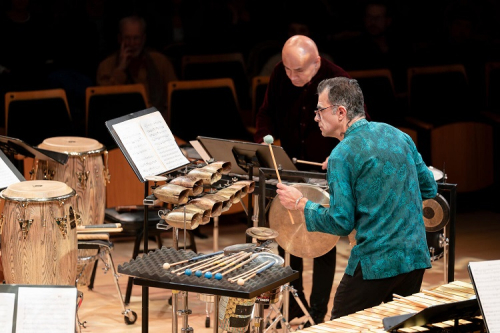
    After intermission, Tambuco Percussion Ensemble performed the movement “Liquid City,” from Ortiz’s 2014 piece, Liquid Borders. The four members of the ensemble played facing each other in a circle (the perfect set-up for the central stage!) and the blooms of sound radiated outwards into the hall. The diverse timbres of the instruments certainly reflected the diverse borders of urban and rural Mexico which Ortiz aimed to reflect in this music, the sounds mixing and shifting into unique and beautiful shapes.


    CH11514777


    Photo by Jennifer Taylor


    The other three pieces on the program were very different in that they were far more homogenous in terms of the instrumental inventory: Jorge Camiruaga’s Cuarteto en chico for four drums, Leopoldo Novoa’s Sábe cómo e’? for four guacharacas (and briefly one marímbula), and Steve Reich’s Mallet Quartet for two vibraphones and two marimbas. While these pieces were certainly reigned in the chaos compared to the first half of the program, they also proved that you could still create a wide variety of sounds and musical textures even among more similar instruments. 


    CH11514766


    Above: Gabriela Ortiz, photo by Jennifer Taylor


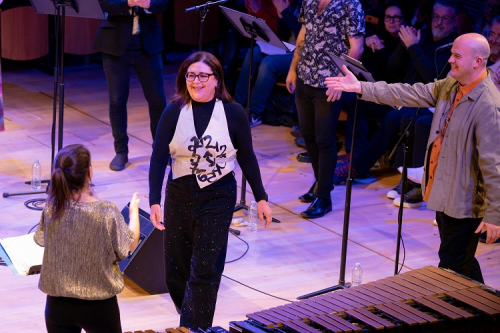
    It was especially fun to see how many of the composers on the program were in the concert hall enjoying the music alongside me and the rest of the audience! I enjoyed this concert so much, and I have a feeling they did too.

    ~ Lili Tobias