Category: Reviews

  • Alisa Weilerstein ~ FRAGMENTS 2

    CH11513997

    Above, Alisa Weilerstein/FRAGMENTS 2 ~ performance photo by Fadi Kheir

    ~ Author: Shoshana Klein

    Tuesday January 21st, 2025 – This evening at Zankel Hall, Alisa Weilerstein’s’ Fragments project continued with its the second installation. You may remember the first one, last April.


    Like last time, there was no program given until the end – a practice I still find interesting, though slightly frustrating. I had a bit of a conclusion that the ideal listener either knows the Bach suites by heart, or doesn’t know them at all; someone like me (knowing them but certainly not well versed on the particular movements, etc) ends up a little stuck on which is which and where we are. 


    For the staging, the same light boxes that were set up for the first installment are set up spread around the stage rather than in a circle around the cellist like they were last time. She entered in full darkness – though during that moment, someone’s phone went off and said clearly “calling emergency services” and everyone laughed, which was a fun communal moment.


    This setting struck me as more theatrical than the last – it started with a bang and bright lights, and Weilerstein was wearing fishnets, a bright fuchsia short dress, and dramatic stage makeup with her hair curled and all over the place. It seemed to evoke a sort of dramatization and maybe a teenage emotionality.


    The way that she played the Bach suite movements were sweeping, very light even though much of the suite is in minor. Her playing of the fast passages is very elegant – bringing out the vocal and conversational qualities of these multi-line pieces written for one instrument.


    CH11513956


    Performance photo by Fadi Kheir


    For the first couple movements there were really smooth transitions and stark lighting changes. The new pieces were lit with green and the Bach was a warmer white/yellow. I wondered if it would continue like that the whole time with the lighting just indicating whether or not we were hearing a new piece, but as it went on the changes became less stark, and the movements had different types of lighting. Maybe adding to this, or reflected by it, particularly in the beginning of the set, the Bach had a more veiled angstyness while the newer pieces had more brash emotionality in the forefront, as if the newer compositions were unearthing the meanings of the Bach and saying them more plainly.


    One standout movement near the end had only pizzicati and required Weilerstein to sing along with her playing. It was simple sounding and also grounding, particularly because this person who is at the highest levels of cello playing was singing like a normal person. Not to say it was bad, it just humanized her in a way that brought reality back in a really sweet way.


    ~ Shoshana Klein

  • Dudamel Conducts Penderecki

    Krzysztof Penderecki jpg

    Above: composer Krzysztof Penderecki

    Gustavo Dudamel conducted a monumental performance of Krzysztof Penderecki’s SEVEN GATES OF JERUSALEM in 2008 with the Orquesta Sinfónica Simón Bolívar. A brief clip at the start shows the composer at a rehearsal.

    Following the Dudamel performance, Penderecki appears onstage, to tumultuous applause.

    Watch and listen here.

    I have loved this piece ever since I attended the US premiere in 1998:

    7 gates

  • Boulez Conducts TRISTAN & ISOLDE

    Pierre-boulez

    Above: Pierre Boulez

    In April of 1967, the Bayreuth Festival’s Wieland Wagner production of TRISTAN UND ISOLDE was brought to Osaka, Japan, for three performances, featuring a stellar cast: Wolfgang Windgassen (Tristan), Birgit Nilsson (Isolde), Hertha Töpper (Brangäne), Frans Andersson (Kurvenal),  Hans Hotter (King Marke), Sebastian Feiersinger (Melot), Georg Paskuda (Young Sailor/Shepherd), and Gerd Nienstedt (Steersman).

    These performances marked the only time Pierre Boulez conducted this Wagner masterpiece.

    Watch and listen here.

    For me, this recording captures, perhaps more truly than any other, the way Birgit Nilsson sounded live in the performances of hers that I heard at The Met.

  • Loretta Di Franco Has Passed Away

    Rigoletto

    Above: Loretta Di Franco as Countess Ceprano in RIGOLETTO, with Placido Domingo as the Duke of Mantua

    Soprano Loretta Di Franco has passed away; from her Met debut as a Page in TANNHAUSER in 1961 to her farewell in 1995, she sang over 900 performances with The Met in New York City and on tour.

    A native New Yorker, Ms. Di Franco had started out at The Met as a member of the chorus. In 1965, she entered and won the Met Auditions, thereafter taking on a vast number of roles in seven languages; I saw her in many of them. She sang both Barbarina and Marcellina in NOZZE DI FIGARO, Pousette in MANON, Berta in BARBIERE DI SIVIGLIA, Giannetta in ELISIR D’AMORE, both Papagena and the 1st Lady in ZAUBERFLOETE, Lisa in LA SONNAMBULA, both the Sandman and the Dew Fairy in HANSEL AND GRETEL, Marianne Leitzmertzin in ROSENKAVALIER, Zerlina, Frasquita, Xenia in BORIS GODUNOV, both Woglinde and Gerhilde in the RING Cycle, and Kate Pinkerton. She sang Violetta in some student matinees of TRAVIATA, and appeared in two Janacek operas at The Met: JENUFA and KATYA KABANOVA.

    Upon retiring from singing, Loretta continued to work at The Met as a language coach.

    Loretta Di Franco appears in videos of several Met productions, but the only free-standing excerpt I could find is the LUCIA sextette from the Met’s 100th Anniversary Gala in 1983: she sings Alisa, joining Robert Nagy (Arturo), Julien Robbins (Raimondo), Roberta Peters (Lucia), Dano Raffanti (Edgardo), and Brian Schexnayder (Enrico). Sir Richard Bonynge conducts. Watch and listen here.

  • Vivaldi’s GLORIA @ at La Pietà, Venice

    Vivaldi-gloria

    A BBC 4 film re-imagines a performance of Antonio Vivaldi’s GLORIA at the Ospedale della Pietà in Venice, where the composer taught and composed from 1703 to 1740.

    Watch and listen here.

  • Vivaldi’s GLORIA @ at La Pietà, Venice

    Vivaldi-gloria

    A BBC 4 film re-imagines a performance of Antonio Vivaldi’s GLORIA at the Ospedale della Pietà in Venice, where the composer taught and composed from 1703 to 1740.

    Watch and listen here.

  • Scenes from a Munich WALKURE

    Scanned Section 15-1

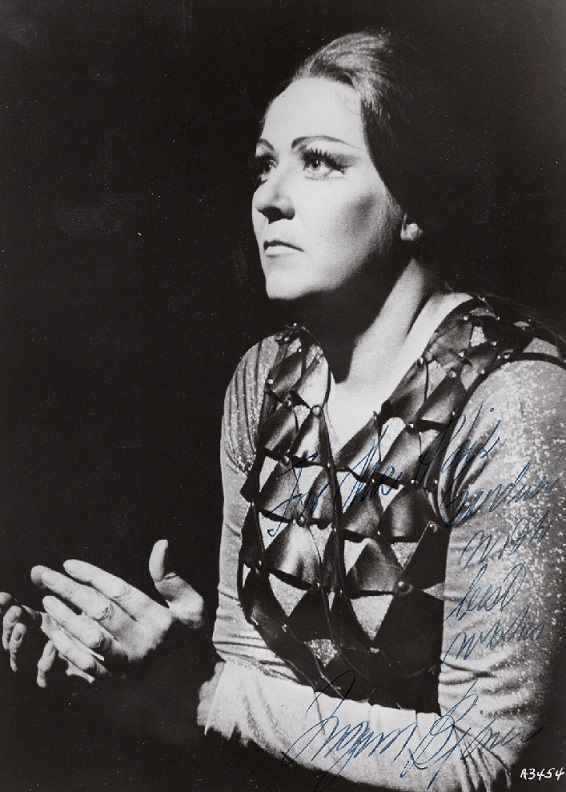
    Ingrid Bjoner (above) is Brünnhilde in these scenes from a performance of Wagner’s DIE WALKURE from Munich, 1972. The in-house sound quality leaves much to be desired, but I’ve always loved this rendering of the Todesverkündigung as sung by Bjoner and James King.

    There are also three brief excerpts from Act III, with Claire Watson as Sieglinde and Heinz Imdahl as Wotan joining Ingrid Bjoner. Rudolf Kempe’s conducting strikes me as just about ideal.

    WALKURE exc – Munich 1972 – Bjoner King Watson Imdahl – Kempe cond

  • TURANDOT @ San Francisco Opera ~ 1968

    Shuard turandot 2

    Above: Amy Shuard as Turandot

    A performance of Puccini’s TURANDOT from San Francisco Opera given in 1968. Audio only.

    Listen here.

    CAST:

    Turandot: Amy Shuard; Calaf: Ludovic Spiess; Liu: Jane Marsh; Timur: Ara Berberian; Ping: Ingvar Wixell; Pang: Raymond Manton; Pong: Alan Crofoot; Mandarin: Clifford Grant

    Conductor: Giuseppe Patanè

  • Concertgebouw: Schoenberg & Mahler

    Untitled

    Performance photo by Chris Lee

    ~ Author: Ben Weaver

    Saturday November 23rd, 2024 – The Royal Concertgebouw Orchestra gave two sold-out concerts at Carnegie Hall last week under the baton of its chief conductor designate Klaus Mäkelä. The second concert on Saturday, November 23rd featured beloved works by Arnold Schoenberg and Gustav Mahler.

    Between the two concerts, this evening’s playing of Schoenberg’s Verklärte Nacht, Op. 4 was the strongest performance of the orchestral works the Concertgebouw presented this week. Originally composed for string sextet in 1899, Schoenberg made an arrangement for a string orchestra and it’s become one of his most beloved and most frequently performed works. The string section of the Concertgebouw was on absolute peak form with its lush yet concentrated sound. Schoenberg’s score is by turns dark, ominous, romantic, and shimmering, and the orchestra reflected each emotion and turn with beautiful clarity. Maestro Mäkelä conducted it without a score, so it appears to be a work that is close to his heart. Maybe that’s why he managed to keep the tension throughout the entire composition. 

    When it comes to playing Mahler, I think the Concertgebouw’s only rival is the New York Philharmonic. These symphonies are close to their hearts and they perform them frequently. The Symphony No. 1 in D major received its Dutch premiere in 1903 under Mahler himself. This evening’s performance under the orchestra’s young incoming chief conductor was somewhat mixed.

    The first movement was something of a mess that echoed the very unfortunate performance of Rachmaninoff’s Symphony No. 2 the previous evening: while Maestro Mäkelä can build to a climax, he was unable to connect any of the climaxes together, the tension and structure of the music disintegrating every few minutes. So it was here, unfortunately. Low voltage would be one way to describe it, a flicker of color quickly draining into something dull and gray.

    Fortunately things improved as the performance continued, and Mäkelä managed to keep the symphony moving. The second movement is filled with sections of chamber music, interrupted by full orchestral blasts. There was some wonderful playing from individual sections of the Concertgebouw, the winds in particular covering themselves in glory.

    The Funeral March was the best part of the performance. The double bass solo (principal Dominic Seldis) was appropriately weary and somber. The mocking tune that interrupts it was nicely paced and delightfully almost jazzy. The Finale was largely well handled, but lacked enough frenzy to be truly satisfying until the very last moments.

    With Maestro Mäkelä taking over two of the world’s top orchestras – the Concertgebouw and the Chicago Symphony Orchestra – these performances left me concerned if he is the right person for these jobs at this time. But time will soon tell if the confidence he has inspired in others pays off.

    ~ Ben Weaver

  • Concertgebouw: Schoenberg & Mahler

    Untitled

    Performance photo by Chris Lee

    ~ Author: Ben Weaver

    Saturday November 23rd, 2024 – The Royal Concertgebouw Orchestra gave two sold-out concerts at Carnegie Hall last week under the baton of its chief conductor designate Klaus Mäkelä. The second concert on Saturday, November 23rd featured beloved works by Arnold Schoenberg and Gustav Mahler.

    Between the two concerts, this evening’s playing of Schoenberg’s Verklärte Nacht, Op. 4 was the strongest performance of the orchestral works the Concertgebouw presented this week. Originally composed for string sextet in 1899, Schoenberg made an arrangement for a string orchestra and it’s become one of his most beloved and most frequently performed works. The string section of the Concertgebouw was on absolute peak form with its lush yet concentrated sound. Schoenberg’s score is by turns dark, ominous, romantic, and shimmering, and the orchestra reflected each emotion and turn with beautiful clarity. Maestro Mäkelä conducted it without a score, so it appears to be a work that is close to his heart. Maybe that’s why he managed to keep the tension throughout the entire composition. 

    When it comes to playing Mahler, I think the Concertgebouw’s only rival is the New York Philharmonic. These symphonies are close to their hearts and they perform them frequently. The Symphony No. 1 in D major received its Dutch premiere in 1903 under Mahler himself. This evening’s performance under the orchestra’s young incoming chief conductor was somewhat mixed.

    The first movement was something of a mess that echoed the very unfortunate performance of Rachmaninoff’s Symphony No. 2 the previous evening: while Maestro Mäkelä can build to a climax, he was unable to connect any of the climaxes together, the tension and structure of the music disintegrating every few minutes. So it was here, unfortunately. Low voltage would be one way to describe it, a flicker of color quickly draining into something dull and gray.

    Fortunately things improved as the performance continued, and Mäkelä managed to keep the symphony moving. The second movement is filled with sections of chamber music, interrupted by full orchestral blasts. There was some wonderful playing from individual sections of the Concertgebouw, the winds in particular covering themselves in glory.

    The Funeral March was the best part of the performance. The double bass solo (principal Dominic Seldis) was appropriately weary and somber. The mocking tune that interrupts it was nicely paced and delightfully almost jazzy. The Finale was largely well handled, but lacked enough frenzy to be truly satisfying until the very last moments.

    With Maestro Mäkelä taking over two of the world’s top orchestras – the Concertgebouw and the Chicago Symphony Orchestra – these performances left me concerned if he is the right person for these jobs at this time. But time will soon tell if the confidence he has inspired in others pays off.

    ~ Ben Weaver