Category: Reviews

  • DON CARLO ~ Caracas 1979

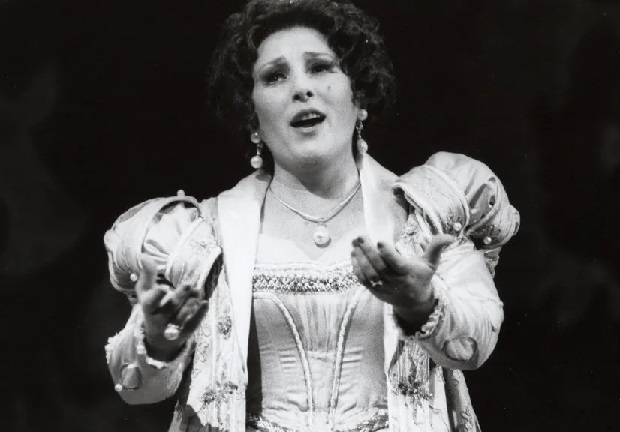
    Dimitrova

    Above: Ghena Dimitrova

    Verdi’s DON CARLO in a performance from Caracas, 1979. Edward Downes conducts.

    Listen here.

    CAST:

    Don Carlo – Rubén Domínguez; Elisabetta – Ghena Dimitrova; Felipe II – Nicola Ghiuselev; Rodrigo – Lorenzo Saccomani; Eboli – María Luisa Nave; Grand Inquisitor – Giovanni Foiani; A Monk – Pedro Liendo

  • Violinist Lun Li @ The Morgan Library

    Lun Li

    ~ Author: Oberon

    Wednesday April 24th, 2024 matinee – This was my third time hearing the Chinese violinist Lun Li. My first encounter was at Merkin Hall when he gave his NY debut as a Young Concert Artist. Soon after, he played the Prokofiev second violin concerto – most impressively – with the Riverside Symphony at Alice Tully Hall.

    This afternoon, Lun Li offered a distinctive program at The Morgan Library, and he played thrillingly from start to finish. I very much liked his idea of having the house lights completely darkened throughout the concert; the only drawback to this was: it was impossible to take anything more than the most rudimentary notes. In the long run, though, notes became superfluous because this was some of the greatest violin playing I have ever heard. After a while, I stopped trying to write anything down and just let the music transfix me.

    Lun Li’s presentation was simple: clad all in black, he stood in a pool of light on the stage, casting a quadruple shadow. The darkness in hall seemed to make the audience more attentive and more focused on the music; there was a resolute stillness in the air, making the charismatic violinist’s extraordinary playing even more compelling.

    The program was devised in three segments followed by a sort of built-in encore. Each segment consisted of a short ‘prelude’, followed by a longer work.

    Music by Henry Eccles – his brief Prelude in A-minor – opened the concert, followed immediately by Nicola Matteis’ Alia Fantasia. The two pieces were written about fifteen years apart and are similar in feeling. Lun Li’s playing was elegant, and technically immaculate.

    Continuing in a Baroque mode, music by Giovanni Bononcini, came next: his Prelude in D-minor led on to the celebrated Chaconne from Partita No. 2 in D-minor, BWV 1004, by Johann Sebastian Bach. This long work offers endless opportunities for brilliant playing, and Lun Li gave as astounding, passionate performance, holding the audience under a spell with his virtuosity. The ensuing ovation was inevitable after such a glorious rendition.

    Following Philip Glass’s Book of Longing, which has a Baroque flavor, but with a tinge of timelessness, Lun Li gave a monumental performance of Béla Bartók’s Sonata for Solo Violin. The sonata was composed in 1944 on a commission from the American violinist Yehudi Menuhin; it was one of the composer’s last works. This solo sonata is in three – or maybe four – movements: Tempo di ciaccona, Fuga, Melodia, and Adagio – the last two being inseparable.

    The sonata places extraordinary demands on the violinist as the music veers from searing, to luminous, to poignant. The sheer number of notes is uncanny, and they were all sewn together in an intense, unforgettable musical experience by our remarkable soloist. If the reaction to the Bach seemed massive, the ovation after the Bartók was simply off the charts.

    Lun Li polished off his program with Tessa Lark’s Jig and Pop, a lively piece with a mile-a-minute swirls of notes. The violinist was called back for numerous bows.

    The near-total darkness in hall today certainly worked in this particular instance, but if it becomes a trend – it’s been that way for years at The Joyce – people like me will be out of a job.

    ~ Oberon

  • 50 Years Ago Today: My First PARSIFAL

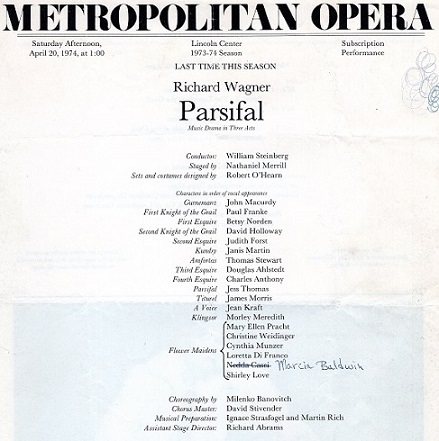
    Parsifal - 1st time-1 jpg

    Fifty years ago today, on April 20th, 1974, I saw my first performance of Wagner’s PARSIFAL  I was in my twelfth year of being an opera-lover, and I understood the importance of seeing this opera for the first time. I’d heard it twice already on Met Texaco Saturday broadcasts: the first in 1966 with Régine Crespin, Sándor Kónya, Walter Cassel, and Jerome Hines, conducted by Georges Prêtre, and the second in 1971, with Irene Dalis, Mr. Kónya, Thomas Stewart, and Cesare Siepi, conducted by Leopold Ludwig. The music seemed way beyond me at the first hearing, though – having been raised in a devout Christian household – I found a lot of it very moving; in fact, I was sometimes moved to tears, though I was not sure why. By 1971, the music seemed much more immediate and the characters – and their stories – began to seem more meaningful. 

    A lot had happened to me between that 1971 broadcast and the afternoon in 1974 that I walked into The Met for my first live performance of this mythic opera. I was, in fact, pretty down at the time. I’d had my first gay sexual experience in October 1973, only to be dumped by the object of my affection soon after. We’d been friends up until our night together, and it wasn’t until a few weeks after that I found out he already had a serious relationship going.

    Uncharacteristically, I stayed away from Gotham for a while, but I kept in touch with another boy in our group, TJ. I had turned to him for solace, and we grew very close, though our ‘first night’ was a disaster. But we really liked each other, so we eventually got on the same groove. As I recall, it was the day after the PARSIFAL that we went to The Frick and it was there, in the Atrium, that we revealed our feelings and decided to make a go of it. A few weeks later, I went up to The Cape to spend the Summer with him. At the end of the Summer, we tried to resume our lives apart, but we missed each other so much that I moved down to live with him in his dorm room at Sarah Lawrence College.

    Anyway, my diary entry about my first PARSIFAL is much briefer than my usual performance notes. As a rule, my diary was hand-written; I am not sure why I typed this entry: Parsifal 2-1 jpg

    I should perhaps clarify that Ms. Martin soon found the ‘staircase’ to her upper register and went on to be a very fine Sieglinde, Ortrud, Dyer’s Wife, and Tosca. Mr. Thomas, who had been my first Calaf and Tristan, went on singing for another eight seasons, with mixed results. Mr. Macurdy continued to develop and refine his Gurnemanz, and it became one of his greatest roles. 

    15747816_10209586751519649_7050039478046055439_n

    The next opera I saw came five months later; by then, I was happily living on campus at Sarah Lawrence with my bookish boyfriend, and posing as a student. Photo by TJ.

    ~ Oberon

  • Luis Lima/Elena Obraztsova ~ Confrontation

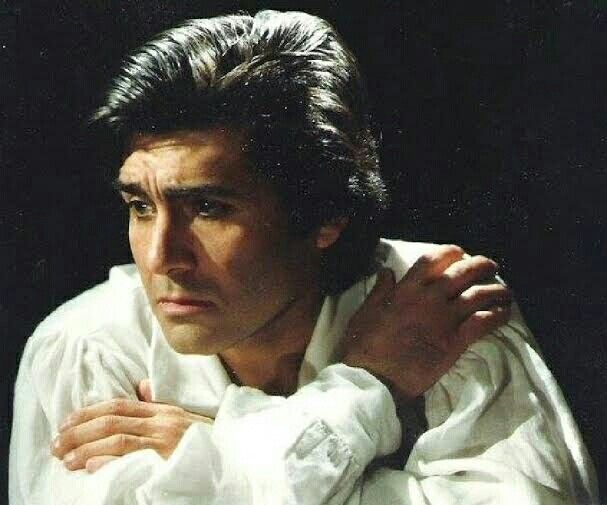
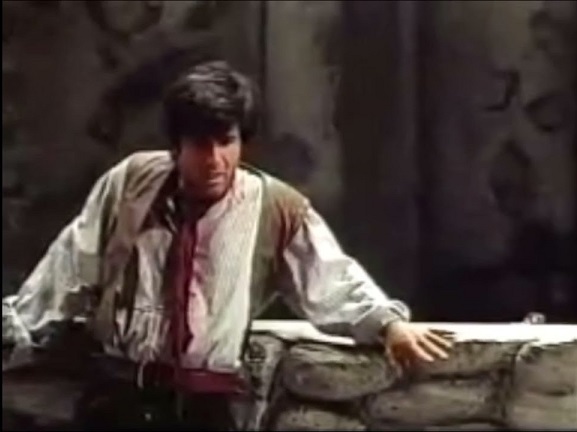
    Luis lima

    In the great confrontation scene from Mascagni’s CAVALLERIA RUSTICANA, Luis Lima as Turiddu (above) is cursed by Elena Obraztsova as Santuzza in a 1985 performance from the Vienna Staatsoper. Lima had broken his arm in a rehearsal; he sang the performances wearing a cast.

    Watch and listen here.

  • CARMINA BURANA @ Carnegie Hall

    Carl-orff

    Above: composer Carl Orff

    ~ Author: Oberon

    Tuesday February 27th, 2024 – This evening at Carnegie Hall, the Orchestra of St Luke’s presented Carl Orff’s CARMINA BURANA. The performance was conducted by Tito Muñoz, with soloists Ying Fang (soprano) Nicholas Phan (tenor), and Norman Garrett (baritone), and the Westminster Symphonic Choir (James Jordan, Director) and the Young People’s Chorus of New York City (Francisco J. Núñez, Artistic Director).

    What an exhilarating evening! The Carnegie stage was jam-packed with music-makers, and they brought the amazing score vividly to life. There is never a dull moment in CARMINA BURANA; every bar of music engages us. Maestro Muñoz had the massed forces under fingertip control, and by keeping his arms poised in the air between the work’s individual movements, he held applause at bay…until the end, when an ovation of tsunami proportions swept thru the venerable Hall, everyone on their feet and cheering with delight.

    The choral singing was truly impressive, ever-alert to the shifting rhythms and the swirls of words. Their dynamic range is vast, down to near whispers at times, and then going full-tilt in the lusty Tavern Song. Likewise, Orff’s keenly judged orchestration was given in its full glory: rich, sweeping strings, clear and enticing winds (a special cheer for the flutes), and the percussionists, who are busy all evening with an array of instruments that includes chimes and castanets. The sounds of piano and celesta add magic to Orff”s imaginative scoring.

    The work is divided into 25 relatively short sections, many of which are assigned to the chorus. There are three solo vocalists; the first to be heard was baritone Norman Garrett, a tall gentleman with an intriguing timbre. He was especially impressive in the Cour d’amours section, where the vocal line took him from falsetto to bass-like depths, and where a high-lying song displayed his lyrical powers. He looked very dapper in his tux.

    By contrast, tenor Nicholas Phan wore an appropriately white nightclub suit in his role of a Roasted Swan. His treacherous aria, which lingers in a super-high tessitura, was cunningly managed, and his droll facial expressions conveyed the bird’s torment.  

    That ravishing soprano, Ying Fang, was the crowning glory of the evening. Clad in an unusual white frock trimmed in black, the soprano’s crystalline purity of timbre was magically projected into the great Hall. She lingered on uncannily sustained pianissimi that hung on the air like an alluring perfume. And on the sensual heights heights of the Dulcissime, Ying Fang’s voice shimmered with an intoxicating glow.

    ~ Oberon

  • TOSCA: Nice 1980 – Caballe/Carreras/Pons

    Mc jc

    A performance of TOSCA given at Nice in 1980 featuring Montserrat Caballe and Jose Carreras (above) as Floria Tosca and Mario Cavaradossi, and Juan Pons as Baron Scarpia. The conductor is Jésus Etcheverry.

    Watch and listen here.

  • Composer Portrait: Amy Williams

    Amy williams

    ~ Author: Oberon

    Thursday February 22nd, 2024 – American composer Amy Williams (photo above by John Mazlish) was the guest at this evening’s Composer Portrait, a popular ‘interview and performance’ series offered by the Miller Theatre at Columbia University. Read the composer’s bio here.

    Tonight the illustrious JACK Quartet were with us to perform Tangled Madrigal (the world premiere of a Miller Theatre commission) and other works by the composer, who, as an accomplished pianist, joined them for a trio and a quintet.

    The evening opened with Cineshape 2 for piano and string quartet, composed in 2007. This was a compelling introduction to the composer’s music. It starts off with a sizzling motif from John Pickford Richards’ viola; as the music turns somber, the viola is joined by Jay Campbell’s distinctive cello, with the composer providing pizzicati from the piano. Suddenly there’s an explosive crash, followed by a passage for skittering piano and chirping violins. Another crash, and then the music turns dreamy, becomes agitated, and stutters before a third crash. The strings descend, the music pulsing, then shivering, before it fades magically away.

    For Bells and Whistles (2022) the composer was joined by violinist Christopher Otto and Mr. Campbell. The gentlemen tap their strings whilst Ms. Williams reaches into the piano to pluck the strings. It’s quite hypnotic! The music grows louder and becomes turbulent, the piano part is very active, with swirls of notes running up and down the keyboard. A trudging motif arises, churning and relentless. An eerie postlude ensues, develops a dense quality, and then turns other-worldly.

    One of Ms. Williams’ most highly regarded works, Richter Textures (2011), was inspired by the paintings of Gerhard Richter. Listed as being in seven movements, my companion and I both detected five: some of the subtle transitions seem to have eluded us.

    From an agitato start, the music turns high and spacey, with brilliant interjectory phrases from Jay Campbell’s cello. As the cello goes low and ominous, the unison violins and viola take up a slow, descending theme, which the cello eventually joins. Then things ascend to the heights.

    Slashing bows evoke a painter’s aggressive brush strokes; these are quietened, and the cello sings low, whist the violins linger on high. Insectuous, insistent buzzings give way to ethereal, kozmic high harmonies.  The music becomes driven – and rather jazzy – before a sudden stop.

    Following the customary interview of the composer, the world premiere of Tangled Madrigal was magnificently played by the JACK Quartet. Early Music influences colour this music, which is so beautifully written…and written with these specific players in mind. From a high, squeaky start, the composer takes us on a time-warp journey back to the Renaissance. Mr. Richards’ viola is gorgeously prominent, Mr. Otto’s violin shines, Jay’s cello has a song to sing, and violinist Austin Wullmans floats in the high register. There is a cadenza from the viola, but it’s the cello that has the last word. I think I could have derived even more pleasure from this piece had not the two girls sitting in front of kept whispering and checking their phones.

    The program was a fine introduction to the composer’s work, though a certain sameness prevailed as the evening progressed. It would have been interesting to hear Ms. Williams in a solo piano work, since her playing is truly captivating. So…the Miller will have to have her back at some point. Meanwhile, having the JACK Quartet for the whole evening was its own reward.

    ~ Oberon   

  • Sutherland/Forst/Hadley ~ ANNA BOLENA

    Forst

    Above: Judith Forst

    I attended this exciting concert performance of Donizetti’s ANNA BOLENA in 1975 at Avery Fisher Hall. Dame Joan Sutherland, Judith Forst, Cynthia Clarey, Jerry Hadley, and Greg Yurisich sang the principal roles, and Richard Bonynge was on the podium.

    Watch and listen here.

  • Riccardo Muti ~ Verdi REQUIEM

    Ombuena

    Above: tenor Vicente Ombuena

    Maestro Riccardo Muti conducts a performance of the Verdi REQUIEM at Ravenna, 1994. The soloists are Michele Crider, Luciana D’Intino, Vicente Ombuena, and Dean Peterson.

    Watch and listen here.

  • @ My Met Score Desk for CARMEN

    Aigul

    Above: Aigul Akhmetshina

    ~ Author: Oberon

    Saturday January 27th, 2024 matinee – Feeling no need to see a 6-ton tractor trailer on the stage of the Metropolitan Opera House, I took a score desk for today’s matinee of the Met’s new production of CARMEN. I wasn’t feeling my best this morning as I prepared to leave for Lincoln Center, and even considered staying home. But once the house lights dimmed, my spirits perked up, CARMEN is an opera I had not heard for a very long time, and the music seemed truly fresh to me today.

    The main draw of the day was Aigul Akhmetshina, the gorgeous Russian mezzo-soprano, in the title-role. I fell under she spell when she sang Maddalena in Verdi’s RIGOLETTO here last season, which I saw three times.

    Maestro Daniele Rustioni got the opera off to a fast start, setting a brisk tempo with the start of the prelude. Unlike some of the other conductors the Met favors these days, Rustioni is not a volume freak; the voices were – for the most part – clearly audible throughout the opera, and his tempi always felt right. I especially like his accelerations as each repeat of the theme of the Act II Danse Bohème sped up: exhilarating! The preludes to the four acts were beautifully played, particularly the touching music that introduces Act III. All the choral work was super as well, notably the lovely smoking chorus in Act I.

    The first solo voice we hear is that of Morales, sung very impressively today Benjamin Taylor; it’s a Met-sized voice of handsome timbre. Equally striking was the singing of Wei Wu as Zuniga. Both these gentlemen deserve more opportunities at The Met.

    Carmen’s friends – Frasquita (Sydney Mancasola), Mercedes (Briana Hunter), Dancairo (Michael Adams), and Remendado (Frederick Ballentine) – joined Ms. Akhmetshina for the quintet in Act II, excelling at the quick repartee. Ms. Mancasola popped off some bright top notes at the end of the Toreador Song and at “La Liberté!” to end the third act.  

    Micaela is the first principal character to appear, in the person of Angel Blue. This role suits Ms. Blue far better than Violetta did last season. She sounded warm and lyrical in the duet with Don José, etching in some appealing piano effects. And her aria in Act III – with its finely-played horn introduction – was a vocal highlight of the afternoon; Ms. Blue’s rich voice could be tapered smoothly to a sweet softness, making for a spine-tingling finish. Her final plea, with its stunning drop at “Ah, José!“, was beautifully handled.

    Maestro Rustioni provided a whiplash start to the famous Toreador Song; Kyle Ketelsen sang the familiar tune engagingly, and he was excellent in his ‘fight’ duet with José in Act III. Later – before the bullfight commences – he and Ms. Akhmetshina shared a lyrical moment. 

    Beczala 2

    Above: Piotr Beczala

    Piotr Beczała’s bio says he is 57 years old, but he certainly doesn’t sound it…nor look it, when I chatted him up at the stage door after the performance: he’s a very handsome guy, with an easy-going charm. His singing today as was most impressive, covering a wide dynamic range, from passionate, house-filling outpourings to ravishingly heady tones.  He and Angel Blue blended voices perfectly in their Act I duet, trading phrases persuasively, and finishing off with Piotr’s amazingly hush-toned “Souvenirs du pays…” 

    Chez Lillas Pasta, after Carmen upbraids José for abandoning her when the trumpets summon him back to the barracks, Mr. Beczala gave us his poetic Flower Song, so ardently voiced…and with a fascinating pianissimo climax to the final phrase. 

    When the music turns darker and the menacing edge of jealousy overtakes Don José, Mr, Beczala unleashed the power of his voice to thrilling effect. The character’s descent into madness was set forth in vocal terms, with a manic desperation in his singing of the final, deadly encounter with Carmen.

    Aigul Akmenshina established herself as one of the finest Carmens imaginable. Introducing herself with a sultry Habanera – the second verse sung with enticing subtlety – the comely mezzo displayed a warm, dusky timbre with a plushy low range and smooth forays to the top. Aigul’s Seguidilla put both the tenor and the audience under her spell with her creamy, gorgeous voice, topping it off with sustained final note. 

    Her singing of the the Chanson Bohème in the tavern scene veered from subtle to triumphant, but the fact that her later castanet song was not working on José as she’d expected unleashes her temper.  After listening patiently to José’s love plea, Carmen returns to enticement. Zuniga’s arrival causes José to capitulate, and he joins the smugglers. My feeling here is that Carmen already hates him.

    At the smugglers’ den, Aigul’s reading of the tarot cards was sung with doom-ladened low notes and a sense that time was running out for her. Her final meeting with Mr. Beczala’s José was fiery, their exchanges quickly descending to threats and taunts. In this production, José kills Carmen with a baseball bat, which I am glad I could not see; the audience gasped.

    Ms. Akhmetshina’s is a welcome voice and presence on the Met stage, and I will always look forward to her performances; I also hope to one day hear her in Chausson’s Poème de l’amour et de la mer, for which I think she has the perfect voice. 

    The few times I glimpsed the the stage setting today, it looked cheap and junky. A real eyesore.

    After the performance, I went to the stage door where I met Aigul and Piotr; they are such kind and lovely people.

    Carmen met-1jpg

    ~ Oberon