Category: Uncategorized

  • Eve Gigliotti ~ Loeffler’s “La Cloche fêlée”

    Eve g

    Eve Gigliotti sings “La Cloche fêlée” from 4 Poèmes, Op. 5, by Charles Loeffler. Eve is joined by violist Shmuel Katz and pianist Thomas Lausmann at a concert given at the Manhattan School of Music on January 15th, 2025.

    Watch and listen here.

  • Vinson Cole ~ ‘Rachel, quand du Seigneur’

    Vinson

    Vinson Cole sings Rachel, quand du Seigneur from Halévy’s LA JUIVE.

    Listen here.

  • PAGLIACCI…in French!

    Jobin

    Above: Raoul Jobin as Canio

    A 1954 performance of Leoncavallo’s opera PAGLIACCI, as sung in French at the Opéra-Comique in Paris. The principals are Raoul Jobin (Canio); Geori Boué (Nedda); Jean Borthayre (Tonio); Robert Massard (Silvio); and Serge Rallier (Beppe). Albert Wolff is the conductor.

    Listen here.

  • Schubert’s “Trout” Quintet @ CMS

    20250328_CMS_Trout_InitialSelects_017

    Above: Arnaud Sussmann, Wu Han, Sterling Elliott, and Paul Neubauer playing Mozart this evening at Chamber Music Society’s concert at Alice Tully Hall; photo by Da Ping Luo

    ~ Author: Oberon

    Sunday March 30th, 2025 – Six master musicians from Chamber Music Society of Lincoln Center’s remarkable roster joined together this evening on the Alice Tully Hall stage to bring us music of W.F. Bach, Mozart, and Schubert – the last named being represented by his beloved “Trout” quintet. Wu Han, the Society’s co-Artistic Director, welcomed us with a speech that was a bit longer than her customary opening remarks, but everything she says is worth hearing. 

    20250328_CMS_Trout_InitialSelects_003

    Above: Arnaud Sussmann, Sterling Elliott, and Paul Neubauer playing W.F. Bach; photo by Da Ping Luo

    Wilhelm Friedemann Bach’s Fugue in F-minor for violin, viola, and cello – in Mozart’s arrangement – opened the evening. W.F. was J.S. Bach’s eldest son. This four-minute musical  mini-masterpiece was played to perfection by Arnaud Sussmann (violin), Paul Neubauer (viola), and Sterling Elliott (an excellent cellist who is a rather recent addition to the CMS family). This is music of constant animation, short and sweet.

    Mozart himself was represented next by his Adagio and Fugue in C-minor for Strings, K. 546, dating from 1788. The phenomenal double bassist Anthony Manzo – often a most welcome presence at the Society’s annual Brandenburgs evenings – underscored sumptuous playing from Mr. Sussmann, Julian Rhee, and Mr. Neubauer.

    20250328_CMS_Trout_InitialSelects_014

    Above: Arnaud Sussmann, Julian Rhee, Anthony Manzo, and Paul Neubauer playing Mozart; photo by Da Ping Luo

    The C-minor Fugue was first composed in December of 1783 for two pianos (K. 426) then re-arranged for strings, with an introductory Adagio, in June 1788 – the summer of wonders wherein the Maestro penned his last three symphonies. Today, our four players achieved a gorgeous blend in the lyrical opening passages, and then took on a more dramatic edge. After a pause, alternating currents of sweet and sorrowful harmonies emerged, the players’ individual timbres mixing to delightful effect in the expressive music. Mr. Manzo’s remarkably nimble playing is astonishing; it is he who kicks off the fugue, picked up in order by Neubauer, Rhee, and Sussmann…each technically dazzling, and playing from their hearts.

    20250328_CMS_Trout_InitialSelects_028

    Above: Arnaud Sussmann, Wu Han, Sterling Elliott, and Paul Neubauer playing the Mozart quartet; photo by Da Ping Luo

    Staying in Mozart mode, his 1786 Quartet in E-flat major for Piano, Violin, Viola, and Cello, K. 493 brought Wu Han to the Steinway, joining Mssrs. Sussmann, Neubauer, and Elliott. Here – and, in fact, all evening – the communication among the four artists was so uplifting to observe. The opening Allegro has a very familiar start, with piano and string trio conversing. Mr. Sussmann and Wu Han are truly simpatico in their music-making. Wu Han’s touch is so magical as her rippling figurations mesh with the string voices, Mssrs. Neubauer and Elliott bringing darker shadings to the palette. Ah, the joys of a Mozart melody!

    Wu Han draws us into the Larghetto with pensive, subtle playing; the strings join, caressing the ear. The harmonies are achingly lovely, with Mr. Elliott’s playing at once elegant and soulful. Piano solo passages are injected into the flow of string themes, as the movement reaches a charming finish. Then, onward to the Allegretto: commencing with a sprightly piano introduction, the music dances along, laced with touches of wit. A mini-tempest erupts, and then a Mozartean sonic feast carries us to the finish line: a spectacular, prolonged trill from Wu Han must be mentioned here. 

    20250328_CMS_Trout_InitialSelects_031

    Above: Julian Rhee, Paul Neubauer, Wu Han, Sterling Elliott, and Anthony Manzo playing the Schubert ‘Trout’ quintet; photo by Chris Lee

    Following the interval, the youthful looking Julian Rhee took the lead for the immortal “Trout” quintet of Franz Schubert. From its sudden start to its finish – a ‘false’ ending drawing a chuckle from the crowd – this was so exhilarating to experience. Schubert’s adding of the double bass was a stroke of genius, and Mr. Manzo’s vividly attentive playing was as enjoyable to watch as to hear.

    In the first of the work’s five movements, Mr. Rhee veered from passionate to poetic as the mood demanded; he and Wu Han showed their virtuosity in a blended passage, later waxing lyrical together as Mssrs. Neubauer and Elliott provide a rhythmic foundation. Throughout, Mr. Manzo continued to cast his spell like a benevolent wizard. There was so much to savor here, including some fast and fine phrases from Mr. Rhee.

    In the ensuing Andante, Mr. Rhee’s timbre, a unique mix of silver and satin, continued to allure the ear. From his fellow players, harmonic bliss was a main attraction here. A slow beat signaled a change of mood, Rhee’s tone continuing to cast a spell, and Manzo simply amazing at every moment. Heavenly harmonies prevail, and then the slow beat resumes, leading to a lovely finish.

    The brisk and ebullient Scherzo lets us bask in the colours that the blended voices evoke. Mr. Rhee – harmonizing first with Mr. Neubauer and then with Mr. Elliott – continues to impress, as does Wu Han’s deft and enticing playing.

    Now comes the tune that inspired the quintet’s code name: Die forelle aka the “Trout”. The melody is heard in various guises during this ‘theme and variations’ movement. Impeccable playing from all here, with Mr. Manzo a steadfast guiding light, whilst various rhythmic and harmonic combinations amuse us. Of special delight was a cello & bass rendering of the song, with the fabulous Wu Han chiming in. There is a grand variation, and a cello variation, and all the while Mr. Neubauer reminds us that the viola is also in on this fishing expedition. Mssrs. Rhee and Elliott again match wits as we move on to the finale. For all the fun to be had here, it’s such a demanding score to play; our quintet of artists this evening seemed to revel in every bar of music Schubert gave them.

    The finale, Allegro giusto, might have felt like an afterthought, but astonishing playing from Wu Han and her colleagues made it feel essential.

    ~ Oberon

    Performance photos by Da Ping Luo, courtesy of Chamber Music Society of Lincoln Center

  • NYFOS: Beginner’s Luck

    Lili_NYFOS-BeginnersLuck_CherylynnTsushima_20250320

    Above: Stephen Blier surrounded by Kate Morton, Zoë Zhou, Reed Gnepper, Bénédicte Jourdois, Jamal Al-Titi, and Chea Kang; photo by Cherylynn Tsushima.

    Author: Lili Tobias

    Thursday March 20th, 2025 – Beginner’s Luck—The Artist’s Journey at the Kaufman Music Center on was an impressive collaborative effort between four singers and three pianists; the concert was part of the New York Festival of Song, co-founded by Steven Blier who also served as artistic director, mentor to Caramoor’s 2025 Schwab Vocal Rising Stars, and one of the pianists in concert. The aforementioned Rising Stars were soprano Chea Kang, mezzo-soprano Kate Morton, tenor Reed Gnepper, baritone Jamal Al-Titi, and pianist Zoë Zhou. They were also joined by associate artistic director and pianist Bénédicte Jourdois.

    All the artists worked together to craft a well-rounded program of songs, from classical to musical theater to other styles of popular song, and it was heart-warming to hear them speak about the music before performing it—clearly a lot of care had gone into choosing and preparing the songs!

    The four singers all had an extensive background in classical singing and opera, so it was interesting to see how they approached the non-classical styles of song on the program. I thought that mezzo-soprano Kate Morton and tenor Reed Gnepper’s voices felt the most at home in a more musical theater-y style, but that’s not to say I didn’t enjoy the other two singers’ performances of that genre. Hearing the wide variety of songs sung in four completely distinct styles revealed that perhaps the variety is not actually quite as wide. There are truly so many similarities—in the capacity for storytelling, in the emotional impact—between classical art songs, musical theater songs, and other styles of song, and depending on the singer, many performances lie within a gray area between genres.


    Lili 2


    Photo: Cherylynn Tsushima


    I love going to concerts and recitals that feature multiple singers because it’s a joy to experience each of their personal approaches to the music, both in terms of vocal quality and technique and stage presence as well. I mentioned previously that I thought Morton and Gnepper’s voices were well suited to musical theater, and  a lot of that was due to the warmth and brightness of their singing, which filled the room with beautiful sound (and this was true for the more classical style songs as well). In contrast, I felt that soprano Chae Kang and baritone Jamal Al-Titi both sang with a more pointed intonation, hitting each note with perfect precision and articulating every single consonant and vowel. Kang’s incredible vocal control was on full display when she performed Edvard Grieg’s Die verschwiegene Nachtigall. It’s a classical music cliche for sopranos to sing music about birds, but I can see the reasoning behind it! Kang meticulously produced every single warble and trill as if she was a real nightingale.


    Lili 3


    Al-Titi (above, photo by Cherylynn Tsashima) displayed incredible vocal control as well in his performance of Mikhail Glinka’s The Traveler’s Song, the musical style of which is akin to “patter songs” most commonly found in opera buffa or other comic operas. Managing the unrelenting rush of notes and syllables was impressive enough, but I was absolutely blown away by Al-Titi’s stage presence during this song, as well as the other ones he performed. He had me and the entire audience smiling and laughing with just a raise of his eyebrow or a movement of his hand. I was also impressed with the chemistry between all the singers when they performed duets.


    Lili 4


    While performing Jeffery Stock’s We Two Boys and Robert Beaser’s I’m so much more me, Gnepper and Al-Titi (above, photo by Cherylynn Tsushima) casually leaned against a piano, showed off some dance moves, nailed a beautiful a cappella section, and held hands for the final bow. 


    Lili 5


    Above:  pianists Zoë Zhou and Bénédicte Jourdois; photo by Cherylynn Tsushima. The coordination between the three pianists (on two pianos, no less) deserves recognition as well! They accompanied the singers in various combinations, from the standard one pianist/one piano to piano four-hands to two piano arrangements. As a pianist who mainly accompanies singers myself, I know just how useful it is for these young singers to be able to work with multiple different pianists (as well as for the pianists to work with many singers). Every musician has their own way of interacting with the other musicians they collaborate with, so it must have been a wonderful learning and growing experience for everyone involved.


    Lili 6


    The encore to the concert was, naturally, George and Ira Gershwin’s (I’ve Got) Beginner’s Luck! Overall, this concert felt like a complete theatrical production, with a plot arc of growing up. While these musicians had only been working all together for the past week, I would have believed it if I was told they had been making music together for years. It was evident from everyone performing in Beginner’s Luck that music has the incredible ability to form deep bonds between people that will likely last a lifetime.


    Lili 7


    Performance photos by Cherylynn Tsushima

    ~ Lili Tobias

  • IL TABARRO @ La Scala ~ 1983

    Snapshot tabarro 3

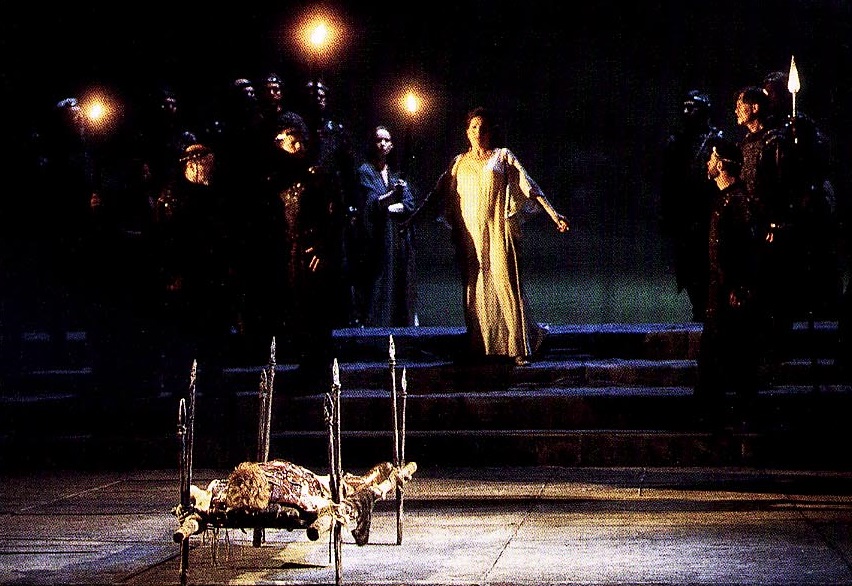
    Above: Piero Cappuccilli as Michele in Puccini’s IL TABARRO at La Scala, 1983.

    Watch and listen here.

    Piero Cappuccilli – Michele
    Sylvia Sass – Giorgetta
    Nicola Martinucci – Luigi
    Sergio Bertocchi – Il ‘Tinca’
    Aldo Bramante – Il ‘Talpa’
    Eleonora Jankovic – La frugola
    Ernesto Gavazzi – Venditore di canzonette
    Vito Gobbi – Voce interna
    Jeda Valtriani – Voce interna
    Bruno Brando – Un amante

    Conductor: Gianandrea Gavazzeni

  • Martha Graham Dance Company/Rehearsal

     Mg011

    Above: Katherine Crockett and Ben Schultz of the Martha Graham Dance Company rehearsing Graham’s PHAEDRA. Photo by Jade Young.

    Click on the images to enlarge.

    Monday October 15, 2012 – The large and history-rich space at Westbeth which is now the home of the Martha Graham Dance Company has become one of my favorite and most meaningful dance destinations. On this late afternoon in mid-October, photographer Jade Young and I were invited to the studio where the Company were rehearsing two Graham works: RITE OF SPRING and PHAEDRA. RITE OF SPRING has not been performed for about twenty years, and PHAEDRA was last danced about a decade ago. Denise Vale supervises the revivals of the Graham repertoire, and watching her work is one of the main pleasures of spending time at Westbeth.

    In 2013 we honor the 100th anniversary of the the scandalous premiere of the Nijinsky/Stravinsky RITE OF SPRING which took place in Paris on May 29th, 1913. The ballet reached American shores in 1930 when Martha Graham danced the Chosen One in Massine’s 1920 realization of the piece. In 1984, Martha Graham’s own vision of RITE was given its world premiere at the New York State Theater. 

    Mg015

    At today’s rehearsal, which was run by Ken Topping, ensemble passages (above) were being worked on with attention to spacing and to the musicality of certain phrases. The score is of course notoriously difficult to count but dancers over the years have become accustomed to it.

    Mg02

    The ballet in Graham’s rendering is both a ritual and an intense dramatic narrative. From what I was able to observe today, it is a richly structured and detailed work which I cannot wait to see fully staged, costumed and lit. We’ll have the opportunity when the Graham Company appear at The Joyce February 20th thru March 3rd, 2013. They will also perform the work in North Carolina as part of a festival celebating one hundred years of RITE:  

    “Carolina
    Performing Arts
    at The University of North Carolina at Chapel
    Hill have announced an exceptional
    two-night program as part of their The Rite of Spring at 100 season. On April 26th and April 27th, 2013, Myth & Transformation
    by the renowned Martha Graham Dance Company will bring to a conclusion
    the performance season of this unprecedented nine-month festival
    celebrating the centennial of the premiere of the Stravinsky-Nijinsky-Roerich masterpiece.

    Myth & Transformation will feature performances of Graham’s powerful The Rite of Spring, which has not been seen by audiences in twenty years, and the much-beloved Graham classic Appalachian Spring;
    the world premiere of a work choreographed by Nacho Duato to music of Arvo Pärt, and performances by guest artist Wendy Whelan, principal
    dancer from the New York City Ballet.”

    That is exciting news indeed!!

    But: back to today’s rehearsal…after a break, a long scene from PHAEDRA was rehearsed. This Graham ballet was once deemed so shocking by two members of Congress that
    they protested the use of State Department funds for its performance on a
    Graham company tour in Europe. The two worthy Congressmen’s reaction was wrong-headed, since things do not end well for Phaedra; the gods punish her immoral longings. But apparently the two legislators did not stay at the performance long enough to find out.

    Mg09

    But that seems like foolish political history now. Today we watched a quartet of Graham dancers bring the piece vividly to life, led by the remarkable Katherine Crockett (above) in the title-role. The ballet, set to a dramatic score by Robert Starer, tells of Phaedra’s obsession with her stepson Hippolytus. the dancers in the run-thru we watched were Katherine Crockett, Ben Schultz, Andrea Murillo and Mariya Dashkina-Maddux. They performed with the intensity one might expect in a staged performance.

    Mg018

    Katherine and Andrea, above.

    It was regrettable that Jade had to leave at this point, for a second cast of dancers for PHAEDRA led by Blakeley White-McGuire and Tadej Brdnik took over the space. We shall have to wait for another opportunity to photograph them. With their powerful and wonderfully indivdual personalities, the dancers of each cast brought out different aspects of the drama. I could have watched and watched and gone on watching…

    For that is the thing about these works and these dancers: an endless fascination both with the actual movement as we watch it, but also with the sense of dance history that one feels in the experience: a history in which Martha Graham wrote a bold and epic chapter.

    You can read more about Graham’s PHAEDRA here, with a very impressive album of production photos from the 2003 performances of the ballet at The Joyce.

    More of Jade’s images from this rehearsal will appear here soon.

  • Ballet Next @ The Joyce/Program A

    BalletNext_1617

    Above: A Paul B Goode photo from Ballet Next‘s presentation of Alison Cook Beatty’s TINTINNABULI. Click on the image to enlarge.

    Sunday October 28, 2012 matinee – While the governor and The City and the MTA stoked fears of an apocalypse with the impending arrival of Hurricane Sandy, Ballet Next went calmly about their business today, presenting their scheduled matinee at The Joyce. The Company weathered their own small storm when one of their dancers sustained an injury, necessitating changes in Alison Cook Beatty’s TINTINNABUILI, the afternoon’s opening work. But if you hadn’t seen this piece in a rehearsal you’d never have known anything was amiss.
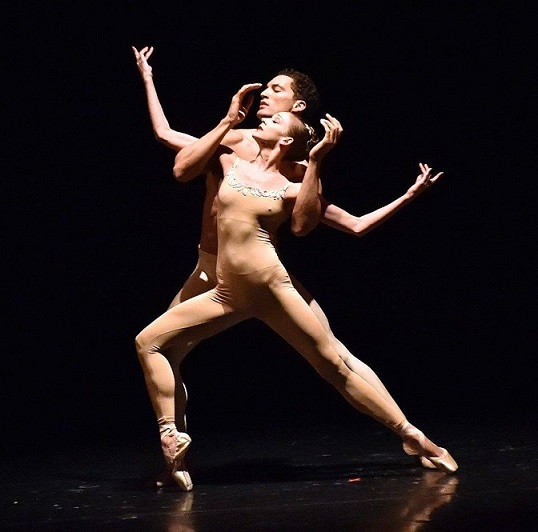
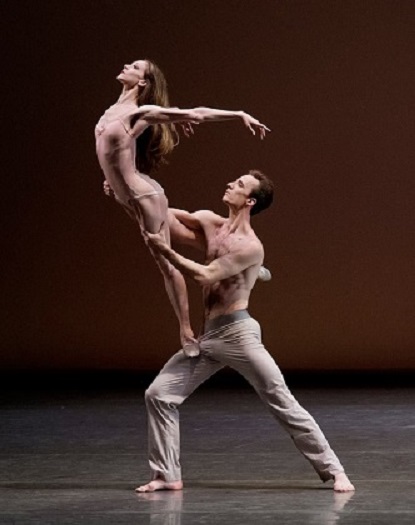
    I have had the pleasure of knowing Alison Cook Beatty as a dancer for the past couple of years, and was happy to learn that she’d been chosen to create a piece for Ballet Next. Alison started off on the right foor by choosing excellent music (Arvo Part) and then went on to create a very pleasing contemporary-style ballet. Inspired by the excellence of the dancers at her disposal (can a young choreographer ask for a finer leading lady than Michele Wiles?) Alison’s TINTINNABULI has a spiriitual quality stemming from the celestial music which was played live by an ensemble of violinists, with piano and cello.

    Opening in a striking diagonal of light, Michele Wiles dances an angular but still lyrical solo observed by Tiffany Mangulabnan and Stuttgart Ballet principal Jason Reilly. Tiffany and her two ‘sisters’ Kristie Latham and Lily Nicole Balogh seem like the three Fates, willing Michele and Jason into a union. In this hair-down ballet, the girls look gorgeous. Tiffany has two very fine solo passages, one spacious and other-worldly, the second a more intense and fiery ritual dance; in the latter, her hair took on a life of its own. The culminating pas de deux for Michele and Jason   features some heavenward lifts, while the trio of girls circle and bind the couple.

    As a choreographer, Alison has things well-in-hand, drawing on the music for inspiration at every turn. And the dancers did her proud wth their committed and passionate dancing. My only slight concern about the piece was that the second half stretched out a bit; this is music that can readily be compressed and I think I would have tightened it a little to make a more succinct statement. As Balanchine once said “…that I too could eliminate”.

    Margo Sappington’s ENTWINED began life as a sensuous Satie pas de deux. In the ensuing months, Sappington enlarged the work with a duet (Georgina Pazcoguin and Kristie Latham), a pas de trois for those two girls plus Charles Askegard, and a solo for Michele Wiles. The initial duet now conclude the ballet, danced tonight by the lovely Katrina Gonzalez with Charles Askegard giving another demonstration of the art of ballet partnering. With Ben Laude’s limpid Satie from the keyboard, the ballet sustained its atmosphere; in the end it is the original pas de deux that still seems to make the most striking effect.

    Mauro Bigonzetti’s LA FOLLIA has become Ballet Next‘s signature work, and rightly so. In this dynamic and demanding work, two ballerinas – Michele Wiles and Georgna Pazcoguin – sweep thru a series of angular combinations with super-sharp pointe work, meanwhile communicating with one another in an elaborate sign-language. It’s breathtaking, and was excitingly danced today by the two women, sending the crowd out to face the storm on an inspired and positive wave of Vivaldi.

    I truly enjoyed both programmes of Ballet Next this week, though I did rather miss having a more classical pas de deux in the repertory. When Michele and Charles dance WHITE SWAN together, it is really something. I hope they will bring that back, or work up another duet from the standard rep: it gives us the chance to savour their partnership, as well as providing a contrast to the new works they are creating.

  • Ballet Next @ The Joyce/Program B

    548378_10151181026112034_44545427_n

    Above: Charles Askegard and Michele Wiles of BALLET NEXT, photo by Paul B Goode.

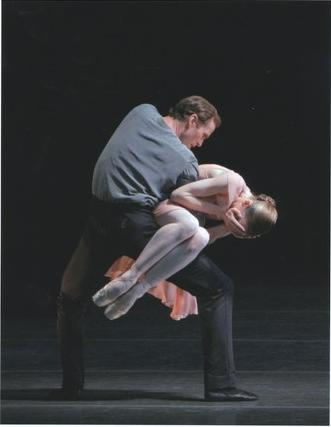
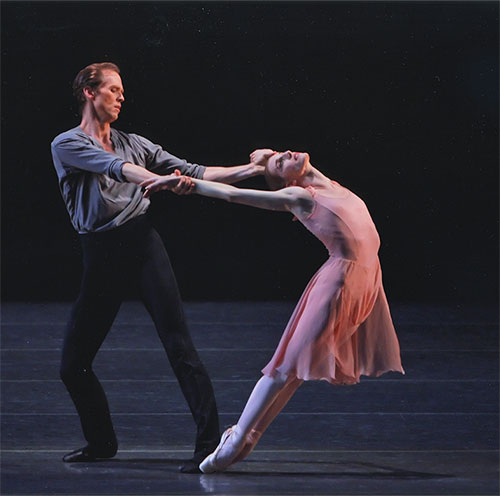
    Wednesday October 24, 2012 – On this, the second evening of Ballet Next‘s current season at The Joyce, an exciting new ballet entitled BACHGROUND by Mauro Bigonzetti seemed to fascinate the audience, evoking a sustained ovation at the end. An excellent Stravinsky pas de deux choreographed by Charles Askegard and Brian Reeder’s dreamlike and evocative PICNIC were also performed – all to live music, and all danced by top-notch dancers.

    Charles Askegard’s setting of some of the fantastical music from Stravinsky’s BAISER DE LA FEE creates a fast-paced duet for the tall danseur and his partner, New York City Ballet‘s truly incredible Georgina Pazcoguin. As choreographer, Charles, who could write a textbook on the art of ballet partnering, devises a full range of of sizzling partnering motifs, some quite unique to his own language. He then proceeds to show us how it’s done. In combinations witty and fresh, Charles sets the Stravinsky score aglow, and both dancers have the agility and musicality to make it shine. In a brisk series of supported pirouettes, Gina made me dizzy. The duet sails brightly forward, propelled by the playing of violinist Hajnal Pivnik and pianist Ben Laude. A refreshing way to open an evening of dance.

    Brian Reeder’s PICNIC is set to the Shostakovich Cello Sonata in D, played by Elad Kabilio and Ben Laude. Finely lit by Alex Fogel and Brandon Sterling Baker, the ballet was inspired by the 1975 film PICNIC AT HANGING ROCK. Set in 1900, the story revolves around a group of Australian schoolgirls who go on an excursion to Hanging Rock; some of them never return, and the mystery of their disappearance was never solved.

    The ballet has been expanded since my first encounter with it earlier this year. Michele Wiles, Erin Arbuckle, Lily Nicole Balogh, Kristie Latham and Tifffany Mangulabnan are the white-frocked young ladies and Charles Askegard the mysterious observer who leads them astray. The girls seem quite innocent, though a kiss shared by Erin and Lily momentarily threatens to cross the line from chaste to impassioned. The narrative is gently applied, and the girls have many opportunities for expressive dancing: there are even fouettes for Kristie and Tffany. Musically and visually, PICNIC is all of a piece.

    Seated on folding chairs in geometric patterns of light and shadow, the six dancers in Mauro Bigonzetti’s BACHGROUND stare at us provocatively before erupting in a series of solos and duets in which the choreographer seems to ask the impossible in terms of elasticity, stretch and sheer nerve…and they all deliver brilliantly. Pianist Ben Laude plays Bach; the individual dancers come forward to dance as their colleagues watch or – in some cases – briskly turn their chairs to face upstage.

    Clifford Williams in a solo of mind-boggling contortions launches the ballet on its jaggedly thrilling way; his torso, gleaming with sweat, glows under the lights as he shapes his limbs into unbelievable poses. His performance drew sustained applause. Georgina Pazcoguin steps ravishingly forward; at first she seems like the Novice in THE CAGE about to have her way with Mr. Williams’ spent body, but he’s magically replaced by Jesus Pastor. In their pas de deux, Gina and Jesus embrace and unfold in torrid stylizations, Gina’s extension remarkably deployed. Kristie Latham and Lily Balogh dance in sync, speaking a complex gestural language; there is a pas de quatre danced in silence by the two girls, Clifford and Jesus. Jesus, wonderfully handsome and enticingly scruffy, has a solo that is passionately physical, and Michele Wiles and Clifford Williams perform another stunningly shaped pas de deux.

    Some of the partnering elements are lifted directly from Mr. Bigonzetti’s New York City Ballet hit OLTREMARE, but choreographers and composers have self-borrowed for centuries and when it works this well, why worry? The cumulative effect of music, movement, lighting and strikingly physical performances by the dancers in BACHGROUND evoked a prolonged ovation from the sold-out house.