(This article was a labor of love; it didn’t make the jump from the Grove to the Glade in the big transfer, but I’ve copied and pasted it to the Glade, in memory of Marvin David Levy, who I had the great please of meeting and getting to know. Thank you, Marvelo!)
Please click on each photo enlarge.

Above: Marie Collier and Evelyn Lear in MOURNING BECOMES ELECTRA at the Met, 1967
Author: Oberon
Marvin David Levy’s MOURNING BECOMES ELECTRA is, for me, the great American opera. Everything about the work is American: the composer and librettist (Henry Butler) were Americans who based their opera on the epic drama of the same name by the great American playwright Eugene O’Neill, and the opera is set in a small New England town, during the years 1865-66.
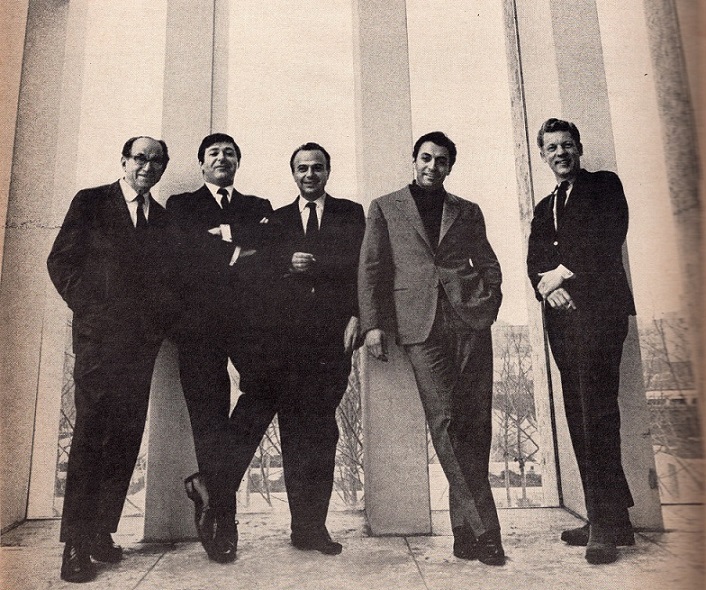
Above, the Met’s MOURNING team: Boris Aronson (designer), Marvin David Levy (composer), Michael Cacoyannis (director), Zubin Mehta (conductor), and Henry Butler (librettist)
MOURNING BECOMES ELECTRA was premiered at the Metropolitan Opera House on March 17th, 1967 during the first season at the new opera house at Lincoln Center. Though often described as a ‘failure’, audience enthusiasm ran high both times I saw it, with extended ovations; and I’ve found many positive reviews.
The Met put forward a powerful cast of singing-actors, especially for the two diva roles: Marie Collier as Christine and Evelyn Lear as Lavinia, both in their Met debuts. These two sopranos provided plenty of vocal and dramatic fireworks. It was a production that gave Sherrill Milnes, then a relative newcomer to The Met, a great opportunity in the role of Adam Brant. John Reardon made a striking impression as the hapless Orin, teetering on the brink of madness. Bassos John Macurdy and Raymond Michalski excelled as General Ezra Mannon and the servant Jed respectively; and I fell in love with soprano Lilian Sukis, who sang Helen Niles (read more about Lilian, further down). The young lyric baritone Ron Bottcher made his mark as Peter Niles, Lavinia’s hopeful suitor. On the podium, Zubin Mehta brought out the melodic aspects of the score as well as the eerie themes associated with a family on the verge.
The score contains themes that might almost be thought of as leifmotifs. They have remained in my mind over all these years, associated with the words from the libretto: “Adam, my love, your face…so pale…so strange…”; “How death becomes the Mannons…”; “You bring the gift of love, Christine…”; “No, Adam, no…not like this…”; and “A long and lonely life…”. These melodic fragments, often cinematic in feeling, are first heard in the prelude, after which the story – of an ongoing duel between mother and daughter – begins to unfold.
~~~~~~~~~~~~~~~~~~~~~~~~~~~~~~~~~~~~~~~~~~~~~~~~~~~~~~~~~~~~~~~~~~~~~~~~~~~~~~~~~~~~~~~~~~~~~
[Note that the colour photos below – from what appears to be a costumed rehearsal at The Met – were given to me by Marvin David Levy. No photographer was credited. The composer wrote notes in the border of each photo.]
The opera opens before the facade of the Mannon house, which looms up out of the shadows as the curtain rises. General Ezra Mannon is returning home from the Civil War. His wife Christine has been having an affair with the sea captain Adam Brant, who comes to the house under the guise of courting the Mannons’ daughter, Lavinia. Lavinia, who adores her father and hates her mother, knows about the Christine/Adam liaison:
A key factor in the drama has been revealed by the servant Jed: that Adam Brant is the bastard son of Ezra Mannon’s brother David and a servant girl, Marie Brantôme.
After Lavinia tells her mother and Brant that they must renounce their affair or she will tell her father of it, she leaves the lovers to say a final goodbye. But Christine has a plan in mind, and tells Brant that she will find a way to come to his ship so they can plan their escape together.
Ezra’s return home is celebrated by the townsfolk with a torchlight gathering. When Ezra and Christine are alone that night, she reveals her love for Adam. Ezra is stricken with a heart attack. He cries out for his medicine, but Christine gives him poison instead. As Ezra dies, Lavinia rushes into the room in time to hear her father accuse Christine of murder.
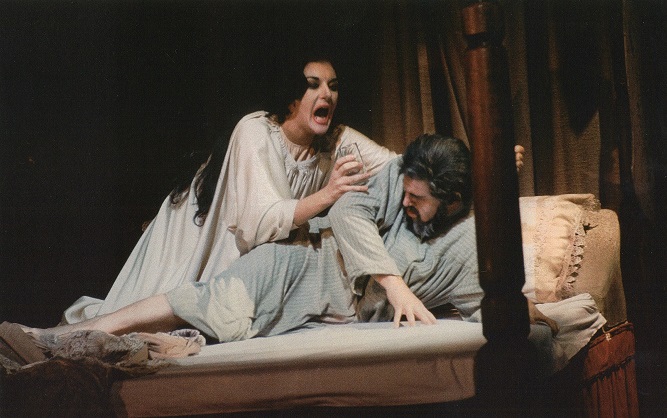
Christine (Marie Collier) reveals her deceit to Ezra (John Macurdy).
MOURNING BECOMES ELECTRA ~ Murder of Ezra Mannon – John Macurdy – Marie Collier – Evelyn Lear
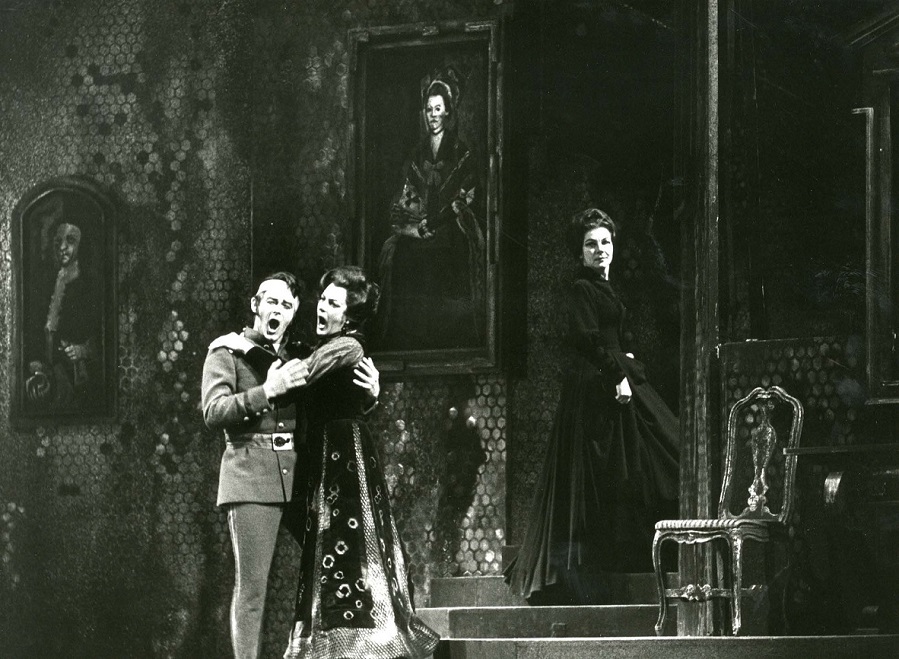
Above: Watched by Lavinia (Evelyn Lear, far right), Orin Mannon (John Reardon) returns home for his father’s funeral and is lovingly greeted by his mother, Christine (Marie Collier). Orin has sustained a head wound in battle. Christine is thrilled to see her son, as are his young friends Helen and Peter Niles (brother and sister).
Lavinia draws her brother away from the amiable chatter and sends him into the library. Orin stands stands before his father’s coffin, torn between guilt and hatred:
Orin: “How death becomes the Mannons…
My duty is to pray for you but not to mourn.
You taught me that a soldier does not weep.
How death becomes the Mannons.
You never cared for me, nor I for you…
but we might meet as friends now that you are dead.”
Lavinia tells Orin about the poison; she places the empty vial in her father’s dead hands. Entering, Christine sees it and goes berserk. She collapses, muttering “…cast me down, but Adam must not die…Adam must not die…!”
Orin adores his mother, but now sees her as an adulteress and murderer. He and Lavinia secretly plan to follow Christine to a rendezvous with Brant aboard his ship.
Waiting for Christine to arrive, Brant sings his tormented aria “Too weak to kill the man I hate”; Sherrill Milnes later recorded this aria, and as far as I know it is the only commercial recording of any part of MOURNING. (It seems Naxos recorded the entire opera from a live performance – possibly the Seattle production – but Mr. Levy had misgivings about one of the singers as did not approve its release).

Above: Sherrill Milnes as Captain Adam Brant
Sherrill Milnes – Too weak to kill the man I hate! ~ MOURNING BECOMES ELECTRA – Met bcast 1967
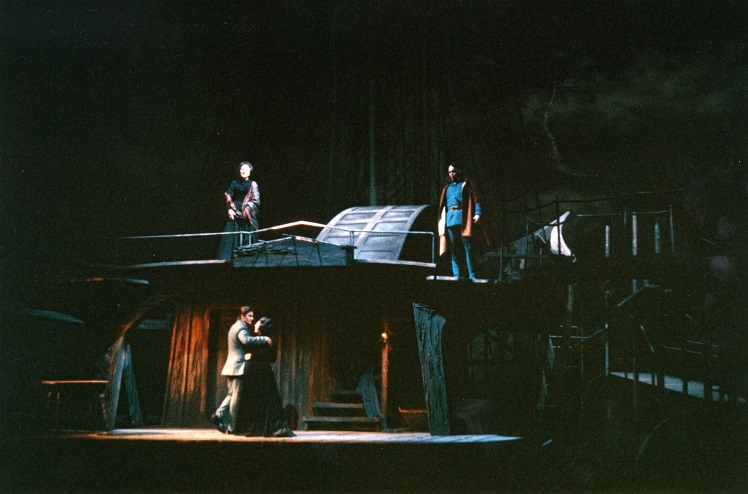
Above: the shipboard quartet: Christine arrives; she and Brant go below as Lavinia and Orin listen thru an open hatch from above. They hear their mother describe Ezra’s murder to Brant. The lovers plan to meet when things have settled, and sail away.
This scene contains two of the opera’s most haunting musical moments: when Adam tells his beloved, “You bring the gift of love, Christine…the rest is simple price.” And later, as she departs. Christine turns to Brant and, looking at his face in the moonlight, sings: “Adam, my love…your face, so pale…so strange. If I leave you, shall I ever see you again?” Listen for these motifs below:
MOURNING BECOMES ELECTRA ~ shipboard scene – M Collier – S Milnes – J Reardon – E Lear
Once Christine has departed, Orin goes below and stabs Brant to death. Lavinia sends Orin into the adjoining cabin to ransack it, so that theft appears the motive. Alone, she gazes at Adam’s body and realizes her feelings towards him. The music becomes almost cinematic as she sings, “No, Adam, no…not like this!” Then she curses him – “May the soul of our cousin Adam Brant rest in peace…and burn in Hell!” – and then flees with her brother into the night:
MOURNING BECOMES ELECTRA – the murder of Adam Brant – John Reardon & Evelyn Lear – Met bcast 1967
Returning home with the first light of dawn, Orin finds his mother pacing restlessly in front of the house. He callously tell her that Adam Brant is dead.
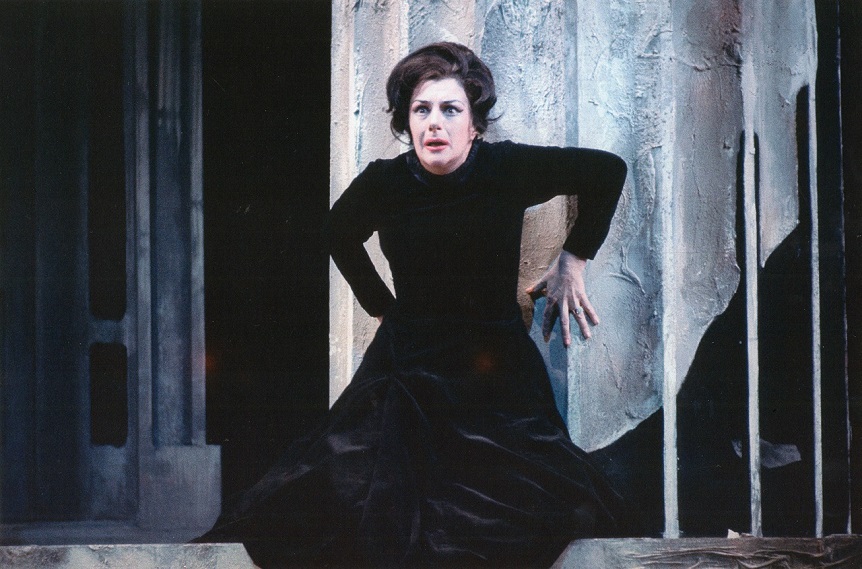
Christine (Marie Collier, above) goes mad with grief, enters the house, and shoots herself:
Marie Collier – Christine’s suicide – from MOURNING BECOMES ELECTRA – with Lear & Reardon

After a year, Orin and Lavinia (Evelyn Lear and John Reardon, above) return from a long sojourn in the tropics. Lavinia comes back rejuvenated, having cast off her inhibitions among the islanders; but Orin is consumed by guilt…
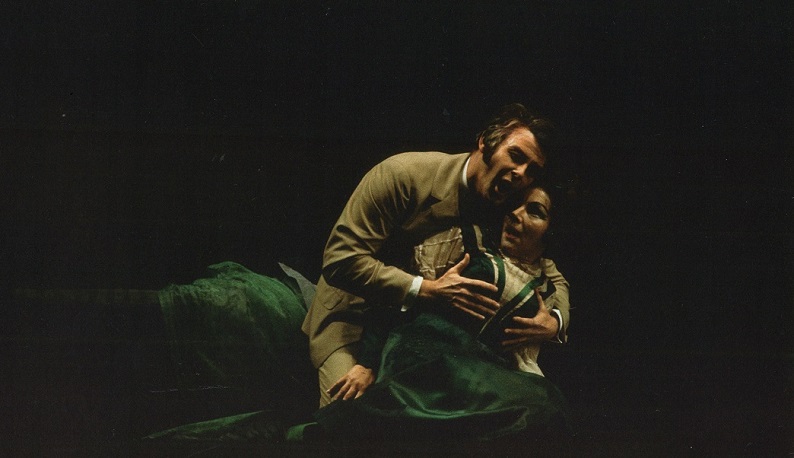
…and longing. He tries to force himself on his sister sexually (above). Lavinia’s resistance drives Orin mad, and he shoots himself with the gun she has handed him:
MOURNING BECOMES ELECTRA – Orin’s madness and death – John Reardon & Evelyn Lear – Met 1967
A few days later, after Orin has been buried, Peter Niles comes to ask Lavinia to marry him. She accepts, and clings to him passionately. But then, she accidentally calls him “Adam”, and Peter withdraws.
MOURNING BECOMES ELECTRA ~ Peter Niles & Lavinia Mannon – Ron Bottcher – Evelyn Lear -Met 1967
Lavinia, utterly forsaken, vows to live out her days alone, among the Mannon ghosts:
Evelyn Lear – MOURNING BECOMES ELECTRA ~ Lavinia’s final aria – Met 1967

Lavinia (Evelyn Lear, above) slowly closes the door as the music fades, and the facade of the House of Mannon recedes into the mist of time.
~~~~~~~~~~~~~~~~~~~~~~~~~~~~~~~~~~~~~~~~~~~~~~~~~~~~~~~~~~~~~~~~~~~~~~~~~~~~~~~~~~~~~~~~~~~~~
Here’s my cast page from the first time I saw the opera:

It’s lovely to have Lilian Sukis’s signature from that performance. Although the role of Helen is quite brief, the young woman is coaxed by Christine to sing a favorite song of Orin’s when he has returned from the war…to which Ms. Collier harmonized:
Lilian and I met by chance not long after at a Beverly Sills performance at New York City Opera, where she invited me to her New York solo recital debut, which I attended. I took her photo there:

Singing Helen in MOURNING put Lilian on the map with some of the Met fans in my circle. She eventually left the Met and became a popular artist at the Bavarian State Opera at Munich.
The Met thought well enough of MOURNING BECOMES ELECTRA to give it in a second season, and I attended what turned out to be the last performance (to date) of the opera at The Met. During the prolonged applause and numerous curtain calls, I was at the orchestra railing with Matthew Epstein – who went on to become a major force in the opera world as a manager of singers – and we agreed that the Great American Opera had been written. I believe Matthew attended every performance of MOURNING given at The Met.

Above: the cast page from my second MOURNING performance, signed by Mssrs Reardon and Milnes, and by the composer. That evening, the two prima donnas signed the photo that appears at the top of this article. Mr. Levy had made major revisions to his opera for this second Met run – and he would continue to do so over the ensuing years. Myself, I remained faithful to the original.
~~~~~~~~~~~~~~~~~~~~~~~~~~~~~~~~~~~~~~~~~~~~~~~~~~~~~~~~~~~~~~~~~~~~~~~~~~~~~~~~~~~~~~~~~~~~
It would be thirty years before MOURNING would be staged in the United States again, but it did have its European premiere at Dortmund, Germany, in 1970 (production poster above). While I could recall that soprano Colette Lorand sang Lavinia, I could not find more information about this production on-line. I contacted the Dortmund Opera to see if they could provide cast and production details. I received a gracious reply from the Company’s librarian, Kerstin Witt, who sent me what little was available in their archive about the production.

Madame Lorand, who gained fame singing Mozart’s Queen of the Night, later took on a vast repertoire that included many 20th-century works. How I wish I could have met her and talked to her about singing Mr. Levy’s opera; having had such a busy and eventful career, I wonder if she would have remembered it at all. She passed away in 2019.

Above is the cast of the Dortmund production. Most of these singers names are completely unfamiliar to me, though I know that Joy McIntyre was a leading soprano with major opera houses in Europe during the 1960s and 70s. She sang at Munich, Vienna, Salzburg, Rome, Berlin, Hamburg, Düsseldorf, Geneva, Barcelona and Copenhagen; her portrayals of Ortrud, Kostelnicka, and the Dyer’s Wife were praised. Ms. McIntyre sang under such conductors as Wolfgang Sawallisch, Marek Janowski, Bruno Maderna, Christoph von Dohnanyi, Leopold Hager, Carlos Kleiber and Olivero di Fabritis, and was acclaimed for her Ortrud in a production of LOHENGRIN staged by the composer’s grand-daughter, Friedelind Wagner.
Seeing the name of Guillermo Sarabia listed for the role of Adam Brant brought back memories of the very fine performances I saw him give: twice as Wagner’s Dutchman – in semi-staged concert performances in Houston (1972) and at Springfield, Massachusetts (opposite Klara Barlow’s Senta) – and as Verdi’s Macbeth, with Cristina Deutekom and Ferruccio Furlanetto, at The Bushnell in Hartford in 1982. Mr. Sarabia died at the young age of 49 in 1985.
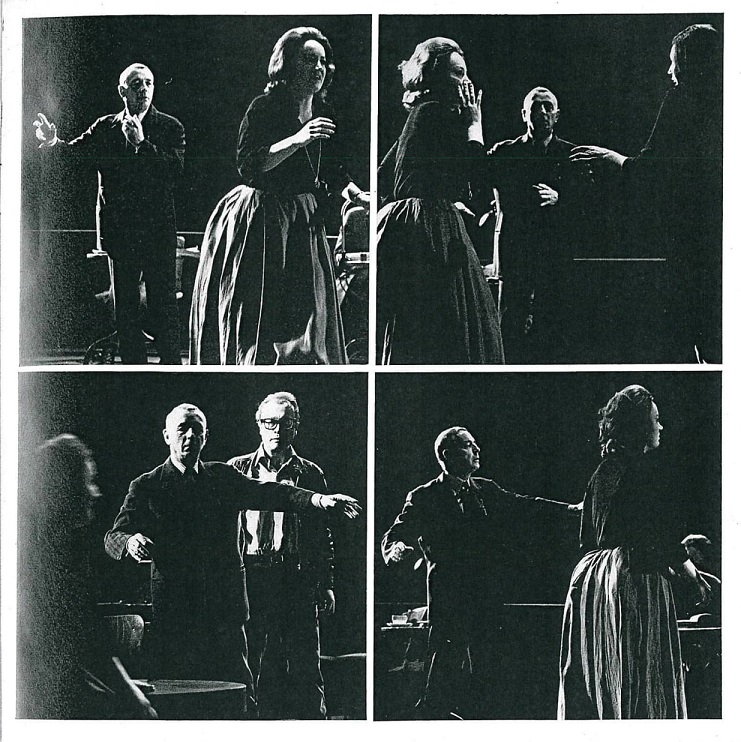
Above: some rehearsal images from the Dortmund production of MOURNING..

Above: more Dortmund rehearsal images; I believe that’s Ms. McIntyre on the left and Ms. Lorand on the right, directly above.
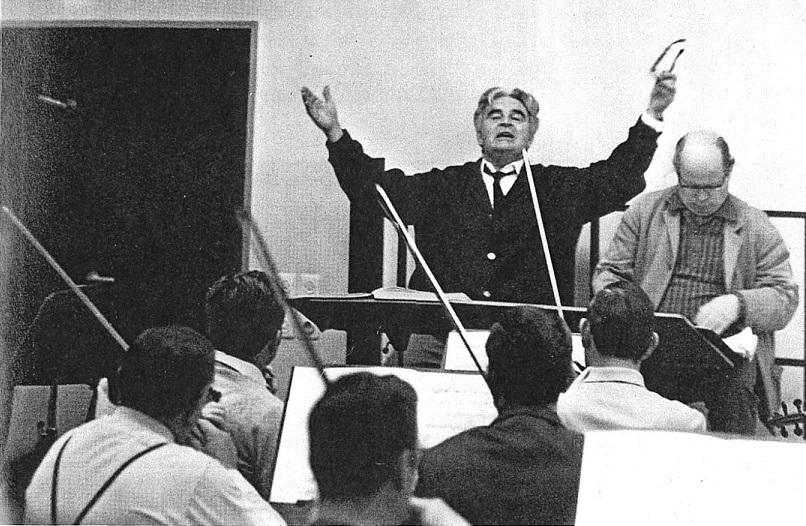
Above: the conductor, Wilhelm Schüchter, rehearsing the opera

Above: set design for the façade of the House of Mannon, for the Dortmund premiere
~~~~~~~~~~~~~~~~~~~~~~~~~~~~~~~~~~~~~~~~~~~~~
In 1998, the Chicago Lyric Opera mounted a gorgeous production of MOURNING, which the composer had revised still further. It was a big success with press and public alike, and there was renewed interest in the piece. The Chicago cast featured Lauren Flanigan as Christine, Cynthia Lawrence as Lavinia, Randolph Locke (a tenor) as Orin, Jason Howard (Adam Brant), and Kevin Langan (Ezra Mannon).
Here are some images from the Chicago production:

Lauren Flanigan as Christine and Cynthia Lawrence as Lavinia

Mother and daughter (Lauren Flanigan and Cynthia Lawrence) nearly come to blows

Jason Howard as Adam Brant and Cynthia Lawrence as Lavinia

Jason Howard as Adam Brant and Lauren Flanigan as Christine. Here is the scene from Act I where Christine tells Adam of her plan to kill her husband, Ezra. Lauren Flanigan is at her most thrilling here:
Lauren Flanigan and Jason Howard – MOURNING BECOMES ELECTRA ~ Act I scene – Chicago 1998

On the verge of homicide: Lauren Flanigan as Christine goads her husband Ezra Mannon (Kevin Langan) with the truth about her affair with Adam Brant.

In the opera’s final scene, with her parents and brother dead, Lavinia is on the verge of accepting Peter Niles’ proposal of marriage (Brett Polegato and Cynthia Lawrence, above); but when she inadvertently calls Peter, “Adam…”, that plan is undone.
~~~~~~~~~~~~~~~~~~~~~~~~~~~~~~~~~~~~~~~~~~~~~~~~~~~~~~~~~~~~~~~~~~~~~~~~~~~~~~~~~~~~~~~~~~
1998 was the year I moved to New York City, and thru my job at Tower Records I met someone in 2001 who was a great MOURNING enthusiast; he gave me a cassette of the Chicago performance of MOURNING. This prompted me to locate Mr. Levy’s website; there was a mailing address on the site, to which I sent a long fan letter. After some months, I received this reply:
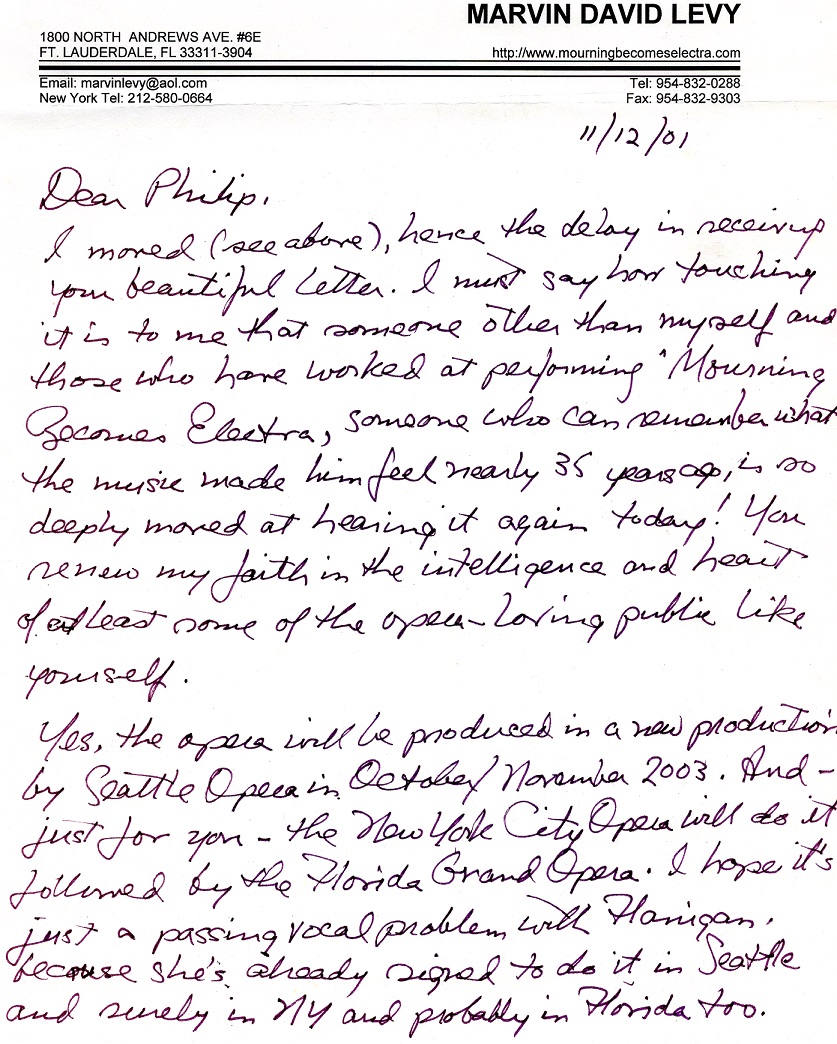
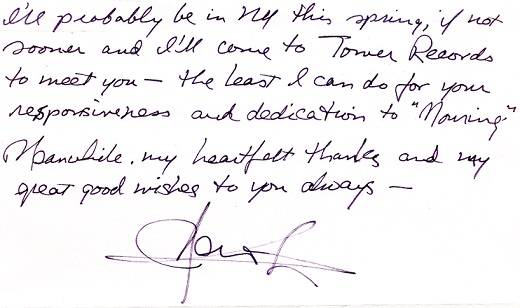
We e-mailed back and forth for a bit; at that time I had no idea of the terrible health issues he was dealing with, so when he stopped writing I simply figured he was busy. The New York production was to be shared with Seattle Opera, and I knew he was doing some revisions.
Then one day in late February 2004, I was paged to pick up a phone call in the opera room at Tower. “Philip! It’s Marvelo!” Long pause. “Marvin David Levy!” He was coming to New York for rehearsals of the NYC Opera production of MOURNING. It was a 2-minute conversation we had that day: he asked about my work schedule and said he would see me ‘soon’.
Sure enough, one March day, he came in to meet me. From my diary: “…he is a wonderful, kind man who is unfortunately suffering from a terrible disease that is affecting his spinal column, causing severe nerve damage and excruciating pain. But he stood and talked with me for several minutes about his opera that I love, and about the NYCO cast and production. Despite his upbeat chatter, his pain was so evident that I dismissed my idea of taking him to lunch. Instead I helped him down to the main floor, and got him a cab. ‘Which performance will you be at?’ he asked me as he slowly sank into the cab’s seat. I told him the dates. ‘Twice!! You are a good man!’ “
As the cab pulled away, I thought to myself that I might not ever meet him again. But I was wrong.
~~~~~~~~~~~~~~~~~~~~~~~~~~~~~~~~~~~~~~~~~~~~~~~~~~~~~~~~~~~~~~~~~~~~~~~~~~~~~~~~~~~~~~~~~~

Above: Lauren Flanigan as Christine at the New York City Opera
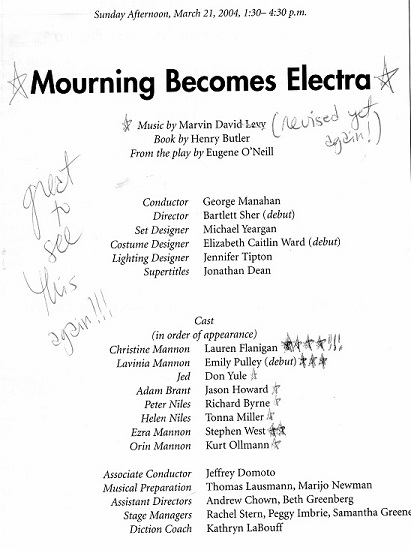
The City Opera’s production was visually impressive, though lacking in the dark, brooding feeling that made the Met’s staging so effective. Lauren Flanigan was simply magnificent as Christine, using her intriguingly flawed voice to optimum emotional effect. She made the character overwhelmingly sympathetic. Emily Pulley was likewise very fine as Lavinia; she had been singing at The Met, but nothing she had done there prepared me for her riveting performance in Mr. Levy’s opera.
Jason Howard’s handsome Adam Brant made the spell he was able to cast over the Mannon women thoroughly understandable, and Kurt Ollmann as Orin sang beautifully though he did not quite find the expressive colours of dementia in his vocalism that made John Reardon so mesmerizing in the part. Stephen West was a splendid Ezra Mannon, and NYCB veteran Don Yule scored yet again with a strong portrayal of Jed. As the Niles siblings, Tonna Miller and Richard Byrne did what they could with the roles, which in this revision have been marginalized. The orchestra played very well indeed under George Manahan’s baton.
I attended the New York City Opera’s production of MOURNING twice; at the prima, I did not see Mr. Levy until he appeared onstage for a bow at the end of the performance. I brought my friend Rob Scott to the second performance (we sat in the front row!), and Mr. Levy saw us in the lobby as we entered the theatre. He made a beeline for us, and chatted us up delightfully.
In all honesty, I did not like most of the revisions that Mr. Levy had made to the score. Especially disappointing were the interjections (both vocal and dramatic) of Christine and the Mannon ghosts into Lavinia’s chilling final aria, which Evelyn Lear had sung so tellingly. But it was truly exciting to hear MOURNING again, and with an excellent cast.
~~~~~~~~~~~~~~~~~~~~~~~~~~~~~~~~~~~~~~~~~~~~~~~~~~~~~~~~~~~~~~~~~~~~~~~~~~~~~~~~~~~~~~~~~~~~

Marvin David Levy’s MOURNING BECOMES ELECTRA was performed for the last time – to date – in 2013 by the composer’s “home” company, Florida Grand Opera. Lauren Flanigan (above) repeated her searing performance as Christine, and the production – and the opera itself – drew very positive critical response.
~~~~~~~~~~~~~~~~~~~~~~~~~~~~~~~~~~~~~~~~~~~~~~~~~~~~~~~~~~~~~~~~~~~~~~~~~~~~~~~~~~~~~~~~~~
Marvin David Levy passed away at Fort Lauderdale, Florida, in 2015.
Something I had not known at the time I met Mr. Levy: a few years after the Met’s performances of his opera, Marvelo had been convicted of serving as a bag-man for a drug syndicate, and he served time in prison. He told an interviewer that the experience changed his view of life completely.
Thanks to both Kerstin Witt, archivist of the Openhaus, Dortmund, and Clark Rahman of the Metropolitan Opera Guild who provided valuable documentation about MOURNING.
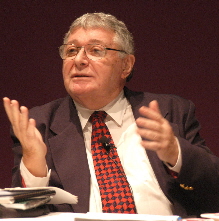
So here, dear Marvelo, is the article I have been working on (for over a year) about your thrilling opera. I hope that – wherever you are – you will find it, read it, and recall the conversations and correspondence we shared. And I hope that you are writing song cycles for Evelyn and Marie, and enjoying champagne brunches with those Mannon women.
~ Oberon
September 02, 2019 | Permalink















 Oberon's Glade
