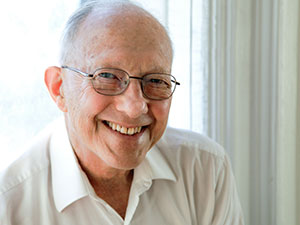
Sunday November 22nd, 2015 – Pianist Gilbert Kalish (above) and a septet of his top-notch colleagues met on the stage of Alice Tully Hall this evening for a programme of works by three composers whose lives were linked to the city of Vienna. On a day when we are still trying to comprehend the recent terror attacks in Paris – and also remembering the death of John F Kennedy on this date 52 years ago – Chamber Music Society of Lincoln Center‘s offered music that was by turns heartening and thought-provoking, and all of it impeccably played.
When New York’s great musical organizations – Chamber Music Society, the NY Phil, Carnegie Hall, The Met, Young Concert Artists – announce their upcoming seasons each year, I love to pore over the listings, searching for certain works or artists and putting the dates immediately on my calendar. Thus for many weeks I’ve been looking forward to today’s Chamber Music Society concert as an opportunity to experience first-hand Arnold Schoenberg’s Kammersymphonie; I discovered this piece years ago – it was actually my introduction to Schoenberg – and have always wanted to hear it played live. Today’s performance of the Webern arrangement was incredibly vivid.
But, to start at the beginning, this musical celebration of Vienna opened with music of Haydn: the E-minor piano trio. Gilbert Kalish, who played in all three works this evening, is at that marvelous point in his career where his playing retains youthful vitality while his artistry – developed over a long career – is at its peak. His playing was marked by effortless technique, an assured rightness of style in each of the three contrasting works, and an Olde World feeling of grace without theatricality.
Seeming taller and slimmer than the last time I saw him, violinist Nicolas Dautricourt strode onstage and for a moment I mistook him for ABT’s Marcelo Gomes. Mr. Dautricourt is a particular favorite of mine, both to watch and to hear; his stage presence is paradoxically relaxed and intense, and his playing is beautifully nuanced with especial attention to dynamic gradations. Cellist Torleif Thedéen was an ideal colleague for M. Dautricourt today: their rapport was inspiring to watch, aligning the harmonies and relishing the melodic opportunities Haydn has given them. Their affection and respect for Mr. Kalish was clearly evident both here and – later – in the concluding Brahms.
Schoenberg’s Chamber Symphony spans a single movement, though the composer has identified five distinct sub-divisions: Sonata (Allegro), Scherzo, Development, Adagio, and Recapitulation and Finale. Originally written for ten wind and five string players, the composer asked his student Anton Webern to re-cast the piece for a smaller ensemble, the better to take it out on tour. The result: twenty-two minutes of sheer musical brilliance.
The Kammersymphonie tonight was given a captivating performance: the quintet of musicians played with such richness of tone, such stimulating sense of colour, and such depth of feeling that one had the impression of a much larger ensemble playing. Gilbert Kalish’s sent waves of plush sound from the Steinway, giving the music an undercurrent of Late-Romantic lyricism; this same feeling was embraced by violinist Kristin Lee who seized upon the composer’s every melodic gesture with her pearly tone. Whenever the music turned more prickly, both Kalish and Lee were up for the adventure.
Tara Helen O’Connor, one of the Society’s elite, sent her flute roulades wafting brightly overall whilst the gorgeous (no other word suffices) tone of Nicholas Canellakis’s cello seems always to achieve a direct hot-wire to the heart-strings.
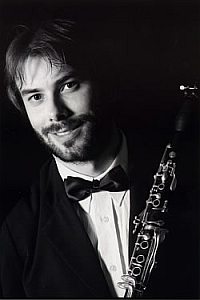
New to me this evening was clarinetist Tomasso Lonquich (above) who made a spectacular impression both with his sumptuous tone and the passion of his playing. Whether at full cry or honing the sound down to a thread, Mr. Lonquich displayed his mastery at every moment; meanwhile his deep commitment to the music sometimes nearly drew him out of his chair as he polished off Schoenberg’s demanding phrases with compelling sincerity.
This staggeringly opulent ensemble drew a din of applause from the Alice Tully audience; as they took a second bow, my companion Adi – who had professed indifference to Schoenberg’s music before the concert began – found his opinion of the composer transformed. That’s what a great performance can accomplish.
As so often at Chamber Music Society’s concert, I found myself at the interval wondering how this level of music-making could possibly be sustained into the second half. Needless to say, as violist Paul Neubauer joined Mssrs. Kalish, Dautricourt and Thedéen for the Brahms Third Piano Quartet, any thoughts of a letdown were immediately dismissed.
Nearly twenty years were to pass between the time Brahms began working on this quartet (in 1855, at the time of his friend Robert Schumann’s last illness, when Brahms was torn between sorrow for his friend and desperate love for his friend’s wife, Clara) and its publication. His romantic inclinations toward Frau Schumann seem to perfume the music, especially in the third movement.
Tonight, Mr. Kalish’s opening octave set the tone for a performance of beautifully blended voices and outstanding solo passages (Mr. Neubauer’s expressiveness so congenial) which achieved a level of surpassing excellence in the Andante. Here Mr. Thedéen’s opening solo was poignantly set forth, with Mssrs. Dautricourt and Neubauer joining in turn: ravishing…a deep delight. The Andante ends magically, and then Nicolas Dautricourt launched the finale with a finely-turned solo. The audience’s enthusiasm at the end called the players back twice.
There was an odd sensation at times tonight that someone was humming along with the music. At first I thought it might have been some acoustical oddity, but Adi noticed it as well.
Prior to the start of the concert, co-artistic Director Wu Han announced the death of the venerable violinist on teacher Joseph Silverstein. This first movement from the Barber violin concerto shows Silverstein’s poetic qualities and persuasive tone to perfection.
The Repertory:
- Haydn Trio in E minor for Piano, Violin, and Cello, Hob. XV:12 (1789)
- Schoenberg Kammersymphonie, arranged for Flute, Clarinet, Violin, Cello, and Piano, Op. 9 (arr. Webern) (1906, arr. 1922-23)
- Brahms Quartet No. 3 in C minor for Piano, Violin, Viola, and Cello, Op. 60 (1855-56, 1874)
The Participating Artists:
- Gilbert Kalish , piano
- Nicolas Dautricourt , violin
- Kristin Lee , violin
- Paul Neubauer , viola
- Nicholas Canellakis , cello
- Torleif Thedéen , cello
- Tara Helen O’Connor , flute
- Tommaso Lonquich , clarinet
 Oberon's Glade
Leave a comment