~ Author: Oberon
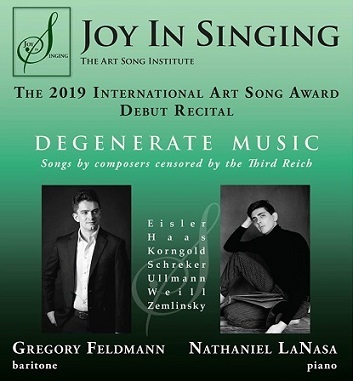
Thursday February 27th, 2020 – Baritone Gregory Feldmann, recipient of the 2019 Joy in Singing Art Song Award, in recital at Weill Hall. Pianist Nathaniel LaNasa was the singer’s collaborator in a program of songs by composers whose music was suppressed under the Nazi regime.
The program was particularly timely, living as we are during a period when our own government seems hellbent on destroying our democracy. It’s ironic that we fought Facism in the 1940s – and that in recent years we have sent our soldiers into harm’s way in faraway lands, purportedly to bring democracy and freedom to the oppressed – only to find our country is now under threat from within. With these thoughts in mind, tonight’s concert became much more than just another lieder recital.
Mssrs. Feldmann and LaNasa, looking dapper in black bow-ties, took the stage to a hearty welcome from the packed house. The first half of their program was given over to songs by such well-remembered composers as Kurt Weill, Franz Schrecker, Alexander von Zemlinsky, and Erich Korngold.
Kurt Weill’s cabaret-style “Berlin im Licht” opened the evening. Weill had been living in Paris – and then in New York – since 1933. But this song was composed for the Berlin Festival of September 1928 (ten years after Germany’s humiliation in World War I); that event marked a resurgence of German pride in its cultural endurance that would eventually fuel Hitler’s rise to power. Tonight, Mr. Feldmann and Mr. LaNasa gave the song a swinging, optimistic treatment.
Franz Schreker had died in 1934, but his music was still proscribed by the Third Reich. In three Schrecker songs, the musical attributes of this evening’s two artists came to the fore. In the Straussian style of “Und wie mag die Liebe“, Mr. Feldmann’s handsome lyric baritone – and his persuasive way with words – assured us we were in for a great deal of very fine vocalism tonight. Of equal appeal was Mr.LaNasa’s playing, especially in the song’s postlude.
The partnership of the two musicians made for a luminous “Sommerfäden”, wherein the duo showed an affinity for Viennese-style melody. The shimmering piano introduction was enticingly played by Mr. LaNasa; this song has a rapturous mid-section, and then a big, operatic outpouring where Mr. Feldmann’s voice rang true.
“Stimmen des Tages” is darkish and unsettled at first; mood swings carry the two musicians thru to a passionate passage. Following a pause, the song resumes as if from the start. The gorgeous piano postlude was a treat in itself in Mr. LaNasa’s rendering.
Four Alexander von Zemlinsky songs were most congenial to the Feldmann voice. The composer, who had moved to Vienna in 1933 and then on to New York City in 1938, was largely forgotten in Germany. His songs have long attracted great singers, and in the first three tonight – “Tod in Ähren“, “Nun schwillt der See so bang “, and “Entbietung” – singer and pianist were simply superb. “Tod in Ähren” stood out for me: following its big opening from the keyboard, it becomes a lament. Both musicians were so persuasive in this song’s gentle lyricism, and in the tenderness of farewell.
The final Zemlinsky offering, “Afrikanischer Tanz” (African Dance), was a complete change of pace: aggressive and blood-stirring! Mssrs. Fedmann and LaNasa caught the mood perfectly, and the song drew a whooping response from the crowd.
Erich Korngold, best-known of the evening’s composers (well, aside from Kurt Weill), was famous for his opera DIE TOTE STADT and for his film scores. He was already established in Hollywood by the time World War II broke out. Tonight we heard a set of four Korngold songs, of which the last – “Vesper” – was of particular appeal, with the piano’s repetitive notes evoking the evening chimes, and a vocal line that took the singer into his upper range. The song’s sustained ending was wonderfully evocative.
Following the interval, works by a trio of less fortunate composers: both Viktor Ullmann and Pavel Haas were sent to Theresienstadt, and then on to Auschwitz where they both perished in 1944, whilst Haans Eisler faced trials of a different sort.
Ullman’s Liederbuch von Hafis consists of four songs, in which jazz influence can be felt. In the bouncy and ironic “Vorausbestimmung”, the music goes deep before one final bounce from the keyboard. In the following song, “Betrunken” (Drunk), agitation finds a lull before proceeding on its droll trajectory.
Mr. Fedmann’s lower range settled in nicely for “Unwiderstehliche Schönheit” (Irresistible Beauty), perhaps the most interesting of the Ullmann set: the piano takes up a trudging motif, a sort of tongue-in-cheek march. It is briefly interrupted by some bright, tinkling keyboard phrases before the pacing resumes. This leads immediately into the final song,”Lob des Weines” (In Praise of Wine), a salute to intoxication. Mssrs. Feldmann and LaNasa certainly had fun with this cycle.
Pavel Haas, who was Czech, drew on ancient Chinese texts for his Four Songs on Chinese Poetry; their sensual nature immediately won the label “degenerate”, and they offered so much fascination tonight as singer and pianist drew us along Haas’s musical pathway.
The songs are full of longing – for home and for loved ones – which must have seemed all too poignant to Pavel Haas, who left his wife and child behind when he was deported. A recurring motif in the songs is a four-note musical ‘message’, referring to the Chorale to St. Wenceslaus: representing home and freedom, this small token would have been meaningful to other Czech prisoners at Terezín.
In these four songs, Mssrs. Feldmann and LaNasa covered a wide spectrum of rhythmic, melodic, and poetic moods. Lines such as “My home is so far away…” and “My yearning keeps me awake…” seemed so poignant, and were so thoughtfully expressed tonight. But all is not gloomy, for the final song – “A Sleepless Night” – suddenly gives way to the sound of a magpie chattering at dawn, depicted by the pianist.
A native of Leipzig, Haans Eisler spent the war years in Hollywood, where he was a successful composer of film score. His troubles came later, when he was investigated by the House Un-American Activities Committee; his own sister denounced him as a Communist. Eisler was deported in 1948.
It was with Eisler’s “Friedenlied” (Peace Song) that the concert tonight ended. With a folkish feeling, this ballad sets forth a vision of hope. Despite a very annoying cellphone interruption, Mssrs. Feldmann and LaNasa carried on, with the pianist savouring a final postlude.
A Zemlinsky encore was the performers’ response to a very enthusiastic ovation.
These observations by the evening’s two artists are truly meaningful:
“When we memorialize victims of atrocities such as World War II,” wrote Mr. LaNasa, “we must also remember the conditions that led to such horrors, and the voices of those who tried to tell the world what they feared was approaching.” And Mr. Feldmann said, “We want to commemorate the lives and work of these artists by giving our audience the opportunity to respond to their work. The oppressors of their day prevented society from hearing these words and scores, and it’s a privilege for us to thwart that mission with music that is so beautiful and potent.”
The vociferous applause at the end of the concert indicated that the price these composers paid is not to be forgotten…and that they live on thru their music.
~ Oberon



















 Oberon's Glade