Blog
-
Pittsburg Symphony Orchestra @ Lincoln Center

Above: pianist Till Fellner, photo by Jean-Baptiste Millot
~ Author: Ben Weaver
Sunday May 19th, 2019 matinee – Great Performers at Lincoln Center presenting Maestro Manfred Honeck and his Pittsburg Symphony Orchestra in a super-sized concert at Lincoln Center this afternoon: Mahler’s Symphony No. 5 was preceded by Beethoven’s Piano Concerto No. 5 – two substantial works that rarely share the stage.
Austrian pianist Till Fellner was the soloist for Beethoven’s 1809 magnum opus, the imposing “Emperor” Piano Concerto. By 1809 Beethoven’s hearing was already deteriorated enough that he stopped playing the piano in public. It is the only one of is concertos that he did not premiere himself. After a single chord from the orchestra, the piano enters majestically with an extended solo. This is followed by another single chord from the orchestra and a cadenza-like solo from the piano; and then again – for the third time – before the orchestra finally launches a traditional introduction.
The lovely Adagio is scored sparingly for the piano, muted strings and winds and it leads without a pause into the raucous final Rondo. Mr. Fellner is a magician behind the keyboard. There is an extraordinary sense of simplicity and ease in his playing; even in the most arduous passages, he makes the music sound like it is being played by the gods themselves. But there is nothing simple about his interpretations, which are filled with shadows and light. He makes the music come alive in a way no other living pianist does. Fellner seems to breathe the music into existence. Each live performance I have attended by this extraordinary musician leaves me in awe. Maestro Honeck and the Pittsburg Symphony musicians seemed to be breathing the same music as Mr. Fellner. They were the perfect partners for this exceptional performance.

Above: Maestro Honeck, photographed by Reinhold Möller
Gustav Mahler’s mighty Symphony No. 5 received a somewhat mixed performance after the intermission. The star-turn trumpet introduction to the symphony was beautifully done, and Honeck’s tightly-controlled and dark funeral march signaled a great start. And for the Pittsburg Symphony, even at maximum volume, the sound remained wonderfully transparent. What was missing from the 3rd and 4th movements as the symphony shifts from darkness to light with its swirling waltzes, gallops and love songs (the Adagietto was nicely paced, but the climax never materialized) was a sense of fun; everyone still seemed to be stuck in the death-haunted first two movements of the symphony. Fortunately the final Rondo came whizzing in like a Mendelssohnian fairy. Honeck’s lightening of textures was a striking effect here and it brought the work to an appropriately affirming conclusion.
~ Ben Weaver
-
Philharmonic Ensembles ~ Season Finale
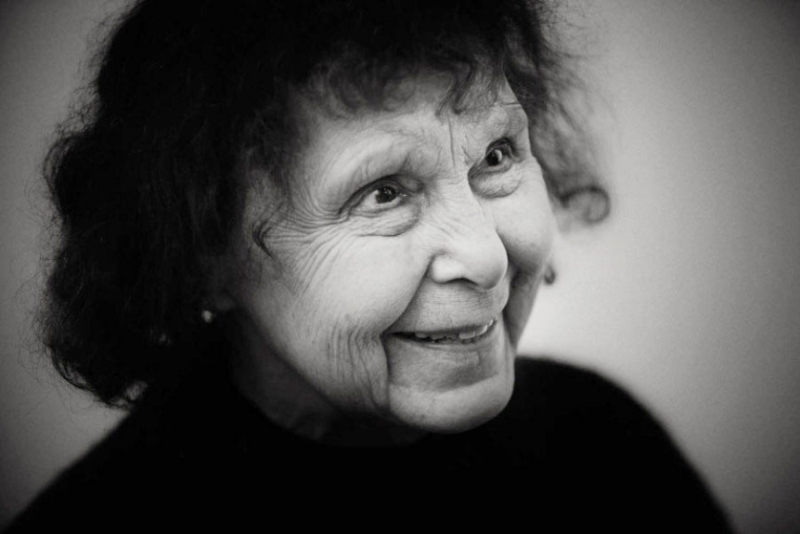
Above: composer Sofia Gubaidulina
~ Author: Oberon
Sunday May 26th, 2019 matinee – This afternoon’s Merkin Hall concert by musicians from The New York Philharmonic marked the season finale of the Philharmonic Ensembles series. These programs invariably mix new or off-the-beaten-path works with classics from the chamber music repertoire.
Both in the choice of repertory and in the superb playing of the musicians, today’s concert was one of the finest I’ve ever experienced. The audience seemed enraptured; wonderfully silent and attentive, they created an atmosphere which doubtless inspired the players to outdo themselves. No coughing, no cellphones, no one dropped anything; there were a number of small children in the audience, but none of them made a peep. What an opportunity for blissful immersion in the music!
An infrequently-performed work by Franz Schubert, Notturno, opened the concert. I greatly enjoyed hearing pianist Hélène Jeanney again, having previously heard her playing Zwilich and Debussy at these concerts. For today’s Schubert, she was joined by Na Sun (violin) and Qiang Tu (cello).
Found among some of Schubert’s papers after his death, the Notturno is a work of timeless beauty and contemplation, commencing with harmonizing strings which pass through lovely modulations in which the piano sets a pace that feels like a slow waltz. Mlle. Jeanney then takes the lyrical lead with a gracious piano melody as the strings are plucked. In a role reversal, the pianist then assumes the role of a harpist, with gentle accents supporting the melodious strings.
In a contrasting section, we move into a minor phase; there is a rising intensity and the music becomes quite passionate, with swirling cascades of notes from the keyboard. A sense of longing rises from the violin and cello, underscored by the restless piano. Na Sun and Qiang Tu then beautifully resume the original theme, the harmonies seeming even more poignant now. Following a rather sudden crescendo, the music rises to a calm finish. How poetic the atmosphere our three players conjured: simply sublime.
The music of Sofia Gubaidulina always intrigues me, and today her Piano Quintet proved fascinating. This quintet is one of her earliest works, written in 1957 while she was still a student at the Moscow Conservatory. Several influences are in play in this quintet: Shostakovich, for sure, but maybe – even more – Prokofiev. And, strangely enough, there are also tinges of the French composers of the Impressionist school along the way. But Gubaidulina manages to weave these threads together convincingly. The quintet sounds really original.
Pianist Eric Huebner joined the Philharmonic’s Qianqian Li and Joo Young Oh (violins), Peter Kenote (viola), and Nathan Vickery (cello) for music-making of the highest order. The composer gives the 2nd violinist a great deal to do in the quintet, and Joo Young Oh (his hair now blonde, and wearing a spiffy golden-tone jacket) played it all superbly.
The opening Allegro has a rhythmic, fun start, with the music driven by Eric Huebner’s lively playing at the Steinway. Throughout, Mr. Huebner constantly reminds us of why it’s called a “piano quintet”: he’s a wonderful pianist. The music, accented, brings forth string harmonies as the piano comments. The second violin has his first chance to shine; his theme is then taken up by first violinist Quinquin Li. A long piano solo has an almost furtive quality, and then things become insistent and sonically dense. Nathan Vickery’s cello sings over pulsing motifs from the piano. The melody is passed about, then the strings assume a high, shimmering blend before the Allegro’s amusing ending.
Peter Kenote’s viola takes the lead in the Andante marciale, which soon gets a swagger on. Laying back a bit, there’s a violin passage and the music turns fragmented. The march then picks up again, reminiscent of the its famous counterpart in Prokofiev’s L’Amour des Trois Oranges. The violin plays on high as the music strides away into the distance.
Yearning strings and the quiet piano mark the start of the Larghetto sensibile, with the violin in a sad song that the cello joins; the piano however seems to hint at a jest. As the viola and 2nd violin blend, there’s a trace of exoticism. Syncopation rises up, becoming insistent until the viola leads us back to some searing harmonies. Mr. Kenote’s viola sounds alone, and Mr. Oh takes his violin on high in a solo passage. Harmonies shift, and Mr. Huebner at the Steinway has a final solo opportunity.
To a bustling piano rhythm, Mr. Kenote leads off the concluding Presto. The music romps along, with momentary calmings along the way. Mr. Huebner continues to shine in the demanding piano music. After simmering down again, the cello begins to pulse and the cello and viola start buzzing in an ascent to the heights where the quintet finds its finish.
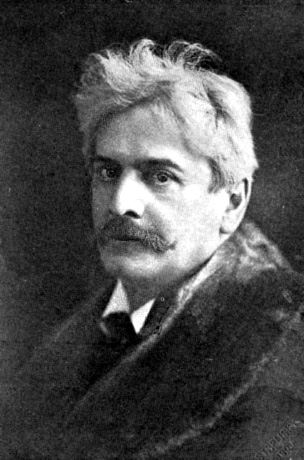
Above: cellist and composer David Popper
An unusual work by David Popper, Requiem, was originally composed for three cellos and orchestra; it was later transcribed for three double-basses and piano, which is how it was presented today (apparently there is also an arrangement for three trombones!).
It’s a terrifically original work, and the three bass players – Blake Hinson, Satoshi Okamoto, and Rion Wentworth – were clearly savouring this opportunity show off what the double-bass can do, whilst pianist Steven Beck played an integral role in this gem of a piece. The doleful depths of the three basses, both in harmonies and in solo passages, continually evoked shivers as the resonances seem to invade the very soul. Passages for solo piano gave contrast; at one point, a trace of the Ave Maria was heard. The basses meanwhile made me think of the profound beauty of the opening of the “Hymn to the Sun” from Mascagni’s Iris.
I enjoyed the Popper rarity immensely: kudos to the bassists for bringing it to us in all its richness.
To close the performance, Piano Trio #2 by Dmitri Shostakovich was given a sterling rendition by Yulia Ziskel (violin), Mr. Vickery (cello), and Jonathan Feldman (piano).
This was by far the most familiar work on the program, so I put away my note pad and let the music dazzle and move me in this performance by three exceptional artists. Ms. Ziskel is a violinist who always maintains an alluring gleam on her tone; her playing could be at once ethereal and heart-wrenching. Following her poignant solo in the Largo, Mr. Vickery’s cello joined her in music that is achingly beautiful and deeply moving. Their playing reached the heights of expressiveness.
The dazzling dance of the concluding Allegretto was so thrilling to experience today. Here Mr. Feldman’s brilliance and irresistible vitality were a pure joy, whilst Ms. Ziskel and Mr. Vickery continued to astonish. The quintet ends as the dance gives way to a reprise of the chorale of the Largo, providing a reassuring comfort which we so desperately need in these troubled times.
As the Shostakovich progressed today, the world around me seemed to vanish; both the music the musicians reached me on a level that is rarely attained. For such moments in life, how can we express our gratitude?
~ Oberon
-
MET Orchestra/Gergiev/Trifonov @ Carnegie Hall
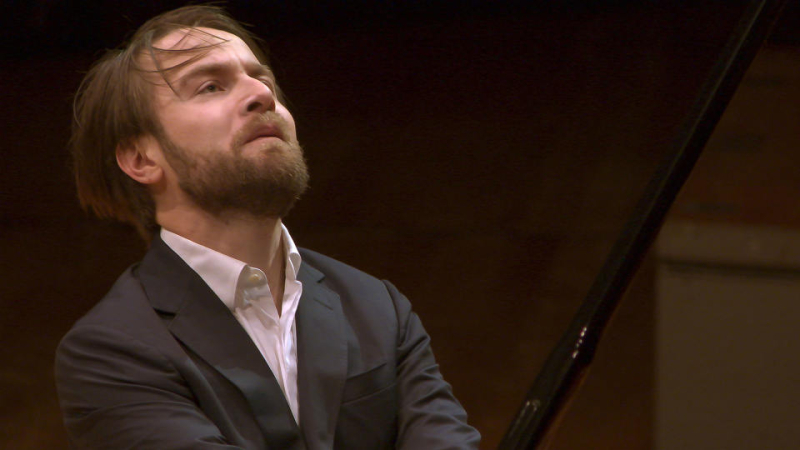
Above: pianist Daniil Trifonov
~ Author: Ben Weaver
Saturday May 18th, 2019 – The MET Orchestra made its way over to Carnegie Hall for one of its popular annual orchestral concerts. Former principal guest conductor Valery Gergiev – director of the Mariinsky Theater of St. Petersburg, and a regular presence on the Met podium – led the performances (without a podium, which seems to be his preferred method; one of his many eccentricities that also include conducting with what appears to be a toothpick.)
For the the first half of the concert Maestro Gergiev was joined by the star pianist Daniil Trifonov for Robert Schumann’s ever-green Piano Concerto in A minor. Mr. Trifonov is an excellent pianist, perhaps even a great one, even at his relatively young age. But as demonstrated by this particular performance (and not for the first time) he often displays his own eccentricities with music-making. He played the introduction to the concerto extremely slow (remarkably, one could hear some early echoes of Rachmaninoff in the piano and orchestra) – and then at the first sign of a something faster, Trifonov sped up like a runaway train. These extremes in the tempos – dragging slow and demonic fast – dominated the entire performance, but felt like an affectation, not organic music-making. This is not a new thing for Mr. Trifonov; his Carnegie Hall debut in 2011 (with Tchaikovsky’s 1st Piano Concerto, conducted by Gergiev) was criticized by the New York Times for similar behavior: “…he tended to offset extremely fast playing with extremely slow, more maundering than meditative: a manic-depressive approach…”
Needless to say, the fast playing was dazzlingly note-perfect. Trifonov does not attempt more than he can actually accomplish. And in the slow sections he frequently displayed extraordinary sensitivity and beauty. But on the whole the performance was, alas, mostly frustrating and even boring. I have little doubt that maestro Gergiev supported all of Trifonov’s choices: Gergiev himself frequently takes similar liberties with the tempo, especially in non-Russian repertoire. Sometimes it works (his Wagner is often thrilling for it), but only sometimes.
The audience greeted Trifonov’s performance warmly (to say the least) and he played a lovely, beautifully articulated and, dare I say, perfectly-paced encore – Schumann’s “Nicht schnell, mit Innigkeit” from Bunte Blätter, Op. 99, No. 1.
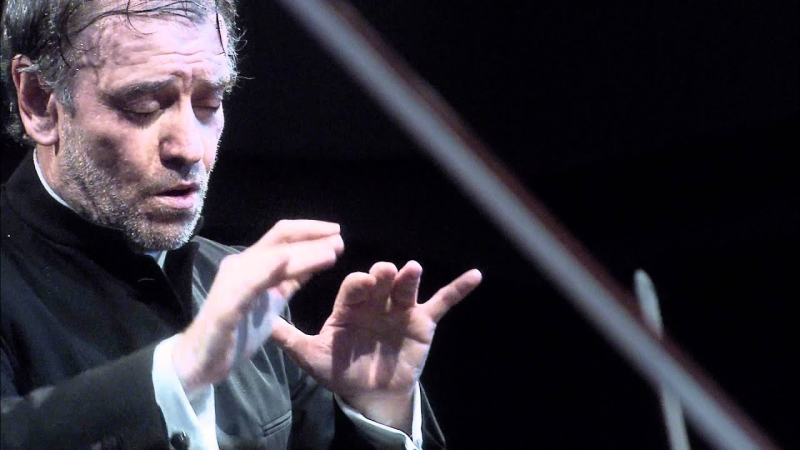
For the second half of the concert the MET Orchestra and Maestro Gergiev (above) took center stage for Franz Schubert’s last symphony, Symphony No. 9 in C major, completed in 1828, the year of his death. The manuscript collected dust in Schubert’s brother’s possession until 1837 when Robert Schumann, passing through Vienna, paid a visit to Ferdinand’s home and was rewarded with a “hoard of riches” of Schubert’s never-before seen manuscripts, including the final symphony. Schumann and his friend Felix Mendelssohn finally arranged the work’s premiere in 1839 under Mendelssohn’s baton. The premiere was not a success with the audiences and it took many years for the symphony to finally gain acceptance for the masterpiece it is. The work’s length, which Schumann called “heavenly,” was a big stumbling block. In due time composers like Anton Bruckner and Gustav Mahler out-composed Schubert’s 9th for time and the work finally did ascend to warhorse status.
The symphony opens with a call from a horn, played beautifully by (probably) MET’s principal hornist John Anderer. The orchestra, under Gergiev’s toothpick, sounded superb. Gergiev has been burnishing his German music credential as the new principal conductor of the Munich Philharmonic. The nicely articulated rhythm were clean and sharp. This work was far more consistently paced than the opening Schumann concerto. Gergiev kept the symphony moving at a clip that never felt rushed. Many solo instruments were given a chance to shine, particularly the woodwinds in the second movement. The Scherzo was graceful and the once controversial final movement – where in the 1830s Mendelssohn found London musicians laughing at the second theme of the movement and refusing to play it – was thrillingly played. But something was missing from the whole: perhaps a little variety of rhythm and dynamics. Gergiev conducting was extremely consistent, but in a work faulted by some for being too repetitive, consistency turned out to be something of a negative.
An extended ovation followed; the audience wanted an encore, but with an imperial wave Maestro Gergiev gave the orchestra permission to disband.
~ Ben Weaver
-
Shostakovich ~ Beethoven @ The NY Philharmonic
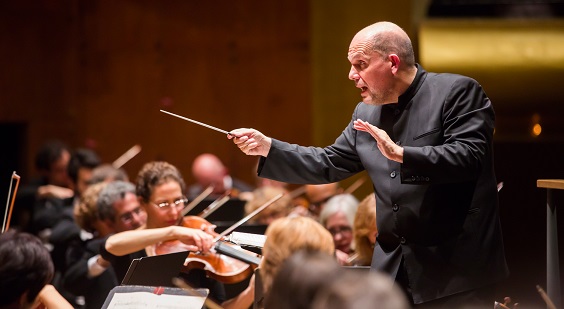
Above: Maestro Jaap van Zweden; photo by Chris Lee
~ Author: Oberon
Wednesday May 22nd, 2019 – As their 2018-2019 season winds down, The New York Philharmonic offered a well-contrasted pairing of works tonight at Geffen Hall: Shostakovich’s Chamber Symphony and Beethoven’s 3rd symphony: the Eroica. The Philharmonic musicians were on top form, and the orchestra’s Music Director, Jaap van Zweden, led a performance that ended with an enthusiastic ovation.
For all the concert’s musical excellence, extraneous factors made the evening something of a trial. The lobby at Geffen Hall during the half-hour leading up to the performance’s start time has lately become weirdly chaotic: it has the feeling of an airport, with staff folks yelling at you to go here or there, and long, snaking lines between the velvet ropes to pass thru the “non-invasive” scanner only to be wanded once you’ve gotten the green light. It’s quite stressful, and hardly conducive to the state of mind one hopes to be in when a concert starts: calm, focused, receptive.
The opening minutes of the Shostakovich featured a chorus of coughers from the audience; the woman next to us coughed throughout the concert while the fellow in front of us nearly busted a lung with one coughing fit: I actually thought he might pass out. Aside from ruining the music, germs are being spread. If you are sick, be courteous enough stay home.
But the performance of the Shostakovich Chamber Symphony was simply thrilling. This work is an arrangement of the composer’s 1960 String Quartet No. 8, Op. 110, by Rudolf Barshai, a renowned violist and conductor who founded the Moscow Chamber Orchestra in 1956. Barshai’s transcription honors the original instrumentation: it’s set for large string ensemble. And it’s simply magnificent to hear.
The symphony is in five movements, played without pause. From a somber start emerges a soft, sorrowing violin melody (beautifully played by concertmaster Frank Huang). Six basses bring a sense of grandeur to the music, which is richly layered. Suddenly, a sizzling energy flares up: the basses dig in, with swirling violins and slashing celli, as the music becomes a huge dance. For a spell, violins and violas compete; then the music comes to a sudden halt.
The violas set the pace for a waltz, played by the violins, which later slows down and fades away. A dirge-like passage is followed by a poignant lament. Carter Brey’s cello sings to us in its highest range, a song which Mr. Huang’s violin takes up. The music meanders a bit, ebbing and flowing, before a magical fading finish.
This work, and the Philharmonic’s playing of it, was one of the highlights of the season for me. Mssrs. Huang and Brey were enthusiastically applauded as they rose for a bow. I was surprised to read that this was The Philharmonic’s premiere performance of this symphony.
I must admit that I don’t find Beethoven’s Eroica all that interesting. Its initial theme:

…reminds me of a simple melodic scrap I wrote for a compulsory exercise in music theory class in high school. We hear it repeatedly in the symphony’s Allegro con brio, and to me it’s tiresome.
Sherry Sylar’s oboe solos and some warm-toned horn playing captured my interest in the Adagio assai, but I don’t think Beethoven’s idea of a funeral march shows much imagination. It feels aimless, missing the weighted grief of Chopin’s or the epic grandeur of Wagner’s (and for wit, there’s always Gounod). The hunting horns in the Scherzo again reminded me of high school, where I struggled to be a proficient horn player, but without success. Ms. Sylar and clarinetist Anthony McGill illuminated their solo bits in the Finale, but I found my mind wandering.
Whenever a musical work that is highly regarded by many fails to reach me, it makes me feel deficient. What am I not getting? So it was interesting to read in the program notes that Beethoven’s 3rd was not initially regarded as a masterpiece, but seemed instead overly long and lacking a sense of unity.
Still feeling that the Eroica has eluded me, I went to a classical music chat room to see if anyone else felt as I do about this symphony. Among the many posts heaping praise on Beethoven’s 3rd, someone wrote: “I would never deny the power and genius of the Eroica, but I never want to sit through it again.”

The evening honored musicians who are retiring from The Philharmonic this season. One who I will especially miss is violinist Anna Rabinova (above), whose dedicated artistry I have come to know thru her appearances at the Philharmonic Ensembles concerts at Merkin Hall. I hope she’ll continue to be part of the City’s musical scene in the coming years.
~ Oberon
-
Ernst Kozub

Above: Ernst Kozub as Lohengrin
The German tenor Ernst Kozub’s career is not well-documented. Born at Duisburg in 1924, he developed a thriving career, singing mainly Wagnerian roles. He performed extensively throughout Germany, and also at Covent Garden and Barcelona.
John Culshaw wanted Kozub to be the Siegfried on Sir Georg Solti’s recording of the complete RING Cycle for Decca. It’s believed that ill health prevented the tenor from learning the arduous role, and he was replaced as Siegfried by the veteran heldentenor Wolfgang Windgassen.
Ernst Kozub died on December 27, 1971, aged 47, at Bad Soden, Germany. Three weeks prior to his passing, he had sung Tannhauser in Italy. The cause of his early death is uncertain; it has been attributed to leukemia by some sources, and to a chronic heart disorder by others.
Here are some samples of Mr. Kozub’s singing:
Ernst Kozub – Die Zauberflöte ~ Dies Bildnis ist bezaubernd schön
Melitta Muszely & Ernst Kozub – Nun In Der Nächt’gen Stille ~ OTHELLO
Claire Watson & Ernst Kozub – WALKURE ~ Act I finale – London 1964 – Solti
~ Oberon
-
Ballets Russes @ Chamber Music Society
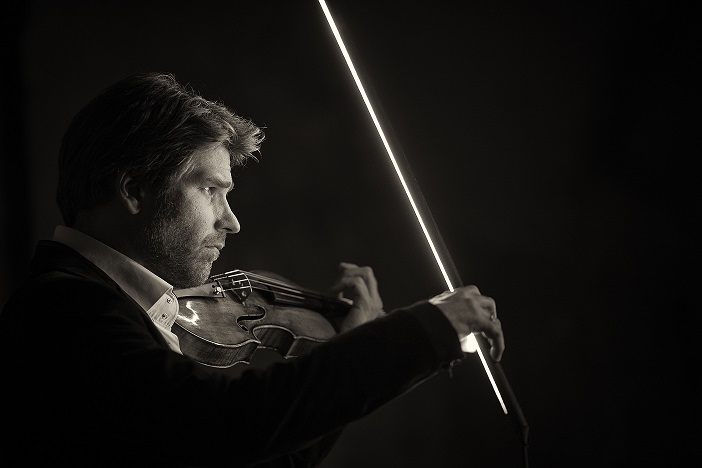
Above: violinist Nicolas Dautricourt, photographed by Bernard Martinez
~ Author: Oberon
Sunday May 19th, 2019 – For their final concert of the 2018-2019 season at Alice Tully Hall, Chamber Music Society of Lincoln Center offered a program of works by composers associated with Serge de Diaghilev’s Ballets Russes. It was a long program, full of rewards.
Jennifer Johnson Cano, the Metropolitan Opera mezzo-soprano who in February shared a memorable program with tenor Matthew Polenzani at Zankel Hall, sang works by Manuel de Falla and Maurice Ravel, and a septet of marvelous musicians were heard – in varying configurations – in these, plus music by Debussy, Prokofiev, and Stravinsky.

Ms. Cano (above, in a Matthu Placek portrait) opened the concert with Manuel de Falla’s Psyché in which she was joined by Tara Helen O’Connor (flute), Nicolas Dautricourt (violin), Yura Lee (viola), David Finckel (cello), and Bridget Kibbey (harp). Composed in 1924, as a setting of a poem by Georges Jean-Aubry, this is the awakening song of Psyché, a mortal woman whose beauty has caught the eye of Cupid, god of Love, who she will eventually marry.
The flûte enchantée of Tara Helen O’Connor opens the work; the addition of M. Dautricourt’s ethereal violin and Ms. Kibbey’s delicate harp create an exotic atmosphere. Ms. Cano’s singing – clear, warm, and wonderfully nuanced – was vastly pleasing; in her unaccompanied opening passage, the sheer beauty of her tone and its evenness throughout the registers marked her as a singer of exceptional natural gifts.
Adding depth and colour to the enticing ‘orchestration’ were Ms. Lee’s viola and Mr. Finckel’s cello; overall the five instrumentalists created an impression of a larger ensemble thru the richness of their individual timbres. The music becomes urgent, and Ms. Cano’s singing golden, as flute trills and harp melismas lure the ear. Psyché this evening was an intoxicating delight.
For Maurice Ravel’s chamber arrangement of Shéhérazade, Ms. Cano and Ms. O’Connor returned, along with pianist Alessio Bax. It’s Mr. Bax’s delicate, silvery playing that sets the mood of the opening song, Asie. At “Je voudrais voir des assassins souriant“, passion builds: Ms. Cano brought an operatic quality to her performance at this point, rising to her steady and blooming upper range to fine effect. Asie has a little pendant at the end, full of lovely mystery. It ends on an exquisitely tapered note.
La flûte enchantée brings forth limpid, entrancing sounds from Ms. O’Connor’s flute, and the weaving together of voice, flute, and piano is hypnotic. The concluding song, L’indifferent, begins with a calm lullabye played by Mr. Bax. Ms. Cano’s beguiling singing, sometimes bringing straight tone into play, was a marvel of expressiveness.
Infringing on our enjoyment of the Ravel was the sound of text booklets dropping onto the floor, and a crash of something falling in the outside corridor. But Ms. Cano held to her course; this is a truly wonderful voice that I would love to hear in the music of Massenet’s Charlotte.
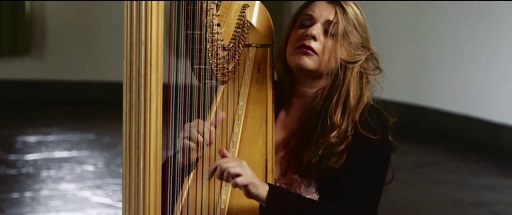
Above: harpist Bridget Kibbey
Mlles. O’Connor, Lee, and Kibbey then offered a sublime performance of Claude Debussy’s Sonata for Flute, Viola, and Harp, written in 1915. In an evening filled with marvelous sounds, the opening sustained flute tone of this sonata – taken up by the viola – sent chills thru me at the start of the Pastorale. The blend these three remarkable musicians produced was exceptional. A gentle animation arose – soft and merry – only to subside. Mlles. Lee and O’Connor duet, the viola deep and buzzy. Swirls of notes from the harp – and then from the flute – lingered on the air.
The Interlude commences with a viola melody underpinned by the harp, After a sprightly interjection, viola and flute play in unison, and the harp tapers to pianissimo.The viola is plucked, the music soft and swift. A percolating motif opens the Finale, like the break of dawn on a sunny day; after a momentary slowing down, the piece ends abruptly.
Prokofiev’s Sonata in D-major for Violin and Piano, Op. 94a, brought together Mssrs. Dautricourt and Bax for a fabulous performance that sparked a shouting, standing ovation from the crowd. Though the piece was composed in 1943 as a flute sonata, Prokofiev later obliged the great violinist David Oistrakh by creating a violin version, which premiered in 1944.
Mr. Dautricourt launched the sonata with a high sweet/melancholy song. As the music becomes increasingly animated, an ultra-familiar theme is heard, which will crop up several times along the way. Vibrant, agitated, march-like music ensues; Mr. Bax displays magic tricks of his own, and the movement has a lovely ending.
In the Scherzo, Mr. Dautricourt’s virtuosity is astounding. A demented, off-kilter dance commences, then slows to a high-lying interlude before resuming. The music, and the playing of it, are thrilling…and then it comes to a sudden halt.
The audience, who all evening applauded between movements, prompted the violinist to declare “Two more!” before commencing the Andante: a sorrowful song which tends to meander a bit over time, with a hint or two of of jazz thrown in; in the end it becomes high and eerie.
The concluding Allegro con brio dances along, with some respite for a poignant interlude before dancing on again. Moodiness briefly takes over, and then a rush to the finish. The applause began before the music stopped: Dautricourt/Bax are a winning team.

Lucille Chung and Alessio Bax (above, photographed by Lisa-Marie Mazzucco) joined together for the evening’s Fokine finale, saluting Diaghilev’s ground-breaking choreographer with a piano-four-hands arrangement of Igor Stravinsky’s Petrushka.
Despite more intrusions – a loud clang from the balcony, and the sound of something (or someone) falling – Stravinsky’s brilliance prevailed. For 40-minutes, the outstanding Bax/Chung duo sustained the vibrancy of a theatrical presentation; everything felt so alive – with dazzling rhythms and infinite colours – that the entire ballet danced in the mind. For their brilliant and generous playing, the couple were rewarded with hall-filling, joyous applause. What a way to end the season!
~ Oberon
-
Larcher and Brahms @ The NY Philharmonic

Above: composer Thomas Larcher
~ Author: Brad S. Ross
Thursday April 25th, 2019 – This evening at David Geffen Hall saw the performance of two imposing, if wildly dissimilar, symphonies—one old, the other new—as The New York Philharmonic made their best effort of this decidedly peculiar concert pairing. Guest conducting the program was the Russian-born Semyon Bychkov, whose steady command brought typically formidable results from our city’s prized orchestra.
The first half of the concert was given over to the United States premiere of the Austrian composer Thomas Larcher’s visceral Symphony No. 2: Kenotaph. It was prefaced with opening remarks by Larcher, who offered concise and mercifully brief pre-performance context for the work. The title (German for “cenotaph”) refers to an empty grave or monument to those buried elsewhere. It was composed between 2015 and 2016 amid the peak of the Syrian refugee crisis, which saw hundreds of thousands of migrants fleeing from their homeland towards a less-than-welcoming central Europe. This tragedy was foremost on Larcher’s mind as he wrote Kenotaph, which, as he put it, is not so much programmatic music as it is “music with empathy.” Its form is cast, quite traditionally, in four movements over a duration of roughly 37 minutes.
It opened with a bang on a furious, colorful Allegro, marked by numerous volatile bursts. This momentum retreated briefly into a somber elegy, before returning with ferocious energy—an energy marked with shrieking strings, discordant brass bursts, and unrelenting percussion that led it to a frightening close. Although occasionally on the discursive side, the movement was characterized by a gripping sense of musical drama that would set the tone for the rest of the work.
It was followed by a mournful, string-heavy Adagio that opened on repeating glissandi in the high strings as warm brass chords and descending mallet lines swelled and trickled underneath—the effect was almost like something out of science fiction. A voluminous march then launched the music into fearful new atmospheres as a lone violin line, performed by the concertmaster Frank Huang, faded the movement into a haunting silence.
Next up was plucky and energetic Scherzo, molto allegro, driven by excitingly colorful percussion. Accelerating tutti bell tones led the piece to a series of fortissimo bursts before an almost Baroque and, by comparison, shockingly tonal phrase brought the movement to a pleasant, bittersweet end.
The final movement, Introduzione, was a somber and almost elegiac affair. It began with a number of featured soli—trumpet, violin, viola—which, once again, were surprisingly tonal in sound. The movement soon became violent and triumphant, as though the gates of hell had been thrust open and the devil himself was leading the charge. The composition here was not unlike Camille Saint-Saëns’s Danse macabre, Malcolm Arnold’s Tam O’Shanter Overture, or some other ghastly jaunt of classical music history. Larcher delightfully milked this for all it was worth and brought the movement to a number false codas before its final climax—always finding ways to say more without ever overstuffing the piece. A quiet postlude followed that featured a ghostly violin solo—again performed by Huang. Finally, as if burying the dead, a tasteful, yet haunting funeral march brought the symphony to its final and, appropriately, unresolved cadence.
The audience’s response was kind, if not totally enthusiastic. A modest number of curtain calls gave Larcher, Bychkov, and the work’s soloists much-deserved chances to take their bows, which, given the strangely contrasted pairing, is perhaps the best for which one could hope. Nevertheless, musically Kenotaph should be regarded as one of the New York Philharmonic’s most exciting premieres of recent memory, alongside Esa-Pekka Salonen’s Cello Concerto, Anna Thorvaldsdottir’s Metacosmos, or Julia Wolfe’s Fire in my mouth.
Had the evening had ended here—and it probably should have—this might have been one of the best concerts of the season. Ticket-holders tend to require more than forty minutes of music to feel satiated, however, so after intermission the audience returned for an enjoyable, if unremarkable, performance of Johannes Brahms’s Fourth Symphony.
Composed between the summers of 1884 and 1885, this would be the last of the Romantic composer’s symphonies before his death in 1897. Cast in four movements over approximately 45 minutes, it comprises a lush and stately Allegro non troppo, a warm and overlong Andante moderato, a fairly dainty Allegro giocoso, and a lively Allegro energico e passionato, which finally injected some much-needed energy to the second half of the program.
After the riveting first half of the concert, this listening experience was almost soporific by comparison. Perhaps it’s simply unfair to judge such an antiquated work against the rigorous complexities of one so new, but it’s one this odd pairing begged to be made. Nevertheless, one could not possibly walk away from this concert feeling anything less than satisfied. All in all, it was another splendid night at the New York Philharmonic—the gem of this great city.
~ Brad S. Ross
-
From Mendelssohn @ Chamber Music Society

Above: pianist Inon Barnatan, photographed by Marco Borggreve
~ Author: Oberon
Sunday April 28th, 2019 – Music by Felix Mendelssohn, and by three composers he inspired, was on offer by Chamber Music Society of Lincoln Center at Alice Tully Hall this evening. The Society drew together an international ensemble of extraordinary musicians for a program of mostly familiar works, with a Schumann gem – a piece I’d never heard, nor even heard of – thrown into the mix for good measure.
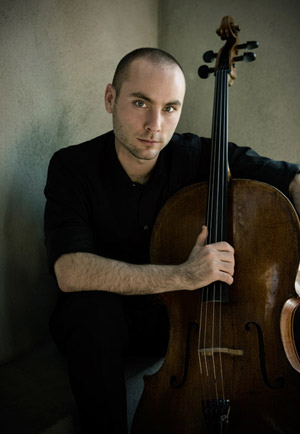
The Swedish cellist Jakob Koranyi (above in a Lisa-Marie Mazzucco photo) and Israeli pianist Inon Barnatan opened the concert with Mendelssohn’s Lied ohne Worte in D-major, Op. 109. The musicians proved to be an ideal pairing: they both play from the heart. This is a song sung by the cello, with a bittersweet melody, and an interlude that is passionate and then animated, before leading back to theme. The cellist ranges from a ravishingly sustained and tapered high note to – soon after – a plunge to the depths; the music ends with a rising phrase. A packed house called the two gentlemen back for a bow. The evening was off to a wonderful start.
Robert Schumann’s Märchenerzählungen (‘Fairy Tales‘) for Clarinet, Viola, and Piano, Op. 132, was one of the composer’s last completed works. It was written in 1853, just five months before his attempted suicide and his subsequent confinement in a mental institution, where he died in 1856 at the age of 46.
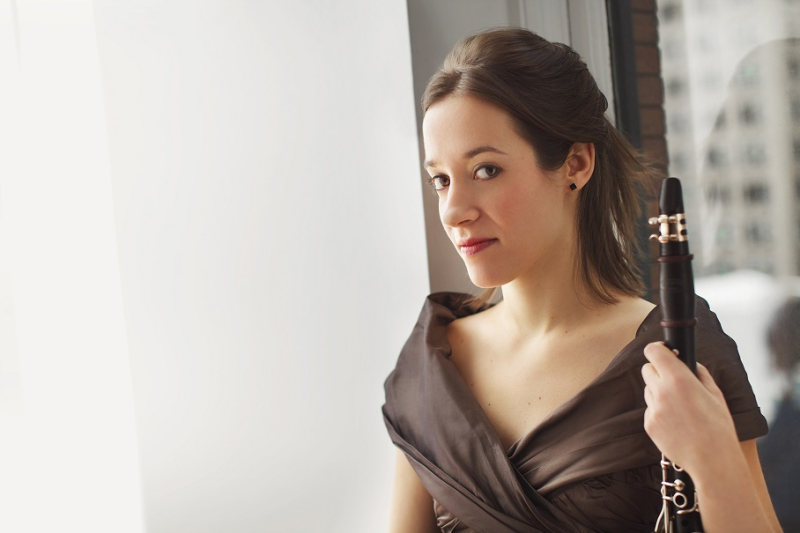
Märchenerzählungen brought forth the excellent Canadian clarinetist Romie DeGuise-Langlois (above); living as we do in a time when a number of superb clarinetists have thriving careers, it’s always a special pleasure for me to hear Romie, with her colorful tone and abundant technique. She was joined by violist Paul Neubauer and Mr. Barnatan for the four miniatures that comprise Märchenerzählungen.
The entwining of the mezzo-soprano-ranged voices of clarinet and viola was intriguing to hear: in the first movement, the music veers from playful to songful with lightness of mood, and Romie’s dynamic range – and her very pretty trill – were beautifully evident.
An almost march-like pace commences the second movement, with blithely harmonized duetting from the clarinet and viola. An ensuing darkish mood felt a bit tongue-in-cheek: was Schumann toying with us?
Mssrs. Neubauer and Barnatan open the third movement with sublime softness, joined soon by the clarinet. A wistfully exquisite blend of the three instruments – with immaculate turns of phrase – became achingly beautiful in its freely flowing lyricism. The movement’s sustained ending was very touching.
In the final movement, clarinet and viola converse, then are heard as a duo. A charming interlude, with lightly etched motifs from Mr. Barnatan at the Steinway, shifts onward to a gallant finish. The only fault I could find with this Schumann work was that it’s too short: I wanted to hear more from Ms. DeGuise-Langlois.

Paul Neubauer (above, in a Tristan Cook photo) returned immediately with Mr. Barnatan for a lustrous performance of Johannes Brahms’ Sonata in E-flat major for Viola and Piano, Op. 120, No. 2, composed in 1894. The opening Allegro amabile brings us a sweet and subtle song, followed by a passionate passage from the pianist. Things then settle into a rather pensive state, both players delighting us with their dynamic palette and their feeling for the ebb and flow of the themes. A Romantic atmosphere, with the music soft and lovely, carries us thru a change of mood.
In the second movement, Appassionato, the urgent passion of the opening statement subsides, but an underlying restlessness lingers. A hymn-like theme for solo piano lets us savour Mr. Barnatan’s artistry; joining in, Mr. Neubauer’s viola carries the melody to the instrument’s depths. In a sudden upswing, the music turns waltzy…and then finds a cool, darkish ending.
The sonata’s final movement has a simple theme; the music is slow, with an air of Bach about it. A charming dance variation crops up, playful in its quirky swiftness, which is eventually becalmed. The work ends with a multi-faceted coda. Mssrs. Neubauer and Barnatan were rightly hailed for their warm-hearted performance.
Following the interval, Mr. Barnatan had the stage to himself for “Juin – Barcarolle” from Tchaikovsky’s Les saisons for Piano, Op. 37b. This is echt-Tchaikovsky, with Mr. Barnatan relishing each note of the theme, which is thoughtful, and almost somber. Following a brief animation, descending notes bring us back to the melody. The music takes on a sort of shimmer, and then goes deep before rising to a soft, fading finish.

Above: violinist Cho-Liang Lin, photo by K C Alfred
The evening ended with a glorious performance of the Mendelssohn Trio No. 2 in C-minor for Piano, Violin, and Cello, Op. 66, in which Mssrs. Koranyi and Barnatan were joined by master violinist Cho-Liang Lin. The two Mendelssohn piano trios were the first chamber works to seize my attention, back at a time when I listened almost exclusively to opera.
The passion – and the abundant lyric detail – of the music was served to perfection by Mssrs. Lin, Koranyi, and Barnatan. Their performance had a polish and glow that somehow made the music sound even more gorgeous to me than it ever has. It would be hard to imagine anything more moving – and thrilling – to me on a personal level than experiencing this music (which essentially opened up a new world for me when I heard it by chance on the radio…oh!, so many years ago) played with such lustre and vitality as it was tonight. A sublime, poignant experience; all my emotions were in play.
It meant so much to me to be hearing this performance, as offered by the Chamber Music Society where – in the past few years, thanks to their generous welcome – I have had the opportunity to explore the vast chamber music repertoire, played by the great artists of our time. I became quite emotional as the trio of musicians produced one glorious passage after another tonight. And, in fact, the entire audience seemed to have fallen under a spell of enchantment.
The bows were not even off the strings when the applause commenced, the audience expressing their fervent delight with the performance – and their admiration for the musicians – in a spontaneous, full-house standing ovation. The players took a second bow as shouts of ‘bravo!‘ rang thru the hall.
~ Oberon
-
@ My Met Score Desk for GOTTERDAMMERUNG

Above: the Norn Scene from the Lepage/Met Opera production of GOTTERDAMMERUNG
~ Author: Oberon
Saturday April 27th, 2019 matinee – The best thing about today’s matinee of Wagner’s GOTTERDAMMERUNG at The Met was the Norn Scene. With a mood of mystery and doom evoked by Maestro Philippe Jordan and the Met Orchestra in the prelude, the three singers who were weaving the ‘Rope of Destiny’ today were Ronnita Miller, Elizabeth Bishop, and Wendy Bryn Harmer. Each sounded splendid in her own way.
Ms. Miller has a rich, deep contralto timbre; Ms. Bishop a brighter quality with a strong feeling for lyricism; and Ms. Harmer an authentic Wagnerian soprano voice: house-filling, with an ample high range. Each has a prolonged solo passage, describing much that has transpired in the first three operas of the RING Cycle.
From her lush “Dammert der Tag?“, Ms. Miller had me in her thrall: such a dusky, abundant sound. She continued to fascinate me with “Die Nacht Weicht…” and concluded the scene with a deep plunge on “Hinab!” that had an other-worldly resonance.
Ms. Bishop, who has been an excellent Dido and Iphigénie at The Met, was likewise in excellent voice today, and she brought subtlety and point to the words. Ms. Harmer’s singing was huge and grandly styled, her high notes gleaming.
As the Norns descended to their mother, Erda, my hopes were high that the vocal standard they had set would be upheld as the afternoon progressed. In the interlude before the Dawn Duet, the noble horns and the Met’s fabulous clarinetist Inn-Hyuck Cho gave a sublime build-up to the entrance of Christine Goerke and Andreas Schager as Brünnhilde and Siegfried, the latter making his Met debut today.
Ms. Goerke got off to a fine start, but – later in the prologue – her notes around G above the staff seemed a bit sour, and the high-C was there – and long – but a shade flat. Mr. Schager has a voice of helden-power, with some brassiness cropping up, and a steady beat to the tone.
The Rhine Journey was light and lively at first, and then turned epic. At the Gibichung Hall, we meet Gunther (Evgeny Nikitin, darkish of timbre and firm-toned), Gutrune (Edith Haller, debuting in a role Ms. Harmer might have doubled), and Hagen (Eric Owens, somewhat lacking in the monumental power of a Salminen or a König). The conductor tended to cover Mr. Owens at times, but the bass-baritone was chilling as he described in whispers the potion with which he would ensnare Siegfried.
Siegfried arrives at the Gibichung Hall to the sound of bungled horn calls; blood-brotherhood is sworn, and the hero’s fate is sealed. Left alone, Mr. Owens in Hagen’s Watch sang well, but seemed more efficient than thrilling, and was unaided by the conductor.
The clarinets depict a return to Brünnhilde’s Rock, where Ms. Goerke impresses as she welcomes her sister Waltraute, sung by Michaela Schuster – the mezzo whose Klytemnnestra last season was so impressive. Ms. Schuster brought a wealth of nuance to her narrative, which had a sense of intimacy as well as urgency: doom is at hand, she warns. Bringing a spine-tingling sense of introspection to her description of the resigned, weary Wotan, Ms. Schuster’s singing seemed truly personal, showing great vocal control; telling Brünnhilde that their father had spoken wistfully of her, the mezzo’s low notes were so alive. And she was simply glorious at “Erlöst war‘ Gott und Welt…” Her plea to Brünnhilde to abandon the ring causes the final rift between the two sisters: with a desperate cry, Waltraute rushes away.
The excitement as Brünnhilde senses Siegfried’s return was somewhat dulled by Ms. Goerke’s non-blooming top range. But in the final moments of the act, Mr. Schager suddenly sounded like the tenor we’d been reading about.
I would have liked to have heard Tomasz Konieczny’s Alberich in his scene with Hagen that opens Act II, but decided instead that the RING was over for me this season, and I headed home. The good has been very good, but there’s also been quite a lot of singing that left me feeling indifferent. It’s not a matter of how these operas should sound, but how they can sound.
~ Oberon
 Oberon's Glade