Blog
-
Back at the Ballet
Wednesday January 25th, 2017 – I haven’t been to a New York City Ballet performance since Jennie Somogyi’s farewell in 2015, but I keep running into the dancers and am constantly reminded of how much I miss watching them dance. A few weeks ago, on a whim, I ordered a ticket for tonight’s all-Balanchine program, before casting was announced. A domestic surprise – a nice one – called me home early: I missed FOUR TEMPERAMENTS tonight. But I greatly enjoyed seeing ALLEGRO BRILLANTE and the Balanchine SWAN LAKE again.
On entering the theater lobby, I was very happy to see that The Lyre has been restored to a place of honor. Once seated, I watched the musicians warming up while the theater filled slowly. I was not feeling the old sense of anticipation, and I was not sure if my idea of re-connecting with NYCB was making sense: perhaps it’s a chapter best left closed?
But then the house lights went down; pianist Susan Walters and conductor Andrew Litton entered the pit for ALLEGRO BRILLANTE and suddenly it felt right to be there. This was my first experience of having Andrew Litton on the podium; the orchestra – apart from a random note or two going astray in SWAN LAKE – played the big Tchaikovsky themes sumptuously. Ms. Walters did a beautiful job with ALLEGRO BRILLANTE; and later in the evening, concertmaster Arturo Delmoni played a ravishing White Swan solo.
Tiler Peck was originally listed for ALLEGRO BRILLANTE, but a pre-curtain announcement informed us that Megan Fairchild would be dancing instead. I was pleased with this announcement, as I’d become quite an admirer of Ms. Fairchild over time; I was curious to see how the Fairchild/Veyette partnership would work under the circumstances, but they are both professionals and carried it off in fine style. Megan’s dancing had a lovely lyrical feeling, and I began to realize how very much I have missed her dancing over the past several months.
When the swans made their entry in the Balanchine SWAN LAKE, it really sank in just how long I’d been away: hardly a familiar ballerina in sight. There was a time when I knew every single person in the Company and could scan a large group of corps dancers with my opera glasses and see one friendly face after another. Tonight the girls seemed beautifully anonymous; I wonder who among them might captivate me as Rebecca Krohn and Ashley Laracey had once done, right from their first performances with the Company?
The soloists, Megan LeCrone and Lauren King, both danced very well. Teresa Reichlen and Russell Janzen created a true sense of poetry and ill-fated romance in their partnership. Russell looks the epitome of a romantic hero: his sense of wonder at finding this fragile creature by the lake, and his desire to protect and cherish her were beautifully expressed. Tess was an elegant Swan Queen, terrified at first and only slowly surrendering to the calming effects of Russell’s care. The two long-limbed dancers make a striking couple, and their ardent tenderness mirrored the music ideally. They were rapturously applauded, and called out for an extra bow.
In ALLEGRO BRILLANTE, I was particularly impressed by the dancing of the supporting ensemble of eight dancers; Balanchine gives them plenty to do, and they all looked superb. These are dancers I followed closely back in my days as an NYCB regular, and it was really good to see them all again, looking so attractive and dancing with such assurance and grace: Megan Johnson, Meagan Mann, Gretchen Smith, Lydia Wellington, Devin Alberda, Daniel Applebaum, Cameron Dieck, and Aaron Sanz. Watching them, I was keenly aware of what I’ve been missing.
-
Back at the Ballet
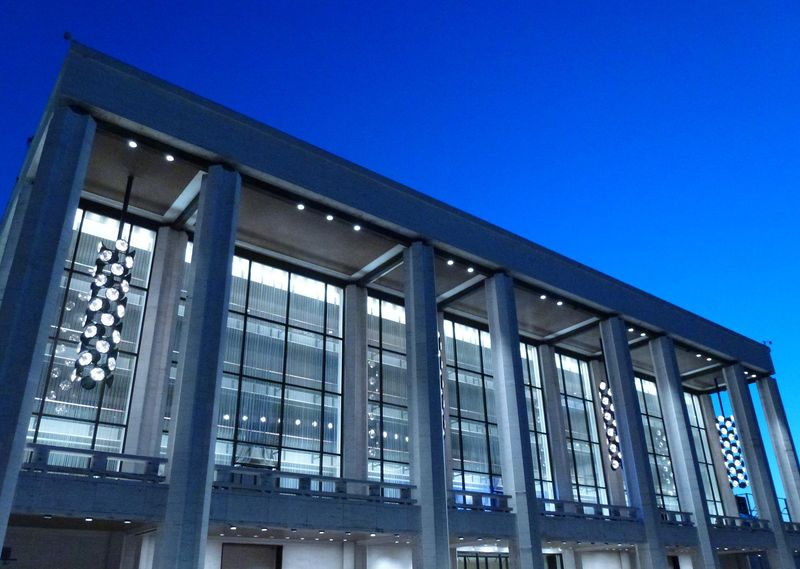
Wednesday January 25th, 2017 – I haven’t been to a New York City Ballet performance since Jennie Somogyi’s farewell in 2015, but I keep running into the dancers and am constantly reminded of how much I miss watching them dance. A few weeks ago, on a whim, I ordered a ticket for tonight’s all-Balanchine program, before casting was announced. A domestic surprise – a nice one – called me home early: I missed FOUR TEMPERAMENTS tonight. But I greatly enjoyed seeing ALLEGRO BRILLANTE and the Balanchine SWAN LAKE again.
On entering the theater lobby, I was very happy to see that The Lyre has been restored to a place of honor. Once seated, I watched the musicians warming up while the theater filled slowly. I was not feeling the old sense of anticipation, and I was not sure if my idea of re-connecting with NYCB was making sense: perhaps it’s a chapter best left closed?
But then the house lights went down; pianist Susan Walters and conductor Andrew Litton entered the pit for ALLEGRO BRILLANTE and suddenly it felt right to be there. This was my first experience of having Andrew Litton on the podium; the orchestra – apart from a random note or two going astray in SWAN LAKE – played the big Tchaikovsky themes sumptuously. Ms. Walters did a beautiful job with ALLEGRO BRILLANTE; and later in the evening, concertmaster Arturo Delmoni played a ravishing White Swan solo.
Tiler Peck was originally listed for ALLEGRO BRILLANTE, but a pre-curtain announcement informed us that Megan Fairchild would be dancing instead. I was pleased with this announcement, as I’d become quite an admirer of Ms. Fairchild over time; I was curious to see how the Fairchild/Veyette partnership would work under the circumstances, but they are both professionals and carried it off in fine style. Megan’s dancing had a lovely lyrical feeling, and I began to realize how very much I have missed her dancing over the past several months.
When the swans made their entry in the Balanchine SWAN LAKE, it really sank in just how long I’d been away: hardly a familiar ballerina in sight. There was a time when I knew every single person in the Company and could scan a large group of corps dancers with my opera glasses and see one friendly face after another. Tonight the girls seemed beautifully anonymous; I wonder who among them might captivate me as Rebecca Krohn and Ashley Laracey had once done, right from their first performances with the Company?
The soloists, Megan LeCrone and Lauren King, both danced very well. Teresa Reichlen and Russell Janzen created a true sense of poetry and ill-fated romance in their partnership. Russell looks the epitome of a romantic hero: his sense of wonder at finding this fragile creature by the lake, and his desire to protect and cherish her were beautifully expressed. Tess was an elegant Swan Queen, terrified at first and only slowly surrendering to the calming effects of Russell’s care. The two long-limbed dancers make a striking couple, and their ardent tenderness mirrored the music ideally. They were rapturously applauded, and called out for an extra bow.
In ALLEGRO BRILLANTE, I was particularly impressed by the dancing of the supporting ensemble of eight dancers; Balanchine gives them plenty to do, and they all looked superb. These are dancers I followed closely back in my days as an NYCB regular, and it was really good to see them all again, looking so attractive and dancing with such assurance and grace: Megan Johnson, Meagan Mann, Gretchen Smith, Lydia Wellington, Devin Alberda, Daniel Applebaum, Cameron Dieck, and Aaron Sanz. Watching them, I was keenly aware of what I’ve been missing.
-
Clarinet Trios @ Chamber Music Society
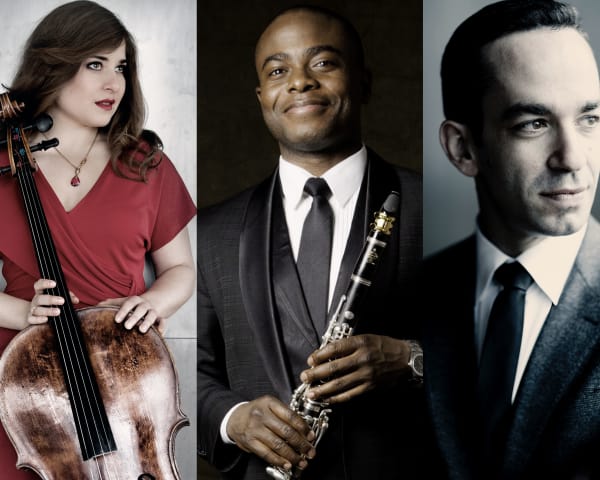
Tuesday January 24th, 2017 – Cellist Alisa Weilerstein, clarinetist Anthony McGill, and pianist Inon Barnatan sharing the Alice Tully Hall stage in a program of piano trios presented by Chamber Music Society of Lincoln Center. Beloved works by Beethoven and Brahms book-ended the New York premiere of Short Stories for Clarinet, Cello, and Piano by Joseph Hallman. The presence of three such superb artists on the program signaled this as a red-letter event in the current season; I’d been looking forward to this evening for months, and it truly surpassed expectations.
The three artists took the stage, Ms. Weilerstein in a beautiful deep violet gown, and launched the Beethoven Trio for Clarinet, Cello, and Piano, opus 11; it quickly became evident that we were in for a night of exceptional music-making. In this particular work, exuberance and delicacy alternate in perfect measure, and the three players relished both the propulsive passages and – most enticingly – those moments when nuance is all.
One of Beethoven’s early masterpieces, this clarinet trio shows the influence of Haydn and Mozart; but once can clearly sense that Beethoven is already finding his own voice. The writing for the three instruments is often conversational, and how lovingly our three musicians this evening spoke to one another.
The opening Allegro con brio is alive with rhythmic delights, including a touch of syncopated witticism. Mr. Barnatan’s scintillating agility was a constant attraction, and it was a great pleasure to watch the communication between the three players.
Ms. Weilerstein opened the Adagio with a cello theme; her heartfelt playing took this simple, straight-forward melody to the heights. She and Mr. McGill duetted tenderly, both playing with great subtlety. The music becomes achingly gorgeous.
Good humor abounds in the Theme and variations setting of the finale: drawing on an aria wildly popular at the time, “Pria ch’io l’impegno” (“Before I begin, I must eat”) from Joseph Weigl’s opera L’AMOR MARINARO, Beethoven sets up bravura hurdles for the three musicians, all of them joyously over-leapt by our intrepid trio. Mr. Barnatan revels in the cascading piano passages, peaking in a perfect cadenza which ends with king-sized trills. Meanwhile Ms. Weilerstein and Mr. McGill seem to finish each other’s sentences, indulging in an amiable game of “Anything you can play, I can play finer!” Again, the sense of camaraderie, and of the players’ anticipation of the sheer pleasure of playing the next phrase, kept the audience visually engaged.
Short Stories, the new Hallman work, is a five-movement trio; it might also be called Scenes from a Relationship. One doesn’t, however, need any narrative reference to enjoy this purely as a musical experience, for Mr. Hallman is an excellent craftsman, and a colorist as well. The composer was sitting just a seat away from us; I can only imagine how delighted he must have been to hear his music being played by three such paragons…a veritable dream come true.
The opening movement, the Break-up, gets off to a stuttering start. The cello shivers before going deep and mournful, whilst the clarinet comments on her predicament. Then they switch roles, like a therapist taking over the couch from his patient. They play in unison, and things turn temporarily witty. But the music ends in the depths.
familial memories at a funeral opens with Mr. McGill’s clarinet in a whispering, misterioso mood. After briefly perking up, a pensive quality develops with a repeated two-note motif for the piano. The clarinetist’s astounding breath-control and his sustained beauty of tone throughout the dynamic range keep the audience mesmerized.
back-and-white noir: hardboiled with a heart of gold is the whimsical title of the third story. It begins agitato, developing an off-kilter rhythm. Mr. Barnatan sweeps up to the high register, while the clarinet and cello play a droopy duo. Ms. Weilerstein then descends to her velvety deep range. The music ebbs and flows, both rhythmically and tonally, as the composer explores the coloristic possibilities of the three instruments.
regret is for the weak is a title that hits home. Mr. Hallman here sets up an eerie, hesitant start. The clarinet percolates briefly, then settles into a very quiet mood whilst the cellist plucks; later, the cello trembles while the piano sounds softly. We seem to be in a moody memory, with Mr. Barnatan drawing forth fleeting surges of melody. Ms. Weilerstein and Mr. McGill sing sadly before the pianist dips down to a punctuating low note.
In the path of the curve, Mr. Barnatan sometimes reaches inside the piano to manipulate the sound. The music here is very quiet, until the clarinet starts warbling. Fluttering and swirling motifs sneak in, then the music seems to run down and the cello again deepens. The piece ends in a sustained quietude.
The only slight reservation I had about Short Stories was that the final movement is perhaps a bit too drawn out; my companion felt the same way. It was unfortunate that, during the work’s quiet closing moments, a cellphone went off directly behind us. At the same time, someone in the from row had a violent coughing fit. Such unfortunate timing. Yet despite these distractions, the Short Stories each cast their own spell, and they were spectacularly played.
Following the interval, the Brahms trio (opus 114) found the three artists on the heavenly heights of tonal and technical perfection, their playing so generous and emotive. From Ms. Weilerstein’s sublime playing of the yearning opening theme, thru the plaintive entry of Mr. McGill’s clarinet and the ever-expressive beauty Mr. Barnatan drew from keyboard, the music took on an impassioned glow. In my scrawled notes, the word “gorgeous’ appears over a dozen times.
Mr. McGill’s spellbinding playing of the sweetly serene theme that opens the Adagio was a magical passage, taken up by the soulful spirituality of Ms. Weilerstein’s cello. The luminous qualities of clarinet and cello are set in high relief by the profound tranquillity evoked by Mr. Barnatan. A long-lined clarinet solo leaves one grasping for adjectives to describe the McGill sound, and his ardent tapering of line. One wanted this meditation by the three players to linger on and on.
A questioning clarinet passage and more marvelous phrasing from Mr. Barnatan set up the waltz-like grace of the Andantino. After a brief diversion, we dance on towards the movement’s end; unexpectedly, Brahms tucks in a calming coda to make a lovely finish.
Restraint is cast aside as the trio dig into the concluding Allegro. A tinge of gypsy colour weaves thru this music. Ms. Weilerstein takes up a melody which she passes to Mr. McGill; then they harmonize. Things speed up. “More cello passion!” was my last dashed-off remark; the Brahms sailed on to its joyous conclusion, and the three stellar artists were greeted with immediate shouts of approval. They took a double curtain call, delighting the crowd.
A thought that recurred to me frequently during the evening was: if Mozart had met McGill, Amadeus would have written DIE ZAUBERKLARINETTE.
- Beethoven Trio in B-flat major for Clarinet, Cello, and Piano, Op. 11 (1797)
- Hallman Short Stories for Clarinet, Cello, and Piano (CMS Co-Commission) (New York premiere) (2016)
- Brahms Trio in A minor for Clarinet, Cello, and Piano, Op. 114 (1891)
-
Sidi Larbi Cherkaoui @ Martha Graham Dance Co

Above: members of The Martha Graham Dance Company at a studio showing of MOSAIC, a new work being created for the Company by choreographer Sidi Larbi Cherkaoui; photo by Brigid Pierce. MOSAIC will premiere during the upcoming Graham season at The Joyce, which opens on February 14th. Details and tickets here.
On January 11th, 2017, friends of Graham gathered at the Company’s homespace at Westbeth on Bethune Street for a first look at the new Cherkaoui piece. This is my fourth time experiencing this choreographer’s work: in 2009, Cedar Lake Contemporary Ballet premiered Larbi’s ORBO NOVO; in 2010, his SUTRA was performed as part of the White Lights Festival; and this past Summer, HARBOR ME was performed at the Joyce by LA Dance Project.
MOSAIC is danced to a score by Felix Buxton; the choreography has a sultry, swaying, Middle Eastern feel. Without giving away more than that, I will only say the Graham dancers look sexy as ever in this provocative style. It was really great seeing Jason Kittelberger, an iconic dancer with the late, lamented Cedar Lake Company; Jason is Larbi’s choreographic assistant for MOSAIC and he introduced the work this evening.
Here are a some images from the showing of MOSAIC; the photographer is Brigid Pierce:

Anne Souder

Leslie Andrea Williams, Lorenzo Pagano, Anne Souder, Lloyd Mayor
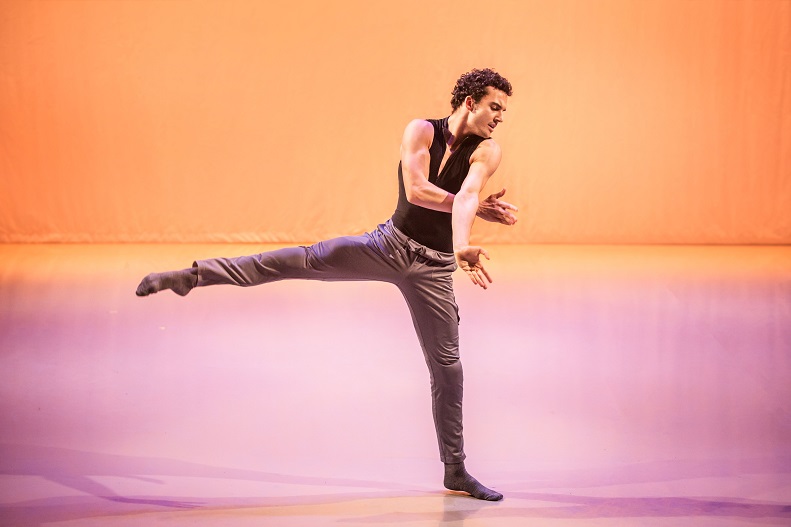
Lorenzo Pagano
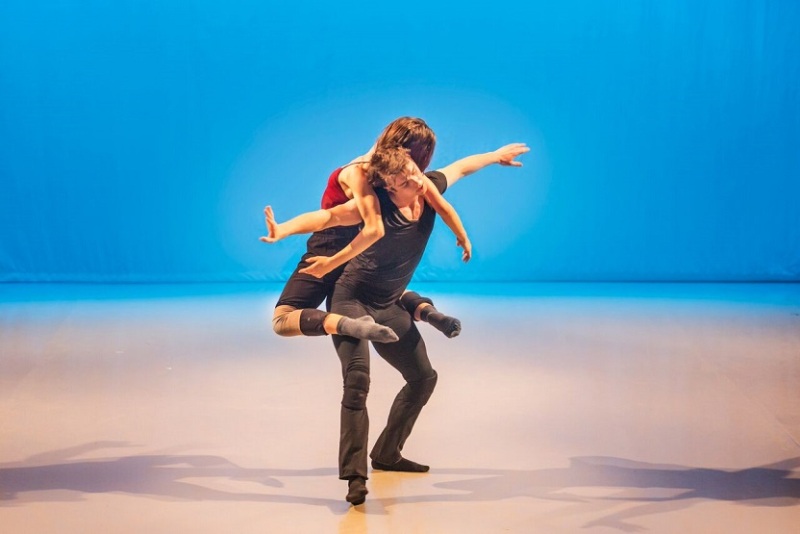
Anne Souder, Lloyd Mayor

Anne Souder, Lloyd Mayor
In addition to MOSAIC, the repertoire for the upcoming Graham season at The Joyce features a premiere by Annie-B Parsons, recent works by Nacho Duato and Pontus Lidberg, a revival of Martha Graham’s PRIMITIVE MYSTERIES, as well as Graham classics MAPLE LEAF RAG, DARK MEADOW SUITE, DIVERSION OF ANGELS, and CLYTEMNESTRA Act II.
I’m hoping to get to a studio rehearsal before the season at The Joyce begins.
-
Irene Dalis: “Er wird zu Stein!”
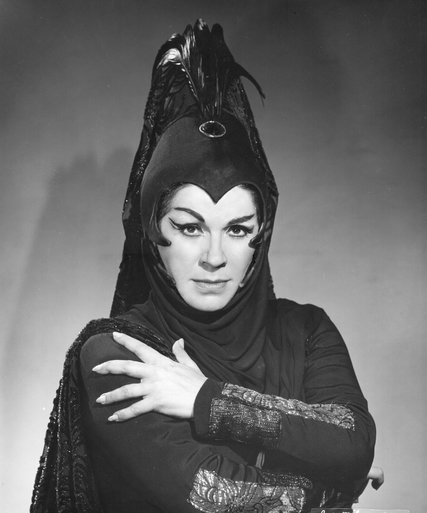
The great mezzo-soprano Irene Dalis (above) found her most memorable role as The Nurse in Richard Strauss’s DIE FRAU OHNE SCHATTEN; I was fortunate enough to have seen her in this opera twice at The Met, and both times she simply dazzled in the fiendishly difficult vocal writing whilst creating a vivid theatrical portrait of this mercurial creature.
The Nurse above all is devoted – to the point of obsession – to her charge: the half-human/half-spirit Empress, daughter of the mysterious and omniscient Keikobad. In the opera’s opening scene, the Nurse is visited by Keikobad’s messenger. The Empress has been married to the Emperor, a mere mortal, for one year, but as she still does not cast a shadow – the sign of her ability to bear children – Keikobad plans to re-claim her for the spirit world in three days. The Nurse is delighted, as she very much hates living among humans and longs to return to Keikobad’s realm.
The Nurse asks what will become of the Emperor after the Empress is taken by her father; “Er wird zu Stein!” says the Messenger: “He will be turned to stone!” This prospect gives the Nurse even greater satisfaction: “He will be turned to stone!” she repeats. “There do I recognize Keikobad, and bow before him!”
FRAU ~ opening scene – Irene Dalis & William Dooley – Bohm cond – Met bcast 1966
-
Irene Dalis: “Er wird zu Stein!”

The great mezzo-soprano Irene Dalis (above) found her most memorable role as The Nurse in Richard Strauss’s DIE FRAU OHNE SCHATTEN; I was fortunate enough to have seen her in this opera twice at The Met, and both times she simply dazzled in the fiendishly difficult vocal writing whilst creating a vivid theatrical portrait of this mercurial creature.
The Nurse above all is devoted – to the point of obsession – to her charge: the half-human/half-spirit Empress, daughter of the mysterious and omniscient Keikobad. In the opera’s opening scene, the Nurse is visited by Keikobad’s messenger. The Empress has been married to the Emperor, a mere mortal, for one year, but as she still does not cast a shadow – the sign of her ability to bear children – Keikobad plans to re-claim her for the spirit world in three days. The Nurse is delighted, as she very much hates living among humans and longs to return to Keikobad’s realm.
The Nurse asks what will become of the Emperor after the Empress is taken by her father; “Er wird zu Stein!” says the Messenger: “He will be turned to stone!” This prospect gives the Nurse even greater satisfaction: “He will be turned to stone!” she repeats. “There do I recognize Keikobad, and bow before him!”
FRAU ~ opening scene – Irene Dalis & William Dooley – Bohm cond – Met bcast 1966
-
Barenboim @ Carnegie: Mozart & Bruckner
Above: Daniel Barenboim and the Staatskapelle Berlin at Carnegie Hall; performance photo by Steve J Sherman
Thursday January 19th, 2017 – The Staatskapalle Berlin in the first of a series of concerts at Carnegie Hall in which Daniel Barenboim appears both as piano soloist and conductor. Each program in the series pairs a Mozart concerto with a Bruckner symphony. Tonight’s was the only performance in the series that I was able to attend, and it proved most valuable as an opportunity to hear not only a great conductor/pianist and orchestra, but also a rare chance to experience Bruckner’s first symphony live.
The evening marked, almost to the day, the 60th anniversary of Daniel Barenboim’s Carnegie Hall debut; on January 20, 1957, he was the piano soloist on a program conducted by Leopold Stokowski. Over the six decades since that momentous night, Maestro Barenboim has maintained his status as a premiere pianist, and has become one of the great conductors of our time.
My personal memories of Barenboim as pianist and as conductor are especially meaningful to me: in November 2008, he and James Levine were the de luxe pianists for a performance of Brahms’ Liebeslieder Waltzes at Weill Hall; the singers were members of the Met Young Artists Program. It was a superbly intimate performance. Shortly after this Liebeslieder evening, Barenboim made his long-awaited debut on the podium at The Met in a splendid series of performances of TRISTAN UND ISOLDE: we went twice, returning for a repeat when Waltraud Meier flew in to rescue one performance and made a striking impression as Isolde.
Above: performance photo by Steve J Sherman
This evening, Maestro Barenboim appeared first as piano soloist for the Mozart Piano Concerto No. 27 in B-flat Major. From the opening bars, my friend Dmitry and I were struck by how absolutely lovely the orchestra sounded in the Carnegie setting. After the interval, when the much larger contingent of players required by the Bruckner took the stage, the sonic effect remained particularly cordial. It’s a stellar orchestra, and within moments I was regretting that I hadn’t made arrangements to hear them in more concerts from this impressive series.
In 1791, the final year of Mozart’s life, the composer was at a low point. Poor health (his own, and his wife’s) and financial worries bore down on him, and he felt the Viennese musical public had somewhat lost interest in him. At the time he was composing his last piano concerto, #27, he wrote to his wife: “I can’t explain to you how I feel…there’s a kind of emptiness which just hurts me: a kind of longing that is never stilled…” His despair shows thru in the 27th concerto, although light still manages to pierce the clouds often enough. First performed on March 4, 1791, it marked Mozart’s last public appearance as a piano soloist.
With a smallish ensemble – no trumpets, drums, or clarinets – this concerto feels intimate, even in the spaciousness of Carnegie Hall. This impression was sustained by the marvelous subtlety of Maestro Barenboim’s playing, particularly in the cadenzas, where he could fine the tone down to a silken whisper.
In the melody-rich first movement, the orchestra cushioned the piano line to gorgeous effect, with the solo flute and bassoon displaying great finesse. The flautist continued to impress in the Larghetto which follows. Maestro Barenboim’s playing here was beautifully sustained and thoughtful, and an atmosphere of tranquility laced with gentle melancholy settled over the Hall. Barenboim’s exquisite tapering of the final phrase hung on the air, but an enormous, ill-timed sneeze from an audience member destroyed this magical moment.
Pianist and orchestra bounced back from this unfortunate intrusion for a perfect rendering of the concerto’s concluding Allegro; Barenboim’s playing here had ample spirit and polish, and the musicians did him proud. This is a somewhat darker finale than Mozart’s usually wrote for his concerti, but it does feature the melody of a little song Mozart was working on: “Sehnsucht nach dem Frühling” (“Longing for Spring“). By late 1791, the composer was fighting for his life; he never saw another Spring, dying on December 5th and thus sadly depriving the world of three or four more decades-worth of magnificent music.
Above: performance photo by Steve J Sherman
Anton Bruckner’s 1st symphony languished in obscurity for over twenty years. Following a single performance in Linz, Austria, in 1868, it was not heard again until 1891 when it was given in a heavily revised version. Its Carnegie Hall premiere didn’t take place – incredibly enough – until 1985, and performances of it remain comparatively rare. After hearing tonight’s excellent performance, I feel its neglect is unjustified; in fact, I look forward to hearing it again…the sooner, the better.
Maestro Barenboim’s fondness for this music was evident from start to finish, and the Staatskapelle Berlin gave it a performance by turns lush, subtle, and vigorous. How thrilling to hear (and watch) the orchestra’s eight double-basses playing in unison; and the timpanist was having a field day – I was mesmerized by him throughout the third and fourth movements.
A march-like cadence sets the opening Allegro on its way; starting almost whimsically, this soon becomes more emphatic. A lull comes as the woodwinds gently introduce a free-flowing violin melody. Suddenly the trombones take control with a mighty fanfare. Distant thunder from the timpani, and the march motif resumes; the movement carries on with an ebb and flow of what feel like climaxes but which subside just short of peaking. Then, after a final rush, we come to an abrupt end. The players’ keen response to Barenboim’s often understated gestures spoke of the natural affinity the maestro and the musicians have established over the years.
The orchestra’s playing of the Adagio was especially moving. This music builds cinematically to a glorious climax, then evaporates into the heavens in an inspired and inspiring coda. Maintaining a perfect balance between the layered voices, Barenboim again showed that this music is in his very blood.
The lively Scherzo is particularly engaging: it has the feel of a tribal dance – by turns throbbing and evocative – reminding me a bit of the well-known Scherzo from the Dvořák 6th. The whirlwind subsides for a gentle interlude before the dance springs up again, stomping on to a quick stop.
Only in the final movement did I feel Bruckner might have been losing his grip somewhat. The music here did not have a cohesive feeling; the structure felt somewhat lacking in tautness, with a couple of walkabouts stemming the flow of the piece. Nevertheless, it was played with utter commitment and a sense of triumph at the close.
Aside from the sneeze, a late seating after the piano concerto’s first movement caused an unfortunate break in my concentration. The spectacular performance of the Bruckner helped to set these distractions aside, with Maestro Barenboim and his orchestra basking in a grand ovation at the end of a wonderful evening of music-making.
-
Roberta Peters Has Passed Away

Roberta Peters has passed away at the age of 86. I first heard her voice on the Texaco broadcasts in the early 1960s, when I was in the earliest stages of my lifelong obsession with opera. She was also on the very first opera LP set I ever owned: an RCA aria collection which my parents had given me. Roberta appeared frequently on the Ed Sullivan Show during those years.
I first saw Roberta live at the Old Met; she sang Despina in an English-language production of COSI FAN TUTTE, and her co-stars included Leontyne Price, Rosalind Elias, and Richard Tucker. After the New Met opened at Lincoln Center in 1966, I saw her as Gilda, the Queen of the Night, Oscar in BALLO IN MASCHERA, Adina (with Pavarotti), and Norina.
My parents took me to Saratoga, where Eugene Ormandy conducted a concert FLEDERMAUS in which Roberta sang Adele opposite Hilde Gueden (Rosalinda) and Kitty Carlisle (Prince Orlofsky). While I was living in Houston briefly in 1973, Roberta gave a delightful recital there, singing everything from Donizetti to Debussy. I saw her onstage for the last time at the Met’s 100th Anniversary Gala in 1983; she sang in the sextet from LUCIA DI LAMMERMOOR.
Her recordings of Gilda, the Queen of the Night, and Rosina remain favorites of mine, and – even with Sutherland, Scotto, and Sills being among my most memorable Lucias – I still really enjoy Roberta’s recording of the role, opposite Jan Peerce.
Roberta Peters – Spargi d’amaro pianto – LUCIA DI LAMMERMOOR


 Oberon's Glade