Blog

  • Recital: Ben Bliss @ Weill Hall

    BenBliss180

    Friday November 18th, 2016 – I first encountered tenor Ben Bliss (above) while he was in the Lindemann Young Artist Development Program at The Met; he was making his Met debut as Vogelgesang in MEISTERSINGER and he stood out for three reasons: tallest man onstage, youngest of the Masters, and a voice of distinctive clarity. 

    Since then, I have enjoyed listening to several of Mr. Bliss’s YouTube offerings which display a voice capable of incredible beauty (especially in the upper range), a deep sense of poetry in his use of dynamics, and very impressive breath control.

    This evening’s program commenced with four songs by Richard Strauss; my initial feeling was that Mr. Bliss was over-singing a bit, and that the piano (even with the lid down) was sometimes too loud. As the songs progressed, the tenor and his pianist Lachlan Glen achieved a more congenial blend, and in “Morgen“, the sensitivity of both artists found truly rewarding expressiveness in a breath-taking performance.

    Turning to the French repertoire, Mr. Bliss chose songs from Lili Boulanger‘s “Clarières dans le ciel”; the composer, who died tragically young, left behind a brief catalog of work of which these mélodies hold a particular appeal. Mssrs. Bliss and Glen savoured the perfume of this music in a performance filled with spine-tingling dynamic modulations. The opening “Un poète disait” served to display the tenor’s marvelously heady tones, with an absolutely gorgeous final phrase. Remarkably sustained singing illuminated “Nous nous aimerons tant“, its dreamy quality interrupted by a “noisy” piano interlude. Mr. Bliss managed a fine mix of passion and refinement in “Vous m’avez regardé avec toute votre âme“, where Mr. Glen’s playing was particularly lovely. The pianist’s rippling motif set the mood for the concluding “Les lilas qui avaient fleuri” and the tenor here displayed an intrinsic sense of vocal nuance, with seductively floated upper tones and a final sustained note that was sheer heaven.

    Tosti’s “Marechiare” closed the rather brief first half of the program; Mr. Bliss’s voice is not really Italianate in sound, but in this outgoing celebration of a passionate infatuation, he and Mr. Glen took an almost militant stance in favor of romance. I would have liked to have heard some of Tosti’s more caressive tunes from Mr. Bliss, but that will have to wait for another opportunity.

    Returning after the interval, the tenor had changed to a white sport coat (no pink carnation, though) for an all-English-language second half. Mr. Bliss described how he came to find the two John Gruen songs – “Spring is like a perhaps hand” and “Lady will you come with me into” – which were never published. With the aid of the composer’s daughter, the manuscripts were located and copies given to the tenor. Musically whimsical, the songs border on cuteness; Mssrs. Bliss and Glen made them perfectly palatable.

    Big singing marked Lowell Liebermann’s “The Arrow and The Song” (“I shot an arrow into the air…”): an emphatic and almost grandiose setting. Ned Rorem’s haunting setting of “Stopping by Woods on a Snowy Evening” beautifully evokes the quietude of the Winter landscape, and was lovingly sung. Does Theodore Chanler’s “I rise when you enter” have a sexual connotation? It seemed so this evening.

    A tenor of Mr. Bliss’s vocal weight and range is of course going to be singing a lot of Britten. Over the years I have come to feel that the composer’s works are best represented by British singers as they seem most persuasive when sung with what we Americans refer to as a “British accent”. That said, Mr. Bliss did very well by the extroverted “The Children and Sir Nameless” whilst Mr. Glen’s introduction to “The Last Rose of Summer” was poetic indeed; as the song progresses, the familiar melody takes on a fresh feeling thru harmonic alterations. Mr. Bliss here again demonstrated his astonishing control in the upper range of his voice.

    The final Britten offering, “The Choirmaster’s Burial“, is a touching narrative on the love of music and on a life dedicated to it. Singer and pianist were at their most moving here.

    The final three numbers on the printed program – songs associated with Nat King Cole, Frank Sinatra, and Ray Charles – are pieces Mr. Bliss grew up with. While I know them well, and can even sing two of the three, they are rather outside my musical sphere. But my companion of the evening is a huge devotee of Sinatra and Charles, and she felt that Mr. Bliss’s singing – for all his efforts to the contrary – was too cultivated, and that the rendition of Ray Charles’s “Hallelujah I love Her So” was all wrong. 

    A very well-known mezzo who was in the vanguard of the crossover phenomenon once asked me why I was put off by her crossover efforts; I replied that thousands of people can sing these Broadway and cabaret numbers to fine effect, but that there are only a half-dozen great Mélisandes in the world. She understood my point, but said she and her audiences took a lot of enjoyment from her less ‘haughty’ recordings. Then I asked her how she would feel if Barbra Streisand decided to sing Idamante; she giggled and rolled her eyes. 

    At any rate, Ben Bliss was called out for two encores tonight: a sweet “Una furtiva lagrima” and that song with the catchy lyrics from WEST SIDE STORY: “Maria…”

    In December I’ll be seeing Ben Bliss as Tamino at The Met and while I wish it wasn’t the pared-down “family” version, I’m really looking forward to it.
  • Noseda|London Symphony|Verdi REQUIEM

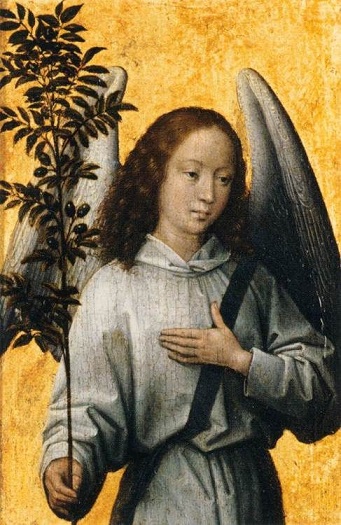
    Hans Memling ca. 1480

    Above: Angel With an Olive Branch; Hans Memling ca. 1480

    Sunday afternoon October 30th, 2016 – The London Symphony Orchestra and Chorus under Gianandrea Noseda’s baton in a performance of the Verdi REQUIEM at Geffen Hall. A packed house seemed pretty much enthralled by the piece, though oddly a few people got up and left in the middle.

    Like every performance of the Verdi REQUIEM I have heard in the past twenty years, this one featured excellent work from the chorus and orchestra and an uneven quartet of principal singers. In a day and age when great Verdi voices are rare, one wonders why orchestras continue to program this demanding work…but I’m glad that they do, for even with a less-than-stellar set of soloists, the REQUIEM is thrilling just as a musical experience. 

    Singing in place of the announced Francesco Meli, Giorgio Berrugi offered warm, idiomatic vocalism. The ample-toned Vitalij Kowaljow made a most impressive vocal entrance and gave by far the most satisfying performance among the four principals. Daniela Barcellona, with a lovely presence, showed a voice that has succumbed to fluttery vibrato, seemingly as a result of tackling roles like Amneris and Dalila. Soprano Erika Grimaldi was seriously over-parted; her bio lists such roles as Mimi and Nedda, and for the REQUIEM you want a soprano of the Norma/BALLO Amelia ilk.

    The performance commenced on a pianissimo hush, with the chorus whispering “Requiem…”; Maestro Noseda chose a very fast tempo at the point where the solo voices enter, slowing down at “Christe…Christe…eleison.”  His tempi all afternoon tended to be on the speedy side.

    The Dies irae was fast and furious; trumpets stationed in the upper tier boxes added to the sonic thrill. Mr. Kowaljow’s Mors stupebit darkly powerful; and – despite the vibrato – Ms. Barcellona made something out of the Liber scriptus (again, very fast): use of chest voice and a little ‘tear’ in the voice.  

    Mr. Berrugi sang well in the Quid sum miser, with distinctive phrasing from the bassoon. The conductor continued to speed things along, and he failed to accommodate his lyric-sized soprano in the big ensemble moments where she was unable to sail over the chorus and orchestra. In the Recordare, the vibratos of soprano and mezzo did not align pleasingly. 

    The tenor gave his best singing of the afternoon in the Ingemisco, the voice clear and the dynamics persuasively modulated; he sounded especially lovely at “Inter oves locum praesta” and the voice rose to a fine conclusion. Mr. Kowaljow’s Confutatis maledictus gave me goosebumps: powerful, emotional singing with a touch of weeping and a huge climax. Mr. Noseda summoned up grumbling lower strings in the Lacrymosa; the four vocalists did not make a good entry at the unaccompanied “Pie Jesu domine“.

    There was slight slip in the overall level of singing in the REQUIEM‘s second half. Mr. Berrugi’s Hostias was not quite as impressive as his Ingemisco had been, and the mingled voices of soprano and mezzo in the Agnus Dei produced some “bad vibes”. In between, the Sanctus showed the chorus off to perfection. Mr. Kowaljow maintained the gold standard with his singing in the Lux aeterna.

    In the silence that followed Ms. Grimaldi’s “…sum ego et timio” a cellphone rang loudly twice; Maestro Noseda put everything on hold until the atmosphere of quietude was restored. The soprano sang bravely in the Requiem aeternam but lacked the spinto plush and vocal glamour the music needs. She was all but swamped by the chorus in the rigors of the finale. 

    Maestro Noseda is a very physical conductor, sometimes squatting down to lure the music from his players. In this afternoon’s performance, he, Mr. Kowaljow, and Verdi himself were the heroes.

  • Noseda|Yuja Wang|London Symphony

    Gianandrea Noseda

    Friday October 28th, 2016 – Gianandrea Noseda (above) conducting the London Symphony at Geffen Hall, with works by Wagner and Shostakovich book-ending a performance of the Ravel G-major piano concerto by Yuja Wang. The concert was part of the Lincoln Center Great Performers series.

    The evening began with the orchestra making an “entrance”. This pretentious ritual should be abandoned, and tonight’s audience weren’t buying it: there was about 5 seconds of applause and then the majority of the players had to find their places in silence. It was all mildly embarrassing. After the intermission, they tried it again and, after a smattering of hand-claps, silence again prevailed. 

    I’m so accustomed to hearing the overture to DIE MEISTERSINGER played from the Metropolitan Opera House’s pit that the massed sound of The London players onstage at Geffen tonight came as a jolt. To me, Gianandrea Noseda’s choice of pacing in the opening theme seemed too slow. The sound was very dense and I missed the layering of voices that can make this music so fascinating. The playing was marvelous, and the impression grandiose, but much of the time it seemed like sonic over-kill: exciting in its own way, but not finding an emotional center. 

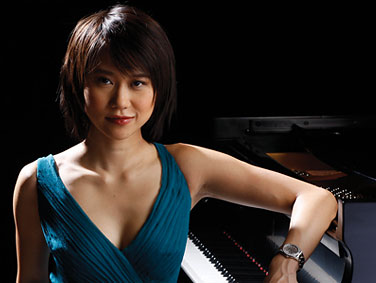
    Yuja-wang

    Above: Yuja Wang

    I love a well-contrasted program, but following the Wagner overture with Ravel’s charmingly jazzy and often delicate G-major piano concerto – an idea that seemed ideal on paper – didn’t quite come off. The Ravel, dazzlingly played by Yuja Wang, seemed oddly inconsequential – for all its delights.

    Commencing in the ‘toy piano’ register, the opening Allegramente proceeds thru varying moods – from magically mystery to bluesy languor – with the piano line woven among gentle coloristic passages from the winds and harp. In the Adagio, introspective yet subtly passionate, we’re reminded of the beautiful ‘beach’ pas de deux that Jerome Robbins created for his ballet “In G Major“. Boisterous interjections from wind instruments attempt to jar the pianist from her mission in the concluding Allegro assai, but the music rushes onward to a final exclamation point.

    Yuja Wang performed the concerto superbly, making a particularly lovely impression with the extraordinary delicacy of her playing in the Adagio. In the animation of the finale, she blazed away with marvelous energy, causing the audience to explode in cheers and tumultuous applause at her final jubilant gesture. Ms. Wang is a musician who brings a rock-star’s pizazz to classical music; but far from being just a stage-crafty icon, she has the technique and artistry to stand with the best of today’s pianists.

    This evening, Yuja Wang played three encores. This delighted the crowd, but in the midst of a symphonic concert, one encore suffices…or two, at a stretch; in a solo recital, you can keep encoring til the wee hours, as Marilyn Horne did at Salzburg in 1984. Ms. Wang’s third recall brought her most intriguing playing of the evening an: arrangement of Schubert’s Gretchen am Spinnrade which was hypnotic in its restlessness and its melodious mood of quiet desperation.

    Is Shostakovich’s fifth symphony the greatest symphony ever written? It certainly seemed that way tonight, and though one wonders what the composer might have written had he not been in need of paying penance to Stalin following the dictator’s displeasure with LADY MACBETH OF MTSENSK, the result of Shostakovich’s desire to please under threatening circumstances resulted in this titanic masterpiece.

    Maestro Noseda and The London players served up this astounding music in a performance that was thrilling from first note to last. Commencing with solo clarinet and moving on to a passage with piano and deep brass, the opening Moderato becomes extremely noisy..and then subsides. The pairing of flute and horn is a stroke of genius, with the clarinet and high violin picking up the melodic thread. The misterioso flute casts a spell.

    In the Allegretto, solo winds pop up before Shostakovich commences a waltz. Irony and wit hover overall, with featured passages for a procession of instruments: violin, flute, trumpet, a bassoon duo. Plucking strings bring a fresh texture.

    The dolorous opening of the Largo dispels any thoughts of lightness that the Allegretto might have stirred up. In this third movement, the brass do not play at all. Weeping strings, and the mingling of harp and flute lead to a rising sense of passion coloured by desolation. This evolves into a theme for oboe and violins. A lonely clarinet and a forlorn flute speak to us before a grand build-up commences with the strings in unison really digging into it. The music wafts into a high haze of despair, the harp trying to console. Just as the whispering final phrase was vanishing into thin air, someone’s device made an annoying intrusion: another great musical moment smudged by thoughtlessness. 

    The fourth movement, with its driven sense of propulsive grandeur, is thought to have marked Shostakovich’s triumph over the woes besetting him; but it has also been described as “forced rejoicing”. Whichever may be the case, the glorious horn theme, the aching strings, and the slow build-up to the epic finish certainly raised the spirits tonight. The cymbalist’s exuberant clashes at the end took on a celebratory feel.  

    It was reported that, at this symphony’s 1937 premiere, members of the audience began to weep openly during the Largo. Today, some 80 years on, there is still much to weep over in the world: religious and political forces continue to divide mankind; our planet is slowly being ravaged; racism, sexism, ageism, homophobia, and casual violence pervade the headlines daily. As we seem to slip deeper and deeper into some terrible abyss, it is in music, art, poetry, dance, and great literature that we may seek consolation. Tonight, the Shostakovich felt like an affirmation of faith in humanity, and we must cling to that against all odds.

  • Frank Huang Plays Bruch @ The NY Phil

    Frank Huang

    Thursday October 27th, 2016 – The New York Philharmonic‘s concertmaster, Frank Huang (above), dazzled the audience at Geffen Hall tonight with his playing of Bruch’s first violin concerto; the highly enjoyable program also featured works by Bartók and Dvořák; Pablo Heras-Casado was on the podium.

    Béla Bartók’s Dance Suite opened the evening. These delightful dancing miniatures display the composer’s signature inventiveness in terms of colour and rhythm whilst providing numerous opportunities for individual players to shine: it’s a wonder they are not programmed more often. Maestro Heras-Casado seemed to have the lilt and sweep of the music in his blood, and the orchestra gave a vibrant performance every dance-step of the way.

    Written in 1923, the suite is listed as being in six movements, though they seem – with a brief pause here or there – to flow into one another. A droll bassoon theme starts things off; the horns sound and the string players tap their bows on their instruments. Big energy develops, only to subside. Lovely passage for violins and harp, the clarinet interjects, and a merry jogging sets forth. Ear-tingling combinations – oboe and bass clarinet, flute and harp – keep cropping up, as do the piano and celesta. A wind choir leads into a high violin passage (Sheryl Staples, tonight’s concertmaster) and when things turn dreamy, Cynthia Phelps’ viola mingles with the harp. Big brass plunges in, and the music takes on a bouncing swagger.

    This suite made an outstanding impression. I do regret that I cannot name the individual players of the various solo wind passages; tonight more than ever I wished these sections of the orchestra were on risers so we could watch them as they play. I did get a glimpse of Liang Wang, who played the numerous Bartok solo phrases with his customary clarity and warmth…wonderful!

    Mr. Huang then appeared for the Bruch. We are accustomed to seeing him as a somewhat reserved figure in his role of concertmaster; stepping into soloist mode, Mr. Huang becomes very animated, bending and swaying as the music impels him. His passionate performance was captivating both to hear and to watch.

    A recording of the Bruch #1 was the first non-operatic CD I ever bought – paired with the Barber concerto, and played by Anne Akiko Myers. The Bruch was thus familiar to me well before I ever ventured to listen to the Tchaikovsky, Sibelius, or Beethoven concerti; and this evening’s performance – my first time experiencing it live – reminded me of what a great piece it is. 

    From the concerto’s initial rising solo passage, Mr. Huang’s tone was most alluring: lustrous at all dynamic levels, and displaying a sensuous quality which he allowed to permeate the music in just the right measure, at just the right moments. A sentimental melody gives way to a filigree of rising trills, and a blend with horn is simply gorgeous. Rising and descending scales from the violin develop into a sweeping orchestral passage. A two-part cadenza and the poignant melody that follows found Mr. Huang at his most persuasive. Excellent!

    The Prelude has flowed directly into the Adagio, making a very long ‘play’ for the soloist, and causing the composer to wonder if he ought not refer to the whole work a fantasy rather than a concerto. He was persuaded otherwise by the great violinist Joseph Joachim.

    In the concluding Allegro energico, Mr. Huang took up the familiar dancelike theme with a nice gypsy swing; decorative threads of coloratura were un-spooled by the violinist with elegant virtuosity, his tone ever-lovely and his articulation showing effortless clarity. The audience, one of the most attentive in recent memory, were clearly much taken with Mr. Huang’s performance: vociferous bravos filled the hall from the moment the concerto ended, and at his solo bow the whole house stood up and cheered whilst his colleagues onstage joined enthusiastically in the ovation.

    Heras- casado

    Following the interval, Maestro Haras-Casado (above) and the players treated us to an outstanding performance of the Dvořák 7th. This familiar work seemed fresh and vital this evening, with plenty of expert solo playing along the way – though the horns were running hot-and-cold throughout. The big, yearning theme of the first movement was especially pleasing to hear tonight, as was the woodwind chorale over plucking strings in the Adagio. Things turn blithe in the folk-dance flavor of the Scherzo, but the composer turns more pensive again as the Finale commences. The rise of a Slavonic march, and the taking up of a new, lyrical theme, led onward to the symphony’s optimistic conclusion.

  • Danish String Quartet @ Zankel Hall

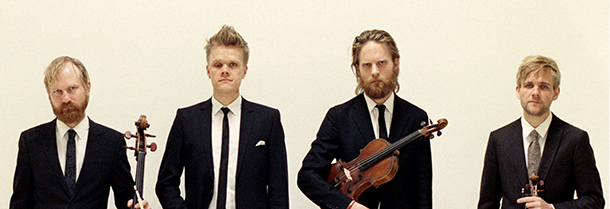
    Danish-Quartet

    Wednesday October 26th, 2016 – The Danish String Quartet (above) in concert at Zankel Hall in a program pairing final masterworks by Shostakovich and Schubert, with cellist Torleif Thedéen joining the Quartet for the Schubert. It was an extraordinary evening of music-making, with the two vividly contrasted pieces superbly played.

    The program opened with a performance of the last of Shostakovich’s fifteen quartets. Composed in 1974, it consists of six inter-connected movements and has the mood of a farewell to life; indeed, the composer died the following year, after a career periodically darkened by deep conflicts with the Soviet government. The ailing Shostakovich created a work of lyrically spare, bleak textures alternating with violent rhythmic gestures.

    The atmosphere of the 15th quartet precludes note-taking; from its quiet opening passage played by the second violin, we are drawn into a unique sound-world of severe beauty and grim intensity. The Danish String Quartet’s playing of the opening movement – which the composer indicated should be performed so slowly that listeners would flee the hall out of boredom – took on an almost religious aspect: a sustained and intimate meditation.

    The Quartet’s hallmark mastery of dynamics, the natural flow of the music from voice to voice, and their finely-balanced layering of sound, created an incredible atmosphere which was sustained throughout the 40-minute work. Moments of great delicacy stood in contrast to jagged slashings; an off-kilter waltz, sustained notes that spring out of nowhere, vibrant trills, a resonant viola cavatina, deep passion from the cello, an overall sense of desolation. Despite a few Playbill-flippers seated near me, the audience was held in a rapt state throughout the piece; the applause – deep and sincere, but not boisterous – signaled the impact the music and the musicians had made.

    Feeling both drained and enriched by this monumental musical experience, I remained in my seat throughout the intermission, deep in thought.

    Following the interval, the Schubert string quintet in C-major, with cellist Torleif Thedéen joining the ensemble. This quintet, written in 1828, was Schubert’s last extended piece of chamber music. It seems that the composer never heard this final masterwork performed; he died on October 2nd, 1828, and the quintet was not performed publicly until 1850.

    One of the longest works in the chamber music repertory, Schubert’s C-major quintet sounds more like a celebration of life than a prelude to death. The composer was desperately ill while composing it, but the work has a feeling of optimism – as though he felt he might actually re-bound and compose for another 30 or 40 years. It was not to be, and – as with Mozart, Chopin, and Pergolesi – we are left to ponder what might have been. 

    The Danish String Quartet’s traversal of the Schubert was so persuasive both in tonal beauty and rhythmic inflection that the work sped by. The songful-to-stormy opening movement, with its return to tranquility in C-major, is followed by one of music’s most marvelous adagios, underscored by plucked lower notes. The players seemed to be having serious fun in the Scherzo, and then moved on to the gypsy-flavour of the finale.

    At the close of the Schubert’s joy-filled final Allegretto, the Danes were given an enthusiastic ovation from the audience. The players responded with an encore: a lyrical, chorale-like quintet that was lovingly played.

    The Participating Artists:

    The Danish String Quartet:

      ~ Frederik Øland, Violin
      ~ Rune Tonsgaard Sørensen, Violin
      ~ Asbjørn Nørgaard, Viola
      ~ Fredrik Schøyen Sjölin, Cello

    Torleif Thedéen, Cello

    The Repertory:

    • SHOSTAKOVICH String Quartet No. 15 in E-flat Minor, Op. 144
    • SCHUBERT String Quintet in C Major, D. 956

  • Autumn Movement

    L1800565

    “I cried over beautiful things knowing no beautiful thing lasts.

    The field of cornflower yellow is a scarf at the neck of the copper sunburned woman, the mother of the year, the taker of seeds.

    The northwest wind comes and the yellow is torn full of holes, new beautiful things come in the first spit of snow on the northwest wind, and the old things go, not one lasts.”

    ~ Carl Sandburg (1878 – 1967)

  • Leonidas Kavakos: Double Duty @ The NY Philharmonic

    Kavakos

    Thursday October 20th, 2016 – Leonidas Kavakos (above) was both soloist and conductor for this evening’s program at The New York Philharmonic. Mr. Kavakos is the Philharmonic’s current Mary and James G. Wallach Artist-in-Residence, and in this capacity will blessedly be with us frequently in the current season. Tonight, the prodigiously talented violinist played Bach and then moved to the podium to conduct works by Busoni and Schumann.

    With the mystique of a Tolkien wizard, Mr. Kavakos worked his magic in a brilliant rendering of J.S. Bach’s Violin Concerto in D minor (reconstructed), BWV 1052; surrounded by an ensemble of the orchestra’s elite string players, and with Paolo Bordignon at the harpsichord, he cast a spell over the hall with his playing. Following a sizzling cadenza midway thru the first movement, the violinist and his colleagues drew us in with the lamenting beauty of the adagio. An unfortunate cellphone intrusion in the very last moments of the movement was brushed aside as Mr. Kavakos sailed forward with stunning virtuoso playing in the allegro, where he summoned up visions of the legendary “mad fiddlers” who played as if possessed by demons.

    The whole ensemble went merrily along on the soloist’s swift ride, and I must mention Timothy Cobb’s plush tone and amiable agility on bass. Shouts of ‘bravo‘ rang thru the hall as the concerto ended. Mr. Kavakos and Sheryl Staples, this evening’s concertmaster, clearly form a mutual-admiration-society; after bowing to the audience’s enthusiasm, the soloist signaled Ms. Staples to rise but instead she and all her colleagues remained seated, vigorously applauding Mr. Kavakos. When he finally got the players to stand, the applause re-doubled.

    The Geffen Hall stage crew swiftly re-set the space for the next work: I had discovered Ferruccio Busoni’s Berceuse élégiaque earlier this season when the Curtis Symphony Orchestra performed it at Carnegie Hall, and was very glad of an opportunity to experience it again tonight.

    This is music wrapped in a somber mystery. The composer wrote these lines as a brief ‘prologue’ to the piece:

    “The child’s cradle rocks, the hazard of his fate reels; life’s path fades, fades away into the eternal distance.”

    During the ten-minute course of this eerie lullaby, the music rises very slowly from the depths; the subtle interjections from the harp add a dreamlike quality, as does the celesta which joins the darkling ensemble near the end. As a chillingly marvelous finish, a gong sounds and its reverberations fade to nothingness.

    The Philharmonic’s Playbills are always loaded with fascinating articles and information; I read them on the train trip homeward after the concerts. One passage in the notes on the Busoni struck a tragic note: Gustav Mahler conducted the Philharmonic premiere of the Berceuse élégiaque on February 21st, 2011. Suffering from heart disease, Mahler was forced to withdraw from a second performance of the work; he sailed back to Europe and died in Vienna in May. The February 21st Philharmonic concert thus marked the last time he ever conducted. 

    Robert Schumann’s Symphony No. 2 was the evening’s concluding work. Here my companion and I were at a loss: the music is absolutely lovely from start to finish, and it was conducted and played with both steadfastness and genuine affection by Mr. Kavakos and the artists of the Philharmonic. But somehow it is simply too much of a good thing. We were trying to figure out the reasons why this music, so congenial, seems to go in one ear and out the other; there’s no edge to it anywhere, and nothing that reaches the heart. Also, for me, part of the problem is all the tutti playing: there’s a shortage of those passages where solos might lure us in or smaller components of the orchestra might bedevil one another. Only in the adagio, where the oboe, clarinet and horns had chances to step forward, did my interest perk up. For the rest, the music simply washed over us to beautiful but unmemorable effect.

  • In Troubled Days of Peace @ ASO

    Donnie-Ray-Albert

    Above: baritone Donnie Ray Albert

    Wednesday October 19th, 2016 = The American Symphony Orchestra presenting concert settings of operas by Ernst Krenek and Richard Strauss in their season-opening program. The timely theme of dictatorships and the eternally evasive concept of peace hung in the air at Carnegie Hall, where appreciative music lovers had gathered, skipping a pointless presidential ‘debate’ in favor of hearing some rarely-performed works. 

    Ernst Krenek’s Der Diktator was completed in August 1926. You can read a synopsis of the opera and find background material here, since I’m going to concentrate on the evening’s presentation.

    Leon Botstein and his intrepid players gave a fine rendering of the very palatable score. The performance was dominated by Donnie Ray Albert as the Dictator. A stalwart force in the realms of opera and concert since 1976, Mr. Albert is now 66 years of age, and boasts a voice that has retained its power, along with interpretive skills that are truly impressive. Whether in bold declamation or in the music’s more lyrical passages, Mr. Albert gave a masterful performance. Another impressive voice was that of Karen Chia-Ling Ho as Maria: displaying a large, spinto sound and hall-filling top notes, the soprano also invested her singing with dramatic urgency. Ilana Davidson, a petite woman with a baby-dollish timbre, piped up boldly as Charlotte, and Mark Duffin was able to combine the power of a helden- and the verbal edge of a character-tenor. Portraying an officer blinded by poison gas while in the Dictator’s service, Mr. Duffin wore sunglasses and managed, for all his gritty vocal power, to create a moving figure.

    Richard Strauss’s Friedenstag (Peace Day) was premiered at Munich in 1938, with Adolf Hitler among the audience. Set during the Thirty Years War, the story is unfolds in a city under siege; after many twists and turns of plot, the wife of the city’s Commandant intercedes with the head of the besieging force and brings about a reconciliation. With music includes many reminders of DIE FRAU OHNE SCHATTEN, FRIEDENSTAG is a good experience for an old Strauss-lover like me; however, it is somewhat weakened by an endless series of “finales”, as though Strauss did not know when to stop.

    Continuing his highly successful evening, Donnie Ray Albert made a grand impression as the Commandant with his generous singing and imposing stature. I had very much been anticipating hearing Tamara Wilson as Maria, the Commandant’s wife, but when we arrived at Carnegie Hall, we found that she had canceled and was being replaced by Kirsten Chambers. A program-insert bio lists Ms. Chambers as the cover for both Isolde and Salome at The Met this season. Blonde, and clad in a bright red gown, the soprano unsparingly hurled herself into the demanding music of Maria, showing a voice of considerable thrust. If one top note was just shy of the mark, overall she managed well in a fiendish role, and saved the evening.

    R Lugo

    Bass Ricardo Lugo (above), as the opposing general, made a vibrant impression with his imposing voice and intrinsic sense of the drama. He was an excellent foil for Mr. Albert, and, between these two powerhouse voices, they kept our focus on the work keenly secured. Mr. Duffin, amplifying the forceful impression he had made in the Krenek, was back as the Burgomaster: one of his upper notes was sustained for an incredibly long time…I really don’t know how he did it!

    FRIEDENSTAG has a number of small roles in which savvy interpreters are able to make their mark. I especially liked the clear sweetness of Scott Joiner’s tenor as a Piedontese soldier (he sang in Italian) and Carsten Wittmoser’s sturdy vocalism as a Musketeer. Tenor Doug Jones and baritone Steven Eddy (in a dual role) seized their chances and did very well, with baritones Steven Moore, Daniel Collins, and Benjamin Cohen contributing strongly. 

    In small vignettes, a number of chorus members stepped forward from time to time. One of these had a special meaning for me: Rachel Rosales, as a Woman of the People, is a soprano I heard lo! these many seasons ago as an exquisite Leila in LES PECHEURS DES PERLES at New York City Opera. I have seen her name listed among choral rosters before, and was feeling nostalgic when she intoned her brief, dramatic solo, a solo which made me think of Strauss’s writing for Die Amme in FRAU OHNE SCHATTEN. In the finale tonight (the final finale), Ms. Rosales and other chorus sopranos sent some high notes sailing into the hall.  

    The Participating Artists:

    American Symphony Orchestra
    Leon Botstein, conductor
    Bard Festival Chorale/James Bagwell, director
    Ilana Davidson, Karen Chia-ling Ho and Kirsten Chambers, sopranos
    Donnie Ray Albert and Steven Eddy, baritones
    Mark Duffin, Scott Joiner and Doug Jones, tenors
    Carsten Wittmoser, bass-baritone
    Ricardo Lugo, bass

  • Lisette Oropesa @ Chamber Music Society

    IMG_0207Lisette

    Tuesday October 18th, 2016 – Soprano Lisette Oropesa (above, photographed by Steven Harris) making her Chamber Music Society of Lincoln Center debut in the opening concert of the Society’s 2016-2017 season.

    The program commenced with a charming performance of Haydn’s ‘Surprise‘ symphony, and if the element of surprise in this very familiar work has long since evaporated, there was still a murmur of delight which passed thru the packed house when that ‘wake up!’ chord sounded. The symphony, a veritable fountain of melodic and rhythmic delights, was played by an ensemble of top-notch musicians: the kind of artists that maintain the Society’s impeccable standards.

    With Michael Brown’s wonderfully attentive and polished playing of the Steinway setting the pace, we could relish the divine piping of Tara Helen O’Connor’s flute and a most pleasing mixture of swiftness and sweetness from Erin Keefe’s violin. Danbi Um, in a pretty forest-green frock, stood out in a brief mingling of voices with Ms. O’Connor flute – Danbi would have more expansive opportunities in the Palestrina/Mendelssohn combination after the interval. Of the lower voices, Richard O’Neill’s dusky viola sound and his deep involvement in the music are always most welcome; and though music stands blocked our view of Mihai Marica, his cello spoke clearly. This assemblage of musicians were as pleasing to watch as to hear, and they set the tone for the evening with their virtuosity and grace.

    It seems incredible that ten years have passed since the voice of Lisette Oropesa first captured my imagination when she sang a very brief role in a performance of Mozart’s IDOMENEO at The Met. I immediately seized on the notion that this was a singer who would be going places, and she has proven me correct: her career has positively bloomed, and she moves from engagement to engagement, conquering audiences from Munich to Santa Fe, from Dallas to Madrid. Conductors tend to love her, as much for her vocal clarity and musicianship as for her preparedness and sunshine-filled personality.

    Lisette walked onstage this evening in a midnight-blue gown, jewels at her neckline, superbly coiffed: the very picture of elegance. With the one-and-only Gilbert Kalish at the Steinway, the soprano proceeded to captivate the audience with her shimmering voice and rapturous delivery. All of the things I love about her singing were in abounding evidence tonight: the distinctive colour, the mastery of dynamics, the magical turns of phrase, the imaginative way with words. In three Mendelssohn songs – “Wanderlied“, “On the Wings of Song” and “Suleika” – Lisette cast a spell over the hall, and Mr. Kalish was a most valuable fellow sorcerer. Together, they created an atmosphere of fascination; and the audience’s enthusiastic response affirmed my feelings.

    Soprano and pianist returned immediately, joined by David Schifrin; some Schifrin fans seated near me buzzed with anticipation. Following the brief piano introduction, the eminent clarinetist made a breathtaking entrance on the sustained tone that heralds Franz Schubert’s “Shepherd on the Rock“; moments later, Lisette began to sing and all seemed right with the world. 

    Shepherd on the Rock” has the feeling of a bel canto scena. Passages of sustained lyricism give way to flights of coloratura, with voice and clarinet mingling in a way that reminds us a bit of the flute and soprano mix in Lucia di Lammermoor’s ‘Mad Scene’.

    The singer must convey the moods of Schubert’s shepherd: his delight in hearing his own voice echo back to him from the valley, his tender longing for his sweetheart far away, and his optimism at the coming of Spring. All this Lisette accomplished with her intrinsic sensitivity to the narrative, finding an ideal give-and-take with her collaborators. The vocal writing here covers a wide range, from peaky top notes to some unusual plunges to the depths; Lisette had it all at her fingertips, and her voice once again spun a web of enchantment. She and the two gentlemen basked in the audience’s very cordial applause.

    At a time when so many lyric-coloratura sopranos on the scene seem to me lacking in real distinction, Lisette shows us what a ‘vocal personality’ really is: it’s not just the sound, nor the technique, nor the communicative gifts; nor really anything to do with physical attractiveness. It’s a light from within, and that’s what sets Ms. Oropesa apart from the rest. 

    Following the intermission, David Finckel let us know that we’d be hearing an added work this evening: a Mendelssohn fugue would follow the brief and rare Palestrina piece we were about to hear. Mr. Finckel then joined Danbi Um, Erin Keefe, and Richard O’Neill to perform Palestrina’s ‘Sanctus’ from Missa Aeterna Christi Munera. The spiritual simplicity of the music, with its poignant beauty, was finely underscored by Mr. Finckel’s gently resonant cello.

    After only a brief pause, the quartet gave us the Mendelssohn fugue: it is launched by Richard O’Neill’s velvety viola, taken up by Ms. Keefe and Ms. Um in turn, and then by the Finckel cello. This lovely work, perhaps too brief to be programmed often, displayed Danbi Um’s satin-sheened tone and the appealing expressive qualities of her playing. 

    We had reached that point in the evening where the final work loomed before us. With all that had gone before, what kind of finale could be devised that would cap the performance in a properly spectacular way? With their customary flair for programming, the Society had kept an ace up their sleeve, and within literally five seconds of Michael Brown’s introduction to the Ravel A-minor trio, I had goosebumps and a tingling spine. What playing from Mr. Brown and his colleagues, Ms. Keefe and Mr. Marica…simply astounding!

    Ravel produced his only work in the piano-trio genre in a burst of fevered inspiration during the summer of 1914, as Europe’s armies mobilized for war. The result is one of Ravel’s most intense – yet still lyrical – works.

    Michael Brown immediately established the atmosphere of the opening movement with his darkish, misterioso playing. Ms. Keefe and Mihai Marica were well-matched in beauty of timbre. A remarkable sustained tone from the cellist was followed by Ms. Keefe’s exquisite ascent to the heights: their perfumed mingling of voices gave me the chills. Simply ravishing passages in the upper reaches from the violin, and then the piano becomes more animated with a rising sense of drama. This subsides to a sweet cello theme; the players demonstrate fantastic pianissimo control. The violin goes deep, the piano quietens to a whisper. Spellbinding fade-away…an engrossing moment.

    Immediately the mood shifts to bright and then lilting in the plucky second movement, featuring a rising motif and a skittishness that sets up a fun ending.

    Mr. Brown’s left-handed piano introduction to the third movement hints at the ominous; Mr. Marica’s cello enters: pensive and low, whilst Ms. Keefe’s violin expresses a sense of yearning. In a hypnotic interlude, Mr. Brown drew me ever deeper into the mood with his incredibly intimate playing. The cello and then the violin re-enter; passion builds, and it’s sublime. Following a soft string duo, the cello sinks to the deep register, and the piano even deeper.

    The finale commences high and buzzy, with a light, bright texture. All three musicians are simply sailing along, and a feeling of rapture develops. Ms. Keefe and Mr. Marica launch a series of trills that might go on forever; but then the swirls and eddies of melody sweep everything forward, to a simply gorgeous end. Such extraordinary playing of an extraordinary piece: the audience burst into eager applause, and the three musicians were called back for a second bow. 

    Marilyn Horne was in the audience tonight, bless her heart. And having Lisette Oropesa and Richard O’Neill on the same program gave me the notion of wanting to hear them together in William Bolcom’s Let Evening Come. This song cycle was composed for the beloved soprano Benita Valente, to whose voice Lisette’s bears a kinship; as a Met Young Artist, a decade ago, Lisette had an opportunity to work with Ms. Valente. I’ve been listening to Benita’s atmospheric recording, and now I’m really wanting to hear the Bolcom performed live

    The Repertory:

    • Haydn Symphony in G major for Piano, Flute, Two Violins, Viola, and Cello, Hob. I:94, “Surprise” (1791)
    • Mendelssohn Selected Songs for Soprano and Piano, Opp. 34 and 57 (1835-41)
    • Schubert Der Hirt auf dem Felsen for Soprano, Clarinet, and Piano, D. 965, Op. 129 (1828)
    • Palestrina Sanctus from Missa Aeterna Christi Munera (1590)
    • Ravel Trio in A minor for Piano, Violin, and Cello (1914)