Blog
-
Recital: Violinist In Mo Yang
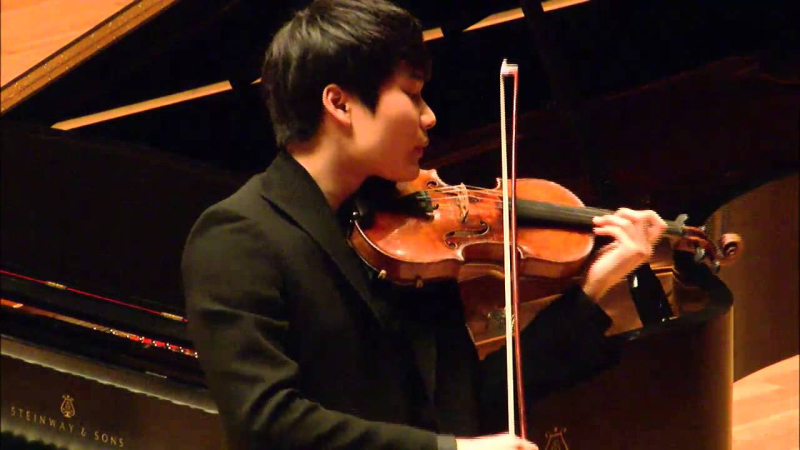
Above: violinist In Mo Yang
Tuesday September 27th, 2016 – In Mo Yang, a young violinist of Korean heritage, in recital with pianist Renana Gutman at Merkin Hall.
It’s only rarely that I do something really spontaneous; my schedule is always so full (and commitments made so far in advance) that there are seldom any opportunities to do things that haven’t been planned weeks in advance. But as I was researching something on the Merkin Hall website, I noticed a violin recital listed for this afternoon. The repertory looked very inviting and there were still a few tickets available, so I headed downtown. It was an impressive and thoroughly enjoyable concert in every regard.
In Mo Yang is the First Prize Winner of the Concert Artists Guild Competition. In 2015, he also earned First Prize at the 54th International Violin Competition “Premio Paganini” in Genoa, Italy, marking the first time since 2006 that the Paganini Competition jury has awarded the top prize.
In Mo Yong, in addition to a very impressive technique, has the gift of playing from the heart. After only a few measures of the opening Bach, I knew I was in the presence of a musician of the finest calibre; by the end of the recital, his name was hovering in my highest echelon of favorite musicians.
The forlorn beauty of the opening theme of the Adagio of Bach’s solo Violin Sonata No.1 in G minor immediately revealed the key elements of In Mo Yong’s playing: radiant and sweetly resonant tone, a mastery of dynamic finesse, innate expressiveness, and seamless phrasing. In the second movement, a minor-key dance, the violinist produced cascades of notes with admirable clarity. A sense of grace tinged with sadness marked his playing of the Siciliana, and in the final Presto, he reeled off reams of coloratura, perfectly defined and beautifully articulated, creating a magical atmosphere.
Pianist Renana Gutman then joined In Mo Yang for the violin sonata of Leoš Janáček. Ms. Gutman’s poised musicality and her attentiveness to details of phrasing were a great boon for the young violinist.
As In Mo Yang noted in his remarks, the flow of lyricism in this Janáček work is constantly interrupted by injections of turbulence or wit. There was a wondrous immediacy to the playing of the two musicians, drawing us in to the many felicities of this quite extraordinary piece. The opening Con moto found the violinist’s passion well met by the pianist’s sense of rapture, right from the outset. In the Ballada that follows, the shimmering piano sets off the singing violin. Sustained beauty of tone as the music’s passion soars, then sinks into a delicate reverie. In Mo Yang ended this movement on an exquisitely sustained, evaporating high note.
In the Allegretto, the music is agitated and pensive by turns; these the mood swings were well-captured by our two players. The concluding Adagio begins hesitantly; then an enchanting melody looms up, only to stall and then re-start. A vibrant theme over glimmering piano leads to alternating passages of agitation and calm before the piece reaches its hushed ending. Splendid playing from In Mo Yang and Ms. Gutman: a really impressive performance.
Karol Szymanowski’s setting of three ‘Paganini’ caprices followed the interval. The first, in D-major, features a high, sweet melody which gives way to an energetic passage before returning to its initial mood. In Mo Yang’s lingering final note was a moment of pure poetry. The second caprice, in A-major, begins in a state of musical density. The violin ascends to a high, aching theme which increases in passion; here In Mo Yang’s mastery of control in the stratospheric register was so evocative. The most familiar of the three caprices, the A-minor, is loaded at first with brisk, swirling motifs. Its sparkle and ironic wit suddenly go deep and mysterious, then things get playful, and then dreamy. This traversal of moods was finely differentiated by the two musicians. After some dazzlingly ping-y plucking from the violin, there’s a false ending; In Mo Yang then ascends again to the high, hazy glow of his upper range before charging on with Ms. Gutman to the grand finale.
All of the qualities that make Felix Mendelssohn one of my favorite composers were evidenced in his violin sonata in F major, written and premiered in 1838. It was not published in the composer’s lifetime, but was ‘rescued’ in 1953 by Yehudi Menuhin, who accordingly tinkered with it before having it published.
After a gallant piano introduction opens the Allegro vivace, a pulsing motif develops as the piano and violin alternately switch from melody to rhythm. Charming variants of major and minor keys – and a lovely sense of Mendelssohnian flow – gave me a lot of listening pleasure.
Ms. Gutman sounds a low song which the violin takes up as the central Adagio casts its spell. Such expressive playing here; and then the music sails forward. And yet again, the heart-rending quality of In Mo Yang’s upper-range playing was a marvel.
Joyous flights of fancy abound in the concluding Assai vivace, the players shifting effortlessly between liveliness and subtlety. With stunning dexterity, In Mo Yang reveled in high-velocity playing here that filled me with smiling admiration.
Sheer gorgeousness to end the afternoon: a Karl Schumann romance was offered as an encore: exceptional playing with a high emotional value.
-
Batiashvili|Tchaikovsky|NY Philharmonic

Saturday September 24th, 2016 – Lisa Batiashvili‘s appearances with The New York Philharmonic are always red-letter events; the mutual admiration society that the luminous violinist has formed with Maestro Alan Gilbert invariably results in something very special, and tonight their entente cordiale produced a magnificent rendering of the Tchaikovsky violin concerto.
When I arrived at Geffen Hall, the atmosphere was already abuzz: “Sold Out” signs were just being posted, and a long line of music-lovers hoping for returns was forming. A packed house always creates its own sense of excitement, and when the ever-elegant Ms. Batiashvili strode onto the stage in a stunning black gown with a bejeweled bodice, the welcome was wonderfully warm. Forty minutes later, the violinist was basking in an epic full-house ovation.
It was another female violinist, Maud Powell, who helped popularize the Tchaikovsky concerto – a concerto at first thought by some to be unplayable. Ms. Powell played the New York premiere of the piece in 1889 with the New York Symphony (which merged with the Philharmonic in 1928); tonight, Lisa Batiashvili carried the banner to new heights.
In the concerto’s opening movement, Ms. Batiashvili combined passionate lyricism with subtle turns of phrase; her coloratura was fleet and fluent, her shaping of phrases so innately appealing. When Alan Gilbert’s full orchestra entered for the big tutti passage, visions of the grandeur of the Romanov court were evoked. Ms. Batiashvili’s cadenza sounded a bit modern (“…to old-fashioned ears…”, as Mrs. Manson Mingott would say) and her playing of it most impressive: superb control of dynamics and a stunningly sustained double trill which led to a poignant restoration of melody. After treating us to some sizzling fireworks, the violinist sailed graciously into an affecting theme before ascending to some very delicate high-register passages and thence to the movement’s final flourishes.
Playing with a melancholy pianissimo, Ms. Batiashvili created a very poetic atmosphere of sadness as the Canzonetta/Andante began. Her tone became incredibly soft, with a lovely sheen to it, while the audience held their collective breath to savour every moment of it.
There’s a direct path into the concerto’s finale, which commences with an intense invitation to the dance, followed by a playful second theme. Relishing these shifts of mood, Ms. Batiashvili sounded gorgeous in a deep-lyric interlude and brilliant in some decorative filigree that followed. On to the final sprint, where the fiery glow of the violinist’s passionate playing swept all before her, igniting an ovation and delighted cries of “Brava!” as the entire audience rose to acknowledge Ms. Batiashvili’s truly thrilling performance.
Lisa was called out for a solo bow – huge din of cheers and thunderous applause – then returned again with Maestro Gilbert, who signaled the wind soloists (who had made such distinctive impressions in the final movement) to rise. The mutual affection of violinist and conductor was movingly evidenced as they embraced and walked off together. But still the ovation would not subside, and the radiant soloist re-appeared for another solo bow, with her onstage colleagues joining the tribute and the audience getting gleefully boisterous.
During the course of the concerto, the marvelous rapport between Ms. Batiashvili and Maestro Gilbert was as endearing to the eye as their playing to the ear: as the music wove its spell, they seemed engaged in a pas de deux which swayed on the ebb and flow of Tchaikovsky’s balletic score. Bravi!!
Enjoy a bit of Lisa’s playing here.
-
American Classical Orchestra @ Alice Tully Hall
 Above: Thomas Crawford leading the American Classical Orchestra; image from William Neumann PhotographyThursday September 22nd, 2016 – The opportunity to hear two favorite works on a single evening drew me to this concert by the American Classical Orchestra at Alice Tully Hall: Mendelssohn’s “Scotch” Symphony, which every ballet-lover knows by heart, and the marvelous song cycle Les Nuits d’été of Hector Berlioz. The pleasure of hearing a ‘new’ voice in the Berlioz, and a natural curiosity about the evening’s third work – Cipriani Potter’s tenth symphony – made the program sound very inviting.Thomas Crawford, the ACO’s founder and artistic director, greeted us with charming and genuinely humorous remarks: the orchestra’s celebrating their 32nd season. There are some very fine musicians in the ensemble, among them Myron Lutzke, who did some especially lovely playing in the solo passages for cello.I must confess that I am not really a ‘period instruments’ person, and that one or two concerts per season in that genre are more than sufficient for me. The flip side of the coin is that so much of the repertory is really appealing; however, I invariably find myself put off by what so frequently sounds to me like out-of-tune playing that my enjoyment is compromised. Tonight this problem was not as annoying as is sometimes the case, though there were some jarring moments along the way.The mystery of Cipriani Potter was cleared up tonight. An Englishman who lived a long life (1792-1871), Potter spent 16 months in Vienna (1817-1818) where he met Beethoven. Back in London, Potter enjoyed a notable career as a pianist, giving the British premieres of three of the Beethoven concertos. He composed ten symphonies, nine of which survive. Tonight we heard the tenth, which may actually have been the sixth one to be written.Cipriani Potter’s 10th symphony is perfectly pleasant but – in the end – not very distinctive music. Attractively played by the ACO tonight under Maestro Crawford’s baton, the symphony provided no revelations and simply flowed along on its well-crafted trajectory. Overall, it put me in mind of such ‘pleasant’ works as the Beethoven ‘Pastoral‘, which I try to avoid. Tonight’s performance was not helped by a late seating after the first movement, which broke my concentration.The slender and very attractive young mezzo-soprano Avery Amereau then appeared for the Berlioz. In his opening remarks, Maestro Crawford had spoken of his impression that this singer should be considered a contralto rather than a mezzo; how right he is! It’s a distinctive voice with a warm and very cordial lower range, and her singing of the Berlioz clearly impressed her existing admirers and won her many new ones.It took a moment or two for things to settle in: the opening ‘Villanelle‘ found the singer’s her upper notes not entirely steady; this, combined with some vague tuning among the players, made me wonder if I was going to derive full pleasure from these beloved songs tonight. But a few measures into the gorgeous ‘Spectre de la Rose‘, everything came together for the singer and her voice positively blossomed, covering the wide range with confident beauty of tone and expression. I was a bit surprised when Ms. Amereau didn’t sink down to the lowest note of ‘Sur les lagunes‘ (to which Regine Crespin so deliciously descends in her magical recording of the work) but that’s a minor detail in the face of all that we could savour in Ms. Amereau’s genuinely fascinating performance. I look forward to hearing her again.At this point in the evening, I was ready to strangle the two girls sitting in front of us who could not sit still to save their souls, whispering and texting and flipping their hair; one of them had smuggled in a can of soda or beer. They seemed to be fans or friends of Ms. Amereau, and tried to film or photograph her performance. Adding to their distractions was the expected constant flipping of Playbill pages as people tried to figure out which song of the Berlioz was being sung at the moment; naturally, a few Playbills slipped and hit the floor, seemingly always at the worst possible moments.These disruptions made me seriously consider leaving at the interval, but my friend Dmitry wanted to hear the Mendelssohn (so did I!), so we stayed on, and it turned out to be the highlight of the evening. The “Scotch” Symphony, so melodically rich and so atmospheric, was inspired by the composer’s 1829 visit to Holyrood Castle, where Mary Stuart was crowned Queen of Scots in 1542. Stories of the adventurous, romantic, and ultimately tragic Queen have inspired musicians, poets, playwrights, and painters over the centuries, and Mendelssohn’s symphony has to be one of the very best of these numerous homages.Tonight’s performance was lovingly played, wonderfully satisfying, and almost compensated up for the distractions of the evening, even though the texting lass in front of us clearly had other things on her mind.
 -
Duo Gagnant: French Music for Two Pianos

Wednesday September 21st, 2016 – Dan K Kurland invited me to this concert of French music – from the familiar to the relatively obscure – for two pianos at Juilliard’s Paul Hall. The program looked very inviting, and since dance themes prevailed throughout the hour-long presentation, it was especially agreeable to have choreographer Claudia Schreier sitting next to me.
We arrived just moments before the house lights dimmed; Paul Hall was nearly full, and we found seats in the front row, in the aisle. The balance of sound may have been slightly off, but it was a very interesting perspective visually.
~ POULENC L’embarquement pour Cynthère
Pianists: Dan K Kurland and Jonathan FeldmanOpening with this 1951 Poulenc gem – music that is so quintessentially French – the tone for the entire evening was set. Described as a Valse-Musette, this piece delights from its vivacious start to its ironic finish. Though Dan Kurland was not originally schedule to play tonight, he did…and wore red socks into the bargain, a subtle nod to a beloved French pianist. Joining Dan was Jonathan Feldman, chairman of Juilliard’s Collaborative Piano Department, making for a brilliant performance.
~ DEBUSSY Prélude à l’après-midi d’une faune
Pianists: Michał Biel and Brian ZegerShifting moods, we are plunged into the erotic mystery of Claude Debussy’s Prélude à l’après-midi d’une faune in a splendid performance by Michal Biel and Brian Zeger. The composer completed his symphonic poem Afternoon of a Faun in 1894, and published a version for two pianos the following year. In a rapture-inducing performance of perfumed sonorities, the two pianists beautifully summoned up the music’s alternating currents of delicacy and turbulent passion. I so enjoyed seeing Brian Zeger again, here in the hall where I first heard him play many moons ago.
~ FRANÇAIX Huit Dances Exotiques
Pianists: Cherie Roe and Arthur WillifordDating from 1957, these eight miniatures represent the “newest” music on the program. Pianists Cherie Roe and Arthur Williford jumped right into the music hall swing-and-sway of the opening Pambiche. Sprightly syncopation and etched-in miniature glissandi delighted us in Baiao, and more syncopation followed in Nube gris; both here and in the lively Merengue that follows, sudden endings took us by surprise. The rolling rhythm of the Mambo was further enhanced by a mid-song change of key. Both the urbane, casually shrugging Samba and the bouncy swirl of the Malambeano caught us off-guard by ending in mid air. The final Rock ‘n’ Roll, wryly jazzy, would have caused my old friend Franky to exclaim, “This is so jive!” The two pianists seemed to be having a blast with this music.
~ CHAMINADE Duo Symphonique
Pianists: Dror Baitel and Nathan RaskinCécile Chaminade, the sole female composer to be included on this evening’s program, wrote her Duo Symphonique in 1905. Of all the music heard this evening, this was the most traditionally “classical” in feeling. It opens operatically, runs on to swirls of notes and later to fanfare-like motifs. The highest and lowest registers of the piano are explored, the vast range adding to the truly symphonic quality of the piece: “…lyrical grandeur…” was one of my descriptive scrawls. A more delicate theme heralds a song-like interlude, followed by a build-up and an a grandiose finale. I loved every minute of it, and was very impressed by the expert playing of Dror Baitel and Nathan Raskin.
~ SAINT-SAËNS Danse Macabre
Pianists: Jinhee Park and Ho Jae LeeSaint-Saëns’ Danse Macabre is a musical setting of a poem by the French poet Henri Cazalis, based on the allegory of the ‘dance of death’. Pianists Ho Jae Lee and Jinhee Park maintained communication across the pianos, which in their sleek blackness took on a coffin-like aspect. The music rises from the depths to jangling heights, descending passages seem to point to the grave (or to hell), and at one point the very lowest notes of the keyboard resound. Becoming wildly dramatic, the music speeds up before turning more pensive and ending in sudden death. The audience took special delight in this piece, and in the two players.
~ DEBUSSY Petite Suite
Pianists: Katelan Terrell and Michał BielDebussy’s Petite Suite was published in its original four-hands version in 1889; transcriptions for solo piano and for violin and piano followed in 1906. The work found great popularity in a 1907 adaptation for chamber orchestra by Henri Büsser. Tonight the four-hands version was played by Katelan Terrell and Michal Biel, seated together at a single keyboard. Commencing in dreamy softness, the suite continues with evocations of Spring, very slight tinges of gypsy allure, contrasts of rhythm and lull, and bursts of joyous rippling in the higher range which maintain brightness. The final movement seems very ‘Parisian’, and, after an interlude, we are carried back to the boulevards by our two sophisticated pianists.
~ RAVEL La Valse
Pianists: Sora Jung and Adam RothenbergBest known (especially to Balanchine admirers) in its orchestral version, Ravel’s La Valse was transcribed by the composer twice, once for solo piano and again for two pianos. The first performance of the piano duo version was given at the home of Misia Sert, with Ravel himself one of the pianists. Misia, one of my favorite characters in the history of music and dance, was the work’s dedicatee. Among those present at Misia’s salon for the premiere performance were Serge Diaghilev, Igor Stravinsky, Francis Poulenc, and Léonide Massine: how I wish I could have been there!
The mystery of the opening of La Valse loomed up from the depths as pianists Sora Jung and Adam Rothenberg launched their intense and remarkable performance. At last the waltz struggles to the surface, and the two pianists delight in flinging myriad colours onto the sonic canvas. Thunderous intrusions alternate with madly ironic swirls of dance. This is music on the verge of madness.
Throughout the Ravel, images of two beloved dancers – Janie Taylor and Sébastien Marcovici – overtook my imagination: they danced this Balanchine masterwork at their New York City Ballet farewell performance in 2014.
Tonight, as all the pianists appeared for a bow on the stage of Paul Hall at the end of the concert, an exuberant standing ovation greeted them. A really wonderful evening!
-
Big Mac Attack
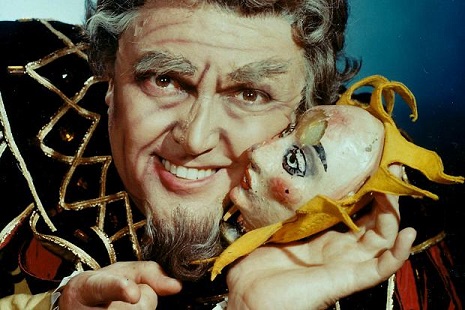
Cornell MacNeil (above) and Ileana Cotrubas bring down the house in the “Si, vendetta!” duet from Verdi’s RIGOLETTO. I love Cotrubas dipping into chest voice on “Perdonate!…“, and Mac’s final note is a triumph.
Ileana Cotrubas & Cornell MacNeil – RIGOLETTO duet – Met bcast 1977
-
Songs of the Sea II
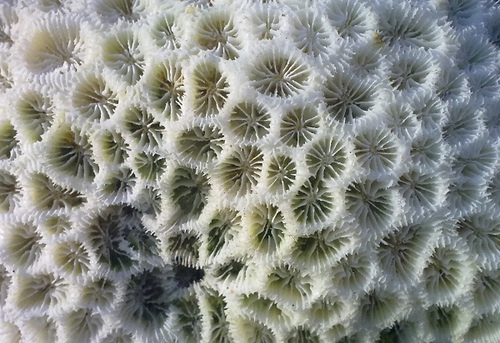
Gladys Ripley sings ‘Where Corals Lie’ from Elgar’s SEA PICTURES.
-
…And All That Djazz @ NCB
Friday September 16th, 2016 – A sold-out house this evening as Miro Magloire’s New Chamber Ballet presented their season-opening program. At a time when I am covering far less dance than in the past, Miro’s work – his choreography, his musical choices, and the dancers and musicians who bring the ballets to life – continues to draw me to his performances and rehearsals. Tonight’s program was one of the finest I have experienced at New Chamber Ballet: wonderfully diverse in the music presented, expertly danced by a quintet of distinctive ballerinas, and played by a violinist and pianist who seem to thrive on the stylistic range and technical challenges of the music Miro selects.
Variety is the spice of life, and it is also – from a musical point of view – an essential element in putting together an evening of dance. Miro will sometimes provoke New Chamber Ballet‘s faithful followers with the thorniness of a score he has decided on; inevitably, his rightness of judgment wins out. These contemporary pieces are counter-balanced by more ‘accessible’ music – tonight, Tartini and Ravel – thus turning the evening into a audio roller coaster. We are along for the ride, which can be quite exhilarating, and the NCB musicians make it all so rewarding.
Opening the evening was a trio, Silk, which premiered in 2006. Doori Na’s playing of the Sonata VII for solo violin by Giuseppe Tartini was stunningly virtuosic. The violinist had a long evening ahead of him, playing in all four works; in the Tartini, he poised himself at a very high level of technique and artistry, and then incredibly soared upward from there. The Ravel that ended the evening was – to use a 60s phrase – mind-blowing.
In Silk, the three dancers – Elizabeth Brown,Traci Finch, and Cassidy Hall – appear in Candice Thompson’s ice-blue, skirted leotards. They commence with slow ‘plastique’ port de bras and poses that might have been inspired by a Grecian urn. A sense of calm pervades their unison trio. There’s a silence as things are re-set for a charming, light-filled allegro.
Striking poses in unison, the girls commence an andante which features a simply gorgeous Tartini melody, superbly intoned by Doori. Cassidy Hall has a long solo, danced beautifully, while Traci and Elizabeth stand back-to-back, swaying gently, and curling their hands in a subtly expressive motif.
Elizabeth and Cassidy sit in a stylized pose as Traci dances an impressive solo with lots of intricate pointe work and a sense of urgency. In a striking passage, Traci balances on both pointes as her upper body sways and angles itself off-kilter. Doori hones his tone down to a thread before it goes deep: this music is so demanding!
Elizabeth Brown, a dancer of unique qualities, has solo passages laced into a spacious trio; as the pace of the music slows and then revs up again, Elizabeth executes lyrical turns and unusual, quirky footwork. The three girls dance in unison, with fast moves to slow music. Silk goes on to a sprightly conclusion.
Above: Cassidy Hall and Sarah Atkins in Upon My Wings; photo by Amber Neff
In the first of the evening’s two premieres, Upon My Wings, Doori Na again made a vivid impression in the music of Reiko Fueting: tanz.tanz was composed for solo violin as an homage to Bach’s famous Chaconne. This ballet, originally entitled Tanz Tanz, was commissioned by the Columbia Ballet Collaborative, where it premiered in 2014. For his own company, Miro has distilled the dancing to a duet for Sarah Atkins and Cassidy Hall.
Skittering sounds from Doori’s violin find the two dancers balancing against one another’s bodies. They kneel and sway. The choreography features the intimate and physically taxing same-sex partnering that Miro has been exploring of late: for example, Sarah being rotated by Cassidy in an off-center balance.
The violin stutters and buzzes, and Doori shows his mastery with some ultra-soft playing, so subtle and shining. The girls echo one another in turns as the music goes Bachian; the ballet ends in silence.
Yellow-Rose-Red-Blue, the evening’s second premiere, marks Miro’s third collaboration with composer Michel Galante; the work is made possible by a grant from the O’Donnell-Green Music and Dance Foundation.
Above: Amber Neff, Cassidy Hall, and Traci Finch in Yellow-Rose-Red-Blue; photo courtesy of New Chamber Ballet
The ballet’s title derives from the colours of Sarah Thea’s stylish and usual costumes: mock-turtle-neck designs with long, gossamer slit-skirts. These elegant frocks add to the airy feeling of the space-filling choreography. Pianist Melody Fader joins Doori Na to play Galante’s very demanding score.
As Amber Neff and Cassidy Hall engage in more of Miro’s intense partnering, the music is almost immediately fiendish: deep piano and growling violin. Things turn waltzy, and the girls pair off and circle the stage in a movement motif that is half-waltz and half-galop. The music continues to engage us: somehow, Doori is able to produce a deep, gritty sound as if he was drawing his bow across sandpaper. The dancers gather in a circle, raising their arms in a reverential gesture.
Amber and Cassidy, standing back-to-back, wrap one another en attitude, and bend apart. The four dancers form a chorus line; the music grows agitated, and the girls rush off into a space-filling chase-about. Their paths cross; poses are struck while the others dance on. They re-form the celebratory circle, reaching for heaven. In an allegro rush, the dancers conjure up a galloping pace, drawing from a repeated note on Melody’s keyboard.
Yellow-Rose-Red-Blue: it’s complicated, both musically and choreographically. It will take further viewings to delve into its riches, and I feel certain we’ll be seeing it again soon. Tonight’s premiere certainly was provocative, and I look forward to this ballet’s future evolution.
Concluding the evening was Djazz. Set to Maurice Ravel’s sonata #2 for violin and piano, the ballet was commissioned by Leslie and Richard Curtis. Here designer Sarah Thea had the three dancers – Sarah Atkins, Traci Finch, and Amber Neff – in dark-coloured leotards to which long fringes have been attached. This gave the girls a “flapper” look which meshed well with Ravel’s jazz-tinted score; when doing fast turns, the fringe flared out, giving an added air of animation.
Sarah Atkins leads off the dancing, soon joined by Traci Finch and Amber Neff; their contrasting personalities are engaging. Miro’s choreography here again calls for tricky partnering, as well as jazz-inspired swaying and sauntering. At the end of the first movement, the dancers wilt; at the end of the second, they sleep. In the finale, the dancing becomes very animated, with high-kicking extensions on display and brisk steps woven into the pulsating music.
In the Ravel, the musical achievement of Doori Na and Melody Fader was extraordinary; I can honestly say I’ve never heard this piece played better. It’s such incredible music: rhythmically captivating, veering from assertive to misterioso, and rich in irony. Doori and Melody were rightly cheered by the full house as the evening drew to its close.
Dancers: Sarah Atkins, Elizabeth Brown, Traci Finch, Cassidy Hall, and Amber Neff
Musicians: Melody Fader, piano & Doori Na, violin -
…And All That Djazz @ NCB

Friday September 16th, 2016 – A sold-out house this evening as Miro Magloire’s New Chamber Ballet presented their season-opening program. At a time when I am covering far less dance than in the past, Miro’s work – his choreography, his musical choices, and the dancers and musicians who bring the ballets to life – continues to draw me to his performances and rehearsals. Tonight’s program was one of the finest I have experienced at New Chamber Ballet: wonderfully diverse in the music presented, expertly danced by a quintet of distinctive ballerinas, and played by a violinist and pianist who seem to thrive on the stylistic range and technical challenges of the music Miro selects.
Variety is the spice of life, and it is also – from a musical point of view – an essential element in putting together an evening of dance. Miro will sometimes provoke New Chamber Ballet‘s faithful followers with the thorniness of a score he has decided on; inevitably, his rightness of judgment wins out. These contemporary pieces are counter-balanced by more ‘accessible’ music – tonight, Tartini and Ravel – thus turning the evening into a audio roller coaster. We are along for the ride, which can be quite exhilarating, and the NCB musicians make it all so rewarding.
Opening the evening was a trio, Silk, which premiered in 2006. Doori Na’s playing of the Sonata VII for solo violin by Giuseppe Tartini was stunningly virtuosic. The violinist had a long evening ahead of him, playing in all four works; in the Tartini, he poised himself at a very high level of technique and artistry, and then incredibly soared upward from there. The Ravel that ended the evening was – to use a 60s phrase – mind-blowing.
In Silk, the three dancers – Elizabeth Brown,Traci Finch, and Cassidy Hall – appear in Candice Thompson’s ice-blue, skirted leotards. They commence with slow ‘plastique’ port de bras and poses that might have been inspired by a Grecian urn. A sense of calm pervades their unison trio. There’s a silence as things are re-set for a charming, light-filled allegro.
Striking poses in unison, the girls commence an andante which features a simply gorgeous Tartini melody, superbly intoned by Doori. Cassidy Hall has a long solo, danced beautifully, while Traci and Elizabeth stand back-to-back, swaying gently, and curling their hands in a subtly expressive motif.
Elizabeth and Cassidy sit in a stylized pose as Traci dances an impressive solo with lots of intricate pointe work and a sense of urgency. In a striking passage, Traci balances on both pointes as her upper body sways and angles itself off-kilter. Doori hones his tone down to a thread before it goes deep: this music is so demanding!
Elizabeth Brown, a dancer of unique qualities, has solo passages laced into a spacious trio; as the pace of the music slows and then revs up again, Elizabeth executes lyrical turns and unusual, quirky footwork. The three girls dance in unison, with fast moves to slow music. Silk goes on to a sprightly conclusion.
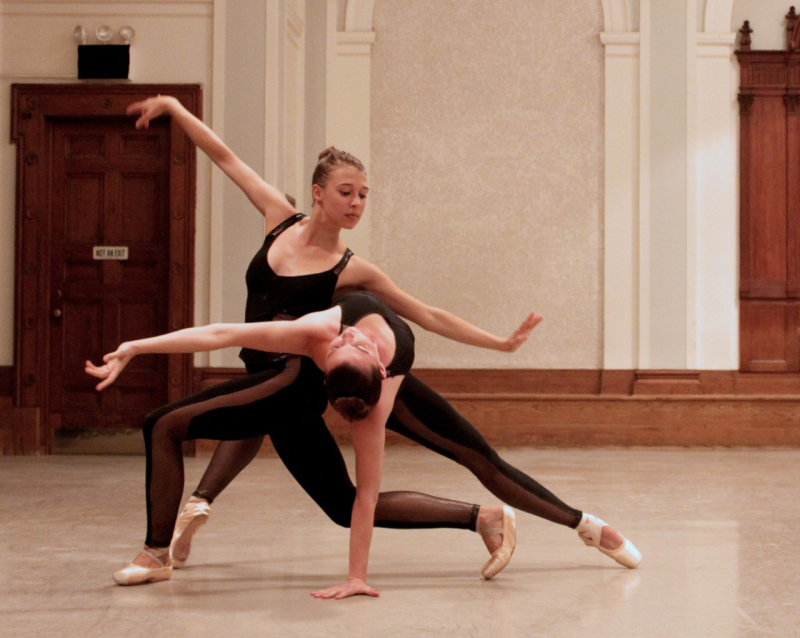
Above: Cassidy Hall and Sarah Atkins in Upon My Wings; photo by Amber Neff
In the first of the evening’s two premieres, Upon My Wings, Doori Na again made a vivid impression in the music of Reiko Fueting: tanz.tanz was composed for solo violin as an homage to Bach’s famous Chaconne. This ballet, originally entitled Tanz Tanz, was commissioned by the Columbia Ballet Collaborative, where it premiered in 2014. For his own company, Miro has distilled the dancing to a duet for Sarah Atkins and Cassidy Hall.
Skittering sounds from Doori’s violin find the two dancers balancing against one another’s bodies. They kneel and sway. The choreography features the intimate and physically taxing same-sex partnering that Miro has been exploring of late: for example, Sarah being rotated by Cassidy in an off-center balance.
The violin stutters and buzzes, and Doori shows his mastery with some ultra-soft playing, so subtle and shining. The girls echo one another in turns as the music goes Bachian; the ballet ends in silence.
Yellow-Rose-Red-Blue, the evening’s second premiere, marks Miro’s third collaboration with composer Michel Galante; the work is made possible by a grant from the O’Donnell-Green Music and Dance Foundation.

Above: Amber Neff, Cassidy Hall, and Traci Finch in Yellow-Rose-Red-Blue; photo courtesy of New Chamber Ballet
The ballet’s title derives from the colours of Sarah Thea’s stylish and usual costumes: mock-turtle-neck designs with long, gossamer slit-skirts. These elegant frocks add to the airy feeling of the space-filling choreography. Pianist Melody Fader joins Doori Na to play Galante’s very demanding score.
As Amber Neff and Cassidy Hall engage in more of Miro’s intense partnering, the music is almost immediately fiendish: deep piano and growling violin. Things turn waltzy, and the girls pair off and circle the stage in a movement motif that is half-waltz and half-galop. The music continues to engage us: somehow, Doori is able to produce a deep, gritty sound as if he was drawing his bow across sandpaper. The dancers gather in a circle, raising their arms in a reverential gesture.
Amber and Cassidy, standing back-to-back, wrap one another en attitude, and bend apart. The four dancers form a chorus line; the music grows agitated, and the girls rush off into a space-filling chase-about. Their paths cross; poses are struck while the others dance on. They re-form the celebratory circle, reaching for heaven. In an allegro rush, the dancers conjure up a galloping pace, drawing from a repeated note on Melody’s keyboard.
Yellow-Rose-Red-Blue: it’s complicated, both musically and choreographically. It will take further viewings to delve into its riches, and I feel certain we’ll be seeing it again soon. Tonight’s premiere certainly was provocative, and I look forward to this ballet’s future evolution.
Concluding the evening was Djazz. Set to Maurice Ravel’s sonata #2 for violin and piano, the ballet was commissioned by Leslie and Richard Curtis. Here designer Sarah Thea had the three dancers – Sarah Atkins, Traci Finch, and Amber Neff – in dark-coloured leotards to which long fringes have been attached. This gave the girls a “flapper” look which meshed well with Ravel’s jazz-tinted score; when doing fast turns, the fringe flared out, giving an added air of animation.
Sarah Atkins leads off the dancing, soon joined by Traci Finch and Amber Neff; their contrasting personalities are engaging. Miro’s choreography here again calls for tricky partnering, as well as jazz-inspired swaying and sauntering. At the end of the first movement, the dancers wilt; at the end of the second, they sleep. In the finale, the dancing becomes very animated, with high-kicking extensions on display and brisk steps woven into the pulsating music.
In the Ravel, the musical achievement of Doori Na and Melody Fader was extraordinary; I can honestly say I’ve never heard this piece played better. It’s such incredible music: rhythmically captivating, veering from assertive to misterioso, and rich in irony. Doori and Melody were rightly cheered by the full house as the evening drew to its close.
Dancers: Sarah Atkins, Elizabeth Brown, Traci Finch, Cassidy Hall, and Amber Neff
Musicians: Melody Fader, piano & Doori Na, violin -
The Met @ Lincoln Center: 50 Years On

September 16th, 2016 – Fifty years ago tonight, the Metropolitan Opera opened at their new home at Lincoln Center with the world premiere performance of Samuel Barber’s ANTONY AND CLEOPATRA starring Leontyne Price, Justino Diaz, and Jess Thomas, conducted by Thomas Schippers. The performance was broadcast live, and – needless to say – I was tuned in.

I remember listening in my little room in the big house in tiny Hannibal, New York, where I grew up. The possibility of a strike by the musicians of The Met’s orchestra had left the future of the season beyond this first night up in the air; but during the intermission, Rudolf Bing stepped out before the gold curtain to announce that the strike had been averted and new contracts signed. I – always so reticent – let out a whoop and raced downstairs, excitedly telling my parents the news; they thought I was deranged, but that was nothing new.
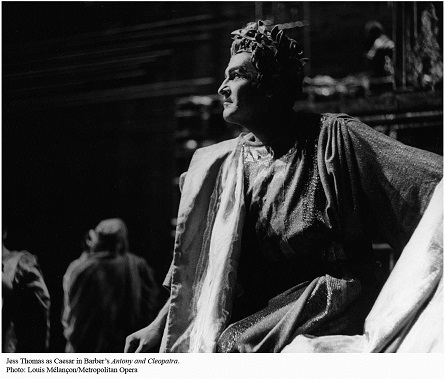
But I had a vested interest in the outcome of The Met’s contract negotiations, because in August I had made my first solo trip to New York City and I had tickets to several upcoming performances, including the final ANTONY AND CLEOPATRA of the run. So now my plans were a “go”, and I was soon making frequent pilgrimages to Lincoln Center and falling in love with the City where I would eventually live.
Read an article about my experience on the first ticket line for The Met at Lincoln Center here.



 Oberon's Glade