Blog
-
EVIDENCE

I didn’t write this, but it expresses my feelings pretty accurately:
“There is not a single shred of evidence to support the claims that the universe was created by a supernatural being, that said supernatural being authored (or edited) a book in his spare time, or that the first member of the human species was formed from dust and divine breath in a magical garden with a talking snake. There is not a shred of evidence to support the stories of ancient virgin births or of special individuals with the ability to change the molecular structure of water into the molecular structure of wine, to walk on water, and to raise the dead. There is not a shred of evidence to support the claim that believing in a supernatural being will lead one to an eternal life of happiness, nor is there any evidence to support the claim that failure to believe will result in eternal damnation.
The fact that many millions of people believe these myths to be factual does not make them true. The fact that many millions of people find peace or take comfort from these tales in time of duress does not make them true. The fact that millions of people find these tales give meaning to their lives does not make them true. The fact that enormous institutions are constructed in support of these tales does not make any of them true. The only thing that could make them true is the same thing that makes anything true, and that is evidence.
Without evidence there is no point in appealing to said supernatural being to relieve us from the burdens and challenges we all face. Such appeals are little more than desperate pleas in the dark. It is time to wake up and recognize these stories for what they are: fables and old wives’ tales. It is time to emerge from fantasy land and embrace reality.”
People will point to the natural wonders of the Earth and of the universe as proof that gods exist, but the Earth and the universe simply are and there’s really no way to determine how they got here. And really – as we live from one day to the next – does it really matter how it all began?
People will quote the Bible in support of their theory that the Christian god created and controls everything, but quoting the Bible no more proves god’s existence than quoting Tolkein’s LORD OF THE RINGS proves the existence of Middle Earth.
-
Safe in Beulah Land

On November 13th, 1969, Beverly Sills sang one of her signature roles, Baby Doe in Douglas Moore’s opera THE BALLAD OF BABY DOE, for what I believe was the last time in her career. It was the date of her mother’s birthday, and she had asked her mom what role she would like to have sung for her on her special day; “Baby Doe,” was the answer, and the performance was a sensation from start to finish.
Sills Mania was in full flourish at that time, and as the members of the Snowstorm Crew gathered in the 5th Ring of the New York State Theatre on that November evening, the anticipation was palpable. Beverly’s first entrance drew a round of welcoming applause, and each of Baby Doe’s arias – and especially the the Willow Song – stopped the show.
The opera is based on the story of Horace Tabor, who made a fortune in silver mining in Colorado in the 1880s. Tabor owned the Matchless Mine in Leadville, and he and his wife Augusta were leading figures in the community. Horace met and became infatuated with Elizabeth “Baby” Doe, a young divorced woman who was twenty-five years his junior. Baby Doe was shunned by high society, being viewed as a fortune-huntress. Horace Tabor divorced Augusta in 1883 and married Baby Doe. They had two daughters.
In 1893, Tabor lost everything when the United States adopted the gold standard. He was named postmaster of the city of Denver, but his spirit was broken and he died in 1899. On his deathbed, he made Baby Doe promise that she would “always hold on to the Matchless Mine.”
True to her word, Baby Doe lived in a tiny cabin at the entrance to the mine until 1935, when, following a severe snowstorm, her body was found frozen to death on the cabin floor. She was buried next to Horace in the Mt. Olivet Cemetery in Jefferson County, Colorado.
Douglas Moore’s operatic setting of the story (libretto by John Latouche) ends with Horace’s death; cradling his body, Baby Doe sings the gentle lullaby, “Always Thru The Changing of Sun and Shadow”. As the aria progresses, the scenery fades away and snow begins to fall, foreshadowing Baby’s eventual demise.
On that November evening – now nearly a half-century ago – Beverly held the audience in the palm of her hand as she sang this song of dedication and undying love.
The ovation was endless, and our ‘snowstorm’ of paper confetti was massive. After several minutes of applause, we all started singing “Happy birthday, Mrs. Silverman!” I wish I had let the tape run to include that.
-
Gallant’s RETROGRADE UNIVERSE @ Danspace
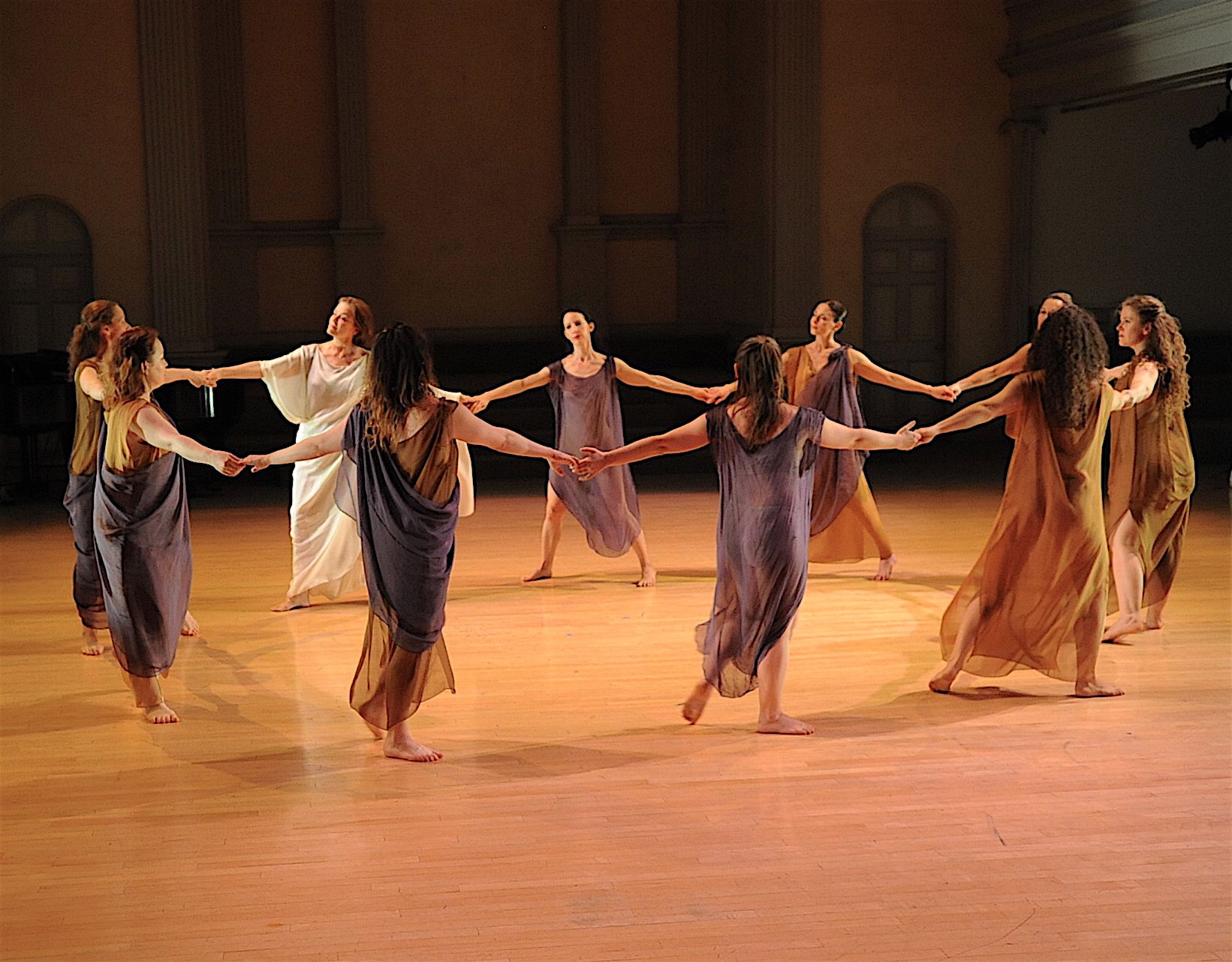
Above: Loretta Thomas and the ensemble, photo by Melanie Futorian
Thursday June 23rd, 2016 – The high-vaulted space of St Mark’s Church can become oppressively warm on a Summer evening, but it was worth this minor discomfort tonight as the engaging dancers of Catherine Gallant/DANCE and Dances by Isadora, under the artistic direction of Ms. Gallant, presented a program offering a wide-ranging musical experience, choreography both new and venerated, and dancing that unfailingly found the heart of each piece presented. The performance affirmed both the power and the poetry of the feminine spirit, seen tonight in its many aspects.
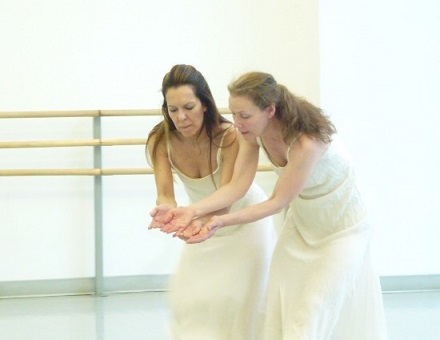
Above: Janete Gondim and Eleanor Bunker rehearsing Catherine Gallant’s The Secret
The evening could not have a had a more propitious start than Ms. Gallant’s The Secret; like white-clad angels, the two dancers – Janete Gondim and Eleanor Bunker – continually conveyed the sense of wonder which permeates this dancework like a delicious fragrance.
With Ygor Shetsov at the piano, playing the Scriabin Poeme in F-sharp major, the two dancers moved about the space with a sort of quiet urgency, pausing to marvel at the treasure they had found, and which they were holding in the palms of their hands. The choreography flows gorgeously on the music: simple moves which take on a poetic resonance in the personalities of the two women; Janete and Eleanor were captivating to watch, and The Secret joins a short list of danceworks I’ve encountered in the past 20 years that ideally meld music, mood, and movement, leaving a lasting impression.
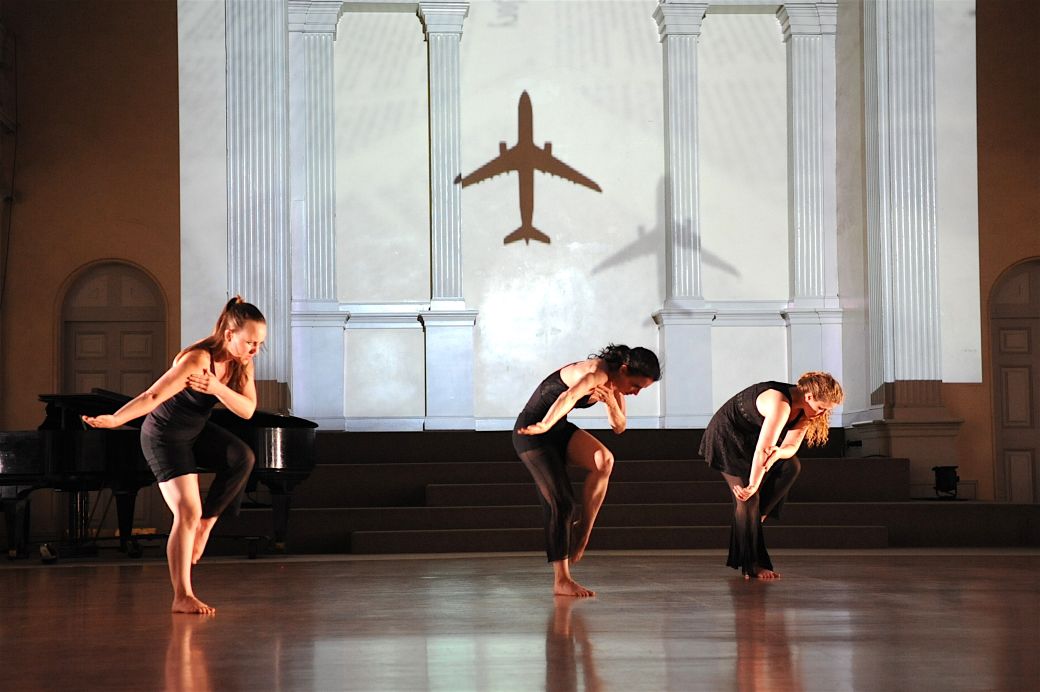
The premiere of Ms. Gallant’s Retrograde Universe (above, in Melanie Furotian’s photo) offered a fine contrast to The Secret. Alternating passages of silence with music of Steve Reich, this piece found excellent interpreters in Michelle Cohen, Megan Minturn, Erica Lessner, and Charlotte Henrickson. The girls periodically flung themselves to the floor, or burst into paroxysms of anxious movement, whilst at other moments they simply stand stock still, striking sculptural poses. Whimsical projections of newsprint and of an airplane whose pilot had clearly lost his sense of direction added a touch of mystery to the work, which seemed at times to be going on a bit too long, but which was kept on track by the energies of the four dancers.
Finally, a Gallant work created in 2009, features a score by Rome prize-winning composer Lisa Bielawa. Using texts from Franz Kafka, the composer creates music of haunting sonic textures as performed by violinist/vocalist Christina Courtin. Loretta Thomas danced this solo tonight, swathed in a long black veil. Her body ‘spoke’ the music, expressing an almost desperate loneliness. Ms. Courtin, in addition to being an emotive violinist, has a voice – plaintive and clear – which makes a poignant effect. At the end, Ms. Thomas, an artist to her fingertips, walked slowly upstage as the lights faded.
Above: Alvaro Gonzalez and Michelle Cohen in Meeting #12; photo by Melanie Futorian
A domestic drama, Meeting #12, opens with the dancers Michelle Cohen and Alvaro Gonzalez seated at a table. Much of this work is danced in silence, with interjections from Schubert’s E-flat major trio occasionally cropping up. The couple are enmeshed in a quarrel which becomes tempestuous, and the table and chairs eventually become part of the choreography. The beauteous Ms. Cohen and the scruffily handsome Mr. Gonzalez are ideally cast, and they make every moment of the work count. In the end, they find that actually conversing with one another may be the best solution. Projections of puffy clouds against a bright blue sky provide a visual counterpoint to the cramped kitchen in which the lovers have been arguing.
The second half of the program was given over to works of Isadora Duncan.
Above: from Valse Brillante, photo by Melanie Futorian
Loretta Thomas has staged Isadora’s Valse Brillante (created c. 1910) for the Company, and it was danced this evening with lively grace by Jessie King, Amelia Sanders, Ella Lang, and Chanda Cragnotti. At the piano, Yegor Shetsov reveled in the ebb and flow of the Chopin Grande Valse Brillante.
Three solos – each set to a Scriabin étude – were engrossing in their contrasting moods, and in the committed interpretations of the dancers.
In Crossing, Scriabin-turbulence buffeted the hesitant anxiousness of Catherine Gallant, who danced with great physical devotion, mirroring the stormy music. The pain of loss and the thought of “nevermore” were movingly evoked by Loretta Thomas in her sorrowful performance of Mother, one of the Duncan works recalling the tragic death of Isadora’s two young children. Personifying feminine strength and the courage of resistance, Kristen Foote, a guest artist from the Limón Dance Company, gave a performance of radiant authority in Revolutionary. Mr. Shetsov played the three Scriabin études which accompany these solos with virtuosity and dramatic nuance.
Catherine Gallant and Loretta Thomas have been working on the reconstruction of two movements of an untitled work – set to movements of the Beethoven 7th symphony – which Isadora performed as a solo between 1904 and 1909 on US and European tours.
Ms. Gallant (clad in white in the above rehearsal photo) danced the leading role tonight in her re-imagining of the symphony’s Allegretto, and Loretta Thomas has choreographed the Presto. Watching the Gallant dancers in this evening’s performance, we are reminded of the unique position held by Isadora Duncan in the history of dance, and of the continuing necessity of seeing her dances lovingly revived and maintained, so that new generations can both honor and enjoy her work, both for its historical value and its continuing resonance in modern times.
Here are some Melanie Futorian images from the two Beethoven movements, the Presto of which closed tonight’s performance on a joyous note.
Loretta Thomas (in white) and the ensemble
-
Gallant’s RETROGRADE UNIVERSE @ Danspace

Above: Loretta Thomas and the ensemble, photo by Melanie Futorian
Thursday June 23rd, 2016 – The high-vaulted space of St Mark’s Church can become oppressively warm on a Summer evening, but it was worth this minor discomfort tonight as the engaging dancers of Catherine Gallant/DANCE and Dances by Isadora, under the artistic direction of Ms. Gallant, presented a program offering a wide-ranging musical experience, choreography both new and venerated, and dancing that unfailingly found the heart of each piece presented. The performance affirmed both the power and the poetry of the feminine spirit, seen tonight in its many aspects.
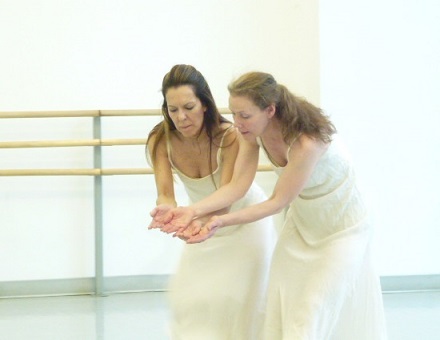
Above: Janete Gondim and Eleanor Bunker rehearsing Catherine Gallant’s The Secret
The evening could not have a had a more propitious start than Ms. Gallant’s The Secret; like white-clad angels, the two dancers – Janete Gondim and Eleanor Bunker – continually conveyed the sense of wonder which permeates this dancework like a delicious fragrance.
With Ygor Shetsov at the piano, playing the Scriabin Poeme in F-sharp major, the two dancers moved about the space with a sort of quiet urgency, pausing to marvel at the treasure they had found, and which they were holding in the palms of their hands. The choreography flows gorgeously on the music: simple moves which take on a poetic resonance in the personalities of the two women; Janete and Eleanor were captivating to watch, and The Secret joins a short list of danceworks I’ve encountered in the past 20 years that ideally meld music, mood, and movement, leaving a lasting impression.
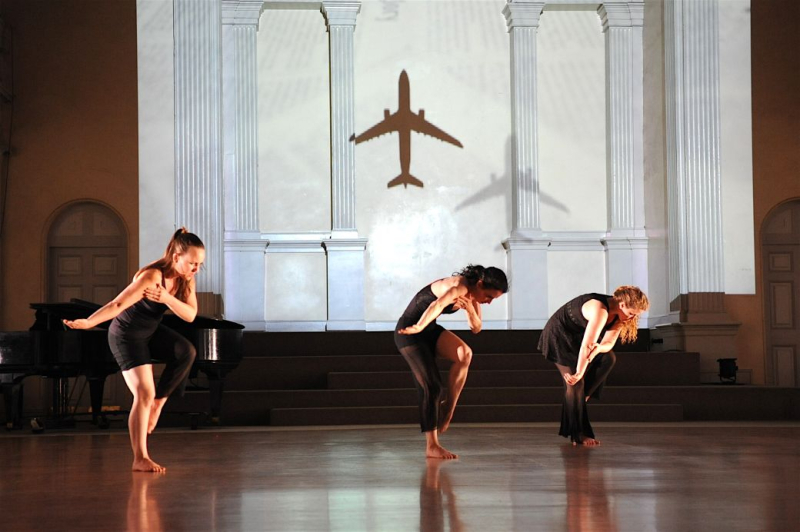
The premiere of Ms. Gallant’s Retrograde Universe (above, in Melanie Furotian’s photo) offered a fine contrast to The Secret. Alternating passages of silence with music of Steve Reich, this piece found excellent interpreters in Michelle Cohen, Megan Minturn, Erica Lessner, and Charlotte Henrickson. The girls periodically flung themselves to the floor, or burst into paroxysms of anxious movement, whilst at other moments they simply stand stock still, striking sculptural poses. Whimsical projections of newsprint and of an airplane whose pilot had clearly lost his sense of direction added a touch of mystery to the work, which seemed at times to be going on a bit too long, but which was kept on track by the energies of the four dancers.
Finally, a Gallant work created in 2009, features a score by Rome prize-winning composer Lisa Bielawa. Using texts from Franz Kafka, the composer creates music of haunting sonic textures as performed by violinist/vocalist Christina Courtin. Loretta Thomas danced this solo tonight, swathed in a long black veil. Her body ‘spoke’ the music, expressing an almost desperate loneliness. Ms. Courtin, in addition to being an emotive violinist, has a voice – plaintive and clear – which makes a poignant effect. At the end, Ms. Thomas, an artist to her fingertips, walked slowly upstage as the lights faded.
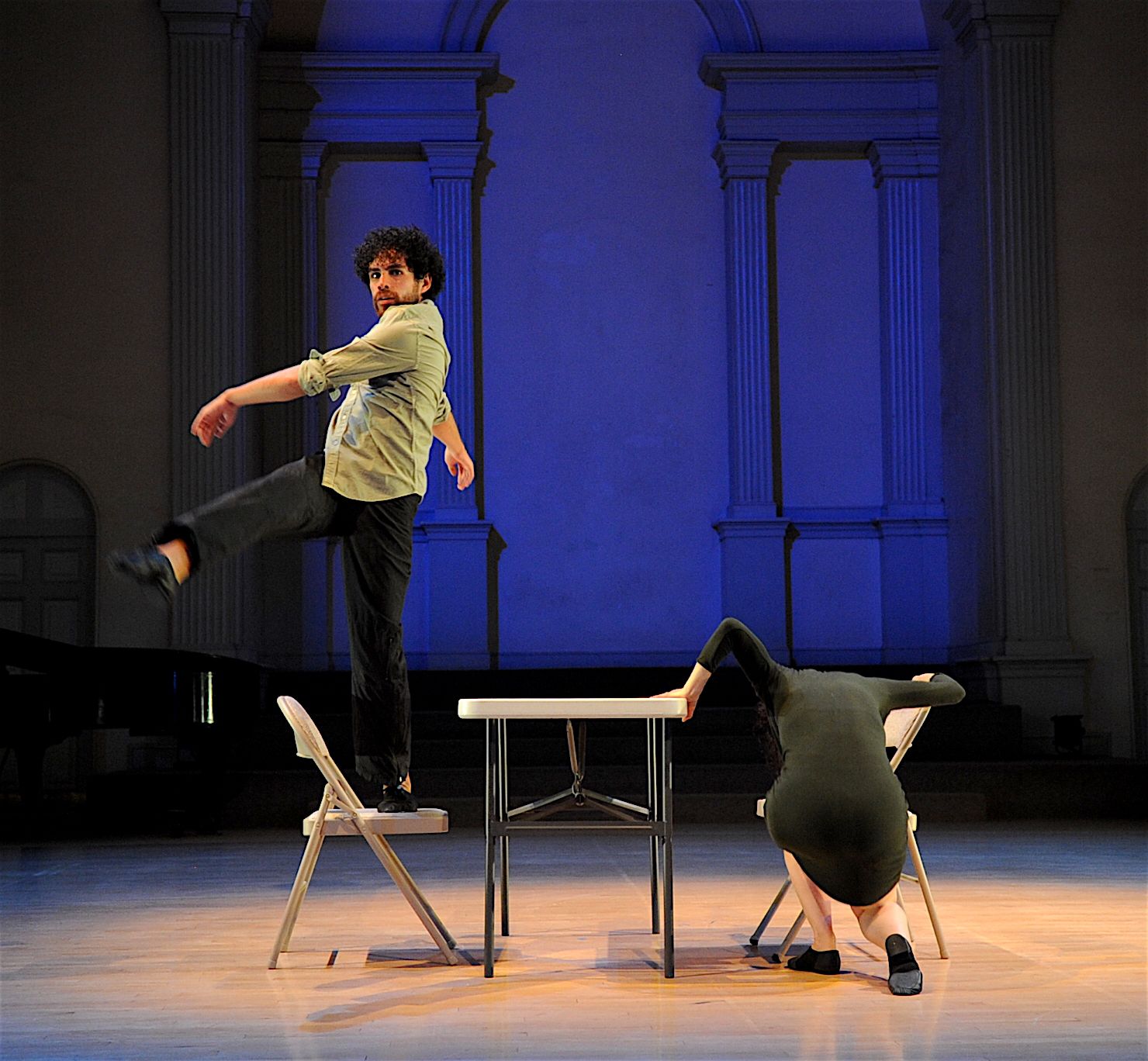
Above: Alvaro Gonzalez and Michelle Cohen in Meeting #12; photo by Melanie Futorian
A domestic drama, Meeting #12, opens with the dancers Michelle Cohen and Alvaro Gonzalez seated at a table. Much of this work is danced in silence, with interjections from Schubert’s E-flat major trio occasionally cropping up. The couple are enmeshed in a quarrel which becomes tempestuous, and the table and chairs eventually become part of the choreography. The beauteous Ms. Cohen and the scruffily handsome Mr. Gonzalez are ideally cast, and they make every moment of the work count. In the end, they find that actually conversing with one another may be the best solution. Projections of puffy clouds against a bright blue sky provide a visual counterpoint to the cramped kitchen in which the lovers have been arguing.
The second half of the program was given over to works of Isadora Duncan.
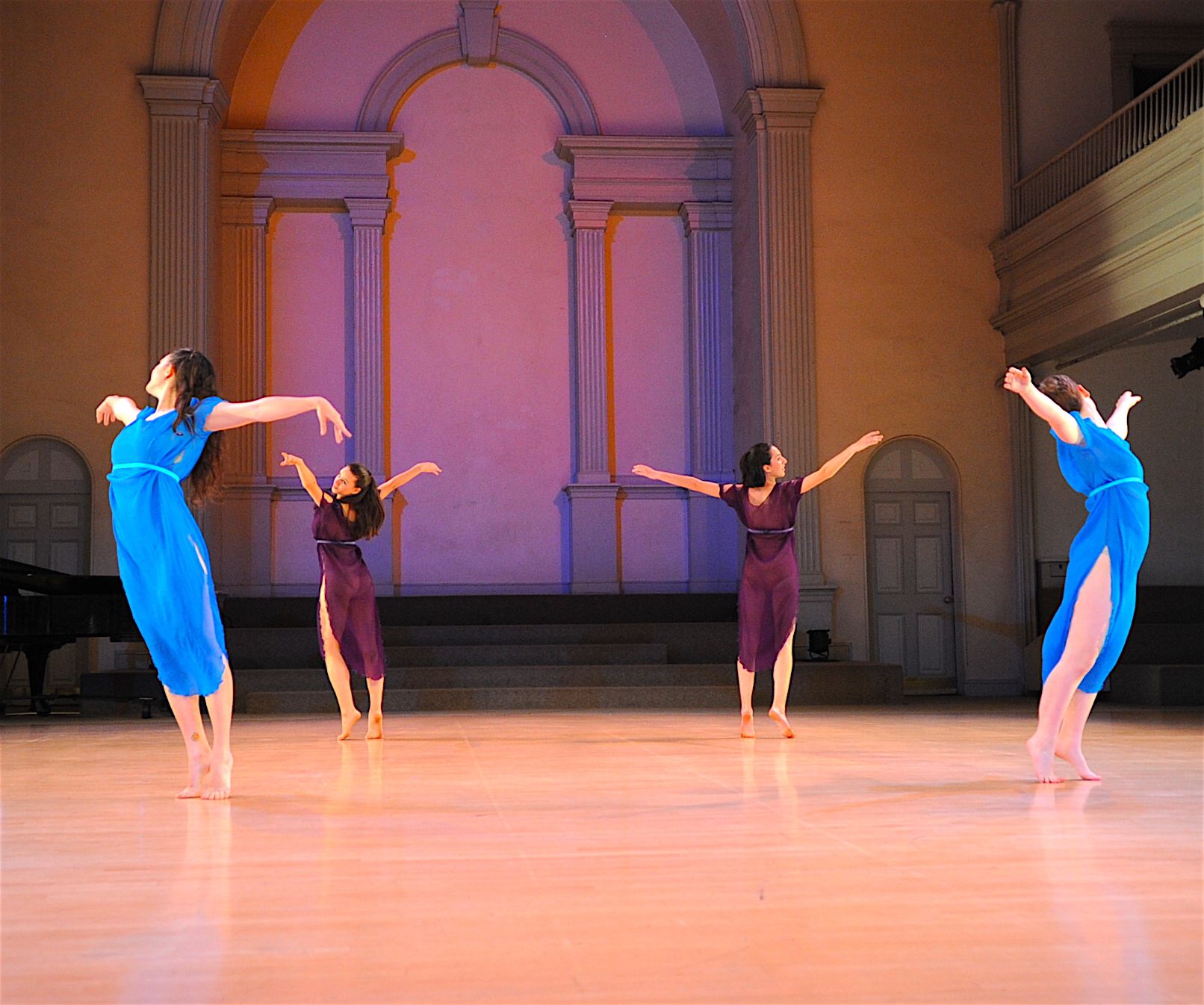
Above: from Valse Brillante, photo by Melanie Futorian
Loretta Thomas has staged Isadora’s Valse Brillante (created c. 1910) for the Company, and it was danced this evening with lively grace by Jessie King, Amelia Sanders, Ella Lang, and Chanda Cragnotti. At the piano, Yegor Shetsov reveled in the ebb and flow of the Chopin Grande Valse Brillante.
Three solos – each set to a Scriabin étude – were engrossing in their contrasting moods, and in the committed interpretations of the dancers.
In Crossing, Scriabin-turbulence buffeted the hesitant anxiousness of Catherine Gallant, who danced with great physical devotion, mirroring the stormy music. The pain of loss and the thought of “nevermore” were movingly evoked by Loretta Thomas in her sorrowful performance of Mother, one of the Duncan works recalling the tragic death of Isadora’s two young children. Personifying feminine strength and the courage of resistance, Kristen Foote, a guest artist from the Limón Dance Company, gave a performance of radiant authority in Revolutionary. Mr. Shetsov played the three Scriabin études which accompany these solos with virtuosity and dramatic nuance.
Catherine Gallant and Loretta Thomas have been working on the reconstruction of two movements of an untitled work – set to movements of the Beethoven 7th symphony – which Isadora performed as a solo between 1904 and 1909 on US and European tours.

Ms. Gallant (clad in white in the above rehearsal photo) danced the leading role tonight in her re-imagining of the symphony’s Allegretto, and Loretta Thomas has choreographed the Presto. Watching the Gallant dancers in this evening’s performance, we are reminded of the unique position held by Isadora Duncan in the history of dance, and of the continuing necessity of seeing her dances lovingly revived and maintained, so that new generations can both honor and enjoy her work, both for its historical value and its continuing resonance in modern times.
Here are some Melanie Futorian images from the two Beethoven movements, the Presto of which closed tonight’s performance on a joyous note.

Loretta Thomas (in white) and the ensemble


-
RIOULT @ The Joyce ~ June 2016

Wednesday June 22nd, 2016 – RIOULT at The Joyce, offering a very pleasing evening of dance from Pascal Rioult’s excellent troupe, with exceptional dancing from both established Company members and relative newcomers. The program was well-varied musically, and the evening was enhanced throughout by fine lighting and canny use of visual effects.
Tchaikovsky’s Orchestral Suite #2 in C-major is the setting for Dream Suite which opened the program; this coloristic ballet – with gorgeously distinctive lighting by Jim French – is a visual treat. The inimitable Charis Haines is the Dreamer, and her dreams veer from lyrical to witty to mystical.
Against a backdrop which shifts from pumpkin-coloured to vivid red, ten dancers move thru Charis’s dreamworld in quirky combinations, sometimes stopping to strike amusingly ironic poses. Masked characters appear: a bull, and ancient reptilian birds. Undercurrents of sexual fantasy are woven in and, as is often the case in dreams, things seem disjointed at times.
The choreography overall is disarmingly simple – when the dancers simply form a circle, the effect is stunning – and Charis Haines excels in her solo passages. Colour – radiant and saturated – is everything. The striking image of a woman stretched out in a flat plank and borne aloft by her partner across the upstage space seems to signal a magical end to the ballet, but there’s another movement to come; that image, though, remains fixed in the memory.
Selected Preludes and Fugues from Bach’s Well-Tempered Clavier (seemingly the Glenn Gould recordings, as there is much extraneous vocalism along the way) are the basis of Polymorphous, a stylized dancework which opened before a gridwork backdrop against neutral colours, with costumes of the same visual texture. Four dancers – Brian Flynn, Charis Haines, Jere Hunt, and Sara Elizabeth Seger – move in sync, almost like automatons. In two duets that follow, the first is accompanied by a ghostly negative-image film of the dancers projected above while during the second, multiple shadow images appear as echoes of the choreography.
Duets, Sacred and Profane opened the evening’s second half; here we meet pairs of the RIOULT dancers in more personalized settings. In the first duet, from Kansas City Orfeo (1996), Sabatino A Verlezza as Orfeo attempts to revive his dead wife, Euridice (Catherine Cooch), to the appropriate music from the Gluck opera; this put me very much in mind of David Grenke’s powerful duet, Vespers.
One of the Company’s newest members, Corinna Nicholson, made a really lovely impression dancing a duet from The Great Mass (2009) with Sara Elizabeth Seger. The girls wear gossamer ‘Baroque’ dresses, and they bring an air of courtliness to this charming piece.
Two of RIOULT‘s most vivid dancers, Jere Hunt and Michael Spencer Phillips, were magnificent in a pas de deux from Te Deum (1995). To the music of Arvo Pärt, Michael – in a dark suit and white shirt – partners Jere, clad in black briefs, in an intimate duet. Though devoid of erotic overtones, the dance is both sensual and spiritual. Various imagined scenarios might be applied – two lovers, two brothers, a father and son, a guardian angel and his charge. Jere Hunt’s muscular physique speaks powerfully in its own right; a vein of poetic vulnerability which runs thru his work as a dancer gives his performances a deeply personal resonance. Michael’s handsomeness and the strength of his movement are captivating to behold: this is a dancer who can express both courage and tenderness. Together, the two men thrilled the audience.
Something special needed to follow this male duet, and we found it the charismatic pairing of Charis Haines and Holt Walborn in a sublime Bach duet from Views of the Fleeting World (2008). Their expressiveness and their sense of the mutual devotion of this couple created a beautiful atmosphere.
For a remarkable finale, Pascal Rioult’s unique setting of Ravel’s Bolero sparked an eruption of cheers from the mesmerized crowd at its end. Against a backdrop by Harry Feiner – a fanciful rendering of architecture à l‘espagnole – eight dancers perform endless repetitions of gestural motifs while periodically moving from one formation to another. Woven into these geometric configurations are illuminated solos which are luxuriantly slow and sometimes self-caressive. The dancers – Mlles. Cooch, Haines, Nicholson, and Seger with Mssrs. Flynn, Hunt, Phillips, and Verlezza – went thru their hypnotic paces with machine-like precision, whilst basking in the more voluptuous solo moments. Brilliant!
-
Bronfman & Braunstein @ Zankel Hall
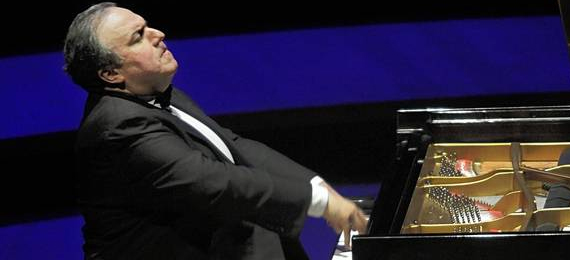
Saturday June 18th, 2016 – Yefim Bronfman (above) concluding a Prokofiev piano sonata cycle at Zankel Hall this evening, playing the 5th and 9th sonatas. Violinist Guy Braunstein joined Mr. Bronfman for the two Prokofiev violin sonatas.
After passing some days in a state of reclusive depression over the Orlando shootings, I ventured out tonight even though I was not really in the mood for it. But Bronfman is one of my most-admired musicians, and Prokofiev among my favorite composers, so I felt a strong desire to be there. Prokofiev’s music is not consoling, as a rule, though there are passages that reach to the soul, especially in the Andante of the second violin sonata, where Mr. Braunstein was at his finest this evening.
Watching Yefim Bronfman perform is a particularly pleasing experience for me. He walks out, bows genially, sits down, and he and the keyboard become one. There are no frills, and no theatricality in his playing: it’s all about the music and his communing with it. Very brief pauses between movements keep the impetus of the music – and our delight in it – in true focus.
Bronfman’s rendering of the 5th piano sonata was deeply satisfying, the audience engrossed as he immersed himself in the music’s ever-shifting melodic and rhythmic elements. This was exactly the ‘great escape’ from world-weariness I so desperately needed tonight. From its songful start, the opening Allegro tranquillo was a complete delight: the touches of dissonance adding spice, with wit, irony, and drama all having their say. A delicate march heralds the Andantino, with fetching trills, before things get darker and more emphatic, leading to a low-rumbling of a finish. By turns jaunty, lyrical, and pungent, the concluding Poco allegretto was polished off with Bronfman’s inimitable clarity and grace, the music seeming to vanish into a dream at the end.
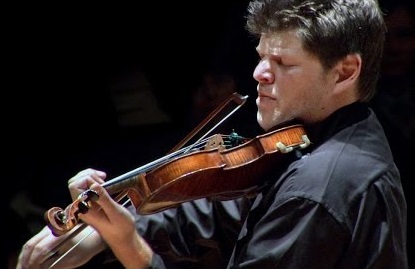
Above: Guy Braunstein
Mr. Braunstein then joined the pianist for the violin sonata #1. Here the piano’s somber opening of the Andante assai gives way to a rather hesitant start for the violin, with some buzzing trills before things expand to a rather labored passage. Then the piano’s misterioso murmurs underpin the violin’s sliding scales. The emphatic start of the Allegro brusco drew some energetic foot stamping from Mr. Braunstein as the turbulence envelops us; and then suddenly his violin sings a lusty song. After re-grouping and re-energizing, the music turns more pensive – but only briefly: a riotous dance ensues, subsiding into lyricism before another dramatic surge.
The Andante features a shimmering piano motif as the violin sings in the alto range; both instruments move to the higher spheres in a unison passage, which eventually goes very high indeed. Back to the alto colourings for more of the violin’s forlorn phrases. High and lilting, the piano signals the movement’s soft ending. A sprightly jig sets off the finale, calming eventually and leading to a delicate pizzicati paragraph. Some lively scrambling makes us think the end is nigh, but instead the violin’s mute goes on and rolling scales summon an impression of “the wind in a graveyard”; the sonata ends sadly.
The performance drew an enthusiastic response from the sold-out house; a bit of iffy intonation from the violin in places mattered little in the end, since Braunstein’s mixture of poetry and vigor made the music so savorable.
Following the interval, Mr. Bronfman returned for the 9th piano sonata. The first movement starts gently, and continues amiably, though there’s an underlying restlessness. More expansive passages, and some low, rumbling scales lead to an eventual quiet finish. The second movement is scherzo-like, with rippling scales and a jogging rhythm; a pensive passage, more jogging, and another soft ending.
The Andante tranquillo brought forth more Bronfman magic: a wistful melody, followed by a glittering brilliance that subsides to mystery and then to sadness. From deep rumblings, the music rises to a high melancholy. After a big start, the Allegro finale turns ironic; “shining” music gleams forth, surrendering to mirth, percolating on high, whispering a farewell. Here Bronfman’s virtuosity and subtle colorations were at their most alluring.
To end the evening, Prokofiev’s second violin sonata, which had started life as a flute sonata, and which David Oistrakh had prevailed on the composer to re-cast for violin in 1943. This familiar work was played with a wonderful melding of the two instruments, the players so alert to one another and marking the beauty of the Andante with glowing sound. Traces of my earlier concerns about pitch in the violin line cropped up again, but my pianist-companion seemed to feel that the issue was minor, and so I let the energy and optimism of the Allegro con brio the finale carry me along…together with the rest of the crowd, who swept to their feet at the finish to salute the generous playing and the final expression of joie de vivre from the two players.
-
Bronfman & Braunstein @ Zankel Hall
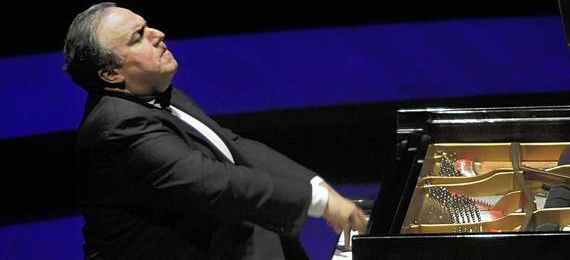
Saturday June 18th, 2016 – Yefim Bronfman (above) concluding a Prokofiev piano sonata cycle at Zankel Hall this evening, playing the 5th and 9th sonatas. Violinist Guy Braunstein joined Mr. Bronfman for the two Prokofiev violin sonatas.
After passing some days in a state of reclusive depression over the Orlando shootings, I ventured out tonight even though I was not really in the mood for it. But Bronfman is one of my most-admired musicians, and Prokofiev among my favorite composers, so I felt a strong desire to be there. Prokofiev’s music is not consoling, as a rule, though there are passages that reach to the soul, especially in the Andante of the second violin sonata, where Mr. Braunstein was at his finest this evening.
Watching Yefim Bronfman perform is a particularly pleasing experience for me. He walks out, bows genially, sits down, and he and the keyboard become one. There are no frills, and no theatricality in his playing: it’s all about the music and his communing with it. Very brief pauses between movements keep the impetus of the music – and our delight in it – in true focus.
Bronfman’s rendering of the 5th piano sonata was deeply satisfying, the audience engrossed as he immersed himself in the music’s ever-shifting melodic and rhythmic elements. This was exactly the ‘great escape’ from world-weariness I so desperately needed tonight. From its songful start, the opening Allegro tranquillo was a complete delight: the touches of dissonance adding spice, with wit, irony, and drama all having their say. A delicate march heralds the Andantino, with fetching trills, before things get darker and more emphatic, leading to a low-rumbling of a finish. By turns jaunty, lyrical, and pungent, the concluding Poco allegretto was polished off with Bronfman’s inimitable clarity and grace, the music seeming to vanish into a dream at the end.

Above: Guy Braunstein
Mr. Braunstein then joined the pianist for the violin sonata #1. Here the piano’s somber opening of the Andante assai gives way to a rather hesitant start for the violin, with some buzzing trills before things expand to a rather labored passage. Then the piano’s misterioso murmurs underpin the violin’s sliding scales. The emphatic start of the Allegro brusco drew some energetic foot stamping from Mr. Braunstein as the turbulence envelops us; and then suddenly his violin sings a lusty song. After re-grouping and re-energizing, the music turns more pensive – but only briefly: a riotous dance ensues, subsiding into lyricism before another dramatic surge.
The Andante features a shimmering piano motif as the violin sings in the alto range; both instruments move to the higher spheres in a unison passage, which eventually goes very high indeed. Back to the alto colourings for more of the violin’s forlorn phrases. High and lilting, the piano signals the movement’s soft ending. A sprightly jig sets off the finale, calming eventually and leading to a delicate pizzicati paragraph. Some lively scrambling makes us think the end is nigh, but instead the violin’s mute goes on and rolling scales summon an impression of “the wind in a graveyard”; the sonata ends sadly.
The performance drew an enthusiastic response from the sold-out house; a bit of iffy intonation from the violin in places mattered little in the end, since Braunstein’s mixture of poetry and vigor made the music so savorable.
Following the interval, Mr. Bronfman returned for the 9th piano sonata. The first movement starts gently, and continues amiably, though there’s an underlying restlessness. More expansive passages, and some low, rumbling scales lead to an eventual quiet finish. The second movement is scherzo-like, with rippling scales and a jogging rhythm; a pensive passage, more jogging, and another soft ending.
The Andante tranquillo brought forth more Bronfman magic: a wistful melody, followed by a glittering brilliance that subsides to mystery and then to sadness. From deep rumblings, the music rises to a high melancholy. After a big start, the Allegro finale turns ironic; “shining” music gleams forth, surrendering to mirth, percolating on high, whispering a farewell. Here Bronfman’s virtuosity and subtle colorations were at their most alluring.
To end the evening, Prokofiev’s second violin sonata, which had started life as a flute sonata, and which David Oistrakh had prevailed on the composer to re-cast for violin in 1943. This familiar work was played with a wonderful melding of the two instruments, the players so alert to one another and marking the beauty of the Andante with glowing sound. Traces of my earlier concerns about pitch in the violin line cropped up again, but my pianist-companion seemed to feel that the issue was minor, and so I let the energy and optimism of the Allegro con brio the finale carry me along…together with the rest of the crowd, who swept to their feet at the finish to salute the generous playing and the final expression of joie de vivre from the two players.






 Oberon's Glade