
Alan Titus singing Wotan’s Farewell at Bayreuth, 2000.
Alan Titus – Wotan’s Farewell – WALKURE – Sinopoli cond – Bayreuth 2000
Alan Titus singing Wotan’s Farewell at Bayreuth, 2000.
Alan Titus – Wotan’s Farewell – WALKURE – Sinopoli cond – Bayreuth 2000

Alan Titus singing Wotan’s Farewell at Bayreuth, 2000.
Alan Titus – Wotan’s Farewell – WALKURE – Sinopoli cond – Bayreuth 2000

Friday November 25th, 2016 – Tonight, Nikolaj Znaider (above) played the Beethoven violin concerto with The New York Philharmonic under the baton of Iván Fischer; the second half of the program was given over to the Dvořák 8th symphony.
The first thing we noticed when entering the hall tonight was the configuration of the orchestra, most especially the welcome addition of risers for the wind players, and the basses (they were on the highest platform). This is something I have always wished to see at Philharmonic performances: up til this evening, it was nearly impossible to determine who was playing solo wind passages during a symphony. Now there’s a better opportunity to watch people like Robert Langevin, Liang Wang, and Anthony McGill: to savor them as individuals and not just as sounds emanating from behind 2 rows of string players and 3 of music stands. It’s unclear whether the risers are going to continue to be in regular use now or whether it’s just something Maestro Fischer asked for. But this set-up really enhanced my enjoyment of the evening, especially given Mr. Langevin’s prominence in the Dvořák: how wonderful to not only hear his magic flute but to actually watch the magician at work.
Nikolaj Znaider is one of those many musicians whose discs I used to hear being played when I worked at Tower Records; at that time, I was still very much immersed in opera and ballet, and I rarely focused on symphonic or chamber music. So now I am making up for lost time, and hearing Mr. Znaider perform live tonight for the first time was genuinely enjoyable.
The violinist is very tall, with courtly manners to the fore as he kissed the hands of violinists Sheryl Staples and Michelle Kim after his triumphant performance of the Beethoven.
The music begins with five soft beats on the kettledrum; this leads to a rather long opening ‘prelude’, commencing in the winds and flowing onward to the violins. Mr. Znaider’s entrance really pricked up my ears, for his timbre is quite striking. My first thought was that his sound had a trace of astringency, a piquant tartness that gives it a particular appeal. As the concerto progressed, his playing took on a silvery aspect. Clarity of articulation and a mastery of dynamics are among Znaider’s most appealing gifts, and – greatly needed in the Beethoven – the control and tonal sheen he displayed in the highest range is really impressive. He also showed off a deliciously shimmering trill.
High, plaintive themes are poignantly set forth, whilst there is a flowing naturalness in his scale passages. Using the Kreisler cadenzas, Mr. Znaider arrived at one of his most compelling moments: a series of trills on various pitches, honed down in the end to a whisper. I must mention here, too, the expressive playing from Kim Laskowski’s bassoon.
Displaying a full range of degrees of piano/pianissimo playing, made Mr. Znaider’s performance in the playing of the Larghetto was truly captivating. Again, roses for Ms. Laskowski – in fact, there was page after page of lovely playing from all the Philharmonic artists under Maestro Fischer’s gentle baton. As Mr. Znaider spun out a long melodic line over plucked strings, his superb control of pianissimo nuances was outstanding.
As the final Rondo: Allegro rolls forward, we are are treated to further adventures as Mr. Znaider continues to explore a vast dynamic range; conductor and ensemble are with him every step of the way, with the brilliant conclusion prompting an immediate and fervent response from the audience. The violinist seemed genuinely pleased with the warm reception, his hand-to-heart gesture sending the affection back to the cheering crowd whilst the musicians onstage applauded him vigorously. A subtly played Bach encore, offered up with captivating delicacy and grace, drew the audience even deeper into Znaider’s artistry.
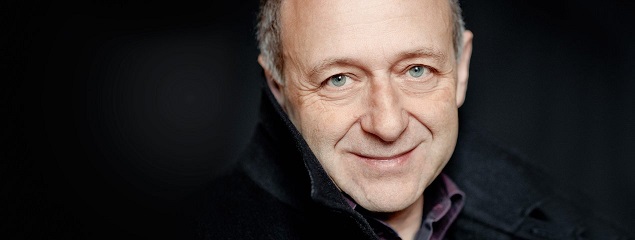
Above: Iván Fischer, in a Marco Borggreve portrait
The Dvořák 8th symphony abounds in folkish themes and ‘nature’ sounds that summon up visions of the Czech countryside, and I truly enjoyed Maestro Fischer’s interpretation in every regard. Robert Langevin’s flute solo early on was a limpid delight, and soon oboist Liang Wang and clarinetist Anthony McGill were piping up with sweetly evocative birdcalls. Phil Myers’ signature “big horn” sound was at its most congenial tonight, and the cellos sounded warmly lyrical.
The symphony’s most familiar theme comes in the Adagio as flute and oboe entwine and then send the melody forward to tonight’s concertmaster Sheryl Staples who shapes the phrases with silken assurance. Things turn rousing; the proverbial “big theme” embraces us. Trumpets sound, and then things recede to a gracious clarinet duo which eventually fades away.
An amiable waltz looms up in the Allegro graziosa, and Liang Wang’s oboe leads off some brief wind passages that move from voice to voice. An expansive song emerges, then the waltz re-bounds. An unusual coda concludes the movement.
Trumpet fanfares introduce the symphony’s finale; a handsome cello tutti leads to a proud dance and Mr. Langevin’s flute replies to the cellos with a variation on their theme. The other wind soloists have their final say before a grand acceleration speeds the symphony to its end. The audience seemed really taken with the entire concert, and the applause was generous and sincere.
To me, it was a perfect evening; my friend Dmitry was less enthusiastic, having some issues with tempi in the Beethoven and transitions in the Dvořák. His familiarity with the symphonic and chamber repertoire vastly surpasses my own, for he was immersed in the Mahler symphonies and Beethoven quartets while the first half-century of my musical ‘career’ was almost exclusively devoted to opera. But for all that, tonight’s concert was an unalloyed pleasure for me and left me in a really good mood.
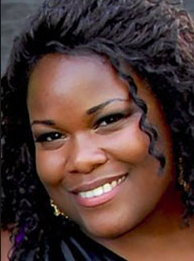
Above: Latonia Moore
Tuesday November 22nd, 2016 – It’s an odd feeling to be dreading a night at the opera because of the hyper-extended intermissions. But so many performances at The Met in recent seasons have suffered from a draining of dramatic and musical impetus as intermissions stretch beyond the 30-minute mark that it really is a concern of mine.
However, I did want to hear at least some of Latonia Moore’s Aida tonight. Latonia was a finalist in the Met Auditions in 2000, the same year my late friend Makiko Narumi participated. I met Latonia a couple of times at patrons events, loved her voice, and her personality. Up to tonight, she had sung a single Aida and a single Butterfly at The Met, whilst having an extensive career elsewhere.
I knew going in that I would not be able to endure two intermissions; my plan was to leave after the Triumphal Scene. Aside from Ms. Moore, the cast was nearly identical to the one I heard earlier this month.
Marco Armiliato and the Met musicians again gave a very atmospheric rendering of the prelude. Marco Berti as Radames was not having a good evening. At the earlier performance, he had been quite impressive in terms of sheer lung-power and some very nice softer singing in the Tomb Scene. Tonight’s “Celeste Aida” was choppily phrased and beset by pitch problems. There was only a trickle of applause after this famous aria. Ekaterina Gubanova, despite some attractive passages (“Vieni, o diletta… appressati” in particular) again seemed slightly under-powered.
With Latonia Moore’s entrance, things perked up. Her voice is warm, with a sensuous tinge to it, and it carries well in the big house. She sang with passion and good sense of line, leaning on but not over-working the chest voice. Her “Ritorna vincitor” was vivid both in terms of sound and dramatic inflection, and she sang quite gorgeously in her plaintive “Numi pieta…” Ms. Moore won a hearty round of applause and bravas from the sizeable audience. My only slight concern was that the very highest notes showed a trace of discomfort; the high-B in the trio was not sustained the full count, nor did she linger on the upper notes of the aria. But overall, she gave some extremely satisfying singing.
I pulled out my copy of Gore Vidal’s KALKI and read for about 15 minutes; and then I thought: “Why am I reading a novel at the opera? Shouldn’t the unfolding of a great score like AIDA sustain me thru the evening? Why is this intermission going to last another 20 minutes?” I packed up and left.

Above: The New York Philharmonic’s principal oboist Liang Wang
Sunday November 20th, 2016 – Music by French, Russian, German, and English composers was on offer this afternoon as a stellar ensemble of players from The New York Philharmonic took the stage at Merkin Hall. The group included some of the orchestra’s principals; the playing was divine, and all four works on the program were new to me.
The matinee opened with the String Trio of Jean Françaix, composed in 1933. Françaix was a child prodigy, writing his first music at age 6 and being published at age 10. His String Trio exemplifies the Neo-classical style which was enjoying favor at the time he wrote it; it consists of four movements, two of which are played with the strings muted. The excellent players – Shanshan Yao (violin), Peter Kenote (viola), and Qiang Tu (cello) – were clearly having a good time with this music, and their enjoyment was transmitted to the audience, who seemed quite taken with the piece.
The opening Allegretto vivo is a witty conversation among the three players; it has a gentle sway and a touch of jazz. With the musical lines in a state of perpetual motion, there is a sense of delicate charm in play. The following Scherzo – un-muted – is a sprightly dance played with a breezy ‘je ne sais quoi‘ quality. Plucking motifs and changes of pace eventually lead to a congenial if quirky waltz. The mutes are on for the Andante, which commences with wistful harmonies. Ms. Yao leads off with a sweet/sad song, taken up by Qiang Tu’s savorable cello and then by Mr. Kenote’s warm-toned viola: so lovely to hear each voice in succession. In a return to C-major, with the mutes set aside again, the lively start of the finale has an effervescent feeling (Mr. Kenote, in his opening remarks, spoke of a cancan). Things slow down a bit, with the violin playing over a plucked accompaniment. The pace then reaches sizzling speed, subsiding to lethargy before re-bounding to briskness and an actual march before vanishing on a surprisingly soft pizzicato. Such a fun piece!
Living in Paris in 1924, Sergei Prokofiev accepted a commission to compose a ballet for a touring troupe; the director asked for a short work for five instruments with a simple plot revolving around life with the circus. Prokofiev produced a quintet for the players the director had on hand: oboe, clarinet, violin, viola, and double bass. The ballet’s title was Trapeze. Since assembling this particular complement of instruments isn’t always easy, the work is not often performed; hearing it today made me wonder what the choreography would have been like.
Drawing from the Philharmonic roster, the instrumentation was handily (and expertly) filled out by a lively group of players, led by Anna Rabinova (violin), with Vivek Kamath (viola), Blake Hinson (bass – he also introduced the work) and wind virtuosos Sherry Sylar (oboe) and Pascual Martinez Forteza (clarinet).
The music definitely has a ‘circus’ atmosphere. A feeling of urban bustle with a slightly Mid-Eastern tinge pervades the opening movement, with oboe and clarinet vying phrase for phrase; the viola and then the violin join the fun, and the bass induces a lumbering motif. The music stalls, and turns pensive before bursting into a fast, flashy dance with violin screeching at us. The striding bass returns us to the opening oboe theme.
In the second movement, the bass growls at us and there’s an off-kilter feeling. The clarinet moves from burbling sounds to straightforward song; discord resolves into a major chord. The third movement, with a steady pacing, finds the clarinet and oboe trading sound-bytes; a swirling turbulence ensues.
In the fourth movement, an Adagio, the oboe sounds a bit ominous; the clarinet trills, the violin shivers, the bass creeps about. A violin melody melds into a dense tutti, with the oboe prominent. The plucking bass introduces the light-hearted fifth movement, with ironic gestures from the clarinet and oboe. The strings pluck and slash before Mr. Forteza’s clarinet polishes things off in fine style.
The final Andantino is whimsically dirge-like; there are clarinet cascades and the oboe gets insistent; the tread of the bass signals a minuet reprise. Suddenly alarms sound, and the piece rumbles raucously to a sudden end.
Several pages of Beethoven’s Quintet in E-flat major (originally penned in 1793) had gone missing by the time Leopold Zellner took up the task of ‘resuscitating’ it in 1862. Zellner relied strictly on the material evidence he found in Beethoven’s drafts in preparing a performing edition.
This work utilizes another off-beat assemblage of instruments: three horns, oboe, and bassoon. The horns – Richard Deane, R Allen Spanjer, and Howard Wall – enter in turn; their music veers from jaunty to Autumnal mellowness. As the work progressed, it became evident that the oboe was taking the most prominent position in terms of melodic opportunity: Liang Wang, the Philharmonic’s principal oboist, demonstrated both his striking virtuosity and his coloristic phrasing throughout the piece. Kim Laskowski’s bassoon seemed mostly limited to echo effects and to joining the horns; I kept hoping for a paragraph from her, but only a few phrases peeked thru the full-bodied sound of the horns.
A horn chorale initiates the Adagio maestoso, with the oboe again very much to the fore – and so attractively played by Mr. Wang. The concluding Minuetto begins brightly and brings us some really rich horn blends. Mr. Wang’s playing was exceptional, and it was a real pleasure to watch and hear him play his extended role here this afternoon, after so often enjoying his solo moments in the big repertory at Geffen Hall.
The Philharmonic’s principal horn, Philip Myers, introduced the concluding work – Ralph Vaughan Williams’ D-major Quintet – with a genuinely amusing speech in which he lamented the relative scarcity of chamber works featuring the horn and spoke of how he seized on the opportunity to play the Vaughan Williams today…which he did, to perfection.
Ralph Vaughan Williams’ Quintet in D-major had been withdrawn from circulation by the composer. He instructed his first wife not to publish it, but his second wife went ahead and did so, and thus we have this unusual work to enjoy today, more than a century after its premiere.
A deluxe quintet of Philharmonic artists gathered to perform the piece: alongside the resplendent sound of Mr. Myers’ horn, principal Anthony McGill’s clarinet playing was simply dazzling; violinist Lisa Kim (violin) and cellist Eileen Moon (my artistic crush) seized on the string passages to fine effect, whilst John Novacek underscored the ensemble beautifully from the keyboard, and relished his solo moments with some very cordial playing.
The four-movement quintet opens with an Allegro moderato initiated by clarinet and piano. A rolling theme for the ensemble sets up a round-robin of voices: piano, violin, clarinet, a horn summons, and cello speak up in turn. Things turn big and emphatic, and Phil Myers’ lush playing here was really grand, with Mr. Novacek ideally supportive. Cello, violin, and clarinet have another say before a shimmering motif from Mr. Novacek and a sustained phrase from Mr. Myers bring the movement to a close.
The second movement takes the form of an intermezzo; it has the feel of a Viennese waltz. Ms. Moon’s cello blends with the piano; later, Myers and McGill play in unison as the music sails on, with the piano taking up the waltz while Ms. Kim plays elegantly, incorporating a brief cadenza.
The velvety sound of the Myers horn sets up the Andantino, with Mr. Novacek’s evocative playing and another lovely passage from Ms. Kim leading into a melodic outpouring from all the voices. Fanfare-like motifs sound forth, and then a rich blending of timbres to savor. The horn plays over a rolling cello figure, and the music turns quite grand. Clarinet and violin descend, and the horn and piano glow gorgeously in a nostalgic theme.
The final Allegro molto induces toe-tapping from note one. Big horn-playing reigns, the clarinet and violin lead a merry dance, and a McGill cadenza with a perky trill delights us before the quintet reaches its boisterous end.
The Repertory:
FRANÇAIX – String Trio
PROKOFIEV – Quintet in G minor for Oboe, Clarinet, Violin, Viola, and Double Bass
BEETHOVEN – Quintet in E-flat major for Oboe, Three Horns, and Bassoon
VAUGHAN WILLIAMS – Quintet in D major for Clarinet, Horn, Violin, Cello, and Piano
The Participating Artists:
Richard Deane, horn
Pascual Martínez Forteza, clarinet
Blake Hinson, bass
Vivek Kamath, viola
Peter Kenote, viola
Lisa Kim, violin
Kim Laskowski, bassoon
Anthony McGill, clarinet
Eileen Moon, cello
Philip Myers, horn
John Novacek, piano
Anna Rabinova, violin
R. Allen Spanjer, horn
Sherry Sylar, oboe
Qiang Tu, cello
Howard Wall, horn
Liang Wang, oboe
Shanshan Yao, violin

Saturday November 19th, 2016 – Even before I started going to The New York Philharmonic faithfully, I was a fan of Cynthia Phelps (above) from her work with Chamber Music Society of Lincoln Center. Tonight, Ms. Phelps was center-stage at Geffen Hall, playing a brand new viola concerto by composer Julia Adolphe. The program further featured works by two of my extreme favorite composers – Wagner and Tchaikovsky – and was conducted by the Philharmonic’s Music Director designate, Jaap van Zweden.
It has been ten years since The Metropolitan Opera last performed LOHENGRIN, and I for one have really missed it; I was grateful tonight for the opportunity to hear the opera’s Act I prelude, and – under Maestro van Zweden’s baton – the artists of the Philharmonic gave it a stunning performance.
Wagner wrote of the prelude as being a depiction of the descent of the Holy Grail to Earth; it opens on high, with ethereal violins, and the rapture slowly spreads from one section of the orchestra to another, creating a sonic glow. At the very end, a return to the stratosphere with a pianissimo whisper from the violins leaves us breathless. Maestro van Zweden molded the piece lovingly, controlling the layerings of sound to perfection and creating an organic whole. It is simply an astonishing and unique piece of music.
Cynthia Phelps, gowned in blue, then took the stage to a warm welcome for Julia Adolphe’s viola concerto; entitled Unearth, Release, the concerto is in three movements, each being sub-titled. The first is Captive Voices, and it opens on a mysterious note with the viola playing in the low register. The composer employs a variety of percussion effects, and here the vibraphone sounds eerily. The viola remains unsettled – as if talking to itself – and then rises slowly out of the depths. A brief shimmer in the violins, a gong resonates ominously, and then the music turns big and cinematic; bells sound, the horns give voice, and magically the harp enters the mix: the concerto’s most intriguing passage – for viola and harp in a pinging dialogue – ensues. An odd, probably sub-conscious quote from LA FORZA DEL DESTINO pricked up my ear; deep, sustained notes from Ms. Phelps, and then her line rises to mingle with the harp again as the music fades into air.
The second movement, Surface Tension, begins with an animated, scurrying passage. The viola is kept busy against shifting rhythmic patterns from the orchestra until the movement comes to an abrupt halt. The dreamlike opening of the third movement, Embracing Mist, features Frank Huang’s violin playing on high. The viola rises, and the cabasa makes a somewhat creepy appearance. Trumpet and English horn speak up before the music turns more expansive, over-lain by a brief horn duet. Ms. Phelps’s viola whispers to us one last time.
The concerto has a darkling appeal, and Ms. Phelps’ playing of it is first-rate; it has the potential to become a vehicle for violists worldwide. The composer took a bow, and the Philharmonic audience – always so responsive when a player from the home team takes a soloist role – showered Ms. Phelps with affection.

Maestro van Zweden (above, in a Marco Borggreve portrait) and the Philharmonic players then gave a thrilling rendering of Tchaikovsky’s 4th symphony. From the opening fanfares, the performance was marked by big, passionate playing whilst jewel-like moments from the various solo voices emerged along the way to delight us. During the course of the first movement, my admiration for Maestro van Zweden became unbounded: his very animated podium personality and his brilliant alternation of jabs, lures, and summonses as he cued the various players was simply delightful to behold. Among the most cordial passages were an alternation of violins vs winds over timpani, and big playing from the horns; flute, clarinet, oboe, bassoon, and horn soloists shone forth. The music excited us thru its sense of urgency.
Liang Wang’s evocative playing of the oboe solo that opens the second movement was a high point of the performance; in this Andantino, very much à la Russe, the wind soloists again flourished in each opportunity the composer provides.
The dazzling unison plucking of the strings in the Scherzo was vividly crisp and clear tonight, with the Maestro’s fingertip control of the volume sometimes honed the sound down to a delicate pianissimo whilst maintaining the lively atmosphere. Oboe and flute again sing appealingly.
A grand, wild start to the concluding Allegro con fuoco established immediately the fact that Maestro van Zweden was taking the designation “con fuoco” (“fiery”) very much to heart. The orchestra simply blazed away, a mighty conflagration that dazzled the audience in no uncertain terms. As the symphony reached its fantastical conclusion, the Geffen Hall audience burst into unrestrained shouts of approval and gales of applause: everyone stood up to cheer. Maestro van Zweden returned and signaled the musicians to rise, but instead they remained seated and joined in the applause, giving the conductor a solo bow. The audience loved it.
An evening, then, that moved from the spiritual to the exhilarating, superbly played, and with a Maestro from whom, it seems clear, we can expect great things.

Friday November 18th, 2016 – I first encountered tenor Ben Bliss (above) while he was in the Lindemann Young Artist Development Program at The Met; he was making his Met debut as Vogelgesang in MEISTERSINGER and he stood out for three reasons: tallest man onstage, youngest of the Masters, and a voice of distinctive clarity.
Since then, I have enjoyed listening to several of Mr. Bliss’s YouTube offerings which display a voice capable of incredible beauty (especially in the upper range), a deep sense of poetry in his use of dynamics, and very impressive breath control.
This evening’s program commenced with four songs by Richard Strauss; my initial feeling was that Mr. Bliss was over-singing a bit, and that the piano (even with the lid down) was sometimes too loud. As the songs progressed, the tenor and his pianist Lachlan Glen achieved a more congenial blend, and in “Morgen“, the sensitivity of both artists found truly rewarding expressiveness in a breath-taking performance.
Turning to the French repertoire, Mr. Bliss chose songs from Lili Boulanger‘s “Clarières dans le ciel”; the composer, who died tragically young, left behind a brief catalog of work of which these mélodies hold a particular appeal. Mssrs. Bliss and Glen savoured the perfume of this music in a performance filled with spine-tingling dynamic modulations. The opening “Un poète disait” served to display the tenor’s marvelously heady tones, with an absolutely gorgeous final phrase. Remarkably sustained singing illuminated “Nous nous aimerons tant“, its dreamy quality interrupted by a “noisy” piano interlude. Mr. Bliss managed a fine mix of passion and refinement in “Vous m’avez regardé avec toute votre âme“, where Mr. Glen’s playing was particularly lovely. The pianist’s rippling motif set the mood for the concluding “Les lilas qui avaient fleuri” and the tenor here displayed an intrinsic sense of vocal nuance, with seductively floated upper tones and a final sustained note that was sheer heaven.
Tosti’s “Marechiare” closed the rather brief first half of the program; Mr. Bliss’s voice is not really Italianate in sound, but in this outgoing celebration of a passionate infatuation, he and Mr. Glen took an almost militant stance in favor of romance. I would have liked to have heard some of Tosti’s more caressive tunes from Mr. Bliss, but that will have to wait for another opportunity.
Returning after the interval, the tenor had changed to a white sport coat (no pink carnation, though) for an all-English-language second half. Mr. Bliss described how he came to find the two John Gruen songs – “Spring is like a perhaps hand” and “Lady will you come with me into” – which were never published. With the aid of the composer’s daughter, the manuscripts were located and copies given to the tenor. Musically whimsical, the songs border on cuteness; Mssrs. Bliss and Glen made them perfectly palatable.
Big singing marked Lowell Liebermann’s “The Arrow and The Song” (“I shot an arrow into the air…”): an emphatic and almost grandiose setting. Ned Rorem’s haunting setting of “Stopping by Woods on a Snowy Evening” beautifully evokes the quietude of the Winter landscape, and was lovingly sung. Does Theodore Chanler’s “I rise when you enter” have a sexual connotation? It seemed so this evening.
A tenor of Mr. Bliss’s vocal weight and range is of course going to be singing a lot of Britten. Over the years I have come to feel that the composer’s works are best represented by British singers as they seem most persuasive when sung with what we Americans refer to as a “British accent”. That said, Mr. Bliss did very well by the extroverted “The Children and Sir Nameless” whilst Mr. Glen’s introduction to “The Last Rose of Summer” was poetic indeed; as the song progresses, the familiar melody takes on a fresh feeling thru harmonic alterations. Mr. Bliss here again demonstrated his astonishing control in the upper range of his voice.
The final Britten offering, “The Choirmaster’s Burial“, is a touching narrative on the love of music and on a life dedicated to it. Singer and pianist were at their most moving here.
The final three numbers on the printed program – songs associated with Nat King Cole, Frank Sinatra, and Ray Charles – are pieces Mr. Bliss grew up with. While I know them well, and can even sing two of the three, they are rather outside my musical sphere. But my companion of the evening is a huge devotee of Sinatra and Charles, and she felt that Mr. Bliss’s singing – for all his efforts to the contrary – was too cultivated, and that the rendition of Ray Charles’s “Hallelujah I love Her So” was all wrong.
A very well-known mezzo who was in the vanguard of the crossover phenomenon once asked me why I was put off by her crossover efforts; I replied that thousands of people can sing these Broadway and cabaret numbers to fine effect, but that there are only a half-dozen great Mélisandes in the world. She understood my point, but said she and her audiences took a lot of enjoyment from her less ‘haughty’ recordings. Then I asked her how she would feel if Barbra Streisand decided to sing Idamante; she giggled and rolled her eyes.
At any rate, Ben Bliss was called out for two encores tonight: a sweet “Una furtiva lagrima” and that song with the catchy lyrics from WEST SIDE STORY: “Maria…”
In December I’ll be seeing Ben Bliss as Tamino at The Met and while I wish it wasn’t the pared-down “family” version, I’m really looking forward to it.
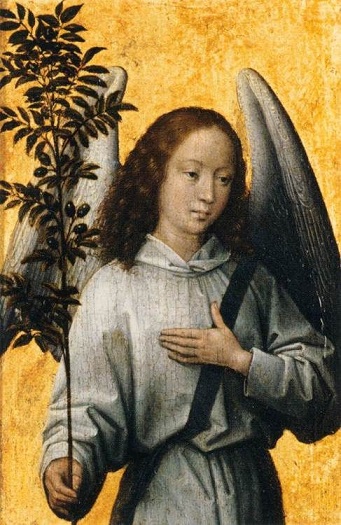
Above: Angel With an Olive Branch; Hans Memling ca. 1480
Sunday afternoon October 30th, 2016 – The London Symphony Orchestra and Chorus under Gianandrea Noseda’s baton in a performance of the Verdi REQUIEM at Geffen Hall. A packed house seemed pretty much enthralled by the piece, though oddly a few people got up and left in the middle.
Like every performance of the Verdi REQUIEM I have heard in the past twenty years, this one featured excellent work from the chorus and orchestra and an uneven quartet of principal singers. In a day and age when great Verdi voices are rare, one wonders why orchestras continue to program this demanding work…but I’m glad that they do, for even with a less-than-stellar set of soloists, the REQUIEM is thrilling just as a musical experience.
Singing in place of the announced Francesco Meli, Giorgio Berrugi offered warm, idiomatic vocalism. The ample-toned Vitalij Kowaljow made a most impressive vocal entrance and gave by far the most satisfying performance among the four principals. Daniela Barcellona, with a lovely presence, showed a voice that has succumbed to fluttery vibrato, seemingly as a result of tackling roles like Amneris and Dalila. Soprano Erika Grimaldi was seriously over-parted; her bio lists such roles as Mimi and Nedda, and for the REQUIEM you want a soprano of the Norma/BALLO Amelia ilk.
The performance commenced on a pianissimo hush, with the chorus whispering “Requiem…”; Maestro Noseda chose a very fast tempo at the point where the solo voices enter, slowing down at “Christe…Christe…eleison.” His tempi all afternoon tended to be on the speedy side.
The Dies irae was fast and furious; trumpets stationed in the upper tier boxes added to the sonic thrill. Mr. Kowaljow’s Mors stupebit darkly powerful; and – despite the vibrato – Ms. Barcellona made something out of the Liber scriptus (again, very fast): use of chest voice and a little ‘tear’ in the voice.
Mr. Berrugi sang well in the Quid sum miser, with distinctive phrasing from the bassoon. The conductor continued to speed things along, and he failed to accommodate his lyric-sized soprano in the big ensemble moments where she was unable to sail over the chorus and orchestra. In the Recordare, the vibratos of soprano and mezzo did not align pleasingly.
The tenor gave his best singing of the afternoon in the Ingemisco, the voice clear and the dynamics persuasively modulated; he sounded especially lovely at “Inter oves locum praesta” and the voice rose to a fine conclusion. Mr. Kowaljow’s Confutatis maledictus gave me goosebumps: powerful, emotional singing with a touch of weeping and a huge climax. Mr. Noseda summoned up grumbling lower strings in the Lacrymosa; the four vocalists did not make a good entry at the unaccompanied “Pie Jesu domine“.
There was slight slip in the overall level of singing in the REQUIEM‘s second half. Mr. Berrugi’s Hostias was not quite as impressive as his Ingemisco had been, and the mingled voices of soprano and mezzo in the Agnus Dei produced some “bad vibes”. In between, the Sanctus showed the chorus off to perfection. Mr. Kowaljow maintained the gold standard with his singing in the Lux aeterna.
In the silence that followed Ms. Grimaldi’s “…sum ego et timio” a cellphone rang loudly twice; Maestro Noseda put everything on hold until the atmosphere of quietude was restored. The soprano sang bravely in the Requiem aeternam but lacked the spinto plush and vocal glamour the music needs. She was all but swamped by the chorus in the rigors of the finale.
Maestro Noseda is a very physical conductor, sometimes squatting down to lure the music from his players. In this afternoon’s performance, he, Mr. Kowaljow, and Verdi himself were the heroes.


 Oberon's Glade