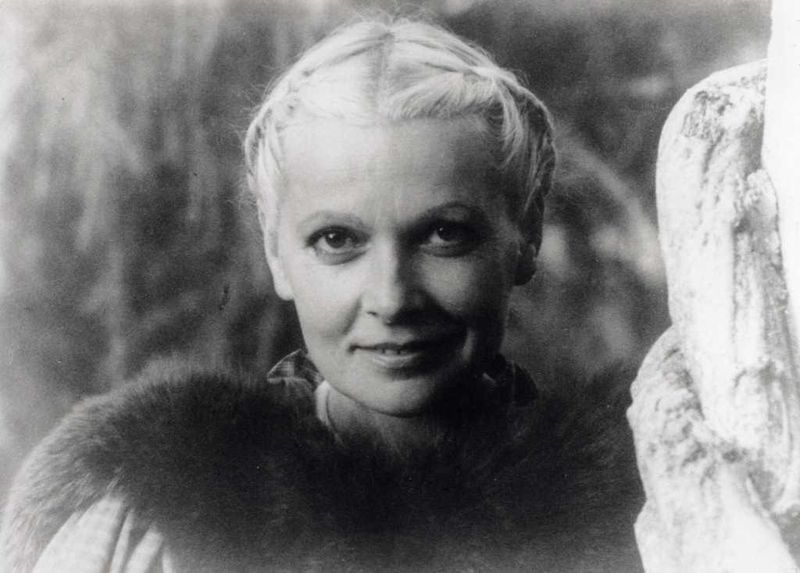
Elena Zilio sings “Esser madre è un inferno” from Cilea’s L`ARLESIANA: LINK
Elena Zilio sings “Esser madre è un inferno” from Cilea’s L`ARLESIANA: LINK
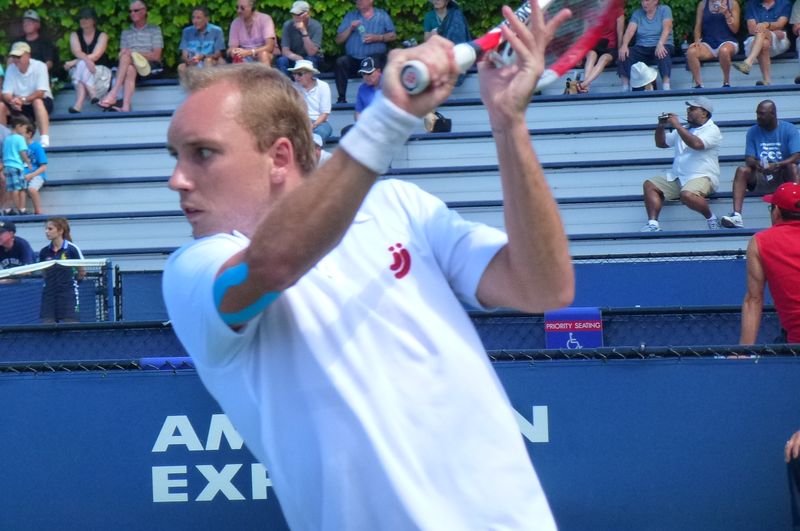
Above: Belgium’s Steve Darcis
Tuesday August 19th, 2014 – Steve Darcis played an immaculate first set at the US Open Qualifying Tournament today. The Belgian is one of my favorite tennis players; I first encountered him in 2007 when he played in the Qualifiers and secured a position in the main draw. He has been ranked as high as #44 (in 2008) but his successes have been counter-balanced by injuries that have kept it from attaining his rightful place in the tennis world. He has everything: serve, return-of-serve (really on today!), depth, variety of shots, great court coverage, and agility at the net.
Throughout the first set today there was virtually nothing Spain’s Inigo Cervantes could do to keep the steam-rolling Darcis at bay. As the second set started, Cervantes seemed newly energized: his powerful serve began to work more impressively and there were some great rallies. And also some vocalism: both players loudly questioned line calls – Steve at one point rushing towards the chair umpire yelling “Jamais! Jamais! Jamais!” – and a bit later Cervantes smashed his racquet to the ground in frustration. Darcis had Cervantes at 5-4 and was serving for the match but he couldn’t close it out. They went on to a tie-breaker where Darcis finally prevailed.
Earlier, Go Soeda – a great favorite of mine and ranked #2 among the qualifiers – played his usual gorgeous game. But Oscar Hernandez’s power and grit were too much for Go to handle. The opposite happened when Ireland’s Louk Sorenson, a powerful and almost brutal player, took the first set from Portugal’s Gastao Elias. Thereafter Elias seized the upper hand, grinding down Sorenson’s stubbornly sturdy game with craftiness and finesse and going on to victory.
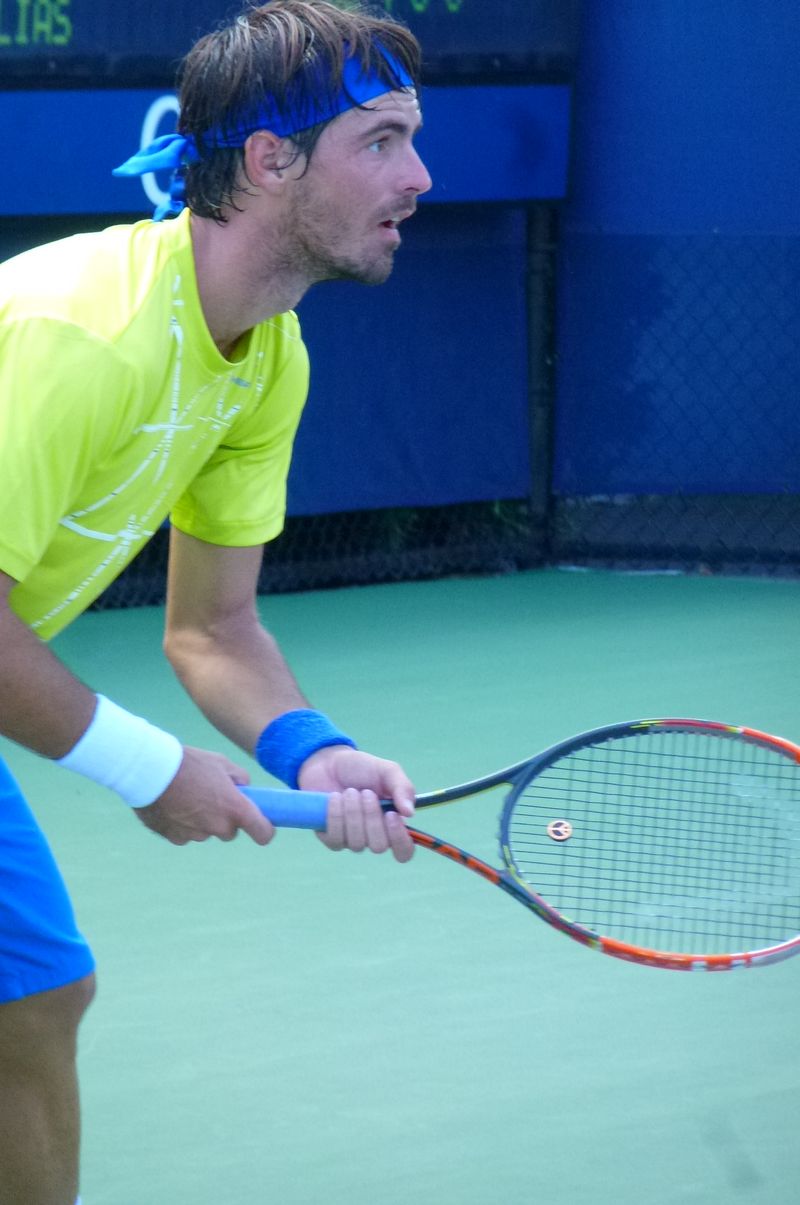
Above: Gastao Elias
Sorenson is a player who grunts emphatically every time he hits the ball. God help us if he and Azarenka ever team up for mixed doubles.
Growing weary of the crowds, I decided to head home a bit earlier than I had originally planned.

Above: Cedar Lake‘s Jon Bond
Wednesday July 30th, 2014 – I have always loved Cedar Lake Contemporary Ballet‘s homespace on West 26th Street and I very much enjoyed this evening’s presentation of Cedar Lab, a new adventure for the Company wherein the dancers create choreography on their colleagues. Tonight, works-in-progress by Jon Bond, Navarra Novy-Williams, Matthew Rich, Joaquim de Santana and Vânia Doutel Vaz were presented.
Earlier this month I stopped in at a rehearsal of two of the works, those created by Navarra and Vânia, so I had a sampling of tonight’s programme. The Cedar Lake dancers are among Gotham’s most talented and alluring, and this opportunity for five of them to spread their choreographic wings did indeed make for a stimulating evening. A quote from dancer/choreographer Navarra Novy-Williams set the tone for this new initiative: “We explored a lot, and I’m certain we are still exploring.”
The only drawback to my enjoyment of the evening was that I was seated in the back row which, despite being on risers, caused my view of anything happening on the floor to be cut off by the rows of spectators in the intervening space. Since most of the choreographers made use of floor time in their danceworks, this aspect of the presentation went for nought from my perspective.
The opening work set a very high standard for the evening in terms of choreography, music, production elements, and dancing. Joaquim de Santana presented his duet DISTANT SILENCE, set to Sigur Rós’ “Fjögur Píanó” and “I Just wanted to Know” by Phillip Jack. The work opened with a brief film by Billy Bell in which the dancers – Jon Bond and Vânia Doutel Vaz – made a ghostly appearance. A large white drape is then torn down and Jon and Vânia appear in the flesh. They cross the space in a flow of gorgeously plastique moves, illuminating the music and choreography in a way that puts the viewer under a spell. Dancing in true sync or in partnered passages, Jon and Vânia were a compelling pair. Jon’s solo, with Vânia doing a walk-about, underscored his status as one of the great movers in the modern danceworld. Vânia is a marvelous match for him: her solo – in the second ‘movement’, set to spoken word and mechanical music – was very finely wrought. Mr. de Santana knows his dancers well and employed their incredible gifts to the finest advantage. There were no bows after the individual works, but if there has been Jon, Vânia and Joaquim would have brought down the house.
Vânia was the next featured choreographer: her ensemble work THEM THERE was danced to an original score by Tom Sansky. The dancers wear simple white shirts and black briefs. One by one they step into the spotlight to pose and emote as their colleagues dance quietly in the background. Combining solo opportunities and in-sync ensemble passages, the overall effect was excellent though I wish I could have seen what was going on on the floor. Ebony Williams, that paragon of contemporary dance, was the last to step into the solo spotlight; she was soon engulfed by her fellow dancers.
I was dazzled by RESIDUAL REACTION, a film in which Matthew Rich combined his ‘double-major’ of dance and fashion, working with Billy Bell who directed and edited the work. A fabulous dance track from Nalepa and Flume sent the movie into orbit with incredible footage of Cedar Lake‘s sexy and spellbinding dancers. And they have never looked more sensuous: Nickemil Concepcion, Joseph Kudra, Navarra Novy-Williams, Guillaume Quéau, Ida Saki, Rachelle Scott, Madeline Wong, with guests Patrick Coker and Daphne Fernberger. The camera invades their privacy, lingering on their skin and muscle with provocative investigation as they move with seductive glamour to the music. Baby powder is an unexpected element, and later – dancing on a rooftop – we are enslaved by the emblematic gorgeousness of the Cedar Lake dancers. I hope this film will soon be available on the Company website, or on YouTube. It makes a super-enticing trailer. The moment it ended I wantd to watch it again.
Some audience members are summoned to the stage to observe MUSE, Navarra Novy-Williams’ series of three solos, danced in turn by Acacia Schachte, Madeline Wong, and Rachelle Scott. Acacia, with her very personal mystique, snaps her fingers to turn on the spotlight for her solo which includes some very witty moves and covers the space fluently. Madeline, in a fanciful puff-skirt, dances to a big lyrical theme by Ennio Morricone, and then Rachelle displays powerful balance and control as she dances to “Moon River“. Here, more than elsewere, my inability so see the floorwork of the dancers was especially disheartening. But enough of the flavour of Navarra’s work emerged, and the music was particularly well-used.
Jon Bond produced a nightmarish work, THE DEVIL WAS ME, dealing with the aspects of sin – one of my favorite topics! Music by Murcof and Peter Broderick summoned excellent work from the dancers – those already mentioned above plus Billy Bell, Gwen Benjamin, Joaquim de Santana and Jin Young Won. The work begins with a deeply ominous theme, Rachelle Scott in the spotlight; later she will endure a satanic ritual performed on a table. The dark gathering of masked feral creatures is briefly relieved by a passage where the dancers appear in silhouette before a yellow-gold sunset. But the overall tone is sinister and sinful. The one thing that might have made this purgatorial work even more fascinating would have been to have Jon Bond dancing in it.
The house was packed, and when I emerged into the lovely summer evening light there was a long line of dance-lovers waiting to get in to the second show. This sort of initiative is a feather in Cedar Lake‘s cap, and I sincerely hope Cedar Lab becomes an annual event.

Above: Dame Gwyneth Jones
A week-long RING Cycle invariably involves RHEINGOLD on Monday night followed immediately by WALKURE on Tuesday. This places heavy demands on the gentleman singing Wotan; he has a lot of singing to do on Monday and even more (much more) on Tuesday. Fricka also appears in both operas, but her role in RHEINGOLD – though major – is not especially demanding, and in WALKURE she has only one scene: quite a strenuous one vocally, but once it’s over she is finished for the night. Fortunately the Wotan in my first Cycle, Hans Sotin, managed the back-to-back operas superbly. And Helga Dernesch’s Fricka was a thrilling interpretation.
WALKURE brings four new characters to the drama: Brunnhilde, Sieglinde, Siegmund and Hunding. With Dame Gwyneth Jones’s first appearance as Brunnhilde in Act II, this RING Cycle – already off to such an impressive start – soared into the stratosphere.
Here’s my diary entry from the second night of the Cycle:
“WALKURE – excellent despite some audience distractions. Levine and the orchestra do wonders with this score. The cast was really fabulous, though I had mixed feelings about the Siegmund of Robert Schunk. He looked well, sang and phrased in a musicianly manner; he had the right feel for the role and – for the most part – more than enough volume. He tended, however, to sing just a shade flat much of the time. Too bad…he tried hard and he did have his moments.
Everyone else was on peak form. Matti Salminen gave a tremendous Hunding, rolling out the tone with tremendous force and simply smacking of evil…really menacing sound and thoroughly convincing as an actor: his long, deadly stare at Siegmund after man-handling his wife was such a provocation (Siegmund, weaponless at this point, is in no posotion to respond). Salminen continues my great line of Hundings – Rundgren, Haugland, Moll, Macurdy – and he’s such a fascinating artist.

We have a wonderful new Wagnerian soprano in Mechthild Gessendorf (above) who, if this performance is any indication of her abilities, is a fine addition to the operatic gallery. Her bright, almost girlish tone has a clear middle range with top notes that can be clean-attacked or slightly scooped-up to: they are exciting! Oddly, she reminds me a bit of Mara Zampieri though I can’t put my finger on why! She gave a glorious Sieglinde, full of feminine warmth and real emotional commitment; I look forward to her Kaiserin and Senta.
Helga Dernesch’s Fricka proved spellbinding, sung with great authority and vocal power; the slight peril in the upper range was overcome by force and she simply did a magnificent job. The drama of her plea was put across with an awesome balance of of security and desperation: really engrossing. And she looked gorgeous…a splendid assumption of the role.
Hans Sotin’s Wotan was given with great vocal command and heartrending dramatic sureness. He was in excellent voice, giving a truly impressive monolog and ending Act II with a furious “Geh!” to Hunding who crashed to the ground at the god’s irate command. Singing gloriously, Sotin came thru with much moving and beautfully modulated vocalism in the third act, and he triumphantly sustained the top notes of his final phrase to majestc effect…bravississimo!!!!
It was a great pleasure to see Dame Gwyneth Jones on the Met stage again: still unsure of how she would sound, she nevertheless is an arresting physical presence. But as soon as she began to sing, it was clear we were in for a thrilling Brunnhilde: her great personal and vocal radiance set its stamp on the entire evening. She is a very different Brunnhilde from Behrens, more feminine and less complicated. She offered a spectacular battle cry, sustaining the clear-attack high-C and thereafter she simply went at it vocally all evening, with powerful and moving singing in the ‘Todesverkundigung‘ where she well portrayed Brunnhilde’s increasing embarrassment at the deceitful way Wotan has treated Siegmund. Jones’s third act was wonderful in every regard, with a movingly intoned “War es so schmählich” and increasing desperation as she begs Wotan to spare her degradation. Her final plea – to surround her slumbering place with magic fire – literally tore at the heart. The sheer size of Dame Gwyneth’s voice is such a treat at The Met, and her occassional wooziness and a couple of oddly pronounced words (“Siegfried” in her Act III address to Sieglinde somehow became “Augfried”) were just trifles compared to the great flood of warm, emotional power she generates. Simply great!! And she looks marvelous…great legs! So, a really remarkable evening with huge ovations for all and a particular hurricane of applause for Dame Gwyneth. A grand night!!!”
Metropolitan Opera House
May 2, 1989
DIE WALKÜRE
Wagner
Brünnhilde..............Gwyneth Jones
Siegmund................Robert Schunk
Sieglinde...............Mechthild Gessendorf
Wotan...................Hans Sotin
Fricka..................Helga Dernesch
Hunding.................Matti Salminen
Gerhilde................Pyramid Sellers
Grimgerde...............Wendy Hillhouse
Helmwige................Marita Napier
Ortlinde................Adriana La Ganke
Rossweisse..............Judith Christin
Schwertleite............Sondra Kelly
Siegrune................Diane Kesling
Waltraute...............Joyce Castle
Conductor...............James Levine

Above, dancer Marie Vestermark at today’s open rehearsal
Sunhwa Chung/Ko-Ryo Dance Company have been invited to participate in Danceforms’ 67th International Choreographers Showcase at the Edinburgh Festival Fringe 2014 in Edinburgh, Scotland, from August 5th through August 9th, 2014.
The Company will perform a trio entitled It Doesn’t Matter, It Already Happened: Life is Every Day III choreographed by Sunhwa; she will also dance in the piece along with Dorothy Chen and Marie Vestermark. Sarang West will perform the solo violin part, and the music will be drawn from works of Evelyn Glennie, Doug-Chang Lim, and Fazil Say.
Today I went down to SoHo to watch an open rehearsal of the piece at a very interesting studio space on Wooster Street. Unfortunately it was a bit too dark to make successful use of my camera, but Sunhwa, Dorothy and Marie ran thru the piece twice, with Sunhwa giving us some background between the two runnings.

Dorothy Chen
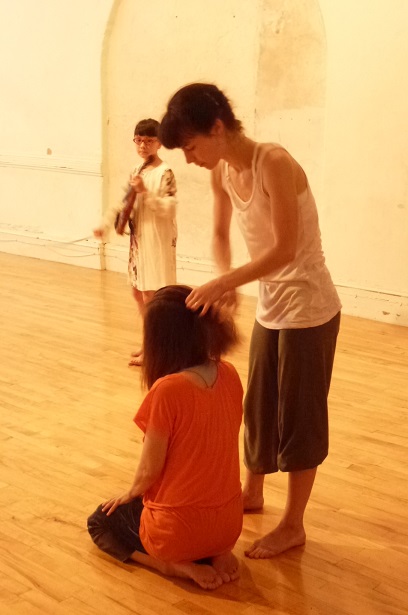
Sarang, Sunhwa and Marie

Sunhwa’s young daughter Sarang West (above) performs a violin solo, and later the dancers begin to sing.

A group of visitors commented on the work during the break as Sunhwa (above) explained that the piece was originally created as three inter-connected solos for one dancer and now she’s set in for a trio.
This will be Sunhwa and her colleagues’ first trip to Scotland, so we wish them “Bon Voyage” and hopefully they will send back some photos from Edinburgh.
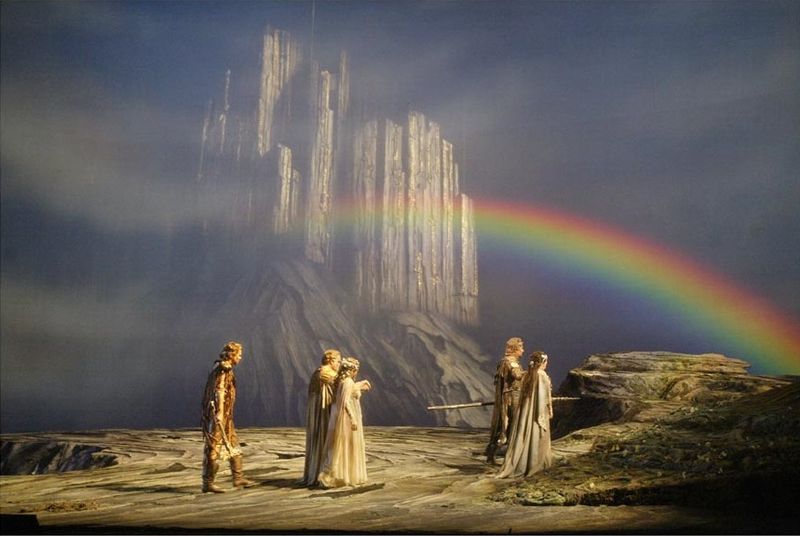
Above: A scene from DAS RHEINGOLD, in the Met’s classic Otto Schenk production; photo by Ken Howard
A quarter-century has passed since I first experienced a complete performance of Wagner’s RING DES NIBELUNGEN as the composer intended it to be seen: over the course of a single week. In fact, though I had seen all the RING operas previously and would see them many times again since, this 1989 Cycle has been the only time to date that I attended a “RING Week”.
I was living in Hartford, Connecticut at that point in time, frequently spending long weekends in NYC to attend opera and ballet performances. My friend Paul Reid and I had decided to attended a Met RING Cycle at the end of the 1988-1989 season. There would be a Saturday matinee Cycle plus two week-long Cycles; we were determined to do a RING Week. So when the casting came out, we quickly decided on the ‘second cast’: we had seen the Hildegard Behrens/James Morris combination in previous performances of the individual operas and they were slated for the first weekly Cycle (as well as the Saturday matinee broadcast Cycle). The second weekly Cycle boasted not only a different Brunnhilde (Eva Marton) and Wotan (Hans Sotin) but ‘new’ and different casting of several prominent roles: William Johns (Siegfried), Franz Mazura (Alberich), Helga Dernesch (Fricka/Waltraute), Mechthild Gessendorf (Sieglinde), and Gweneth Bean (Erda). James Levine of course was conducting every Cycle.
We ordered our tickets, and then a cast change was announced: Eva Marton had withdrawn and would be replaced by Deborah Polaski. This gave us pause, since at the time neither of us were admirers of Ms. Polaski. We fretted a bit, but it was too late to switch to another Cycle (they had all sold out very quickly). Then came another announcement: Ms. Polaski had withdrawn and the Brunnhilde would now be Dame Gwyneth Jones. We were not thrilled with this announcement either, since Dame Gwyneth had at that time something of a reputation for wobbling vocally. It wasn’t until she appeared onstage for Act II of WALKURE that our concerns were allayed: she was magnificent in every regard.
In the days leading up to our Cycle, anticipation built and built. Concerns about leaving my young lover Kenny on his own for a week were swept aside as the idea of seeing the RING in toto was about to become reality. Paul and I had booked (separate) rooms at the Colonial House on West 22nd. I had stayed there several times in recent seasons: a very comfortable and affordable gay guest house. I was leading a promiscuous life then (despite being in a relationship) and the wonderful thing about the Colonial House was: it was hook-up heaven. There was no need to go to a bar or club: there were always men who were ready, willing and able staying at the House. The roof deck, which offered nude sun-bathing, was especially conducive to socializing.
May 1st finally arrived; Paul and I checked in at the Colonial and geared up for our big operatic adventure.
Here’s what I wrote about the RHEINGOLD in my diary:
“I am finally seeing the complete RING Cycle in the course of a single week which fulfills a long-held operatic desire. The opening RHEINGOLD was a wonderful evening and set forth high expectations for the evenings to come. Levine’s skillful conducting and the excellent playing of the Met orchestra were a major factor in this magnificent Wagnerian evening. The production is visually engrossing, especially the opening scene in the murky depths of the Rhine. Casting was strong all down the line, with a very fine trio of Rhinemaidens (Diane Kesling stood out, and Kaaren Erickson and Meredith Parsons were both very good…though I did feel they gave a bit too much vibrato at times).
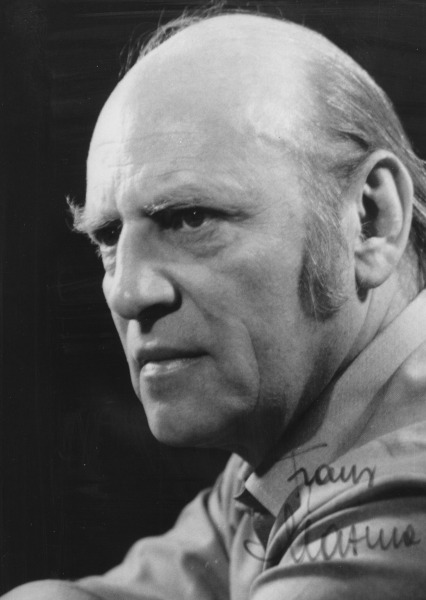
Franz Mazura (above) as Alberich arrived on the scene and seized our imagination with his huge, thrustingly creepy voice, full of darkest intent. He was a fabulous Alberich, tireless in his vocal and dramatic commitment. Could this bizarre creature be more powerfully portrayed? Mazura’s generous artistry assured his huge success in the role: he made the character seem so real.

Above: the Lord of This RING: Hans Sotin. He was in top form for a really impressive Wotan, immediately showing his vocal authority in his opening conversation with Fricka. His voice – large and steady and even from top notes down to the depths – created a real sense of majesty. [Sotin, as it turns out, sang his final Met Wotans in these performances].

Helga Dernesch (above): her fascinating voice and truly intense emotional involvement brought Fricka to life – incredibly powerful, with her deep lower voice and somewhat insecure top which curiously adds to her appeal.
Her siblings were Gary Bachlund as Froh, revealing an embryonic heldentenor of some warmth; James Courtney as a sturdy Donner; and Mari-Anne Häggander, who made a great deal out of Freia’s brief role with her vulnerable appearance and full, clear lyric soprano.
The giants were especially good: John Macurdy’s voice (Fasolt) sounded huge, and Matti Salminen (Fafner) let his oily tones roll out with great dramatic force – super! Horst Hiestermann was a vivid Mime, but I found Graham Clark’s Loge did a bit too much prancing physically; and I guess I prefer more heldentenorish sound in the role, though Clark surely did sing musically and with clarity and good carrying power. Gweneth Bean’s large, rich voice created a really glorious impression as Erda – she just poured the tone out!
At the end, a very enthusiastic reception for everyone – especially Bean, Dernesch, and Levine. Very exciting inaugural night of my RING! There were many moments when chills passed thru me: a sensation that is not often experienced at the opera these days. Mazura in particular thrilled me in this way with his theft of the gold and again as he placed his curse on the Ring. So exciting!”
Metropolitan Opera House
May 1, 1989
DAS RHEINGOLD
Wotan...................Hans Sotin
Fricka..................Helga Dernesch
Alberich................Franz Mazura
Loge....................Graham Clark
Erda....................Gweneth Bean
Fasolt..................John Macurdy
Fafner..................Matti Salminen
Freia...................Mari-Anne Häggander
Froh....................Gary Bachlund
Donner..................James Courtney
Mime....................Horst Hiestermann
Woglinde................Kaaren Erickson
Wellgunde...............Diane Kesling
Flosshilde..............Meredith Parsons
Conductor...............James Levine
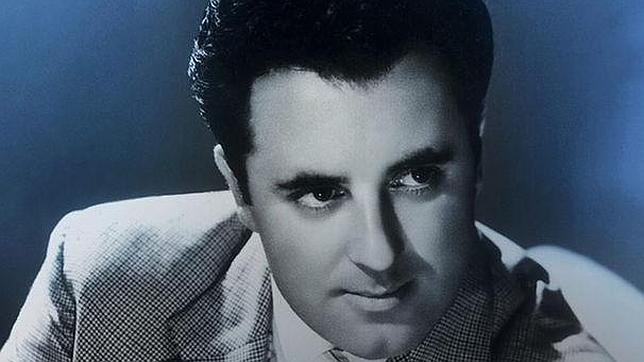
My all-time favorite tenor and one of the last surviving titans of the ‘last golden age’ of opera has passed away: Carlo Bergonzi.
Bergonzi sang over 320 performances at The Met, debuting in AIDA in 1956 opposite the also-debuting Antonietta Stella. He sang his final Met performance in 1988 in LUCIA DI LAMMERMOOR. Over the years, Bergonzi – who started his operatic career as a baritone – gradually lost the ease and surety of his upper register, but stylistically he remained a paragon throughout his long career.
When I started listening to opera at the age of 11, I had no idea of how long a singing career could last or how a voice would age. The first singers I fell in love with – Milanov, Tebaldi, Jan Peerce, Robert Merrill, Giorgio Tozzi : it seemed to me they were eternal, that they had always been singing and would always continue to sing, and that they would always sound exactly the same as they did on the first recordings I acquired. Imagine my despair when I discovered early on that two of my first idols, Jussi Bjorling and Leonard Warren, were already dead!
I last saw Bergonzi onstage in 1988 as Rodolfo in LUISA MILLER, one of his last Met performances. People were raving about the staying power of this 64-year-old primo tenore but to me the voice was sadly pallid. The style, however, was wonderfully intact: the generosity of line, the feeling for the language, the skillful mastery of dynamics. Despite his admirable ability to cope with the music technically, I was disheartened and left midway thru the evening. Twelve years later, I was living in New York City when Bergonzi announced he would sing Verdi’s Otello in a concert performance at Carnegie Hall. My friends, knowing of my great love for the tenor, assumed I would be there but I feared it would be an unhappy evening…and it was: beset by vocal problems, he was forced to withdraw after Act II.
No, I would rather remember the great years, though in fact he was already well along in his career when I first heard him live in a concert performance of Catalani’s LA WALLY at Carnegie Hall in 1968. Appearing opposite Renata Tebaldi, Bergonzi managed to steal the show: he brought down the house after Hagenbach’s Act IV aria.
At The Met I heard his superb Radames, once with Lucine Amara and once with Martina Arroyo. It was with Arroyo that he triumphed as Verdi’s ERNANI in a stellar performance that also featured Sherrill Milnes and Ruggero Raimondi. He was a generous-toned and poetic Andrea Chenier in a performance where Renata Tebaldi struggled vocally, only to cast off all reserve in the final duet where she and Bergonzi thrilled us with their passionate outpouring of sound. And the tenor managed to convey the youthful vigor and tenderness of Alfredo Germont opposite the moving Violetta of Jeannette Pilou.
Listening to a matinee broadcast of TOSCA in 1975, I was dismayed to hear Bergonzi struggling with the top notes and fighting a losing battle, though he sang on to the end. He took a year and a half off (at least from the Met) returning in November 1976 as Radames opposite Rita Hunter. After a somewhat cautious but still impressively handled “Celeste Aida” Bergonzi went on to give a spectacular performance with some of the most generous singing I ever heard.
And such generosity won him great acclaim in 1979 when he returned to a signature role, Riccardo in BALLO IN MASCHERA. His phenomenally sustained top notes, sometimes attained thru sheer will-power, and his matchless phrasing drew enormous ovations on both evenings that I attended: one performance with Teresa Zylis-Gara and another with Carol Neblett. In 1982 Bergonzi was still on impressive form in FORZA DEL DESTINO, and in 1985 he scored a grand success in a concert performance of Verdi’s GIOVANNA D’ARCO opposite Margaret Price and Sherrill Milnes. In every one of these performances, whatever slight misgivings one might have, his ever-persuasive style carried the day.
But there was a final small chapter in my Bergonzi story: eight years after the MILLER that I walked out on, he appeared at James Levine’s 25th Met Anniversary gala, singing the aria from LUISA MILLER and the trio from I LOMBARDI. Massive demonstrations of love rained down on him and people raved about his longevity but for me, despite admiring his courage, he was a shadow of his glorious self.
But, I have lots of recordings (both commercial and live) to keep my favorite tenor’s voice ever in my ear. His early Decca aria recital has never – in my opinion – been matched by any other tenor’s, though some have come very close. Both his commercial BALLO recordings are superb. His Duke in RIGOLETTO (opposite Scotto and Fisher-Dieskau) is a fine document of Verdi tenor singing. In TROVATORE, PAGLIACCI, BOHEME and DON CARLO, he is The King. I deeply love his BUTTERFLY with Tebaldi, his TOSCA with a voice-in-peril Callas (she still has some magical moments though); and his lovely TRAVIATA with Montserrat Caballe. And I am particularly fond of Bergonzi’s splendid performance as Edgardo in the RCA LUCIA with Anna Moffo.
Carlo Bergonzi sings Tosti’s ‘Ideale’ here.
Hail and farewell, Maestro. If there’s a heaven, you can teach the angels how to sing.
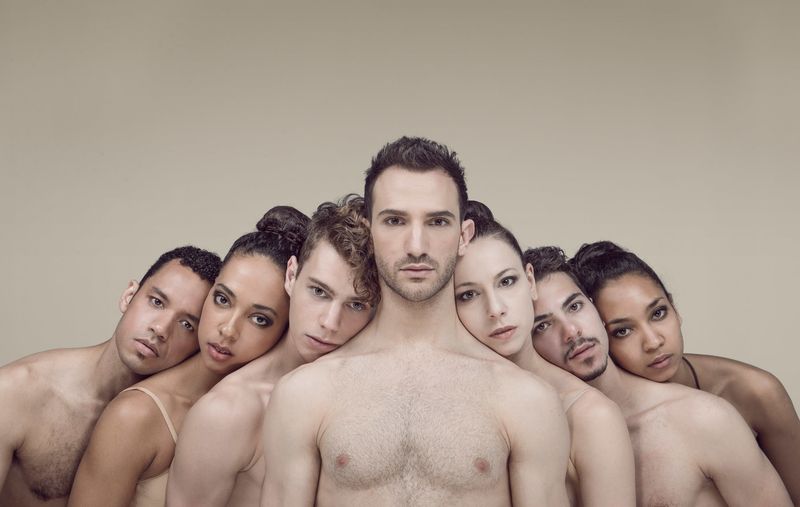
Above: the artists of Fadi J Khoury Dance, photo by Nir Arieli
Wednesday July 23rd, 2014 – Fadi J Khoury Dance enjoyed a highly successful opening night at New York Live Arts, the first of two sold-out evenings. Founded by Fadi Khoury, a native of Iraq, the Company boasts an international roster: dancers from Turkey, Spain, Italy, France, Costa Rica, and Colombia join together to present danceworks in a style in which Fadi, as choreographer, has skillfully merged elements of ballet and ballroom, with a dash of distinctively Middle Eastern spice thrown into the mix.
I met Fadi and his partner, Sevin Ceviker, when they were dancing with Nejla Yatkin’s troupe; another of tonight’s dancers, the lovely Karina Lesko, has also danced for Nejla and for Morales Dance.
The opening work tonight, TANGO UNFRAMED, was danced to a collage of tango-oriented music by Ron Jackson, Emilio Solla, and Rosa Antonelli. Judith Daitsman’s lighting designs were an intrisic element in the evening’s visual appeal.
Blending the sultry sophistication of the tango with a fusion of ballet and contemporary movement, TANGO UNFRAMED opens with a striking vision of the lithe and charismatic Fadi Khoury standing in a pool of light. His solo dancing is marked by expansive port de bras and an elegance of phrasing which is underscored by a subtle sensuality. Sevin Ceviker, in high heels and a pretty frock, appears in her own spotlight and establishes a connection with Fadi.
The three other couples come and go from the dance; there is a female ensemble segment and then a finely-wrought duet for Sevin and Fadi, danced to a piano solo. They display a mystic affinity both for the music and for one another.
Fadi has been onstage all the time up to this point, but now the space clears and the stage remains empty for a piano interlude. Then there is an amusing quartet where two girls set their sights on two boys only to find that the boys have their sights set on one another.
Sevin and Fadi commence another duet which blossoms into the work’s closing ensemble for the entire Company. The audience responded with genuine enthusiasm to this evocative, passionate work.
The intermission stretched a bit long and though I usually dislike hearing music played during intermissions at dance performances – it tends to detract from the music the choreographer has chosen to set his dances to – some Middle Eastern melodies here would have been welcome.
ARABESQUE opens with Sevin Ceviker seated upstage in a lighted space as fog swirls about. The music is ominous, with an outer-space feeling. She remains on the floor for a while, then rises to dance on pointe. The other women join her, dancing to a big beat, then suddenly Fadi explodes onto the scene with a spacious jeté.
The bleak sound of the desert wind signals the start of a ritualistic duet for Sevin and Fadi; they are kneeling, facing upstage, and they remain on the floor for a long time but luckily Fadi is a choreographer who knows what to do with floor time and so the duet sustained our interest, especially when Fadi sank back in a pair of voluptuous backbends.
The ensemble intrudes, the boys bare chested in satiny midnight blue tights. Then Sevin and Fadi resume their duet, the music driving to a pounding beat: things get sexy, yet the movement remains balletic. The girls dance to a swirl of Arabic music, then the boys come leaping on one by one. Sevin and Fadi continue to dance in their own private realm.
In a new section, two couples appear, followed by a boy’s trio and a trio for the girls which melds into a dance for all six. Sevin and Fadi ignite another duet passage, which leads into the concluding ensemble for the whole Company.
The composers drawn upon for ARABESQUE are Mercan Dede, Samer Ali and Said Mrad: a very effective mixture, and again Ms. Daitsman’s lighting was excellent.
The evening ended with a rousing standing ovation and the Company dancers were all greeted with cheers, marking an auspicious start for Fadi J Khoury Dance. Let’s see where this success leads them!

Above: Cedar Lake dancers prepare for Cedar Lab (above: from Vânia Doutel Vaz’s new work)
Monday July 21st, 2014 – Today I visited Cedar Lake Contemporary Ballet at their home on West 26th Street. The Company are preparing for Cedar Lab, a new venture in which Company dancers create new choreography on their colleagues. The works will be presented at four showings on July 29th and 30th, 2014. Details here. It’s a free event!
Jon Bond, Navarra Novy-Williams, Matthew Rich, Joaquim de Santana and Vânia Doutel Vaz are the choreographers, and today I watched rehearsals of the works being created by Navarra and Vânia. I had met these two young women in 2012 when Kokyat photographed them rehearsing Angelin Preljocaj’s magnificent dancework L’ANNONCIATION.

I love watching danceworks under construction! Navarra is create a piece with three of the Company’s women: Madeline Wong and Acacia Schachte (above)…

…and Rachelle Scott (above). Each dancer has a solo, and Navarra was working with them today on the detailing process. I heard some of the music, which is quite lyrical, and Rachelle dances to a beautiful rendition of ‘Moon River‘.
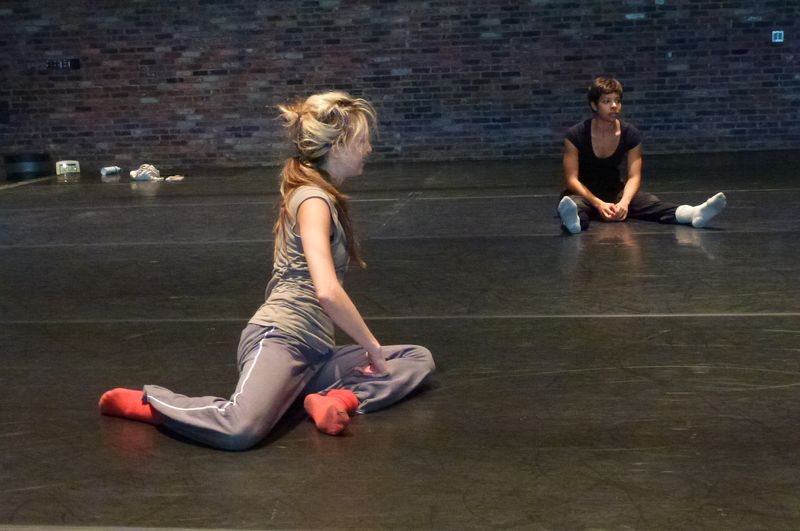
Navarra (above, with Rachelle); I love observing the creative process and seeing the dancers at close range.

We moved from the theater space to the studio where Vânia Doutel Vaz (above) was working on her ensemble piece. She conducted her rehearsal in silence, so I am not sure what the musical setting will be. Or maybe it’s a silent dancework…which could be very interesting.

The dancers were mastering a complicated set of freeze-frame poses to which they had applied a numeric encoding. There was a light-hearted atmosphere as they worked to get the sequence right.
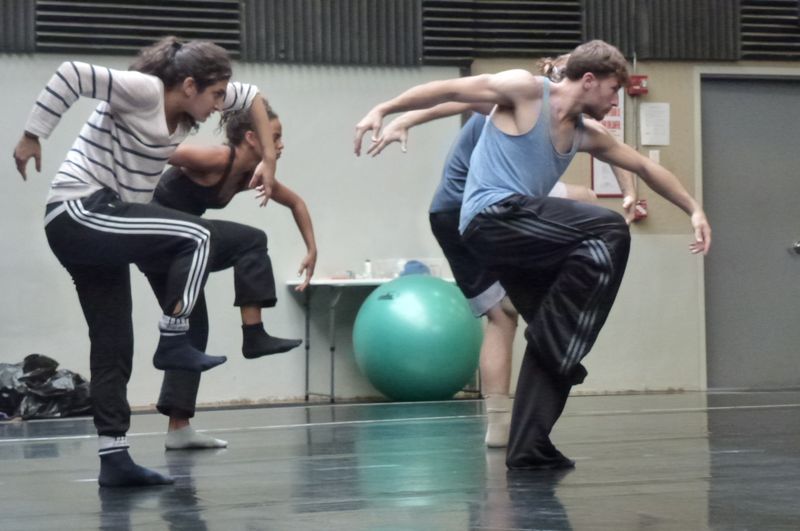
Later the work expands dynamically into the space. Now that I’ve had a sampling from these new works, I look forward to seeing them – and the other new creations – in a performance setting next week.
Here are a few more images of the individual dancers rehearsing today:

Acacia Schachte

Rachelle Scott
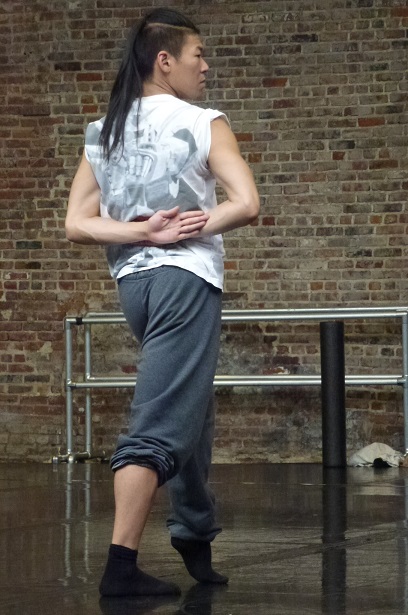
Matthew Rich

Joseph Kudra
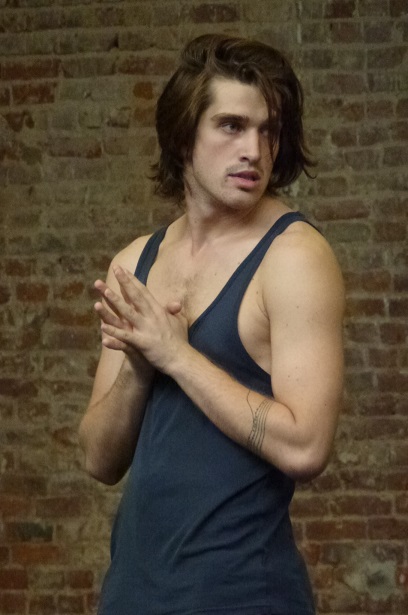
Guillaume Quéau

Jin Young Won
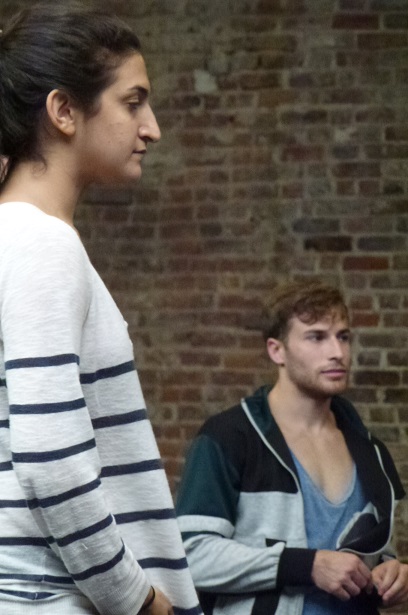
Ida Saki with Joseph Kudra

These days I hardly listen to anything but Wagner at home, and invariably it’s one of the RING Cycle operas. Thanks to my friend Dmitry I have a stack of CDs as yet un-listened-to. Today I’ve set out on a 1963 Bayreuth WALKURE, led with distinction by Rudolf Kempe, which starts with a truly urgent rendering of the ‘chase’ music that serves as the opera’s prelude. Although the sound quality is erratic, with some over-load and distortion, it’s certainly more than tolerable.

Pictured above, soprano Jutta Meyfarth – yet another ‘forgotten’ voice – may not have an ideally warm or expansive voice for Sieglinde’s music: her timbre is a bit hard. But she has a great way with words and she constantly is alert to the dramatic nuances of the music and words. I listened to the last scene of Act I, starting with Meyfarth’s whispered ““Schläfst du Gast?”, several times, liking her more and more with each hearing.

The Finnish soprano Anita Välkki (above) tosses off one of the most brilliant renderings of “Ho-Jo-To-Ho!” that I ever heard. This under-rated soprano, her career overshadowed by the more famous Nilsson, Rysanek, Bjoner and Lindholm, has a bright and at times girlish vocal quality. In the “Todesverkündigung” – the great scene in which Brunnhilde announces to Siegmund his imminent death – Välkki shows clarity of expression and considerable beauty of tone.
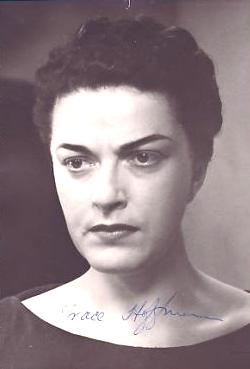
Mezzo-soprano Grace Hoffman (above) rounds out a strong trio of female leads in this WALKURE. Her wide-ranging voice, her intense sense of Fricka’s wronged dignity, and her verbal and dynamic alertness make a capital effect.
Hans Hotter was in his mid-fifties at the time of this performance, and he had been singing Wotan for a quarter-century. If vocally he is a bit less fresh than in the 1953 Keilberth/Bayreuth performance, he is remarkably authoritative and relishes both the powerful and subtle moments of this great role.
Hans Hotter was vehemently anti-Hitler and when he was queried during the de-Nazification interviews following the end of the war as to why Hitler would have kept his recordings in his private collection, Hotter replied that the Pope had some of them, too.
Gottlob Frick again fills me with admiration here, singing Hunding. A somewhat less-than-stellar Siegmund – Fritz Uhl – still has his moments, but though I don’t pretend to speak German, some of his diction seemed rather odd.
The third act is strong, with Meyfarth convincing in Sieglinde’s distress and Välkki doing some warm, espressive singing from “War es so schmälich…” to her final plea with her father to ring the Valkyrie Rock with fire. Hotter is Wotan – yet again – with the power of his wrath slowly subsiding into the tenderness of a father bidding farewell to his beloved child. Perhaps no other singer has such an innate quality of heartbreak in the voice.
~~~~~~~~~~~~~~~~~~~~~~~~~~~~~~~~~~~~~~~~~~~~~~~~~~~~~~~~~~~~~~~~~~~~~~~~~~~~~~~~~~~~~~~~~~~~~~~~~


Above: Tomasz Konieczny and Petra Lang
The Polish bass-baritone Tomasz Konieczny made a magnificent vocal impression when he sang Jochanaan in Strauss’s SALOME in a concert performance by the Vienna State Opera at Carnegie Hall in March 2014. Konieczny is the Wotan in the recently released WALKURE on the Penta Tone label, part of a complete RING Cycle conducted by Marek Janowski and recorded in a series of live concert performances in Berlin starting in 2012.
Very curious to hear Konieczny’s voice again, but not wanting to delve into the full WALKURE until I’d first had a chance to hear the RHEINGOLD, I listened to the final scene of the WALKURE as a free-standing excerpt. The bass-baritone sings powerfully and is a vibrant, dramatic presence especially as he takes his errant daughter Brunnhilde to task for having disobeyed his direct orders. Konieczny is quite splendid while letting off steam, though the poetry of the later scene where his bids farewell to Brunnhilde and puts her to sleep on the Valkyrie Rock is not quite yet in the singer’s expressive realm. He will doubtless attain that depth of understanding and an ability to communicate it as he sings the role in coming years. Marek Janowski’s conducting is alert and vivid, and Petra Lang – who has given some striking performances as a mezzo-soprano – now sings Brunnhilde. And if she does not seem destined to achieve the exalted echelon occupied by such great Wangeriennes as Nilsson, Behrens and Dame Gwyneth, Lang nonetheless makes a wonderful impression is her moving rendering of “War es so schmählich…” and is perfectly satisfying in the rest of the act.
I acquired the first two acts of a Stockholm WALKURE from 1975 mainly to hear Barbro Ericson’s Fricka and to have a sampling of another voice that had eluded me til now: soprano Siv Wennberg. Rudolf Kempe’s conducting again seems ideal.
Kempe has this music in his blood and gives yet another great reading of the score. Ms. Ericson, one errant top note aside, is a passionate and exciting Fricka. Neither Ms. Wennberg nor her Siegmund, Helge Brilioth, are likely to displace other favorite interpreters of these roles in the Völsungen sweepstakes, but both are very good story-tellers. Thru dynamic and verbal shadings, the soprano gives us quite an intriguing “Der Männer Sippe“, and – earlier – the tenor does likewise as he tells the story of how he came to be under Hunding’s roof. Mr. Brilioth will later have some pitch issues, and his cries of “Wälse!’ Wälse!’” suffer from very bad audio overload. Ms. Wennberg holds steady throughout the first two acts.
As Brunnhilde, Berit Lindholm lauches a pert, eager “Ho-Jo-To-Ho“, and she makes a good impression in the Todesverkundigung: the very heart of the opera. David Ward, whose Wotan I so thoroughly enjoyed in the 1965 Covent Garden performance conducted by Solti, is understandably a bit less fresh vocally here in Stockholm ten years on, but he is still very impressive and expressive in his long monolog (so well-supportedby Kempe) and he gives a violently dismissive “Geh!” as he dispatches Hunding to his fate at the very end of Act II.

The most surprising aspect of this performance is a superbly sung Hunding from basso Rolf Cederlöf (above). This is a voice I’d never heard before, and even as a name he was unknown to me. It’s a beautiful, deep, voluminous sound, and from his entrance the vocal ‘temperature’ of the first act rises: he seems to inspire Wennberg and Brilioth in their narratives…and in turn they are all inspired by Kempe.
~~~~~~~~~~~~~~~~~~~~~~~~~~~~~~~~~~~~~~~~~~~~~~~~~~~~~~~~~~~~~~~~~~~~~~~~~~~~~~~~~~~~~~~~~~~

Continuing in WALKURE mode, I recently took from the library the 1947 discs of Toscanini rehearsing the first act of the opera for a concert perfomance. This issue is a favorite among collectors as it gives an aural portrait of the fiery conductor at work. The Sieglinde is Rose Bampton (above) and I was very much taken with her interpretation. Wanting to hear more of Bampton, I turned to a 1944 Met broadcast of WALKURE conducted by George Szell. This seventy-year-old performance begins with a breathlessly-paced prelude depicting Siegmund’s rush thru the forest; Szell brings the first act full circle with an equally speedy burst of energy in the postlude as brother and sister rush off to their unknown fate.
Lauritz Melchior, that tireless Wagner-machine, is Siegmund. The paragon of heldentenors, Melchior sang over 500 performances at The Met alone; his career there lasted nearly a quarter-century (debut in 1926). Like Toscanini – who keeps admonishing the orchestra players “piano! piano!” during the rehearsal – Szell draws out some remarkably intimate passages from both musicians and singers in Act I. Melchior is able to sing some beautifully supported piano passages, and also to cut loose with sustained powerhouse cries of “Wälse! Wälse!“. Alexander Kipnis growls darkly as an authoritative Hunding.
Ms. Bampton’s singing sets her firmly alongside my favorite Sieglinde of all time: Johanna Meier. Bampton shares with Ms. Meier a deeply feminine sensibility as well as a feeling of great dignity, despite the hardships she has endured: married off against her will, and ill-treated by her abusive husband. Bampton’s wonderfully vivid diction, her ability to move the voice from subtle inflection to generous outpouring in the twinkling of an eye, and the overall appeal of her sound make for a winning combination in this role.
One added sonic element is the subtle use of a wind machine during the prelude; and it cunningly is heard again when the doors to Hunding’s hut blow open just before the “Winterstürme”.

I found myself being drawn deeper and deeper into this performance as Act II unfolded. Szell (above) seems, perhaps more than any other conductor I’ve experienced in the opera, to summon forth the various leitfmotifs and weave them ideally into the sonic tapestry. Thus the introduction to Act II presents the brass heralding the impending presence of Wotan and Brunnhilde whilst the strings yearningly deliver the theme of Sieglinde’s “Du bist der Lenz” (in a minor key) forecasting the theme of the entire act: the fate of the Völsung and his sister/bride; later, as Wotan and Fricka heatedly debate the issue, Szell brilliantly manages to support both sides of their argument thru orchestral underlining.
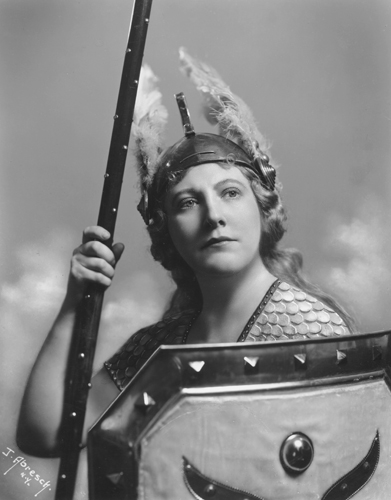
Helen Traubel’s Brunnhilde (above) rings true with rich, warm tone: a lone clapper greets her appearance – a few other audience members gingerly join in (applause during a Wagner opera is pretty much frowned upon) – and she has a fine success with “Ho-Jo-To-Ho” despite a hint of shortness at the top of the range. The sound of her voice at times reminds me, curiously, of Eleanor Steber’s.
Herbert Janssen’s Wotan is of the baritonal rather than basso persuasion: some of the roles lower notes are a bit of stretch for him. But he’s so completely at home in the role both verbally and vocally that it doesn’t matter. It’s not one of those grandiose Wagnerian voices, but has instead a dimension of the humanity that will eventually be the god’s undoing. Wotan’s monolog has some internal cuts, but Janssen sings it impressively and Traubel’s interjections are beautifully rendered.

Kerstin Thorborg’s imperial Fricka (above) is vocally opulent, and she deals from strength in her confrontation with Wotan, thoroughly dismantling his every argument as their scene progresses; a wonderfully sung Wagnerian exchange by two seasoned interpreters. Melchior and Bampton arrive at the mountain pass, fleeing from Hunding. Their scene is vividly urgent and again Szell and his orchestra continually project the dramatic situation; Melchior’s Siegmund is finally able to calm his desparate sister-bride, setting the stage for the heart of the opera: the ‘Todesverkündigung’ (the Annunciation of Death).
The Todesverkündigung is my favorite scene of WALKURE and my initial reaction on listening to the scene in this performance was of a slight letdown from all that had gone before. Szell and his orchestra did not seem to evoke the dreamlike quality needed (and there are a few bad notes among the brass players) and Melchior’s singing seemed factual and lacking in reverence to the demi-goddess who has appeared before him. I played the scene again a few hours later and found it far more impressive, especially as Traubel is so tonally secure and noble-sounding – at least until her cold façade begins to crumble in the face of Siegmund’s queries and his growing bitterness towards the deception he has been dealt. When the warrior tells Brunnhilde that he carries an invincible sword – Nothung – the Valkyrie replies: “He who bestowed it sends thee now death: for the spell he now takes from the sword!” her warning ricochets back at her when Siegmund cries: “This sword, given by a false man to a true one…!” The atmosphere is palpable, the scene as heart-breakingly beautiful as ever.
The end of the second act in this performance is somewhat undermined by the voices of Hunding, Brunnhilde and Wotan being too far off-mike to make the needed impact.
The third act opens with an exciting Ride of the Valkyries and an emotional rendering of the scene where Brunnhilde tells Sieglinde that Siegmund’s death was not in vain: she presents the unhappy widow with the pieces of the shattered Nothung and declares that Sieglinde, miraculously pregnant after only meeting her husband one day earlier, will give birth to the greatest of heroes: Siegfried. Mmes. Traubel and Bampton are very dramatically involved here, and both sing very well.
Traubel remains steady and impressive throughout the final scene with Herbert Janssen; the baritone’s voice has a steady beat to the tone – a kind of slow tremelo – that gives his singing of the opera’s heart-rending farewell of Wotan to his favorite daughter a wonderfully human dimension.
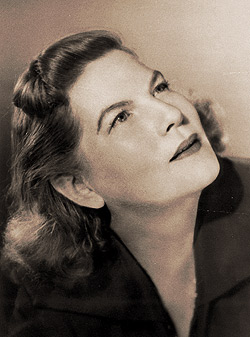
Among the Valkyries, the name Margaret Harshaw (above) stands out. She is Schwertleite here, as she was on many a Met evening over the years. In 1949 she moved on to Fricka and in 1954 she took on Sieglinde for the first time. And later in 1954 she assumed the role of Brunnhilde. It was in this last-named role that Harshaw sang in a Met WALKURE for the last time, in 1962. She took over the opera’s title-role that night in place of an ailing Birgit Nilsson. It was quite a night, as this descriptive review attests:
“Soprano Birgit Nilsson, scheduled to sing the role of Brünnhilde, had to bow out the evening before the performance. General Manager Rudolf Bing gave the role to soprano Margaret Harshaw, who was to have sung Sieglinde; into the Sieglinde role went soprano Gladys Kuchta. One of the Valkyries, mezzo Gladys Kriese, was ill with tracheitis: her part went to mezzo Ethel Greene, regularly a member of the chorus.
Somehow, the opera got started on time. But in Act II, just when baritone Otto Edelmann seemed to be booming along comfortably in the role of Wotan, his voice began to fail. Edelmann withdrew at the end of Act II. He was replaced by baritone Randolph Symonette, who lasted on stage for only four minutes. 'It seemed to me like four hours,' said shaken conductor Erich Leinsdorf, later. It was apparent to Leinsdorf that Symonette 'could not get any music out of his throat.' When Symonette finally croaked out the line 'Aus meinem Angesicht bist du verbannt'('From my presence you are banished'), Leinsdorf ordered the curtain rung down.
Conductor Leinsdorf started again after a jump of ten pages in the score to cut out some of the more tortuous vocal passages, and baritone Edelmann came on again as Wotan, in brighter voice after his rest. Happily, they all made it to the final curtain.
"I felt like the pilot who decides on a crash landing," said Leinsdorf. "We made it without the plane going up in flames."
 Oberon's Glade