
Blog
-
Heidi Latsky Dance @ Baruch

Above: Jillian Hollis of Heidi Latsky Dance, rehearsal photo
Tuesday June 25, 2013 – Heidi Latsky Dance in performance at Baruch Performing Arts Center. I met Heidi and her dancers just a few days ago at a rehearsal and I pushed things around on my schedule so I could attend her performance tonight. She presented the two works I’d seen in rehearsal: SOLO COUNTERSOLO and SOMEWHERE.
SOLO COUNTERSOLO opens with six dancers clad in simple black outfits standing in a row in “dark light”. The music by Chris Brierley seems jittery and anxious but the dancers hardly move until the pace slows to a deep adagio; this evolves into a soulful turbulence and later into music that is best described as ‘starlit’. To this sound tapestry, the dancers move in and out around Heidi, who seems to dance in her own world. Tempos vary but the movement isn’t always rigidly aligned to the beat: at one point everyone moves faster and faster, and later there is a simple, stylized procession. A mystical trio for women, a dynamic male duet, a meditative quartet, Heidi dancing with the two boys: all of this flows naturally. Heidi continues to express her own private passions in fluid combinations as the dancers swirl around her is restless pirouettes. A gorgeous wing-like motif for the arms seems to be a signature element (it’s also used in SOMEWHERE) and gives an expansive, ecstatic quality. As the piece draws to a close, step-dancing takes on a new look, to a bouncy beat; but the work in fact ends with a silent coda.
Aided and abetted by her generous, tireless dancers (Meredith Fages, Saki Masuda, Jillian Hollis, Brynt Beitman and Gregory Youdan), Heidi has crafted a “dance about dancing” that is physically demanding and very rewarding to watch.
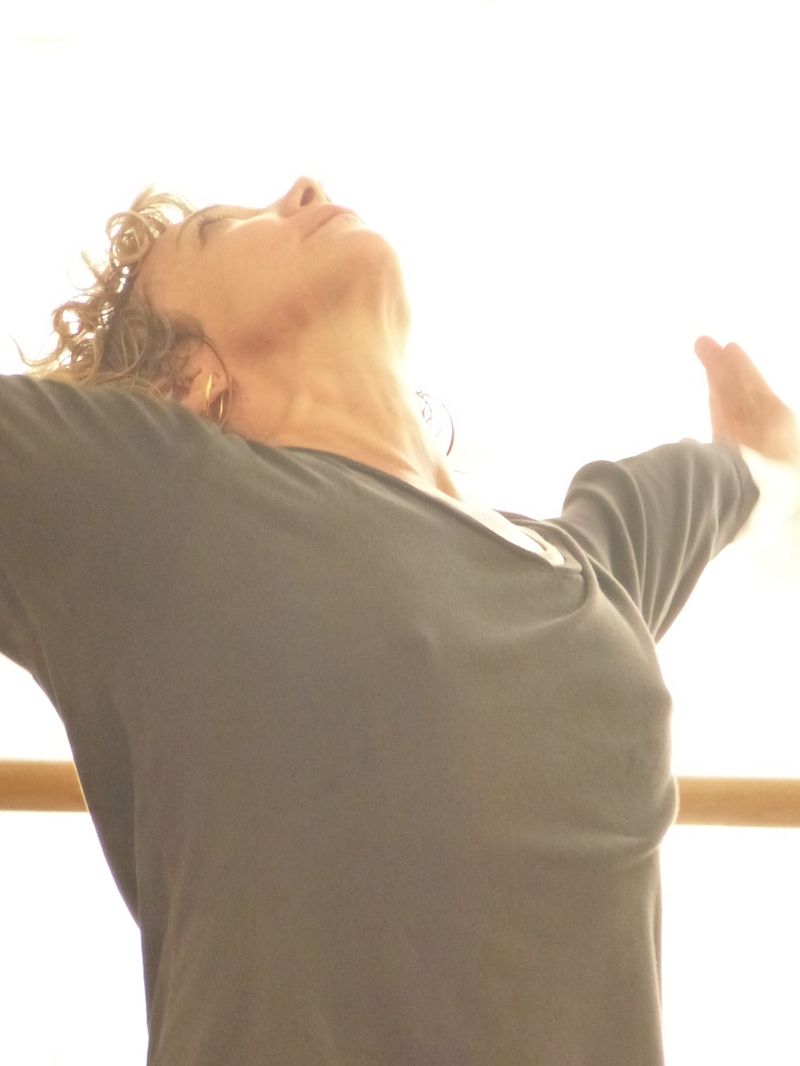
Heidi Latsky: winged victory
After only the briefest of breaks, the dancers were right back onstage for SOMEWHERE. Much as the song “Somewhere Over The Rainbow” is both melodically and lyrically resonant, the idea of hearing ten versions of it in a row might seem too much of a good thing. But the settings – everything from boys’ choir to disco to barbershop quartet – showed such a variety of pace and feeling that it made for an engrossing soundtrack. I took a special liking for Israel Kamakawiwo’ole’s charming version with ukelele in which the vocalist plays with the words to delicious effect. And of course there was Judy Garland’s classic version of the song.
In this work Heidi’s company of dancers were joined by performers with physical disablities; steering clear of anything maudlin or overly sentimental, Heidi gave them beautiful and expressive movement which added to the emotional power of the piece. Thus Robert Simpson opened SOMEWHERE seated with his back to the audience, the “wing” motif used with simple clarity. In the far corner, Greg Youdan’s solo echoes Robert’s phrasing. Meredith Fages and Brynt Beitman have distinctive solo passages, as does Jerron Herman who dances with electric animation. Greg and Jerron have a smooth, linear duet and Saki Masuda and Jillian Hollis dance vividly in-sync. Sign language expressed at high velocity marks the duet for Alexandria Wailes and John McGinty, followed by Ms. Wailes’ remarkably lovely signing solo as she kneels before the seated Mr. Mc Ginty. Heidi’s adagio solo flows seamlessly into a strikingly intimate duet for Jillian and Jerron in which they stand stock still, only their faces meeting as they express a dreamlike connection. They embrace tenderly as the light fades.

Jillian Hollis and Jerron Herman
A reprise of ‘…Over The Rainbow‘ accompanied the curtain calls and then Brynt Beitman suddenly burst into an impromptu solo. Perfect way to end the evening.
Heidi had a full house for this first of three shows (repeats are this Thursday and Friday) and it was great running into Cherylyn Lavagnino, Jill Echo and Take Ueyama.
-
Concert at El Museo de el Barrio
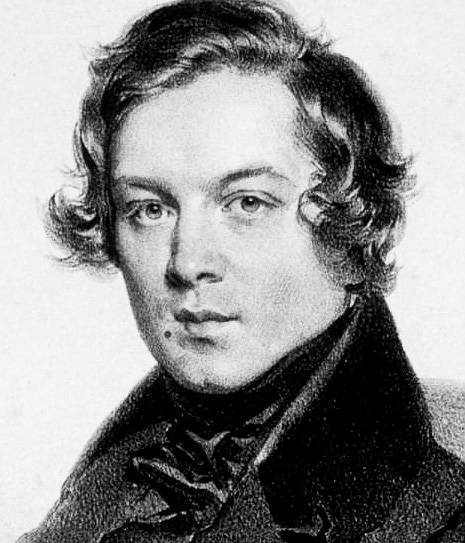
Above: the composer Robert Schumann
Saturday June 22nd, 2013 – The Hudson Valley Singers presented a concert entitled HYMN OF LOVE at the Museo de el Barrio this evening. I walked across Central Park North under a beautiful summer sky and met my friend Monica there. The theatre space at the Museo is charming, with its fairy tale murals; it was a full house, or nearly so.
One doesn’t expect to hear a piano concerto or an orchestral suite at a choral concert, and the program stretched to two and a quarter hours, what with all the rearranging of the stage to suit the configurations of musicians and singers for each piece. During the longish intermission, Monica and I caught up on ballet gossip.
Piano Concerto #1 by Carl Maria von Weber opened the evening. Weber has never been high on my list of opera composers: a performance of FREISCHUTZ that I attended decades ago at NYC Opera was a crashing bore, and despite the splendid “Ozean!” aria I have never been able to listen to the whole of OBERON. But beyond opera, his enchanting ‘Invitation to the Dance’ makes a perfect setting for the Fokine ballet SPECTRE DE LA ROSE. And so it was an interesting opportunity to hear the composer’s piano concerto tonight. Eugene Sirotkine both played very well and conducted from the keyboard. The New York Metamorphoses Orchestra is a fine ensemble of young players, notably their flautist and oboist. The concerto might make a first-rate classical ballet, in the right choreographic hands.
The chorus, with vocal soloists, then took to the stage for two pieces by Roobert Schumann: Adventlied and Requiem fữr Mignon. These two works deal with aspects of parenthood, the first being in anticipation of the birth of a new baby and the second a sad reflecton on the death of a beloved child. The large chorus, a lovely generational mix, sang with fervent lyricism. The music for the trio of women in the Requiem (Eleni Colenos, Liana Brooke Guberman and Alexandra Lushtak) brought to mind the trio of nymphs in Strauss’ ARIADNE AUF NAXOS. Robert Garner was the baritone soloist in both Schumann works, joined in the Adventlied by Mlles. Brooke Guberman and Kushtak along with the appealing tenor sound of David Guzman.
In a delightful interlude, The Elm City Girls Choir brought us folksongs from America, Russia, Bulgaria and Africa. Their fresh young voices blended well in surprisingly confident harmonies as they swayed and clapped to the varying rhythms of each song.

Above: the composer Carl Nielsen
From Aladdin Suite by Carl Nielsen – a tuneful colorful compilation of vignetttes composed as incidental music for a play – we heard an Oriental
March, a Dance of the Morning Clouds. a delicate Chinese Dance, and the concluding Blackamoor’s Dance. The players of the New York Metamorphoses Orchestra, under Mr. Sirotkkine’s baton, seized on the music’s coloristic opportunities, each instrument having its expressive voice. Seated in the audience, the chorus took up some humming passages, adding to the sonic palette.Hymnus Amoris (the title which inspired the programme) by Carl Nielsen, is a large-scale work which the composer crafted as a paean to love after taking his honeymoon. All of the evening’s choral participants took part, along with soloists Ms. Calenos, Mssrs. Guzman and Garner, and bass Emmanuel Mendez-Chumaceiro. The music is celebratory and ecstatic, and voices and instruments joined in a fervent ‘hymn of love’ with Mr. Sirotkine at the helm.
-
Haydn, Rouse & Gilbert’s Wagner

Above: pianist Emanuel Ax, soloist with the New York Philharmonic this evening
Friday June 21st, 2013 – The New York Philharmonic‘s current Artist-in-Residence, Emanuel Ax, and Composer-in-Residence, Christopher Rouse, were both featured in the first half of this evening’s programme at Avery Fisher Hall. After the intermission, the orchestra’s Music Director Alan Gilbert led a performance of his own RING JOURNEY: music drawn from Richard Wagner’s epic RING Cycle.
In the Playbill, Maestro Gilbert answers the “…terrible question: who is you favorite composer?” with the name ‘Haydn’. His admiration was evident in the joyous clarity of his shaping of the composer’s Piano Concerto No. 11 in D Major. Emanuel Ax’s playing had a youthful gleam, turning the melodic lines with elegance and the cadenzas with polished perfection, his trills lovingly defined. Pianist, players and conductor meshed their artistry in pure music-making that was deeply satisfying to experience.
I first heard the music of Christopher Rouse from a Yo-Yo Ma recording of the composer’s Cello Concerto. At the New York City Ballet, Peter Martins has created two ballets to Rouse works: the 2002 INFERNAL MACHINE (seen earlier this year) and the 2006 FRIANDISES.
In its New York première performances,
Rouse’s Symphony No. 3 is a tribute to the Prokofiev 2nd symphony, the “symphony of iron and steel” (Prokofiev’s words). The orchestral forces are huge and the opening statements are a cacophonous but lucid fanfare, thunderous and epic. Later, in the more lyrical passages of the work, the composer finds unusual veins of beauty: a passage involving oboe and harp made me think of FIREBIRD. Throughout, the dense sound textures were vividly expressed by the orchestra’s super-human players, and Maestro Gilbert shaped the whole into a persuasive, and gigantic, statement.Alan Gilbert’s RING JOURNEY takes its inspiration from Erich Leinsdorf’s earlier arrangement of the Cycle’s immortal themes. RING fanatics (Mr. Gilbert is one, by his own description) draw their life blood from this music, and the standing ovation that greeted the conductor at the end of the evening seemed to me to indicate that people want to hear more of Gilbert’s Wagner.
Alan Gilbert’s RING JOURNEY, which he rightly describes as a ‘suite’ rather than a ‘fantasy’, commences with the ‘Ride of the Valkyries’ and continues chronologically thru excerpts from WALKURE, SIEGFRIED and GOTTERDAMMERUNG. Gilbert shows a sure and steady hand at maintaining the flow of the music; some of the passages he chose to include are ‘transitional’ in the operatic sense, but they are gorgeous transitions and by exploring them here Gilbert steers clear of a ‘greatest hits’ feeling.
The overall span of the piece was quite glorious, and the playing was simply superb: a special ‘bravo‘ to Philip Myers who stepped offstage to play Siegfried’s horn call with splendid warmth and amplitude.
In view of such grandeur and musicality it seems selfish to ask for more; but I’d hoped to hear the Rhinemaidens’ trios, the Entry of the Gods into Valhalla, the Winterstürme theme, the Sword motif, and most especially Brunnhilde’s poignant “Ewig war ich” – the core melody of the SIEGFRIED Idyll. The answer, dear Maestro Gilbert, is that you must program more of the RING in the next few seasons, especially in view of the fact that The Met can’t deliver it anytime soon.
Hearing this music so spectacularly played and watching Mr. Gilbert’s loving sculpting of it from the podium, I couldn’t help but wish for voices. As the conductor built the introducton to the GOTTERDAMMERUNG prologue duet with breath-taking clarity and passion, I desperately wanted Christine Goerke or Lise Lindstrom to burst thru the door and launch into “Zu neuen Taten!”
-
Monte/Muller Move! @ NYLA

Above: Seiko Fujita and Chellamar Bernard rehearsing for Jennifer Muller/The Works. Photo by Brian Krontz.
Friday June 20, 2013 – Two companies shared the stage at New York Live Arts tonight: Elisa Monte Dance and Jennifer Muller/The Works. With two intermissions the evening stretched long, but the diversity of music and the appeal of both Companies’ dancers proved rewarding.
Grass, Jennifer Muller’s newest creation, opened the evening. I had recently seen a studio run-thru of this work, loosely inspired by Walt Whitman’s Leaves of Grass,
and I feel it’s one of Ms. Muller’s finest. Actually danced on a rectangle of living grass, and enhanced by subtle lighting (Jeff Crotier), Grass profits beautifully by being performed to live music: composer/cellist Julia Kent, seated stage left, wove some melancholy ‘Russian’ nuances into her poignant score which has a slightly folkish feel blended with Glassian lyricism.Gen Hashimoto, one of Gotham’s most fluent movers, opens the ballet as he wanders pensively onto the patch of lawn. The other dancers come on one by one; the dance flows on Ms. Kent’s rhythmic shifts. In this collective which is not yet a community, many emotional textures are revealed as the dancers seek to form relationships. Olivia Jordan, her silky long hair giving her a vulnerability that was most appealing, seems to be the outsider; only near the end does the group view her with compassion. Having banded together at last, the dancers move off into the late afternoon, leaving Gen to stretch out on the ground in a solitary daydream.
Grass is at once simple and complex; it is a work which will reward repeated viewings since both in terms of choreography and psychological undercurrents it is too rich to absorb in a single performance. The dancers of Ms. Muller’s company – in addition to Gen and Olivia – are Rosie Lani Fiedelman, Seiko Fujita, Caroline Kehoe, Katherine Hozier, Duane Gosa, Chellamar Bernard, and Michael Tomlinson. Both as individuals and as an ensemble, they are beyond beautiful to behold.
Excellence of dancers is one thing the Muller and Monte troupes have in common. The power and authority of the Monte men – Prentice Whitlow, Riccardo Battaglia and Justin Lynch – became immediately evident in their first work of the evening: Unstable Ground. This brooding and unsettlling work is set to a Lois Vierk score that vibrates with dark foreboding. The men are handsomely costumed by Keiko Voltaire. It is a floor-oriented piece in which the dancers seem to strive against the impending collapse of their known world.
Things brighten somewhat in terms of both setting and music with Monte’s Shattered in which Michael Gordon’s score impels the dancers to broader and swifter movement. Maria Ambrose and Riccardo Battaglia have a striking duet, and the red-haired Lisa Peluso dances a spacious, dramatic solo which evolves into another duet with Riccardo. Mindy Lai and Lisa Borres move with fleet-footed assurance among the shifting patterns of the ensemble.
Volkmann Suite, a Monte classic, uses a gorgeoulsy ‘classical’ Michael Nyman score in this tribute to photographer Roy Volkmann. Three dancers – Clymene Baugher (topless), Prentice Whitlow and Riccardo Battaglia (both men in black briefs) – deliver sensual, sculptural partnering in a pas de trois laced with erotic imagery. The atmosphere suggests a photoshoot that turns into an intimate exploration of the models’ bodies and souls. The dancers were magnificent in their physicality and allure.
Speeds, danced by the Muller company, brought the evening to a bright conclusion. In this clever – but not cute – ensemble piece the dancers call out for changes of tempo as they move to Burt Alcantara’s panoramic synthesizer soundscape. All in white and brilliantly lit, the dancers seize on the eclecticism of the musical settings in a series of vignettes ranging from vari-paced walking to utter stillness (Katherine Hozier posing in a white picture-hat to silence). Ms. Hozier and Duane Gosa are a fabulous duo in a long pas de deux that is not long enough, while Rosie Lani Fiedelman and Michael Tomlinson have a sporting time in their jazzy duet. Seiko Fujita periodically interrupts the flow of dance to strike poses while enticing the audience with her quizzical expressions. This vastly entertaining white ballet capped the evening to fine effect.
-
Castle

Would someone kindly buy Moritzburg Castle for me? It was built near Dresden by Duke Moritz of Saxony in the 1540s. I would like to live here with several of my friends, each of whom will be provided his/her own room. We’ll have dance studios created in those two small, square buildings on either side of the main driveway where my choreographe/friends can create.
There’s a Baroque chapel on the premises where we’ll have choral and chamber concerts, and if there isn’t a theatre in or near the castle, we’ll have one created so we can present dance, opera and annual performances of CYMBELINE. Artists, photographers, poets and film-makers can come there to do their work in peace. There will be a big library and an even bigger kitchen, where my friend Janusz will be in charge of the daily menu. And I’ll finally learn how to play the violin and to play tennis.
-
Invocation

“Then give me a mood of the mountain tops
And the sacred presence of song
And I shall resume where the last star stops
And my chant shall be clear and strong.
My words shall be writ in the world-heart’s blood
And sung to a cosmic lyre
Where sighs are a wind, and where tears are a flood
And where love is the central fire.”
~ Louis K Anspach/”To Isadora: April 8, 1917″
-
At Jennifer Muller’s Studio

Above: Chellamar Bernard and Seiko Fujita of Jennifer Muller/The Works. Photo by Brian Krontz.
Wednesday May 28th, 2013 – An invited audience of friends of Jennifer Muller/The Works enjoyed a sneak preview of Jennifer’s newest creation GRASS, as well as highlights from the Company’s repertoire at a private studio showing this evening.
Jennifer Muller/The Works will be performing at New York Live Arts June 20th thru 22nd, 2013, sharing the programme with Elisa Monte Dance. Ticket information here.
This evening’s studio showing opened with a quartet from EDGE danced by Seiko Fujita, Caroline Kehoe, Gen Hashimoto and Michael Tomlinson. This was followed by a richly emotional duet from HYMN FOR HER danced by Rosie Lani Fiedelman and Duane Gosa. A quintet from FLOWERS showed off a seductive sway, performed by Seiko, Rosie, Caroline, Duane and Gen.
In prefacing the excerpts from the new work GRASS, Ms. Muller spoke of drawing inspiration from Walt Whitman’s poetry, and told us about the impending arrival of the actual turf on which the work will be danced. For the NYLA performances, the score will be played live by composer/cellist Julia Kent. Jennifer then introduced the individual dancers, leading off with Olivia Jordan, in solo phrases. The ensuing excerpts were danced first in silence as Jennifer described the motifs of movement, and then danced again to parts of a recording of the score. Contrasting the solitude of the individual with the underlying seach for common bonds, GRASS should look incredibly beautiful onstage.
The evening concluded with a celebratory performance of the final movement of MOMENTUM, led with vivid energy by Duane Gosa. At the finish, the audience saluted all of the dancers and Ms. Muller with sustained applause.
-
Mozart’s Last Aria
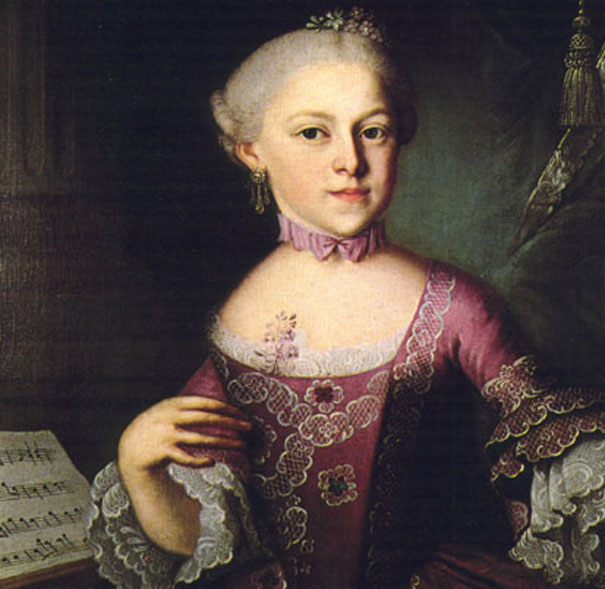
Above: Maria Anna (Nannerl) Mozart
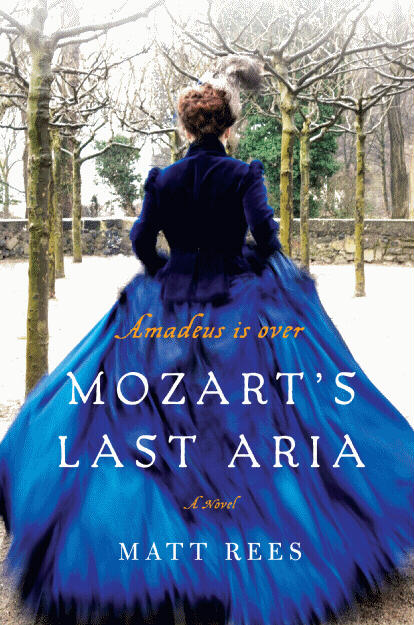
After recently watching the film Mozart’s Sister, my curiosity was piqued about Mozart’s older sister Nannerl, herself a talented musician forever in the shadow of her genius-brother. Matt Rees’s novel MOZART’S LAST ARIA popped up on my radar, and I grabbed a copy from Amazon; admittedly the book’s attractive cover was an added incentive:
Nannerl, four-and-a-half years older than Wolfgang, was considered a musician of equal talent to her brother. As their father carted them all over Europe, playing for royalty, Wolfgang began to eclipse his sister in notoriety.
Both children began to compose, Wolfgang openly and Nannerl furtively. Wolfgang admired and encouraged his older sister’s work. At a
concert, when Wolfgang announced that the piece he had just played was
written by his sister, their father Leopold was furious. He ordered Nannerl never to
compose music again because in the 18th century, women did not become
composers.Thereafter, Leopold focused all his attentions on Wolfgang, leaving Nannerl at home, taking only her brother on tour, and forcing her to give piano lessons to wealthy students to finance Wolfgang’s travels. Nannerl became depressed, and in the years that followed the close relationship of brother and sister faded, especially once Wolfgang had married Constanze.
In 1784, Nannerl had married the magistrate Johann Baptist Franz von Berchtold zu Sonnenburg; they lived in St. Gilgen and she did not see Wolfgang again. In the novel, which begins with Nannerl, having received a letter from Constanze informing her of Wolfgang’s death, leaving St. Gilgen for Vienna in an effort to learn the facts surrounding Wolfgang’s untimely demise.
Of course, there have always been rumours that Mozart was poisoned – namely by the rival composer Antonio Salieri. There is no verifiable evidence of this, but the myth has persisted anyway.
Constanze’s letter to Nannerl hints at foul play. This induces Nannerl’s trip to Vienna where she runs up against a wall of silence and deception. Attempting to ascertain who might have had cause to desire her brother’s death – the jealous husband of one of his amours? a
sinister creditor? a rival composer? or those involved in the secret and banned acttvities of the Masons? – Nannerl finds her own life endangered.At a soiree where Nannerl dresses as her brother and plays one of his compositions for an elite assemblage, the culprit is unmasked. But many questions remain, and as Nannerl slowly sorts things out, a complex web of duplicity and political intrigue is revealed.
In reality, Nannerl did not travel to Vienna following her brother’s death. But in using her as the axis of his novel, the author has crafted a finely-paced murder mystery into which real personages from the time – including Emanuel Schikaneder, librettist of Mozart’s “Masonic” opera THE MAGIC FLUTE – are introduced. The novel would seem well-suited to a cinematic treatment: a beautiful period piece with a host of brilliant character roles and a built-in soundtrack of some of the greatest music ever written.

 Oberon's Glade