Blog

  • Maria von Ilosvay

    Maria von Ilosvay

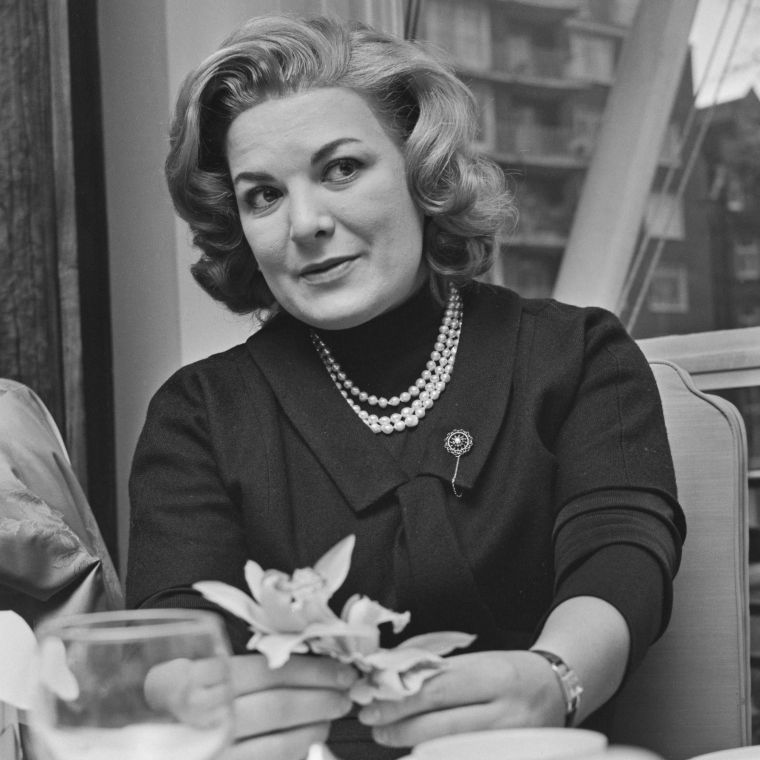
    The Hungarian mezzo-soprano Maria von Ilosvay won the 1937 International Singing Contest at Vienna. Thereafter she joined a touring opera company for two years – even traveling to America, in performances organized by Sol Hurok – before joining the Hamburg Opera in 1940. She sang at Vienna, Brussels, Amsterdam, and Salzburg,

    Ms. von Ilosvay participated in the first post-war Bayreuth Festivals. In her book New Bayreuth, Penelope Turing writes with admiration of the mezzo in such RING Cycle roles as Erda, Waltraute, and the First Norn.

    At the Salzburg Festival, Ms. von Ilosvay took part in the first staged performance of LE VIN HERBE by Frank Martin in 1948, and in the premiere of Carl Orf’f”s ANTIGONAE in 1949. With the ensemble of the Hamburg Staatsoper, she was a guest at the Edinburgh Festival, and in 1956 sang Jocasta in Stravinsky’s OEDIPUS REX at the Holland Festival. Also in 1956, she appeared as a guest artist at London’s Royal Opera House.

    In 1967, Maria von Ilosvay sang Marcellina in a filmed German-language ‘studio’ performance of Mozart’s NOZZE DI FIGARO. Her scene with the brilliant Susanna of Edith Mathis is a delight.

    Ms. von Ilosvay recorded the role of Erda twice, and was the mezzo-soprano soloist on a recording of the Verdi REQUIEM with the Accademia di Santa Cecilia. She is also The Mother on Herbert von Karajan’s recording of HANSEL UND GRETEL. She did a great deal of concert work, and was a noted recitalist.

    Maria von Ilosvay passed away at Hamburg in 1987.

  • L’invitation au voyage

    maurane

    Camille Maurane sings Duparc’s L’invitation au voyage:

  • Rita Gorr ~ Printemps qui commence

    rita gorr

    The great Belgian mezzo-soprano Rita Gorr sings Dalila’s evocative aria “Printemps qui commence” from Camille Saint-Saëns’ SAMSON ET DALILA.

  • Dame Joan Hammond ~ Vissi d’arte (in English)

    Read about the beloved Australian soprano Dame Joan Hammond here.

    Listen to her singing Tosca’s “Vissi d’arte” in English:

  • Varady/Brendel: ONEGIN ~ Final Scene

    Julia Varady and Wolfgang Brendel in the final scene from Tchaikovsky’s EUGENE ONEGIN, from a performance given at Munich in 1985.

  • Peter Mattei ~ Kindertotenlieder

    Peter Mattei sing’s Mahler’s Kindertotenlieder at a 2021 concert given by the Royal Concertgebouw Orchestra, conducted by Fabio Luisi.

    Filmed during the pandemic; the orchestral soloists are particularly fine.

  • A Fresh Take on the Kindertotenlieder

    Sara gouzy

    Gustav Mahler’s Kindertotenlieder (song settings of poems by Friedrich Rückert), in an arrangement by Andreas N. Tarkmann, Musicians of the WDR Symphony Orchestra accompany singer Sara Gouzy (photo above), from a concert given in 2024.

    Watch and listen here

  • Teatro Nuovo’s MACBETH @ City Center

    Teatro Nuovo 2025 Macbeth - Chorus of Scottish Exiles (Act Four)_Photo by Steven Pisano

    Above: the chorus of Scottish exiles; photo by Steven Pisano

    (Note: click on each image to enlarge)

    ~ Author: Ryan Vasquez

    Wednesday July 23rd, 2025 – This year, Teatro Nuovo staged both Verdi’s Macbeth (the 1874 edition) and Donizetti’s La Sonnambula. Verdi’s Macbeth is a relatively faithful adaptation of Shakespeare’s classic, but the opera could just as well have been titled Lady Macbeth, both because of the impressive music Verdi wrote for the character and because of Alexandra Loutsion’s commanding performance as the (almost) titular villain. The entire principal cast sang beautifully, but the night undoubtedly belonged to Loutsion.

    Teatro Nuovo is a summer festival where young singers and budding professionals spend the season working on two bel canto operas. Although Verdi is not typically categorized as a bel canto composer, his early works, Macbeth among them,clearly sit at the tail end of that stylistic era.

    The performance took place at New York City Center, just a block from Carnegie Hall. It was my first time attending a show at the venue, and it was fantastic, beautiful and acoustically quite pleasing. I was also glad to see a diverse audience that truly reflected the breadth of NYC’s population and age demographics.

    The full orchestra was positioned directly in front of the stage and served as a formidable counterpoint to the otherwise completely bare stage. I was surprised to find there were no set pieces at all, but I chose to be patient and see how things would unfold.

    Teatro Nuovo 2025 Macbeth_Jakob Lehmann conducting the Teatro Nuovo Orchestra_Photo by Steven Pisano

    Conductor Jakob Lehmann (photo above by Steven Pisano) walked out and began the overture. The orchestra displayed masterful control, delivering Verdi’s score with both power and delicacy. Their ability to handle the softer passages was especially noteworthy: opera orchestras aren’t always known for subtlety, but this one maintained finesse throughout the entire evening.

    I noticed the overture featured prominent use of brass, which I loved for its tone-painting quality. Brass instruments have long been associated with death, and Verdi’s thick brass textures effectively foreshadowed the bloodshed to come.

    Teatro Nuovo 2025 Macbeth_witchs chorus_Photo by Steven Pisano

    Above: the chorus of witches; photo by Steven Pisano

    The back wall of the stage lit up with a beautiful projection of Scotland, setting the scene for the witches’ chorus. Shakespeare’s version begins with three witches who famously chant, “Double, double, toil and trouble,” but this adaptation featured three groups of singing witches. All dressed in black, these choristers were young artists covering the main roles and performing comprimario parts.

    They sang well, and several performers fully embraced their witchy characters. However, a number of them seemed to lack fully developed characterizations. Overall, it was an effective, if slightly static, opening.

    Shortly after the choral number concluded, Macbeth, played by Ricardo José Rivera, and Banco, played by Cumhur Görgün, entered. Both were dressed in formal black attire, a costume choice shared by the rest of the male cast.

    They sang the duet “Due vaticini compiuti or sono” beautifully. I was particularly struck by Rivera’s smooth legato line. Görgün’s voice had a rich color, and I noted that the upper part of his range had more heft, making me wonder if he might actually be a bass-baritone. Regardless, the duet was a strong introduction to both characters and their voices.

    Teatro Nuovo 2025 Macbeth_Alexandra Loutsion as Lady Macbeth_Sleepwalking_2_Photo by Steven Pisano

    Above: Alexandra Loutsion as Lady Macbeth; photo by Steven Pisano

    After the stage cleared, a new projection depicted Macbeth’s castle. Lady Macbeth, portrayed by Ms. Loutsion, entered and delivered lines in wonderful Italian. I was surprised the passage wasn’t sung in recitative form, but soon she transitioned into the recitative section of her aria, “Nel dì della vittoria.

    Ms. Loutsion’s voice initially sounded like a mezzo’s, but given the heights her voice achieved, she was clearly a soprano. She commanded the stage and fully embodied the ambitious Lady Macbeth. The crowd adored her. Her coloratura rang with crystal-clear pitch, an impressive technical feat, and her intonation was impeccable. When she finished her aria, the audience erupted into applause. Well deserved cries of “Brava!” rang out. Loutsion stood in place until the cheers subsided, then exited the stage.

    Teatro Nuovo 2025 Macbeth_Ricardo José Rivera and Alexandra Loutsion as the Macbeths 3_Photo by Steven Pisano

    Above, the Macbeths: Mr. Rivera and Ms. Loutsion, photo by Steven Pisano

    Rivera’s characterization of Macbeth in the first scene leaned heavily into “anxious,” which worked initially but grew somewhat one-note. Fortunately, more nuance emerged during his duet with Lady Macbeth. The two had excellent chemistry, and Ms. Loutsion appeared more relaxed. If the shift in tone was an intentional choice to reflect Macbeth’s comfort in his wife’s presence, it was an effective one.

    They sang well, but I realized midway through their duet that I didn’t fully understand what had just happened to prompt the number. This moment highlighted the production’s biggest weakness: the acting and staging were secondary to the music.

    The motivation behind the duet was that Macbeth had just murdered the king and was now panicking over the bloodied dagger. However, the murder itself wasn’t shown. While the libretto indeed places the murder offstage, the production did little to make that event clear. The action often felt like an inconvenient hurdle rather than a driving force for the music.

    This lack of clarity recurred throughout the show. Events that should have been staged were either skipped entirely or summarized in supertitles. The most jarring example came at the end, when Macbeth and Macduff left the stage to fight. A supertitle then informed us that “Macbeth was fatally wounded.” After which the two returned. Macbeth proceeded to lie on the floor. And then die. 

    Returning to the earlier moment: after the Macbeth/Lady Macbeth duet, the chorus launched into a rousing Verdi finale. It had all the signature hallmarks of Verdi’s brilliance, even in this early work. I was particularly impressed by Martin Luther Clark, who sang the role of Macduff. Though Macduff doesn’t do much until the final act, Clark’s sterling tenor soared clearly above the orchestra.

    Teatro Nuovo 2025 Macbeth_Cumhur Görgün as Banco  Olivia Trinchera Citterio as Fleanzio_Photo by Steven Pisano

    Above: Cumhur Görgün as Banquo and Olivia Trinchera Citterio as Fleance; photo by Steven Pisano

    In the next act, Banco and his child were outside the palace, unaware of the events unfolding within. Görgün sang Banco’s aria beautifully, again showing off his warm tone. Banco then exited the stage and was murdered (again offstage), and the scene shifted back to Macbeth’s castle.

    Teatro Nuovo 2025 Macbeth_Ricardo José Rivera as Macbeth_6_Photo by Steven Pisano

    Above: Ricardo José Rivera as Macbeth is haunted by Banquo’s ghost; photo by Steven Pisano

    Act II featured more beautiful singing, and Rivera seemed more animated and confident. During the finale, Banco’s ghost appears, visible only to Macbeth, but the staging failed to indicate he was a ghost. Since we never actually saw Banco die, the moment felt muddled. Simple makeup or lighting could have clarified things. Still, the ghost was soon forgotten as the act closed.

    Once again, the orchestra impressed. Their dynamic sensitivity, likely thanks to Lehmann’s direction, was a rare treat in opera.

    I thoroughly enjoyed the sprite scene in Act 3, where the female chorus returned as witches. The choral numbers throughout were well executed. The staging in this act was more dynamic, with some choreographed movement that added interest.

    Macbeth’s aria following the sprites was Rivera’s best of the night. His soft passages were beautifully rendered, showcasing his technique. He ended with a rousing cabaletta and held an extended final note that had the audience in raptures, particularly in the balcony, where the applause outlasted that of the orchestra level.

    The scene turned back to Macbeth’s castle. Although I had never seen this opera in person, I knew about the most famous scene that was Verdi’s take on Shakespeare’s famous lines for Lady Macbeth, “Out, damned spot! Out, I say!” Lady Macbeth’s attendants stood on stage giving the background details on why Lady Macbeth had seemed to have lost her mind. Once the preamble was finished, Ms.  Loutsion walked out as if in a trance and started to sing the famous aria Una macchia è qui tuttora.”  As the soprano mimed out washing her hands the audience was transfixed, for the entire scene, waiting with bated breath for the next moment to happen. And as Ms. Loutsion finished she walked off the stage with applause.

    Next came a scene featuring Macduff and Malcolm, the prince destined to take the throne Macbeth killed (offstage) to acquire. Romeo Lopez, who sang Malcolm, had a sweet voice but was overpowered by the orchestra. As a young artist, he has time to develop his voice, but for now, he struggled to be heard.

    Teatro Nuovo 2025 Macbeth_Martin Luther Clark as Macduff_2_Photo by Steven Pisano

    Above: Martin Luther Clark as Macduff; photo by Steven Pisano

    Clark’s rendition of Macduff’s aria “Ah, la paterna mano” was a standout moment. Macduff is one of those roles where you don’t have too much to do and learn, but you get a wonderful song that everyone remembers after the show. Clark performed it with tenderness and grief rather than anger, revealing the piece’s emotional depth. His pianissimi were particularly moving, making me appreciate the aria in a new light. The ovation was well earned.

    In the final scene, Macbeth and Macduff faced off. Macbeth, emboldened by the witches’ prophecy that no man born of woman could kill him, is shocked when Macduff reveals he was born via cesarean section. They leave the stage, Macbeth is mortally wounded, they walk back onstage, and the show ends.

    Musically, this Macbeth was executed beautifully. The orchestra was superb, and the singers brought Verdi’s music to life with skill and passion, thankfully, onstage.

    ~ Ryan Vasquez

    (Performance photos by Steven Pisano)

  • CMS Summer Evenings 2025 – Concert VI

    Viano 2 da ping luo

    Above, the Viano Quartet: Hao Zhou & Lucy Wang (violins); Tate Zawadiuk (cello); and Aiden Kane (viola). Photo by Da Ping Luo.

    ~ Author: Ben Weaver

    Sunday July 27th, 2025 – The oppressive heat of the summer was broken for a few hours by the Chamber Society of Lincoln Center with the last of their summer concerts at Alice Tully Hall. The Viano Quartet – Lucy Wang & Hao Zhou, violins; Aiden Kane, viola; Tate Zawadiuk, cello – played a wonderful program of Haydn, Mozart, Mendelssohn, and Schumann to a sold out hall.

    First half of the program was for the classical era – Haydn and Mozart. I think many think of Haydn music as preceding Mozart, and Haydn was certainly older. But he outlived Mozart and his String Quartet in D minor, Hob. III:83, heard tonight, was composed 21 years after Mozart’s. Consisting of only two movements, Haydn did intend to compose the traditional four, but his failing health prevented its completion. It opens with a graceful, charming Andante grazioso, although the movement is briefly interrupted by a more driven middle section, before reprising the light first theme. The Minuet is more dramatic and the Vianos revealed a muscular sound. First violinist Hao Zhou dominated the proceedings, but Tate Zawadiuk was given a few solo passages to show off his warm cello playing.

    Mr. Zhou remained in the first violin chair for Mozart’s G major String Quartet, K. 387. This was one of Mozart’s so-called “Haydn Quartets,” which he dedicated to the older master. The opening Allegro vivacious assai is also a light and elegant, and Mozart lets the second violin (Lucy Wang, who would move into the first chair for the second half of the program) take some wonderfully soaring solo turns. The movement ends gently, almost as if in the middle of a thought. The playful Menuetto was interrupted by a ringing cell phone, as was the lovely slow movement that followed. Mozart gives all the instruments turns to shine on their own, and every member of the Viano Quartet is a first-rate soloist. The closing movement consists of two fugatos, with each instrument passing melodies to one another and then back again.

    Felix Mendelssohn’s Fugue in E-flat major, Op. 81 is the final of the Four Pieces for String Quartet, which were published posthumously, though Mendelssohn composed the Fugue when he was just 18. (The other pieces in the collection were composed 20 years later.) It opens somberly with the viola before the others join in. Mendelssohn’s layering of the melodies is masterly, and not just for one so young. Mendelssohn’s mastery of the form – and the occasionally wild nature of the writing – reminded me somewhat of Beethoven’s demented Grosse Fugue.

    Robert Schumann’s magnificent Quartet in A major, Op. 41, No. 3 closed the program and brought down the house. Schumann opens with work with a brief slow introduction before unleashing a yearning, romantic melody, which is said to represent his wife Clara. The rest of the piece is filled with anxiety, restlessness and thunderous outbursts, with occasional humorous and romantic reprieves.

    The Viano Quartet produces a big, dominating sound. There’s a raw, visceral energy and bite to their performances, though they are capable of tenderness that makes you lean in. It’s always so interesting to hear how the same four instruments can combine to create such different sounds depending on the four musicians and their approach to music-making. The Vianos’s energy and drive reminded me of the great Belcea Quartet, who also manage to pack a wallop.

    As an encore the quartet performed a lovely arrangement of Debussy’s beloved Claire de lune, before everyone made their way out to the simmering NYC streets.

    CMS will stream a video recording of this wonderful concert in the coming weeks, so check out their web-site.

    Viano 3 da ping luo

    Performance photo by Da Ping Luo

    ~ Ben Weaver

    (Concert photos by Da Ping Luo, courtesy of Chamber Music Society of Lincoln Center…with our thanks to Beverly Greenfield)  

  • Arthur Endrèze ~ Eri tu?

    A-3551744-1532928297-1250

    Arthur Endrèze sings “Eri tu? from Verdi’s BALLO IN MASCHERA in French. The recording dates from 1932.