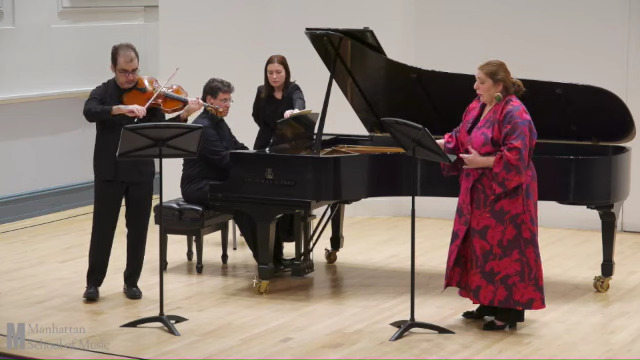
Eve Gigliotti sings “La Cloche fêlée” from 4 Poèmes, Op. 5, by Charles Loeffler. Eve is joined by violist Shmuel Katz and pianist Thomas Lausmann at a concert given at the Manhattan School of Music on January 15th, 2025.
Watch and listen here.
Eve Gigliotti sings “La Cloche fêlée” from 4 Poèmes, Op. 5, by Charles Loeffler. Eve is joined by violist Shmuel Katz and pianist Thomas Lausmann at a concert given at the Manhattan School of Music on January 15th, 2025.
Watch and listen here.

~ Author: Oberon
Saturday July 26th, 2025 – Wei was with me tonight for The Shanghai Grand Theatre’s production of LADY WHITE SNAKE, playing a brief run at Lincoln Center. The program note provides this outline of the story: “The legend of the White Snake is a classic Chinese folk tale about Bai Suzhen, a snake spirit who transforms into a beautiful woman in order to experience life and love as a human. She falls in love with and marries a mortal named Xu Xian, but their relationship is threatened by a Buddhist monk named Fahaj, who recognizes Bai Suzhen’s true identity. The story explores themes of love, sacrifice, and the conflict between the mortal and supernatural worlds.”
There’s much more to the story than that, but I chose to focus more on the choreography and the music rather than on the narrative. The Shanghai company, under the direction of the marvelous Yuanyuan Tan, a longtime star of San Francisco Ballet who I once had the opportunity to meet, is full of beauteous dancers of both sexes.
I guess I was expecting a more mythic approach to the story; much of the time the look and feel were quite contemporary. Most of the visuals were stunning. The musical score, by Xu Zhou, which featured passing nods to Chinese folk music, was – in general – more redolent of Rachmaninoff and Borodin: grand, cinematic, and a bit glossy. The choreography, by Wang Peixian, is mainly rooted in classical ballet, with some acrobatic passages for the men woven in. Sets, lighting, and video designs were all strikingly impressive, especially the presence of an enormous bell hovering over the scene.
It’s been a while since I took notes in the House of Balanchine; I’d forgotten that it’s nearly as pitch-black as The Joyce. I soon found that I’d over-written existing comments with newer ones.
The storytelling was quite clear in Act I; Act II was less compelling, with some scenes feeling over-extended. The choreography lost some of its potency as the ballet progressed, though the level of dancing never faltered. The principals in the cast danced and acted to perfection: Liu Sirui as the White Snake and Wang Nianci as the Green Snake are beauties: my husband referred to them as sisters. Both women danced and acted with finesse and deep commitment. Sun Jiayong as Xu Xian, husband of the White Snake, was poetic, elegant of movement, and an attentive partner. As the rather sinister Psychologist, Fa Hai, Su Hailu gave a stunning performance, his acrobatic feats dazzling to behold.
Though losing some momentum after the interval, the production continued to be visually engrossing. The audience seemed thoroughly tuned in to the story-telling, though I began to think the tale of Lady White Snake might be more persuasively told as an opera rather than a ballet. A bit of research revealed that there is indeed an operatic setting of the story: Madame White Snake, composed by Zhou Long and premiered in Boston in 2010; two friends of mine – Ying Huang and Michael Maniaci – were in the cast.
The evening ended with a tumultuous ovation and a set of staged curtain calls that sustained the applause for several minutes. One delightful aspect of the performance for me was running into my long-time fellow NYC Ballet fan, Lynne Goldberg, and two of my beloved Graham divas: Xin Ying and Natasha Diamond-Walker.
~ Oberon

Above: the Cathedral Church of the Assumption of Mary in Koper, Slovenia
A performance of the Vivaldi GLORIA with the Camerata Academica Koper Chamber Orchestra and the University of Primorska Acedemic Choir and the Chamber Choir Aegida.
The soloists are Tatjana Vasle and Neža Vasle, sopranos, and Edita Garčević Koželj and Ana Vidmar, altos. Choral preparation by Ambrož Čopi; the conductor is Slaven Kulenović.
The performance took place at the Cathedral Church of the Assumption of Mary in Koper, Slovenia, in July of 2020.
Watch and listen here.
Koper, Slovenia, can trace its name back to the Roman town of Caprea. In 1278, the town voluntarily joined Venice and was later renamed Capo d’Istria. Once part of the Venetian republic, it was ceded to Austria in 1797 and then to Italy in 1918; the city was later incorporated into Yugoslavia. The Communists built an unattractive sprawl of factories and warehouses to the city’s south, but mercifully left the old town almost entirely untouched; it’s this treasure trove of Italian architecture that draws tourists to Koper in modern times.
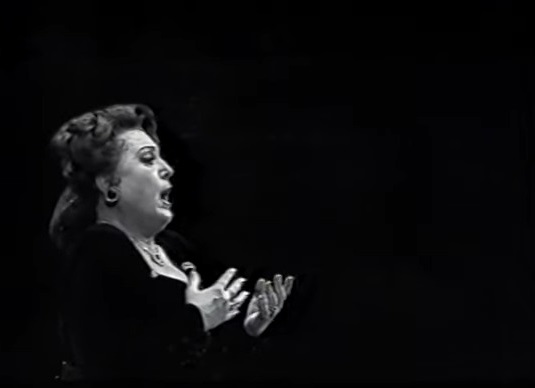
The great Bulgarian soprano Anna-Tomowa Sintow sings the aria “La mamma morta” from Giordano’s ANDREA CHENIER. Vladimir Ghiaurov conducts. No information on the date and venue is provided.
Watch and listen here:
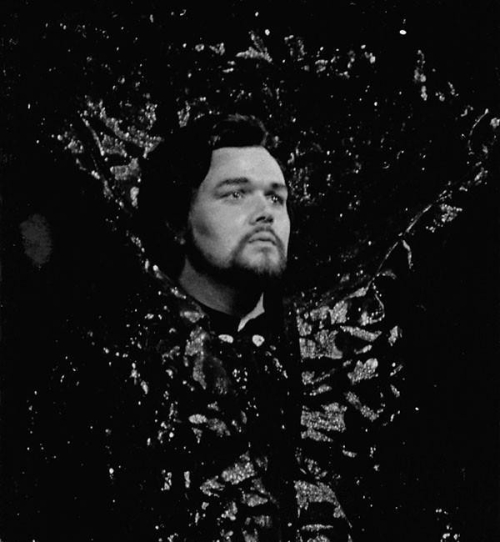
Above: David Rendall as Don Ottavio in DON GIOVANNI
It’s sad to learn of the death of British tenor David Rendall, who enjoyed a brilliant international career until an onstage injury forced his premature retirement.
Read about Mr. Rendall’s rise from his studies at the Royal Academy of Music, London, to his great successes on the world’s foremost opera stages here. He later wrote of his sad demise here.
I had the good fortune to see David Rendall onstage at the Metropolitan Opera House where he sang more that 130 performances in NY City and with the Company on tour, beginning with his 1980 debut as Ernesto in DON PASQUALE. My first chance to hear him came when the Met brought their DON GIOVANNI to Boston. I later saw him – an expert Mozartean – in COSI FAN TUTTE and IDOMENEO, as well as Matteo in Strauss’s ARABELLA. His other Met roles included David in MESTERSINGER, Alfredo in LA TRAVIATA, and Tamino in ZAUBERFLOETE.
In 1983, David participated in the Met’s 100th anniversary gala, joining such luminaries as Edda Moser and Sesto Bruscantini in an ensemble from Rossini’s ITALIANA IN ALGERI, which brought down the House. Watch it here.
One of my favorite Rendall recordings is of the English-language production of Donizetti’s MARY STUART, which marked Dame Janet Baker’s farewell to the English National Opera; listen to their lovely duet here.
And here is the tenor’s “Il mio tesoro” from Mozart’s DON GIOVANNI.
David Rendall was married to the beloved mezzo-soprano Diana Montague; their son, Huw Montague Rendall, upholds the high musical standards set by his parents in his highly successful career in opera and lieder.

~ Author: Oberon
Tuesday July 22nd, 2025 – I wasn’t feeling well but decided to go to this evening’s Chamber Music Society concert because I was especially keen to hear the Arensky quartet that was the closing work on the program. The prevailing heat and humidity had exhausted me, but now we had had a cooler day, and I was glad to get out of the house. In the event, I didn’t make it to the end of the evening.
Mikhail Glinka’s Variations on a Theme of Mozart, as played by Anna Geniushene (photo above), got the evening off to a dazzling start. From its extraordinarily subtle opening bars, the music soon turns fanciful. Ms. Geniushene’s technical command made for a fascinating aural experience as her mastery of piano/pianissimo colorations and touches of rubato constantly enticed the ear; her extraordinary delicacy of touch was a testament to her amazing control. Just as she was polishing off the final bar of music, someone sneezed loudly. Yes, I know these things can happen, but really spoiled the atmosphere in the hall.
During the ensuing performance of Beethoven’s Variations in G-major for Piano, Violin, and Cello, Op. 121a, “Kakadu”, my evening began to unravel. A couple sitting in front of me began sharing whispers, and even cuddled a bit, whilst two women next to me fanned themselves briskly with their Playbills. I managed to tune these distractions out – at least momentarily – as Ms. Geniushene was joined by violinist Francisco Fullana and cellist Sterling Elliott for the Beethoven.
After a unison start, the pianist sets a gentle pace; the strings veer between intensity and lyricism, the violin tender, the cello deep. Moments of drama alternate with delicious subtleties as the music turns dancelike.
Now the variations commence: the first for solo piano, the second for nimble violin & piano, the third for mellow cello & piano. Scale passages from the Steinway underscore themes traded between the string voices in the fourth, The fifth has a lyrical flow, the sixth is witty, with the strings making slashing attacks. Violin and cello are charming in the seventh variation, and Ms. Geniushene plays wistfully in the eighth, soon joined by the strings. Then a merry dance strikes up and the finale is quite grand. The three musicians were warmly cheered.
Schubert’s Adagio and rondo concertante in F-major for Piano, Violin, Viola, and Cello, D. 487, commenced with violist Lawrence Dutton and the gorgeous cellist Inbal Segev cellist joining Ms. Geniushene and Mr. Fullana for some sublime music-making. But the chatterboxes in front of me could not sit still, and now the man behind kept whispering to his companion, whilst the two women to my right had fallen asleep. As the Schubert reached its brilliant finish, to hearty applause, I decided to head home, not having heard the Arensky, which is why I was there in the first place.
~ Oberon
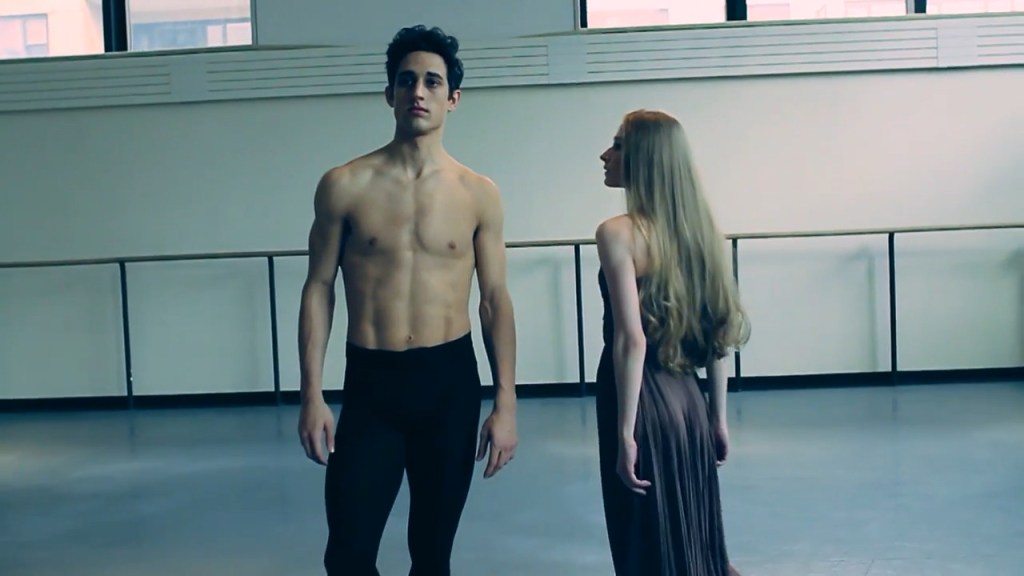
Janie Taylor and Justin Peck dance to music by Philip Glass in this brief film, made for The Block magazine .
Watch and listen here.
Bringing opera to the people: I saw this tenor in MADAMA BUTTERFLY at The Met and I met him afterwards. Tall, great-looking guy, very cordial. I love this video, especially the two tuba players.
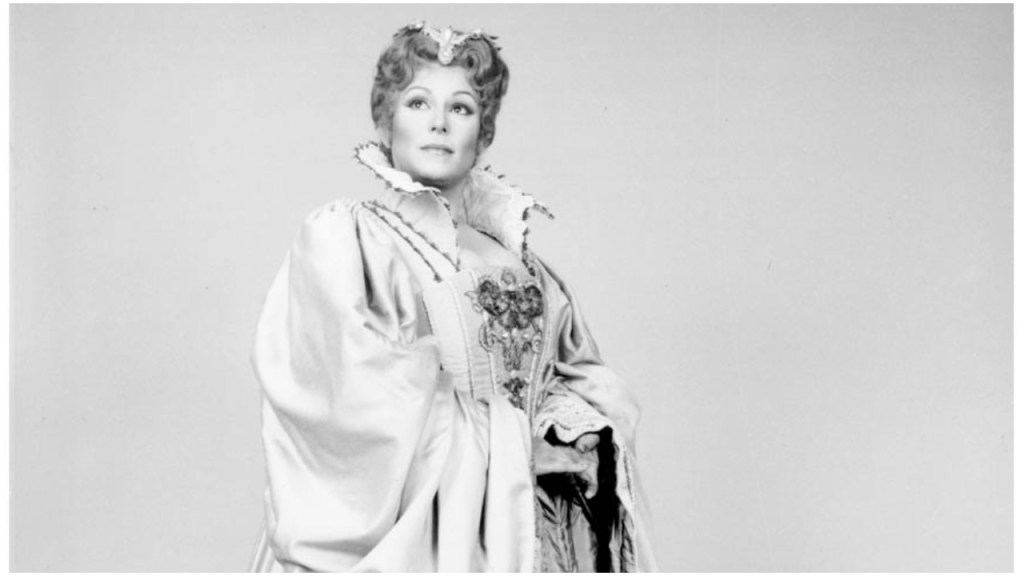
The wonderful Mexican soprano Gilda Cruz-Romo (above, as Desdemona) has passed away at the age of 85.
Read a long article about her that I wrote many years ago:
https://oberonsglade.blog/oberons_grove/2008/07/singers-gilda-cruz-romo.html
Listen to Gilda and the great Jon Vickers in the OTELLO love duet as performed at Houston in 1979:
 Oberon's Glade