~ The Austrian Expressionist has been having a moment with gallery goers. Now his life is an opera.
by Andrew Kupfer

In 1963, when she was 29, Alessandra Comini was in Neulengbach, Austria, hunting for Egon Schiele. Or rather for his prison cell. An art historian, Comini was in the country for graduate school, and she knew that in 1912, long before the Nazis dubbed his art degenerate, Schiele had been jailed for obscenity—the only European painter ever to have been imprisoned for his work. She also knew from his prison diaries that his basement cell had bars widely enough spaced to toss an orange between them, as Schiele’s lover had done when he was incarcerated. And on this day she had a hunch the old municipal building she was standing before was the right place. She approached the caretaker. He refused to let her in, claiming the former cells held important government papers.
She left, but loitered nearby. At lunch she noticed a stream of workers leaving the building. “So I did what we used to do to sneak into the movies when we were kids,” she told me. “I stood in the crowd as they exited and slowly walked backwards into the building.” She popped down the stairs and found six doors. On the inside of the second were the carved initials of Schiele’s predecessor, just like in one of Schiele’s prison watercolors. She had found it. As she was leaving, she looked for the government documents. “There were no papers,” she recalls. “Only firewood.”
Ten years later, that story led to a book, Schiele in Prison, her first of three about the artist. And now that book has inspired an opera by Jared Schwartz, 43, the all-around musical polymath who composed the score and wrote the libretto.

Above: Jared Schwartz
A century after he created them, Schiele’s paintings still have the power to shock. They are unflinching, raw, frank, and altogether unsettling, and they challenge the visitor to experience emotions one usually doesn’t feel when viewing a painting, like disgust. In a way, they are car-crash art: one can hardly bear to look and yet one cannot look away. Drama is inherent in the images.
What better subject for an opera?
The project came to fruition about four years ago when a friend and collaborator of Schwartz introduced him to Comini, who broached the idea of an opera. The more he heard the more he liked it. He began composing, meeting with Comini once or twice a week to talk through their ideas. And she provided him with a budget. With that funding, and with the Neue Gallery in New York as a presenting partner, Schwartz mounted a workshop production of Schiele in Prison in January. And I got to see the rehearsals.
How I happened to be there was a bit of serendipity. Schwartz was staying with an old friend of mine while he was running the rehearsals, and I passed on word that I’d love to sit in one day. I was struggling to write a show of my own and was hoping to see first-hand how an opera might come together. He kindly wrote to say I could come to whatever rehearsals I wished. I think both he and I were surprised that I ended up coming to all of them, every day for two weeks. But after the first rehearsal, I was curious to see what happened next, and after the second or third came a compulsion to see how it all turned out. The singers seemed to accept me as part of the furniture. And here I was with a thrilling opportunity—to witness a group of supremely talented people at the top of their profession as they created a work of art.
Any opera goer can tell you of the electrifying moment when a well-tuned chorus reaches full voice and fills a hall with sound. To encounter those vocal forces in a small rehearsal studio from a distance of three feet is an altogether different experience. Within two seconds, the thoughts going through my head in quick succession are (1) OHMYGOD THAT’S LOUD (2) People can do that? (3) Is this safe?
It was also gorgeous. And art isn’t supposed to be safe anyway. In other words, this first impression is a good aural metaphor for Schiele’s art. Schiele in Prison aims to subvert the common conception of the painter as a twisted curio, showing him as a courageous idealist. And that changes how we see the paintings.
The opera opens in the basement cell where Schiele served his sentence—and where Schwartz spent a night to steep in the atmosphere. He likens the experience to being in a tomb. “It was terrifying,” Schwartz says. “Schiele was only there for 24 days, but for the first 21, he didn’t know how long he would stay. I knew I could leave, but even so I felt panicked and choked.” Along with Schiele’s prison diaries, the visit informed Schwartz’s libretto.
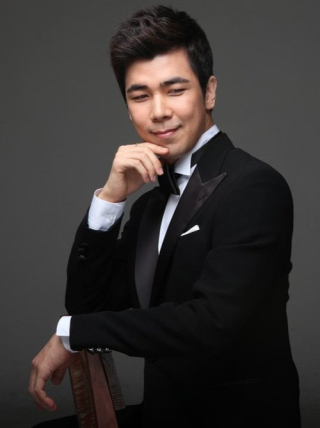
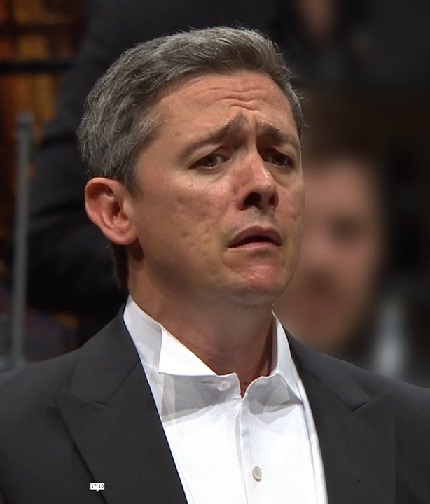
From there Schwartz moves back in time through the watershed events in Schiele’s life. First Schiele (played in the workshop by Colin Levin) and his younger sister (Christa Dalmazio) try to navigate their fraught childhood in a home dominated by an unbalanced father who had conversations with people who weren’t there. Schiele then bristles against the orthodoxies of art school, impulsively quitting and seeking the mentorship of Gustav Klimt (Bert Johnson). He visits his lover, Max Oppenheimer (Hans Tashjian), an artist, who laments that Schiele doesn’t have the courage to be open about his bisexuality. The scene shifts to the flat he shares with his other lover, Wally (Soon Cho), his model and muse; she would be with him during the pivotal event of the story, when police arrive in search of a young girl who had earlier taken shelter there. The police find not the girl but Schiele’s paintings. “What is this filth?” ask the police. “My art,” replies Schiele simply, again and again.
Next comes the wild heart of the opera, a kaleidoscopic spectacle in which the cast morph into townspeople attending a show of Schiele’s art. As they gather at the gallery, they hold masks to their faces in a display of piety. They lower them as they are seized by deliriously obscene desires, accosting Schiele’s agent to buy one or another of the erotic works that best fits their masturbatory, armpit-licking fantasies. The ensemble leaves the scene en masse, swirling from the gallery into Schiele’s jail cell, at which point the audience will realize that the scenes from Schiele’s life had all been conjured by the artist as he sat in prison. The opera ends as it began, with Schiele, defiant, defending his art.
I don’t think of high school very often, but during the fortnight of rehearsals I remember a lesson in my physics class on the difference between constructive and destructive interference in sound. When sound waves from two sources—a tenor and a baritone, say—are perfectly in synch, they combine, producing a larger crest and delivering a louder sound than the sum of the two waves on their own. If they are even slightly out of synch, with one wave sliding toward its trough as the other peaks, they partially cancel each other out, and the perceived sound diminishes, which is one reason why a professional chorus can sound louder than a chorus of talented amateurs three times its size.
It is that synchronic confluence of voices that nearly knocks me out of my seat on the first day of rehearsals. What follows from that salvo is a primer on how to mount a show, which, for anyone interested in process, is fascinating in its granular detail and has me canceling all my other plans for two weeks. The rehearsals start with the gallery scene, musically the most demanding in the show, with almost the entire ensemble in action. Each day brings a new section, with the action usually returning to the gallery scene in any spare moment. Emphasis shifts throughout. The early days focus on musical phrasing and clarity of diction—bite off your words so the listener can tell when they end, music director Richard Cordova, cajoles the players again and again—which, with 11 people singing at once, is a challenge. When they do, the sound pops.
That the cast’s voices align so well is a function of how Schwartz worked with them in the weeks before the group rehearsals, meeting with the singers one-on-one to go over their parts. If something didn’t sit well with their voice, Schwartz made revisions to the score at the piano as they rehearsed. These deft on-the-fly touches helped give the singing its power.
As the rehearsals progress, the focus widens to take in dramatic presentation, fine-tuning gesture and attitude. Jim Brown, the staging director, works with Schiele’s demented father to sharpen his insanity. “Sometimes you glance over to your family when you’re supposed to be talking to your imaginary guests,” says Brown. “It seems like you’re talking to your wife.” David Mejia, as the father, adjusts, boring in on his phantoms.
Over the course of the first week, Brown layers in blocking and choreography, with movements that are clever enough to add doses of attitude and humor but simple enough for a group of non-dancers to master quickly. In the gallery scene, he deploys the cast for an assault on the sensibilities of a prim and proper Vienna. “In the third bar of the fanfare the lights will come up,” he explains. “You can’t wait to see this debased art. You run in and see the audience, and you stop dead. You put up your masks because you don’t want them to see you.” Brown has them march in time to the music, and, as they sing “We are the people who Run. This. Town!” they point to themselves on each word, a gesture that gives the crew a collective moxie. Whenever they walk backward—which is often—they lean forward, and when they move ahead, they lean back. “Contraporto!” Brown exclaims. “Remember, the more precise it is, the funnier it is.”
Indeed, if the earlier scenes are alternately harrowing and moving, the gallery scene is raucous fun. Brown encourages improvisation. “We want various sexy poses,” he says. “So meet your scene partners!” The tableau instantly transforms into a Bosch painting, if the figures in a Bosch painting could bump and grind. A soprano immediately stands behind a tenor and bends him forward at the waist. Another duo entwine limbs and gyrate as they hocket. Later, during a solo, a tenor gives a pelvic thrust. “And when you say ‘erotic’, you need another pelvic thrust,” says Brown. “More pelvic thrusts!” Each time they run the scene, the improv is different, and just a bit raunchier, and it’s a hoot to see how inventively the cast use dramatic muscles opera singers don’t often get to flex.
In week two, rehearsals move to the performance venue, and a string quartet joins the company, marking the first time all the singers and musicians are in the same place at the same time—the so-called sitzprobe, or seated rehearsal, where the entire ensemble gathers to run through the music. It’s the one day of rehearsals I miss; I have finally come down with the fluey illness that has been tearing through the cast, forcing a few to rehearse by Zoom some days. The new venue is as different from a dank basement prison cell as you can imagine—an urban sky mansion in the old headquarters building of the Carl Fischer music publishers, now condominiums, this one the property of Jim St. George and Mark Sullivan, tech philanthropists who frequently use the space to help creators mount workshop productions of new shows.
Schwartz is now at the keyboard—which will be his station for the performances—and he is worried about the balance between the piano and the strings; he plays with enough power to drown out the quartet if he doesn’t take care. In fact, he had been on track to be a concert pianist till he was 18 and damaged the tendons in his right wrist playing tennis, necessitating surgery; it was months before he could play again, and the wrist was never the same. “It’s my first string quartet,” he confesses. “But I started playing the violin when I was 5. And then the viola. And then the cello.” Wait—you play the violin, the viola, the cello, and the piano? “And the French horn, too. And a whole bunch of other instruments,” he says. He’s also a singer, a lyrical bass. “I’ve just really loved music since I was 3.”
Tweaks and adjustments continue through the dress rehearsals. Brown adapts the choreography to the new space. It’s a vast, open-plan layout, but there are some immovable obstacles—on the left a marble coffee table that reminds me of the altar in The Brutalist (if you haven’t seen The Brutalist, it’s a hunk of Carrara marble that had to be winched into place), on the right a kitchen island. In the dress rehearsal, the pace picks up, with no time to work passages and with tweaks made on the spot.
During a run-through of the phantasmagoric fifth scene, Schwartz declares from the piano: “You’re getting this wrong every single time!” Someone was singing the old version of a passage that Schwartz had changed a few days before. He repeats the section, and suddenly dashes from the keyboard to the choral scrum with the hint of a smile and sticks his ear an inch from the mouth of each vocalist, like the round, flat mike in a recording session. He returns to the keyboard mollified; he’s a perfectionist. “I knew I had to do something outrageous to get their attention,” he admits later. “As a music director, I have very high standards, and I offer high support. I also have a lot of fun.” Schwartz agrees with my impression that the singers were having fun too. “Every single person in the cast really wanted to be there. They really wanted the show to work,” Schwartz says. “That’s not normal. Usually most people are there to do the gig.”
Performance day arrives. Well suited to the venue are the plummy complement of invited guests. A good number of them have come from Austria. The cast negotiate the obstacles and sail past the odd glitch and dropped line with no one in the audience who hadn’t sat through 50 hours of rehearsal any the wiser. “All I could hear is every wrong note I played at the piano,” Schwartz tells me afterwards. “But the piece is compelling and powerful, even in a living room, even in rushed circumstances.” The first show marks the birthday of Professor Comini. At the end Colin Levin, who plays Schiele, pulls her up to take a bow with the cast. She nearly topples over—she is 90 that day—but she holds her ground, as she did all those years before in Neulengbach.
Now come revisions and the hard graft of finding backers and a producer. Europe is the most likely site for a fully staged performance; the opera is a little too racy for, say, Texas. Schwartz plans to restore some material that he removed for the workshop performances. “I tamed it down. I didn’t want penises out in Mark and Jim’s living room. It’s too small a space,” he says. “But all the nudity and masturbation will have to be there for Europe. I’ll have to get back into the score and make it scandalous again.”
So more creative tests lie ahead. A workshop—even a terrifically exciting one—is just a first step.
~ Andrew Kupfer is a writer and editor in New York City.