Blog

  • Alisa Weilerstein ~ FRAGMENTS 2

    CH11513997

    Above, Alisa Weilerstein/FRAGMENTS 2 ~ performance photo by Fadi Kheir

    ~ Author: Shoshana Klein

    Tuesday January 21st, 2025 – This evening at Zankel Hall, Alisa Weilerstein’s’ Fragments project continued with its the second installation. You may remember the first one, last April.


    Like last time, there was no program given until the end – a practice I still find interesting, though slightly frustrating. I had a bit of a conclusion that the ideal listener either knows the Bach suites by heart, or doesn’t know them at all; someone like me (knowing them but certainly not well versed on the particular movements, etc) ends up a little stuck on which is which and where we are. 


    For the staging, the same light boxes that were set up for the first installment are set up spread around the stage rather than in a circle around the cellist like they were last time. She entered in full darkness – though during that moment, someone’s phone went off and said clearly “calling emergency services” and everyone laughed, which was a fun communal moment.


    This setting struck me as more theatrical than the last – it started with a bang and bright lights, and Weilerstein was wearing fishnets, a bright fuchsia short dress, and dramatic stage makeup with her hair curled and all over the place. It seemed to evoke a sort of dramatization and maybe a teenage emotionality.


    The way that she played the Bach suite movements were sweeping, very light even though much of the suite is in minor. Her playing of the fast passages is very elegant – bringing out the vocal and conversational qualities of these multi-line pieces written for one instrument.


    CH11513956


    Performance photo by Fadi Kheir


    For the first couple movements there were really smooth transitions and stark lighting changes. The new pieces were lit with green and the Bach was a warmer white/yellow. I wondered if it would continue like that the whole time with the lighting just indicating whether or not we were hearing a new piece, but as it went on the changes became less stark, and the movements had different types of lighting. Maybe adding to this, or reflected by it, particularly in the beginning of the set, the Bach had a more veiled angstyness while the newer pieces had more brash emotionality in the forefront, as if the newer compositions were unearthing the meanings of the Bach and saying them more plainly.


    One standout movement near the end had only pizzicati and required Weilerstein to sing along with her playing. It was simple sounding and also grounding, particularly because this person who is at the highest levels of cello playing was singing like a normal person. Not to say it was bad, it just humanized her in a way that brought reality back in a really sweet way.


    ~ Shoshana Klein

  • Dudamel Conducts Penderecki

    Krzysztof Penderecki jpg

    Above: composer Krzysztof Penderecki

    Gustavo Dudamel conducted a monumental performance of Krzysztof Penderecki’s SEVEN GATES OF JERUSALEM in 2008 with the Orquesta Sinfónica Simón Bolívar. A brief clip at the start shows the composer at a rehearsal.

    Following the Dudamel performance, Penderecki appears onstage, to tumultuous applause.

    Watch and listen here.

    I have loved this piece ever since I attended the US premiere in 1998:

    7 gates

  • Michal Partyka ~ Vision fugitive

    Partyka jpg

    Polish baritone Michal Partyka (above) sings “Vision fugitive” from Massenet’s HERODIADE at a 2012 concert given by the Orchestre de L’Opera National de Paris, conducted by Guillaume Tourniare.

    Watch and listen here.

  • Boulez Conducts TRISTAN & ISOLDE

    Pierre-boulez

    Above: Pierre Boulez

    In April of 1967, the Bayreuth Festival’s Wieland Wagner production of TRISTAN UND ISOLDE was brought to Osaka, Japan, for three performances, featuring a stellar cast: Wolfgang Windgassen (Tristan), Birgit Nilsson (Isolde), Hertha Töpper (Brangäne), Frans Andersson (Kurvenal),  Hans Hotter (King Marke), Sebastian Feiersinger (Melot), Georg Paskuda (Young Sailor/Shepherd), and Gerd Nienstedt (Steersman).

    These performances marked the only time Pierre Boulez conducted this Wagner masterpiece.

    Watch and listen here.

    For me, this recording captures, perhaps more truly than any other, the way Birgit Nilsson sounded live in the performances of hers that I heard at The Met.

  • Loretta Di Franco Has Passed Away

    Rigoletto

    Above: Loretta Di Franco as Countess Ceprano in RIGOLETTO, with Placido Domingo as the Duke of Mantua

    Soprano Loretta Di Franco has passed away; from her Met debut as a Page in TANNHAUSER in 1961 to her farewell in 1995, she sang over 900 performances with The Met in New York City and on tour.

    A native New Yorker, Ms. Di Franco had started out at The Met as a member of the chorus. In 1965, she entered and won the Met Auditions, thereafter taking on a vast number of roles in seven languages; I saw her in many of them. She sang both Barbarina and Marcellina in NOZZE DI FIGARO, Pousette in MANON, Berta in BARBIERE DI SIVIGLIA, Giannetta in ELISIR D’AMORE, both Papagena and the 1st Lady in ZAUBERFLOETE, Lisa in LA SONNAMBULA, both the Sandman and the Dew Fairy in HANSEL AND GRETEL, Marianne Leitzmertzin in ROSENKAVALIER, Zerlina, Frasquita, Xenia in BORIS GODUNOV, both Woglinde and Gerhilde in the RING Cycle, and Kate Pinkerton. She sang Violetta in some student matinees of TRAVIATA, and appeared in two Janacek operas at The Met: JENUFA and KATYA KABANOVA.

    Upon retiring from singing, Loretta continued to work at The Met as a language coach.

    Loretta Di Franco appears in videos of several Met productions, but the only free-standing excerpt I could find is the LUCIA sextette from the Met’s 100th Anniversary Gala in 1983: she sings Alisa, joining Robert Nagy (Arturo), Julien Robbins (Raimondo), Roberta Peters (Lucia), Dano Raffanti (Edgardo), and Brian Schexnayder (Enrico). Sir Richard Bonynge conducts. Watch and listen here.

  • Zwilich & Barber @ Carnegie Hall

    Zwilich

    Above: composer Ellen Taaffe Zwilich

    ~ Author: Oberon

    Saturday December 28th, 2024 – The New York String Orchestra were back at Carnegie Hall this evening, following up their Christmas Eve concert in the same Hall with a program of Zwlilich, Barber, and Brahms. I’d been down with flu-like symptoms for a couple of days, and debated whether I should attend tonight’s concert, but I couldn’t pass up a chance to experience the Barber violin concerto played live in this hall. Whether I could make it to the evening’s end remained to be seen.

    1983 Pulitzer Prize-winner Ellen Taafe Zwilich’s composed her Prologue and Variations for string orchestra on a commission from the Chattanooga Symphony, which premiered it under the baton of Richard Cormier in 1984. In her remarks on this piece, the composer spoke of her wish to celebrate “the special sonorities, character, and expressiveness of the string orchestra”. In tonight’s performance, the young players of the New York String Orchestra truly did the composer proud. 

    The violins open the piece, with start-and-stop phrases, soon picked up by the cellos. The violins then soar over an insistent beat. After a passage of luminous softness, the celli and basses cushion sizzling violins motifs. The opening theme recurs, and then a series of slow, mysterious sustained tones lead to a full stop.

    An animated section quietens to a slightly ominous lulling atmosphere. Then an agitato springs up, full of scale-work and insistent bowing. The music turns pensive, with brooding celli and deep basses. A trudging rhythm and fading violins lead to the work’s eerie ending.

    Enthusiastic applause greeted the musicians, and then Maestro Laredo gestured to Ms. Zwilich in her first tier box to rise for a bow; well-deserved bravas greeted the composer, now in her 85th year.
    Koh jpg

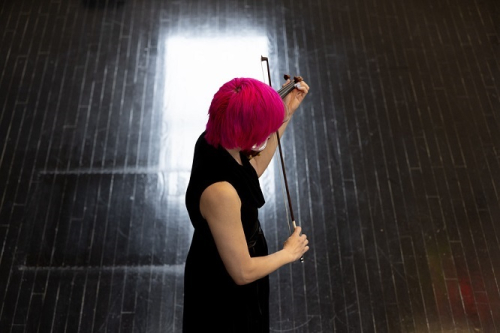
    Above: Jennifer Koh – I borrowed this stunning photo from her Facebook page

    Violinist Jennifer Koh then took the stage for the Barber, my enduring favorite among all the violin concertos I have heard thru the years. Ms. Koh looked striking in a silver-gray gown, her hair a bright, fiery red.

    This was Barber’s first effort in the concerto genre, written on a 1939 commission for the then-astonishing sum of $1000. When the originally scheduled soloist, Iso Briselli, found the concerto’s third movement too short and inconsequential, the work was premiered in 1941 by Albert Spalding; it was great success, and became one of Barber’s most beloved works, perhaps second only to his Adagio for Strings.

    Aside from concert performances, I have heard this music many times at New York City Ballet, where in 1988 Peter Martins premiered his ballet of the same title at the Company’s American Music Festival. The  ballet brings together a pair of ballet dancers and a pair of bare-footed modern dancers. The original cast starred Merrill Ashley and Adam Lüders as the classical couple, and Paul Taylor Dance Company’s delightful Kate Johnson and the charismatic choreographer/dancer David Parsons as the modern couple. Tonight’s performance was spectacular both for Ms. Koh’s fascinating way with the music, and for Maestro Laredo’s savvy exploration of the score, which allowed us to savour the composer’s gift for orchestral detail.

    Ms. Koh’s timbre has a vast colour-palette, ranging from burnished purple to shimmering silver. The very opening note of the piece always intrigues me, as Barber has the piano intone the first phrase along with the violin; Bo Zhang, at the Steinway, highlighted the keyboard’s participation throughout the concerto. 

    Ms. Koh’s playing of the familiar opening melody immediately seized my imagination; her tone has a special, spiritual quality that always gives meaning to the music. The gorgeous main theme, played by the entire orchestra, inevitably stirs my soul. Oboe (William Dunlop) and clarinet (Keyu (Frank) Tao) sing clearly over a steady pulse; violin and piano mesh, Ms. Koh rising to a shining top note. Pianist and violinist unite. The music turns grand, with a huge build-up and then my favorite moment of all: a dramatic plunge to the basses’ deepest notes. Now Ms. Koh’s violin hovers on high, descends, rises again to a delicate, suspended note; her cadenza is entrancing. Oboe, clarinet, and timpani draw us on to the movement’s conclusion. Throughout, the pianist has managed to be both prominent and unobtrusive…really impressive.

    Mr. Dunlop’s playing of the oboe solo that opens the Andante was hauntingly beautiful. The celli take up the theme, the basses sound richly, the horn solo (Engelberth Mejia-Gonzalez) glows. Out of the marvelous sonic blend, Ms. Koh’s violin rises poignantly to a shimmering trill as the trumpet (Bailey Cates) and piano interject before the violinist takes up the andante‘s opening melody with heart-rending passion. A sense of grandeur fills the hall. But then, a loudly dropped object somewhere upstairs killed the movement’s marvelous finish. Why do these things always happen at the worst possible moment?

    The timpani commences the final, brief Presto, in the course of which Ms. Koh plays what feels like thousands of notes with amazing dexterity and commitment. The celli scamper up the scale. So many notes!  All this rhythmic energy comes to a sudden halt after a final violin flourish.

    The audience cheered Ms. Koh’s intense and thrilling performance. My companion – who had played the Barber in his schooldays – and I were feeling a kind of elated exhaustion, and so we took leave of Carnegie Hall for 2024.

    ~ Oberon

  • Great Polish Voices in the Verdi REQUIEM

    Zylis-gara

    Above: Teresa Zylis-Gara

    A Verdi REQUIEM with four outstanding Polish singers from the recent past: Teresa Żylis-Gara – soprano; Krystyna Szostek-Radkowa – mezzo-soprano; Wiesław Ochman – tenor, and Leonard Andrzej Mróz – bass. The conductor is Kazimierz Kord.

    Listen here.

  • IL TABARRO @ La Scala ~ 1983

    Snapshot tabarro 3

    Above: Piero Cappuccilli as Michele in Puccini’s IL TABARRO at La Scala, 1983.

    Watch and listen here.

    Piero Cappuccilli – Michele
    Sylvia Sass – Giorgetta
    Nicola Martinucci – Luigi
    Sergio Bertocchi – Il ‘Tinca’
    Aldo Bramante – Il ‘Talpa’
    Eleonora Jankovic – La frugola
    Ernesto Gavazzi – Venditore di canzonette
    Vito Gobbi – Voce interna
    Jeda Valtriani – Voce interna
    Bruno Brando – Un amante

    Conductor: Gianandrea Gavazzeni

  • IL TABARRO @ La Scala ~ 1983

    Snapshot tabarro 3

    Above: Piero Cappuccilli as Michele in Puccini’s IL TABARRO at La Scala, 1983.

    Watch and listen here.

    Piero Cappuccilli – Michele
    Sylvia Sass – Giorgetta
    Nicola Martinucci – Luigi
    Sergio Bertocchi – Il ‘Tinca’
    Aldo Bramante – Il ‘Talpa’
    Eleonora Jankovic – La frugola
    Ernesto Gavazzi – Venditore di canzonette
    Vito Gobbi – Voce interna
    Jeda Valtriani – Voce interna
    Bruno Brando – Un amante

    Conductor: Gianandrea Gavazzeni

  • Vivaldi’s GLORIA @ at La Pietà, Venice

    Vivaldi-gloria

    A BBC 4 film re-imagines a performance of Antonio Vivaldi’s GLORIA at the Ospedale della Pietà in Venice, where the composer taught and composed from 1703 to 1740.

    Watch and listen here.