
A BBC 4 film re-imagines a performance of Antonio Vivaldi’s GLORIA at the Ospedale della Pietà in Venice, where the composer taught and composed from 1703 to 1740.
Watch and listen here.
A BBC 4 film re-imagines a performance of Antonio Vivaldi’s GLORIA at the Ospedale della Pietà in Venice, where the composer taught and composed from 1703 to 1740.
Watch and listen here.

~ Author: Oberon
Tuesday December 24, 2024 – I spent Chrstmas Eve with a dear, long-time friend at Carnegie Hall, where the The New York String Orchestra were offering their customary Christmas Eve concert. The all-Mozart program brought us an overture, a concerto, and a symphony – all by the Master, and all beautifully played by the young musicians of this large and unique orchestra.
Maestro Jaime Laredo opened the evening with the overture to The Impresario, a comic singspiel which Mozart composed in 1786. This overture is short…I might even say too short!
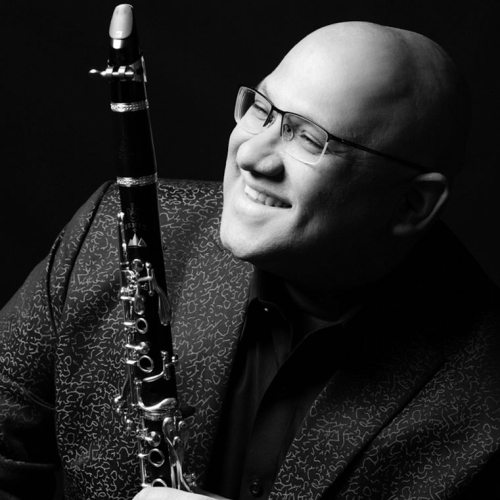
Ricardo Morales (above) then took the stage as soloist in Mozart’s heavenly Clarinet Concerto. I’ve never forgotten hearing music from this celebrated piece for the first time: in the film Out of Africa, Baroness Blixen (Meryl Streep) and Denys Finch Hatton (Robert Redford) are on safari; Finch Hatton has brought along a gramophone, and he puts on an old 78 rpm of the concerto, which attracts a pair of curious monkeys who – after listening raptly for a few moments – attack the gramophone.
The first movement, Allegro, has a pulsing, melodious start. Dulcet clarinet roulades immediately introduce us to Mr. Morales’ mastery of dynamics, and his gift for incredible subtlety in his playing. His silky-smooth sound is captivating, and his agility astounds, with fabulously clear scale-work and a charming passage where he deftly bounces from low to high notes. A mini-cadenza leads to the movement’s finale, where the Morales clarinet warbles like a magical bird over the orchestra’s plush playing.
The Adagio – the heart of the concerto, and perhaps of Mozart’s entire oeuvre – introduces the clarinet’s simple but heartfelt melody, soon taken up by the orchestra. A fresh, wide-ranging theme evolves, in which Mr. Morales’ control and breath support are mind-boggling to experience. Following a brief cadenza, the main theme returns, hauntingly lovely; a heavenly trill from the clarinet draws the movement to a close.
The concerto’s final Rondo has a sprightly start; Mr. Morales commences a flow of fantastical fiorature. The orchestra has an exotic, minor-mode passage, and then the clarinet’s wide range – from gleaming highs to velvety low notes – is explored in colorful playing. A magical performance, full of wonders. Bravissimo, Mr. Morales!
Symphony No. 36, “Linz”, closed the evening. Mozart was en route to Vienna when he stopped at Linz to visit an old friend, Count Thun-Hohenstein. On learning that a concert was scheduled just 5 days after his arrival at Linz, Mozart worked feverishly to compose a new work for the occasion: the result was a symphony in C-major, which soon earned the nickname the “Linz” Symphony.
The first movement has a regal start. In the ensuing melody, bassoon and oboe stand out. A wistful mood sets in for a bit, then more joyous music sounds…with an odd rhythmic echo of Handel’s Hallelujah chorus. The music flows on, by turns thoughtful and grand.
The ensuing Poco adagio begins elegantly. The music darkens, but only slightly, with the timpani evoking a sound of distant thunder. Somber moments alternate with courtly ones. The third movement – Menuetto – feels stately and grand at first, then becomes a conventional minuet, with some outstanding playing by bassoonist Laressa Winters.
Mozart’s chose a Presto rather than a Rondo for the symphony’s finale, wherein swift and gracious themes alternate with lyrical lulls.
Heading to the train home, I asked my companion if he felt that Mozart sometimes went on and on in his symphonies – something one rarely feels in his operas. He replied: “I was just thinking the same thing!”
~ Oberon
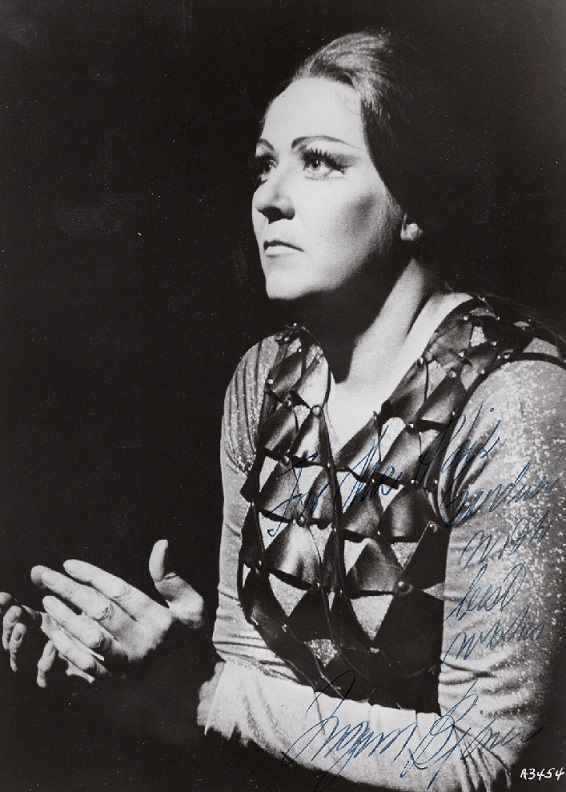
Ingrid Bjoner (above) is Brünnhilde in these scenes from a performance of Wagner’s DIE WALKURE from Munich, 1972. The in-house sound quality leaves much to be desired, but I’ve always loved this rendering of the Todesverkündigung as sung by Bjoner and James King.
There are also three brief excerpts from Act III, with Claire Watson as Sieglinde and Heinz Imdahl as Wotan joining Ingrid Bjoner. Rudolf Kempe’s conducting strikes me as just about ideal.
WALKURE exc – Munich 1972 – Bjoner King Watson Imdahl – Kempe cond

Above: Amy Shuard as Turandot
A performance of Puccini’s TURANDOT from San Francisco Opera given in 1968. Audio only.
Listen here.
CAST:
Turandot: Amy Shuard; Calaf: Ludovic Spiess; Liu: Jane Marsh; Timur: Ara Berberian; Ping: Ingvar Wixell; Pang: Raymond Manton; Pong: Alan Crofoot; Mandarin: Clifford Grant
Conductor: Giuseppe Patanè

~ Author: Lili Tobias
Tuesday November 26th, 2024 – I don’t celebrate Christmas, but I do love the traditions of music written for the holiday, especially when that music is choral! So this past Tuesday, I attended An Eric Whitacre Holiday at Carnegie Hall. This annual concert is a celebration of Whitacre’s Christmas music, his Christmas-adjacent music, and some other Christmas music by different composers (including Melissa Dunphy who was in the audience!).
Whitacre himself conducted the Distinguished Concerts Singers International (DCSI), part of Distinguished Concerts International New York (DCINY), which produces concerts around New York that bring together singers from around the globe. This concert featured two different 250-member choirs, accompanied by pianist Kelly Yu-Chieh Lin and the Distinguished Concerts Orchestra. These musicians had only been rehearsing all together for the past two days, but they performed so well together that the short time wasn’t at all apparent. I was impressed with the clarity of the singers’ diction, as well as their ability to reach incredibly low volumes despite how many of them there were. I always enjoy the sound of a really large choir too, since the diverse array of different voices actually enhances the blend of sound.
Whitacre is best known for the enchanting harmonies he uses in his music, in particular his tone clusters. The majority of the program for this concert was indeed very harmony-focused and, overall, very slow moving. While this aspect of Whitacre’s music is certainly beautiful, I find that his music really shines when it’s faster and more rhythmic. There were a few moments of quick music that I absolutely loved, including in the “An Unexpected Turn” scene from his opera The Gift of the Magi. In particular, Whitacre is really good at utilizing odd time signatures to drive the music forward while still maintaining the flow. These moments were a refreshing change, and I bet the singers had so much fun singing them too!
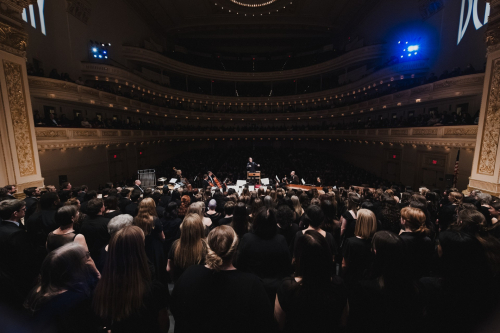
As I briefly mentioned earlier, this concert also included Whitacre’s Christmas opera, The Gift of the Magi. This was actually the world premiere of the orchestrated version, orchestrated by Evan L. Snyder and Whitacre. I was impressed with how the staging was done, given that most of the stage was taken up by 250 singers and a small orchestra. The action took place in the areas on either side of the orchestra, so the characters could travel across the stage for the different scenes. The singers also used the conductor’s podium to sit on or lay down props such as gift boxes. I felt that the production was just right for the venue, and the singing was wonderful too!
This concert had an extremely warm and welcoming atmosphere. It was a family affair all around, as the audience was largely made up of the choir members’ relatives coming to support them. And not only that, but Whitacre’s wife, soprano Laurence Servaes, starred as Della in the opera, and his son (for whom he had written Goodnight Moon) was in the audience. While I won’t be celebrating Christmas this year, I certainly celebrated an Eric Whitacre holiday on Tuesday night!
The performance photos are by Dan Wright.
~ Lili Tobias

José Carreras sings “La dolcissima effigie” from Cilea’s ADRIANA LECOUVREUR. Montserrat Caballé is Adriana.
Watch and listen here.
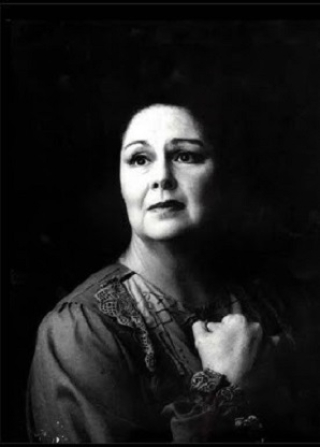
This rare video of scenes from a 1988 production of Giordano’s ANDREA CHENIER from Pretoria, South Africa, caught my attention with the names of Carla Pohl (photo above) and George Fortune in the cast. Unfortunately, Mr. Fortune’s “Nemico della patria” is not included, but most of Maddalena’s music suits Ms. Pohl very well (though her hairdo is hardly credible at the time of the Reign of Terror).
I saw Maurizio Frusoni as Cavaradossi in a very exciting TOSCA given at Bridgeport, Connecticut (of all places) in 1984 opposite excellent colleagues Olivia Stapp and Frederick Burchinal. Mr. Frusoni is a solid Chenier in the Pretoria production.
Watch and listen here.
Performance photo by Chris Lee
~ Author: Ben Weaver
Saturday November 23rd, 2024 – The Royal Concertgebouw Orchestra gave two sold-out concerts at Carnegie Hall last week under the baton of its chief conductor designate Klaus Mäkelä. The second concert on Saturday, November 23rd featured beloved works by Arnold Schoenberg and Gustav Mahler.
Between the two concerts, this evening’s playing of Schoenberg’s Verklärte Nacht, Op. 4 was the strongest performance of the orchestral works the Concertgebouw presented this week. Originally composed for string sextet in 1899, Schoenberg made an arrangement for a string orchestra and it’s become one of his most beloved and most frequently performed works. The string section of the Concertgebouw was on absolute peak form with its lush yet concentrated sound. Schoenberg’s score is by turns dark, ominous, romantic, and shimmering, and the orchestra reflected each emotion and turn with beautiful clarity. Maestro Mäkelä conducted it without a score, so it appears to be a work that is close to his heart. Maybe that’s why he managed to keep the tension throughout the entire composition.
When it comes to playing Mahler, I think the Concertgebouw’s only rival is the New York Philharmonic. These symphonies are close to their hearts and they perform them frequently. The Symphony No. 1 in D major received its Dutch premiere in 1903 under Mahler himself. This evening’s performance under the orchestra’s young incoming chief conductor was somewhat mixed.
The first movement was something of a mess that echoed the very unfortunate performance of Rachmaninoff’s Symphony No. 2 the previous evening: while Maestro Mäkelä can build to a climax, he was unable to connect any of the climaxes together, the tension and structure of the music disintegrating every few minutes. So it was here, unfortunately. Low voltage would be one way to describe it, a flicker of color quickly draining into something dull and gray.
Fortunately things improved as the performance continued, and Mäkelä managed to keep the symphony moving. The second movement is filled with sections of chamber music, interrupted by full orchestral blasts. There was some wonderful playing from individual sections of the Concertgebouw, the winds in particular covering themselves in glory.
The Funeral March was the best part of the performance. The double bass solo (principal Dominic Seldis) was appropriately weary and somber. The mocking tune that interrupts it was nicely paced and delightfully almost jazzy. The Finale was largely well handled, but lacked enough frenzy to be truly satisfying until the very last moments.
With Maestro Mäkelä taking over two of the world’s top orchestras – the Concertgebouw and the Chicago Symphony Orchestra – these performances left me concerned if he is the right person for these jobs at this time. But time will soon tell if the confidence he has inspired in others pays off.
~ Ben Weaver

Performance photo by Chris Lee
~ Author: Ben Weaver
Saturday November 23rd, 2024 – The Royal Concertgebouw Orchestra gave two sold-out concerts at Carnegie Hall last week under the baton of its chief conductor designate Klaus Mäkelä. The second concert on Saturday, November 23rd featured beloved works by Arnold Schoenberg and Gustav Mahler.
Between the two concerts, this evening’s playing of Schoenberg’s Verklärte Nacht, Op. 4 was the strongest performance of the orchestral works the Concertgebouw presented this week. Originally composed for string sextet in 1899, Schoenberg made an arrangement for a string orchestra and it’s become one of his most beloved and most frequently performed works. The string section of the Concertgebouw was on absolute peak form with its lush yet concentrated sound. Schoenberg’s score is by turns dark, ominous, romantic, and shimmering, and the orchestra reflected each emotion and turn with beautiful clarity. Maestro Mäkelä conducted it without a score, so it appears to be a work that is close to his heart. Maybe that’s why he managed to keep the tension throughout the entire composition.
When it comes to playing Mahler, I think the Concertgebouw’s only rival is the New York Philharmonic. These symphonies are close to their hearts and they perform them frequently. The Symphony No. 1 in D major received its Dutch premiere in 1903 under Mahler himself. This evening’s performance under the orchestra’s young incoming chief conductor was somewhat mixed.
The first movement was something of a mess that echoed the very unfortunate performance of Rachmaninoff’s Symphony No. 2 the previous evening: while Maestro Mäkelä can build to a climax, he was unable to connect any of the climaxes together, the tension and structure of the music disintegrating every few minutes. So it was here, unfortunately. Low voltage would be one way to describe it, a flicker of color quickly draining into something dull and gray.
Fortunately things improved as the performance continued, and Mäkelä managed to keep the symphony moving. The second movement is filled with sections of chamber music, interrupted by full orchestral blasts. There was some wonderful playing from individual sections of the Concertgebouw, the winds in particular covering themselves in glory.
The Funeral March was the best part of the performance. The double bass solo (principal Dominic Seldis) was appropriately weary and somber. The mocking tune that interrupts it was nicely paced and delightfully almost jazzy. The Finale was largely well handled, but lacked enough frenzy to be truly satisfying until the very last moments.
With Maestro Mäkelä taking over two of the world’s top orchestras – the Concertgebouw and the Chicago Symphony Orchestra – these performances left me concerned if he is the right person for these jobs at this time. But time will soon tell if the confidence he has inspired in others pays off.
~ Ben Weaver

 Oberon's Glade