
Above: Savannah Green in Takehiro Ueyama’s HEROES; photo by Christopher Duggan for BalletX
~ Author: Oberon
Wednesday September 25th, 2024 – Philadelphia’s BalletX at The Joyce tonight, offering three New York premieres: Takehiro Ueyama’s HEROES, Jodie Gates’ BEAUTIFUL ONCE, and Loughlan Prior’s MACARONI. Over the years, this Company has commissioned nearly 130 world premieres.
The three works presented tonight were well-contrasted, and I must immediately praise the Lighting Designer, Michael Korsch, whose work was nothing less than sensational; this gave a special glow to the evening. Of the beautiful and highly accomplished BalletX dancers, two were known to me: Savannah Green (who danced in the closing work) and Jerard Palazo, who danced in the ballets by Loughlan Prior and Takehiro Ueyama, and who generated considerable star-power.
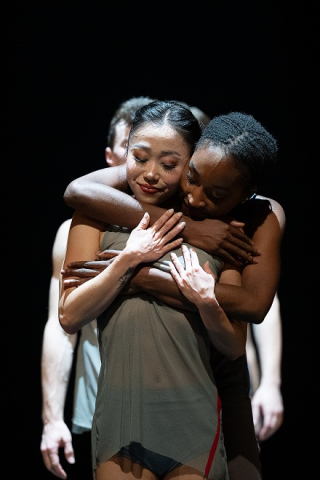
Above: Minori Sakita and Ashley Simpson in Jodie Gates’s BEAUTIFUL ONCE; photo by Christopher Duggan for BalletX
The evening opened with Jodie Gates’s BEAUTIFUL ONCE, set to a score by Ryan Lott performed by Son Lux and yMusic. The slurring music of the opening moments soon transforms into rhapsodic themes as the dancers meet on the gorgeously lit stage, embracing one another with genuine affection. The choreography – danced on pointe – is full of sweeping lifts and swirling movement, all gracefully executed. A series of duets, laced with fleeting solos and passages danced as trios and quartets, keeps the eye thoroughly engaged.
The music becomes dense and passionate, and a sense of belonging pervades the stage. When the dancers are not dancing, they remain on the sidelines, as if supporting their colleagues. A lovely quintet for the women seems to offer a perfect ending to the piece, but then the men take over and the dancing flows on. As the ballet nears its end, individual couples step forward and embrace – not passionately, but tenderly.
The program note refers to BEAUTIFUL ONCE as “a response to the chaotic moments in life”, and reminds us of the blessèd assurance of friendship and community.

Above: Jonathan Montepara and company in Loughlan Prior’s MACARONI; photo by Christopher Duggan for BalletX
I hardly ever enjoy comic ballets (Jerome Robbins’ THE CONCERT being an exception) and I can’t say that I derived much pleasure from Loughlan Prior’s MACARONI, a spoof on gay manners from the powdered wig era. The music, by Claire Cowan, served the choreographer well, laced with sounds of the harpsichord to evoke the baroque.
The cast of eight included three women en travesti, dancing on pointe. Everyone danced superbly whilst showing expert comic timing and entering fully into the campy atmosphere. But as the work progressed, I felt rather sad: yes, we have made so much progress over the years…and yes, we must be able to laugh at ourselves. But there is still rampant homophobia and plenty of anti-gay/anti-trans violence in this country. Just a week ago, I heard three Spanish boys talking about me on the subway, using their favorite slur: pato. Will it never end?

Above: Francesca Forcella and Jerard Palazo infrom Take Ueyema’s HEROES; photo by Christopher Duggan for BalletX
After the interval, Takehiro Ueyama’s HEROES summoned up a world of poignant beauty and mystery – a world we can always access in our imaginations but which the choreographer here transforms into reality. In his program note, Take dedicates the ballet to citizens who played a crucial role in the recovery of Japan from the devastation of World War II.
Here, Mr. Korsch’s lighting designs (in collaboration with Christopher Ham) were extraordinarily atmospheric, and Eugenia P. Stallings’ costume designs – red garments that seemed at once ancient and ultra-contemporary – evoked the priestly rites that bind the community together.
The piece opens with a prologue: deep rumblings are heard, and the summoning sound of chimes. From the pit, Tokoshieni – composed by percussionist Kato Hideki and performed by him and violinist Ana Milosavljevic – transports us to an illusory place and time. A red-clad couple emerge from the shadows and perform a slow, stylized duet to the sound of mysterious whispers. An eerie, brooding feeling creeps in; the man performs a slow solo and and the woman responds in kind. They don red jackets and vanish into the darkness.
The music of John Adams – The Chairman Dances – rises as the full stage becomes illuminated. A diagonal of white chairs stage right becomes a walkway as the dancers enter. They move the chairs about, establishing a place for the evolving ritual. The chairs are lined across the stage and there is a wonderful seated passage of arm and hand gestures. A unison dance and individual walkabouts are highlighted by brief solos.
The music turns spacious and the dance slows, only to rebound as the dancers march about. Another unison passage leads to everyone dropping to the floor…only to rise and race about in a circle. Now the jackets come off and are collected; the dancers sit in a semi-circle, with the corpse of a woman covered with a jacket.
A new beat develops; there is an intense duet which evolves into a trio and then a wild female solo. The lighting continues to play a powerful part in the effect of the choreography. In a visual coup, there is a striking line-up across the space, and the dancers advance towards us. They then fall into single-file and proceed to cross the bridge of chairs, sure of their destiny.
More of Christopher Duggan’s images from HEROES:
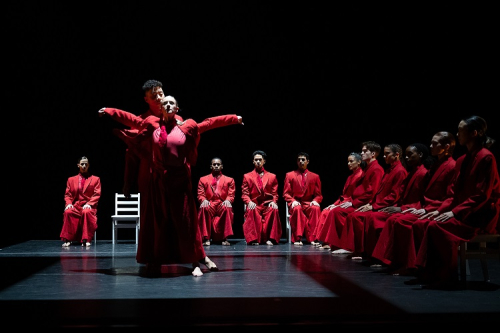
Above: dancers Skyler Lubin and Mathis Joubert

Above: dancer Itzkan Barbosa
~ Oberon



![Behrens_Isolde[5]](https://oberonsglade.blog/wp-content/uploads/2025/09/8e7cf78aa481d0817ad4e0921bc81edd.jpg "Behrens_Isolde[5]")
 Oberon's Glade