
Leontyne Price sings Aida’s “O patria mia“, her signature aria. This comes from her remarkable “Blue Album”: some of her finest singing ever, and still available.
Leontyne Price sings Aida’s “O patria mia“, her signature aria. This comes from her remarkable “Blue Album”: some of her finest singing ever, and still available.
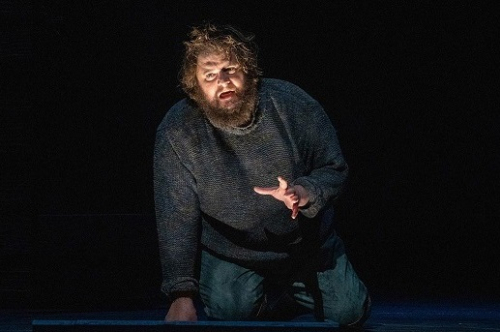
Above: Allan Clayton as Peter Grimes; a Met Opera photo
NOTE: This article was delayed due to problems with Typepad. Photos may be slow to load, and the musical excerpt may not play.
Saturday October 28th, 2022 matinee – I didn’t like the Met’s current PETER GRIMES production, which premiered in 2008, when I saw it in the House, but later I watched it on DVD and found it thrilling. For this revival, I pondered getting a seat with a view, but then opted for practicality and took a score desk.
I first saw GRIMES in 1983; it was a day I shall never forget. We’d been to SIMON BOCCANEGRA in the afternoon, and I was exhausted; sitting there waiting for GRIMES to begin, I thought “I’ll never make it to to end.” But moments after the curtain rose, Jon Vickers delivered his blazing first line, “I swear by almighty God…”, stepping on Swallow’s line in his impatience, and from that moment on, I was riveted. Vickers, his colleagues Elisabeth Söderström and Thomas Stewart, and a stellar lineup of singing actors (Jean Kraft, Lili Chookasian, Jerome Hines, Dale Duesing, Ezio Flagello, and Robert Nagy) gave me a thrilling first GRIMES, under the baton of the great Sir John Pritchard.
In the ensuing years, I experienced two magnificent portrayals of Grimes at The Met: Philip Langridge and Anthony Dean Griffey each made an overwhelming impression. This afternoon, the British tenor Allan Clayton staked out his own claim to the role with a stunningly sung performance. I first heard the voice of Allan Clayton on the excellent Decca DVD entitled Britten’s Endgame.
The Met Orchestra were on top form this afternoon, and the opera’s interludes – well-beloved as a concert ‘suite’ – were by turns painfully beautiful and searingly violent. The conductor, Nicholas Carter, was at his finest in these glorious passages. But he was less successful when solo voices were singing, sometimes giving too much volume and either covering the singers or leaving them to struggle for a heftier sound. The Met Chorus, with so much to do in this opera, were simply grand: “O tide that waits for no man…spare our coasts!“
Metropolitan Opera House
October 28th, 2022 matinee
PETER GRIMES
Britten
Peter Grimes............Allan Clayton
Ellen Orford............Laura Wilde (debut)
Captain Balstrode.......Adam Plachetka
Mrs. Sedley.............Michaela Martens
Auntie..................Denyce Graves
Niece...................Brandie Sutton
Niece...................Maureen McKay
Hobson..................Harold Wilson
Swallow.................Patrick Carfizzi
Bob Boles...............Chad Shelton
Rev. Horace Adams.......Tony Stevenson
Ned Keene...............Justin Austin
John....................Brandon Chosed
Villagers: Helena Brown, Ross Benoliel, Scott Dispensa,
Ned Hanlon, Jeremy Little, Patrick Miller, Steven Myles, Earle Patriarco,
Jonathan Scott, Meredith Woodend, Yohan Yi
Conductor...............Nicholas Carter
Settling in at my desk well before curtain time. I opened the old, heavy score I had taken from the library, and found the incredible inscription shown below. It means that Benjamin Britten actually held this score in his hands.

~ Oberon

Above: the Danish String Quartet, photographed by Caroline Bittencourt. From left: Rune Tonsgaard Sørensen (violin); Fredrik Schøyen Sjölin (cello); Frederik Øland (violin); Asbjørn Nørgaard (viola)
NOTE: I again apologize for the “look” of this post. Due to a prolonged downtime at Typepad, the photo may not appear.
Sunday October 30th, 2022 – How wonderful to hear the Danish String Quartet live again! Their iconic sound is really quite unlike that of any other string quartet, though how to describe what actually sets them apart is nearly impossible. You simply have to be there.
This evening they brought us music of Mozart, Britten, and Schumann, all of it played with silken smoothness of tone and technique. One nice thing about the Danish: the two violinists switched seats in the course of the program, so that today we got to experience Rune Tonsgaard Sørensen taking the lead for the two Mozart works, and Frederik Øland in the Britten and Schumann.
A large audience greeted the Danes with warm applause; the players sat down, and immediately set the evening sailing with Mozart’s Divertimento #15, K. 138. Expert timing marked their playing of the uplifting opening Allegro; world weariness was quickly banished as polished phrase after phrase drew us in. What sounds! The sustained line of the Andante allowed us to savour the textures of Mozart’s harmonies, which become quite delicate for a while. Mr. Tonsgaard Sørensen’s sublime phrasing, and the velvety warmth provided (all evening) by cellist Fredrik Schoyen Sjölin were most welcome. From its lively start, the concluding Presto swept us along, its charming and witty mid-section an added attraction. This short and sweet Divertimento was a perfect concert opener.
How wonderful to hear Benjamin Britten’s Three Divertimenti the day after experiencing the composer’s masterwork PETER GRIMES at The Met. These brilliant miniatures make a nicely-contrasted concert set, and The Danes played them to perfection. The amusingly off-kilter March highlights the quartet’s outstanding violist Asbjørn Nørgaard. The music steps along, with a brief detour for some Mendelssohnian lightness, before gaining speed to a sudden finish. The second divertimento, Waltz, features gently plucking rhythms, the violin and viola topping things off. We dance blithely along, faster and faster, to a cute conclusion. The agitato start of Burlesque soon has the players strumming, plucking, and tapping their instruments. The music accelerates to a brisk conclusion.
Now for another Mozart treat: the Quartet in E-flat major, K. 428. The opening Allegro non troppo commences with the players in unison, Mr. Tonsgaard Sørensen leading the way. Such gracious music: the violist much (and marvelously) occupied, the cellist the beating heart, the violin’s upward runs providing a gentle lift to the spirit. It’s magical music, and magically played. The Andante con moto has a lovely start, with bending harmonies sweetly blended. The intrinsic beauty of Mozart’s melodies creates a timeless feeling, with Mr. Tonsgaard Sørensen‘s silken tone giving us the blessing of calm. I wanted it to go on and on.
But, instead, a Minuet must be danced: such elegance! A minor-key interlude provides contrast, and Mr. Tonsgaard Sørensen‘s demonstrates perfect control before passing a theme off to Mr. Øland. We now arrive at the final Allegro vivace, bustling and blithe, with coy hesitations. The abounding charm of the music gives the feeling that all’s right with the world….an illusion, I know, but…illusions are, by their nature, sweet.
Following the interval, Robert Schumann’s Quartet in A-major, Op.41, No, 3, made for a spectacular finish to the program. A feeling of sweet sadness permeates the opening movement, in which the intertwining voices mingle expressively. An agitato figuration for the cello draws a response from the other three voices. There is an underlying anxiousness at the start of the second movement which creates a restless feeling, and the cello takes the lead with a tender theme; the music – rich and dense – becomes a slow dance. Again, the blend the players achieve is simply miraculous.
Now comes the crowing glory of the evening: the Adagio molto. Following a poignant start, the viola draws us in with a searching feeling. The violin and viola play a rising phrase that seems to draw us heavenward, whilst a captivating density of tone from the lower voices carries us deeper and deeper into the music; the sounds of the violins seem to hypnotize us. The end of the movement is so profoundly gorgeous that all else is forgotten.
But Schumann has an Allegro molto vivace up his sleeve to delight us: from an agitato start, scurrying motifs pop up. Then a trudging beat commences, dancing us on the the finish.
Reveling in a full-house standing ovation, the Danish String Quartet offered an encore from Papa Haydn’s very first work for string quartet, giving us yet another sublime musical experience.
~ Oberon
The National Youth Choir of Australia, conducted by Noel Ancell, sing Benjamin Britten’s Rosa Mystica at the Sacred Heart Church, Carlton, Melbourne, on July 9, 2018.
Watch and listen here.
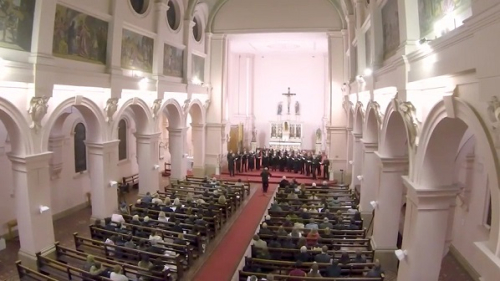
The National Youth Choir of Australia, conducted by Noel Ancell, sing Benjamin Britten’s Rosa Mystica at the Sacred Heart Church, Carlton, Melbourne, on July 9, 2018.
Watch and listen here.
Ingeborg Hallstein sings Frühlingsstimmen (‘Voices of Spring’) by Johann Strauss II.
Watch and listen here.

Ingeborg Hallstein sings Frühlingsstimmen (‘Voices of Spring’) by Johann Strauss II.
Watch and listen here.

Monday October 24th, 2022 – When I saw the announced program for this evening’s concert by Ensemble Connect at Weill Hall, I knew I had to be there: what an enticing line-up of composers…and, in the event, it was all so dazzlingly played!
The young musicians of Ensemble Connect are exceptionally talented; all the music tonight sounded fresh and vibrant. They are also appealing to watch. The works on this well-contrasted program spanned the years from 1717 to 1994, and it was a sonic feast from first note to last.

Above, playing the Martinů: Yasmina Spiegelberg, Garrett Arney, Laura Andrade, and Cort Roberts; photo by Fadi Khier
Bohuslav Jan Martinů’s rarely heard Quartet for Clarinet, Horn, Cello, and Side/Snare Drum, H. 139, dates from 1924. This rather quirky mix of instruments does – as hornist Cort Roberts pointed out in his introductory remarks – represent the four ‘families’ of the symphony orchestra: strings, winds, brass, and percussion. What delightful sounds we heard from Mr. Roberts and his colleagues: Yasmina Spiegelberg (clarinet), Laura Andrade (cello), and Garrett Arney (snare drum).
The work is full of wit and irony, yet in the central Poco Andante comes a poignant lament that is extraordinarily moving. Snare drum and cello lead off the opening Allegro moderato, which becomes march-like as the clarinet and horn join in. A trudging feeling develops, with a horn solo which later shifts to the clarinet. The music seems about to fade away, but there’s a big bang ending.
As the Andante commences, my companion and I were simply blown away by the depth and beauty of tone that cellist Laura Andrade produced. Ms. Andrade played in all four works this evening, and maintained her beautiful sound and sterling musicality at every moment. Ms. Spiegelberg joins the cellist with a rather mysterious air; Mr. Arney’s snare drum comments on the women’s duet, and then Mr. Roberts’ mellow horn sounded a somber theme. The cello solo returns to the touching opening passages, played with heart-rending beauty.
At the jaunty start of the concluding Allegretto, the voices enter one by one: drum, cello, clarinet, horn. The music jogs along, with the horn ringing forth. After the instruments have exchanged lively, wry phrases, there is a little unison coda to round things off. Such a wonderful way to open the evening, and what a stroke of genius on Martinů’s part to center the work on that profound lament.
The petite but hugely talented pianist Joanne Kang now joined the impressive Venezuelan violinist Rubén Rengel and Ms. Andrade for a simply glorious performance of Clara Schumann’s Piano Trio in G-Minor, Op. 17. Their playing was tremendously beautiful and moving, and they are as attractive to watch as to hear; their performance of this masterwork seem so vital and immediate, making it an outstanding musical experience of recent seasons
Clara Schumann’s writing shows a mastery of counterpoint and a heartfelt gift for melody. It’s music alive with romantic ardor. The opening Allegro moderato begins in a melancholy mood, and soon develops a passionate flow of lyricism, with dramatic outbursts along the way adding a sense of urgency. Ms. Kang kept the momentum going with her perfect timing, whilst Mr. Rengel and Ms. Andrade displayed rich, abundant tone as one lustrous theme after another sprang up. The Scherzo – “in the tempo of a minuet” – commences with an elegant passage for violin and piano; it is gentle, pensive music, and again Ms. Andrade’s plush sound warmed the soul.
Ms. Kang lovingly played the Andante‘s waltz-like opening, soon joined by the hushed, poetic sound of Mr. Rengel’s violin; their blend carries them thru captivating harmonies. The music gets a bit wild, only to be calmed by more gorgeousness from the Andrade cello. Achingly beautiful playing from these young artists, with the cellist rounding everything of with a simple descending scale that brought tears to my eyes.
The trio’s final Allegretto brought forth more dazzling playing from the three musicians; Ms. Kang in particular shown here with sumptuous, large-scale playing and – later – passages of glistening arpeggios. Following a mini-fugue, the music gets grand, only to simmer down to a melody of longing, then moving onward to its epic finish. My companion and I were so thrilled by this rapturous performance.

Following the interval, music by the Jamaican-born composer Eleanor Alberga (photo above): her String Quartet No. 2. As violist Halam Kim remarked before the playing started, the entire 18-minute single movement develops from a very brief descending phrase that opens the piece; this Mr. Rengel dashed off for us as an introductory demo: it lasts less than a second.
From its active start, dance-like with dazzling dissonances, the piece moves on with complex harmonies and rhythmic shifts as well as witty touches, such as a repetitive figuration for the 2nd violin (Brian Hong) that made me smile. Mellowing to an andante section laced with enticing harmonies, we arrive at an intriguing passage where tremolo shivers from Mlles. Kim and Andrade underscore an eerily harmonized theme for Mssrs. Rengel and Hong. Ms. Andrade’s knockout cello playing continues to fascinate us, whilst plucked notes from Ms. Kim and Mr. Hong support a high-flying passage for Mr. Rengel’s violin.

Above, playing the Alberga quartet: Rubén Rengel, Brian Hong, Laura Andrade, and Halam Kim; photo by Fadi Kheir
The music dances on, getting dense and with a big buildup until it turns heartfelt and lush; we seem to be headed to the finish line, but…no: a delightful return of the tremolo viola/cello combo with woozy violins pops up before the music’s energetic final measures. The piece was enthusiastically received; I was hoping Ms. Alberga might be among the audience so we could hail her for her colorful, marvelous score.
There was a slight delay before the evening’s concluding piece as a technical glitch with the tablets took some straightening out. Ah, for the simple beauty of a paper score!

Above: the ensemble playing Bach; photo by Fadi Kheir
It was with J. S. Bach’s Brandenburg Concerto No. 5 that the evening closed. The large ensemble featured all the players from earlier in the evening, plus bassoonist Nik Hooks – a player with rich, amiable tone and agile technique – and the proverbially “tall, dark, and handsome” Iranian/Pakistani/American flautist, Amir Farsi: limpid of tone, with a personable presence as he bends and sways to the music. Mr. Hooks and Ms. Andrade provided a very high-class continuo, with Ms. Kim and Mr. Hong the supporting strings. Mr. Rengel and Mr. Farsi played magnificently, and there was truly a sense of magic in the hall as the performance unfolded.

Above, Joanne Kang at the harpsichord for the Bach; photo by Fadi Kheir
Of course, this is “the Brandenburg with the harpsichord”, and Mr. Kang gave us a fleet-fingered and fabulous rendition of the long cadenza. The audience, and her colleagues, could not resist breaking in with applause for her stunning playing, one of the highlights of the evening. Other treats in the Bach were the poignant blending of Mr. Rengel’s violin with Mr. Farsi’s flute in the Affetuoso, and the light and lively finale wherein Ms. Andrade and Mr. Hooks put the continuo in the spotlight.

Above, the principal players for the Bach: Rubén Rengel, Joanne Kang, and Amir Farsi; photo by Fadi Kheir
Such a pleasing and deeply satisfying evening! For two hours, the woes of the world and the cares of daily life were forgotten. A thousand thanks to these dedicated musicians, and to the music that makes life worth living.
All photos by Fadi Kheir, courtesy of Carnegie Hall.
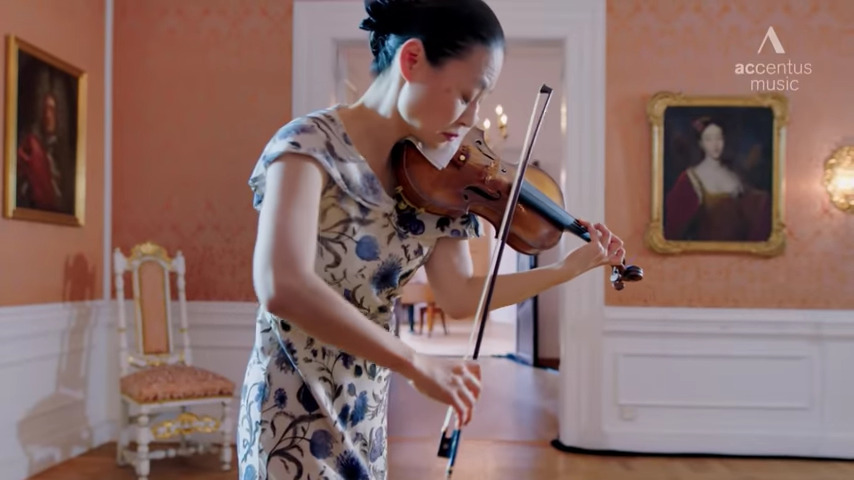
Midori plays the Chaconne from Bach’s Partita #2, filmed at Castle Köthen, where the sonatas and partitas for solo violin were written.
Watch and listen here.
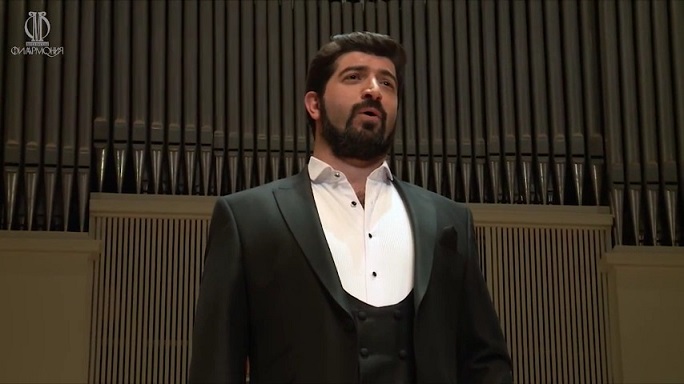
Georgian basso Goderdzi Janelidze sings Prince Gremin’s aria from Tchaikovsky’s EUGEN ONEGIN.
Watch and listen here.

 Oberon's Glade