
Soprano Karina Gauvin sings “Lascia ch’io pianga” from Handel’s RINALDO in a recording session film.
Watch and listen here.
Soprano Karina Gauvin sings “Lascia ch’io pianga” from Handel’s RINALDO in a recording session film.
Watch and listen here.

Above: Lar Lubovitch, photo courtesy of NYC Dance Project
Friday May 21st, 2021 – This evening I tuned in to watch a program of highlights from three works by the eminent choreographer Lar Lubovitch. The program featured excerpts from two familiar ballets by Lar, and part of his unique The Planets.
Watching the film’s duet from Concerto Six Twenty–Two brought back memories of a beautiful afternoon photographer Nir Arieli and I spent watching a rehearsal of this piece in 2013. Mr. Lubovitch was coaching dancers Attila Joey Csiki and Clifton Brown, and the atmosphere in the studio was palpable.
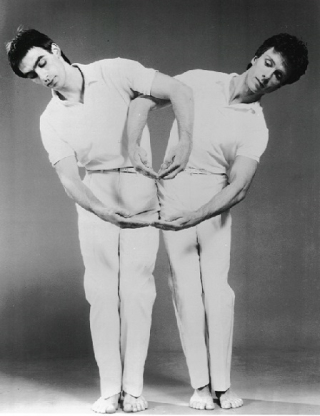
Above: Sylvain LaFortune and Rick Michalek in Concerto Six Twenty–Two; photo by Jack Mitchell
The duet is set to the adagio from Mozart’s Clarinet Concerto, a beloved work that reached a wide audience when it was used in the film Out of Africa. Sylvain LaFortune and Rick Michalek are the dancers in today’s program; clad all in white, they could be lovers, or brothers, or best of friends. The Lubovitch choreography is a poignant response to the music; the men are mutually supportive and tender without becoming cloying. There are solo passages, danced whilst the other man observes. It’s a study in masculine grace.
Othello, which premiered in 1997, was a joint creation for the Lubovitch Company, American Ballet Theatre, and San Francisco Ballet. In 2018, as part of the celebration of the Lubovitch Company’s 50th anniversary, Fabrice Calmels and his colleagues from The Joffrey performed excerpts from Othello at The Joyce.

Above: Desmond Richardson and Yuan Yuan Tan in Othello
This evening we saw the ballet’s third act from a filmed performance by San Francisco Ballet. The stellar cast featured Desmond Richardson as Othello, Yuan Yuan Tan as Desdemona, Parrish Maynard as Iago, Katita Waldo as Emilia, and a very young Gonzalo Garcia as Cassio.
As Act III opens, Cassio is in chains, being interrogated by Othello with Iago a menacing observer. Despite his pleas of innocence, the young captain doesn’t stand a chance; he is taken away. Now Desdemona comes on the scene: Yuan Yuan Tan, achingly lovely, seeks to placate her jealous husband. Parrish Maynard as a scarily intense Iago watches the couple. The potent physicality of Desmond Richardson’s Othello holds sway over his blameless wife. Katita Waldo as Emilia joins for a pas de quatre set to dynamic music.
Othello and Iago are left alone, and the latter summons up the green-eyed monster: jealousy. Here composer Elliot Goldenthal makes cunning use of the saxophone. Whilst Iago weaves his web of lies, Othello sees visions of Cassio courting his wife. Then Iago produces the handkerchief and Desdemona’s fate is sealed.
The perfection of Desmond Richardson’s portrayal is now to be savoured in a solo of technical perfection and great dramatic intensity. He then confronts his wife, and, following an anguished duet, he strangles her with the handkerchief. Now Emilia rushes in, and reveals Iago’s deception; she barely has time to state the truth before her husband murders her. Othello, overcome with remorse, stabs himself.
The excellence of the cast made for a truly absorbing performance of this Lubovitch masterpiece.
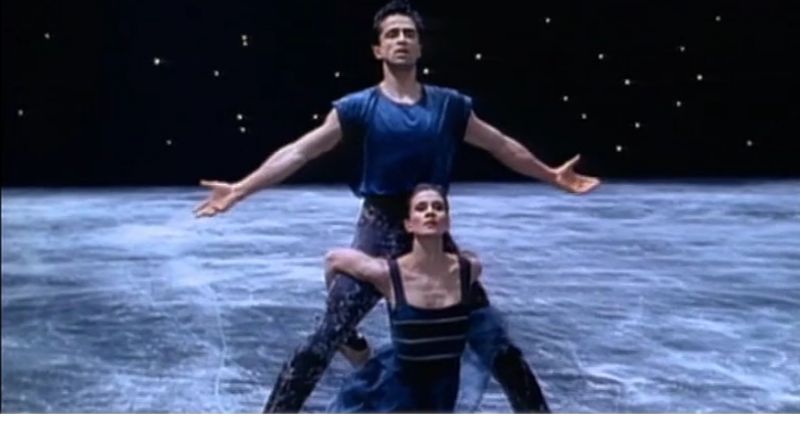
Above: Isabelle and Paul Duchesnay in The Planets
Completing the program, we had an excerpt from The Planets, in which figure skaters and ballet dancers joined together. The music is “Venus” from Holst’s The Planets, Mr. Lubovitch choreographed the skating, and Doug Varone the ‘court of Venus’. The goddess is portrayed by Sonia Rodriguez of the National Ballet of Canada, and the principal skating couple are Paul and Isabelle Duchesnay, 1992 Olympic Silver Medalists.
Venus, after drinking from an enchanted pool, sees a vision of a company of lovers, come to pay her homage. These skaters fill the ice with swirling, flowing combinations. Now the principal couple – the brother-and-sister Duchesnays – execute a lush duet, sailing across the ice to the lyrical Holst music.
Paul Duchesnay kneels before Ms. Rodriguez’s Venus; she is captivated by this mortal male and they begin a duet in which Ms. Rodriguez’s feet never touch the ice. The goddess then returns to her temple, but the encounter has left its mark on her.

Above: Sonia Rodriguez in The Planets
While watching the program, many memories of my experiences with Lar Lubovitch’s work – and of meeting him briefly in various settings – came flooding back. It’s thanks largely to my friendship with Attila Joey Csiki – an iconic Lubovitch dancer – that I discovered the world of Lubovitch. Here are some articles and images from my blog about these encounters:
Meeting Attila in person for the first time in November 2010 when he was preparing a Lubovitch solo with pianist KathleenTagg.
In 2011, with Attila teaching a Lubovitch class, is where the Lubovitch connection took hold. Three dancers in the class – Greg Lau, Sarah Pon, and Blake Hennessy-York – were embarking on their careers at the time.
Attila arranged for Kokyat and me to watch a rehearsal of Lar’s Men’s Stories. This was the first time I met Mr. Lubovitch; he was quite formal, which I liked.
2014 brought the fascinating Black Rose to The Joyce.
In 2017, in preparation for the 50th anniversary of the Lubovitch Company, Lar set his Legend of Ten on the Martha Graham Dance Company. Photographer Nir Arieli and I had a fantastic time watching a rehearsal.
And in 2018, the 50th anniversary was celebrated in high style at The Joyce.
There’s so much more Lubovitch in my dance diary! And there’s no way I could finish this article without mentioning my two Lubovitch goddesses: Nicole Corea and Kate Skarpetowska.
~ Oberon

Above: Elena Cernei as Amneris
You never forget your first Amneris; mine happened to be Elena Cernei, a comely Romanian mezzo-soprano with a marvelous chest-register. My first AIDA came during the Met’s second season at Lincoln Center, on December 27th, 1967; Ms. Cernei’s colleagues were Gabriella Tucci, Flaviano Labo, Mario Sereni, and Bonaldi Giaiotti, with Thomas Schippers on the podium.
Born in 1924, Ms. Cernei studied at Bucharest. She joined the Romanian National Opera in 1952, singing there thru 1977. She also sang at La Scala, Paris, Barcelona, Brussels, Mexico City, and at the Bolshoi.
She debuted at The Met in 1965 as Dalila; her other Met roles were Amneris, Maddalena in RIGOLETTO, the Princesse de Bouillon in ADRIANA LECOUVREUR, and Carmen.
Ms. Cernei’s repertoire further included Azucena, both Laura and La Cieca in LA GIOCONDA, Ulrica, Rossini’s Arsace, and Gluck’s Orfeo. She was named an Honored Artist of the Republic of Romania. Upon retiring from the stage, she lived and taught at Rome. She passed away in 2000, and a commemorative postage stamp was issued in her honor.

Elena Cernei sings the Séguédille from Bizet’s CARMEN here.
And here’s a sampllng of her Dalila:

UPDATE (4/28/21): It was sad to read today that the composer James Primosch has passed away at the age of 65. This is an article I wrote in May 2020 upon the release of CARTHAGE by The Crossing:
~~~ Newly released by Navona Records, CARTHAGE features works by composer James Primosch performed by the choral group The Crossing. This music came my way during the isolation of the pandemic in May of 2020.
From the opening phrase of the opening piece, Journey, a spell was cast over me. Listening to the men of The Crossing intoning these words drawn from the work of 13th-century monk and mystic Meister Eckhart – “There is a journey you must take. It is a journey without destination. There is no map. Your soul will lead you. And you can take nothing with you.” – was all it took to draw me in. Not just the evocative words themselves, but the particular beauty of the voices created a mood that is sustained throughout the span of the album.
While the title track, Carthage, evokes for me visions of the lost city of Carthage, where Dido died of despair after being abandoned by Aeneas, it’s Marilynne Robinson‘s novel Housekeeping that is the source of the text. James Primosch provides wondrous harmonies which feel at once ancient and vividly of our time. Individual voices sometimes rise from the ensemble as the music veers from pensive to ecstatic. After listening, I ordered a copy of Ms. Robinson’s book.
Following is Mass for the Day of St. Thomas Didymus. Comprised of five movements, this work employs four soloists singing the traditional texts from the Latin mass whilst the main choir of The Crossing sing from Denise Levertov’s cycle of poems which inspired the work’s title.
In Kyrie, the solo voices are deeply affecting, the choir’s harmonies alive with dynamic and rhythmic shifts. The Gloria is appropriately more animated and upbeat, whilst the Credo opens thoughtfully, with especially marvelous harmonies in a variety of moods. The Sanctus opens with solo voices, each on its own trajectory and finally meshing; following a dense harmonic burst, the word “Sanctus” is repeated. The music then becomes lullaby-like. Agnus Dei, the final passage of this Mass, opens with the beloved “Lamb of God” text gently voiced; later, an emotional rise subsides into a fading finish, a quiet plea for peace.
The album’s notes so accurately describe this work honoring St. Thomas Didymus – known as “doubting Thomas” – as “…plumbing the depths between unbelief and faith in which true spirituality so often resides.” That is the exact place I have dwelt for so many years.
spiraling ecstatically has a vivid spatial sense, a drifting loveliness followed by a high-rising passage of animation to a sustained finish. Two Arms of the Harbor opens thoughtfully, the voices soft and reflective. A female voice explores some high-range coloratura, leading to a brief energy surge. The music then subsides to a gentle coda, drifting into silence.
The album closes with One with the Darkness, One with the Light. In this brief track, a feeling of reverent acceptance pervades. The text, from poet Wendell Berry, is so simple and heartfelt, and composer James Primosch has given it a dreamlike setting in which the voices of The Crossing quietly reach us in the depths of the soul.
“At night make me one with the darkness
In the morning make me one with the light
When I rise up, let me rise joyful like a bird.
When I fall, let me fall without regret, like a leaf.
Let me wake in the night and hear it raining and go back to sleep.”
~~~~~~~~~~~~~~~~~~~~~~~~~~~~~~~~~~~~~~~~~~~~~~~~~~~~~~~~~~~~~~~~~~~~~~~~~~~~~~~~~~~~~~~~~~~~~

Above: composer James Primosch; photo by Deborah Boardman
Mr. Primosch was born in Cleveland, Ohio, in 1956. He studied at Cleveland State University, the University of Pennsylvania, and at Columbia University. Among his teachers were Mario Davidovsky, George Crumb, and Richard Wernick, In 1988, the composer joined the faculty of the University of Pennsylvania. His website is here.

The Crossing (above, in a Becky Oehlers photo) is a Grammy Award-winning chamber choir. Under the direction of Donald Nally, the ensemble have commissioned over one hundred choral works. Visit The Crossing’s website here. ~~~
~ Oberon
Above: José Cura, Nathalie Stutzmann
A production of TANNHÄUSER, sung in French, from Monte Carlo, 2017. José Cura sings the title-role and Nathalie Stutzmann conducts.
Watch and listen here.
CAST: Tannhäuser: José Cura; Wolfram: Jean-François Lapointe; Walther: William Joyner; Elisabeth: Annemarie Kremer; Venus: Aude Extremo; Landgraf Hermann: Steven Humes; Biterolf: Roger Joakim; Henry: Gijs van der Linden; Reinmar: Chul-Jun Kim; Un Pâtre: Anaïs Constans.
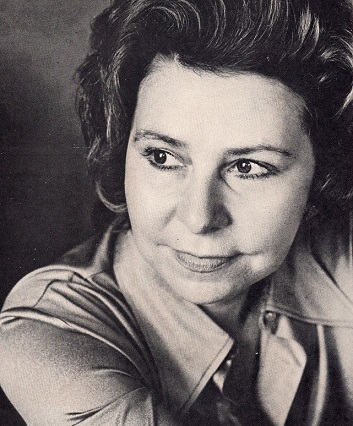
April 25th, 2021 – Throughout the sixty years that I have been obsessed with opera, I have loved and admired many wonderful singers. But when people ask me, “Who was the greatest singer you ever heard?”, I must answer: “Christa Ludwig.” Today, news has come of her death at the age of 93.
Christa Ludwig made her Vienna State Opera debut as Cherubino in Mozart’s NOZZE DI FIGARO in 1955. She went on to give 769 performances of 42 roles in Vienna. At the Metropolitan Opera, her 1959 debut (also as Cherubino) marked the start of a 38-year association with The Met, where she sang 119 performances of 15 roles.
Christa Ludwig was my first Octavian, and also my first Dyer’s Wife in FRAU OHNE SCHATTEN (in a stellar cast with Leonie Rysanek, Irene Dalis, James King, and Christa’s then-husband, Walter Berry, with Dr. Böhm conducting), my first Dido in TROYENS, and my first Klytemnestra. Her other Met roles were Amneris, Brangaene, Ortrud, Fricka, Kundry, Charlotte in WERTHER, and Waltraute; and she gave a single performance as Leonore in FIDELIO.
My first experience of seeing Christa Ludwig onstage was as the Dyer’s Wife; my first FRAU was part of a thrilling weekend in February 1969 that also included my very first RHEINGOLD (with Herbert von Karajan conducting) and the now legendary Nilsson/Caballe TURANDOT. Christa’s Dyer’s Wife was a blazing creation, her voice spanning the wide range with complete command, the highest notes sailing into the Big House with stunning clarity and power.
From a commercial recording of the great Act III duet for Barak and his wife:
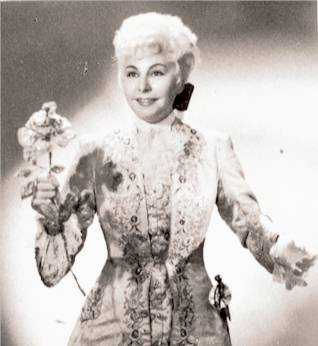
I next saw Ms. Ludwig onstage on Valentine’s Day, 1970, as Octavian in DER ROSENKAVALIER. Karl Böhm was again on the podium, and the cast further featured Marion Lippert, Reri Grist, and Mr. Berry. The sight of Ms. Ludwig as Octavian entering the hall of the Faninal mansion, bearing the silver rose, left an indelible impression on my romantic heart. Over time, it became for me the iconic image of everything I love about opera.

Above: Nuit d’ivresse with Jon Vickers and Christa Ludwig; a Louis Melançon photo
On October 27th, 1973 – a red-letter day in my personal life – I saw LES TROYENS for the first time. Shirley Verrett and Louis Quilico as Cassandra and Chorebus had given glorious performances in PRISE DE TROIE. Then, as the scene shifts to Carthage, Christa Ludwig and Jon Vickers sang so poetically the quietly rapturous love duet, Nuit d’ivresse. Inspired by their ecstasy, I spent the night with Z – and I have ever since felt that life really began for me with that encounter.
More than a decade was to pass before I saw Christa Ludwig on the Met stage again: in 1984, she was a fascinating Klytemnestra in my first-ever ELEKTRA. Ute Vinzing, Johanna Meier, and Simon Estes were her co-stars, with Maestro Levine presiding. Ms. Ludwig’s singing, with an undercurrent of creeping madness, bore the stamp of a great lieder singer; her characterization sometimes veered endearingly to the melodramatic.
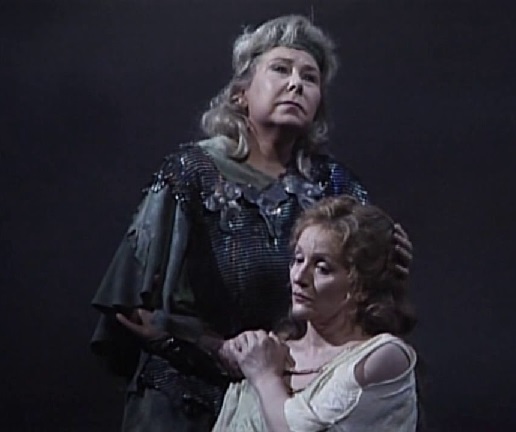
Above: Ludwig and Behrens in GOTTERDAMMERUNG
A four-year interval then passed before I saw Christa in opera again: the 1988 opening night of the Schenk/Levine GOTTERDAMMERUNG. This was a spectacular performance in every regard: Levine and his orchestra were on peak form, and Hildegard Behrens and Matti Salminen thrilled me to the core as Brunnhilde and Hagen. Christa, as Waltraute, looked spiffy in her Valkyrie gear – with black trousers and high black boots – and she moved about, restless as a caged panther, as she told her sister of their father’s frightening state of mind. Having failed in her mission, Waltraute rushes away. The curtain calls that night were fantastic: I think Ms. Ludwig truly didn’t expect the massive wave of applause and bravas that greeted her as she stepped out for a solo bow. It was so moving to watch her accept the audience’s loving appreciation.
I saw Christa Ludwig on the Met stage for the last time in April 1989 as Fricka in WALKURE. It was a cast of titans: Hildegard Behrens, Jessye Norman, Gary Lakes, James Morris, and Kurt Moll were Christa’s colleagues, and again Levine and the Met orchestra were beyond the beyond. The tension in the great argument between Fricka and Wotan was palpable; then Christa – having won – gathered her dignity and took her final parting shot at Brunnhilde with barely disguised contempt.
Christa Ludwig made her farewell appearance at The Met as Fricka in a Saturday matinee broadcast of WALKURE on April 3, 1993. Here is her scene from that performance, with Dame Gwyneth Jones as Brunnhilde, James Morris as Wotan, and James Levine conducting. I was listening at home, and as Ms. Ludwig exited the stage, I had a sense that the audience wanted desperately to burst into applause.
Christa Ludwig as Fricka ~ Met farewell performance with G Jones +J Morris – Levine cond – 4~3~93
While Vienna and The Met loomed large in the Ludwig career, she also appeared at La Scala, Covent Garden, Chicago Lyric Opera, and at the festivals at Bayreuth and Salzburg. In addition, she sang the great concert works of Bach and Mahler.
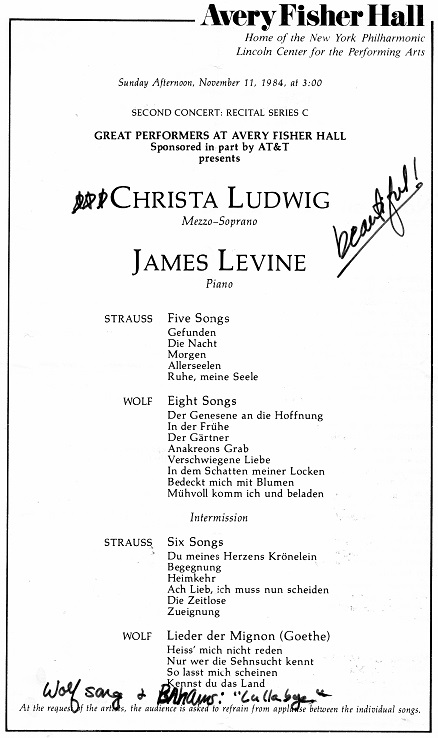
Christa Ludwig was a beloved recitalist; in 1984, I had the great pleasure of hearing her at Avery Fisher Hall with James Levine at the piano. The program of Strauss and Wolf lieder ended with a marvelous encore: the Brahms “Wiegenlied”.
Ms. Ludwig left us with a large and lovely catalog of recordings; among my favorites are Bartok’s BLUEBEARD’S CASTLE, the Kempe LOHENGRIN, the Solti TANNHAUSER, the Böhm TRISTAN from Bayreuth with Nilsson and Windgassen, scenes from Strauss operas with Walter Berry…and her SAMSON ET DALILA with James King holds a special appeal for me. She created a stir in 1986 by recording Schubert’s Winterreise with James Levine; they had performed the great Schubert cycle together on the Met stage in 1983.
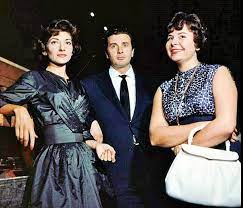
Above: Christa in the recording studio with Maria Callas and Franco Corelli for the EMI NORMA
Christa Ludwig sings Strauss’s “Morgen” with Charles Spencer at the piano. Watch and listen here.
Listen to more from Christa Ludwig:
Christa Ludwig – Es gibt ein reich – ARADNE AUF NAXOS
Christa Ludwig – MACBETH – Act I scena – Vienna 1970
Christa Ludwig – Liebestod ~ TRISTAN UND ISOLDE
Christa Ludwig – Mahler ~ Ich bin der welt abhanden gekommen
Christa Ludwig – Der Engel from Wagner’s Wesendonck Lieder
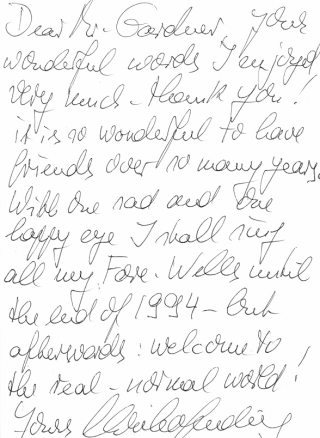
A lovely note I received from Christa Ludwig after I wrote to her on the occasion of her Met farewell in 1993:
~ Oberon
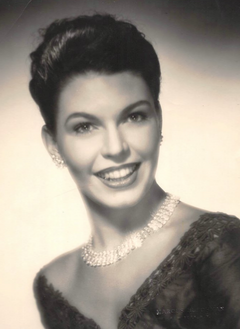
Soprano Eileen Schauler, a pillar of the New York City Opera in my earliest years of opera-going, has passed away at the age of 92.
A native of New Jersey, Ms. Schauler studied at Juilliard. She first made her mark as a powerful Katerina Ismailova at New York City Opera; among her other roles were Anna Maurrant in STREET SCENE, Lizzie Bordon, the Marschallin, and the Governess in TURN OF THE SCREW. She was admired for her stage presence and committed acting as well as for her emotionally engaged singing. I saw her as Tosca (a performance that marked Placido Domingo’s conducting debut) and as a fiery Santuzza.
After retiring from the stage, she taught both privately and at college.
Eileen Schauler – TOSCA aria – in English – Pasadena 1967
Eileen Schauler as Tosca – Act III excerpt – in English – Pasadena 1967
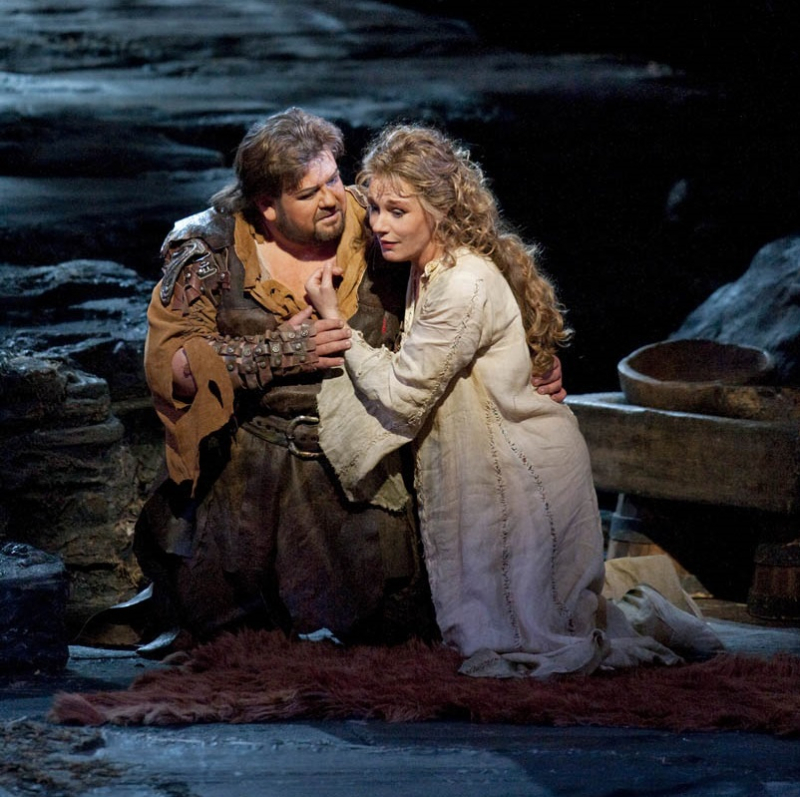
On April 6th, 2009, Waltraud Meier and Johan Botha appeared as Sieglinde and Siegmund in DIE WALKURE at The Met – the only time they sang these roles together in New York City. They gave a thrilling performance of their Act I scene, conducted by James Levine.
Waltraud Meier & Johan Botha – WALKURE ~ Act I scene – Levine cond – Met 2009
The photo is by Ken Howard/Met Opera.
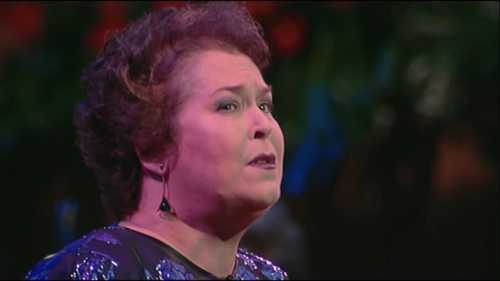
Elizabeth Connell sings the Liebestod from TRISTAN UND ISOLDE at a 2007 concert conducted by Richard Hickox.
Watch and listen here.
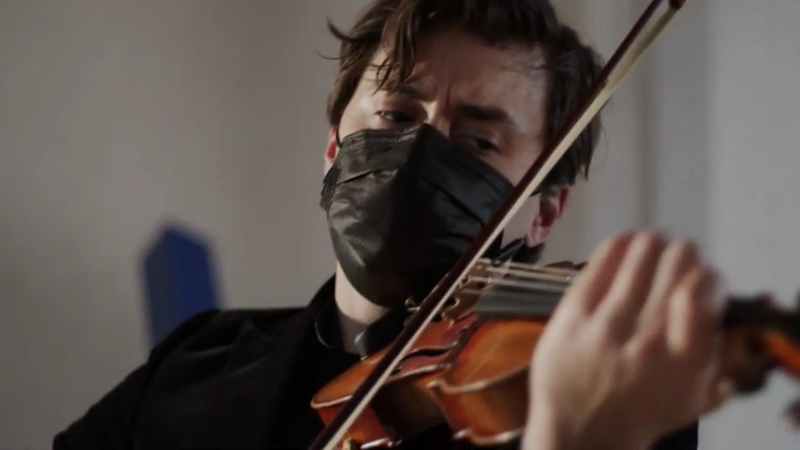
I hope you will take the time to watch this superb film from the Tippet Rise Art Center. It’s one of the finest musical presentations I have watched during the pandemic.
Many thanks to composer Chris Rogerson for drawing my attention to this deeply pleasing film. Chris’s work begins at 24:53 – his Partita for Violin, played by Benjamin Beilman.
Watch and enjoy here.


 Oberon's Glade