
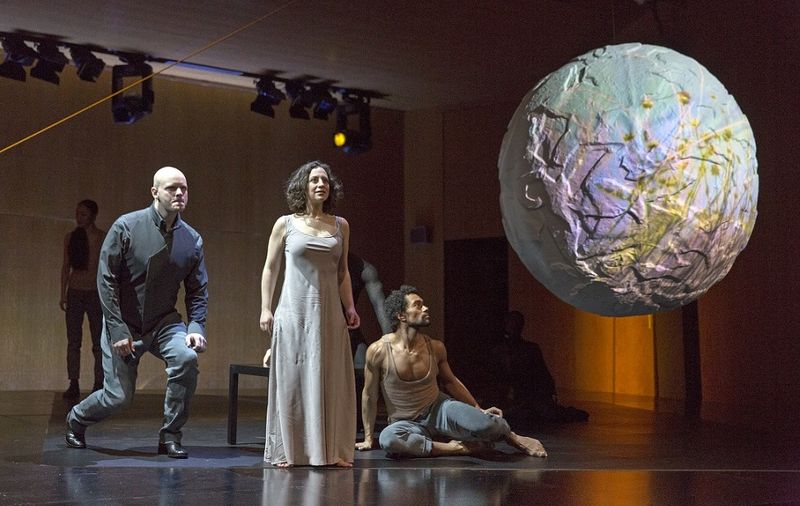
Above: Xin Ying and Abdiel Jacobsen in Sidi Larbi Cherkaoui’s Mosaic; photo by Brigid Pierce
Friday February 17th, 2017 – A richly rewarding evening of dance from The Martha Graham Dance Company, performing works by Graham, Nacho Duato, and Sidi Larbi Cherkaoui at The Joyce. A packed house seemed spellbound by the ballets, and went wild for the Graham dancers – and rightfully so: their power, commitment, bravery, and beauty make them seem super-human.
As a prelude to the evening, Peter Sparling’s gorgeous film SacredProfane was shown as audience members found their seats and settled in. You can sample Sparling’s imaginative work here.

Above: Pei-Ju Chien-Pott and the ensemble in Primitive Mysteries; photo by Brigid Pierce
Primitive Mysteries is the Graham work I have most been wanting to see ever since I first read about it a few years ago, shortly after I had attended the rehearsal of Chronicle with photographer Brian Krontz which turned my curious interest in Graham into something of an obsession.
Performed to music by Louis Horst for flute and piano, Primitive Mysteries is divided into three sections: “Hymn to the Virgin,” “Crucifixus,” and “Hosannah.” The work premiered on February 2, 1931, with Martha Graham in the central role. This ritualistic ballet draws inspiration from the veneration of the Virgin Mary that permeates Catholicism, but also from the rites of the Native Americans whose belief systems were obliterated by the arrival of undocumented immigrants on these hitherto unsullied shores.
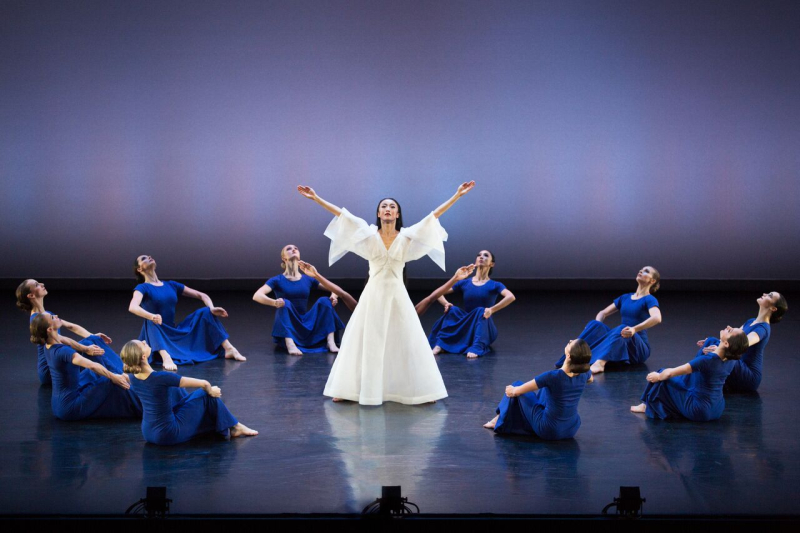
Above: PeiJu Chien-Pott and the ensemble in Primitive Mysteries; photo by Brigid Pierce
A corps of twelve blue-clad women frame the iconic Virgin, portrayed this evening by that fascinating Graham paragon, PeiJu Chien-Pott. Clad in pristine white, her hair flowing like black silk, Ms. Chien-Pott presides over her acolytes with benign yet unquestionable authority.
The dancers enter in silence, with slow, unified strides: they will exit and re-enter in the same mode for each section of the ballet. Trademark Graham moves are to be seen, with high-stepping, contracted motifs, and regimented, stylized gestures unifying the sisterhood. In the second movement, Ms. Chien-Pott strikes a pose of crucifixion, arms outstretched, while the women circle her at increasing speed.
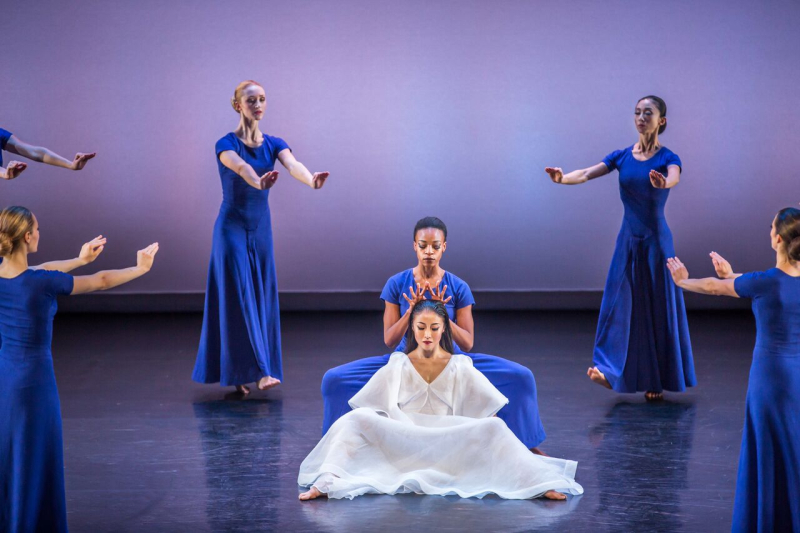
Above: PeiJu Chien-Pott and Leslie Andrea Williams (center) in a Brigid Pierce photo
In the concluding “Hosannah”, Ms. Chien-Pott and Leslie Andrea Williams – a charismatic, ascending Graham dancer – strike ecstatic plastique poses, ending with Ms. Williams in a slow, backward collapse into Ms. Chein-Pott’s arms: a Pietà-like vision. Transfigured, the women slowly leave the stage as darkness falls.
Primitive Mysteries evoked the first of the evening’s ovations, the dancers receiving vociferous screams of delight from the crowd as they took their bows.
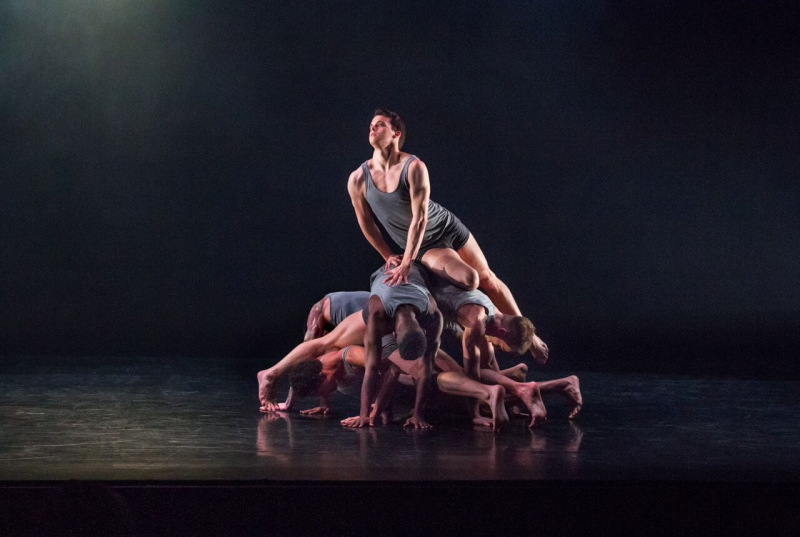
Above: Lloyd Mayor at the top of the heap in Rust; a Brigid Pierce photo
After a brief pause, the curtain rose on Nacho Duato’s Rust, a powerful all-male work that served as an ideal counterpoise to the feminine spirit of the preceding Graham work. Lorenzo Pagano emerges from the shadows under the relentless beam of an interrogation spotlight; upstage, the hapless Ari Mayzick is kicked, tortured, and left for dead. Ben Schultz, Lloyd Mayor, and Abdiel Jacobsen complete the quintet as Mr. Duato puts them thru demanding physical passages and down-trodden floor work.

Above: from Rust; photo by Brigid Pierce
Rust is danced to Arvo Pärt’s deep-chanting “De Profundis” (composed in 1980); voices emerge from the depths of despair, rising up to create an atmosphere of devotional reverence. The spirituality of the music and the brutality of the action remind us of the violence that permeates the history of the great religions. Rust ends with the men kneeling, hooded and with their hands tied behind their backs: all are prisoners, one way or another.
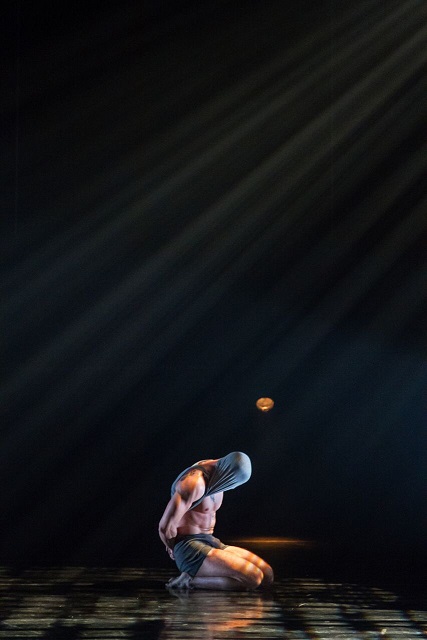
Above: Ben Schultz in Rust; photo by Brigid Pierce
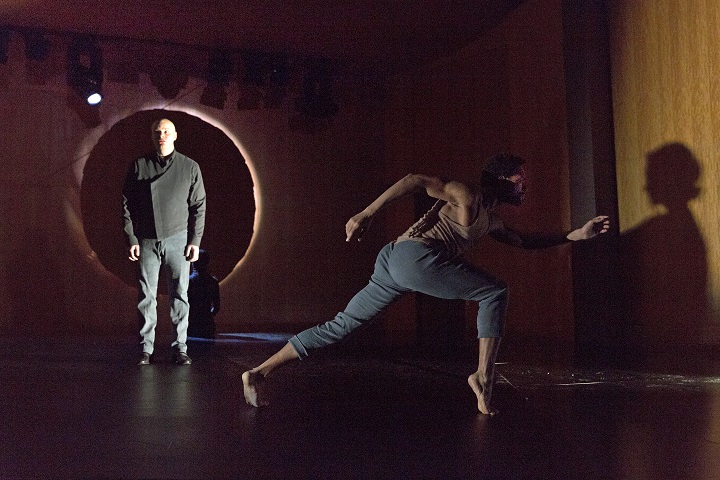
We had had a preview of Sidi Larbi Cherkaoui’s Mosiac a few weeks ago at the Graham studios. Tonight this exotic, sensual but also shadowy ballet looked mysterious in Nick Hung’s lighting. Felix Bunton’s mid-Eastern score, spicy and alluring, is embellished by spoken commentary from the news networks.
The dancers, costumed in soft, warm-hued garments, are seen in a cluster at curtain-rise. In a solo passage, Anne Souder’s personal beauty and physical flexibility made an alluring impression. Vocals that evoke deserts, minarets, and marketplaces set the dancers swirling; smoke drifts on the air as Lorenzo Pagano steps forward for a solo.
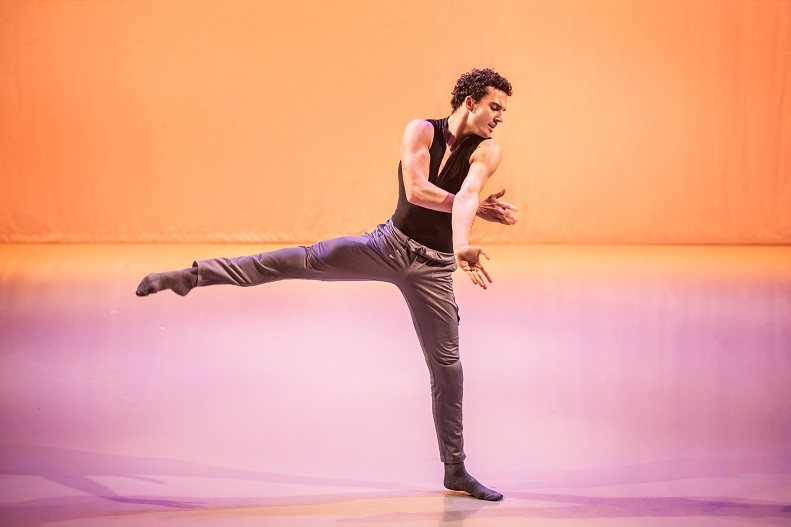
Above: Lorenzo Pagano in Mosaic; Brigid Pierce’s image from a studio showing

Above: Xin Ying in Mosaic; photo by Brigid Pierce
A threatening atmosphere arises; the incomprehensible talk all sounds like bad news. Stylized dancing under aqua lights brings forth the Company’s incredible Xin Ying: her feel for the sway of the music is intrinsic. A big beat and strobe lights give off contrasting impressions: are we in a nightclub or a prison yard? The dancers begin to shed their outer layers of clothing, and their vulnerability lends a new aspect to the story.

A duet for Anne Souder and Lloyd Mayor (above, photo by Brigid Pierce) could be provocative, or manipulative. In the end, the dancers return to the clustered formation, but now they are trembling uncontrollably.
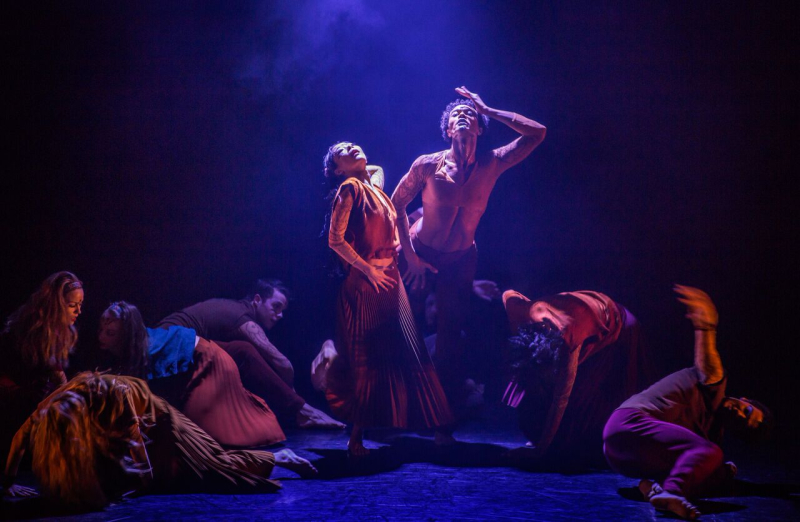
Above: Xin Ying and Abdiel Jacobsen in Mosaic; a Brigid Pierce photo
To close the evening Diversion of Angels, Martha Graham’s glowing commentary on the aspects of love, was marvelously danced. To Norman Dello Joio’s lyrical, romance-tinged score, we meet three women who embody the ages of love: Charlotte Landreau (Young Love, in yellow), Xin Ying (Passionate Love, in red), and Konstantina Xintara (Deep and Lasting Love, in white); each has her beloved: Lloyd Mayor, Lorenzo Pagano, and Ben Schultz respectively. An ensemble of four women (So Young An, Marzia Memoli, Anne Souder, and Leslie Andrea Williams) and an additional man (Jacob Larsen – to complete the male quartet) fill out the stage picture with animated choreography, often heralding or echoing the principals.

Ms. Xintara (above) and Mr. Schultz exude calm: her elongated arabesques show romantic centeredness and confidence while his muscular physique provides a pillar of strength for his beloved. A particular gesture of Ben’s reminded me ever so much of Nijinsky’s Faune. At times, this White Couple simply stand together, assured of their mutual affection as they watch the younger generations leap and swirl.

Xin Ying (above), superbly beautiful in her red frock, repeatedly displays her own arabesque-motif, sustaining the pose with awesome control. Mr. Pagano is a more fleeting lover here, but when he and his love do meet up, their passion sizzles.

Charlotte Landreau (above) is a dancer to cherish. With her strong technique and engaging presence, Charlotte seems destined for many Graham roles. As the Woman in Yellow tonight, her breezy jetés – stretched long and wonderfully elevated – delighted my choreographer/friend Claudia Schreier and me. As Charlotte’s ardent young lover, Lloyd Mayor hovered over his sweetheart, looking at once smitten and protective.
Jacob Larsen, handsome of face and form, kept pace with the Company’s dynamic men; he looks likely to become a valuable asset in the Graham rep.
An excellent evening on every count, and the cheers and applause that greeted the generous Graham dancers as they took their bows were eminently deserved.
Production photos in this article are by Brigid Pierce, sent to me at just the right moment by the Graham Company’s press agent, Janet Stapleton.



 Oberon's Glade