
Cheryl Studer and Luciana D’Intino sing the confrontation duet from Act II of Verdi’s AIDA from a 1994 performance at London’s Covent Garden.
Watch and listen here.
Cheryl Studer and Luciana D’Intino sing the confrontation duet from Act II of Verdi’s AIDA from a 1994 performance at London’s Covent Garden.
Watch and listen here.

Nina Stemme sings Brunnhilde’s Battle Cry from Act II of DIE WALKURE. Thomas Mayer is Wotan and Kent Nagano conducts.
Watch and listen to this concert excerpt here.

The great dramatic mezzo-soprano Irene Dalis in the scene of confrontation between Fricka and Wotan from Act II of Wagner’s DIE WALKURE:
Irene Dalis as Fricka – WALKURE – w Birgit Nilsson & Otto Edelmann – Leinsdorf cond – Met bcast 1961
From her 1957 debut there, Irene Dalis sang some 275 performances with the Metropolitan Opera Company – in New York City and on tour – during her twenty-year Met career. Her greatest roles were The Nurse in DIE FRAU OHNE SCHATTEN and Amneris in AIDA. In 1969, her electrifying performance of Verdi’s Egyptian princess at a concert performance at the Sheep Meadow, Central Park, drew an estimated crowd of 50,000; Dalis’s super-charged singing in the Judgement Scene evoked a thunderous ovation.

Following her retirement from singing, Irene Dalis founded Opera San Jose, which she ran with great success for over two decades.
In August 2007, I wrote an appreciation of Irene Dalis, which she eventually found and read; she sent me a lovely message of thanks.
~ Oberon
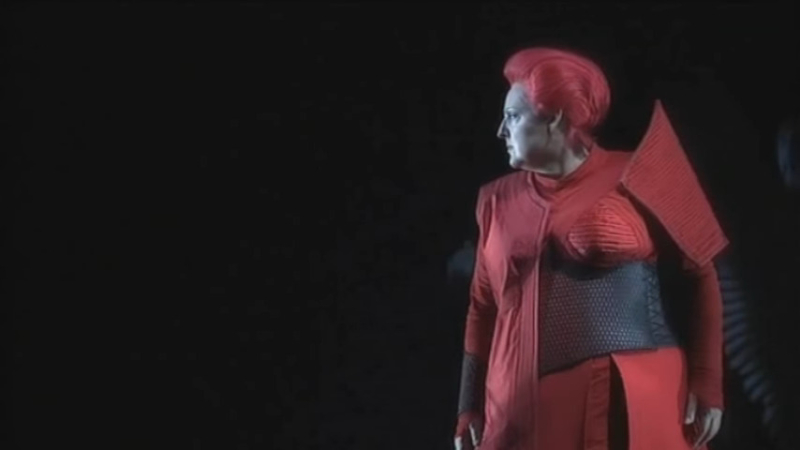
Brünnhilde (soprano Linda Watson, above) appears as a vision to Siegmund – announcing his imminent death – in Act II of Wagner’s DIE WALKURE.
I’ve recently experienced something of a revelation regarding Ms. Watson – more about that soon when I write about “The Colón RING“.
Tenor Endrick Wottrich, who is Siegmund in this recording, sadly passed away in the Spring of 2017 at the age of 52.
Linda Watson & Endrick Wottrich – Todesverkundigung ~ WALKURE – Bayreuth 2006
Above: Alfred Roller’s 1903 set design for Act II of TRISTAN UND ISOLDE
Ben Weaver writes about some of his favorite recordings (and a DVD) of Wagner’s TRISTAN UND ISOLDE. Ben, a longtime TRISTAN addict, helped me to break down my resistance to this opera when we stood thru three performances of it – including Waltraud Meier’s only Met Isolde – in 2008. Prior to that, I had only seen the opera once, in 1971, with a stellar cast in a then-new production. In part, it was the magic of that performance that kept me from seeing it again for so many years: I felt nothing could compare.
Earlier this year, I watched several video versions of the opera, becoming thoroughly immersed. The Met’s DVD, in the production that has moved me so much, is rightly hailed by Ben Weaver at the end of his article. Levine and the orchestra are splendid, and if Jane Eaglen and Ben Heppner are not physically everyone’s idea of how the lovers should look and move, to me they create all that is needed with their voices. Add Dalayman, and Pape, and the marvelous settings, and…voilà!…TRISTAN!
Here is Ben’s article:
“Richard Wagner’s 1859 opera Tristan und Isolde was declared unplayable by orchestra musicians and un-singable by singers. Wagner spent nearly 6 years after completing it trying to get it staged. He failed repeatedly. Rio de Janiero, Strasbourg, Paris, Karlsruhe, Dresden, Weimar, Prague were all failures. Over 70 rehearsals in Vienna led to cancellation of the scheduled premiere. Finally the generosity of King Ludwig II of Bavaria – who would also pay for Wagner’s theater in Bayreuth – allowed the world premiere to take place in Munich on June 10, 1865 with the husband and wife team of Ludwig and Malvina Schnorr von Carolsfeld singing the title roles, with Hans von Bülow – with whose wife Wagner was having an affair – conducting. After only 4 performances, on July 21st, the tenor suddenly collapsed and died. Rumors began circulating that the exertion of singing the part of Tristan killed him. That’s probably not true, although the opera did additionally claim the lives of two conductors: both died in the orchestra pit during Act 2 – Felix Mottl in 1911 and Joseph Keilberth in 1968.


~ Ben Weaver

As Laura Adorno and La Gioconda respectively, mezzo-soprano Luciana D’Intino (above) and soprano Eva Urbanová duke it out aboard Enzo’s ship, the Hecate, in this famous scene from Act II of Ponchielli’s LA GIOCONDA. From one of my favorite Italian operas, this excerpt begins with Laura’s prayer “Stella del marinar” and goes on to the fiery duet of the two rivals, “L’amo come il fulgor del creato!”
GIOCONDA Act II exc Urbanova D’Intino Scala 1996

Above: Eva Urbanová…the Czech soprano has had a substantial operatic career, and also has a following as a pop and rock singer. She sang at The Met from 1998-2004 where I saw her striking debut performance as Ortrud and also had the good fortune to experience her only Met Tosca, a portrayal that was enhanced by her detailed characterization as well as some surprisingly nuanced singing.
Luciana D’Intino’s Met career to date has consisted of two appearances each in the “big three” Verdi mezzo roles: Eboli, Amneris, and Azucena. I saw her in all three operas and her performances were astounding in their vocal richness and as marvelous examples of what is now the fast-fading authentic Verdi style.
Wednesday May 27th, 2015 matinee – Farewells are always bittersweet, and this afternoon at ABT as Paloma Herrera took her final bows with the Company, it seemed rather sad that she should be leaving us since she is in gorgeous physical shape, technically polished to perfection, exuding prima ballerina confidence, and wildly popular with audiences.
Sometimes at a farewell, the occasion overshadows the actual work being performed, but this afternoon’s GISELLE was excellent in every way. Paloma’s Giselle is a classic: the marvelous feet, the expressive hands; the clarity with which she presents the character’s hopefulness, her illness, her devotion to Loys, the devastation of his betrayal, and her fall into madness and death all so perfectly projected in Act I. As a Wili, she is able to portray both spectral remoteness and human tenderness in perfect measure.
Her Act I solo – the hops on pointe and then a swift, swirling manège – drew screams of delight from the audience, and her Wili solo in Act II literally stopped the show: she was called out twice to ecstatic applause. For all the brilliant surety of her dancing, it was her simple gesture of steadfast love after having saved Albrecht that will always linger in the memory.
Roberto Bolle is a blindingly handsome Albrecht, and handsome is as handsome does: his dancing and partnering are superb. As he watches Giselle being crowned queen of the harvest, Bolle’s eyes reveal his foresight: “My number’s up, this will all end soon.” We cannot quite tell if he’s taken his village romance seriously or has viewed it as a lark: whichever is the case, he is almost cripplingly devastated by remorse in Act II.
Bolle’s bravura solo in Act II and his long series of entrechats were much admired by the audience; he and Paloma sustained a spiritual link throughout their other-worldly encounter, imbuing the adagio with the palpable sense of a dream from which he hopes never to awaken.
The most moving moment of the performance came with their final parting. As Herrera/Giselle was about to descend into her tomb, she stretched out her hand to the bereft Bolle/Albrecht to give him a single flower. He can barely reach her, barely grasp the blossom…her token of forgiveness. That’s when I burst into tears.
The cast was a strong one down the line, with Thomas Forster’s towering Hilarion, Susan Jones’s clearly mimed presage of disaster as Berthe, and Luciana Paris’s luscious Bathilde all making a fine effect. Youthful brio and charm marked the Peasant pas de deux as danced by Skylar Brandt and Aaron Scott, with Skylar bringing a touch of rubato to her first solo. In Act II, Devon Teuscher’s Myrthe was imperious and sublimely danced, and Melanie Hamrick and Leann Underwood as the principal Wilis floated thru their solo passages with Sylph-like grace.
The final ovation was monumental: many of Ms. Herrera’s partners – past and present – and seemingly the entire current ABT roster filled the stage to honor her, heaping flowers at the ballerina’s feet. The applause went on and on, with a group of devoted fans yelling “PA-LO-MA! PA-LO-MA!!” At last she appeared alone before the Met’s gold curtain to a veritable avalanche of applause and cheers.

 Oberon's Glade