Tag: Adolf Hitler

  • They’ll Remember You

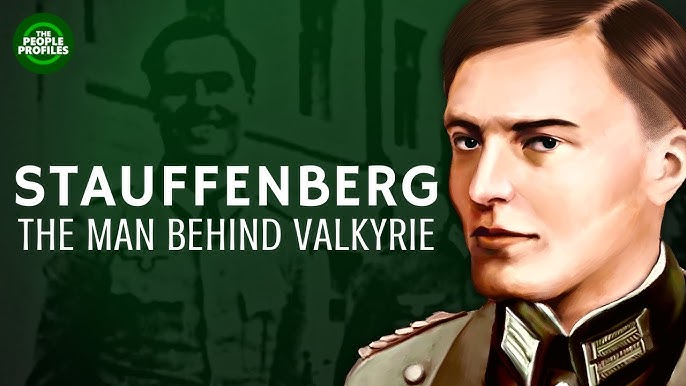
    Stauffenberg

    Last week, I was re-watching the 2008 film VALKYRIE, which is based on the story of a plot to kills Adolf Hitler. By mid-1944, it was clear that Germany was losing the war. Hitler, growing increasingly deranged, was firm that Germany should fight to the last man and never surrender.

    There was a group of high-level German military officers who foresaw the massive destruction and loss of civilian lives that the final months of the war would bring; among these was Count Claus von Stauffenberg, who was a decorated hero of the war in North Africa, where he lost a hand and an eye in serving the Reich.

    A plot was hatched to assassinate Hitler at a war council meeting of German officials to be held at Hitler’s hideaway, the Wolf’s Lair. Count von Stauffenberg managed to sneak a bomb into the conference room, but on realizing that Himmler was absent from the gathering, the plan was dropped. 

    A few days later, at a second meeting, the Count was able to detonate the bomb by a time-delay fuse, after he had hastily left the meeting saying he was called to Berlin on an urgent matter.

    The bomb exploded, killing four attendees and injuring several others; but Hitler was only slightly hurt. von Stauffenberg, back in Berlin with his fellow conspirators, soon learned that the plot had failed. He and the other conspirators were subsequently executed. The war lingered on for nine more months, with catastrophic property damage and loss of German lives, until Hitler committed suicide on April 30th, 1945. 

    I realized, in my latest viewing of the film, that I had never played thru the credits to the end. In the last moments of the soundtrack, there is a moving hymn to the heroes who tried to bring down a tyrant and madman. It was composed, as was the film’s score, by John Ottman.

    The text is drawn from Wanderer’s Nightsong II by Johann Wolfgang van Goethe, translated as follows:

    Up there all the summits
    are still.
    In the tree-tops
    you will feel but the dew.
    The birds in the forest have stopped singing.
    Soon, done with walking,
    you shall rest, too.”

    Listen to “They’ll Remember Youhere, with mezzo-soprano Sylke Schwab as soloist.

  • They’ll Remember You

    Stauffenberg

    Last week, I was re-watching the 2008 film VALKYRIE, which is based on the story of a plot to kills Adolf Hitler. By mid-1944, it was clear that Germany was losing the war. Hitler, growing increasingly deranged, was firm that Germany should fight to the last man and never surrender.

    There was a group of high-level German military officers who foresaw the massive destruction and loss of civilian lives that the final months of the war would bring; among these was Count Claus von Stauffenberg, who was a decorated hero of the war in North Africa, where he lost a hand and an eye in serving the Reich.

    A plot was hatched to assassinate Hitler at a war council meeting of German officials to be held at Hitler’s hideaway, the Wolf’s Lair. Count von Stauffenberg managed to sneak a bomb into the conference room, but on realizing that Himmler was absent from the gathering, the plan was dropped. 

    A few days later, at a second meeting, the Count was able to detonate the bomb by a time-delay fuse, after he had hastily left the meeting saying he was called to Berlin on an urgent matter.

    The bomb exploded, killing four attendees and injuring several others; but Hitler was only slightly hurt. von Stauffenberg, back in Berlin with his fellow conspirators, soon learned that the plot had failed. He and the other conspirators were subsequently executed. The war lingered on for nine more months, with catastrophic property damage and loss of German lives, until Hitler committed suicide on April 30th, 1945. 

    I realized, in my latest viewing of the film, that I had never played thru the credits to the end. In the last moments of the soundtrack, there is a moving hymn to the heroes who tried to bring down a tyrant and madman. It was composed, as was the film’s score, by John Ottman.

    The text is drawn from Wanderer’s Nightsong II by Johann Wolfgang van Goethe, translated as follows:

    Up there all the summits
    are still.
    In the tree-tops
    you will feel but the dew.
    The birds in the forest have stopped singing.
    Soon, done with walking,
    you shall rest, too.”

    Listen to “They’ll Remember Youhere, with mezzo-soprano Sylke Schwab as soloist.

  • Führerbunker

    Holocaust_Memorial_large

    Above: the Berlin Holocaust Memorial

    On Thursday April 30th, 2015, the 70th anniversary of the death of Adolf Hitler will be marked. On that date in 1945, with the Red Army only blocks from his bunker underneath the Reich Chancellery, Hitler and his wife Eva Braun committed suicide.

    On 16 January 1945, Hitler had moved into the Führerbunker, a secure underground haven of residential and office space from whence he continued to rule Germany for three more months. He was joined by his senior staff, Martin Bormann, and later by Eva Braun. At some point Joseph Goebbels with his wife Magda and their six children also took up residence in the upper Vorbunker. Two or three dozen support, medical, and administrative staff were also living there. These included Hitler’s secretaries (among them Traudl Junge), a nurse named Erna Flegel, and telephonist Rochus Misch. Hitler’s dog Blondi was also one of the occupants of the underground bunker; Hitler could sometimes be seen strolling around the chancellery garden with Blondi.

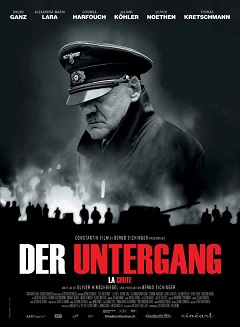
    This recent article in The Guardian tells of the lingering effects of Hitler’s reign of horror on the city of Berlin. Reading the story of course prompted me to watch, yet again, Oliver Hirschbiegel’s 2004 film ‘Der Untergang‘ (Downfall). 

    Der untergang

    In this powerful film, which I cannot recommend highly enough, the Swiss actor Bruno Ganz creates a portrait of Hitler in the final days of his life that has a harrowing feeling of reality. The dictator’s slow grasp of the fact that his Reich is doomed is detailed in scenes in which the character veers from cool efficiency and calculation to epic temper tantrums as he berates his generals and clings desperately to the belief that Germany can still prevail. Once that illusion has been shattered by incoming reports that the bunker is surrounded, Hitler becomes a ghost of himself. He marries Eva, has cyanide capsules tested on his beloved dog Blondi, and finally withdraws with his wife to the private room where they end their lives, having bid farewell to his faithful staff.

    In the film’s most chilling scene, Magda Goebbels (another uncannily ‘real’ characterization, from actress Corinna Harfouch) systematically murders her six children; she then sits down to a game of solitaire before going up to the Chancellery garden where her husband shoots her before taking his own life. This scene so powerfully depicts the sway Hitler held over his followers, creating a vast cult in which he was viewed as nothing less than a god. Following his death, many of the faithful shot themselves rather than face a world where Hitler was no longer.

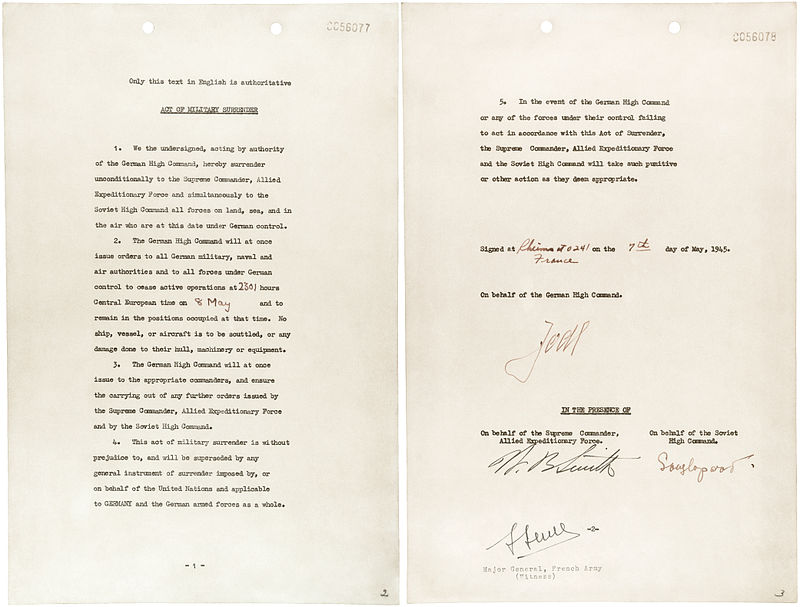
    German_instrument_of_surrender2

    Above: the instrument of surrender, which ended the war in Europe.