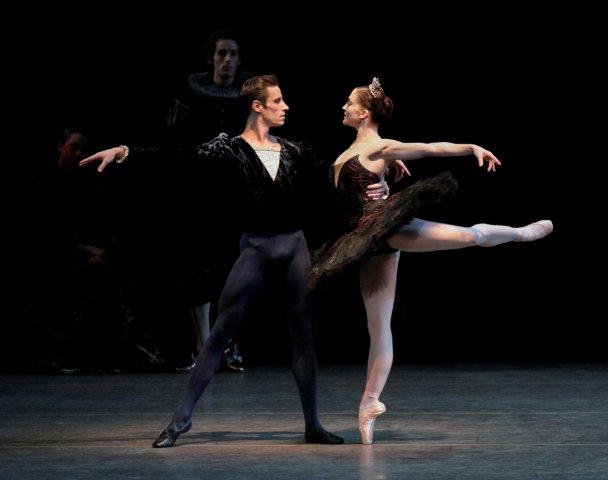
Above: New York City Ballet principal artists Andrew Veyette and Ashley Bouder in SWAN LAKE; photo by Paul Kolnik
Saturday evening September 21, 2013 – When New York City Ballet announced Peter Martins’ SWAN LAKE for their Autumn 2013 season I was hoping we’d have a 2-week run with some new Swan Queens; but instead there were only six performances (all, seemingly, sold out) and the dual role of Odette/Odile remained the property of three of the Company’s top interpreters: Sara Mearns, Teresa Reichlen, and Ashley Bouder.
Tonight was an opportunity to re-visit the Bouder traversal of this very demanding dual role. In this video, Ashley speaks of her constant work in the studio, endeavoring to bring her interpretation of Odette up to the level of her Odile. Tonight she seemed to have reached – and even surpassed – her goal.
A key element in making tonight’s performance so enjoyable was the lack of audience distractions, which so plagued the first half of the previous evening’s SWAN LAKE. Tonight we were seated amongst well-behaved folks who seemed keenly focussed on the stage throughout the performance; even the annoying late-seating was far enough away from us to be tuned out. It makes an enormous difference in one’s appreciation of the performance when there’s nothing to infringe on the powers of concentration.
And so from the very first notes of the prelude to the final heart-rending departure of the doomed Odette, the evening was among the most enjoyable I have spent at NYCB in recent seasons.
Clothilde Otranto paced the music beautifully: full-speed ahead when the drama called for propulsion; tenderness and a sense of lingering when love – or the loss of it – was the theme. The powerful ending of this SWAN LAKE – from both a visual and emotional standpoint – hits home every time, and Peter Martins’ remarkable vision of the ballet’s final moments tends to make me forgive some of his lapses in other productions.
For people like me who simply adore the NYCB dancers, this ballet affords one of the most satisfying ways of savoring so many favorites all at once: from well-established principals to the newest apprentices, SWAN LAKE is a chance to revel in the enormous variety of faces, forms and personalities who make up this phenomenal Company. And so from curtain-up to curtain calls we are immersed in NYCB on a personal level.
The sixteen corps dancers and the flock of small children who appear in the Prince’s Act I birthday festivities have plenty to dance, and they danced up a storm. As the opera glasses wander about the scene, you can pause anywhere and watch someone like Likolani Brown or David Prottas exuding their talents – both in terms of technique and stage-craft. This is not an anonymous bunch of automatons going thru the motions, but lively individual personalities doing what they love.
Troy Schumacher gave a dazzling virtuoso display as the Jester – a demanding role in which the character, in this production, never overstays his welcome. Antonio Carmena as Benno danced with generous spirit and space-filling bravura: his jumps and turns clear and vivid. He shared the pas de trois with two of our recently-promoted soloists: Ashley Laracey and Lauren King, both dancing with sweet assurance. Marika Anderson’s Queen was excellent: her distinctive features reacting to the dramatic situation, her height and bearing setting her apart from her subjects.
Andrew Veyette’s Siegfried was both impressively danced and instinctively well-acted; his portrayal of the lonely boy facing a destiny that doesn’t suit him was remarkably resonant. It’s no wonder that in his magical encounter with equally unhappy Odette he seems to have found his soulmate. That his love for her is her eventual undoing is the basis of the tragedy; his unwitting duplicity, concocted by Rothbart, leaves the bereft Prince on the brink of suicide at the end of the ballet. Andrew moved thru the events of the prince’s coming-of-age – his discomfort at having to choose a bride, his joy when his beloved suddenly appears in the ballroom, his desperation when Rothbart’s ploy is revealed – with a sense of natural nobility mixed with hapless naïveté; his final collapse in a state of deepest despair was so moving. All evening Andrew’s dancing – his lithe and effortless virtuosity – was aligned to his masculine grace and skillful partnering, making for a portrayal that was thoroughly satisfying in every way,
Ashley Bouder’s technical sorcery and her sense of theatrical vitality have always made her Odile an exciting event. Not only is she undaunted by the role’s virtuoso demands, she simply revels in them – and she even adds her own flourishes. The character – sly, enticing, peerlessly confident – has always been a triumphant Bouder realization. Meanwhile, Odette – despite Ashley’s impeccable dancing – has seemed to just slightly elude the ballerina in terms of poetry and expressive nuance. Tonight she seemed to have moved deeper into Odette’s soul and found the needed resonance there: this seems to have come about both thru hard work and thru the natural virtue of the ballerina’s maturing into womanhood. Her Odette tonight was moving, passionate, tragic. Her performance of the iconic dual role is now a complete work of art, though I feel with certainty that she’s not one to rest on her laurels: I suspect the next time we see Ms. Bouder in this ballet she will have taken things to yet another level. But for now: a triumph.
As I remarked earlier, the evening was a feast for devotees of the Company: the Four Cygnets were especially well-matched and accomplished tonight: Sara Adams, Alexa Maxwell, Sarah Villwock and Kristen Segin were among the finest teams I’ve ever seen in this tricky piece.
Presenting themselves as candidates for marriage to the Prince, six ballerinas dance a lovely set-piece in which each steps forward in turn to make her mark: Faye Arthurs, Likolani Brown, Meagan Mann, Jenelle Manzi, Mary Elizabeth Sell and Lydia Wellington all looked lovely in this piece, one of my favorite passages in the production. Faye, of the lyrical extension, was also seen as the Vision of Odette.
Megan LeCrone looked superb in the pas de quatre, with Ana Sophia Scheller and Erica Pereira completing the trio of dark-haired beauties, and the amiable partnering and handsome virtuosity of Gonzalo Garcia making me wish he’d been cast as Siegfried this season (could we not have a Scheller/Garcia SWAN LAKE next time around?)
Georgina Pazcoguin gave off incredible star-power in the Hungarian dance, and the handsome and rather rare Craig Hall matched her for intensity and charisma. Janie Taylor’s intoxicating presence lured my opera glasses in the Russian dance, with Ask LaCour looming over her, part predator and part slave. In the Spanish quartet, Gretchen Smith and Gwyneth Muller imbued their steps wth a flamenco flourish, their yellow fans a decorative asset; Andrew Scordato and Taylor Stanley looked dashingly sexy. Allen Peiffer, always a handsome Neapolitan lad, now has a new village lass to charm: Kristen Segin was excellent and she and Allen are a delightful match-up.
As the Black Swan pas de deux unfolded, brilliantly danced by Bouder and Veyette, a tall newcomer to the stage, Silas Farley, showed an already keen flair for stagecraft with his manipulative, faux-courtly Rothbart.
And so we come to the end: at the lakeside where they had met, Odette and Siegfried are now torn asunder. The power of their love has vanquished Rothbart, but his curse endures. Odette vanishes amidst the swans, and Siegfried collapses in remorseful despair.
 Oberon's Glade