Tag: Anthony McGill

  • Saint-Saëns and Fauré @ CMS

    Anthony_McGill_2022-Todd-Rosenberg

    Above: Anthony McGill, photo by Todd Rosenberg

    ~ Author: Oberon

    Sunday February 25th, 2024 – Music by two of France’s most beloved composers – Camille Saint-Saëns and Gabriel Fauré – was on offer this evening at Alice Tully Hall. Chamber Music Society of Lincoln Center once again assembled a stellar group of musicians, assuring a thoroughly enjoyable concert experience.

    Gabriel Fauré’s Dolly Suite for Piano, Four-Hands, composed between 1894 and 1896, made for a charming start to the program. Pianists Anne-Maria McDermott and Gloria Chien gave a splendid performance of the work, which derives its name from an affectionate nickname for Helene Bardac, the young daughter of Fauré’s long-time mistress, Emma Bardac. Fauré composed these gem-like miniatures between 1893 and 1896, to mark Helene’s birthdays and other events in her young life.

    The suite’s movements are:

    Berceuse (a lullabye), honoring Helene’s first birthday (Allegretto moderato).
    Mi-a-ou, which gently mocks Helene’s attempts to pronounce the name of her elder brother Raoul, who later became a pupil of Fauré’s.
    Le Jardin de Dolly (Andantino); this was composed as a present for New Year’s Day, 1895. It contains a quotation from Fauré’s first violin sonata, composed 20 years earlier.
    Kitty-valse: this is not about a cat, but rather about the Bardacs’ pet dog, named Ketty.
    Tendresse, an andante, was written in 1896 and presages the composer’s beloved Nocturnes.
    Le pas espagnol (Allegro) denotes a lively Spanish dance tune which brings the suite to its close.

    Tonight, Ms. Chien was in charge of the lower octaves, and Ms. McDermott of the upper. They seemed to be truly enjoying playing this music, which veers from rambunctious to elegant. At the end, they embraced, and then basked in the audience’s warm applause.

    It’s always a delight to hear Anthony McGill, Principal Clarinet of The New York Philharmonic, and this evening he regaled us with his sumptuous playing of Camille Saint-Saëns’ Sonata in E-flat major, Op. 167, dating from 1921…one of the composer’s last works. With Ms. Chien at the Steinway, the music simply glowed, from first note to last.

    The opening Allegretto has a subdued start, but passion lurks beneath the surface. Mr. McGill was soon astounding us with his mastery of dynamics and his fluent coloratura. His pianissimi must be experienced to be believed: such control! Infinite beauty of tone is a McGill trademark, reaching our souls like a blessing from above. The movement has a poetic finish.

    From a sprightly start, the Allegro animato finds the two players in perfect simpatico mode. Enchanting subtleties from both musicans continually cast a spell over the Hall. Ms. Chien opened the Lento with a deep, somber melody. She then commences a soft heartbeat motif, with Mr. McGill’s clarinet singing a forlorn melody. A wistful ‘ending’ is reached, but there’s a lovely piano postlude to follow.

    Rapid keyboard figurations open the concluding Molto allegro, wherein the virtuosity of both players delights us: rapid scales and sparkling cascades of notes are crystal clear. Then M. Saint-Saëns makes a surprising mood-swing: there is a gorgeous fade-away, from which a lovely melody arises. Mr. McGill’s final pianissimo note, sustained to spine-tinlging effect, was simply uncanny.  
    Meigui-zhang-original c

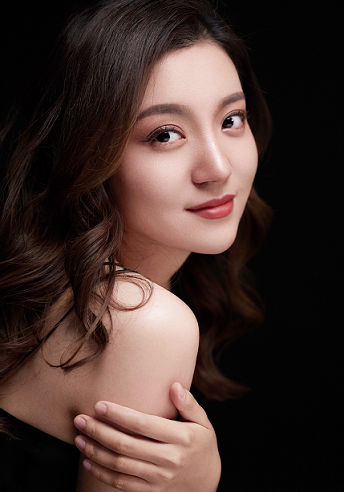
    I cannot recall ever having heard Fauré’s La Bonne Chanson performed live before. When this concert was first announced, Sasha Cooke was listed as the soloist; but in the event, it was the radiant young Chinese soprano Meigui Zhang (photo above) who sang the Fauré for us…exquisitely.

    It’s been nearly a year since I first heard Ms. Zhang: in John Luther Adams’ Vespers of the Blessed Earth, on a memorable evening at Carnegie Hall, which you can read about here. For the Fauré songs tonight, she joined an ensemble of outstanding musicians: violinists Arnaud Sussmann and Paul Huang, violist Matthew Lipman, the NY Phil’s primo basso Timothy Cobb, and Ms. Chien at the piano.

    The nine songs are settings of nine poems by Paul Verlaine, which the poet wrote as a wedding gift to his wife. (Ironically, Verlaine had also had an affair with Emma Bardac, mistress of Fauré.)

    The songs explore many moods, by turns restless, idyllic, passionate, and pensive. The pretty, lyrical quality of Ms. Zhang’s voice is ideally suited to these songs. Particularly impressive were “J’allais par les chemins perfides” where the singer’s silken tone sounded especially lovely among the rich string mix; the urgent ecstasy of “Avant que tu ne t’en ailles“; the meltingly soft allure of her tone in “Donc, ce sera par un clair j:our d’été” with its beautifully sustained final note; and the sweet rapture of her “L’hiver a cessé“. Surely Ms. Zhang gained many new admirers this evening.

    In these songs, the piano and strings provide a sonic tapestry into which the voice is woven to magical effect. Ms. Chien’s playing was a constant source of pleasure, and Arnaud Sussmann’s tone shimmered on high, seconded by Paul Huang. The deeper voices gave plushness to the ensemble: Matthew Lipman (viola) and David Requiro (cello) have much to do – they were particularly fine in “N’est-ce pas?”  The composer might have given more to the bass, but Mr. Cobb made the most of each opportunity.

    Following the interval, a glorious rendering of Camille Saint-Saëns’ 1875 Quartet in B-flat major brought together Ms. McDermott, and Mssrs. Huang, Lipman, and Requiro. Ms. McDermott commences the opening Allegretto, with the trio of strings joining in a unison passage. The blending of the four voices is most cordial, with the pianist’s seamless phrasing and the intriguing timbres of the three string players. I hadn’t heard Paul Huang for a while, and it was simply great to hear his distinctive sound again, as he sailed thru an ascending/decending solo motif. The Allegretto has a terrific ending.

    Ms. McDermott emphatically attacks the opening bars of the Andante maestoso; the strings again join in unison, and the music has a vaguely Russian feel. There’s a slow piano theme, with the strings etching in comments along the way. Things then turn fast and furious, Ms. McDermott commanding the keyboard and the strings slashing away. Turbulence! 

    Mr. Lipman and Ms. McDemott launch the delightful Poco allegro, which charmed my companion and me with its Mendelssohnian flavor. There are major/minor shifts which lead to a Paul Huang cadenza, passionately played and with a ravishing trill. The music races lightly forward to a deliciously subtle finish.

    The concluding Allegro starts briskly, the piano leading the way. The strings play in unison or pass phrases to one another. There’s an underlying restlessness that calms to a series of soft pizzicati. A slow build-up of tension gives way to a luxuriant sense of peace before a rising passage brings this splendid piece to its end. The musicians enjoyed a standing ovation; with our spirits lifted, we headed out into the freezing winter night.

    ~ Oberon
  • The Labèque Sisters|van Zweden|NY Philharmonic

    Labeque-01

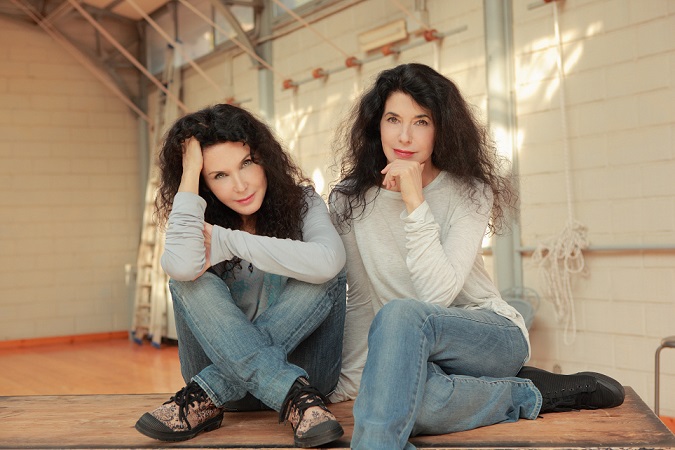
    Above: Katia and Marielle Labèque

    Author: Oberon

    Saturday September 23rd, 2017 – The first thing we noticed upon taking our seats at The New York Philharmonic this evening was that the seating arrangement for the orchestra had changed: risers are now in use. Hopefully this is a permanent enhancement, as it is so pleasing to be able to actually see people like Judith LeClair, Robert Langevin, Anthony McGill, and Liang Wang while they are playing. 

    This week has marked the start of the Jaap van Zweden era at the Philharmonic, even though it’s not until next season that the appendage “Designate” will be dropped from the title “Music Director”.  The orchestra played superbly for the Maestro, and if the vociferous standing ovation that erupted the moment the Mahler 5th ended is any indication, the audience is embracing Mr. van Zweden in no uncertain terms.

    The New York premiere of Philip Glass’s Concerto for Two Pianos and Orchestra opened the program. The Labèque sisters, in fitted black trousers and be-spangled sweaters, were warmly greeted by the crowd; they have been top-rank musicians for a long time and they still look sensationally slender and attractive…and their playing retains its accustomed verve and grace.

    Glass calls for a huge orchestra for this most recent of his creations; no fewer than seven percussionists take part, along with vast troupes of string, wind, and brass players. The concerto is in three movements and sets out from a jazzy opening that develops into a feeling of a giant hurdy-gurdy playing as a kozmic merry-go-round swirls madly. Pulsing waves of sound, in dense textures, wash over us.  From this turbulence, a lovely misterioso motif for the pianos emerges, with a gong struck softly as an undertone.

    The pianists playing in their lower ranges open the second movement, with wooden clappers beating time. The trumpets and flutes join voices; at this point a cellphone went off in the audience but it merged into the musical texture. Rhythmic and textural variety sustain this central movement. The concerto concludes with a sort of adagio of somewhat darkish hues.

    The new concerto is appealing in its way, but I can’t say it’s particularly distinctive or memorable. The pianos do not take the prominence one might expect in a concerto setting, but rather they are simply one constant voice in the overall chorus of instruments, given a few solo/duo passages along the way. I was hoping for an encore from the Labèque sisters, or possibly an appearance by Philip Glass, but after a couple of bows, the intermission commenced.

    Van-zweden-jaap-banner

    Above: Jaap van Zweden

    Mahler’s Fifth Symphony was composed during the summers of 1901 and 1902, during his annual holiday from his job as director of the Vienna Court Opera. It was in Vienna the winter prior to beginning his fifth symphony that Mahler had met Alma Schindler, the beautiful daughter of a famous landscape painter. Mahler proposed to her in the Autumn of 1901, and the symphony, with its journey from mourning thru the dreamworld of the Adagietto to happy triumph seems to mirror the composer’s state of mind with his new-found love.

    The symphony’s brilliant opening trumpet fanfare was excitingly introduced by Christopher Martin. As the first three movements of this very long symphony progressed, the Philharmonic players responded thrillingly to Maestro van Zweden’s intense, almost daemonic vision of the score. In the beloved Adagietto, for strings and harp, the conductor’s gentle pace and his summoning of luminous textures from the musicians created a depth of beauty in which we could – for a few minutes – forget the dark dangers of living in today’s uncertain world. In the grandeur of the symphony’s dazzling Rondo-Finale, the maestro and his musicians swept the celebratory feeling forward, pausing only for a couple of momentary roundabouts, and on to its epic conclusion. The audience went wild.

    ~ Oberon

  • Clarinet Trios @ Chamber Music Society

    Clarinettrios

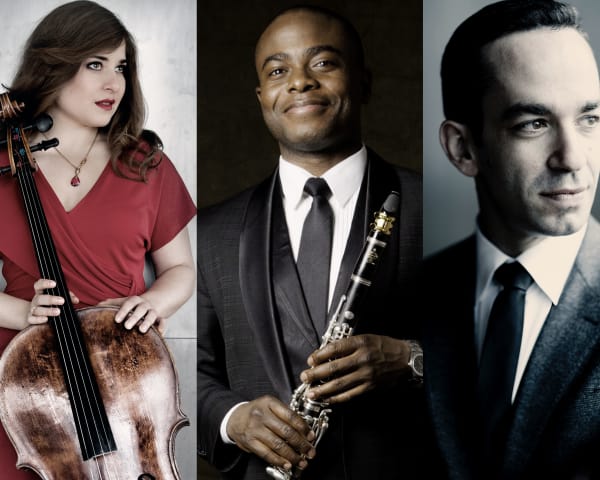
    Tuesday January 24th, 2017 – Cellist Alisa Weilerstein, clarinetist Anthony McGill, and pianist Inon Barnatan sharing the Alice Tully Hall stage in a program of piano trios presented by Chamber Music Society of Lincoln Center. Beloved works by Beethoven and Brahms book-ended the New York premiere of Short Stories for Clarinet, Cello, and Piano by Joseph Hallman. The presence of three such superb artists on the program signaled this as a red-letter event in the current season; I’d been looking forward to this evening for months, and it truly surpassed expectations.

    The three artists took the stage, Ms. Weilerstein in a beautiful deep violet gown, and launched the Beethoven Trio for Clarinet, Cello, and Piano, opus 11; it quickly became evident that we were in for a night of exceptional music-making. In this particular work, exuberance and delicacy alternate in perfect measure, and the three players relished both the propulsive passages and – most enticingly – those moments when nuance is all.

    One of Beethoven’s early masterpieces, this clarinet trio shows the influence of Haydn and Mozart; but once can clearly sense that Beethoven is already finding his own voice. The writing for the three instruments is often conversational, and how lovingly our three musicians this evening spoke to one another.

    The opening Allegro con brio is alive with rhythmic delights, including a touch of syncopated witticism. Mr. Barnatan’s scintillating agility was a constant attraction, and it was a great pleasure to watch the  communication between the three players.

    Ms. Weilerstein opened the Adagio with a cello theme; her heartfelt playing took this simple, straight-forward melody to the heights. She and Mr. McGill duetted tenderly, both playing with great subtlety. The music becomes achingly gorgeous.

    Good humor abounds in the Theme and variations setting of the finale: drawing on an aria wildly popular at the time, “Pria ch’io l’impegno” (“Before I begin, I must eat”) from Joseph Weigl’s opera L’AMOR MARINARO, Beethoven sets up bravura hurdles for the three musicians, all of them joyously over-leapt by our intrepid trio. Mr. Barnatan revels in the cascading piano passages, peaking in a perfect cadenza which ends with king-sized trills. Meanwhile Ms. Weilerstein and Mr. McGill seem to finish each other’s sentences, indulging in an amiable game of “Anything you can play, I can play finer!” Again, the sense of camaraderie, and of the players’ anticipation of the sheer pleasure of playing the next phrase, kept the audience visually engaged.

    Short Stories, the new Hallman work, is a five-movement trio; it might also be called Scenes from a Relationship. One doesn’t, however, need any narrative reference to enjoy this purely as a musical experience, for Mr. Hallman is an excellent craftsman, and a colorist as well. The composer was sitting just a seat away from us; I can only imagine how delighted he must have been to hear his music being played by three such paragons…a veritable dream come true.

    The opening movement, the Break-up, gets off to a stuttering start. The cello shivers before going deep and mournful, whilst the clarinet comments on her predicament. Then they switch roles, like a therapist taking over the couch from his patient. They play in unison, and things turn temporarily witty. But the music ends in the depths.

    familial memories at a funeral opens with Mr. McGill’s clarinet in a whispering, misterioso mood. After briefly perking up, a pensive quality develops with a repeated two-note motif for the piano. The clarinetist’s astounding breath-control and his sustained beauty of tone throughout the dynamic range keep the audience mesmerized.

    back-and-white noir: hardboiled with a heart of gold is the whimsical title of the third story. It begins agitato, developing an off-kilter rhythm. Mr. Barnatan sweeps up to the high register, while the clarinet and cello play a droopy duo. Ms. Weilerstein then descends to her velvety deep range. The music ebbs and flows, both rhythmically and tonally, as the composer explores the coloristic possibilities of the three instruments.

    regret is for the weak is a title that hits home. Mr. Hallman here sets up an eerie, hesitant start. The clarinet percolates briefly, then settles into a very quiet mood whilst the cellist plucks; later, the cello trembles while the piano sounds softly. We seem to be in a moody memory, with Mr. Barnatan drawing forth fleeting surges of melody. Ms. Weilerstein and Mr. McGill sing sadly before the pianist dips down to a punctuating low note.

    In the path of the curve, Mr. Barnatan sometimes reaches inside the piano to manipulate the sound. The music here is very quiet, until the clarinet starts warbling. Fluttering and swirling motifs sneak in, then the music seems to run down and the cello again deepens. The piece ends in a sustained quietude.  

    The only slight reservation I had about Short Stories was that the final movement is perhaps a bit too drawn out; my companion felt the same way. It was unfortunate that, during the work’s quiet closing moments, a cellphone went off directly behind us. At the same time, someone in the from row had a violent coughing fit. Such unfortunate timing. Yet despite these distractions, the Short Stories each cast their own spell, and they were spectacularly played.

    Following the interval, the Brahms trio (opus 114) found the three artists on the heavenly heights of tonal and technical perfection, their playing so generous and emotive. From Ms. Weilerstein’s sublime playing of the yearning opening theme, thru the plaintive entry of Mr. McGill’s clarinet and the ever-expressive beauty Mr. Barnatan drew from keyboard, the music took on an impassioned glow. In my scrawled notes, the word “gorgeous’ appears over a dozen times.

    Mr. McGill’s spellbinding playing of the sweetly serene theme that opens the Adagio was a magical passage, taken up by the soulful spirituality of Ms. Weilerstein’s cello. The luminous qualities of clarinet and cello are set in high relief by the profound tranquillity evoked by Mr. Barnatan. A long-lined clarinet solo leaves one grasping for adjectives to describe the McGill sound, and his ardent tapering of line. One wanted this meditation by the three players to linger on and on.

    A questioning clarinet passage and more marvelous phrasing from Mr. Barnatan set up the waltz-like grace of the Andantino.  After a brief diversion, we dance on towards the movement’s end; unexpectedly, Brahms tucks in a calming coda to make a lovely finish.

    Restraint is cast aside as the trio dig into the concluding Allegro. A tinge of gypsy colour weaves thru this music. Ms. Weilerstein takes up a melody which she passes to Mr. McGill; then they harmonize. Things speed up. “More cello passion!” was my last dashed-off remark; the Brahms sailed on to its joyous conclusion, and the three stellar artists were greeted with immediate shouts of approval. They took a double curtain call, delighting the crowd.

    A thought that recurred to me frequently during the evening was: if Mozart had met McGill, Amadeus would have written DIE ZAUBERKLARINETTE.

    • Beethoven Trio in B-flat major for Clarinet, Cello, and Piano, Op. 11 (1797)
    • Hallman Short Stories for Clarinet, Cello, and Piano (CMS Co-Commission) (New York premiere) (2016)
    • Brahms Trio in A minor for Clarinet, Cello, and Piano, Op. 114 (1891)