Tag: Anthony Trionfo

  • Flautist Anthony Trionfo @ The Morgan Library

    Trionfo

    Thursday April 14th, 2022 – Young Concert Artists presenting flautist Anthony Trionfo (above, in a Matt Dine portrait) in a noontime recital at The Morgan Library. Mr. Trionfo was joined by Emmanuel Ceysson (harp), Hsin-Yun Huang (viola), and Albert Cano Smit (piano) in a program of music by Debussy, Prokofiev, and YCA Composer Katherine Balch.

    I first heard Mr. Trionfo in recital at Merkin Hall in 2018 and was dazzled by his extraordinary talent. This afternoon, he chose works especially dear to him and then invited colleagues he especially enjoys working with to join him. The result was a very personal and pleasing hour of music-making of the highest order. 

    Cano_Smit_Albert4_credit_Chris_Lee

    Above: pianist Albert Cano Smit, photo by Chris Lee

    Sergei Prokofiev’s Sonata in D-major, Opus 94, opened the concert; Mr. Trionfo’s collaborator here was the tall, handsome Dutch/Spanish pianist Albert Cano Smit.  

    The sonata has a lyrical Moderato start, which soon peps up. A familiar melody is heard, and then there’s a sort of fanfare-like passage. Fanciful fluting follows, high and swift. Calming with more sustained themes, the familiar melody returns, moving on to a soft ending. The charming Scherzo has an exuberant quality, which both players relished. A peaceful interlude gives way to a feast of coloratura from Mr. Trionfo. The Andante has a dreamy quality, and an air of mystery. The concluding Allegro con brio opens with a rhythmic dance, and there are cascades of notes from the flautist. At the piano, Mr. Smit keeps things zipping along, and then has a strikingly dramatic interlude. A pensive melody for the flute leads on to the sonata’s flashy finish. The Trionfo/Smit duo reinforced the high esteem in which I hold Prokofiev’s music with their brilliant playing.
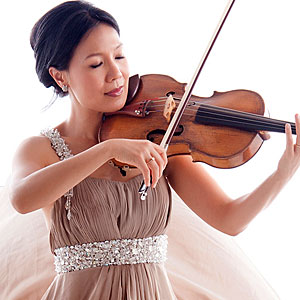
     

    Hsin-yun-huang

    For Ms Balch’s miniature, Musica Spoila, violist Hsin-Yun Huang (above) joined Mssrs. Trionfo and Smit. In announcing the work, Mr. Trionfo spoke of the intense concentration needed by the three players for this quirky, fifteen-minute score; he said the composer wanted the music to sound like a “crisp, light machine”, and the trio achieved just that quality.

    The music putters and sputters, with the viola scraping and plucking. Each player produces various sound effects: Mr. Trionfo makes eerie breathing noises on the piccolo, and the piano is sometimes tapped or plucked from within. It’s all very subtly done, and perfectly timed. The piece was over in the twinkling of an eye.

    I had heard Hsin-Yun Huang earlier this season playing Arnold Schoenberg’s Verklärte Nacht with Chamber Music Society of Lincoln Center; I was very glad of this opportunity to hear her again today.

    Emmanuel

    Above: harpist Emmanuel Ceysson

    Claude Debussy’s Sonata for flute, violin, and harp brought forth harpist Emmanuel Ceysson, who gained a large following of fans during his five seasons with The MET Opera Orchestra. Currently, he is principal harpist with the Los Angeles Symphony. He’s a great-looking guy whose love of music is palpable; watching Mr. Ceysson is as pleasing as listening to him.

    From the gentle start of the sonata’s opening Pastorale, the intriguing blend of the sweet-toned flute, the poignant viola, and the the caressive harp gives us a feeling of peace. In the lower range, Hsin-Yun Huang’s viola has a lovely duskiness. After a passage of gentle animation, the movement ends with a dreamy hush.  The central Interlude soon takes on the feeling of a gentle romp in a Spring meadow; to magical glissandi from Mssr. Ceysson’s golden harp, the sound of the flute and viola entwine in blithe melodies which become quite lively. The vibrant harp sets off the concluding Allegro con brio, giving an agitato feeling. The flute and viola exchange simple passages. The pace quickens, and the blended textures of the three instruments become denser, delighting the ear.

    The trio were enthusiastically applauded for their brilliant playing and, returning for a bow, they called on Mr. Smit to join them onstage.

    The music today was twice interrupted by the loud ringing of cellphones. As always, these intrusions came at just the wrong moments; I felt sorry for the players, who carried on despite the distraction.

    ~ Oberon

  • YCA Presents Flautist Anthony Trionfo

    Anthonyhiresmattdine3

    Above: Anthony Trionfo, photographed by Matt Dine

    ~Author: Oberon

    Wednesday March 28th, 2018 – Young Concert Artists presenting flautist Anthony Trionfo at Merkin Hall. Mr. Trionfo is a musician of prodigious talent and scintillating personality; along with the excellent pianist Albert Cano Smit and a quartet of string players, he offered a wide-ranging, adventurous program combining the familiar, the rare, and the new.

    Gabriel Fauré‘s Fantasy in E minor, Op. 79, opened the evening. Mr. Trionfo’s shining tone and his feel for the sensuous undercurrents of the opening Andantino gave way, in the Allegro, to florid passages of crystalline coloratura. Mr. Cano Smit was the ideal partner here, his playing impeccably tailored, his seriousness of intent and commitment most welcome in such a young artist. 

    Returning alone to the stage, Mr. Trionfo gave a superbly confident performance of J.S. Bach’s Partita in A minor, BWV 1013. In this suite of dances, the flautist showed great subtlety and a multi-hued timbre that kept the music ever-alive. The Courante had a feel of birdsong, the Sarabande a forlorn air of touching simplicity. In the concluding Bourrée anglaise, the playing was light-filled and lovely.

    The New York premiere of drip/spin by Katherine Balch, the 2017 YCA Composer-in-Residence, was prefaced by Mr. Trionfo’s remarks about the ‘dew-drop necklace’ – silk threads and mucus droplets – with which the glow-worm attracts and entraps its prey. The perpetual motion of the piano part seems to envision the spinning toils of the glow-worm, whilst the sighs and blips from the flute depict the unsuspecting victim. Some of the piano keys have been ‘prepared’, adding a ghostly quality. The flute lingers on high, until an energy drain occurs. Then the piano begins a rolling motif; in its death throes, the preyed-upon flute goes wild, with harsh accents that finally sputter out.

    Al21165

    For the Chant de Linos by André Jolivet, a string quartet comprised of Mélanie Genin (harp), Aleksey Semenenko (violin), Ida Kavafian (viola) and Sang-Eun Lee (cello) joined Mr. Trionfo onstage. André Jolivet (1905-1974) composed this work on commission from the Paris Conservatoire in 1944 as a compulsory test piece for competitors in the Solo de Concours; the prize was won that year by Jean-Pierre Rampal. The work is a threnody (or lament to the dead) inspired by the story of Linos, son of Apollo. Linos taught Orpheus to play the lyre, and he was later killed by Heracles for criticizing him too much. André Jolivet was a composer inspired by the legends from antiquity; he wrote many chamber music works, eleven concertos, as well as orchestral and vocal music.

    The rich yet transparent textures of the strings are quite contemporary in sound yet they evoke a distant, mythic past. A dreamy passage for flute and harp draws us in; the music can veer from lyrical to explosive in the twinkling of an eye. A subtle flute solo leads to a darkish dance played by all. Things get a bit woozy before turning to lament; following a cadenza, the music dances onward with the flute trilling and piping. What a great idea to program this ensemble piece tonight: a wonderful opportunity to hear this music, and so beautifully played.  

    Albert cano smit

    Above: pianist Albert Cano Smit

    A fascinating performance of Lowell Liebermann’s Sonata for flute and piano, Op. 23, followed the interval. The opening Lento con rubato soon wraps us in the strange beauty of its misterioso atmosphere. Delicate sounds from the piano’s upper register are followed by a big outburst which subsides into ghostliness. Single notes struck by the pianist underscore a sinuous flute motif; then the flute sound turns big and piercing. Rippling piano figurations summon the flautist back to song, a gentle flow becoming a percolation. The haunting melody returns in all is mystery, and Mr. Trionfo’s flute makes a final ascent to a remarkably sustained note that tapers away.

    In the ensuing Presto energico, there is much bouncy, lively coloratura from the flute which Mr. Trionfo conveyed brilliantly, with lots of body English; meanwhile the piano writing is animated…almost wild. The music sails forward, with virtuosic playing from Mr. Cano Smit whilst Mr. Trionfo spins high flourishes with his flute. This work drew a very warm audience response, with the composer taking a bow to waves of enthusiasm.

    Ian Clark’s Zoom Tube again gave Mr. Trionfo the opportunity to demonstrate some of the various sound effects his flute could produce…like the Balch, but more extroverted and pop-oriented. He sometimes seemed to be producing two different sounds at the same time, ‘speaking’ or blowing air, playfully jazzing things up, even emitting a whooping scream at one point.

    Mr. Trionfo’s arrangement of the traditional Carnival of Venice provided an immensely enjoyable showcase for his virtuosity. After a captivating trill, the flautist embarked on a series of variations on the familiar tune: the blues, bel canto, jazz, a Latin lilt, ‘Casta diva‘, and on and on. Mr. Cano Smit was the perfect accomplice in this imaginative tour de force as the two players kept the audience thoroughly engaged with their technical dazzle and well-contrasted personalities.

    As an encore, Mr. Trionfo offered Debussy’s Syrinx, ending on a sustained, gossamer pianissimo.

    ~ Oberon